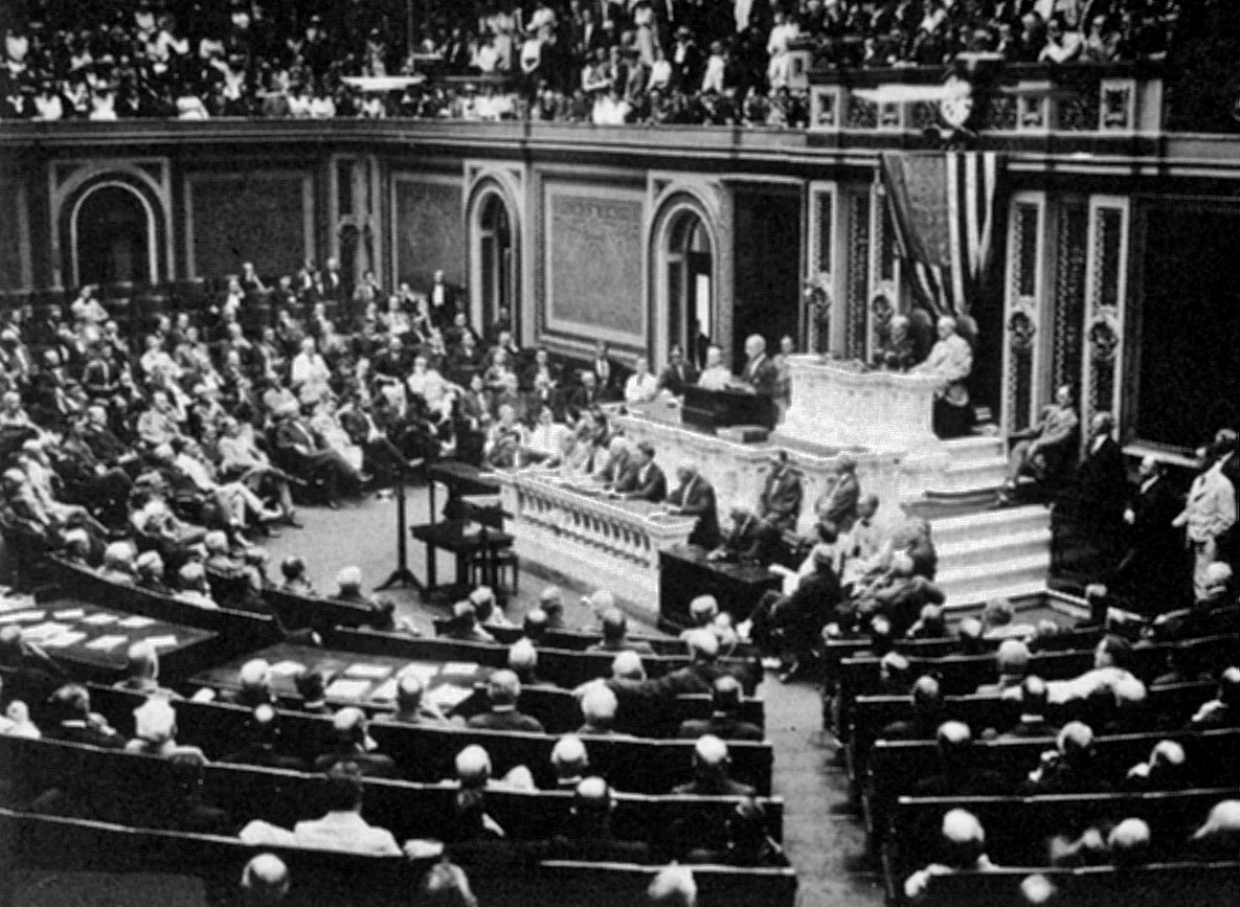
November 7, 1916: America elects a President. The Democratic nominee is the incumbent, President Woodrow Wilson, campaigning against American entry into World War I. His slogan was, "He kept us out of war."
The Republican nominee is Charles Evans Hughes, who had been Governor of New York and a Justice of the Supreme Court, who believes America should enter the war. It should be noted that each man's party is roughly evenly divided on the subject, for various reasons.
When the night is over, Hughes appears to be the winner. But, as with President Samuel J. Tilden, there's a reason most of you have never heard of President Charles E. Hughes: He, too, went to bed as the President-elect, and woke up as not that.
The problem turns out to be the communication systems of the time, with the results in rural areas not getting to the State capitals quickly, and thus not being sent on to the national capital quickly. For example, New Hampshire: Wilson ended up winning it by 56 votes. Not 56,000, not 5,600, but fifty-six. That's the smallest margin ever recorded in a State in a Presidential vote.
The key State is California, then having 13 Electoral Votes (about 1/4 of what it has now). At first, Hughes is winning it, and he goes to bed believing he has won it. Wilson, too, had gone to bed, thinking he had lost the State, and thus the country.
When the night is over, Hughes appears to be the winner. But, as with President Samuel J. Tilden, there's a reason most of you have never heard of President Charles E. Hughes: He, too, went to bed as the President-elect, and woke up as not that.
The problem turns out to be the communication systems of the time, with the results in rural areas not getting to the State capitals quickly, and thus not being sent on to the national capital quickly. For example, New Hampshire: Wilson ended up winning it by 56 votes. Not 56,000, not 5,600, but fifty-six. That's the smallest margin ever recorded in a State in a Presidential vote.
The key State is California, then having 13 Electoral Votes (about 1/4 of what it has now). At first, Hughes is winning it, and he goes to bed believing he has won it. Wilson, too, had gone to bed, thinking he had lost the State, and thus the country.
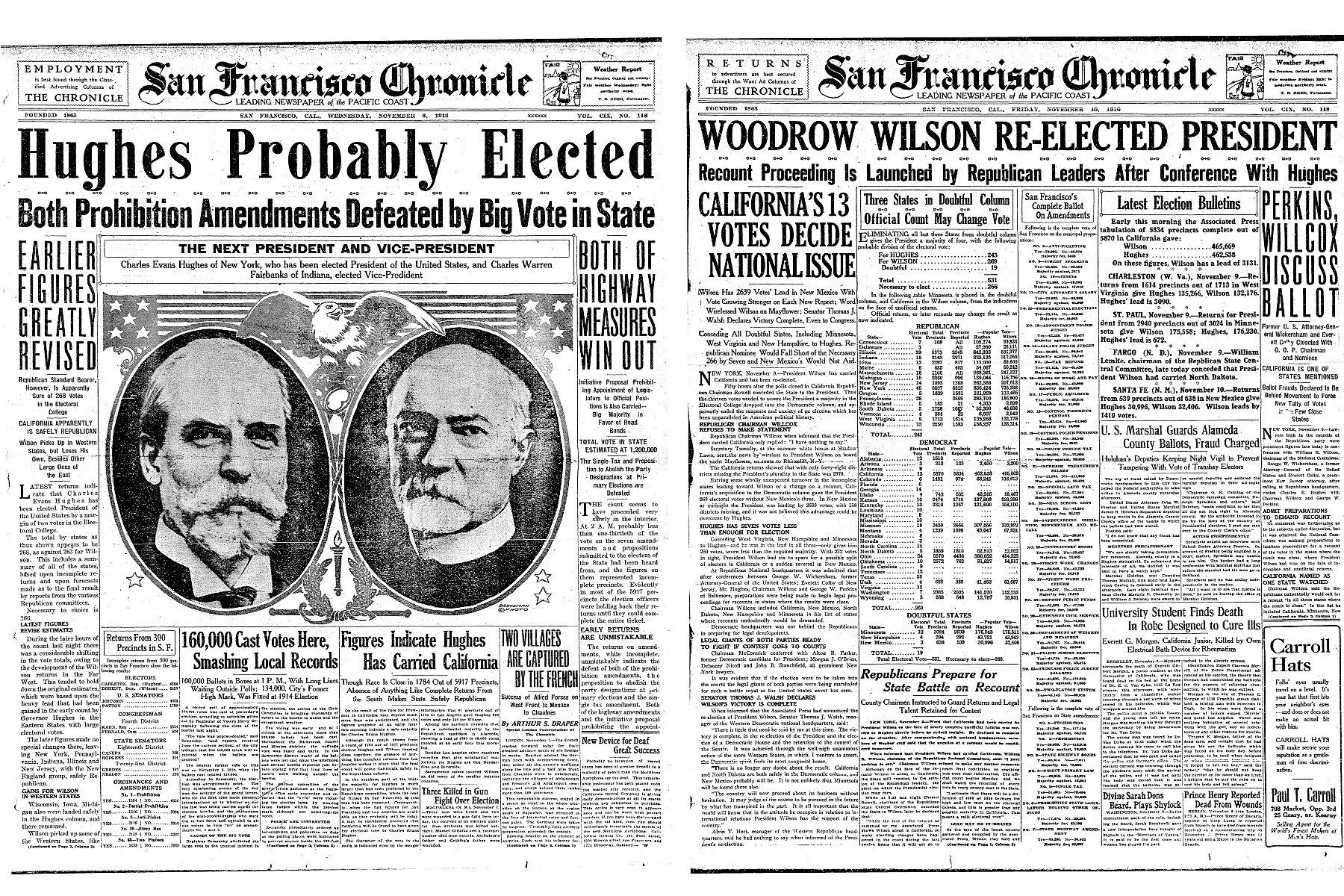
The San Francisco Chronicle, needing 2 tries to get it right
The story, perhaps apocryphal, tells of a reporter learning early the next morning that Wilson has taken the lead in California, and thus won the election, and calling Hughes' home. Hughes' son, or his butler, or someone else (depending on who's telling the story), tells the reporter, "The President-elect is asleep." The reporter says, "When he wakes up, tell him he's not the President-elect anymore."
With 266 Electoral Votes then needed for victory, Wilson wins, 277-254. If Hughes had won California, he would have won, 267-264. Wilson won 49.2 percent of the national popular vote, Hughes 46.1 percent. For both of his terms, Wilson would be a plurality President -- which had already happened to Grover Cleveland, and would later happen to Bill Clinton.
By the time he is Inaugurated again on March 5, 1917 (the usual date until 1933, March 4, was a Sunday that year), it is clear that Wilson will have to take America into the war. The war will make him beloved around the world. The peace process will make him despised at home.
A stroke in October 1919 paralyzed him, and when he left office in March 1921, he was, physically and emotionally, a broken man. He died in 1924. Hughes was appointed Secretary of State by Wilson's successor, Warren Harding, in 1921, and Chief Justice of the Supreme Court by Herbert Hoover in 1930. He served until retiring in 1941, and lived until 1948.
With 266 Electoral Votes then needed for victory, Wilson wins, 277-254. If Hughes had won California, he would have won, 267-264. Wilson won 49.2 percent of the national popular vote, Hughes 46.1 percent. For both of his terms, Wilson would be a plurality President -- which had already happened to Grover Cleveland, and would later happen to Bill Clinton.
By the time he is Inaugurated again on March 5, 1917 (the usual date until 1933, March 4, was a Sunday that year), it is clear that Wilson will have to take America into the war. The war will make him beloved around the world. The peace process will make him despised at home.
A stroke in October 1919 paralyzed him, and when he left office in March 1921, he was, physically and emotionally, a broken man. He died in 1924. Hughes was appointed Secretary of State by Wilson's successor, Warren Harding, in 1921, and Chief Justice of the Supreme Court by Herbert Hoover in 1930. He served until retiring in 1941, and lived until 1948.
In the same election, Jeannette Rankin becomes the 1st woman elected to Congress. At the time, her home State of Montana was 1 of 10 States which then had full voting rights for women – all of them West of the Missouri River.

A pacificst, Rankin voted against America's entry into World War I, and was defeated for re-election in 1918. She bided her time, rebuilt her reputation, and was elected again in 1940. And voted against America's entry into World War II, and was defeated for re-election in 1942. She lived on until 1973.
*
November 7, 1916, like all modern American election days, was a Tuesday. Baseball was out of season. Football was in midweek. Professional basketball barely existed. And the professional hockey season was still a few months away. So there were no scores on this historic day.