Showing posts with label casey stengel. Show all posts

Thursday, October 13, 2022

October 13, 1960: The Bill Mazeroski Game

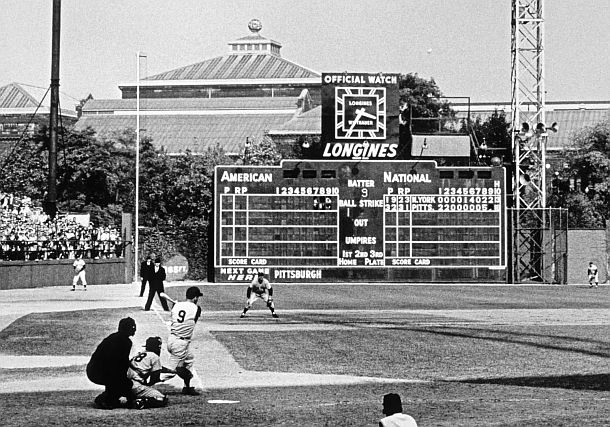
In case you're curious, the building behind the scoreboard
is the Carnegie Library of Pittsburgh.

October 13, 1960: Perhaps the greatest game in the history of baseball is played. But if you are among Yankee Fans age 70 and over, mention it at your peril.

The 1960 World Series may have been the wildest Fall Classic ever. The Pittsburgh Pirates, Champions of the National League for the 1st time in 33 years, faced the New York Yankees, the team they faced in their last appearance. Since that 1927 World Series, the Yankees had appeared in 19 of them, winning 16.

In Pittsburgh, the Pirates won Game 1, 6-4., but the Yankees won Game 2, 16-3. In New York, the Yankees won Game 3, 10-0, but the Pirates won Game 4, 3-2, and Game 5, 5-2. The Series went back to Pittsburgh, and the Yankees won Game 6, 12-0.

And so, on this Thursday afternoon, 36,683 people jammed themselves into Forbes Field for Game 7. Millions more listened to Pirates announcer Bob Prince and Yankees announcer Mel Allen call the game for television on NBC. Still more millions listened to NBC radio, with Baltimore Orioles announcer Chuck Thompson and Chicago Cubs announcer Jack Quinlan.

The game began at Forbes Field, precisely at 1:00 PM, Eastern Daylight Time, as home plate umpire Bill Jackowski said, "Play ball!" The other umpires: at 1st base, Nestor Chylak; and 2nd base, Dusty Boggess; at 3rd base, Johnny Stevens; in left field, Stan Landes; and in right field, Jim Honochick.
Forbes Field

The starting pitcher for the Pirates was Vernon Law, who would be named the winner of the Cy Young Award. Leading off for the Yankees was 2nd baseman Bobby Richardson, who lined out to short. Shortstop Tony Kubek popped up to 2nd. Right fielder Roger Maris closed the inning by popping up to 3rd.

The starting pitcher for the Yankees was Bob Turley, who had won the Cy Young and the World Series Most Valuable Player awards in 1958. He got center fielder Bill Virdon to fly to left, and shortstop Dick Groat, who would be named NL MVP that season, to pop up to his opposite number, Kubek.

Cliché Alert: Walks can kill you. Turley walked left fielder Bob Skinner. Then 1st baseman Rocky Nelson hit a home run to right field. Turley got right fielder Roberto Clemente -- eventually to become the most famous Pirate player who ever lived -- to pop up to 2nd, but after 1 inning, it was Pirates 2, Yankees 0.
Roberto Clemente

Things would get worse for the Yankees in the 2nd inning. Center fielder Mickey Mantle flew to center. Yogi Berra, now playing left field after switching positions with Elston Howard, now the catcher, grounded to 3rd. And 1st baseman Bill "Moose" Skorwon grounded to short.

Pirate catcher Smoky Burgess led off the bottom of the 2nd with a single to right. Perhaps overreacting to a bad 1st inning by Turley, Yankee manager Casey Stengel replaced him with Bill Stafford. This didn't work: Stafford walked 3rd baseman Don Hoak, and 2nd baseman Bill Mazeroski beat out a bunt.

Law grounded back to Stafford, who started a double play, eliminating Burgess at the plate and Law at 1st. But Hoak advanced to 3rd, Mazeroski to 2nd. Virdon singled to right, scoring Hoak. Maris mishandled the ball, allowing Mazeroski to score and Virdon to reach 2nd. Stafford got Groat to ground to 3rd, but after 2, it's Pirates 4, Yankees 0.

It got no better for the Yankees. In the top of the 3rd, Johnny Blanchard, catching in place of the injured Howard, grounded back to Law. The 3rd baseman, Clete Boyer, popped up to 2nd. Stengel sent Hector Lopez up to pinch-hit for Stafford, and he singled to left, but Richardson flied to left.

The new Yankee pitcher was Bobby Shantz, the 1952 AL MVP with the Philadelphia Athletics, whom Stengel put in the bullpen, and was rewarded by Shantz helping to win the 1958 World Series. He got Skinner to ground to 1st, walked Nelson, and got Clemente to ground into a 4-6-3 double play. End of 3, Pirates 4, Yankees 0.

Kubek popped to short. Maris hit a sinking liner to right that Clemente caught. Mantle singled to right, but Berra flew out in that direction. Shantz got Burgess and Hoak to both ground to 2nd, and Mazeroski to pop to short. Maybe Stengel should have started Shantz. After 4, Pirates 4, Yankees 0.

Skowron led off the 5th with a home run, but that's all the Yankees got. Blanchard flied to center, Boyer lined to 2nd, and, allowed to bat for himself, Shantz popped up to 1st. Shantz then got Law to ground to 3rd, Virdon to ground to 2nd, and Groat to hit a line shot right back at him, which he caught. End of 5, Pirates 4, Yankees 1.

Finally, in the top of the 6th, the Yankees woke up. Richardson singled to center. Kubek worked Law for a walk. Pirate manager Danny Murtaugh had seen enough, and replaced Law, bringing his closer, Roy Face, into the game in the 6th inning. Big risk, and it didn't work: He got Maris to pop up to 3rd, but Mantle singled up the middle to score Richardson, and Berra hit one down the right field line, for a 3-run homer, giving the Yankees the lead. Face got Skowron to pop to 3rd and Blanchard to ground to 1st, but the damage was done.

Shantz breezed through the Pirates in the bottom of the 6th, getting Skinner to line to right, Nelson to ground to 1st, and Clemente to ground back to him. Yankees 5, Pirates 4. Now, we had a game worth of Game 7 of the World Series.

The 7th inning was comparatively uneventful. Boyer flied to center. Shantz was again allowed to bat for himself, and rewarded Stengel's confidence by singling to left. Richardson grounded to 3rd, resulting in a force play that eliminated Shantz at 2nd. Kubek lined to right, and the 7th Inning Stretch was on.

Shantz allowed Burgess to single to center. Murtaugh sent Joe Christopher in to run for him. Hoak lined to left, and the fine-fielding Mazeroski got a taste of his own medicine, as he grounded to short, resulting in a Kubek-to-Richardson-to-Skowron double play. End of 7, Yankees 5, Pirates 4.

The 8th inning moved this game from merely interesting to classic. Hal Smith took Burgess' place behind the plate for Pittsburgh, and this would prove crucial. Maris grounded back to Face. Mantle lined to short. But, again, comes the cliche about the danger of walks: Berra drew one, and this was followed by a single by Skowron, and RBI single by Blanchard, and an RBI double by Boyer. Stengel again allowed Shantz to bat for himself, but he lined out to right. However, it was now 7-4 Yankees.

But the Pirates were far from done. Murtaugh sent Gino Cimoli up to bat for Face, and he singled to right. And then came a play that changed baseball history. Forbes Field was known for having the worst infield in the major leagues. And Virdon hit a grounder to short. It should have been an easy play for Kubek, and the start of a double play. But the ball hit a pebble, and jumped up and struck Kubek in the throat. He went down like a ton of bricks.

He had to leave the game. Stengel put Joe DeMaestri in to play short, and got Jim Coates up in the bullpen. The delay in getting Kubek off the field gave Coates time to get ready -- perhaps, a little too much time. Groat singled Cimoli home, to make it 7-5 Yankees. Stengel finally removed the heroic Shantz, and brought in Coates. Skinner bunted the runners over. Nelson flied out to right. But Clemente singled home Virdon, and Smith, batting for the 1st time in the game, hit a home run to left. The Pirates had the lead again.

Stengel brought Ralph Terry in to pitch. He got Hoak to fly to left. But after 8 innings, it was Pirates 9, Yankees 7. The Buccos were just 3 outs away from their 1st World Championship in 35 years.

But the Bronx Bombers refused to go down quietly. Bob Friend, who had been the Pirates ace before Law came into his own that year, was brought in to close it out. But Richardson dunked a single into short left-center. Dale Long, himself a former Pirate, who hit home runs in a record 8 straight games for them in 1956, was sent up to pinch-hit for DeMaestri. Now, Stengel would need his 3rd shortstop of the game. He singled to right, and, just like that, the tying runs were on with nobody out.

Murtaugh brought in Harvey Haddix. The previous year, Haddix had pitched a perfect game against the Milwaukee Braves for 12 innings. But because Lew Burdette, hero of the Milwaukee Braves' 1957 World Series triumph over the Yankees, was also pitching a shutout, the game kept going, and the Braves not only broke up the perfect game, the no-hitter and the shutout in the 13th inning, but won the game. Now, Haddix was being asked to save Game 7 of the World Series.

He got Maris to pop up to Smith. But Mantle, the Yankee superstar of the era, singled to right, scoring Richardson. Gil McDougald, who had announced his retirement and, win or lose, was playing in his last game, pinch-ran for Long. He would go in to play 3rd base, and Boyer would move to short -- if the Yankees could get that 9th run (or more) and send the game to a bottom of the 9th.

Yogi Berra was the batter. He hit a sharp grounder to 1st. Had the Pirates' other 1st baseman been in place, Dick Stuart, this could have been a disaster: Although he hit the ball nearly as far as Mantle, he was an atrocious fielder, eventually earning the nicknames "Stonefingers" and "Dr. Strangeglove." But Nelson grabbed the ball, and ran to 1st for the 2nd out. He should have tagged Mantle for the out that won the World Series.

But Mickey, not the brightest of men off the field, was a genius on it. He executes a head-fake, and makes Nelson think he's going to break for 2nd. That makes Nelson look toward Mazeroski at 2nd, and allows Mantle to get back to 1st base safely, and allows McDougald to score. Tie ballgame. Haddix got Skowron to ground to short for a force play, but the inning ended with the score tied 9-9.

On NBC radio, Thompson said, "Well, a little while ago, when we said this one was going right down to the wire, little did we know." He also mentioned that Art Ditmar was throwing -- but did not specify, "in the Yankee bullpen." That led a lot of Yankee Fans to incorrectly hold Ditmar responsible for what happened next, and he got a lot of nasty mail about it, and he got very bitter about it.

The leadoff batter in the bottom of the 9th was Mazeroski, 24 years old, born in Wheeling, West Virginia, and grown up on the other side of the Ohio River, 14 miles to the north, in Rush Run, Ohio. He grew up as a fan of his home State's Cleveland Indians, but Rush Run is considerably closer to the site of Forbes Field, 53 miles, than it is to that of Cleveland Municipal Stadium, 141 miles.

He had debuted with the Pirates in 1956, and had already become regarded as the best-fielding 2nd baseman in the major leagues. But he wasn't really known as a hitter: He had batted .273 that season, with 11 home runs and 64 RBIs. Those were decent numbers, especially for a righthanded hitter in that ballpark: Similar to Yankee Stadium at the time, Forbes had a 300-foot right field pole, but a 457-foot center field fence and was 360 feet to left. So, Maz was a good hitter, but not the player who would be expected to be the big hitting hero.

Terry's 1st pitch to Mazeroski was high, ball 1. Blanchard didn't like that, and went out to talk to Terry for a moment. Terry threw a 2nd pitch. The time was 3:36 PM. Chuck Thompson's call on radio:

Here's a swing, and a high fly ball, going deep to left, this may do it! Back to the wall goes Berra, it is over the fence, home run, the Pirates win!
Yogi played in 75 World Series games, more than anyone.
This is one he probably wanted back.

After pausing to let the cheering be heard, Thompson started again, and was so excited, he got the score wrong at first:

Ladies and gentlemen, Mazeroski has hit a one-nothing pitch over the left field fence at Forbes Field to win the 1960 World Series for the Pittsburgh Pirates by a score of ten to nothing! Once again, that final score, the Pittsburgh Pirates, the 1960 World Champions, defeat the New York Yankees. The Pirates ten, and the Yankees nine! And Forbes Field is an insane asylum!

Mel Allen, so often accused of being a "homer" for the Yankees, called it this way on TV:

There's a drive into deep left field, look out now! That ball is going, going, gone! And the World Series is over! Mazeroski hits it over the left field fence, and the Pirates win it 10–9, and win the World Series!

The ball went over Berra's head, at around the 406-foot mark in left field, and landed among the cherry trees in Schenley Park. Mazeroski took off his batting helmet and swung it around as he circled the bases. 
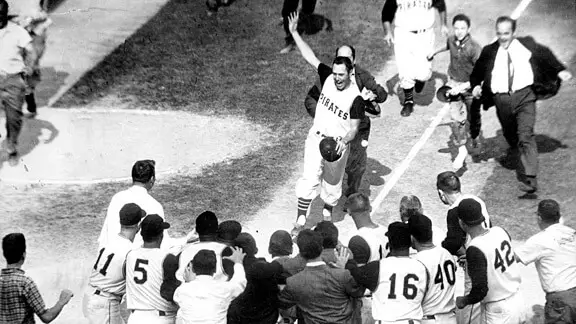
The ball was found by Andy Jerpe, 14 years old. Mazeroski would sign the ball for him, but he foolishly used the ball in a neighborhood game, and it was lost. No one knows where it is now. The Pirates don't have it. Neither does the Baseball Hall of Fame.

The Yankees outscored the Pirates 55-27 during the Series, but the Pirates won it, 4 games to 3. Richardson had a Series record 12 RBIs, and remains the only player from a losing side to be named the MVP of a World Series. Mazeroski? He batted .320 in that Series, and that was his 2nd homer in it, for his 5th RBI in it, and he played his usual good games in the field. He got robbed. But I'm sure he'd rather have the title.

After the game, Berra issued one of his "Yogi-isms," saying, "We made too many wrong mistakes." Mantle would later say that, of the 12 World Series he played in, this was the only time he believed that the better team lost. He also said he cried on the entire flight home, and this was confirmed by multiple teammates.

*

Was Yogi right? Did the Yankees make too many mistakes, "wrong" or "otherwise"? Pirate outfielder Gino Cimoli told Bob Prince, the Pirates' Hall of Fame broadcaster, in the locker room afterward, "They broke all the records, and we won the game! How 'bout that!" (So he closed by invoking the catchphrase of Allen, the Yankees' Hall of Fame broadcaster)

So why did the Yankees lose? How did the Pirates win?

The Yankees were in the process of making changes, including the manager: Team owners Del Webb and Dan Topping had decided that the 70-year-old Stengel, who missed several games that year due to an illness, would be fired even if the Yankees won the World Series.

They made Casey read a statement in which he said he is resigning. When Casey finished reading the statement, he put the paper down, and told the press, "I guess this means they fired me." He later said that they forced him out due to his age: "I'll never make the mistake of being 70 again."

Competitively, firing Casey may have been the right decision: Ralph Houk managed the Yankees to the next 3 American League Pennants, and the next 2 World Championships. Given that 4 new teams were being expanded into existence, and managerial changes are common, the Yankees would have lost Houk if they hadn't made him manager.

Still, Casey was treated shabbily. Topping and Webb could have done something. Casey was rich, having made savvy investments when he was younger, and owning a bank in the Los Angeles suburb of Glendale, California, where he lived in the off-season. They could have sold him a piece of the ownership. They could have made him a well-paid special consultant. They could have let him stay, or walk away, with dignity.

Instead, they canned him. It would be 10 more years, after they sold the team, before new Yankee president Mike Burke invited Casey back, to make peace and to retire his Number 37.

The Bill Mazeroski Game was also the last game as Yankee general manager for George Weiss. For all his cheapness and bigotry, Weiss was an organizational genius. First as farm system director from 1932 to 1947, and then as GM, he helped to build 23 Pennants (counting the 4 won in the 4 years after he left), and 17 World Series.

But he saw the writing on the wall. He knew that the system he used, of trading multiple players, usually a mix of over-the-hill veterans and prospects, for 1 of 2 players who could help the Yankees win the Pennant that year, couldn't work much longer, as the farm system was drying up.

He also knew that Topping and Webb didn't care, as they were planning to sell. At his resignation, Weiss told the press, "I give it 5 years." He was right: 1961, they won the Pennant and the World Series; 1962, they won the Pennant and the World Series; 1963, they won the Pennant but lost the World Series; 1964, they won the Pennant but lost the World Series; 1965, they finished in 6th place, the 1st of 7 straight seasons without even coming close to contending.

The Yankee stars of the 1950s, including the ones that had won 4 straight American League Pennants from 1955 to 1958, were on their way out. As a result, a lot of players -- 1960 AL Most Valuable Player Roger Maris, for one -- may have been good enough to be Yankees, but hadn't yet won the big one as Yankees.

The Yankees had last won the World Series in 1958, and would next win it in 1961, the year after the Mazeroski Game. How many players were on the World Series roster on both sides of this 3-year gap? Only 7: Mickey Mantle, Yogi Berra, Whitey Ford, Bill "Moose" Skowron, Elston Howard, Bobby Richardson and Tony Kubek. Bob Turley could have made it 8, but he was injured, and didn't play in the '61 Series.

The 1960 season was also the 1st in which catcher Yogi Berra and left fielder Elston Howard, whose natural position was catcher, had been switched, which is why Yogi was the left fielder tracking Mazeroski's homer, and it's his head, along with the outfield wall, that it went over.

The Pirates also had a distinct home-field advantage. Although Forbes Field had dimensions very similar to the pre-renovation Yankee Stadium, including a right-field pole 300 feet from home plate and a center field 457 feet away, it had only 35,000 seats, making it about half the size. As a result, while the noise at Yankee Stadium could be overwhelming, the fans were much closer to the field in Pittsburgh. Hence, Thompson's declaration that it was "an insane asylum."

Forbes Field was also known for having the worst infield in the National League. Even by the standards of ballparks that went up before World War II (and there were still 13 of the 16 teams, including the Yankees, playing in such ballparks in 1960), it was known to be bad. Since the Pirates, unlike any other team, played there regularly, they knew how to handle the comparatively high grass, the hard dirt, and the pebbles that were all over the place in said dirt.

Which leads us to the play that knocked Kubek out of the game. If that had happened to any of the the game's legendary losers, -- such as the Boston Red Sox, the Chicago Cubs, the Philadelphia Phillies, the Cleveland Indians, or, even though they didn't exist yet, the Mets -- it would be forever known as The Pebble, Capital T, Capital P, and we would never stop talking about it. 

But it happened to the Yankees, so hardly anybody makes a big deal out of it. And, of those who do, most think the Yankees had it coming.

And, of course, we must give due credit to the other team: The Pirates were not a better team than the Yankees, but they were worthy champions. They led the NL in batting average, on-base percentage, OPS, runs, hits and doubles; and were 2nd in slugging percentage and triples. Groat batted .325 in a season that got him named NL MVP. Clemente batted .314. Of their usual 8 starters, 6 had an OPS+ of 109 or higher: Clemente 121, Hoak 120, Dick Stuart 114, Groat 110, Smoky Burgess 110 and Skinner 109.

Only Stuart (23) had more than 16 home runs, a by-product of Forbes Field being a terrible park for righthanded hitters, and the team was 6th in the NL in homers. And none had at least 100 RBIs. But Clemente had 94, Skinner 86, Stuart 83, Hoak 79, and Mazeroski 64. Groat only had 50, a very low total for an MVP. Smith had only half as many plate appearances as you would get in a full season, and still had 45 RBIs.

In spite of Stuart, a born DH if ever there was one, and the bad infield, the Pirates were otherwise good defensively. Mazeroski's defensive prowess was already unquestioned: He did for 2nd base what Brooks Robinson later did for 3rd base. Despite the bad infield, Hoak only made 25 errors, and that was the most on the team. Groat, at shortstop, the most error-prone position, made 24. Stuart made 14 (a bad number for a 1st baseman, especially playing only 108 games, as Nelson was a frequent sub), Mazeroski only 10 in 151 games (an astoundingly low figure for a 2nd baseman).

The Pirates' .979 fielding percentage led the NL, and their 128 errors for their entire team were 3rd in the NL. In other words, this was a team that did not beat themselves.

Then there was the pitching. Between them, Law, Friend, Wilmer "Vinegar Bend" Mizell (later a Congressman from Mississippi) and Harvey Haddix (he of the 1959 game where he pitched 12 perfect innings but lost in the 13th, but was the winning pitcher in 1960 World Series Game 7) made 123 of the Pirates' 155 starts (the standard for the time, 154, plus a rainout makeup). Law went 20-9, Friend 18-12, Mizell 13-5 and Haddix 11-10. ERAs: Friend 3.00, Law 3.08, Mizell 3.12, Haddix 3.97. ERA+: Friend 125, Law 122, Mizell 121, Haddix 95. WHIP: Law 1.126, Friend 1.128, Mizell 1.201, Haddix 1.317.

The Pirates didn't really need a bullpen: Friend completed 37 of his 38 starts, Law all 35 of his, Haddix 28 of his 29, and Mizell all 23 of his. That's 121 complete games out of 123 starts, or 98.4 percent. (Don't show this stat to Brian Cashman.) It was when a 5th starter was needed that relief ace Face was needed, appearing 68 times, all in relief, a record at the time.

Face was the apparent inventor of the forkball, the pitch that was the "father" of the split-fingered fastball, and he used it to set a record for highest winning percentage in a season with at least 13 decisions: .947, 18-1, in 1959. A year later, he helped the Pirates win the World Series with a record of 10-8, 24 saves, and a glittering WHIP of 1.064.

Think about this: Baseball-Reference.com, a website which is your friend, whether you know it or not, lists photos of each team, each year, with its Top 12 Players according to WAR. And Clemente, a Hall-of-Famer, one of the Top 25 players of all time, is only 5th in WAR among '60 Bucs, behind Groat, Hoak, Friend and Law.

The Yankees weren't cheated, and they didn't give the Series away. They were simply defeated by a good team.

The Baseball Gods were cruel to Ralph Terry that day in Pittsburgh, but they would be kind to him for the next 2 years, allowing him to win 39 regular-season games for back-to-back Yankee World Championship teams, to add the 1962 Cy Young Award to his honors, and to add his own shutout in Game 7 of the 1962 World Series. So, as bad as certain moments of Yankee history, such as the Bill Mazeroski Game, have been, there's usually a sequel that sets it all right, and goats become heroes.
Ralph Terry

Still, this game stands out in the minds of Yankee Fans old enough to remember it. Don't ever ask actor-comedian Billy Crystal, who was 12 years old at the time, about it. You certainly can't ask paleontologist Stephen Jay Gould, then 19 and attending Antioch College in western Ohio, about it, since he died in 2002. But, when interviewed on the subject by Ken Burns for his 1994 miniseries Baseball, Gould said, "The one thing that must never be mentioned in my presence is Game 7 of the 1960 World Series."

In 1993, Joe Carter hit what we would now call a "walkoff home run" to win the World Series for the Toronto Blue Jays over the Philadelphia Phillies. His home run actually took the Jays from behind, 6-5, to win, 8-6. Mazeroski's team was tied when he came to the plate. But the Jays were already up 3 games to 2, and it was Game 6. Mazeroski remains the only player ever to win Game 7 of a World Series with a walkoff home run.

The image of Mazeroski swinging his helmet around in his right hand would later serve as the model for a statue of him that now stands outside the Pirates' current home, PNC Park. After the Pirates moved to Three Rivers Stadium in 1970, playing there until 2000, Forbes Field was demolished, and the University of Pittsburgh built classrooms on the site. The (approximate) location of Forbes Field is preserved under lucite, and it is the same plate (it wasn't moved to Three Rivers, although that stadium's plate was moved to PNC Park), so you can "touch" the plate that Mazeroski touched.

Part of the outfield wall was left standing. A line of bricks marks where the rest of the wall was, and a plaque marks the spot there the ball went over it.
The Pirates would also retire Mazeroski's Number 9, following a career that included 10 All-Star Games and 8 Gold Gloves, and ended in 1972. He and Clemente would be the only 2 players on this 1960 World Series-winning team still with the Pirates when they won their next World Series in 1971.

But it took until 2001 for him to be elected to the Baseball Hall of Fame. Why? Some people think he doesn't deserve it at all, because he doesn't have the hitting stats, and that he's only in because of the home run.

I think it's the exact opposite: I think the home run changed people's perception of him. Think about it: The 1st thing that comes to mind when you hear his name is, "He hit the home run that won the 1960 World Series."

Now, imagine that the Series had ended any other way, even one favorable to the Pirates. Suppose Mazeroski had led the inning off with a single, and scored the title-winning run on somebody else's hit. Then, the 1st thing that would come to mind when you hear his name is, "He's the greatest-fielding 2nd baseman who ever lived." He probably would have gotten in much sooner.

Today, William Stanley Mazeroski is 86 years old, retired and living in Panama City, Florida, and is a spring-training fielding instructor for the Pirates. 
At a still-standing, ivy-covered piece of the
Forbes Field outfield wall, October 13, 2010,
the 50th Anniversary of the home run.

One more note: Game 7, for all of its scoring, pitching changes, and other stops in the action, lasted 2 hours and 36 minutes, from first pitch to Mazeroski touching the plate. In fact, except for Game 2 going 3:14, none of these games went longer than 2:41.

In 1981, baseball historian John Thorn published Baseball's 10 Greatest Games. He included this game as one of them. (He also included Haddix' near-perfecto.) For 2 hours and 36 minutes, the New York Yankees and the Pittsburgh Pirates may have provided the greatest game in the history of baseball. And it definitely had the greatest ending in the history of baseball. Even if the team I would one day go on to root for lost it.

UPDATE: The Pirates have a team Hall of Fame. From their 1960 World Champions, they have inducted manager Danny Murtaugh; right fielder Roberto Clemente, 2nd baseman Bill Mazeroski, shortstop Dick Groat; and pitchers Vern Law, Bob Friend and Roy Face.

*

October 13, 1960 was a Thursday during football season, so no NFL or AFL games were played. And the NBA season hadn't started yet. There was one NHL game that day: The Montreal Canadiens beat the Detroit Red Wings, 4-3 at the Montreal Forum.

Wednesday, October 12, 2022

October 12, 1948: The Yankees Hire "Clown" Casey Stengel

October 12, 1948: The New York Yankees hire Charles Dillon "Casey" Stengel as their manager. Stengel had just managed the Oakland Oaks -- including former star big-league catcher Ernie Lombardi and a 20-year-old sparkplug local boy from West Berkeley named Billy Martin -- to the Pacific Coast League Pennant, so chances were that some big-league team would have snapped him up in the next year or two if the Yankees didn't.

But his 2 previous big-league managing jobs, with the Brooklyn Dodgers (managing them in between Wilbert Robinson and Leo Durocher) and the Boston Braves, were terrible. In Brooklyn in 1935, it was quipped that overconfidence might cost the Dodgers 6th place.

In Boston in 1943, Casey was slightly injured when hit by a cab, and a sportswriter called the driver the man who had done the most for Boston baseball that season. One man wrote an open letter to Casey, sending it to a Boston newspaper, saying, "There is a train leaving Boston at 6:00 tonight. Be under it." Not on it, under it.

He was 58 years old in 1948, and, like Connie Mack, he always looked even older than he was. And he had a reputation as a "clown," for such antics as tipping his cap and letting a bird fly out from under it, and protesting the weather to an umpire by walking out of the dugout with an umbrella. This was not a man who would manage "the Yankee way," sportswriters said.

Then again, Casey really didn't have the players in Flatbush or in Allston. Once he proved everyone wrong by winning the 1949 Pennant, he said, with a mixture of pride and humility, "I couldn't have done it without my players."

"My players." The holdovers from the Joe McCarthy days did not get along with Casey: DiMaggio, Tommy Henrich, Charlie Keller, Phil Rizzuto. (Most of McCarthy's pitchers were already gone.) Casey began phasing them out almost immediately, and replacing them with his guys: Yogi Berra, Billy Martin, Gil McDougald, Gene Woodling, Hank Bauer. And yet, he never really treated his best player, Mickey Mantle, like "one of his guys."

Finally having the horses, Casey went on to manage the Yankees for 12 years, winning 10 Pennants and 7 World Series.

He then managed the Mets in their first 4 years, 1962-65, prompting Warren Spahn, running out the string with the Mets after 22 years with the Braves, to say, "I'm the only man who played for Casey both before and after he was a genius."

Yogi Berra, by then one of Casey's coaches, came out of retirement and played a few games, including behind the plate. Someone asked him if he and Spahn were the oldest "battery" -- pitcher-catcher combination -- in baseball history. Yogi told him, "I don't know if we're the oldest, but we're certainly the ugliest."

Casey is still the most successful manager in baseball history. He was fast-tracked to election to the Hall of Fame after his retirement, the Yankees dedicated a Plaque in Monument Park to his memory, and he lived to see both the Yankees and the Mets retire his Number 37. The parking lot at Shea, and now at Citi Field, is named Casey Stengel Plaza, and the Long Island Rail Road yard across Roosevelt Avenue is named the Casey Stengel Depot.

*

October 12, 1948 was a Tuesday. The baseball season had ended the day before, with the Cleveland Indians beating the Boston Braves in Game 6 to win the World Series. Football was in midweek. The NHL season started the next day. And the season of the league that would become the NBA started 20 days later. So there were no scores on this historic day.
 

Wednesday, October 5, 2022

October 5, 1953: Five Straight World Series Wins

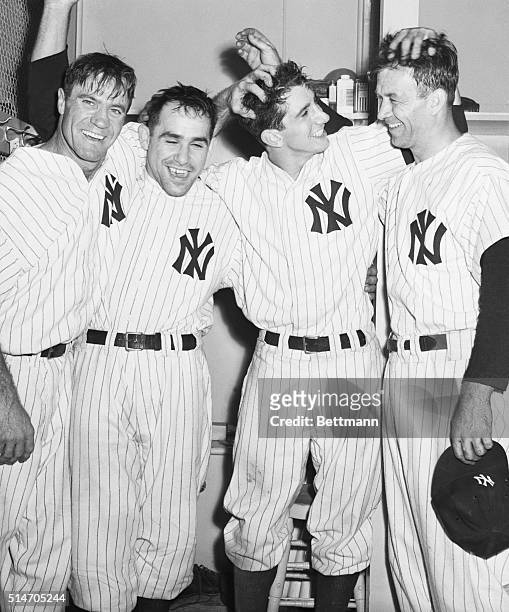
Left to right: Hank Bauer, Yogi Berra,
Billy Martin and Joe Collins

October 5, 1953: The New York Yankees beat the Brooklyn Dodgers, 4-3 at Yankee Stadium, to win Game 6 of the World Series, clinching it, 4 games to 2. This was the 5th straight World Championship for the Yankees. No other baseball team has ever done that.

The Yankees hired Charles Dillon "Casey" Stengel as their manager for the 1949 season, and he led them to the American League Pennant in each of the next 5 years. In 1949, they beat the Dodgers in the World Series in 5 games. In 1950, they swept the Philadelphia Phillies in 4 straight. In 1951, they beat the New York Giants in 6 games. That was Joe DiMaggio's last season, and Mickey Mantle's 1st season.

In 1952, it took them 7 games to finish the Dodgers off. That gave them 4 straight World Series wins, matching the Joe McCarthy-managed Yankees of 1936 to 1939.

In 1953, they faced the Dodgers again. It's important to note that, due to his U.S. Army commitments -- the Korean War was over by this point, but not everybody serving in it had been discharged yet -- the Dodgers did not have their best pitcher, Don Newcombe, for either the 1952 or the '53 Series. However, the Yankees had lost Whitey Ford to the war for the Series in '51 and '52. And the Giants had lost their best player, Willie Mays, for the '52 and '53 seasons, so if he was available, maybe they would have won those Pennants instead of the Dodgers.

The Dodgers were loaded. They won 105 games, which would remain a franchise record for 64 years. They finished 13 games ahead of the newly-moved Milwaukee Braves in the National League. They had 6 .300+ hitters, led by NL batting champion Carl Furillo at .344, and center fielder Edwin "Duke" Snider right behind at .336.

All 8 starting position players had at least 18 doubles, with Snider and Furillo each hitting 38. 2nd baseman Jim Gilliam led the NL with 17 triples. Snider hit 42 home runs, catcher Roy Campanella hit 41, and 1st baseman Gil Hodges hit 31. They had 5 players with at least 95 RBIs, with Campy leading the NL with 142, the Duke having 126, and Hodges 121. Campy was named NL Most Valuable Player.

They were superb defensively as well: Furillo also had the best right field arm in the game at the time, Snider was at least the equal with the glove in center as the Yankees' Mickey Mantle (if not of Mays), Hodges was the best-fielding 1st baseman in baseball, Billy Cox was the best-fielding 3rd baseman, Harold "Pee Wee" Reese was still the best shortstop in the NL; and Jackie Robinson, rotated between 2nd base, 3rd base and left field, played all of those positions well.

Their pitching was also strong, even without Newcombe available. Carl Erskine had the best curveball in the NL, going 20-6, leading the League with a .769 winning percentage. Russ Meyer, "The Mad Monk," was 15-5. Billy Loes was 14-8. Elwin "Preacher" Roe was 11-3. Rookie Johnny Podres was 9-4. Clem Labine, Joe Black and Jim Hughes made for a good bullpen.

But the Yankees were still the Yankees. They still had the best catcher in all of baseball, Lawrence "Yogi" Berra. Mantle, not yet 22 years old, had come into his own, launching some of the longest home runs anyone had ever seen: That season alone, he may have hit the longest ones ever seen at Griffith Stadium in Washington, Shibe Park/Connie Mack Stadium in Philadelphia, and Sportsman's Park/Busch Stadium in St. Louis. Left fielder Gene Woodling and right fielder Hank Bauer both batted over .300. Phil Rizzuto was still Reese's equal as a shortstop. Gil McDougald had become an excellent 3rd baseman.

And Ford returned to a starting rotation that still had "The Big Three": Allie Reynolds, Eddie Lopat and Vic Raschi. Stengel's alternation from the speedy Reynolds to the junkballing Lopat, then to the speedy Raschi, then to the mix-it-up master Ford kept American League batters on their toes, and made it hard for them to get into a day-to-day rhythm. The Yankees won 99 games, finishing 8 1/2 ahead of the Cleveland Indians, whose 3rd baseman, Al Rosen, narrowly lost the batting title to cost himself the Triple Crown. He was named the AL's MVP.

Despite the Dodgers' firepower, the Yankees' experience, especially against the Dodgers, made them slight betting favorites. Dwight D. Eisenhower, a former West Point baseball and football player in his 1st year as President, admitted before Game 1 that, "It would be nice if someone besides the Yankees won for a change."

With 85-year-old Cy Young throwing out the ceremonial first ball to Berra to open the World Series -- Yogi said, "It was like watching a statue come to life" -- the Yankees won Game 1, 9-5 at Yankee Stadium in The Bronx. Yogi hit a home run, and Eisenhower, having watched the television broadcast of the game on NBC, said, "I received a terrific kick out of Yogi Berra's home run. That fellow really slammed it out of the park."

The Yankees won Game 2 at home, 4-2. The Series moved to Ebbets Field in Brooklyn, and the Dodgers won Game 3, 3-2, and Game 4, 7-3. In Game 4, Erskine struck out 14 batters, setting a new Series record that would last for 10 years. But in Game 5, Mantle hit a grand slam to give the Yankees an 11-7 win, and a 3-2 lead in the Series.

Game 6 was played at Yankee Stadium, in front of 62,730 fans, about the twice the seating capacity of Ebbets Field. Ford started for the Yankees, Erskine for the Dodgers. With one of the best curveballs in the game at the time, "Oisk," as the Dodger fans called him in their Brooklyn accent, gave the Flatbush Faithful -- also known as the Flastbush Flock -- hope that "Dem Bums" could push the Series to a Game 7.

But the Yankees struck quickly. Woodling led off with a walk. 1st baseman Joe Collins struck out, but Bauer singled, and Berra hit a ground-rule double to get Woodling home. Mantle was walked intentionally. 2nd baseman Billy Martin grounded to 2nd, and Gilliam bobbled the ball, allowing Bauer to score. For whatever reason, Dodger manager Charlie Dressen had put his usual 2nd baseman, Jackie Robinson, in left field.

The Yankees scored again in the 2nd, on a sacrifice fly by Woodling. The game remained 3-0 until the top of the 6th. With 1 out, Robinson doubled to left, and stole 3rd base. Campanella got him home on a groundout, to make it 3-1.

Stengel brought Reynolds in for the 8th inning, thinking he had the right mentality to close the game out. Perhaps the best starting pitcher on his 5 Pennant winners, Reynolds had a blazing fastball, and was willing to throw inside. He hit 57 batters during his career, but claimed he only hit 6 on purpose. The Dodgers accused him of targeting black players, but he seemed to brush white players back with the same frequency. He once plunked a batter on a 3-0 count, telling a reporter after the game, "If I'm going to put you on, I might as well hurt you." Partly because of his Cherokee heritage, and partly because his fastball seemed to bring up memories of a speeding train of that name, he was known as the Superchief.

Reynolds got through the 8th, giving up only a single to Robinson. But with 1 out in the 9th, he walked Snider, and then gave up a home run to Furillo. The game tied, Reynolds then struck out Cox and the opposing pitcher, Labine.

This was the last game played by Hall-of-Famer Johnny Mize: "The Big Cat," a 1st baseman, pinch-hit for Collins in the 8th, and grounded out to 1st. He was 40 years old and fat, so, despite also being a 1st baseman, he did not take the position in the 9th, Stengel instead sending Don Bollweg in to do so.

Cliché Alert: Walks can kill you, especially the leadoff variety. Labine walked Bauer to start the bottom of the 9th. He got Berra to fly to right. But Mantle beat out a single to 3rd. The batter was Martin. An ordinary player from April through September, he always seemed to turn it on for the World Series, turning a regular-season batting average of .257 to a World Series average of .333. In 28 World Series games, he hit 5 home runs and had 19 RBIs. Stretch that to a full 154-game season, as was standard at the time, and it would have been 28 homers and 105 RBIs. And a catch he made in Game 7 in 1952 may have saved the Series for the Yankees. Whatever else can be said about Billy -- as a player, as a manager, and as a person -- he was a clutch performer as a player.

At this point, 4 players had collected 12 hits in a single World Series: Charles "Buck" Herzog of the 1912 New York Giants, Shoeless Joe Jackson of the 1919 Chicago White Sox (in spite of the accusation that he helped "throw" the Series), Sam Rice of the 1925 Washington Senators, and Johnny "Pepper" Martin of the 1931 St. Louis Cardinals. Oddly, all but Pepper Martin -- no relation to Billy -- were on the losing side.

Billy Martin singled up the middle, for his 12th hit of the Series, and Bauer came around 3rd to score the winning run: Yankees 4, Dodgers 3. The Yankees had won their 5th straight World Series.

There were 11 players who played on all 5 of those Yankee World Champions: Phil Rizzuto, Yogi Berra, Johnny Mize, Gene Woodling, Hank Bauer, Jerry Coleman, Joe Collins, Allie Reynolds, Vic Raschi, Eddie Lopat, and, though he played just 156 games in those 5 seasons, and just 1 ever in the World Series, backup catcher Charlie Silvera. Coleman, however, was serving in the Korean War for most of the '52 and '53 seasons, and, though he returned for the end of the '53 season, was not placed on the Series roster. Collins was a rookie in '49, and was not on the Series roster.

Since then, 3 in a row has been done, but not 4, and certainly not 5. The Montréal Canadiens would soon start a streak of 5 straight Stanley Cups, but they were unable to make it 6. The Boston Celtics would later win 8 straight NBA Titles, but basketball didn't exactly get the best athletes then.

This was the last World Series, and the last Pennant in either League, won by an all-white team. The next season, the Yanks lost the American League Pennant to the well-integrated Cleveland Indians, and the argument of, "Why integrate? We're winning with what we've got" was no longer valid. Elston Howard became the 1st black man to play for the Yankees the following April, and the team went on to win 9 Pennants and 4 World Series in the next 10 years.

Art Schallock is the last surviving member of the 1953 World Champion New York Yankees. He is also the last surviving former teammate of Joe DiMaggio, although he was not on the World Series roster in either 1951 or 1952. As of October 5, 2022, he is the oldest living former player, age 98. (UPDATE: He lived to be 100, but died in 2025, shortly before he would have turned 101.)

There have now been 3 players with 13 hits in a single World Series: Bobby Richardson of the 1964 Yankees, Lou Brock of the 1968 Cardinals, and Marty Barrett of the 1986 Boston Red Sox -- and all 3 ended up on the losing side.

In 1972-74, the Oakland Athletics won 3 straight World Series. They remain the only team other than the Yankees ever to win more than 2 straight. The Yankees won 3 straight in 1996-98.

*

October 5, 1953 was a Monday. This was before Monday Night Football, so there were no football games. It was too early to start the new NBA and NHL seasons. So there were no other scores on this historic day.

But this was also the day that President Dwight D. Eisenhower appointed Earl Warren to be Chief Justice of the Supreme Court of the United States. I have a separate entry for that event.

Sunday, October 2, 2022

October 2, 1961: "Password" and "Ben Casey" Premiere

The Odd Couple/Password crossover. Left to right:
Betty White, Allen Ludden, Jack Klugman and Tony Randall

October 2, 1961: The TV game show Password premieres. In runs on CBS until 1967, then on ABC until 1975. Allen Ludden hosts.
The main part of the game features five words, shown to the audience, whispered by an announcer. Two teams, made up of a celebrity panelist and an ordinary citizen contestant, take turns giving and receiving the clues. The contestants were usually one man and one woman, with a celebrity of the same gender assisting. On occasion, the female celebrity panelist would be Ludden's wife, comic actress Betty White.
The person giving must say a word that is a clue to the "password." If the first team gets it, that's 10 points. If they don't, the other team gets to try, for 9 points; then 8, and so on. The five passwords are a clue to a larger password, which is worth bonus points.
Password figured in the December 1, 1972 episode of The Odd Couple, also on ABC. Allen (playing himself) invited sportswriter Oscar Madison (Jack Klugman) to appear as one of the celebrity guests, and he brings his roommate, commercial photographer Felix Unger (Tony Randall), as a contestant. Even Allen and Betty agree that the results are "ridiculous."
The show would be revived on NBC as Password Plus from 1979 to 1982, but Ludden died of cancer in 1981, and was replaced briefly by Bill Cullen, and then by Tom Kennedy. NBC brought it back as Super Password from 1984 to 1989, hosted by Bert Convy. Unfortunately, Convy also developed cancer, and it was decided to close the show. He died in 1991. In the 2008-09 season, CBS brought it back as Million Dollar Password. In 2022, NBC brought it back, with actress Keke Palmer as host.
(UPDATE: Shortly after she began hosting, Palmer announced that she was pregnant. Given the nature of TV "seasons" in recent years, it was easy to schedule new tapings around her maternity leave. She is probably the 1st pregnant game show host on U.S. network television. Vanna White had been pregnant as the letter-turner on Wheel of Fortune, but that doesn't count as hosting.)
*
Also on October 2, 1961, Ben Casey premieres on ABC. Vince Edwards played Casey, a talented young neurosurgeon. Sam Jaffe played Dr. David Zorba, the chief of neurosurgery at the hospital where Casey worked. Every episode began with a hand drawing the symbols "♂, ♀, ✳, †, ∞" on a chalkboard, as Jaffe delivered the meaning behind the symbols: "Man, woman, birth, death, infinity." The series ran for 5 seasons.
Vince Edwards

Jaffe died in 1984, Edwards in 1996. 

Speaking of men named Casey, in this case a real one: Also on this day, coming out of retirement, former Yankee skipper Casey Stengel agrees to manage the Mets, New York's National League expansion team.

At his introductory press conference, he goofed, and said, "I'm very pleased to be managing the New York Knickerbockers." I guess nobody told him the real name of the team -- which, since it hadn't played a game yet, was partly understandable.

That would not be the most embarrassing thing that happened to the franchise during Stengel's involvement. During in their 1st season, 1962, he was quoted as saying, "Come and see my amazing Mets! I been in this game a hundred years, but they've shown me ways to lose that I never knew existed before!" On another occasion, he was quoted as saying, "Can't anybody here play this game?"

*

October 2, 1961 was a Monday. Baseball was between the end of the regular season and the World Series. Football was in midweek: The debut of Monday Night Football was 9 years away. And it was too soon for either the NBA or the NHL season for 1961-62 to begin. So there were no scores on this historic day.

October 2, 1949: Both Leagues' Pennants Decided On the Final Day

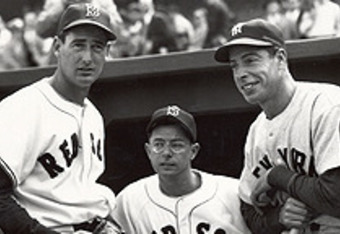
Left to right: Ted Williams, Dom DiMaggio, Joe DiMaggio.

October 2, 1949: Yankee Stadium, Bronx, New York. Regular-season finale. Winner takes the American League Pennant.

On the last day of the 1948 regular season, the Boston Red Sox beat the New York Yankees at Fenway Park in Boston, clinching at least a tie for the AL Pennant, and knocking the Yanks out of a chance for it. Ted Williams went 2-for-4 with 2 RBI doubles. Sox center fielder Dom DiMaggio went 3-for-4, including a solo home run. His brother, Yankee center fielder Joe DiMaggio, went went 4-for-5 with 2 doubles and 3 RBIs -- meaning that, between them, the DiMaggios go 7-for-9 with 3 extra-base hits and 4 RBIs. And brother Vince, who also reached the majors, wasn't even in this game! Although he was there, as were their parents.

The next day, also at Fenway, the Sox lost a playoff for the Pennant to the Cleveland Indians, 8-3, as Tribe shortstop-and-manager Lou Boudreau hit 2 home runs. They went on to beat the Boston Braves in the World Series.

In the off-season, the Yankees Bucky Harris, who had managed them to the 1947 World Series, and hired Casey Stengel, who had just won the Pacific Coast League Pennant with the Oakland Oaks, but had failed as manager of the Brooklyn Dodgers and the Boston Braves. The Sox were managed by Joe McCarthy, who had managed the Yankees from 1931 to 1946, winning 8 Pennants and 7 World Series.

Joe DiMaggio, the best player in baseball since he arrived in the major leagues in 1936, missed the 1st 2 months of the season with a heel spur. In late June, the pain vanished. In a 3-game series at Fenway on June 28, 29 and 30, he went 5-for-9, with 4 home runs and 9 RBIs. The Yankees swept, winning 5-4, 9-7 and 6-3. During the 3rd game, a fan flew a plane over Fenway, trailing a banner reading "THE GREAT DIMAGGIO." The joke was that it had to be for Joe, since Dom was only a very good DiMaggio.

The Yankees jumped out to a 12-game lead, but blew it, mainly due to injuries that kept several players out of the lineup for long stretches. They trailed the Sox by 1 game with 2 to play -- and these 2 were against the Sox at The Stadium.

For the 1st time, the Pennant would come down to the Yankees and the Red Sox. Yes, there was 1904, but that was between the New York Highlanders and the Boston Americans. Not only had the teams not yet adopted their familiar names, but the rivalry tailed off, sparked again by the Red Sox' sale of Babe Ruth and practically their entire starting rotation to the Yankees in the early 1920s.

On October 1, the Yanks held Joe DiMaggio Day, since his brother Dom played for the Sox, and thus the whole family could attend. Joe had been ill with pneumonia, but had kept playing, and says, "I'd like to thank the Good Lord for making me a Yankee." (I guess he didn't have an agent back in 1934.) In the game that followed, the Sox, acting like more recent Red Sox teams, blew a 4-0 lead, Johnny Lindell hit an 8th-inning homer, and the race was tied. Yankees 5, Red Sox 4.

In fact, in the 1901 to 1968 era of 2 single-division leagues, 1949 was the only season in which both leagues' races were unresolved as the final day of the regular season dawned. On the last day of the season, the Brooklyn Dodgers needed a win or a St. Louis Cardinals loss to win the National League Pennant. If they'd gotten neither, there would have been a Playoff.

The Dodgers needed 10 innings, but they got their win, 9-7 over the Philadelphia Phillies at Shibe Park (later renamed Connie Mack Stadium) in Philadelphia. Pee Wee Reese led off the inning with a single. Eddie Miksis sacrificed him to 2nd base. Duke Snider singled him home. Jackie Robinson was intentionally walked to set up the inning-ending double play. But Luis Olmo, one of the earliest Puerto Rican players in the major leagues -- and considered "white" enough to make it before Robinson desegregated the game -- singled Snider home. Jack Banta held the Phils off in the bottom of the 10th, and got the win in relief of Don Newcombe.
1949 Dodger photos. Top row, left to right: Ralph Branca,
Jackie Robinson, Gil Hodges, Roy Campanella.
Bottom row, left to right: Pee Wee Reese,
Duke Snider, a 2nd photo of Hodges, Don Newcombe.

October 2, 1949, Yankee Stadium. This was for the Pennant. A crowd of 68,055 was on hand. Phil Rizzuto led off the bottom of the 1st inning with a triple to left field. Tommy Henrich grounded to 2nd, and "The Scooter" scored. It was 1-0 Yankees.

The Yanks still led 1-0 with 1 out in the top of the 8th, when McCarthy sent Tom Wright up to pinch-hit for his starting pitcher, Ellis Kinder. Big mistake. Wright drew a walk, but Dom DiMaggio grounded into a double play.

Henrich led off the bottom of the 8th with a home run off Mel Parnell, ordinarily the Boston ace. McCarthy removed him, and brought in Tex Hughson, the ace of the Sox' 1946 American League Pennant winners. Yogi Berra, who came into his own this season as both a hitter and a catcher, singled to left. Joe DiMaggio grounded into a double play. But Lindell singled to center, with Hank Bauer pinch-running for him. Billy Johnson singled to left. Hughson, unintentionally, walked Cliff Mapes to load the bases. Jerry Coleman sent a drive down the right field line, clearing the bases, although he was out trying to stretch it from a double to a triple. It was 5-0 Yankees.

Yankee starter Vic Raschi had allowed only 2 hits over the 1st 8 innings, and got the 1st out in the 9th. Then he faltered: He walked Williams, threw a wild pitch, and allowed a single to Vern Stephens. Bobby Doerr lifted a drive to center field. Joe DiMaggio, still sick, dropped an easy fly ball, scoring both runners. Normally so good out there, Joe walked off the field, taking himself out of the game for the good of the team. Stengel moved Bauer from left field to right, moved Mapes from right to center, and put Gene Woodling in left.

Raschi got Al Zarilla to fly to center, where the newly-installed Mapes caught it. But Billy Goodman singled to center, scoring Doerr. It was now 5-3, the tying runs were on, and the run that could win the Pennant was at the plate, in the person of Sox catcher George "Birdie" Tebbetts.

Berra went out to talk to Raschi. "The Springfield Rifle" angrily said, "Gimme the goddamned ball, and get the hell out of here!" Yogi did as he was told, and Raschi got the final out, as Tebbetts popped up to 1st base, where Henrich, normally a right fielder, caught it. Final score: Yankees 5, Red Sox 3. The Yankees had won their 16th American League Pennant.

The Yanks beat the Dodgers in the World Series. In the last 2 seasons, the Sox had won 192 games, and didn't even win a Pennant.

"I won one," a jubilant Stengel said in the locker room. Later, in his weird way of talking that became known as "Stengelese," he said, "I couldn't a-done it without my players."

The following season, the Yankees won it again; while the Dodgers and Phillies again needed 10 innings to settle the race, this time against each other, with no scoreboard-watching. Dick Sisler hit a home run to win it.

UPDATE: The Red Sox have a team Hall of Fame. From their 1948 and 1949 near-misses, they have inductedleft fielder Ted Williams, center fielder Dom DiMaggio, 2nd baseman Bobby Doerr, shortstops Johnny Pesky and Vern Stephens, infielder Billy Goodman; pitchers Tex Hughson, Joe Dobson, Boo Ferris, Mel Parnell and Ellis Kinder; team owner Tom Yawkey, general manager Joe Cronin, scout George Digby, executive Edward F. Kenney, and longtime vendor Arthur D'Angelo.

But from between the 1949 near-miss and the 1967 Pennant, only broadcaster Curt Gowdy, 1st baseman Pete Runnels, 3rd baseman Frank Malzone, center fielder Jimmy Piersall, right fielder Jackie Jensen, and pitchers Frank Sullivan, Bill Monbouquette and Dick Radatz. That should show you how bad the Sox were in the 1950s and most of the 1960s.

*

October 2, 1949 was a Sunday. These other baseball games were played that day:

* The 3rd team in New York -- and, since the Dodgers' 1941 Pennant, they were unquestionably 3rd -- the New York Giants, lost to the Boston Braves, 2-1 at Braves Field in Boston.

* The St. Louis Cardinals beat the Chicago Cubs, 13-5 at Wrigley Field in Chicago. Stan Musial went 3-for-5 with 2 home runs, a walk and 4 RBIs. Once again, Stan was "The Man." But the Dodgers also won, so there would be no Playoff for the Pennant between the teams, as there was in 1946, and there would be between the Dodgers and the Giants in 1951.

* The Washington Senators beat the Philadelphia Athletics, 3-0 at Griffith Stadium in Washington. Dick Weik allowed just 1 hit over the 1st 4 innings, then was replaced by Lloyd Hittle. No indication is given as to why. Hittle allowed only 1 hit over the last 5 innings.

* A doubleheader was split at Forbes Field in Pittsburgh. The Pittsburgh Pirates won the opener, 4-2. The Cincinnati Reds won the nightcap, 6-5.

* The Cleveland Indians beat the Detroit Tigers, 8-4 at Briggs Stadium (later Tiger Stadium) in Detroit. The Tigers scored 4 runs in the 6th to take the lead away from Bob Feller, but the Indians scored 4 in the 8th, to make Feller the winning pitcher.

This would be Bill Veeck's last game as Indians owner. Although he had made the acquisitions necessary to win them the 1948 World Series, he went broke, and had to sell them. Before the last home game of this season, he had a "funeral" for the team's 1948 Pennant, burying it in center field. (Presumably, it was eventually dug up and salvaged.) He would recover, buy and sell the St. Louis Browns, and then later buy and sell the Chicago White Sox -- twice.

* And a doubleheader was split at Sportsman's Park in St. Louis. The White Sox won the 1st game, 4-3. The Browns won the 2nd game, 5-3.

Since it was Sunday, there was NFL action, but only 2 games were played. The Chicago Bears beat the Chicago Cardinals, 17-7 at Comiskey Park in Chicago. And the Los Angeles Rams beat the Green Bay Packers, 48-7 at City Stadium in Green Bay, Wisconsin.

Although Monday Night Football didn't arrive until 1970, there were 2 games the next day, October 3. With Briggs Stadium available, the Detroit Lions lost to the Philadelphia Eagles, 22-14. And with Forbes Field available, the Pittsburgh Steelers lost to the Washington Redskins, 27-14.

The preceding Friday, September 30, at the Polo Grounds, the football version of the New York Giants beat the New York Bulldogs, 38-14. The Bulldogs had been the Boston Yanks (yes, there was actually a team with that name) from 1944 to 1948, playing at Fenway Park, of all places. In 1950, they moved to Yankee Stadium, and used the name "New York Yanks" that year and in 1951. In 1952, they became the original Dallas Texans. In 1953, they became the 2nd, and most familiar version, of the Baltimore Colts.

This was the 4th and final season of the All-America Football Conference. On October 2, the Cleveland Browns, the only Champions the AAFC would ever know, beat the Los Angeles Dons, 42-7 at Cleveland Municipal Stadium; and the original version of the Colts beat the original version of the Buffalo Bills, 35-28 at Civic Stadium (later renamed War Memorial Stadium) in Buffalo.

The preceding Friday, the San Francisco 49ers beat the Chicago Hornets, 42-24 at Soldier Field in Chicago. One AAFC team had the week off, and it was named the New York Yankees. After the season, the Browns, the 49ers and the Colts were admitted to the NFL, but the original Colts flopped and folded, allowing for the newer version in 1953.

Friday, September 30, 2022

September 30, 1934: Yes, Bill Terry, Brooklyn Is Still In the League

He was 44 years old, and not yet known
as "The Ol' Perfesser."

September 30, 1934: Baseball's regular season comes to a close. Among the games played on this day, the Brooklyn Dodgers beat their arch-rivals, 8-5 at the Polo Grounds. The Giants' 3rd-best pitcher, "Fat" Freddie Fitzsimmons, noted for his usually beating the Dodgers, did not pitch well, although he helped his own cause with a home run.

In the top of the 10th inning, neither the Giants' starter and 2nd-best pitcher, Hal Schumacher, nor their ace, "King" Carl Hubbell, could hold off a Dodger rally. Here's the sequence:

* Sam Leslie singled to left.
* Tony Cuccinello doubled to left, moving Leslie to 3rd base.
* Terry took Schumacher out, and brought Hubbell in.
* Hubbell struck out the Dodgers' pitcher, Johnny Babich.
* Jersey Joe Stripp was intentionally walked, to load the bases and set up an inning-ending double play. But there was only 1 out, and the potential winning run, the run that could have cost the Giants the Pennant -- they didn't know what was going on in St. Louis at the time -- was just 90 feet away.
* Giants shortstop John "Blondy" Ryan muffed a grounder hit by Al Lopez, a very good catcher and later to become a Hall of Fame manager, and Leslie scored.
Glenn Chapman hit a sacrifice fly to left, scoring Cuccinello.
* And Ralph "Buzz" Boyle singled o right, scoring Stripp.

The preceding January, a sportswriter had asked Bill Terry, the 1st baseman who had also managed the Giants to win the previous year's World Series, who would be their top challengers in 1934. He said, "Pittsburgh, St. Louis, and Chicago will be the teams we'll have to beat. I don’t think the Braves will do as well as they did last year. I was just wondering, Is Brooklyn still in the league?"
Bill Terry

Over the last 3 games of the regular season, the Dodgers proved that, yes, Brooklyn was still in the National League. That sweep of a doubleheader on Saturday and the single game on Sunday cost the Giants the Pennant. Had the Giants won 2 out of 3, they would have finished in a tie for the Pennant, and forced a best-2-out-of-3 Playoff with the St. Louis Cardinals.

Oh, yes: The Dodgers' manager was Charles Dillon "Casey" Stengel, who had played for the Giants and the Dodgers.

The Cards needed a win, or a Giant loss, to clinch the Pennant on this final day. They got both: The Giants, as already stated, lost; and the Cardinals beat the Cincinnati Reds, 9-0 at Sportsman's Park in St. Louis. Jay "Dizzy" Dean pitched a 7-hit shutout, to advance to 30-7 on the season. No NL pitcher has won 30 games in a season since. Only 1 has won 28, and only 1 other has won 27.
Dizzy Dean

Like the Giants, they had a player-manager. Like Fitzsimmons would in 1941, he was an ex-Giant who came back to haunt his former team: Frankie Frisch, the graduate of Fordham University in The Bronx who was nicknamed "The Fordham Flash." On this day, he went 3-for-5. The Cards got home runs from Bill Delancey and James "Ripper" Collins.

The Cardinals went on to beat the Tigers in the World Series. They are remembered as "The Gashouse Gang," but that nickname wouldn't come until the next season.

For Dodger fans, who hated the Giants even more than Red Sox fans would eventually hate the Yankees, it was a rare moment in the Sun. In 1941, they won their 1st Pennant in 1920, with their ace being... a 40-year-old Freddie Fitzsimmons.

Terry had batted .401 in 1930, and remains the last National League player to top .400. He had managed the Giants to win a World Series. He would manage them to back-to-back Pennants in 1936-37. He would be elected to the Baseball Hall of Fame. After their move to San Francisco, the Giants would retire his Number 3.

But, as much as anything else, he is remembered for asking, "Is Brooklyn still in the league?" And getting an answer that embarrassed him, the Giants, and Giant fans everywhere.

In spite of this, In 1949, Ogden Nash, my grandmother's favorite poet, even though she was a Dodger fan and remembered that 1934 Pennant race well, wrote "Line-Up for Yesterday" for Sport magazine, an alphabetical list of star players, and honored Terry, the manager of his favorite team, with his entry for the letter T:

T is for Terry
The Giant from Memphis
Whose .400 average
You can't overemphis.

*


September 30, 1934 was a Sunday. These other baseball games were played.

* The New York Yankees lost to the Washington Senators, 5-3 at Griffith Stadium in Washington, despite a home run from Lou Gehrig. Babe Ruth goes 0-for-3, and it turns out to be his last appearance for the Yankees.

The Yankees finished 2nd in the AL, 7 games behind the Tigers. This is in spite of having players winning both the batting and the pitching Triple Crown. Gehrig batted .363, with 49 home runs and 165 runs batted in. Vernon "Lefty" Gomez won 26 games (against just 5 losses, and no Yankee has matched those 26 wins since), had a 2.33 earned-run average, and struck out 158 batters. All of those figures led the League. Gehrig and Mickey Mantle remain the only Yankees to win batting Triple Crowns.

So why didn't the Yankees win the Pennant? Yes, the Tigers had a great team, but that didn't usually stop the Yankees between 1921 and 1964. Part of the problem was injuries. Center fielder Earle Combs hit his head on an unpadded outfield wall on July 24, played only 63 games, and was never the same. In addition, 3rd baseman Red Rolfe played only 89 games. And while Gomez and Charles "Red" Ruffing were, as usual, the best lefty-righty combo in AL pitching, there wasn't really a good 3rd starter, let alone a 4th.

* A doubleheader was split at Fenway Park in Boston. The Boston Red Sox won the opener, 5-0. George Hockette allowed 8 hits, but kept the shutout. The Philadelphia Athletics won the nightcap, 4-2. Over the 2 games, Jimmie Foxx went 1-for-6 with 3 walks and an RBI.

* The Chicago White Sox won the 1st game of a doubleheader against the Cleveland Indians, 9-5 at League Park in Cleveland. Ted Lyons was the winning pitcher, and former Athletics star Al Simmons went 5-for-5. The Indians were leading the 2nd game, 5-3 after 5 innings, when the game was called due to darkness.

* The Boston Braves swept the Philadelphia Phillies, 4-3 and 5-4 at Baker Bowl in Philadelphia. The 1st game went 10 innings, and the 2nd was called due to darkness after 7. (This was the day the U.S. switched from Daylight Savings Time to Standard Time.)

The Braves finished 78-73, in 4th place, 16 games out of 1st. But the next year, they had one of the worst seasons in baseball history, going 38-115, the most losses of any MLB team between 1916 and 1962. For the 1936 season, as would be said today, they "rebranded": They became the Boston Bees, and Braves Field became National League Park, a.k.a. the Bee Hive. Neither name caught on, and in 1941, they went back to "Boston Braves" and "Braves Field."

* The Detroit Tigers sweep a doubleheader from the St. Louis Browns, 10-6 and 6-2 at Navin Field in Detroit. The ballpark will be renamed Briggs Stadium in 1938, and Tiger Stadium in 1961. The Tigers played in it from 1912 to 1999.

In the top of the 6th inning, Charley O'Leary, a coach activated for this game, 2 weeks short of his 59th birthday, and not having appeared in a major league game in 21 years, pinch-hit for Browns pitcher George Blaeholder, and singled off Elden Auker. Following a single by Jake Garms and a double by Jack Burns, he scored. O'Leary thus became the oldest player in Major League Baseball history (a record that stood for 31 years), the oldest to bat (ditto), the oldest to get a hit (a record he still holds), and the oldest to score a run (ditto). I have a separate entry for this event.

* The Chicago Cubs swept the Pittsburgh Pirates, 8-2 and 7-5 at Wrigley Field in Chicago. The next season, Crosley Field in Cincinnati became the 1st major league ballpark with lights. From 1948 to 1988, Wrigley was the last one without lights. Yet, on this day, despite the doubleheader and the early sunset, they got a full 18 innings in. (Well, 17, as neither game needed a bottom of the 9th.)

There were 4 games played in the NFL:

* The football version of the New York Giants lost to the Green Bay Packers, 20-6 at City Stadium in Green Bay, Wisconsin.

* The football version of the Brooklyn Dodgers beat the Boston Redskins, 10-6 at Ebbets Field.

* The Chicago Bears beat the Cincinnati Reds, 21-3 at Crosley Field in Cincinnati.

* And the Detroit Lions beat the Chicago Cardinals, 6-0 at the University of Detroit Stadium.

December 31, 1999 & January 1, 2000: The Millennium

December 31, 1999:  The Millennium arrives. The people of planet Earth survived. At a terrible cost. But we hadn't destroyed ourselves. ...