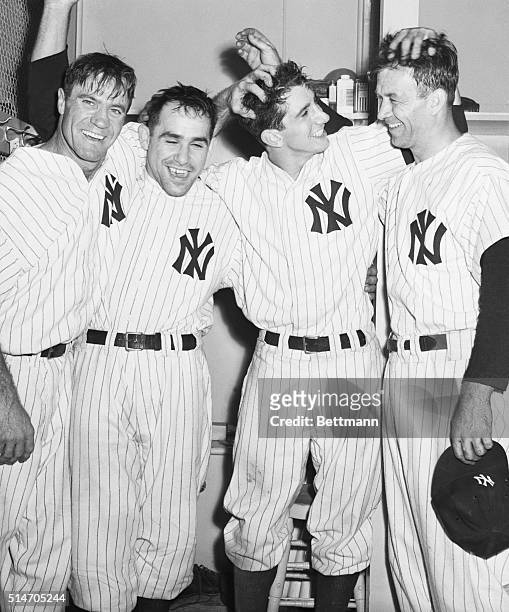
Left to right: Hank Bauer, Yogi Berra,
Billy Martin and Joe Collins
October 5, 1953: The New York Yankees beat the Brooklyn Dodgers, 4-3 at Yankee Stadium, to win Game 6 of the World Series, clinching it, 4 games to 2. This was the 5th straight World Championship for the Yankees. No other baseball team has ever done that.
The Yankees hired Charles Dillon "Casey" Stengel as their manager for the 1949 season, and he led them to the American League Pennant in each of the next 5 years. In 1949, they beat the Dodgers in the World Series in 5 games. In 1950, they swept the Philadelphia Phillies in 4 straight. In 1951, they beat the New York Giants in 6 games. That was Joe DiMaggio's last season, and Mickey Mantle's 1st season.
In 1952, it took them 7 games to finish the Dodgers off. That gave them 4 straight World Series wins, matching the Joe McCarthy-managed Yankees of 1936 to 1939.
In 1953, they faced the Dodgers again. It's important to note that, due to his U.S. Army commitments -- the Korean War was over by this point, but not everybody serving in it had been discharged yet -- the Dodgers did not have their best pitcher, Don Newcombe, for either the 1952 or the '53 Series. However, the Yankees had lost Whitey Ford to the war for the Series in '51 and '52. And the Giants had lost their best player, Willie Mays, for the '52 and '53 seasons, so if he was available, maybe they would have won those Pennants instead of the Dodgers.
The Dodgers were loaded. They won 105 games, which would remain a franchise record for 64 years. They finished 13 games ahead of the newly-moved Milwaukee Braves in the National League. They had 6 .300+ hitters, led by NL batting champion Carl Furillo at .344, and center fielder Edwin "Duke" Snider right behind at .336.
All 8 starting position players had at least 18 doubles, with Snider and Furillo each hitting 38. 2nd baseman Jim Gilliam led the NL with 17 triples. Snider hit 42 home runs, catcher Roy Campanella hit 41, and 1st baseman Gil Hodges hit 31. They had 5 players with at least 95 RBIs, with Campy leading the NL with 142, the Duke having 126, and Hodges 121. Campy was named NL Most Valuable Player.
They were superb defensively as well: Furillo also had the best right field arm in the game at the time, Snider was at least the equal with the glove in center as the Yankees' Mickey Mantle (if not of Mays), Hodges was the best-fielding 1st baseman in baseball, Billy Cox was the best-fielding 3rd baseman, Harold "Pee Wee" Reese was still the best shortstop in the NL; and Jackie Robinson, rotated between 2nd base, 3rd base and left field, played all of those positions well.
Their pitching was also strong, even without Newcombe available. Carl Erskine had the best curveball in the NL, going 20-6, leading the League with a .769 winning percentage. Russ Meyer, "The Mad Monk," was 15-5. Billy Loes was 14-8. Elwin "Preacher" Roe was 11-3. Rookie Johnny Podres was 9-4. Clem Labine, Joe Black and Jim Hughes made for a good bullpen.
But the Yankees were still the Yankees. They still had the best catcher in all of baseball, Lawrence "Yogi" Berra. Mantle, not yet 22 years old, had come into his own, launching some of the longest home runs anyone had ever seen: That season alone, he may have hit the longest ones ever seen at Griffith Stadium in Washington, Shibe Park/Connie Mack Stadium in Philadelphia, and Sportsman's Park/Busch Stadium in St. Louis. Left fielder Gene Woodling and right fielder Hank Bauer both batted over .300. Phil Rizzuto was still Reese's equal as a shortstop. Gil McDougald had become an excellent 3rd baseman.
And Ford returned to a starting rotation that still had "The Big Three": Allie Reynolds, Eddie Lopat and Vic Raschi. Stengel's alternation from the speedy Reynolds to the junkballing Lopat, then to the speedy Raschi, then to the mix-it-up master Ford kept American League batters on their toes, and made it hard for them to get into a day-to-day rhythm. The Yankees won 99 games, finishing 8 1/2 ahead of the Cleveland Indians, whose 3rd baseman, Al Rosen, narrowly lost the batting title to cost himself the Triple Crown. He was named the AL's MVP.
Despite the Dodgers' firepower, the Yankees' experience, especially against the Dodgers, made them slight betting favorites. Dwight D. Eisenhower, a former West Point baseball and football player in his 1st year as President, admitted before Game 1 that, "It would be nice if someone besides the Yankees won for a change."
With 85-year-old Cy Young throwing out the ceremonial first ball to Berra to open the World Series -- Yogi said, "It was like watching a statue come to life" -- the Yankees won Game 1, 9-5 at Yankee Stadium in The Bronx. Yogi hit a home run, and Eisenhower, having watched the television broadcast of the game on NBC, said, "I received a terrific kick out of Yogi Berra's home run. That fellow really slammed it out of the park."
The Yankees won Game 2 at home, 4-2. The Series moved to Ebbets Field in Brooklyn, and the Dodgers won Game 3, 3-2, and Game 4, 7-3. In Game 4, Erskine struck out 14 batters, setting a new Series record that would last for 10 years. But in Game 5, Mantle hit a grand slam to give the Yankees an 11-7 win, and a 3-2 lead in the Series.
Game 6 was played at Yankee Stadium, in front of 62,730 fans, about the twice the seating capacity of Ebbets Field. Ford started for the Yankees, Erskine for the Dodgers. With one of the best curveballs in the game at the time, "Oisk," as the Dodger fans called him in their Brooklyn accent, gave the Flatbush Faithful -- also known as the Flastbush Flock -- hope that "Dem Bums" could push the Series to a Game 7.
But the Yankees struck quickly. Woodling led off with a walk. 1st baseman Joe Collins struck out, but Bauer singled, and Berra hit a ground-rule double to get Woodling home. Mantle was walked intentionally. 2nd baseman Billy Martin grounded to 2nd, and Gilliam bobbled the ball, allowing Bauer to score. For whatever reason, Dodger manager Charlie Dressen had put his usual 2nd baseman, Jackie Robinson, in left field.
The Yankees scored again in the 2nd, on a sacrifice fly by Woodling. The game remained 3-0 until the top of the 6th. With 1 out, Robinson doubled to left, and stole 3rd base. Campanella got him home on a groundout, to make it 3-1.
Stengel brought Reynolds in for the 8th inning, thinking he had the right mentality to close the game out. Perhaps the best starting pitcher on his 5 Pennant winners, Reynolds had a blazing fastball, and was willing to throw inside. He hit 57 batters during his career, but claimed he only hit 6 on purpose. The Dodgers accused him of targeting black players, but he seemed to brush white players back with the same frequency. He once plunked a batter on a 3-0 count, telling a reporter after the game, "If I'm going to put you on, I might as well hurt you." Partly because of his Cherokee heritage, and partly because his fastball seemed to bring up memories of a speeding train of that name, he was known as the Superchief.
Reynolds got through the 8th, giving up only a single to Robinson. But with 1 out in the 9th, he walked Snider, and then gave up a home run to Furillo. The game tied, Reynolds then struck out Cox and the opposing pitcher, Labine.
This was the last game played by Hall-of-Famer Johnny Mize: "The Big Cat," a 1st baseman, pinch-hit for Collins in the 8th, and grounded out to 1st. He was 40 years old and fat, so, despite also being a 1st baseman, he did not take the position in the 9th, Stengel instead sending Don Bollweg in to do so.
Cliché Alert: Walks can kill you, especially the leadoff variety. Labine walked Bauer to start the bottom of the 9th. He got Berra to fly to right. But Mantle beat out a single to 3rd. The batter was Martin. An ordinary player from April through September, he always seemed to turn it on for the World Series, turning a regular-season batting average of .257 to a World Series average of .333. In 28 World Series games, he hit 5 home runs and had 19 RBIs. Stretch that to a full 154-game season, as was standard at the time, and it would have been 28 homers and 105 RBIs. And a catch he made in Game 7 in 1952 may have saved the Series for the Yankees. Whatever else can be said about Billy -- as a player, as a manager, and as a person -- he was a clutch performer as a player.
At this point, 4 players had collected 12 hits in a single World Series: Charles "Buck" Herzog of the 1912 New York Giants, Shoeless Joe Jackson of the 1919 Chicago White Sox (in spite of the accusation that he helped "throw" the Series), Sam Rice of the 1925 Washington Senators, and Johnny "Pepper" Martin of the 1931 St. Louis Cardinals. Oddly, all but Pepper Martin -- no relation to Billy -- were on the losing side.
Billy Martin singled up the middle, for his 12th hit of the Series, and Bauer came around 3rd to score the winning run: Yankees 4, Dodgers 3. The Yankees had won their 5th straight World Series.
There were 11 players who played on all 5 of those Yankee World Champions: Phil Rizzuto, Yogi Berra, Johnny Mize, Gene Woodling, Hank Bauer, Jerry Coleman, Joe Collins, Allie Reynolds, Vic Raschi, Eddie Lopat, and, though he played just 156 games in those 5 seasons, and just 1 ever in the World Series, backup catcher Charlie Silvera. Coleman, however, was serving in the Korean War for most of the '52 and '53 seasons, and, though he returned for the end of the '53 season, was not placed on the Series roster. Collins was a rookie in '49, and was not on the Series roster.
Since then, 3 in a row has been done, but not 4, and certainly not 5. The Montréal Canadiens would soon start a streak of 5 straight Stanley Cups, but they were unable to make it 6. The Boston Celtics would later win 8 straight NBA Titles, but basketball didn't exactly get the best athletes then.
This was the last World Series, and the last Pennant in either League, won by an all-white team. The next season, the Yanks lost the American League Pennant to the well-integrated Cleveland Indians, and the argument of, "Why integrate? We're winning with what we've got" was no longer valid. Elston Howard became the 1st black man to play for the Yankees the following April, and the team went on to win 9 Pennants and 4 World Series in the next 10 years.
Art Schallock is the last surviving member of the 1953 World Champion New York Yankees. He is also the last surviving former teammate of Joe DiMaggio, although he was not on the World Series roster in either 1951 or 1952. As of October 5, 2022, he is the oldest living former player, age 98. (UPDATE: He lived to be 100, but died in 2025, shortly before he would have turned 101.)
Art Schallock is the last surviving member of the 1953 World Champion New York Yankees. He is also the last surviving former teammate of Joe DiMaggio, although he was not on the World Series roster in either 1951 or 1952. As of October 5, 2022, he is the oldest living former player, age 98. (UPDATE: He lived to be 100, but died in 2025, shortly before he would have turned 101.)
There have now been 3 players with 13 hits in a single World Series: Bobby Richardson of the 1964 Yankees, Lou Brock of the 1968 Cardinals, and Marty Barrett of the 1986 Boston Red Sox -- and all 3 ended up on the losing side.
In 1972-74, the Oakland Athletics won 3 straight World Series. They remain the only team other than the Yankees ever to win more than 2 straight. The Yankees won 3 straight in 1996-98.
*
October 5, 1953 was a Monday. This was before Monday Night Football, so there were no football games. It was too early to start the new NBA and NHL seasons. So there were no other scores on this historic day.


No comments:
Post a Comment