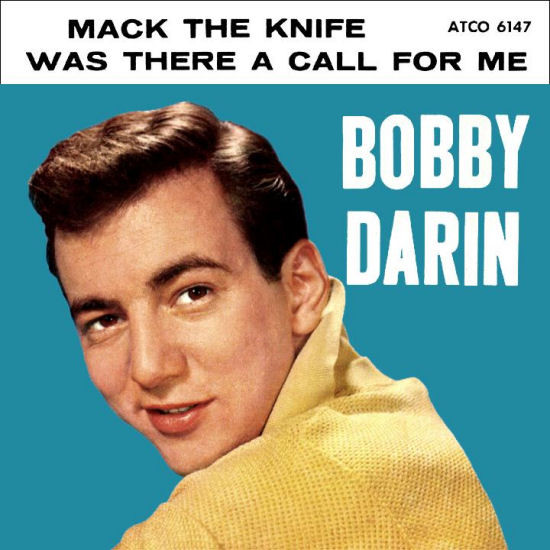
October 5, 1959: Bobby Darin's recording of "Mack the Knife" hits Number 1 on Billboard magazine's Hot 100 chart, the defining "pop music" chart in America. Released by Atco Records, Number 6147, it stayed at Number 1 for 9 weeks, and, according to "oldies" station WCBS-FM, 101.1, eventually became the biggest-selling record in New York City's history.
That the all-time biggest selling platter in the Big Apple was recorded by a New York native was not surprising. That it was not a rock and roll record is a little surprising. That it was written by 2 German guys in 1928 is a bit of a shock.
In 1958, Bobby had his 1st big hit, with "Splish Splash." He followed it with rockers "Queen of the Hop" and "Dream Lover." He was young, handsome and multi-talented, seemingly perfect for the rock and roll generation. But his heart was in the older music, in the style of Frank Sinatra. He used rock as a springboard for what he really wanted to do.
And one of those things was to sing show tunes. On December 19, 1958, at Fulton Studios in New York, he recorded "Mack the Knife," from The Threepenny Opera by Kurt Weill and Bertolt Brecht.
In the original German, the title is "Die Moritat von Mackie Messer." A "moritat" is a medieval version of the "murder ballad" performed by strolling minstrels. In The Threepenny Opera, the Moritat singer with his street organ introduces and closes the drama with the tale of the deadly Mackie Messer, or Mack the Knife, a character based on the dashing highwayman Macheath in Jay Gay's 1728 composition The Beggar's Opera.
The character of Macheath had been based on the historical thief Jack Sheppard (1702-1724). The Brecht-Weill version of the character was far more cruel and sinister, whose crimes included rape and murder, and transforming him into what would now be called an antihero. Because "Mack" rhymes with "Jack," the 2nd word is "the," he used a knife, and it's a period piece set in London, "Mack the Knife" is often incorrectly thought to be based on Jack the Ripper.
The song was a last-minute addition, inserted before the show's premiere on August 31, 1928, at the Theater am Schiffbauerdamm in Berlin (which is still in operation), because Harald Paulsen, the actor who played Macheath, demanded that Brecht and Weill add another number that would more effectively introduce his character. However, Weill and Brecht decided the song should not be sung by Macheath himself, opting instead to write the song for a street singer, in keeping with the Moritat tradition.
At the premiere, the song was sung by Kurt Gerron, who played Police Chief Brown. Weill intended the Moritat to be accompanied by a barrel organ, which was to be played by the singer. At the premiere, the barrel organ failed, and the pit orchestra -- a jazz band, as seen in the musical and film Cabaret, set in Berlin around this time -- had to quickly provide the accompaniment for the street singer.
The original German lyrics compare Macheath, in the danger he presents, to a shark, and go on to tell of his misdeeds, those known, and those suspected: "And now, Macheath spends just like a sailor. Could it be our boy's done something rash?"
A Broadway production with an English translation failed in 1933. Broadway tried in English again in 1954, and this one succeeded, including listing the names of Macheath's victims -- mistakenly mentioning Lotte Lenya, who was married to Weill and a star of the original version, but not one of the characters pursued by Macheath.
It was this version that was turned into hit singles in 1956 by Louis Armstrong and Ella Fitzgerald. Several "Big Band" orchestras had hits with instrumental versions, many of them titling it not "Mack the Knife," but simply "Moritat."
Bobby Darin's recording of the song followed the 1954 version. It starts softly, with mufflehead drums, moves to soft horns, then a light piano, and it all gets louder and louder, until he's singing over a full orchestra going full blast. His version hit Number 1 in America on October 5, 1959, and stayed there for 9 weeks. It went on to become the biggest-selling record in New York City history, because it was a rare thing that teenagers and their parents could agree on.
Darin wanted to be the next Frank Sinatra. He probably came closer to it than anybody else did. Sinatra himself, who recorded the song with Quincy Jones on his album L.A. Is My Lady in 1984, called Darin's the "definitive" version, saying:
Darin continued to sing the song, including in his short-lived 1972-73 TV variety show, until his death from heart trouble on December 20, 1973.
A personal note: Despite being the right age to be one of the high school girls who screamed over The Beatles, my mother hated rock and roll, preferring classical and folk music. There were 2 songs from 1959 that she especially hated: "Mack the Knife" and "Sixteen Candles" by The Crests. I love both recordings.
*
October 5, 1959 was a Monday. Maya Lin, the architect who designed the Vietnam Veterans Memorial in Washington, D.C., was born.
There was only one score on this historic day. Game 4 of the 1959 World Series was played, at the Los Angeles Memorial Coliseum, where the Los Angeles Dodgers played from their 1958 move from Brooklyn through 1961, after which Dodger Stadium was ready. A record crowd of 92,650 saw them beat the Chicago White Sox, 5-4. Gil Hodges, the 1st baseman from the last few years in Brooklyn, hit a home run in the bottom of the 8th inning to win it. The Dodgers won the Series in 6 games.


No comments:
Post a Comment