Showing posts with label otto graham. Show all posts

Monday, December 26, 2022

December 26, 1955: Otto Graham Goes Out a Winner

December 26, 1955: The NFL Championship Game is played at the Los Angeles Memorial Coliseum. It was moved up a day, because, that year, December 25 fell on a Sunday, and the NFL refused to play on Christmas Day until 1971.

The Cleveland Browns were playing in a league championship game for the 10th straight year: The 1st 4 in the All-America Football Conference (1946-49), winning all 4 of those; and the last 6 in the NFL, having beaten the Los Angeles Rams in 1950, lost to the Rams in 1951, lost to the Detroit Lions in 1952 and 1953, and beaten the Lions in 1954. Now, they were playing the Rams again.

Quarterback Otto Graham had been there for all of those games. Under head coach Paul Brown, an offensive genius, he had been, in terms of results, the most successful quarterback in pro football history. (Sure, Tom Brady later got teams into 10 championship games under the Super Bowl name, all within the NFL. But Graham did 10 in a row, and matched Brady with 7 wins. And Graham never had to cheat.)

Graham had retired after the 1954 Championship Game, but Brown talked him into returning for 1 more season. He led the Browns to a 9-2-1 record. They opened with a loss to the Washington Redskins, but shrugged it off to beat the San Francisco 49ers away, the Philadelphia Eagles at home, the Redskins away, the Green Bay Packers at home, the Chicago Cardinals away, and the New York Giants at home.

In addition to Graham, the Browns still had receiver Dante Lavelli, center Frank Gatski, tackle and placekicker Lou Groza, and defensive end Len Ford, who would all be elected to the Pro Football Hall of Fame. So would Brown. So would linebacker Chuck Noll, albeit as the later head coach of the Pittsburgh Steelers.

The Browns lost to the Eagles in Philadelphia, then beat the Steelers at home. They could only manage a tie with the Giants in New York, then won away to Pittsburgh, and closed by beating the Cardinals at home.

The Rams were coached by Sid Gillman, whose innovations in the passing game had begun to rival those of Paul Brown. They had finished 8-3-1, with 2 of their losses inflicted by the Chicago Bears. They still finished ahead of the Bears, who went 8-4.

The Rams still had several of the players who beat the Browns in the 1951 title game, including quarterback Norm Van Brocklin and his top 2 receivers, Tom Fears and Elroy "Crazy Legs" Hirsch, all of whom would be elected to the Pro Football Hall of Fame. So would Gillman, and linebacker Les Richter. Running back Paul "Tank" Younger and defensive tackle Gene "Big Daddy" Lipscomb have not yet been elected to the Hall, but should be.

And, this being an odd-numbered year, the Western Division winners would have the home-field advantage. And the Coliseum was the only stadium in the NFL that seated more than the Browns' Cleveland Municipal Stadium, so 87,695 fans came out, supporting the blue and gold, rather than the orange and white.

Groza kicked a 43-yard field goal to give the Browns a 3-0 lead at the end of the 1st quarter. The 2nd quarter featured several big plays, including Don Paul intercepting Van Brocklin, and returning it 65 yards for a touchdown, to make it 10-0 Browns; Van Brocklin throwing a 67-yard touchdown pass to Volney "Skeet" Quinlan, closing the Rams to within 10-7; and Graham throwing a 50-yard touchdown pass to Lavelli, giving the Browns a 17-7 halftime lead.

Graham himself ran the ball in for 2 touchdowns in the 3rd quarter, and the Browns led, 31-7. In the 4th quarter, Graham's last touchdown pass was 35 yards to Ray Renfro. Ron Waller scored from 4 yards out to give the Rams a consolation score, and the Browns won, 38-14.

It was the 7th league championship, the 3rd in the NFL, for Graham and Paul Brown. It would be the last. Graham retired again, and, this time, stuck with it. Brown led the Browns until 1962, before being fired by new owner Art Modell. He later founded the Cincinnati Bengals.

Gillman would further develop his passing ideas, and lea the San Diego Chargers to the 1963 AFL Championship. Bill Walsh, who served as an assistant on the Bengals under Brown, and also under on the Oakland Raiders under Al Davis, who had been an assistant on the Chargers under Gillman, would coach the San Francisco 49ers to 3 Super Bowl wins.

Under the new regime, the Browns won the Championship in 1964 -- and haven't reached a world championship game since. The Rams would fare little better, not reaching another until Super Bowl XIV in the 1979 season, and losing. They moved to St. Louis in 1995, won Super Bowl XXXIV in the 1999 season, lost Super Bowl XXXVI in the 2001 season, moved back to Los Angeles in 2016, and have lost Super Bowl LIII in the 2018 season and won Super Bowl LVI in the 2021 season.

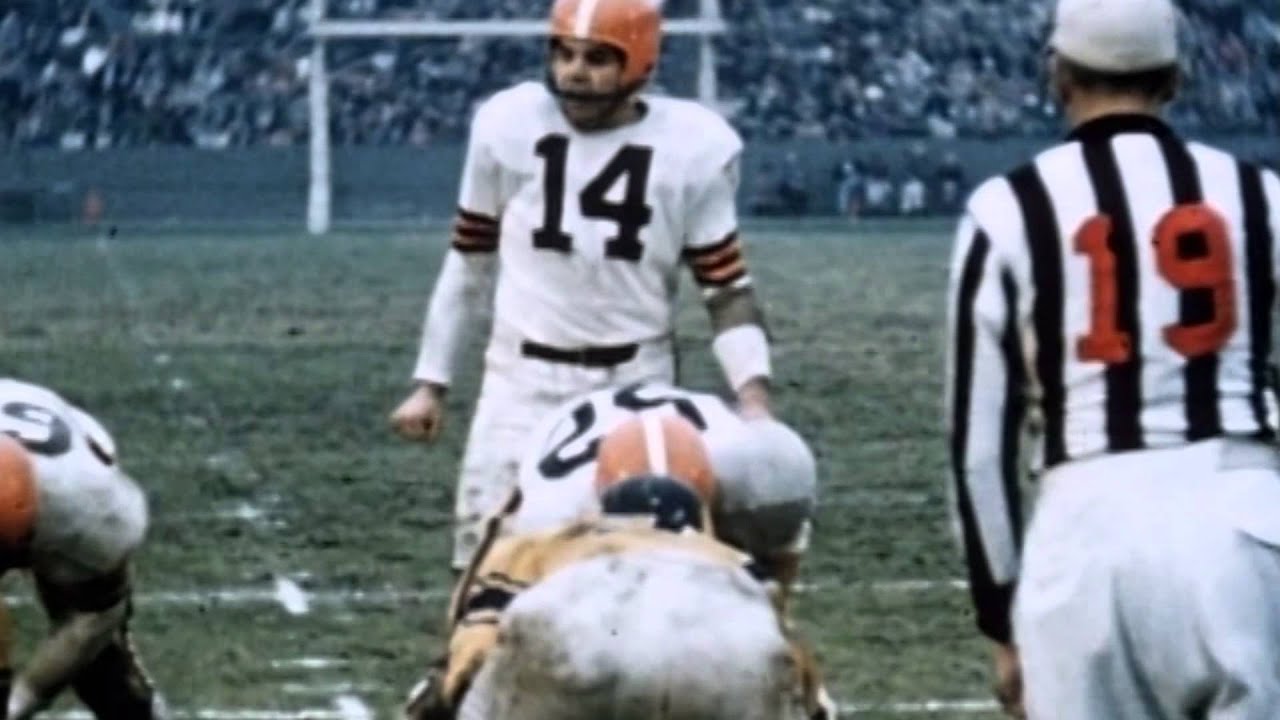
Graham started his professional career wearing Number 60, from 1946 to 1951. From 1952 onward, he wore Number 14. The Browns retired that number, and also named him to their Ring of Honor. He was elected to the Pro Football Hall of Fame in its 3rd class, in 1965.

He later served as head coach and general manager of the Washington Redskins, and as head coach and athletic director at the U.S. Coast Guard Academy. In 1999, he was ranked 7th on The Sporting News' list of the 100 Greatest Football Players, trailing only Joe Montana and Johnny Unitas among quarterbacks. He died in 2003.

In 2010, the NFL Network ranked Graham 16th on its list of the 100 Greatest Players, among quarterbacks trailing only Montana, Unitas, Peyton Manning and the even earlier Sammy Baugh, but not yet Tom Brady. He was named to the NFL's 50th Anniversary Team in 1969, its 75th Anniversary Team in 1994, and its 100th Anniversary Team in 2019. Also in 2019, a statue of Graham was dedicated outside Huntington Bank Field in Cleveland.

*

December 26, 1955 was, as suggested, a Monday. Evan Bayh, who would follow his father Birch Bayh in being elected U.S. Senator from Indiana, was born on this day.

Baseball was out of season. No college football bowl games were played. There were no games scheduled in the NHL. There were 3 games played in the NBA:

* The New York Knicks beat the Philadelphia Warriors, 108-97 at the Philadelphia Civic Center.

* The Rochester Royals beat their arch-rivals, the Syracuse Nationals, 93-91 at the Rochester Community War Memorial (now the Blue Cross Arena) in Rochester, New York.

* And the Fort Wayne Pistons beat the St. Louis Hawks, 83-67 at the Allen County War Memorial Coliseum in Fort Wayne, Indiana.

In Britain, the day after Christmas is Boxing Day, and it's a day for major soccer matches. Arsenal and Birmingham-area team Wolverhampton Wanderers played to a draw, 3-3 at the Arsenal Stadium, a.k.a. Highbury, in North London.

Friday, September 16, 2022

September 16, 1950: The Cleveland Browns Announce Their Presence

Marion Motley carrying the ball -- painted white,
to be more visible in a night game. This did not catch on.

September 16, 1950: The National Football League features a season-opening game between their defending Champions and those of a newly-defunct rival league.

The game was played at the 105,000-seat Municipal Stadium in South Philadelphia. Usually playing their home games at Shibe Park in North Philadelphia, the Philadelphia Eagles had played home games at Municipal Stadium from 1936 to 1939, and select games thereafter.
Municipal Stadium, by this point named John F. Kennedy Stadium.
Just to the north was The Spectrum; to the north of that, Veterans Stadium.

This game was, as soccer fans would call it, a "Charity Shield" or "Super Cup" game: The 2-time defending NFL Champion Eagles vs. the Cleveland Browns, 4-time titlists in the All-America Football Conference. The Browns were 47-4-3 over the AAFC's 4-season history; the Eagles, 22-3-1 over the last 2 years, thanks to a 5-2 alignment that was the 1st defensive unit to have a memorable nickname: Before San Diego, Detroit and Los Angeles had lines that became known as the Fearsome Foursome, Philly had the Suicide Seven.

Some people then called it "The Game of the Century," and some now think of as an unofficial "first Super Bowl." Such a name is ironic, since it took the Eagles until 2018 to win an NFL Championship in the Super Bowl era, and, through the 2021 season, the Browns haven't even been to a Super Bowl yet.

Playing on a Saturday night -- making it, sort of, not just "the 1st Super Bowl" but "the 1st Monday Night Football game" -- in front of 71,237 fans, still the largest crowd ever to watch a professional football game in Pennsylvania (and nearly double the capacity of Shibe Park, which really limited the Eagles' attendance), the Browns put on a show.

Paul Brown, having mastered his craft at every level below the NFL -- at Massillon High School outside Cleveland, at Ohio State University where he won the 1942 National Championship, and with the Browns in the AAFC -- was the greatest offensive mind the game of football had yet seen. With Otto Graham as his quarterback, passing to Dante Lavelli, Mac Speedie and Dub Jones, and with the acceptance of black players like fullback Marion Motley and guard Bill Willis, he had won those 4 AAFC titles.
Paul Brown

(The Browns were named for Paul Brown. The story that Brown, or the original owner, Arthur B. McBride, wanted to name the team the Cleveland Brown Bombers in honor of Joe Louis, then the Heavyweight Champion of the World, is a myth. McBride had run a fan contest to determine the name, and the winner was "Cleveland Panthers," who played from 1919 to 1933, including in the 1st American Football League in 1926, but Paul Brown called them a failed team that he wanted no part of. So, over Brown's objection, McBride named them the Browns.)

And that Saturday night in South Philly, Brown let his team put on a show. The Eagles took an early lead on a field goal by Cliff Patton. But Graham threw freely, and the Browns scored the next 4 touchdowns: A 59-yard pass from Graham to Jones, a 26-yard pass from Graham to Lavelli, a 13-yard pass from Graham to Speedie (that was his real name: He was born Mac Curtis Speedie), and a 1-yard run by Graham.

It was 7-3 Browns at the end of the 1st quarter, 14-3 Browns at the half, 21-3 Browns after 3 quarters, and 28-3 Browns before Bill Mackrides threw a touchdown pass to Pete Pihos to get the Eagles into double figures. Late in the game, Rex Bumgardner ran for a touchdown, making the final score Browns 35, Eagles 10. To borrow a line from Bull Durham, a movie from another sport, the Browns had announced their presence with authority.

The Eagles actually had more 1st downs, 24-23; more rushing yards, 148-141; and fewer penalties, 3 for 45 yards to the Browns' 12 for 98 yards. And there were plenty of turnovers on both sides: 5 for Philadelphia, 4 for Cleveland.

But Graham completed 21 of 38 passes for 346 yards, a display that NFL fans, even with Sid Luckman of the Chicago Bears and Sammy Baugh of the Washington Redskins still active, simply weren't used to. It forced the Eagles into the air: Between them, Mackrides and Tommy Thompson attempted 32 passes, but only completed 11.
Until 1951, the Browns wore white helmets,
and Otto Graham wore Number 60. After that,
he switched to 14, and the Browns have worn
orange helmets ever since.

The performance stunned football fans all over the nation. Eagle coach Earle "Greasy" Neale was contemptuous of the aerial assault, calling the Browns "a basketball team." When the teams met again on December 3 at Cleveland Municipal Stadium, Brown told Graham not to throw a single pass, just to make a point, and he didn't. And the Browns didn't score a single offensive touchdown. They didn't need to: Warren Lahr intercepted a Thompson pass, and returned it 30 yards for a touchdown, while Lou Groza added 2 field goals, and the Browns won, 13-7. Brown had a great defense, too.

The Eagles never recovered, going 6-6, and didn't reach the NFL Championship Game again for 10 years. The Browns won the NFL title that year, and appeared in 7 title games in 8 years, winning 3: 1950, 1954 and 1955. Brown and 8 of his 1950 Browns would be elected to the Pro Football Hall of Fame: Graham, Motley, Groza, Lavelli, Speedie, Willis, end Len Ford and center Frank Gatski.

Paul Brown would be fired by new team owner Art Modell after the 1962 season. Cleveland fans treated this as the 1st time Modell aggrieved them, and it would be far from the last, or the worst. In 1968, Brown founded a team in the American Football League, the Cincinnati Bengals. He tried to remake the team in the old Browns' image, using the same colors and the same offense. They even had the same initials, although there had been a previous team with theCincinnati Bengals name, which played in the 2nd (1936-37) and 3rd (1940-41) leagues with the AFL name.

Don McCafferty (1970 NFL Champion Colts) coached under him at Ohio State. Among his coaches with the Browns were Weeb Ewbank (1958 and '59 NFL Champion Baltimore Colts, 1968 World Champion New York Jets), Blanton Collier (his replacement as Brown coach, 1964 NFL Champions), Lou Saban (1964 and '65 AFL Champion Buffalo Bills) and Don Shula (1968 NFL Champion Colts, 1972 and '73 NFL Champion Miami Dolphins). Among his coaches with the Bengals were Bill Walsh and Sam Wyche (who, among their other achievements, opposed each other in Super Bowl XXIII in 1989).

Take it to the next level, and his "3rd generation" coaches include Red Miller (1977 AFC Champion Denver Broncos), Howard Schenllenberger (1983 NCAA Champion Miami), Dick MacPherson (undefeated season with Syracuse in 1987), George Seifert (1990 and '94 NFL Champion San Francisco 49ers), Paul Holmgren (1996 NFL Champion Green Bay Packers, 2005 AFC Champion Seattle Seahawks), Marty Schottenheimer (4 AFC Championship Games, although he lost them all), Tony Dungy (2006 NFL Champion Indianapolis Colts), Doug Pederson (2017 NFL Champion Philadelphia Eagles) and Andy Reid (2019, '22 and '23 NFL Champion Kansas City Chiefs).

Through Schottenheimer, his "coaching tree" also includes Bill Cowher (2005 NFL Champion Pittsburgh Steelers), Lovie Smith (2006 NFC Champion Chicago Bears), Mike Tomlin and Ken Whisehunt (who, among their other achievements, opposed each other in Super Bowl XLIII in 2009), Mike McCarthy (2010 NFL Champion Packers), Gary Kubiak (2015 NFL Champion Broncos) and Bruce Arians (2020 NFL Champion Tampa Bay Buccaneers). So Brown's NFL legacy spans that much: 1950 to 2022, including 22 of the 1st 56 Super Bowls, and 25 of the last 73 NFL Championships.

The Browns won the 1964 NFL Championship under Collier, reached the NFL Championship Game in 1968 and '69, and reached the AFC Championship Game in 1986, '87 and '89. After the 1995 season, Modell moved them, and they became the Baltimore Ravens. Cleveland was granted a replacement team, and the new Browns began in 1999. They have mostly struggled since. As have the Bengals, although they have won AFC Championships in 1981, 1988 and 2021.

Paul Brown died in 1991. When the Bengals moved into a new stadium for the 2000 season, it was named Paul Brown Stadium. It held that name until Paul's son, Mike Brown, often ridiculed as one of the NFL's cheapest owners (hence, their struggles), finally took his father's name off the stadium and sold the naming rights: In 2022, it became Paycor Stadium.

Speaking of stadiums: The Eagles moved to the University of Pennsylvania's Franklin Field in 1958, then returned to the South Philadelphia sports complex in Veterans Stadium in 1971, replacing that with Lincoln Financial Field in 2003. They won the NFL Championship in 1960, the NFC Championship in 1980 and 2004, and finally won a Super Bowl in the 2017 season.

In 1964, Philadelphia Municipal Stadium was renamed John F. Kennedy Stadium. On August 16, 1966, the Beatles played there. On July 13, 1985, it hosted the American end of Live Aid. But that show exposed to the world that it already falling apart. The Rolling Stones, who had packed the place on their 1981 Tattoo You tour, chose the considerably smaller Vet for Steel Wheels in 1989. It was demolished in 1992, and the new arena opened on the site in 1996.

*

September 16, 1950 was, as I said, a Saturday. All the other NFL games that opening week were played the next day.

There were 11 college football games played that day. Only 1 involved a team then ranked in the Top 20: Number 13 Kentucky, coached by Paul "Bear" Bryant and quarterbacked by Vito "Babe" Parilli, beat North Texas, 25-0 at McLean Stadium in Lexington, Kentucky.

And these baseball games were played:

* The New York Yankees beat the Detroit Tigers, 8-1 at Briggs Stadium in Detroit. (It was renamed Tiger Stadium in 1961.) Rookie Whitey Ford advanced to 7-0, supported by a home run from Joe DiMaggio.

* The New York Giants lost to the Chicago Cubs, 6-4 at the Polo Grounds.

* The Brooklyn Dodgers lost to the St. Louis Cardinals, 4-3 at Ebbets Field. Stan Musial went 1-for-3 with 2 walks. Duke Snider hit a home run, in support of Carl Erskine. Jackie Robinson only appeared as a pinch-runner, and did not score.

* The Pittsburgh Pirates beat the Boston Braves, 4-0 at Braves Field in Boston. The Pirates' Cliff Chambers and the Braves' Vern Bickford traded goose eggs for 11 innings. But in the top of the 12th, Bickford ran out of gas, allowing 4 singles, 2 walks, a wild pitch and a sacrifice fly. Ralph Kiner went 0-for-5, although he did draw a walk.

* The Cincinnati Reds beat the Philadelphia Phillies, 2-0 at Shibe Park in Philadelphia. Ewell Blackwell pitched a 3-hit shutout.

* The Cleveland Indians beat the Washington Senators, 5-1 at Cleveland Municipal Stadium. Bob Feller went the distance for the win, supported by home runs by Al Rosen and Jim Lemon.

* The Chicago White Sox beat the Philadelphia Athletics, 10-3 at Comiskey Park in Chicago.

* And the St. Louis Browns, for once playing on the same level as the 1950s Cleveland Browns, beat the Boston Red Sox, 5-2 at Sportsman's Park in St. Louis. Ted Williams went 1-for-4.

Also, in English soccer, Arsenal beat Yorkshire team Huddersfield Town, 6-2 at Highbury in North London.

Tuesday, August 2, 2022

August 2, 1963: The College All-Stars Upset the Green Bay Packers

August 2, 1963: The Green Bay Packers, defending NFL Champions, are upset, 20-17, by the College All-Stars in the annual Chicago College All-Star Game, at Soldier Field in Chicago. This would be the last time the All-Stars would win the Game, which began in 1934 and was discontinued after 1976.

The All-Stars were coached by Otto Graham, the Hall of Fame quarterback of the Cleveland Browns, who was then the head coach of the football team at the U.S. Coast Guard Academy in New London, Connecticut. He had been the head coach for the All-Stars since 1958, and would remain the Coast Guard coach and the All-Star coach until 1966, when he accepted the job as head coach of the Washington Redskins.

The Packers had won the last 2 titles, going through the 1962 season 13-1, their only loss a Thanksgiving Day shocker to the Detroit Lions. They had beaten the New York Giants, 16-7 at Yankee Stadium in the NFL Championship Game. To emphasize how much of a shock this All-Star Game was: The previous season, the Packers had beaten the All-Stars, 42-20.

But the Packers would have to go through the 1963 season without their best running back. On April 17, Paul Hornung had been suspended indefinitely by NFL Commissioner Pete Rozelle, for betting on sporting events. Lions defense tackle Alex Karras had received the same suspension, for the same reason. Unlike Pete Rose, then starting his rookie season in Major League Baseball, Hornung and Karras came clean immediately, and cooperated completely. As a result, both men had their suspensions lifted after the 1963 season, and resumed their careers.

Hornung was thus unavailable for this game. So was linebacker Ray Nitschke, due to an injury. Their other star running back, Jim Taylor, was playing hurt.

Ron Vander Kelen, who had led the University of Wisconsin to the Big Ten Conference title the year before, quarterbacked the All-Stars. Also on that team was a future Packer star, Penn State linebacker Dave Robinson; a man who would oppose the Packers in Super Bowl I, linebacker Bobby Bell of Minnesota; and a man who would oppose the Packers in back-to-back NFL Championship Games, Lee Roy Jordan of Alabama.

Without Hornung, the Packers finished 11-2-1, with both of their losses coming to the Chicago Bears, who went on to win the NFL Championship. So, not counting games in or against Chicago, they were 11-0-1, even without Hornung.

They missed the Playoffs again in 1964, but won the next 3 NFL Championships, including Super Bowls I and II.

Graham would be fired as Redskins coach after the 1968 season. His successor was... Vince Lombardi. Lombardi coached the Redskins to a 7-5-2 record in 1969, but died of colon cancer before the next season could begin. Graham never coached in the NFL again. To show how medicine had progressed: Graham not only survived colon cancer, but became an advocate for early screening. He lived until 2006.

Vander Kelen played 5 seasons as as backup to Fran Tarkenton on the Minnesota Vikings, and 1 more season with the CFL's Calgary Stampeders.

*

August 2, 1963 was a Friday. These baseball games were played that day:

* The New York Yankees lost to the Baltimore Orioles, 5-3 at Yankee Stadium. Former Phillies ace Robin Roberts outpitched Whitey Ford. Mickey Mantle was injured and did not play. Brooks Robinson went 2-for-3 with an RBI.

* The New York Mets split a doubleheader with the Milwaukee Braves at Milwaukee County Stadium. The Braves won the opener, 8-0. Bob Hendley pitched a 4-hit shutout. Hank Aaron, Eddie Mathews and Joe Torre all hit home runs. The Mets won the nightcap, 3-1. Joe Hicks singled home the winning run in the top of the 11th inning. Over the 2 games, Aaron went 4-for-8 with 4 RBIs.

* A doubleheader was split at District of Columbia Stadium in Washington. (It was renamed Robert F. Kennedy Memorial Stadium in 1969.) The Boston Red Sox won the opener, 5-0. Earl Wilson pitched a 6-hit shutout, and helped his own cause with a home run. The Washington Senators won the nightcap, 4-3. Carl Yastrzemski went 3-for-4 with a walk and an RBI, but then went 0-for-4.

* The Cincinnati Reds beat the Pittsburgh Pirates, 3-0 at Crosley Field in Cincinnati. Jim Maloney pitched a 4-hit shutout. Frank Robinson went 1-for-3. Rookie Pete Rose went 0-for-3 with a walk. Roberto Clemente went 0-for-4.

* The Detroit Tigers beat the Cleveland Indians, 10-9 at Tiger Stadium in Detroit. Al Kaline went 2-for-5 with an RBI.

* The Chicago Cubs beat the San Francisco Giants, 12-11 at Wrigley Field in Chicago. This was one of those days when the wind was blowing out at Wrigley. Billy Williams, Leo Burke and Ellis Burton hit home runs for the Cubs; while Willie Mays and Orlando Cepeda hit them for the Giants.

Ironically, it was a future major league pitching coach, with a .223 lifetime batting average, Jimmy Schaffer, who drove in the winning run, with a single in the bottom of the 10th inning. Ernie Banks did not start the game, later came in as a pinch-hitter and 1st baseman, and drew 2 walks.

* The St. Louis Cardinals beat the Philadelphia Phillies, 3-2 at Busch Stadium (formerly Sportsman's Park) in St. Louis. Stan Musial, in his last 2 months as an active player, did not appear in the game.

* The Minnesota Twins beat the Kansas City Athletics, 10-3 at Kansas City Municipal Stadium. Harmon Killebrew went 2-for-4 with 2 walks.

* The Houston Colt .45s beat the Los Angeles Dodgers, 4-1 at Colt Stadium in Houston. The Colts became the Astros in 1965.

* The Chicago White Sox beat the Los Angeles Angels, 5-1 at Dodger Stadium in Los Angeles. The Angels groundshared with the Dodgers until their Anaheim stadium was built in 1966.

December 31, 1999 & January 1, 2000: The Millennium

December 31, 1999:  The Millennium arrives. The people of planet Earth survived. At a terrible cost. But we hadn't destroyed ourselves. ...