Showing posts with label 1919. Show all posts

Monday, December 26, 2022

December 26, 1919: The Yankees Purchase Babe Ruth

Yankee owner Jacob Ruppert,
manager Miller Huggins, and slugger Babe Ruth

December 26, 1919: The New York Yankees purchase the contract of outfielder George Herman "Babe" Ruth from the Boston Red Sox. It is the most famous transaction in the history of North American professional sports -- or, if you're a Red Sox fan, the most infamous.

Let's take a step back, to properly set it up: On July 30, 1919, Harry Frazee, owner of the Red Sox, traded pitcher Carl Mays to the Yankees for pitchers Bob McGraw and Allen Russell (neither of whom ever did much for either club) and $40,000. There was a hell of a to-do about this, as Mays had left, or "jumped" the Sox and gone home, and was suspended. At the time, the rules said you couldn't trade a suspended player.

This trade pretty much split the American League: Frazee, Yankee owner Jacob Ruppert, and Chicago White Sox owner Charlie Comiskey were on one side; on the other were AL founder and President Ban Johnson and the owners of the other 5 clubs. They were the brothers John and Ben Shibe and Connie Mack of the Philadelphia Athletics, former Yankee manager Clark Griffith of the Washington Senators, Frank Navin and Walter Briggs of the Detroit Tigers, Phil Ball of the St. Louis Browns, and Sunny Jim Dunn of the Cleveland Indians.

The National Commission, which oversaw baseball in those days, ruled in favor of Frazee and Ruppert, and Mays became the 1st major player to go from Frazee's Sox to Ruppert's Yanks. There would be more. (Mays' role in the death of Cleveland Indians player Ray Chapman is a story for another time.)

As a result of the Mays contretemps, Frazee, Ruppert, and Comiskey, now known as "the Insurrectos," could pretty much now only make deals with each other, as the other AL owners, "the Loyal Five," wanted nothing to do with them.

Due to circumstances that Frazee should have been able to control, but didn't, he had to get rid of Babe Ruth, who, in 1918 and '19, had gone from being baseball's best lefthanded pitcher to being the biggest power hitter in the game, but also the biggest headache. He was already a carouser, and he was demanding that his salary be doubled from $10,000 to $20,000 for the 1920 season.

So Frazee sold the Babe to the Yankees, mainly because Ruppert was willing to pay $125,000 for Ruth's contract; while the other possibility, the White Sox, were run by Comiskey, a notorious cheapskate. (His parsimony led to a problem with that year's World Series, as you may be aware.)

So if you're a Red Sox fan, don't blame Frazee for what happened: He didn't have much choice, unless he wanted the press and the public to think Ruth was running the team.

The deal was announced on January 5, 1920. People in Boston weren't happy about it. But nobody could have foreseen what would result from it. Ruth revolutionized the game with the Yankees, turning the home run from a rare thing into a common occurrence. And there would be more deals between Ruppert and Frazee, as Mays would be joined on the Yankee pitching staff by former Sox Waite Hoyt, "Bullet Joe" Bush and "Sad Sam" Jones.

From 1918 to the present... Yankees 27, Red Sox 0. Without cheating, anyway.

UPDATE: The Red Sox have a team Hall of Fame. From their 1912, 1915, 1916 and 1918 World Champions: Manager Bill Carrigan, shortstop Everett Scott, 3rd baseman Larry Gardner, left fielder Duffy Lewis, center fielder Tris Speaker, right fielder Harry Hooper, and pitchers Smoky Joe Wood, Dutch Leonard, Herb Pennock and Babe Ruth.

But from the 1920s, they have inducted only outfielder Ira Flagstead and pitcher Red Ruffing -- and, in Ruffing's case, it's only because he's in the main Baseball Hall of Fame in Cooperstown, New York, and that for what he did later, after he was... traded to the Yankees. From the 1930s: Team owner Tom Yawkey, general manager Eddie Collins, shortstop and manager Joe Cronin, catcher Rick Ferrell, and pitchers Lefty Grove and Wes Ferrell. That should give you an idea of how bad the Sox were from the 1919 sale of Ruth until Yawkey bought the team in 1933.

*

December 26, 1919 was a Friday. It was the off-season for baseball, The NFL and the NBA did not yet exist. The NHL did, but it held no games that day.

In Western Canada, there was 1 game in the Pacific Coast Hockey Association. The Victoria Cougars beat the Seattle Metropolitans, 2-1, at the Patrick Arena, built by the hockey-playing brothers Lester and Frank Patrick, in Victoria, the capital of the Province of British Columbia. 

This was no mean feat, as the Metros had won the PCHA title and reached the Stanley Cup Final in the previous season, against the NHL Champion Montreal Canadiens, but it was called off due to the Spanish Flu epidemic. In 1917, they had beaten the Canadiens to become the 1st American-based team to win the Stanley Cup. They would go on to win the PCHA title again in 1920, but lose the Stanley Cup Final to the Ottawa Senators, and fold in 1924.

The Cougars would win the West Coast Hockey League title in 1925, and beat the Canadiens, making them the last team from outside the NHL to win the Stanley Cup. They moved to the Western Hockey League, and won their title in 1926, but lost the Stanley Cup Final to the Montreal Maroons. Along with their league, they folded, but the bulk of their players were signed for a new team in the NHL. While not officially true, it can legitimately said that the Victoria Cougars still exist today, as the Detroit Red Wings.

In Britain, December 26 is known as Boxing Day, and England's Football League plays on the day, usually nearby rivals, to make it easier for people to travel. In this era, there tended to be what Americans would call a split doubleheader: Two teams facing each other at one's ground on Christmas Day, and at the other's ground the next day.

For North London team Arsenal, it wasn't a nearby team on this occasion. On the 25th, they lost to Derby County, 2-1 at The Baseball Ground, so named because Derbyshire was one of the few parts of the British Isles where baseball caught on, but only briefly. By this point, the stadium had been redeveloped so that playing baseball there was just about impossible, and you had a stadium which, like the Polo Grounds in New York, was named for a sport that was not being played there. On the 26th, Arsenal and Derby played at Highbury, and Arsenal won, 1-0.

Friday, November 11, 2022

November 11, 1919: The Centralia Massacre

November 11, 1919: An incident breaks out between U.S. Army veterans and labor union members in Centralia, Washington, about halfway between Seattle and Portland. It becomes known as the Centralia Tragedy, or the Centralia Massacre.

Note: There was an earlier event known as the Centralia Massacre, in Centralia, Missouri, about halfway between St. Louis and Kansas City, on September 27, 1864, a terrorist attack led by Confederate soldiers including Jesse James.

The American Legion was a brand-new organization, having been founded by U.S. Army officers still in Paris on March 15, 1919. They patterned themselves after the advocacy group for veterans of the American Civil War, the Grand Army of the Republic.

On November 11, the 1st Anniversary of the Armistice that ended World War I, they held a parade in Centralia. But the Pacific Northwest had also been a successful venue for the Industrial Workers of the World, a leftist labor union nicknamed the "Wobblies."

As the Legion tended to be conservative (in spite of their former commander-in-chief, President Woodrow Wilson, being a Democrat, and liberal on most issues except race), this sometimes brought the two groups into conflict. This included Warren Grimm, commander of the Legion's Centralia post and a former All-American football player at the University of Washington; and Elmer Smith, a lawyer for the IWW, and a pacifist who was known for antiwar activities.

The Legionnaires marched through Centralia, with loaded rifles, and fears of a repeat of the 1916 massacre in Everett, Washington, gripped the Wobblies. Grimm was at the head of the march, and he was shot in the head by Eugene Barnett. Whether the Legionnaires had charged the gathered Wobblies first has been disputed. Shooting and fighting broke out. When it ended, 4 Legionnaires, a Wobbly and a Deputy Sheriff were dead.

Smith was arrested, but, once it was determined that he did not participate, he was released. He lived until 1932. Wesley Everest was misidentified as Grimm's killer, arrested, and lynched before the night was up. Barnett was imprisoned, but released in 1931 before evidence was later found that he was the man who fired the shot that killed Grimm. He lived until 1973.

*

November 11, 1919 was a Wednesday. Baseball was out of season. Football was in midweek. Professional basketball barely existed. And the NHL season didn't start for over a month. So there were no scores on this historic day.

Sunday, October 9, 2022

October 9, 1919: The Fixed World Series

October 9, 1919: The World Series comes to a close, and millions of people find the result hard to believe.

Sometimes, it seems as though a sporting event was decided before it even began. This one was.

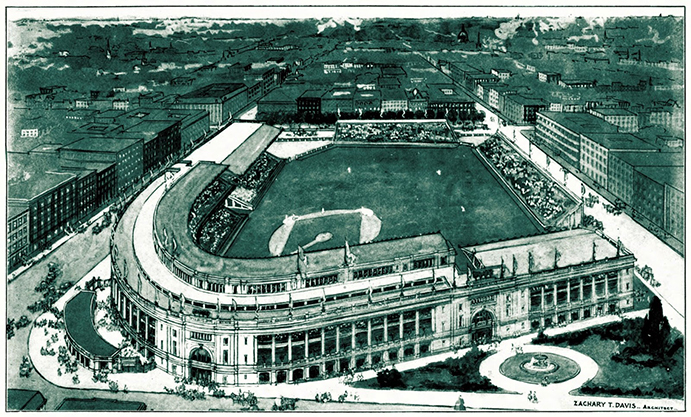
October 1, 1919: Game 1 is played at Redland Field (renamed Crosley Field in 1934) in Cincinnati. The Cincinnati Reds, Champions of the National League, are hosting the Chicago White Sox, Champions of the American League.

"Everybody" said that the White Sox were the superior team. Actually, while the ChiSox were more experienced – they had won the Series 2 years earlier, beating the New York Giants – they had won 88 games in the 1919 season, but the Reds had won more, 95. And the Reds had Hall-of-Famer Edd Roush, and a few players who would have been All-Stars at least once in their careers, had there been an All-Star Game at the time.

Still, everybody seemed to think the Sox were better. And yet, just before the Series began, the betting shifted to make the Reds the favorites. What had happened?

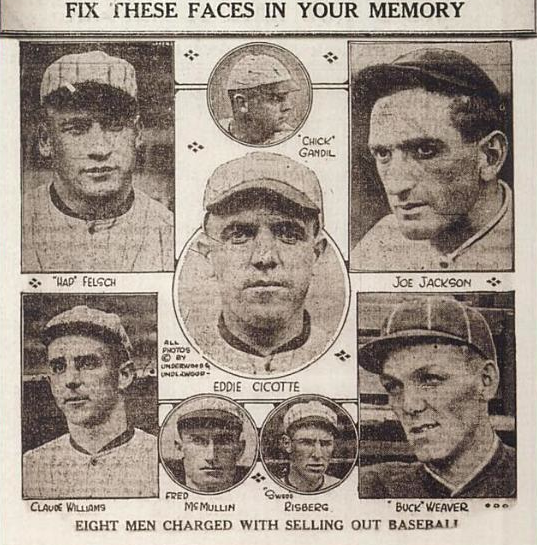
The Game 1 starter for the White Sox is knuckleballer Eddie Cicotte. The 1st batter for the Reds is 2nd baseman Morrie Rath. Cicotte, not known as a dirty pitcher, but who had taken $10,000 (about $164,000 in today's money) from gamblers the night before, throws a strike with his 1st pitch, but hits Rath with his 2nd. This is the signal to the gamblers, including ringleader Arnold Rothstein, that the fix to which they'd agreed is still on. (Ironically, Rath was a former White Sock.)

In the bottom of the 4th, the game is tied 1-1. So far, nothing has happened to suggest to the unaware spectator that anything is amiss. But then Cicotte melts down, and allows 5 runs. The Reds win, 9-1, and the "upset" is on, as is what became known as the Black Sox Scandal.
Redland/Crosley Field, in its 1912-37 configuration

October 2: Game 2 in Cincinnati. The Reds beat the White Sox 4-2, to go up 2 games to none. Sox pitcher Claude "Lefty" Williams, just as suddenly as had Cicotte the day before, goes from very effective to a meltdown. He holds the Reds scoreless for the 1st 3 innings, but in the 4th, he walks 3 batters, gives up a single to Roush, and then a triple to Larry Kopf.

After the game, Sox manager William "Kid" Gleason tells team owner Charlie Comiskey that he's suspicious of his players. But Comiskey has been feuding with his old friend Ban Johnson, President of the American League, with the 2 men having founded the League. So Comiskey goes to National League President John Heydler. Heydler tells Johnson about Gleason's suspicions. But Johnson does nothing about it, thinking people will see it as a vengeful act against Comiskey.

Gleason is not the only one who is suspicious: Hugh Fullerton of the Chicago Herald-Examiner, and his protégé, Ring Lardner of the Chicago Tribune, make note of some questionable plays. So does former Giants pitcher Christy Mathewson, covering the Series for a national newspaper syndicate.

October 3: Game 3, at Comiskey Park in Chicago. It's 289 miles between the ballparks, but there is no day off for travel, and the teams traveled by train, not plane. Rookie lefthander Dickie Kerr seems to show no effects of either the traveling, the lack of rest, or his teammates' treachery. He pitches a 3-hit shutout, left fielder Joe Jackson gets 2 hits, and 1st baseman Arnold "Chick" Gandil gets 2 RBIs.
Comiskey Park, in its 1910-26 configuration

The White Sox win, 3-0, and close the Reds' lead to 2 games to 1. Jackson and Gandil were in on the fix, but Kerr was not.

Adolfo "Dolf" Luque, the Reds' Cuban pitcher, pitches in relief, and thus becomes the 1st Latin American player to appear in a World Series game. He pitches a scoreless 8th inning.

Joseph Jefferson Jackson had become known as "Shoeless Joe" because of an incident in a minor league game. The shoes he'd been given were too tight, so he took them off in the outfield. He was a farmboy from the Appalachian western region of South Carolina, and had never learned how to read. He knew he had to learn how to sign his name, to give kids autographs, but he got around his illiteracy by having his wife order for him in restaurants.

He could "read" pitchers, though. Babe Ruth supposedly modeled his lefthanded swing after Jackson's. At the close of the 1920 season, just 33 years old, he had a .356 lifetime batting average (still the 3rd-highest ever), a whopping 170 OPS+, and 1,772 hits, including 307 doubles, 168 triples and 54 home runs. What would later be known as the 3,000 Hit Club was within reach for him.

He was also a good baserunner, having stolen 202 bases. How good a fielder was he? Ty Cobb called him the greatest left fielder he'd ever seen, and his glove "the place where triples go to die."

There was no Baseball Hall of Fame yet, but Shoeless Joe seemed to be on his way. None of the other players implicated in the scandal were likely to make it, though.

October 4: Game 4 in Chicago. Cicotte, in on the fix, didn't want to look as bad as he had in Game 1, so he could throw off suspicion. He and Jimmy Ring trade goose eggs for 4 innings. But in the 5th, Cicotte makes a bad throw of a comebacker. Jackson makes a run-allowing error on the next play. The Reds beat the White Sox 3-1, and take a 3-1 lead in the Series.

After the game, Joseph J. "Sport" Sullivan, the Boston bookmaker who helped Rothstein put the fix together, gives $20,000 to Gandil, who splits it equally among the 2 men who'd led the fix from the players' side, shortstop Charles "Swede" Risberg, center fielder Oscar "Happy" Felsch, and the next day's starter, Williams.

Allegedly, Cicotte had a good reason for getting in on the fix. Comiskey had promised him a $10,000 bonus if he won 30 games in the 1919 season. He got to 29, and then the ever-cheap Comiskey ordered Gleason to not pitch Cicotte again.

This wasn't true. Cicotte did win 29 games, but Gleason did start him again, and he was unable to win the 30th: He won his 29th on September 19, he was taken out after allowing 5 runs in 7 innings in a game the White Sox came back to win on September 24, and got knocked out of the box after 3 innings on September 28. Yet the story persists, because it's emblematic of Comiskey's cheapness. It got into the 1988 movie version of Eliot Asinof's 1963 book about the scandal, Eight Men Out.

There were 2 starts that Cicotte could have made between September 5 and 19, but didn't. I can't find an explanation for that. But he definitely was not held out once he won his 29th.

There is a story about Comiskey's cheapness that is absolutely true. In 1917, the White Sox won the World Series, but throughout the year, their uniforms seemed to get dirtier and dirtier, because Comiskey wouldn't pay to have them washed on the road. Hence, the term "Black Sox" referred not to the scandal that would later be attached to them, but to their dirty uniforms.

My grandmother, who grew up in Queens in the 1930s, knew that (with help from her and my Bronx native Yankee Fan grandfather) my knowledge of baseball history was encyclopedic, and asked me where the Black Sox name came from.

She was a Brooklyn Dodger fan, so she knew the National League cold, and knew that her team's name came from Brooklynites being called "trolley dodgers." But she did not know the lore of the American League. Until she asked me, she literally thought the team was officially called the Black Sox, and then changed to "White Sox" to clean their image up after the scandal.

I had to tell her that it was totally the opposite: Chicago teams had been called the "White Stockings" going back to the dawn of professional baseball in the 1870s, as a contrast to the Cincinnati and Boston teams being known as the Red Stockings, and that the AL team took the White Stockings name after the NL team became the Colts in 1890 (and eventually the Cubs in 1903), and that the Black Sox name was a nickname, and then came the scandal.

October 6: Game 5 in Chicago, following a Sunday rainout. Reds pitcher Horace "Hod" Eller pitches a 3-hit shutout. In the 2nd and 3rd innings, he strikes out 6 players in a row: Gandil, Risberg, Ray Schalk, opposing pitcher Williams, Harry "Nemo" Leibold and Eddie Collins.

In addition, the Reds score 4 runs in the 6th on, among other things, bad throws by Jackson and Felsch. Schalk is not in on the fix, but he does the kind of thing that could have gotten him suspected: He gets thrown out of the game for arguing a safe call on a slide into the plate by the Reds' Henry "Heinie" Groh.

The Reds win, 5-0, and go up 4 games to 1 in this best-5-out-of-9 Series. One more win, and the Reds take the title.

So of the 7 players in on the fix, 5 appeared in this game, and all had something to do with the defeat.

Collins, formerly a star with the Philadelphia Athletics, was not in on the fix. He remains one of the greatest 2nd basemen who ever lived, and is in the Baseball Hall of Fame.

Schalk is in the Hall as well, because he is considered one of the best-fielding catchers who ever lived. But his .253 lifetime batting average is the lowest for any player in the Hall not generally considered a pitcher. It is suspected that he was elected because he refused to go in on the fix. Did he actively refuse? There's no known record of him being asked.

One player who was asked, but refused, was 3rd baseman George "Buck" Weaver. He didn't think the gamblers who were setting the fix up could be trusted. But he also didn't report what he knew. And this would be his downfall.

Fred McMullin, a utility infielder, had overheard Gandil and Felsch discussing the fix, and he wanted in. Since the White Sox clinched the Pennant with a few games to spare, he could be sent to Cincinnati to scout the Reds, and so, even though he wouldn't get much playing time in the Series, he could tell the players on the take how best to take advantage of the Reds' tendencies.

On the train back to Cincinnati, Lardner vents his spleen at the White Sox. To the tune of one of the biggest hits of the year, "I'm Forever Blowing Bubbles" -- later to become the unofficial theme song of London soccer team West Ham United -- he sings:

I'm forever blowing ballgames
Pretty ballgames in the air
I come from Chi
I hardly try
Just go to bat
and fade and die
Fortune's coming my way
that's why I don't care
I'm forever blowing ballgames
and the gamblers treat us fair.

The scene would be recreated in the film version of Eight Men Out, with John Sayles directing, and also playing Lardner.

October 7: Game 6 in Cincinnati. The White Sox must win 4 straight to win the Series. Risberg makes 2 errors, and Felsch makes 1, holding up their end of their corrupt bargain. But Jackson and Weaver combine for 7 hits. Kerr, who had won Game 3, wins again, as the White Sox top the Reds 4-0.

Years later, Gandil said, "The eight of us did our best to lose it, but little Dickie Kerr did his best to win it."

October 8: Game 7 in Cincinnati. The White Sox are playing like they mean it. The supposedly tainted Jackson and Felsch each drive in 2 runs, and the supposedly tainted Cicotte pitches well. Meanwhile, uncharacteristically, the Reds make 4 errors. The White Sox win, 4-1, and close to within 4 games to 3.

All the White Sox need to do now is win the next 2, both at Comiskey Park. Is this thing on the level after all? Or have the guilty Sox players abandoned the fix? Or... are the Reds now on the take, too?

After the game -- all day games, as the Reds will be the 1st team to introduce night games in the major leagues, but not until 1935 -- the teams take trains to Chicago. At his home, Williams receives a visitor, telling him he had better lose Game 8, or else his family will be harmed. The gamblers are taking no chances. They've got too much money invested in a Cincinnati victory.

October 9: Game 8 at Comiskey Park. The Reds defeat the White Sox, 10-5, taking the best-5-out-of-9 World Series. It is the 1st World Championship for Cincinnati – or, at least, the 1st since the unofficial one for the Cincinnati Red Stockings, the 1st openly professional baseball team, in 1869, half a century earlier. (If that anniversary had been observed in Cincinnati, it wasn't mentioned in most of the books about the 1919 season. It was observed on the 100th Anniversary in 1969 and the 150th in 2019.)

Williams gets just 1 man out in the 1st before departing, having allowed 4 runs. The Reds go on to give Eller plenty of offense. Jackson hits the only home run of the Series. Collins' 3 hits give him a total of 42 in Series play‚ a record broken in 1930 by Frank Frisch‚ and bettered by Lou Gehrig in 1938. A stolen base by Collins is his 14th in Series competition‚ a record tied by Lou Brock in 1968, but still not broken to this day.

On September 28, 1920, with the White Sox, the Cleveland Indians, and the New York Yankees in a 3-way dogfight for the Pennant, the 7 Chicago players who were in on the fix were indicted for conspiracy to throw the Series. So was Weaver, who refused to take part, but was indicted because he knew about it and refused to report it.

On July 28, 1921, a Chicago jury acquitted the 8 players of conspiracy to defraud, because there wasn't enough evidence for a conviction. But on August 2, Kenesaw Mountain Landis, a Chicago-based former federal Judge who had been appointed Commissioner of Baseball by the team owners to help re-establish the sport's credibility, banned them all from participation in the sport, at either the major or the minor league level -- permanently.

For the rest of their lives, Roush, the last survivor (he lived until 1988), and the other 1919 Reds insisted that, if the Series had been on the up-and-up, they would have won anyway.

Really? Here's something else to consider: Down 4 games to 1 in that best-5-out-of-9, the Sox won Games 6 and 7, playing to win because the gamblers hadn't come through with their payments, and Williams only caved in for Game 8 because his family had been threatened if he did not comply. Williams was 0-3 for the Series, a record not "achieved" honestly until 1981 and George Frazier of the Yankees.

It's been said that Babe Ruth and his home runs "saved baseball after the Black Sox Scandal." This is ridiculous. Ruth was hitting home runs like crazy all season long in 1920, and attendance remained higher throughout the "Roaring Twenties" than it was in the years before America entered World War I. Babe's homers didn't save baseball after the scandal, but they may have helped cover it up.

What happened to the 8 banned players?

* Shoeless Joe Jackson played with and managed some semi-professional teams, not under the jurisdiction of "organized ball" and Judge Landis. (Landis was usually referred to by his former title of "Judge," instead of "Commissioner," and he liked it like that.) He later ran a drycleaning business, a barbecue restaurant, and a liquor store. In 1951, he suffered a heart attack, and died at age 64.

He was played by D.B. Sweeney in the 1988 film version of Eight Men Out, and Ray Liotta in the 1989 film Field of Dreams, based on W.P. Kinsella's 1982 novel Shoeless Joe.

* Fred McMullin, ironically, went into law enforcement, being named a Deputy Marshal in Los Angeles County in California in 1940. But high blood pressure led to a fatal stroke in 1952, at age 61. He was played by Perry Lang in EMO, but the actor playing him in FOD was not credited.

* Buck Weaver remained in Chicago, and continued to press his case for reinstatement, not because he felt the need to play again, but because he wanted his name officially cleared, not just by the court (as it had already been), but by baseball itself. He died of a heart attack in 1956, at 65. His family continues to appeal on his behalf, so far without success. He was played by John Cusack in EMO, and Michael Milhoan in FOD.

* Lefty Williams played in outlaw leagues, outside Landis' jurisdiction, then operated a garden nursery business outside Los Angeles. He died from the effects of years of heavy drinking, at 66, in 1959, 40 years after the Series in question, and the year the White Sox finally won their next Pennant. He was played by James Read in EMO, but the actor playing him in FOD was not credited.

* Happy Felsch played semi-pro ball in the west of America and Canada for another 15 years, before returning to his native Milwaukee, opening a grocery store and a series of bars. Apparently, he sampled his own product more than he should, because it died of liver failure, in 1964, shortly before turning 73. He was played by Charlie Sheen (perhaps appropriately) in EMO, but the actor playing him in FOD was not credited.

* Eddie Cicotte returned to Michigan, managed a service station, served as a game warden, worked for Ford Motor Company, and ran a farm outside Detroit. He died in 1969, at 84. He was played by David Strathairn in EMO and Steve Eastin in FOD.

* Chick Gandil had little to lose: He had already decided to leave organized ball, and returned to California, where he played semi-pro ball on a team with Jackson, Risberg, McMullin, and another player banned due to his connection to the scandal, Joe Gedeon of the St. Louis Browns. In 1925, he played in Arizona with some banned players, including Hal Chase, a former Yankee 1st baseman known for great fielding but also for throwing games.

Gandil gave an interview to Sports Illustrated in 1956, admitting to being the scandal's ringleader, expressing regret for it, and agreeing that he and the others deserved to be banned. He died of heart trouble in 1970, at 82. He was played by Michael Rookier in EMO and Art LaFleur in FOD. (LaFleur would later play the ghost of Babe Ruth in The Sandlot).

* Swede Risberg also played semi-pro baseball, including in 1922 in Minnesota on a team with Felsch and Williams. He returned to his native Northern California, worked on a dairy farm, and later ran a tavern and a lumber business. He was the last survivor, dying on his 81st birthday, October 13, 1975. He was played by Don Harvey in EMO, and Charles Hoyes in FOD.

It is arguable that the 2 most famous World Series of them all have been those of 1919, in which Risberg was heavily involved in the fix;and 1975, during which Risberg died -- and the Cincinnati Reds won them both, in each case under controversial circumstances. (At your own peril, ask a Red Sox fan about 1975 Game 3.)

Trust me on this one: If you want to get closer to the facts of the case, see the film Eight Men Out; but if you want to see a movie that makes you feel good, see the factually-challenged but beautiful
Field of Dreams.

UPDATE: The Reds have a team Hall of Fame. Elected from this 1919 team have been 1st baseman Jake Daubert, shortstop Larry Kopf, 3rd baseman Henry "Heinie" Groh, left fielder Raymond "Rube" Bressler, center fielder Edd Roush, Cuban pitcher Adolfo "Dolf" Luque, and team president August Herrmann.

From the 1920s, they have inducted catcher Eugene "Bubbles" Hargrave, 2nd baseman Hughie Critz; and pitchers Eppa Rixey, Pete Donohue and Charles "Red" Lucas.

*

October 9, 1919 was a Thursday. The NFL and NBA hadn't been founded yet, and it was too soon for the NHL season. So there were no other scores on this historic day.

Saturday, October 1, 2022

October 2, 1919: President Woodrow Wilson's Stroke

October 2, 1919: President Woodrow Wilson suffers a stroke at the White House. He had been traveling around America by train, trying to lobby people to contact their State's U.S. Senators, and have them approve the Treaty of Versailles, allowing America into the League of Nations, thus making America part of the effort to preserve peace following the recently-won World War. But he had run himself ragged, and his wife Edith saw he wasn't well, and ordered their return to Washington. It wasn't soon enough, and he has the stroke on this day.

Wilson was paralyzed on his left side, and nearly blinded. His inner circle concealed the extent of his impairment, and Edith and his private secretary, Joseph Tumulty, controlled who could see him and with what he would be presented in terms of official business. For this reason, Edith Wilson has been called "the 1st female President of the United States." It would be much fairer to say that she was the 1st female White House Chief of Staff. In real life, through October 2, 2022, neither of those positions has ever been held by a woman.
The 28th 1/2 President of the United States?

Wilson's stroke left him both physically and politically paralyzed. But he refused to resign and let Vice President Thomas R. Marshall take the job, due to an intense personal dislike for him that both he and Edith had developed. With no law in place to cover a living but incapacitated President at the time -- the 25th Amendment was ratified in 1967 -- for all intents and purposes, for nearly a year and a half, at a time when the nation really could have used some leadership, it had no functioning President.

Wilson recovered somewhat between the stroke and leaving office on March 4, 1921. He became the only former President to establish a permanent residence in Washington, D.C. after leaving the White House. He died on February 3, 1924, saying, "The machinery is worn out." He spoke just one more word, calling out, "Edith!"

She lived on as a Washington society matron, dying on December 28, 1961 -- the 105th anniversary of her husband's birth, and a few hours before she was scheduled to attend the dedication of a bridge named for him, carrying Interstates 95 and 495, the Capital Beltway, over the Potomac River, south of the city.

*

October 2, 1919 was a Thursday. There was only one score on this historic day, and it was in Game 2 of the World Series, at Redland Field in Cincinnati. (It was renamed Crosley Field in 1934.) The Cincinnati Reds beat the White Sox 4-2, to go up 2 games to none. Sox pitcher Lefty Williams holds the Reds scoreless for 3 innings, but in the 4th, he walks 3 batters, gives up a single to Edd Roush, and then a triple to Larry Kopf.

Sox manager Kid Gleason tells owner Charlie Comiskey that he's suspicious of his players. But Comiskey has been feuding with his old friend Ban Johnson, President of the American League, with the 2 men having founded the League. So Comiskey goes to National League President John Heydler. Heydler tells Johnson about Gleason's suspicions. But Johnson does nothing about it, thinking people will see it as a vengeful act against Comiskey.

Gleason is not the only one who is suspicious: Hugh Fullerton of the Chicago Herald-Examiner, and his protégé, Ring Lardner of the Chicago Tribune, make note of some questionable plays. So does former Giants pitcher Christy Mathewson, covering the Series for a national newspaper syndicate.

Friday, September 30, 2022

September 30, 1919: The Elaine Massacre

September 30, 1919: The Elaine Massacre begins in Elaine, Arkansas, and continues over the next 2 days. It was part of a year of civil rights abuses in America.

African Americans were organizing against peonage and abuses in tenant farming. The white mobs that attacked them were aided by federal troops, requested by Governor Charles H. Brough of Arkansas, and local terrorist organizations. Gov. Brough led a contingent of 583 U.S. soldiers from Camp Pike, with a 12-gun machine gun battalion.

Estimates of deaths made in the immediate aftermath of the Elaine Massacre by eyewitnesses range from 50 to "more than a hundred." Walter Francis White, an NAACP attorney (and later its Director) who visited Elaine shortly after the incident, stated "... twenty-five Negroes killed, although some place the Negro fatalities as high as one hundred." More recent estimates in the 21st Century of the number of black people killed during this violence are higher than estimates provided by the eyewitnesses, and have ranged into the hundreds.

According to The Encyclopedia of Arkansas, "The Elaine Massacre was by far the deadliest racial confrontation in Arkansas history and possibly the bloodiest racial conflict in the history of the United States."

After the massacre, state officials concocted an elaborate cover-up, claiming that blacks were planning an insurrection. National newspapers repeated this falsehood. A New York Times headline read, "Planned Massacre of Whites Todaym", and the Arkansas Gazette (the leading newspaper in the State) wrote that Elaine was "a zone of negro insurrection."

Subsequent to this reporting, more than 100 African Americans were indicted, with 12 being sentenced to death by electrocution. After a years-long legal battle by the NAACP, the 12 men were acquitted.

Because of the widespread racial violence during the "Red Summer" of 1919, the Equal Justice Initiative of Montgomery, Alabama classified the black deaths at Elaine as lynchings in its 2015 report on the lynching of African-Americans in the South.

*

September 30, 1919 was a Tuesday. There were no scores on this historic day: Baseball's World Series began the next day, and it became the most controversial World Series of all time.

Saturday, September 24, 2022

September 24, 1919: The Cicotte Betrayal (That Never Happened) & the Ruth Record

Eddie Cicotte

September 24, 1919: The Chicago White Sox beat the St. Louis Browns, 6-5 at Comiskey Park, and clinch their 2nd American League Pennant in the last 3 years. They come back from a 5-2 deficit, capped by "Shoeless" Joe Jackson letting loose a drive that could have been a triple, had the Sox not needed only the one base of Nemo Leibold scoring from 3rd.

Legend has it that the biggest reason the 8 players later banned for life, including Jackson and Ed Cicotte, took money to throw the World Series is that team owner Charlie Comiskey promised Cicotte a bonus of $10,000 -- about $166,000 in 2022 money -- if he won 30 games this season, then ordered manager William "Kid" Gleason to hold Cicotte out of games after the 29th win, so Comiskey wouldn't have to pay up.

In fact, no evidence has ever been found that the promise was made. Cicotte came into this game with 29 wins, but was losing when Gleason took him out. And Gleason gave Cicotte his last regularly-scheduled start, 4 days later, at home to the Detroit Tigers, but he only lasted 2 innings. It sounds like, if you want to blame anyone for Cicotte not winning 30 games that season, you should blame Cicotte himself first, and Gleason second.

Also on this day, the New York Yankees split a doubleheader with the Boston Red Sox at the Polo Grounds. In the opener, "Sad Sam" Jones pitched a 5-hit shutout, and the Sox won, 4-0.

In the nightcap, the Yankees won 2-1. The only Boston run came in the 9th inning, when Babe Ruth hit a home run over the right field roof, at least the 2nd time he'd done that at the Polo Grounds. It was his 28th home run of the season, a new record. Ned Williamson had hit 27 for the 1884 Chicago White Stockings (forerunners of the Cubs). But the Yankees won the game in the bottom of the 13th, when Wally Pipp hit a leadoff triple against Waite Hoyt, and then Del Pratt hit a sacrifice fly to bring him home. Hoyt had pitched all 13 innings, as had Yankee starter Bob Shawkey.
Ruth, of course, would soon become a Yankee. So would Jones, and Hoyt, and current Sox pitchers Herb Pennock and "Bullet Joe" Bush. The value of the pitchers who went from the Sox to the Yanks was more important in the 1910s Boston dynasty becoming the 1920s New York dynasty than Ruth.

*

September 24, 1919 was a Wednesday. These other baseball games were played that day:

* A doubleheader was split at Braves Field in Boston. The New York Giants won the 1st game, 6-1. Jesse Barnes won his 24th game of the season. The Boston Braves won the 2nd game, 3-2. Tony Boeckel singled Dorsey "Dixie" Carroll home with the winning run in the bottom of the 10th inning.

Over the 2 games, Frankie Frisch went 2-for-9, Ross Youngs went 2-for-7 with 2 walks and an RBI, and George "High Pockets" Kelly went 3-for-8 with an RBI. Art Fletcher went 4-for-5 in the 1st game, but did not play in the 2nd game.

* The Brooklyn Robins, as the Dodgers were known while Wilbert Robinson managed them from 1914 to 1931, swept a doubleheader from the Philadelphia Phillies, 4-1 and 14-7 at Baker Bowl in Philadelphia. Over the 2 games, Zack Wheat went 3-for-9 with a walk and 4 RBIs.

* The Detroit Tigers beat the Cleveland Indians, 4-1 at Navin Field (later renamed Briggs Stadium and Tiger Stadium) in Detroit. Hubert "Dutch" Leonard outpitched Jim Bagby Sr. Ty Cobb went 1-for-4 with an RBI. Tris Speaker went 0-for-3 with a walk.

* And the Chicago Cubs, the Cincinnati Reds, the Philadelphia Athletics, the Pittsburgh Pirates, the St. Louis Cardinals and the Washington Senators were not scheduled.

Wednesday, September 14, 2022

September 14, 1919: The Debut of the Green Bay Packers

Curly Lambeau

September 14, 1919: The football team of the Indian Packing Company of Green Bay, Wisconsin, coached and captained by local hero and former University of Notre Dame quarterback Earl "Curly" Lambeau, a Green Bay native, defeats the Menominee North End Athletic Club, 53-0 at Hagemeister Park.
Thus debuted the team that would come to be known as the Green Bay Packers, the most successful team in the history of professional football, with 13 NFL Championships.

Because they were made up of co-workers, the Packers were a "company team," or what the British would call a "works side." This would also be true of the team that would become their arch-rivals, the Chicago Bears, who began the following season as the Decatur Staleys, representing the A.E. Staley Starch Company of Decatur, Illinois.

The Staleys/Bears, run by George Halas, were a founding team of the NFL in 1920. The Packers were not, but joined in 1921. The Packers won the NFL Championship in the single-division, no-playoff era, 3 straight times: 1929, 1930 and 1931. They won the NFL Championship Game in 1936, 1939, 1944, 1961, 1962, 1965, 1966 and 1967, meaning they won 3 straight NFL Championships for a 2nd time. No other franchise has done this. Vince Lombardi coached them to those last 5 titles. They also lost NFL Championship Games in 1938 and 1960.

Those last 2 titles, 1966 and 1967, were won by defeating the Dallas Cowboys, the former on New Year's Day 1967 at the Cotton Bowl in Dallas, the latter on New Year's Eve 1967, in frigid conditions that got the game nicknamed "The Ice Bowl."

That game was played at their new stadium, built in 1957, which, like its predecessor, was named Green Bay City Stadium. Curly Lambeau, who played for them from 1919 to 1929, coached them from 1920 to 1949, and later coached the Chicago Cardinals and the Washington Redskins, died before the 1965 season. In his memory, the 2nd City Stadium was then renamed Lambeau Field.
Statue of Lambeau outside the stadium

Those last 2 NFL titles sent the Packers to the games that would retroactively be named the 1st 2 Super Bowls, and they won both. After a long down period, they won Super Bowl XXXI in 1997, and lost Super Bowl XXXII in 1998, both under head coach Mike Holmgren. They have usually been at least competitive since. In 2011, they won Super Bowl XLV, under head coach Mike McCarthy.

Because Green Bay is a small city -- population 62,888, according to a sign shown in a 1967 NFL Films documentary, and 107,395 according to the 2020 Census -- the Packers often played regular-season games in Milwaukee, including the 1939 NFL Championship Game at the State Fair stadium in suburban West Allis, now a racetrack known as the Milwaukee Mile; and at Milwaukee County Stadium, home of baseball's Braves and later the Brewers.

They stopped doing this in 1994, as Lambeau Field had been expanded to be bigger than County Stadium, and it had become more costly to move everything from one "home field" to another and back than it did to stage the games in the much bigger city.

Green Bay is the only one of the NFL's early small cities to survive -- R.I.P. Providence, Rhode Island; Hartford, Connecticut; Rochester, New York; Pottsville, Pennsylvania; Canton, Massillon and Dayton, Ohio; Muncie and Hammond, Indiana; Decatur and Rock Island, Illinois; Racine, Wisconsin; and Duluth, Minnesota.

How? Halas, despite his rivalry with Lambeau, stepped in to use his influence to keep the Packers in the League. And the NFL's TV revenue-sharing agreement means that the Packers can compete on an even level with big cities like New York, Chicago and Los Angeles. Without that, most likely, the Packers would have begun "groundsharing" with the Brewers at the Milwaukee domed stadium now named American Family Field.

Since the team now known as the Arizona Cardinals, despite claiming an official connection to a Chicago athletic club that began playing professional football in 1898, hasn't played continuously since then, the Packers are officially the NFL's oldest franchise, older than the NFL itself. And their rivalry with the Bears is the NFL's oldest, and probably its best, helping to give first the NFC Central Division (1970-2001), then the NFC North Division, the nickname "The Black and Blue Division."

Interestingly, while the Packers named their stadium for Lambeau, and dedicated a statue of him outside (along with one of Lombardi), they have never retired his Number 20.

*

September 14, 1919 was a Sunday. Because the Commonwealths of Massachusetts and Pennsylvania still prohibited professional sports on Sunday, it was difficult for pro football leagues to gain traction, prior to the NFL's founding the next season. And some baseball teams were forced to take the day off. But these baseball games were played that day:

* The New York Yankees beat the St. Louis Browns, 8-1 at the Polo Grounds. The newly-acquired Carl Mays went the distance for the win. Wally Pipp hit a home run. George Sisler went 0-for-4 for the Browns.

* The New York Giants lost to the St. Louis Cardinals, 3-1 at Robison Field in St. Louis. Rogers Hornsby went 1-for-4. The Giants got only 4 hits, 2 by Art Fletcher.

* The Detroit Tigers beat the Washington Senators, 9-4 at National Park (later renamed Griffith Stadium) in Washington. Ty Cobb went 2-for-3 with 2 walks, a stolen base, and 2 RBIs. Harry Heilmann went 4-for-5 with 2 RBIs.

* The Cincinnati Reds beat the Boston Braves, 1-0 at Redland Field (later renamed Crosley Field) in Cincinnati. Ray Fisher pitched a 6-hit shutout. Edd Roush, the Hall of Fame center fielder about to lead the Reds to a World Series win over the Chicago White Sox -- and he insisted until his death that the Reds would have won even if the White Sox had played on the level -- went 4-for-4.

* And the Chicago Cubs beat the Philadelphia Phillies, 4-0 at Weeghman Park -- later renamed Cubs Park and Wrigley Field -- in Chicago. Elwood "Speed" Martin allowed the Phils 10 hits, but kept the shutout.

Saturday, September 10, 2022

August 24, 1919: Ray Caldwell Is Struck By Lightning -- and Wins

Ray Caldwell, 1920. The mourning band
was for teammate Ray Chapman.

August 24, 1919: A major-league baseball player is struck by lightning during a game. If this were to happen today, even if the player survived, the umpires would suspend the game immediately.

They did not do so on this occasion. The player lived -- and won the game.

A native of Salamanca, New York, Ray Caldwell pitched for the New York Yankees from 1910 to 1918. In 1919, the Cleveland Indians acquired him. On August 24, he started against the Philadelphia Athletics at League Park in Cleveland. The Indians scored 2 runs in the bottom of the 4th, and the A's pulled 1 back in the top of the 5th. In the 8th, Caldwell helped his own cause with a hit, but was stranded.

Storm clouds rolled in, but it looked like Caldwell would finish the game off before the rain started. He got the 1st 2 outs in the top of the 9th. Joe Dugan, later to be the shortstop on the Yankee Pennant-winners of the late 1920s, was the batter. Suddenly, Caldwell was struck by a bolt of lightning, knocking him unconscious.

Incredibly, he wasn't hurt. He regained consciousness, and got Dugan to ground out to 3rd to end the game: Indians 2, Athletics 1.

He did not miss a start. On August 29, he went the distance in a loss to the Chicago White Sox. After that, he missed a start, but on September 10, he pitched a no-hitter against the Yankees at the Polo Grounds. In a span of just 17 days, he went from getting struck by lightning to pitching a no-hitter. And managers and general managers "baby" today's pitchers.

Lightning didn't stop Ray Caldwell. Alcohol did. He helped the Indians win the 1920 World Series, going 20-10, but had a poor season in 1921, and was released, having pitched his last major league game at age 33. Because of his reputation as an unreliable boozer, no major league team would sign him.

He hung on in the minor leagues until he was 45 years old, famously pitching the Birmingham Barons to the 1931 Southern Association Pennant, and then, at 43, outpitching Dizzy Dean, then the 21-year-old ace of the Texas League Pennant-winners, the Houston Buffaloes, to win the Dixie Series. In the major leagues, his career record was 134-120; counting the minors, his pro record was 293-267.

He became a bartender at a country club, marrying the cook, and lived until 1967.

*

August 24, 1919 was a Sunday. At this time, in Massachusetts and Pennsylvania, home to 5 major-league baseball teams between them, it was still illegal to play professional sports on a Sunday. These other games were played that day:

* The New York Yankees lost to the Chicago White Sox, 4-1 at Comiskey Park in Chicago. Lefty Williams won his 20th game of the season. Shoeless Joe Jackson went 2-for-2 with 2 walks and an RBI. Both would be involved in the upcoming World Series fix. Eddie Collins, not involved but an all-time great, went 1-for-2 with a walk.

* The New York Giants beat the Pittsburgh Pirates, 1-0 at the Polo Grounds. Fred Toney, who had pitched one side of MLB's only double no-hitter with the 1917 Reds, and Hal Carlson both pitched goose eggs into the bottom of the 10th. That's when Heinie Zimmerman led off with a double off Carlson. Frankie Frisch grounded to Pirate 1st baseman George Whitted, who made a bad throw to Toney covering, that Zimmerman scored the winning and only run.

* The Brooklyn Robins -- as the Dodgers were known when Wilbert Robinson managed them from 1914 to 1931 -- beat the St. Louis Cardinals, 10-1 at Ebbets Field.

* The Boston Red Sox beat the Detroit Tigers, 8-7 at Navin Field in Detroit. (It would later be renamed Briggs Stadium and Tiger Stadium.) The Tigers led 5-4 going into the 9th, but the Sox tied it. The Sox scored 3 in the top of the 11th, and the Tigers could only come back with 2 in the bottom half. Babe Ruth went 3-for-5 with 2 home runs and 4 RBIs, including the winning run on a single in the 11th. Ty Cobb went 1-for-5.

* The Washington Senators beat the St. Louis Browns, 5-0 at Sportsman's Park in St. Louis. Tom Zachary pitched the 1st 6 2/3rds innings, allowing 6 hits, for the win. Walter Johnson went the rest of the way, allowing 2 hits, and earning the save, not that anybody knew what a save was at the time. George Sisler was available for the Browns, but did not play.

* The Boston Braves and the Chicago Cubs interrupted their series at Braves Field in Boston, because it was Sunday. And the Cincinnati Reds and the Philadelphia Phillies interrupted their series at Baker Bowl in Philadelphia, for the same reason.

Thursday, August 18, 2022

August 18, 1919: "The Marines' Hymn" Is Copyrighted

August 18, 1919: "The Marines' Hymn" is copyrighted, by The Leatherneck, the official magazine of the United States Marine Corps. It is the oldest official song in the United States Armed Forces.

In 1859, Geneviève de Brabant, an opera by Jacques Offenbach, premiered in Paris. In 1867, Offenbach revised it. Among the pieces in the revival's Act II is "The Gendarmes' Duet." Later that year, Francesco Maria Scala was the Director of the United States Marine Band. He had the Band play "The Gendarmes' Duet." Let's just say it sounds a bit different in "translation" from opera buffa to military march.

At some point between then and 1929, lyrics were added by an unknown author. In 1929, General Wendell Neville, then the Commandant of the Marine Corps, authorized this combination of lyrics and music as the Corps' official song. This makes "The Marines' Hymn" the oldest official song in the United States Armed Forces.

The Hymn's opening line is familiar to most Americans: "From the Halls of Montezuma, to the shores of Tripoli." This refers to a pair of early battles with significance in Marine history, albeit in reverse chronological order.

Marines fought at the Battle of Derna, in the Spring of 1805, as part of the First Barbary War, in present-day Libya, whose capital, then as now, was Tripoli. In the Mexican-American War, the Battle of Chapultepec was fought on September 12 and 13, 1847. Marines stormed Chapultepec Castle in Mexico City, taking heavy losses, but also insuring that the war would be won by U.S. troops. The term "Halls of Montezuma" is poetic license: Montezuma and his Aztec Empire fell over 250 years before construction began on Chapultepec Castle.

*

August 18, 1919 was a Monday. Wally Hickel, who was Governor of Alaska in the 1960s and again in the 1990s, was born on this day.

These baseball games were played:

* The New York Yankees lost to the Cleveland Indians, 2-1 at League Park in Cleveland. Jim Bagby Sr. outpitched Carl Mays. Tris Speaker went 0-for-4. Both Cleveland runs were driven in by a double in the 8th inning, by Ray Chapman. Almost exactly 1 year later, Chapman would bat against Mays again, with tragic results.

* The Boston Braves and the St. Louis Cardinals were tied, 1-1 after 10 innings at Braves Field in Boston, when the game was called due to darkness.

* The Pittsburgh Pirates beat the Philadelphia Phillies, 3-2 at Baker Bowl in Philadelphia. Carson Bigbee won the game with a home run in the top of the 13th inning.

* The Detroit Tigers beat the Washington Senators, 4-3 at Navin Field (later Briggs Stadium and Tiger Stadium) in Detroit. Ty Cobb went 1-for-3 with a walk.

* The Chicago White Sox beat the Philadelphia Athletics, 11-6 at Comiskey Park in Chicago. Eddie Collins went 1-for-3 with 2 stolen bases and an RBI. "Shoeless" Joe Jackson went 3-for-5 with 2 RBIs. Chick Gandil went 4-for-4 with an RBI. Games like this were why so many people thought the White Sox were better than the team they ended up playing in the World Series, the Cincinnati Reds.

* The St. Louis Browns beat the Boston Red Sox, 4-3 at Sportsman's Park in St. Louis. George Sisler went 2-for-3 with an RBI. Babe Ruth went 1-for-2 with a walk.
 
* Both of the New York City teams in the National League got rained out, and made up their games the next day as part of doubleheaders. The New York Giants faced the Chicago Cubs at the Polo Grounds. The Cubs won the 1st game, 4-3. Grover Cleveland Alexander was the winning pitcher. The Giants won the 2nd game, 5-1.

* And the Brooklyn Dodgers, or the Robins as they were known under manager Wilbert Robinson, were swept by the Cincinnati Reds, 1-0 and 6-1. Jimmy Ring pitched a 3-hit shutout in the 1st game.

Saturday, July 30, 2022

July 30, 1919: The Carl Mays Trade

July 30, 1919: The Boston Red Sox trade pitcher Carl Mays to the New York Yankees for pitchers Bob McGraw and Allen Russell, and $40,000. More than any other trade in the history of the sport, this one changed the history of baseball.

McGraw, Russell and the money don’t matter for this discussion. Mays, a 27-year-old Kentuckian with a righthanded "submarine" delivery -- think 1979 Pittsburgh Pirates World Series hero Kent Tekulve, and 1980s Kansas City Royals closer Dan Quisenberry -- had already helped the Red Sox win the 1915, 1916 and 1918 World Series.

But he was a rotten guy, what we would now call "a clubhouse cancer." One teammate (I can't find a record of which one) said, "He has the disposition of a man with a permanent toothache."

Mays himself couldn't explain it: "I always have wondered why I have encountered this antipathy from so many people, wherever I have been. And I have never been able to explain it, even to myself."

While he was at Spring Training in 1919, his farm house in Missouri burned down. He believed it was arson. He began the 1919 season with a 5-11 record. In a game in Philadelphia, home fans at Shibe Park pounded on the roof of the visitors' dugout, and Mays reacted to this by getting up and throwing a ball into the stands, hitting a fan in the head.

On July 13, against the Chicago White Sox at Comiskey Park, Eddie Collins tried to steal 2nd base. Catcher Wally Schang tried to throw him out, and hit Mays in the head by mistake. When the inning ended, Mays walked off the field, walked into the clubhouse, changed his clothes, went to the train station, and headed back to Boston. He told Burt Whitman, a Boston sportswriter:

I’m convinced that it will be impossible for me to preserve my confidence in myself as a ballplayer and stay with the Red Sox as the team is now handled. The entire team is up in the air and things have gone from bad to worse. The team cannot win with me pitching, so I am getting out…

Maybe there will be a trade or a sale of my services. I do not care where I go.

His teammates had turned against him. Sox management were eager to get rid of him. The Yankees, needing pitching, were happy to make the trade.

But, because he had "jumped the club," Mays had been suspended by Red Sox owner Harry Frazee. And Byron Bancroft "Ban" Johnson, President of the American League, ruled that Mays could not be traded while he was suspended.

"Baseball cannot tolerate such a breach of discipline," Johnson said. "It was up to the owners of the Boston club to suspend Carl Mays for breaking his contract, and when they failed to do so, it is my duty as head of the American League to act."

This move by Johnson split the League. On one side: Johnson, one of its co-founders, and the "Loyal Five": The Philadelphia Athletics, owned by Benjamin Shibe and manager Connie Mack; the Cleveland Indians, owned by James Dunn; the Detroit Tigers, owned by Frank Navin; the St. Louis Browns, owned by Phil Ball; and the Washington Senators, owned by former pitching star Clark Griffith.

On the other side, the "Insurrectos," the other 3 teams: The Red Sox, owned by Frazee; the Yankees, owned by Jacob Ruppert and Tillinghast L'Hommedieu Huston; and the Chicago White Sox, owned by the AL's other co-founder, Charlie Comiskey, once Johnson's best friend, and now a bitter enemy.

The Yankees went to court, and got an injunction against Johnson's ability to prevent the trade. Mays went 9-3 the rest of the way, finishing the season 14-14. He would win 80 games for the Yankees, helping them win their 1st  Pennants and their 1st World Series.

He would also -- unintentionally, he always insisted -- become the only pitcher ever to kill an opposing batter with a pitch: On August 16, 1920, at a time when there were no batting helmets, he hit Cleveland shortstop Ray Chapman in the head. Chapman died the next day.

But the implications of this trade went beyond that. After this, the Loyal Five refused to make any deals with the Insurrectos. Those 3 teams could now only make deals with each other. And Comiskey was famously cheap, which resulted in the Black Sox Scandal. So if Frazee had to make a deal, he had to make it with Ruppert. (Huston more or less stayed out of it.)

And that's why so many of the Red Sox champions of the 1910s went to the Yankees, and helped to make their Dynasty of the 1920s. Mays was the first, and Babe Ruth would be the biggest. Pretty much everybody who has studied this period of baseball history knows that.

What they tend to overlook is what happened to the Loyal Five. Sure, the moves wrecked the Red Sox for a generation. But what did it do to the other teams? The downfall of the White Sox can be traced to the banning for life of the "Eight Men Out" during the Black Sox Scandal.

But from 1921 (after the Indians won the 1920 World Series) through 1964, while the Yankees were winning 29 Pennants in 44 years, how many did the Loyal Five win? The Tigers 4, the Athletics (moving to Kansas City in 1955 and Oakland in 1968) 3, the Senators (becoming the Minnesota Twins in 1961) 3, the Indians 2, the Browns (becoming the Baltimore Orioles in 1954) 1.

And even that wasn't the end of it. The injunction unblocking the Mays trade, combined with the Black Sox Scandal, led to the replacement of the command structure of what we would now call Major League Baseball.

Previously, the game was run by a National Commission, consisting of each League's President and a 3rd man, allegedly impartial (but still doing what the owners wanted.) Afterward, the Office of the Commissioner of Baseball was created. The League Presidents would still have power, particularly in the area of discipline, until Commissioner Bud Selig eliminated their offices in 1999. But they would never be so strong again.

The Carl Mays trade was huge, above and beyond leading to the Babe Ruth sale.

*

July 30, 1919 was a Wednesday. These baseball games were played that day:

* The New York Yankees split a doubleheader with the Chicago White Sox at the Polo Grounds, and both games went to 10 innings. The Yankees won the opener, 6-5, on a suicide squeeze bunt by James "Truck" Hannah that scored Del Pratt. Bob Shawkey went the distance for the win. Wally Pipp hit a home run.

The South Siders won the nightcap, 5-3. Buck Weaver doubled home the winning run. Over the 2 games, "Shoeless" Joe Jackson went 4-for-5 with 3 walks and an RBI, and Eddie Collins went 3-for-10.

* A doubleheader was split at Forbes Field in Pittsburgh. The New York Giants won the 1st game, 9-0. Jesse Barnes pitched a 3-hit shutout. Hal Chase went 4-for-4 with an RBI and a stolen base, unaware that, due to getting caught throwing games, he was in his last 2 months as an active player. The Pittsburgh Pirates won the 2nd game, 6-1.

* The Brooklyn Robins beat the Chicago Cubs, 6-0 at Weeghman Park in Chicago. Jeff Pfeffer allowed 9 hits, but kept the shutout. Zack Wheat went 3-for-4 with a walk and 2 RBIs. (The Dodgers were named the Robins while Wilbert Robinson was their manager, from 1914 to 1931. Weeghman Park was renamed Cubs Park in 1920, and Wrigley Field in 1926.)

* A doubleheader was split at Fenway Park in Boston. The Detroit Tigers won the 1st game, 3-1. The Boston Red Sox won the 2nd game, 3-2. Over the 2 games, Ty Cobb went 4-for-7 with 2 walks and a stolen base, and Babe Ruth went 0-for-6 with 2 walks.

* The Philadelphia Athletics beat the Cleveland Indians, 2-1 at Shibe Park in Philadelphia. Tris Speaker went 0-for-4.

* The Washington Senators beat the St. Louis Browns, 1-0 at Griffith Stadium in Washington. With 1 out in the bottom of the 9th, Sam Rice hit a triple, and Robert "Buzz" Murphy singled him home. Jim Shaw pitched a 4-hit shutout. George Sisler got 1 of those hits.

* The Cincinnati Reds beat the Boston Braves, 7-6 at Redland Field in Cincinnati. (It was renamed Crosley Field in 1934.)

* And the Philadelphia Phillies beat the St. Louis Cardinals, 3-1 at Robison Field in St. Louis. Rogers Hornsby went 0-for-4.

Monday, July 4, 2022

July 4, 1919: Jack Dempsey Says Hello

July 4, 1919: The Heavyweight Championship of the World changes hands in the most devastating fashion in its history.

The Champion was Jess Willard, from Kansas. At 6 feet, 6½ inches at 245 pounds, he was known as the "Pottawatamie Giant." He had won the title 4 years earlier, knocking out Jack Johnson, the 1st black Heavyweight Champion. He successfully defended his title against Frank Moran in 1916, before World War I prevented him from making another defense.

The war over, he was set to defend it at Bayfront Park in Toledo, Ohio, on the 4th of July. He took a 21-3-1 record into the fight. But he was 37 years old, and it was going to be hot. And his opponent...
Bayfront Park

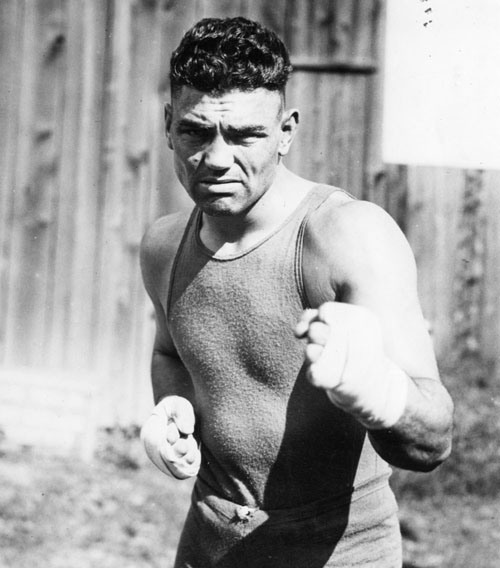
William Harrison Dempsey was 24, stood 6-foot-1 and weighed 187, and was 56-4-9. That's right: 13 years younger, and had won more than twice as many fights as Willard had fought.

He was called Jack because of an earlier fighter, former Middleweight Champion Jack "Nonpareil" Dempsey (real name John Edward Kelly, held the title from 1884 to 1891). He was from Mansassa, Colorado, and was known as the Manassa Mauler. And, because this was the 1910s, and he was a white man who nonetheless had a very dark complexion, he was called "Kid Blackie."

His last 6 fights before his title shot all ended in knockouts, all of them in the 1st round. Or, as boxing historian Bert Sugar put it, "In his last two fights before the Willard fight, Dempsey knocked his opponents out in 19 and 27 seconds. Not rounds."

But he had learned to box in hobo camps and saloons, places barely removed from the "Wild West." He hadn't fought serious contenders. Surely, a seasoned professional and a gigantic man, like Willard, would be able to handle him easily. But Lightweight Champion Benny Leonard wrote a newspaper column predicting that Dempsey would win, because, despite being smaller, he was stronger.

Leonard was right: The fight was a massacre. Dempsey knocked Willard down 7 times in the 1st round. At the time, the rules allowed the standing fighter to remain standing over the one knocked down, to wait for him to get up, and then go after him again. Dempsey took advantage of this rule.

Had current rules been in place, Willard still wouldn't have lasted much longer: Dempsey would have had to go to a neutral corner (a new rule that he forgot about in 1927, in what became known as the Long Count Fight), Willard would have been given a standing 8-count, and with the 3rd knockdown of the round, the fight would have been declared over.

Somehow, Willard got up for the 2nd and 3rd rounds, but not the 4th. Dempsey was the new Heavyweight Champion of the World, and became one of the sports icons of the 1920s. For a while, he was both loved and hated in equal measure: Loved, even more than Babe Ruth for a time, for his success and his personality; hated, because some accused him of not properly serving his country in World War I, calling him a "slacker." Out of the ring, Dempsey was a considerably more mild-mannered man, but the "slacker" tag bothered him.
Go ahead. Call him a slacker. I dare you.

Reports on Willard's injuries were conflicted. The New York Times reported "severe swelling" on one side of his face, but mentioned no broken bones. Other reports suggested broken facial bones, several broken teeth, a broken jaw, and broken ribs.

Willard would accuse Dempsey of cheating. Many others agreed: How could Dempsey have injured Willard's face so badly, without injuring his own hands?

Eventually, Dempsey would have a falling-out with his manager, Jack Kearns. In 1964, with both fighters also still alive, Kearns gave an interview to Sports Illustrated, claiming he applied plaster of Paris to the wrappings on Dempsey's hands.

Also still alive at that point was Nat Fleischer, founder and editor of The Ring magazine, known as "the Bible of Boxing." He said he was present when Dempsey's hands were wrapped:

Jack Dempsey had no loaded gloves, and no plaster of Paris over his bandages. I watched the proceedings and the only person who had anything to do with the taping of Jack's hands was Deforest. Kearns had nothing to do with it, so his plaster of Paris story is simply not true.

And boxing historian J.J. Johnston said, "the films show Willard upon entering the ring walking over to Dempsey and examining his hands." That, along with an experiment conducted by a boxing magazine designed to re-enact the fight, have been noted as proof that Kearns' story was a lie.

Willard fought only twice more. In the 1st prizefight ever held at the original Yankee Stadium, on May 12, 1923, he knocked Floyd Johnson out in the 11th round. Two months later, at Boyle's Thirty Acres in Jersey City, New Jersey, he got knocked out in the 8th round by Luis Angel Firpo. That was it for Willard, who died in 1968.

Willard's last fight was Firpo's warmup for a fight with Dempsey at the Polo Grounds, one of the greatest fights in Heavyweight Title history. It was to be Dempsey's last title defense, as he then didn't fight for 3 years, losing the title to Gene Tunney in 1926. He lived until 1983, one of the last surviving sports stars of "The Roaring Twenties," a.k.a. "The Golden Age of Sports."

*

July 4, 1919 was a Friday. Football, basketball and hockey were out of season. But baseball was in midseason, and the 4th of July was often a day for doubleheaders:

* The New York Yankees swept the Washington Senators at the Polo Grounds, 8-2 and 6-5. Bob Shawkey was supported in the opener by 2 home runs from former Athletics slugger Frank "Home Run" Baker. Former Red Sox star Duffy Lewis won the nightcap with a double in the bottom of the 9th.

* The New York Giants swept the Philadelphia Phillies at Baker Bowl, 3-1 and 8-3.

* A doubleheader was split at Ebbets Field in Brooklyn. The Brooklyn Robins (as the Dodgers were known from 1914 to 1931) won the 1st game, 7-3. The Boston Braves won the 2nd game, 5-2.

* The Boston Red Sox swept the Philadelphia Athletics at Fenway Park in Boston, 9-2 and 9-6. In the 2 games, Babe Ruth went 3-for-4 with an RBI double.

* The Chicago Cubs swept the Pittsburgh Pirates at Forbes Field in Pittsburgh, 7-3 and 4-1.

* The Cleveland Indians swept the St. Louis Browns at League Park in Cleveland, 9-4 and 11-1. Tris Speaker went 3-for-8, while George Sisler went 3-for-5.

* The Cincinnati Reds swept the St. Louis Cardinals at Redland Field in Cincinnati (it was renamed Crosley Field in 1934), 4-3 in 12 innings, and 4-2.

* And the Chicago White Sox swept the Detroit Tigers at Comiskey Park in Chicago, 8-1 and 2-1. Ty Cobb only appeared as a pinch-hitter in the 1st game, unsuccessfully, before going 1-for-4 in the 2nd game. Shoeless Joe Jackson went 3-for-7 with an RBI.

December 31, 1999 & January 1, 2000: The Millennium

December 31, 1999:  The Millennium arrives. The people of planet Earth survived. At a terrible cost. But we hadn't destroyed ourselves. ...