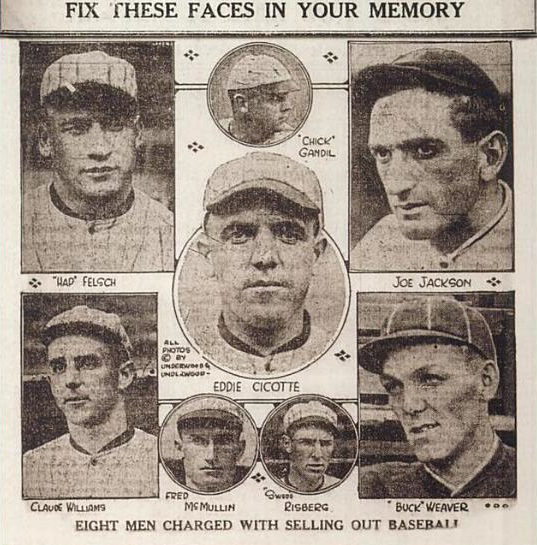
October 9, 1919: The World Series comes to a close, and millions of people find the result hard to believe.
Sometimes, it seems as though a sporting event was decided before it even began. This one was.
October 1, 1919: Game 1 is played at Redland Field (renamed Crosley Field in 1934) in Cincinnati. The Cincinnati Reds, Champions of the National League, are hosting the Chicago White Sox, Champions of the American League.
"Everybody" said that the White Sox were the superior team. Actually, while the ChiSox were more experienced – they had won the Series 2 years earlier, beating the New York Giants – they had won 88 games in the 1919 season, but the Reds had won more, 95. And the Reds had Hall-of-Famer Edd Roush, and a few players who would have been All-Stars at least once in their careers, had there been an All-Star Game at the time.
Still, everybody seemed to think the Sox were better. And yet, just before the Series began, the betting shifted to make the Reds the favorites. What had happened?
The Game 1 starter for the White Sox is knuckleballer Eddie Cicotte. The 1st batter for the Reds is 2nd baseman Morrie Rath. Cicotte, not known as a dirty pitcher, but who had taken $10,000 (about $164,000 in today's money) from gamblers the night before, throws a strike with his 1st pitch, but hits Rath with his 2nd. This is the signal to the gamblers, including ringleader Arnold Rothstein, that the fix to which they'd agreed is still on. (Ironically, Rath was a former White Sock.)
In the bottom of the 4th, the game is tied 1-1. So far, nothing has happened to suggest to the unaware spectator that anything is amiss. But then Cicotte melts down, and allows 5 runs. The Reds win, 9-1, and the "upset" is on, as is what became known as the Black Sox Scandal.
Redland/Crosley Field, in its 1912-37 configuration
October 2: Game 2 in Cincinnati. The Reds beat the White Sox 4-2, to go up 2 games to none. Sox pitcher Claude "Lefty" Williams, just as suddenly as had Cicotte the day before, goes from very effective to a meltdown. He holds the Reds scoreless for the 1st 3 innings, but in the 4th, he walks 3 batters, gives up a single to Roush, and then a triple to Larry Kopf.
After the game, Sox manager William "Kid" Gleason tells team owner Charlie Comiskey that he's suspicious of his players. But Comiskey has been feuding with his old friend Ban Johnson, President of the American League, with the 2 men having founded the League. So Comiskey goes to National League President John Heydler. Heydler tells Johnson about Gleason's suspicions. But Johnson does nothing about it, thinking people will see it as a vengeful act against Comiskey.
Gleason is not the only one who is suspicious: Hugh Fullerton of the Chicago Herald-Examiner, and his protégé, Ring Lardner of the Chicago Tribune, make note of some questionable plays. So does former Giants pitcher Christy Mathewson, covering the Series for a national newspaper syndicate.
October 3: Game 3, at Comiskey Park in Chicago. It's 289 miles between the ballparks, but there is no day off for travel, and the teams traveled by train, not plane. Rookie lefthander Dickie Kerr seems to show no effects of either the traveling, the lack of rest, or his teammates' treachery. He pitches a 3-hit shutout, left fielder Joe Jackson gets 2 hits, and 1st baseman Arnold "Chick" Gandil gets 2 RBIs.
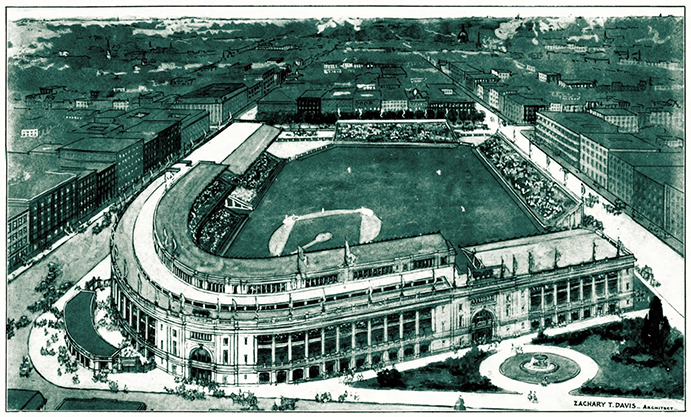
Comiskey Park, in its 1910-26 configuration
Adolfo "Dolf" Luque, the Reds' Cuban pitcher, pitches in relief, and thus becomes the 1st Latin American player to appear in a World Series game. He pitches a scoreless 8th inning.
Joseph Jefferson Jackson had become known as "Shoeless Joe" because of an incident in a minor league game. The shoes he'd been given were too tight, so he took them off in the outfield. He was a farmboy from the Appalachian western region of South Carolina, and had never learned how to read. He knew he had to learn how to sign his name, to give kids autographs, but he got around his illiteracy by having his wife order for him in restaurants.
He could "read" pitchers, though. Babe Ruth supposedly modeled his lefthanded swing after Jackson's. At the close of the 1920 season, just 33 years old, he had a .356 lifetime batting average (still the 3rd-highest ever), a whopping 170 OPS+, and 1,772 hits, including 307 doubles, 168 triples and 54 home runs. What would later be known as the 3,000 Hit Club was within reach for him.
He was also a good baserunner, having stolen 202 bases. How good a fielder was he? Ty Cobb called him the greatest left fielder he'd ever seen, and his glove "the place where triples go to die."
There was no Baseball Hall of Fame yet, but Shoeless Joe seemed to be on his way. None of the other players implicated in the scandal were likely to make it, though.
October 4: Game 4 in Chicago. Cicotte, in on the fix, didn't want to look as bad as he had in Game 1, so he could throw off suspicion. He and Jimmy Ring trade goose eggs for 4 innings. But in the 5th, Cicotte makes a bad throw of a comebacker. Jackson makes a run-allowing error on the next play. The Reds beat the White Sox 3-1, and take a 3-1 lead in the Series.
After the game, Joseph J. "Sport" Sullivan, the Boston bookmaker who helped Rothstein put the fix together, gives $20,000 to Gandil, who splits it equally among the 2 men who'd led the fix from the players' side, shortstop Charles "Swede" Risberg, center fielder Oscar "Happy" Felsch, and the next day's starter, Williams.
Allegedly, Cicotte had a good reason for getting in on the fix. Comiskey had promised him a $10,000 bonus if he won 30 games in the 1919 season. He got to 29, and then the ever-cheap Comiskey ordered Gleason to not pitch Cicotte again.
This wasn't true. Cicotte did win 29 games, but Gleason did start him again, and he was unable to win the 30th: He won his 29th on September 19, he was taken out after allowing 5 runs in 7 innings in a game the White Sox came back to win on September 24, and got knocked out of the box after 3 innings on September 28. Yet the story persists, because it's emblematic of Comiskey's cheapness. It got into the 1988 movie version of Eliot Asinof's 1963 book about the scandal, Eight Men Out.
There were 2 starts that Cicotte could have made between September 5 and 19, but didn't. I can't find an explanation for that. But he definitely was not held out once he won his 29th.
There is a story about Comiskey's cheapness that is absolutely true. In 1917, the White Sox won the World Series, but throughout the year, their uniforms seemed to get dirtier and dirtier, because Comiskey wouldn't pay to have them washed on the road. Hence, the term "Black Sox" referred not to the scandal that would later be attached to them, but to their dirty uniforms.
My grandmother, who grew up in Queens in the 1930s, knew that (with help from her and my Bronx native Yankee Fan grandfather) my knowledge of baseball history was encyclopedic, and asked me where the Black Sox name came from.
She was a Brooklyn Dodger fan, so she knew the National League cold, and knew that her team's name came from Brooklynites being called "trolley dodgers." But she did not know the lore of the American League. Until she asked me, she literally thought the team was officially called the Black Sox, and then changed to "White Sox" to clean their image up after the scandal.
I had to tell her that it was totally the opposite: Chicago teams had been called the "White Stockings" going back to the dawn of professional baseball in the 1870s, as a contrast to the Cincinnati and Boston teams being known as the Red Stockings, and that the AL team took the White Stockings name after the NL team became the Colts in 1890 (and eventually the Cubs in 1903), and that the Black Sox name was a nickname, and then came the scandal.
October 6: Game 5 in Chicago, following a Sunday rainout. Reds pitcher Horace "Hod" Eller pitches a 3-hit shutout. In the 2nd and 3rd innings, he strikes out 6 players in a row: Gandil, Risberg, Ray Schalk, opposing pitcher Williams, Harry "Nemo" Leibold and Eddie Collins.
In addition, the Reds score 4 runs in the 6th on, among other things, bad throws by Jackson and Felsch. Schalk is not in on the fix, but he does the kind of thing that could have gotten him suspected: He gets thrown out of the game for arguing a safe call on a slide into the plate by the Reds' Henry "Heinie" Groh.
The Reds win, 5-0, and go up 4 games to 1 in this best-5-out-of-9 Series. One more win, and the Reds take the title.
So of the 7 players in on the fix, 5 appeared in this game, and all had something to do with the defeat.
So of the 7 players in on the fix, 5 appeared in this game, and all had something to do with the defeat.
Collins, formerly a star with the Philadelphia Athletics, was not in on the fix. He remains one of the greatest 2nd basemen who ever lived, and is in the Baseball Hall of Fame.
Schalk is in the Hall as well, because he is considered one of the best-fielding catchers who ever lived. But his .253 lifetime batting average is the lowest for any player in the Hall not generally considered a pitcher. It is suspected that he was elected because he refused to go in on the fix. Did he actively refuse? There's no known record of him being asked.
One player who was asked, but refused, was 3rd baseman George "Buck" Weaver. He didn't think the gamblers who were setting the fix up could be trusted. But he also didn't report what he knew. And this would be his downfall.
Fred McMullin, a utility infielder, had overheard Gandil and Felsch discussing the fix, and he wanted in. Since the White Sox clinched the Pennant with a few games to spare, he could be sent to Cincinnati to scout the Reds, and so, even though he wouldn't get much playing time in the Series, he could tell the players on the take how best to take advantage of the Reds' tendencies.
On the train back to Cincinnati, Lardner vents his spleen at the White Sox. To the tune of one of the biggest hits of the year, "I'm Forever Blowing Bubbles" -- later to become the unofficial theme song of London soccer team West Ham United -- he sings:
I'm forever blowing ballgames
Pretty ballgames in the air
I come from Chi
I hardly try
Just go to bat
and fade and die
Fortune's coming my way
that's why I don't care
I'm forever blowing ballgames
and the gamblers treat us fair.
The scene would be recreated in the film version of Eight Men Out, with John Sayles directing, and also playing Lardner.
October 7: Game 6 in Cincinnati. The White Sox must win 4 straight to win the Series. Risberg makes 2 errors, and Felsch makes 1, holding up their end of their corrupt bargain. But Jackson and Weaver combine for 7 hits. Kerr, who had won Game 3, wins again, as the White Sox top the Reds 4-0.
Years later, Gandil said, "The eight of us did our best to lose it, but little Dickie Kerr did his best to win it."
October 8: Game 7 in Cincinnati. The White Sox are playing like they mean it. The supposedly tainted Jackson and Felsch each drive in 2 runs, and the supposedly tainted Cicotte pitches well. Meanwhile, uncharacteristically, the Reds make 4 errors. The White Sox win, 4-1, and close to within 4 games to 3.
All the White Sox need to do now is win the next 2, both at Comiskey Park. Is this thing on the level after all? Or have the guilty Sox players abandoned the fix? Or... are the Reds now on the take, too?
After the game -- all day games, as the Reds will be the 1st team to introduce night games in the major leagues, but not until 1935 -- the teams take trains to Chicago. At his home, Williams receives a visitor, telling him he had better lose Game 8, or else his family will be harmed. The gamblers are taking no chances. They've got too much money invested in a Cincinnati victory.
October 9: Game 8 at Comiskey Park. The Reds defeat the White Sox, 10-5, taking the best-5-out-of-9 World Series. It is the 1st World Championship for Cincinnati – or, at least, the 1st since the unofficial one for the Cincinnati Red Stockings, the 1st openly professional baseball team, in 1869, half a century earlier. (If that anniversary had been observed in Cincinnati, it wasn't mentioned in most of the books about the 1919 season. It was observed on the 100th Anniversary in 1969 and the 150th in 2019.)
October 9: Game 8 at Comiskey Park. The Reds defeat the White Sox, 10-5, taking the best-5-out-of-9 World Series. It is the 1st World Championship for Cincinnati – or, at least, the 1st since the unofficial one for the Cincinnati Red Stockings, the 1st openly professional baseball team, in 1869, half a century earlier. (If that anniversary had been observed in Cincinnati, it wasn't mentioned in most of the books about the 1919 season. It was observed on the 100th Anniversary in 1969 and the 150th in 2019.)
Williams gets just 1 man out in the 1st before departing, having allowed 4 runs. The Reds go on to give Eller plenty of offense. Jackson hits the only home run of the Series. Collins' 3 hits give him a total of 42 in Series play‚ a record broken in 1930 by Frank Frisch‚ and bettered by Lou Gehrig in 1938. A stolen base by Collins is his 14th in Series competition‚ a record tied by Lou Brock in 1968, but still not broken to this day.
On September 28, 1920, with the White Sox, the Cleveland Indians, and the New York Yankees in a 3-way dogfight for the Pennant, the 7 Chicago players who were in on the fix were indicted for conspiracy to throw the Series. So was Weaver, who refused to take part, but was indicted because he knew about it and refused to report it.
On July 28, 1921, a Chicago jury acquitted the 8 players of conspiracy to defraud, because there wasn't enough evidence for a conviction. But on August 2, Kenesaw Mountain Landis, a Chicago-based former federal Judge who had been appointed Commissioner of Baseball by the team owners to help re-establish the sport's credibility, banned them all from participation in the sport, at either the major or the minor league level -- permanently.
For the rest of their lives, Roush, the last survivor (he lived until 1988), and the other 1919 Reds insisted that, if the Series had been on the up-and-up, they would have won anyway.
Really? Here's something else to consider: Down 4 games to 1 in that best-5-out-of-9, the Sox won Games 6 and 7, playing to win because the gamblers hadn't come through with their payments, and Williams only caved in for Game 8 because his family had been threatened if he did not comply. Williams was 0-3 for the Series, a record not "achieved" honestly until 1981 and George Frazier of the Yankees.
It's been said that Babe Ruth and his home runs "saved baseball after the Black Sox Scandal." This is ridiculous. Ruth was hitting home runs like crazy all season long in 1920, and attendance remained higher throughout the "Roaring Twenties" than it was in the years before America entered World War I. Babe's homers didn't save baseball after the scandal, but they may have helped cover it up.
What happened to the 8 banned players?
He was played by D.B. Sweeney in the 1988 film version of Eight Men Out, and Ray Liotta in the 1989 film Field of Dreams, based on W.P. Kinsella's 1982 novel Shoeless Joe.
* Fred McMullin, ironically, went into law enforcement, being named a Deputy Marshal in Los Angeles County in California in 1940. But high blood pressure led to a fatal stroke in 1952, at age 61. He was played by Perry Lang in EMO, but the actor playing him in FOD was not credited.
* Buck Weaver remained in Chicago, and continued to press his case for reinstatement, not because he felt the need to play again, but because he wanted his name officially cleared, not just by the court (as it had already been), but by baseball itself. He died of a heart attack in 1956, at 65. His family continues to appeal on his behalf, so far without success. He was played by John Cusack in EMO, and Michael Milhoan in FOD.
* Lefty Williams played in outlaw leagues, outside Landis' jurisdiction, then operated a garden nursery business outside Los Angeles. He died from the effects of years of heavy drinking, at 66, in 1959, 40 years after the Series in question, and the year the White Sox finally won their next Pennant. He was played by James Read in EMO, but the actor playing him in FOD was not credited.
* Happy Felsch played semi-pro ball in the west of America and Canada for another 15 years, before returning to his native Milwaukee, opening a grocery store and a series of bars. Apparently, he sampled his own product more than he should, because it died of liver failure, in 1964, shortly before turning 73. He was played by Charlie Sheen (perhaps appropriately) in EMO, but the actor playing him in FOD was not credited.
* Eddie Cicotte returned to Michigan, managed a service station, served as a game warden, worked for Ford Motor Company, and ran a farm outside Detroit. He died in 1969, at 84. He was played by David Strathairn in EMO and Steve Eastin in FOD.
* Chick Gandil had little to lose: He had already decided to leave organized ball, and returned to California, where he played semi-pro ball on a team with Jackson, Risberg, McMullin, and another player banned due to his connection to the scandal, Joe Gedeon of the St. Louis Browns. In 1925, he played in Arizona with some banned players, including Hal Chase, a former Yankee 1st baseman known for great fielding but also for throwing games.
Gandil gave an interview to Sports Illustrated in 1956, admitting to being the scandal's ringleader, expressing regret for it, and agreeing that he and the others deserved to be banned. He died of heart trouble in 1970, at 82. He was played by Michael Rookier in EMO and Art LaFleur in FOD. (LaFleur would later play the ghost of Babe Ruth in The Sandlot).
* Swede Risberg also played semi-pro baseball, including in 1922 in Minnesota on a team with Felsch and Williams. He returned to his native Northern California, worked on a dairy farm, and later ran a tavern and a lumber business. He was the last survivor, dying on his 81st birthday, October 13, 1975. He was played by Don Harvey in EMO, and Charles Hoyes in FOD.
It is arguable that the 2 most famous World Series of them all have been those of 1919, in which Risberg was heavily involved in the fix;and 1975, during which Risberg died -- and the Cincinnati Reds won them both, in each case under controversial circumstances. (At your own peril, ask a Red Sox fan about 1975 Game 3.)
Trust me on this one: If you want to get closer to the facts of the case, see the film Eight Men Out; but if you want to see a movie that makes you feel good, see the factually-challenged but beautiful
Field of Dreams.
UPDATE: The Reds have a team Hall of Fame. Elected from this 1919 team have been 1st baseman Jake Daubert, shortstop Larry Kopf, 3rd baseman Henry "Heinie" Groh, left fielder Raymond "Rube" Bressler, center fielder Edd Roush, Cuban pitcher Adolfo "Dolf" Luque, and team president August Herrmann.
From the 1920s, they have inducted catcher Eugene "Bubbles" Hargrave, 2nd baseman Hughie Critz; and pitchers Eppa Rixey, Pete Donohue and Charles "Red" Lucas.
*
October 9, 1919 was a Thursday. The NFL and NBA hadn't been founded yet, and it was too soon for the NHL season. So there were no other scores on this historic day.


No comments:
Post a Comment