Showing posts with label robert f. kennedy stadium. Show all posts

Saturday, October 1, 2022

October 1, 1961: America's National Stadium

October 1, 1961: District of Columbia Stadium opens in Washington, D.C. The Washington Redskins lose to the New York Giants, 24-21.

As with most major American cities early in the 20th Century, the biggest stadiums were the baseball parks. The biggest stadiums built for football were on the campuses of State universities, which tended to be in or near State capitals, which were not necessarily the biggest city in their State.

In 1916, Representative George Hulbert, a Democrat, proposed the construction of a 50,000-seat "national stadium" -- not in New York City, where the Rochester native had practiced law, but in the nation's capital, Washington, D.C.. The idea was that it would host the 1920 Olympics, the Army-Navy football game, and Davis Cup tennis matches. It wasn't taken seriously.

Later, another Representative from New York, Representative Hamilton Fish III, and D.C.'s Director of Public Buildings and Parks, Ulysses S. Grant III -- the former's grandfather had been Secretary of State under the latter's grandfather -- decided to build a 100,000-seat national stadium, as a memorial to President Theodore Roosevelt, either on the island in the Potomac River that bore TR's name, or on the National Mall, as a bookend to the Lincoln Memorial. In addition to the preceding events, it was thought that Presidential Inaugurations could be held there. But Los Angeles won America's bid to host the 1932 Olympics, and, eventually, the National World War II Memorial became the Lincoln Memorial's bookend.

In 1944, a 9-man National Memorial Stadium Commission was appointed, and a site was chosen for a national stadium, next to the D.C. Armory, which opened in 1941, where East Capitol Street met the Anacostia River. But, with World War II still ongoing, getting Congress to fund a 100,000-seat stadium for the 1948 Olympics was impossible, and the Games were held in London.

In 1956, Representative Charles R. Howell, Democrat of New Jersey (I wasn't born yet, but, had I lived then where I live now, he would have been "my Congressman") proposed legislation funding a national stadium, after the National Capital Planning Commission re-proposed "the East Capitol Site."

Clark Griffith, longtime owner of baseball's Washington Senators, had recently died, leaving the team to his nephew, Calvin Griffith, and he didn't want to play at Griffith Stadium, a 27,000-seat stadium, expandable to only 35,000 for the NFL's Washington Redskins, and in a neighborhood that was growing increasingly black -- to the point where, after the ballpark was demolished, Howard University, the school known as "the Black Harvard," built its hospital on the site. It was thought that a national stadium could not only attract the Olympics and the Army-Navy Game, but save the Senators and Redskins from moving.

This time, Congress passed the District of Columbia Stadium Act, authorizing a 50,000-seat stadium, and President Dwight D. Eisenhower signed it into law on July 29, 1958. It was the 1st stadium built from scratch for both baseball and football -- up the Parkway, Baltimore repurposed the existing Municipal Stadium as Memorial Stadium for both sports in a conversion process from 1950 to 1954 -- and it opened in time for the Redskins to open the 1961 season there. (By a weird coincidence, both that stadium and DC/RFK Stadium would be built across the street from a school named Eastern High School.)

There was a snag, though: The Redskins were the last NFL team that hadn't racially integrated, and the stadium was on federal government property. When John F. Kennedy became President on January 20, 1961, he appointed Representative Stewart Udall of Arizona as Secretary of the Interior, overseeing the site. (Stew's brother, Morris "Mo" Udall, won his seat, and each of them had a son who went on to be elected to the U.S. Senate.) The Secretary told Redskins owner George Preston Marshall, a known racist, that he had to integrate the team, or he couldn't have D.C. Stadium. Marshall caved.

Griffith moved the Senators for the 1961 season, anyway, making them the Minnesota Twins. An expansion franchise was placed at Griffith Stadium for 1961, named the Washington Senators. D.C. Stadium became their home on April 9, 1962, and they beat the Detroit Tigers, 4-1. It hosted the 1962 and 1969 Major League Baseball All-Star Games. JFK threw out the ceremonial first ball at both Opening Day and the All-Star Game in 1962.
JFK is flanked by Vice President Lyndon Johnson
and White House aide Dave Powers. Also identifiable behind him:
Senators Hubert Humphrey, Everett Dirksen and Mike Mansfield;
and White House aide Larry O'Brien, later Chairman of the Democratic Party
(his offices at the Watergate were bugged in 1972) and NBA Commissioner.

On January 18, 1969, having served the entirety of the JFK and Lyndon B. Johnson Administrations, Secretary Udall announced that the stadium had been renamed Robert F. Kennedy Memorial Stadium, for JFK's brother and Attorney General, who had been elected to the Senate in 1964, had run for President in 1968, and, like JFK, had been assassinated. A formal rededication ceremony was held on June 7. (Most people dropped the "Memorial" when talking about it, and called it "RFK Stadium," or even just "RFK.")

On July 1, 1977, the Washington Metropolitan Area Transit Authority opened the Stadium-Armory subway station, serving RFK Stadium and the D.C. Armory on the Blue Line and the Orange Line, with the Silver Line later added. It was a bit of a walk, though: The station was at 19th and A Streets Southeast, a 10-minute walk from the Stadium, whose mailing address was 2400 East Capitol Street Northeast.

Not having subway access hurt the Senators, who left after the 1971 season, and, with a few exceptions such as preseason exhibitions and old-timers' games, baseball did not return until 2005. The Washington Nationals arrived, and remained through the 2007 season, then moved into Nationals Park.

The Redskins played there until 1996, building the NFL's most intimidating home-field advantage, reaching 4 Super Bowls, winning 3. Their last game there was on December 22, 1996, a 37-10 pasting of their arch-rivals, the Dallas Cowboys. Moving out to the far larger stadium in suburban Landover, Maryland turned the 'Skins from the team with the best home-field advantage in the NFL to the worst.
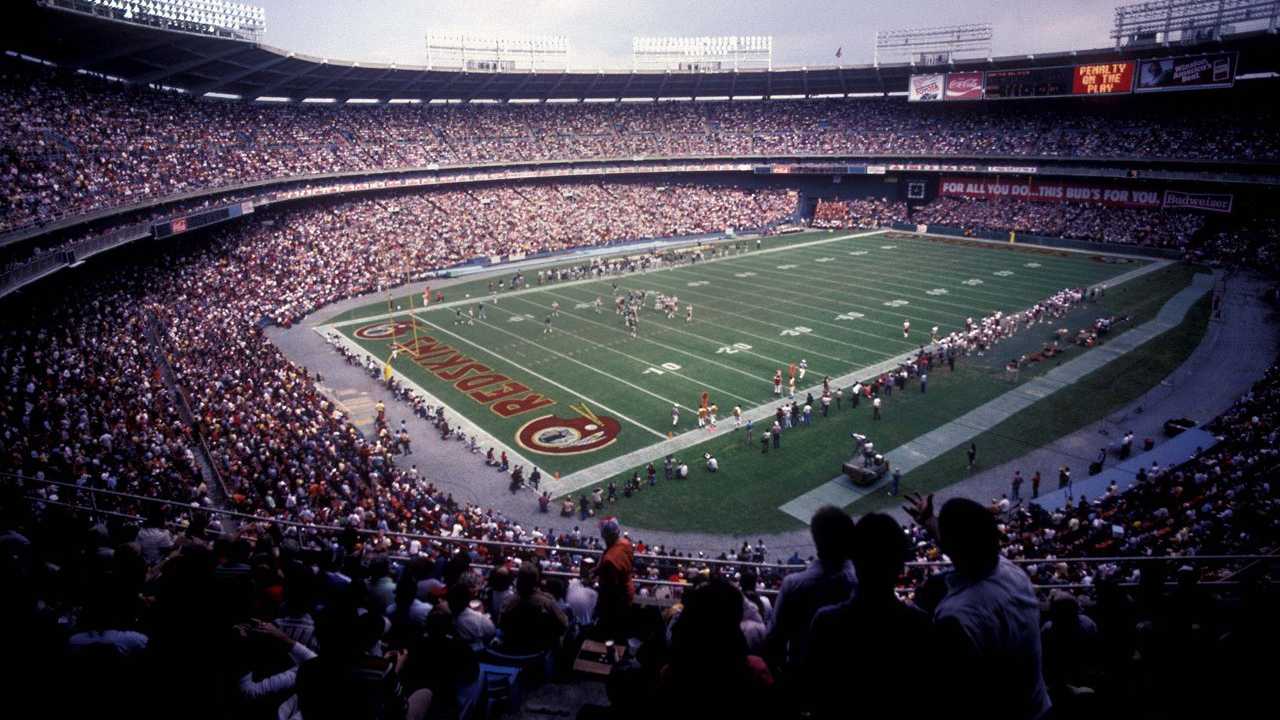
This seat would have been behind home plate
in the stadium's baseball configuration.
You can make out the dugouts.

Unlike most countries, the United States does not have an official "national stadium." RFK is the closest we come to it: Not only is it in the nation's capital, but it has hosted the national soccer team more times than any other venue, 24 times. (The Los Angeles Memorial Coliseum is 2nd, with 20; with the now-demolished Orange Bowl in Miami right behind, with 19.) Which become more amazing when you realize that the 1st such match wasn't until 1977, and the 2nd not until 1991. Why? Interest in the team was too low: RFK Stadium was too big for them until they reached the 1990 World Cup.

In those 24 matches, the U.S. won 15, lost 3, and drew 6. These matches include the 100th Anniversary match of the U.S. Soccer Federation, held on June 2, 2013, a 4-3 U.S. win over Germany. I was there -- it was hot and humid, and it had rained earlier -- and I took this photo.
This seat would have been in center field
in the stadium's baseball configuration.
Again, you can make out the dugouts.
After hosting the Washington Wolves and the Washington Diplomats of the old North American Soccer League, the latter including Dutch superstar Johan Cruyff, in 1996, RFK Stadium became the home of D.C. United, a charter team in Major League Soccer. It continued to be DCU's home through the 2017 season, after which they moved into Audi Field. DCU won the MLS Cup while playing there in 1996, 1997, 1999 and 2004, with the MLS Cup Final being played there in 1997, 2000 and 2007.
The last event at RFK Stadium was on October 22, 2017, a 2–1 D.C. United loss to the New York Red Bulls. It has been announced that RFK Stadium will be demolished in 2021. The 1st of the multi-purpose oval stadiums built in America in the 1960s, '70s and '80s, it is one of the last to still be standing. The only one still in use is the Oakland Coliseum, although the Astrodome is still standing.
In the 2014 film X-Men: Days of Future Past, Erik Lensherr, a.k.a. the supervillain Magneto (played in the flashback sequences by Michael Fassbender, and as an old man by Ian McKellen), ripped the circular stadium off its foundation, levitated it, and moved it across town, surrounding the White House, with the intention of killing President Richard Nixon. He failed. Computer-generated imagery was used to simulate the stadium's appearance in 1973, complete with period-appropriate advertising.
UPDATE: Demolition was delayed until 2025. That year, the District, the NFL, and the renamed Washington Commanders agreed on a deal to built a new stadium on the site, intending to open it in time for the 2030 season.
In "death," RFK Stadium still holds the record for most times hosting the U.S. Men's National Team (USMNT), with 24. The L.A. Coliseum is still 2nd, with 20. But Dignity Health Sports Park, in the Los Angeles suburb of Carson, California, has tied the Orange Bowl for 3rd, with 19. The Landover replacement for RFK Stadium, currently named Northwest Stadium? Only 2.
*
October 1, 1961 was a Sunday. This was also the day that television network CTV went on the air in Canada. I have a separate entry for that event.
These other games were played in the NFL:
* The football version of the St. Louis Cardinals beat the Philadelphia Eagles, 30-27 at Franklin Field in Philadelphia.
* The Baltimore Colts beat the Minnesota Vikings, 34-33 at Memorial Stadium in Baltimore.
* The Cleveland Browns beat the Dallas Cowboys, 25-7 at Cleveland Municipal Staidum.
* The San Francisco 49ers beat the Detroit Lions, 49-0 at Tiger Stadium in Detroit.
* The Green Bay Packers beat their arch-rivals, the Chicago Bears, 24-0 at Green Bay City Stadium (later renamed Lambeau Field).
* And the Los Angeles Rams beat the Pittsburgh Steelers, 24-14 at the Los Angeles Memorial Coliseum.
In the American Football League:
* The New York Titans beat the Boston Patriots, 37-30 at the Polo Grounds. The Titans became the Jets in 1963, and the Patriots became the New England Patriots in 1971.
* The Dallas Texans beat the Houston Oilers, 26-21 at the Cotton Bowl in Dallas. The Texans became the Kansas City Chiefs in 1963, and the Oilers became the Tennessee Titans in 1999.
* The Oakland Raiders beat the Denver Broncos, 33-19 at Candlestick Park in San Francisco. The Raiders wouldn't actually play a game in Oakland until 1962, moved to Los Angeles in 1982, moved back to Oakland in 1995, and moved to Las Vegas in 2020.
* And, the day before, the San Diego Chargers beat the Buffalo Bills, 19-11 at War Memorial Stadium in Buffalo. This was the Chargers' 1st game as a San Diego team, after spending the AFL's founding year of 1960 in Los Angeles. They returned to Los Angeles in 2017.
And it was the last day of baseball's regular season:
* The New York Yankees beat the Boston Red Sox, 1-0 at Yankee Stadium. The only run of the game came in the 4th inning, when Roger Maris hit his record-breaking 61st home run of the season, off Tracy Stallard. Bill Stafford (3 hits over 6 innings), Hal Reniff (a perfect 7th) and Luis Arroyo (1 hit over 2) combined on a 4-hit shutout. I have a separate entry for this game.
* The St. Louis Cardinals beat the Philadelphia Phillies, 2-0 at Connie Mack Stadium in Philadelphia. Bob Gibson pitched a 6-hit shoutout. Stan Musial appeared only as a pinch-hitter, and did not reach base.
* The Pittsburgh Pirates beat the Cincinnati Reds, 3-1 at Forbes Field in Pittsburgh. Roberto Clemente did not play. Frank Robinson went 0-for-2 with a walk. Despite this game, the Reds had dethroned the Pirates as National League Pennant winners, and would face the Yankees in the World Series. The Yankees won in 5 games.
* The Los Angeles Dodgers beat the Chicago Cubs, 8-2 at Wrigley Field in Chicago. Ernie Banks went 1-for-4 with an RBI. Duke Snider drew a walk as a pinch-hitter.
* A doubleheader was split at Milwaukee County Stadium. The San Francisco Giants won the opener, 8-2. The Milwaukee Braves won the nightcap, 3-2. Al Spangler singled Hank Aaron home with the winning run in the bottom of the 10th inning. Over the 2 games, Aaron went 4-for-9, and Willie Mays went 3-for-7 with a home run and 3 RBIs.
* The Detroit Tigers beat the Minnesota Twins, 8-3 at Metropolitan Stadium in the Minneapolis suburb of Bloomington, Minnesota. Norm Cash hit a home run, and Al Kaline had an RBI double as a pinch-hitter. This was the Tigers' 101st win of the year, but the Yankees won 109 to take the American League Pennant.
For the Twins, completing their 1st season after being "the old Washington Senators," Harmon Killebrew went 0-for-3 with a walk, and relief pitcher Pedro Ramos hit a home run, 1 of 3 he hit on the season, and 1 of 15 he hit in a surprisingly powerful career for a pitcher who was mainly a reliever.
* The Kansas City Athletics beat "the new Washington Senators," 3-2 at Kansas City Municipal Stadium.
* After providing a venue for the Pacific Coast League's Los Angeles Angels from 1925 through 1957, and the major league expansion team with the same name this season, the West Coast version of Wrigley Field hosts its last professional baseball game. The Halos are defeated by the Cleveland Indians, 8-5 in front of 9,868 fans. Wrigley West will be torn down in 5 years, to make room for an eventual public playground and senior center.
* And the Baltimore Orioles and the Chicago White Sox completed their seasons the day before, against each other, with the O's winning, 4-3 at Memorial Stadium in Baltimore.

Friday, September 30, 2022

September 30, 1971: The Last Washington Senators Game Is Played

September 30, 1971: The last Washington Senators game is played, against the New York Yankees at Robert F. Kennedy Memorial Stadium in Washington. Team owner Bob Short, having already moved the NBA's Minneapolis Lakers to Los Angeles in 1960, has announced he's moving the Senators to the Dallas area, to become the Texas Rangers. He complains about the low attendance, despite having the highest ticket prices in the American League, and no subway access to RFK Stadium. (Washington's Metro would not open until 1976.)
Frank Howard, the Senators' most popular player in their 2nd go-around of 1961-71, hits the last home run. Dick Bosman starts, and stands to be the winning pitcher, as the Senators lead 7-5 with 1 out left in the 9th. All he has to do is get Bobby Murcer out.
Frank Howard

But he can't, through no fault of his own. Angry fans from the "crowd" of 14,461 people storm the field. The umpires cannot restore order, and they forfeit the game to the Yankees. The next April, Bosman also started the team's 1st game as the Rangers.
Only 2 AL games have been forfeited since, both promotions that turned into fiascos: The Cleveland Indians' Ten-Cent Beer Night in 1974, and the Chicago White Sox' Disco Demolition Night in 1979. Rusty Torres, who turned 23 on this day, was also in uniform on each of those occasions.
That last season had been a difficult one for the Senators, even before the move was announced. Ted Williams had been named their manager in 1969, and the man who literally wrote the book on hitting (The Science of Hitting, published the next year) really improved their hitting, to the point where the Senators won 86 games. It was the best season in Washington baseball since 1945, when the original Senators, who moved to become the Minnesota Twins in 1961 and were replaced by this expansion team, won 87 and missed the Pennant by a game and a half.
But the Boston Red Sox legend couldn't improve the pitching, and soon, the hitters stopped listening to his authoritarian ways. The Senators won only 70 games in 1970. In 1971, they traded for Denny McLain, the former 2-time Cy Young Award winner whose shoulder injury and bad attitude rendered him nearly useless; and the rights to Curt Flood, who had refused to accept a trade from the St. Louis Cardinals to the Philadelphia Phillies, but was willing to come back and play in Washington, and was so rusty after sitting 1970 out that he had to retire.
The Senators won just 63 games, and while a solid core of fans missed them, the D.C. metropolitan area as a whole did not. As Richard Nixon, President at the time, was quoted as saying, "All anybody cares about in Washington is the Redskins." And since the Redskins won the NFC Championship in 1972, and stayed contenders for the next 20 years, this was one time when Nixon was right.
In 1973, the NBA's Baltimore Bullets moved down the Baltimore-Washington Parkway, and were successful for the next 10 years, including a Championship in 1978. The 1970s also saw a renaissance in basketball at the University of Maryland, located outside the District of Columbia, but inside the Capital Beltway.
In 1974, the NHL introduced the Washington Capitals, and, while they were terrible their first few years, they have usually been contenders since the mid-1980s. The 1980s also saw the rise of the basketball team at Georgetown University.
In 1984, President Ronald Reagan went to the MLB city closest to Washington at the time, Baltimore, and threw out the ceremonial first ball before the Orioles' home opener, restoring the old Washington tradition. Although the Orioles fell into decline after a generation of winning, including 3 World Series wins (including 4 Pennants from 1966 to 1971, which took many Maryland fans away and, indirectly, helped to doom the Senators), Washington insiders began making the trip up the Baltimore-Washington Parkway, and the Orioles became D.C.'s team as well as Baltimore's.
The Orioles' 1989 Playoff run, though ultimately unsuccessful, increased interest from Washington area fans. The building of Oriole Park at Camden Yards in 1992 moved them just 4 miles, but it also put them next to Interstate 95, the Baltimore-Washington Parkway, and Camden Station, all with access to D.C.
This whetted capital-area baseball appetites even more, and led to the 2004-05 move of the Montreal Expos, becoming the Washington Nationals. They played the 2005, '06 and '07 seasons at RFK Stadium before moving to Nationals Park. Being in the other League means their rivalry with the Orioles isn't as nasty as Yankees-Red Sox, Dodgers-Giants, or even Cubs-Cardinals. The fact that the teams are partners in the Mid-Atlantic Sports Network (the O's own 77 percent of MASN, and the Nats 23 percent) also helps.
The Nats finally started making the Playoffs in 2012, the 1st postseason for a Washington baseball team since the 1933 Senators, unless you count the Homestead Grays of the Negro Leagues, who split their "home games" between Washington and Pittsburgh. And in 2019, the Nats won the World Series, the 1st such win for Washington since the 1924 Senators.
The last active player for the "New Senators" was Toby Harrah, who played until 1986. The last active player for the "Old Senators," who became the Minnesota Twins in 1961, was Jim Kaat, who pitched until 1983.
*
September 30, 1971 was a Thursday. These 8 other Major League Baseball games were played that day:
* The New York Mets beat the St. Louis Cardinals, 6-1 at Shea Stadium. Tom Seaver gets the win, his 20th of the season, and will go on to win his 2nd Cy Young Award. A young right fielder named Ken Singleton, who had grown up in New York as a Met fan, hits 2 home runs. But he will become better known for playing for the Baltimore Orioles, and broadcasting for the Yankees.
No one knows it at the time, but this is the last game the Mets will play with Gil Hodges as their manager. At the end of Spring Training in 1972, he suffers a heart attack and dies, not quite 48 years old.
* The Chicago Cubs beat the Montreal Expos, 5-3 at Jarry Park in Montreal. The retiring Ernie Banks played his last game with the Cubs 4 days earlier.
* The Pittsburgh Pirates beat the Philadelphia Phillies, 4-3 at Veterans Stadium in Philadelphia. Roberto Clemente and Willie Stargell both went 1-for-4.
* The Atlanta Braves beat the Cincinnati Reds, 6-2 at Atlanta Stadium (later Atlanta-Fulton County Stadium). Pete Rose went 1-for-4. Both the Reds' Johnny Bench and the Braves' Hank Aaron got the day off.
* The San Francisco Giants beat the San Diego Padres 5-1, at what was then named San Diego Stadium. (It was later renamed Jack Murphy Stadium, Qualcomm Stadium, and SDCCU Stadium.) The Giants thus clinch the National League Western Division title. This turns out to be their only postseason berth between 1962 and 1987.
* The Chicago White Sox beat the Milwaukee Brewers, 2-1 at Comiskey Park in Chicago.
* The California Angels beat the Minnesota Twins, 3-2 at Metropolitan Stadium in the Minneapolis suburb of Bloomington, Minnesota.
* And the Los Angeles Dodgers beat the Houston Astros, 2-1 at Dodger Stadium in Los Angeles.
And actress Jenna Elfman was born.

Friday, September 16, 2022

September 16, 1962: The Last NFL Team Is Integrated

September 16, 1962: The Washington Redskins and the Dallas Cowboys play to a 35-35 tie at the Cotton Bowl in Dallas. Making his debut for the Redskins, flanker Bobby Mitchell catches 6 passes for 135 yards for 2 touchdowns, and returns a kickoff 92 yards for another touchdown.

By any standard, it was, in spite of the result, an excellent game for him, especially since it was on the road. In the South. By a black man. Who thus became the 1st black man ever to sign a contract for that team. He had been joined in that 1st game by 2 other black players, guard John Nisby and running back Ron Hatcher.

It had taken 16 years since Kenny Washington and Woody Strode re-integrated the NFL with the Los Angeles Rams, and Marion Motley and Bill Willis had debuted along with the Cleveland Browns and their league at the time, the All-America Football Conference.

It had been 15 years since Jackie Robinson of the Brooklyn Dodger re-integrated baseball. It had been 3 years since the Boston Red Sox became the last Major League Baseball team to integrate. And all the NBA's teams had already done so. By 1955, so had all the NFL's other teams, and so did all the teams in the rebel American Football League when it was founded in 1960. What had taken the Redskins so long?

Two weeks later, on September 30, the Redskins played their 1st home game of the season, at D.C. Stadium. They beat the St. Louis Cardinals, 24-14. Mitchell caught 7 passes for 147 yards and 2 touchdowns.

In a 50th Anniversary interview in 2012, Mitchell said, "You're performing for a group of people, and you're not sure if they want you, so I had a lot of mixed emotions that game. I still don't believe I performed as well as I did, knowing how I felt all week long getting ready."

The Redskins were owned by George Preston Marshall. Born in 1896 in segregated West Virginia, he moved with his family to Washington as a boy. At the time, Washington was, despite being the nation's capital, a relatively small city, and segregated. In 1919, his father died, and he took over the family business, a chain known as Palace Laundromats. His first foray into sports was a basketball team, named for the city and the business: The Washington Palace Five. It lasted just 2 years, 1926 to 1928.

In 1932, he and 3 partners bought a Boston franchise for the NFL. Like most NFL teams at the time, they played in the biggest stadium in town, which was Braves Field. And so, like many (but not all) NFL teams at the time, he named the football team after the baseball team: The Boston Braves.

After a bad season, both on the field and at the box office, the other 3 partners wanted out. Marshall bought them out, and, for 1933, moved them to Fenway Park, which had fewer seats but better transit access. The Boston Red Sox wouldn't allow a team named the Boston Braves playing in their ballpark, so Marshall changed the name to the Boston Redskins. It was close to "Red Sox," and it allowed Marshall, who valued the color green even more than he valued the color white, to keep the Native American logos instead of buying new uniforms.

But the team never drew fans. At the time, Boston was a good college football town, and people weren't interested in a pro team. In 1936, the Redskins won the NFL Eastern Division, entitling them to host the NFL Championship Game. Marshall was sure he wouldn't get good attendance even for this, so he asked NFL President Joe Carr if he could move the game to the Polo Grounds in New York. Carr gave permission, and 29,545 people came out -- not good, but probably twice as many fans as Marshall would have gotten at Fenway. The Redskins lost to the Green Bay Packers, 21-6.

Marshall moved the team to his hometown for the 1937 season, and the Washington Redskins they would remain through the 2019 season. He drafted Sammy Baugh, who became the 1st rookie quarterback ever to lead a team to an NFL Championship, as the Redskins beat the Chicago Bears. The Redskins lost the NFL Championship Game to the Bears in 1940, beat the Bears in it in 1942, lost to the Bears in it in 1943, and lost to the Cleveland Rams in it in 1945. The Rams then followed the Redskins' example, and immediately moved to another city, Los Angeles.

Marshall capitalized -- pardon the choice of words -- on the popularity of college football by treating the Redskins like a college team, giving them a marching band, a fight song titled "Hail to the Redskins," and big halftime shows. He was also the man who suggested 2 notable rule changes: Making a forward pass legal anywhere behind the line of scrimmage, not just 5 yards as it had been; and moving the goalposts from the end line to the goal line, making it easier to kick field goals. Both rules increased scoring in the NFL. (The posts were moved back to the end line in 1974.)
George Preston Marshall.
He looks like the villain in a Frank Capra movie.

Baugh retired after the 1952 season, and the Redskins fell into decline. Sharing the 27,000-seat Griffith Stadium with baseball's Washington Senators didn't help: Although the Redskins were more popular, they simply couldn't draw more fans than the ballpark would hold, which topped out at 35,000 with the addition of bleachers along the right field fence, behind which there were no permanent seats. Marshall needed money.

Observing that the St. Louis Cardinals, as the southernmost and westernmost team in Major League Baseball, had built a vast radio network, and had thus become "the South's team," Marshall noted that his Redskins were the southernmost team in the NFL, so he did the same thing. By 1956, he had 60 radio stations and 29 television stations broadcasting Redskin games. (This was before the massive TV contracts for the NFL as a whole.)

Marshall was a visionary, but what he didn't want to see loomed larger than what he had foreseen. Those Southern TV stations didn't want to see black players on the Redskins. That was fine with Marshall, who didn't want to see it, either. His stock answer was, "We will sign black players when the Harlem Globetrotters sign white players."

The capital's leading sportswriter, Shirley Povich of The Washington Post, took to writing that, whenever a black player, such as Jim Brown of the Cleveland Browns, scored a touchdown against the Redskins, he had "integrated the Washington end zone." Having had enough of this, Marshall sued Povich for $200,000. Marshall lost.

And he was losing games. The Redskins went 6-5-1 in 1953, and 8-4 in 1955. Other than that, they didn't have a single winning season from 1949 to 1969. They bottomed out in 1960, going 1-9-2, and 1961, going 1-12-1. The other teams had signed black players, and had passed the Redskins by.

Marshall was unmoved: "I am surprised that, with the world on the brink of another war, they are worried about whether or not a Negro is going to play for the Redskins."

It looked like Marshall would finally get his wish, as the new District of Columbia Stadium was built in 1961. But it was built by the federal government, on federal government land, next to the D.C. Armory. In other words, the feds had control over how the stadium was used. The Senators were integrated, so there was no issue with them playing there.

But, on request of the Attorney General, Robert F. Kennedy -- with the implicit approval of his brother, President John F. Kennedy -- Stewart Udall, who, as Secretary of the Interior, had the authority to do so, told Marshall that unless he signed a black player, the government would deny the Redskins a lease on D.C. Stadium.

Marshall had been married twice, to an actress and a showgirl -- the latter of whom called him "the Marshall without a plan." Keeping the show business analogy, Marshall said, "I didn't know the government had the right to tell a showman how to cast the play." But it did have the right to determine who was allowed to "act" in its "theater." So  Marshall had options, none of which he liked:

* Take the black player and the increased revenue from a new 56,000-seat stadium.
* Keep his racist principle, and stay in Griffith Stadium, a 50-year-old, obsolete, 35,000-seat ballpark, which was in an increasingly black neighborhood, anyway.
* Negotiate a deal to play elsewhere, which probably wouldn't work, since the next-closest stadium bigger than Griffith was Byrd Stadium, on the campus of the University of Maryland, a State-owned institution that wouldn't allow a segregated team; the next-closest was at the U.S. Naval Academy in Annapolis, federally-owned; the next-closest was Memorial Stadium in Baltimore, and the Colts were not going to let the Redskins groundshare with them; and the next-closest was Scott Stadium on the campus of the University of Virginia, a school which had a black graduate as far back as 1953, but no black football players until 1970, and even if they had been willing to let the Redskins play there, they were over 100 miles away.
* Or buy some land, and build his own stadium, where he could make his own rules, but that would force him to spend his own money, which he might not have had enough of, anyway.

Marshall caved: He promised to make a black player his choice in the 1st Round of the 1962 NFL Draft. Udall relented, and the stadium opened on October 1, 1961, with the Redskins losing to the New York Giants, 24-21. (This was also the day that Roger Maris hit his 61st home run of the 1961 season.)

Marshall kept his half of the deal: On December 4, 1961 -- the NFL Draft was held late in the preceding year until 1967 -- he drafted Ernie Davis of Syracuse University, who had become the 1st black player to win the Heisman Trophy. Davis knew Marshall's reputation, and he refused to play for him. The Browns, who'd already had success with a Syracuse running back with Jim Brown, provided a way out: They traded Bobby Mitchell to Washington for the rights to Davis. Davis agreed to play for Cleveland, and Mitchell agreed to play for Washington.

But Davis would never play for the Browns: He developed leukemia, and died in 1963. Mitchell did play for the Redskins, until 1968, and was a big part of their revival. He scored 91 touchdowns, and his 14,078 combined net yards was then the 2nd-highest total in NFL history. He was elected to the Pro Football Hall of Fame in 1983. From 1969 until 2003, he worked in the Redskins' front office. He died in 2020, and the team retired his Number 49.
By the time Marshall had his epic clash with Udall, the Redskins were already no longer the southernmost team in the NFL. Clint Murchison Jr. wanted a team in Dallas, but Marshall stood in the way, because he wanted that southernmost distinction. So Murchison bought the rights to the fight song, "Hail to the Redskins." He told Marshall that if Marshall allowed his Dallas Cowboys into the League, he would sell the rights to the song to Marshall for one dollar; if not, Marshall would owe him royalties every time the song was played. Again, Marshall's love of money overrode everything else, and the Cowboys entered the NFL.

In 1963, due to his contributions to the League, Marshall became one of the charter inductees into the Pro Football Hall of Fame, and attended the induction ceremony at the new complex in Canton, Ohio. Shortly thereafter, he suffered a stroke that left him legally incompetent to manage his own affairs, let alone those of the team.

This complicated the team's return to competitiveness, before Edward Bennett Williams and Jack Kent Cooke, to whom Marshall had sold minority shares of the team, were able to get through the red tape. (Williams, a Washington native, was considered one of America's greatest lawyers; and Cooke had previously owned the Toronto Maple Leafs minor-league baseball team, and later owned the Los Angeles Lakers and Kings.)

Marshall died in 1969, and had a well-attended funeral in Washington, but was buried in his native West Virginia. That same year, District of Columbia Stadium was renamed Robert F. Kennedy Memorial Stadium. A monument to Marshall was installed outside RFK Stadium, but removed in 2020, after it was vandalized as part of the George Floyd protests.

In 1988, the Redskins won Super Bowl XXII, beating the Denver Broncos, 42-10. Their quarterback was Doug Williams, the 1st black quarterback to play in a Super Bowl, the 1st to start in one, and the 1st to win one.

Edward Bennett Williams sold his shares of the Redskins to Cooke in 1974, and Cooke remained the main owner through 3 Super Bowl wins, until his death in 1997, shortly before the 91,000-seat stadium, bearing his name, that he'd built in the suburb of Landover, Maryland was set to open. His family sold the team to Daniel Snyder in 1999, and the stadium was renamed FedEx Field.

Cooke has sometimes been called the best team owner in sports history, but never considered changing the racist named "Redskins." Snyder has been one of the worst, but finally gave up in 2020. At the same time that the Marshall monument was removed, Marshall's name was removed from the Redskins' Ring of Fame at FedEx Field, and the Redskins name was dropped. For the 2020 and 2021 seasons, the team was simply known as "The Washington Football Team," until a new name could be agreed upon. In 2022, the new name was chosen: The Washington Commanders.

Griffith Stadium, close to the campus of Howard University, the "historically black" school sometimes called "the Black Harvard," was torn down after the 1965 season. In 1975, a new building for the Howard University Hospital opened on the site.

The Senators left Washington after the 1971 season, becoming the Texas Rangers. The Redskins left RFK Stadium after the 1996 season. This left D.C. United of Major League Soccer as the stadium's last tenant. In 2005, the Montreal Expos became the Washington Nationals, and they played at RFK through 2007, until Nationals Park was built. In 2018, DCU moved to Audi Field, 3 blocks from Nationals Park. There is now a plan to demolish RFK Stadium in 2023, and build a new stadium for the Commanders on the site.

(UPDATE: Demolition of RFK Stadium began on December 7, 2022. The D.C. Council approved a new stadium for the site on August 1, 2025. It is planned to open for the 2030 season.)

*

September 16, 1962 was a Sunday. These other NFL games were played on that day:

* The New York Giants lost to the Cleveland Browns, 17-7 at Cleveland Municipal Stadium.

* The St. Louis Cardinals beat the Philadelphia Eagles, 27-21 at Franklin Field in Philadelphia.

* The Baltimore Colts beat the Los Angeles Rams, 30-27 at Memorial Stadium in Baltimore.
* The Detroit Lions beat the Pittsburgh Steelers, 45-7 at Tiger Stadium in Detroit.

* The Green Bay Packers beat the Minnesota Vikings, 34-7 at Green Bay City Stadium. (The 2nd stadium with that name, built in 1957, it was renamed Lambeau Field in 1965.)

* And the Chicago Bears beat the San Francisco 49ers, 30-14 at Kezar Stadium in San Francisco.

In the AFL that day:

* The New York Titans lost to the San Diego Chargers, 40-14 at Balboa Stadium in San Diego. (The Titans, then owned by Harry Wismer, a former minority owner of the Redskins, were sold the next year, and became the Jets.)

* The Boston Patriots beat the Houston Oilers, 34-21 at Harvard Stadium in Boston. (The Patriots took on the "New England" name when they moved to suburban Foxborough, Massachusetts in 1971.)

* The day before, the Denver Broncos beat the Buffalo Bills, 23-20 at War Memorial Stadium in Buffalo.

* And the Dallas Texans (who became the Kansas City Chiefs the next season) and the Oakland Raiders had the week off.

In Major League Baseball:

* The New York Yankees lost to the Boston Red Sox, 4-3 at Fenway Park in Boston. Gene Conley outpitched Whitey Ford. Mickey Mantle went 2-for-4 with an RBI. Carl Yastrzemski went 2-for-3 with 2 walks and an RBI.

* The New York Mets beat the Cincinnati Reds, 8-2 at the Polo Grounds. Roger Craig went the distance for the win, his 9th of the season, against 23 losses. He was supported by a home run from Marv Throneberry, who, contrary to his reputation, did not make an error at 1st base -- although Craig did make an error on the mound. Frank Robinson went 0-for-4.

* The Philadelphia Phillies beat the St. Louis Cardinals, 3-1 at Connie Mack Stadium in Philadelphia. Art Mahaffey outpitched Bob Gibson. Johnny Callison hit a home run. Stan Musial went 0-for-4.

* The Chicago White Sox beat the Washington Senators, 7-4 at D.C. Stadium. As with most baseball teams at the time, when they rented to a pro football team, the baseball had schedule preference, so the Redskins had to open the season on the road.

* The Pittsburgh Pirates beat the San Francisco Giants, 6-4 at Forbes Field in Pittsburgh. Smoky Burgess won it with a home run in the bottom of the 10th inning. Roberto Clemente went 2-for-3 with 2 walks. Rookie Willie Stargell appeared as a pinch-hitter, but struck out. Willie Mays went 1-for-3 with a 3-run homer and a walk.

* The Chicago Cubs beat the Los Angeles Dodgers, 5-0 at Wrigley Field in Chicago. Bob Buhl pitched a 4-hit shutout. Ernie Banks went 1-for-3 with a walk. Duke Snider, in his last season with the Dodgers, appeared as a pinch-hitter, but did not reach base.

* The Milwaukee Braves beat the Houston Colt .45s, 5-4 at Milwaukee County Stadium. The Colts became the Astros in 1965. Hank Aaron only appeared as a pinch-hitter, and drew a walk.

* The Minnesota Twins beat the Cleveland Indians, 4-3 at Metropolitan Stadium in the Minneapolis suburb of Bloomington, Minnesota. Harmon Killebrew hit a home run off Jim "Mudcat" Grant, who would later become the Twins' ace.

* The Kansas City Athletics beat the Baltimore Orioles, 12-5 at Kansas City Municipal Stadium. Brooks Robinson went 4-for-5 with a home run and 3 RBIs.

* And the Detroit Tigers beat the Los Angeles Angels, 4-2 at Dodger Stadium in Los Angeles, where the Angels groundshared until their stadium in Anaheim opened in 1966. Al Kaline went 1-for-3 with a walk.

Monday, September 5, 2022

September 5, 1983: “He-Man and the Masters of the Universe” Premieres

September 5, 1983: He-Man and the Masters of the Universe premieres in syndication. It is the most cynical show in the history of children's television. Why? Because it was literally created to answer this question: "Can a TV show succeed if we introduce the toys first?"

The answer was, "Yes": It ran 2 seasons, 65 episodes, led to big sales of the accompanying toys made by Mattel, and produced a spinoff series about He-Man's long-lost twin sister, She-Ra: Princess of Power.

John Erwin provided the voice of Prince Adam, heir to the throne of the planet Eternia, a.k.a. He-Man. He also did a few 9-Lives commercials as Morris the Cat, and was the radio announcer in Back to Future Part II. As of September 5, 2022, he is still alive, age 85.

Alan Oppenheimer voiced not only Adam's pet Cringer, who morphed into He-Man's Battle Cat, but also Duncan, the royal Man-At-Arms, and adoptive father of Teela, Captain of the Royal Guards. Oppenheimer also voiced Skeletor, the series' main villain.

Lou Scheimer, listed in the credits as Erik Gunden, was the voice of several characters, including Orko, a wizard who served as comic relief. He also voiced Adam's father, King Randor, monarch of Eternia. Linda Gary (not to be confused with Dallas actress Linda Gray) voiced all the major female characters: Teela, Queen Marlena, the Sorceress of Castle Grayskull, and the villainous Evil-Lyn. Melendy Britt served as the voice of She-Ra.

Marlena was an Earth astronaut who got thrown across space, arrived on Eternia, and, with no hope of returning home, accepted the King's marriage proposal, becoming the mother of Adam and Adora, who grew up to become He-Man and She-Ra, respectively.

The Sorceress oversees Castle Grayskull, the source of He-Man's power, and the target of Skeletor's ambition. She, Duncan and Orko are the only people who know the dual identities of He-Man and Battle Cat. Her real name is Teela Na, and, unbeknownst to all but Duncan, is Captain Teela's birth mother. (Even He-Man, who appears to be in love with the Captain, doesn't know.)

Her birth father's identity has never been revealed, in any continuity. I had assumed that Duncan was her father, and that he and the Sorceress broke up at some point, while Duncan raised Teela. But there is no indication that Duncan and the Sorceress have ever gone beyond friendship.

It’s been suggested that, because his powers are based in magic, He-Man could beat Superman in a fight. Well, "could" doesn’t mean "would." And is He-Man's protection of his secret identity any better than Superman's? A tan instead of glasses? No mask, and the same hairstyle?

And if the Sorceress is Teela's mother, shouldn't she be older? Or does she have some kind of magic that keeps her eternally young?

A live-action film bombed in 1987, probably because people who saw Rocky IV were not yet ready to see Dolph Lundgren play a hero. Frank Langella played Skeletor.

The cartoon was rebooted in 2002 (it tanked), and again in 2021 (it's doing better).

*

September 5, 1983 was a Monday, Labor Day. Lincoln Riley, one of the top current coaches in college football, was born on this day.

These Major League Baseball games were played:

* The New York Yankees lost to the Milwaukee Brewers, 3-1 at Milwaukee County Stadium. Knuckleballer Tom Candiotti outpitched Shane Rawley. Mark Brouhard hit a home run for the Brew Crew, the defending American League Champions, managed by Harvey Kuenn and known as "Harvey's Wallbangers." Robin Yount went 1-for-3, and Paul Molitor went 1-for-4. The only Yankee run came on a home run by Don Baylor. Dave Winfield went 0-for-3, and rookie Don Mattingly went 0-for-4.

* The New York Mets beat the Philadelphia Phillies, 6-5 at Shea Stadium. In the 9th, the Phils scored 2 runs to take the lead, but the Mets scored 3 to win, on a home run by George Foster. Mike Schmidt hit a home run, while Pete Rose, Foster's former Cincinnati teammate, went 0-for-4.

* The Montreal Expos beat the Chicago Cubs, 7-3 at the Olympic Stadium in Montreal.

* The Boston Red Sox beat the Baltimore Orioles, 2-0 at Memorial Stadium in Baltimore. Bob Ojeda (4 over 6 innings) and Bob Stanley (1 over 3) combined on a 5-hit shutout, outpitching Mike Boddicker. John Shelby got 3 of the Orioles' 5 hits. The Red Sox also got only 5 hits, but 1 was an RBI triple by Rich Gedman.

* The Atlanta Braves beat the Houston Astros, 7-4 at Atlanta-Fulton County Stadium.

* The Toronto Blue Jays beat the California Angels, 7-0 at Exhibition Stadium in Toronto. Jim Gott pitched a 5-hit shutout. Both Reggie Jackson and Rod Carew got the day off for the Angels.

* The Cleveland Indians beat the Detroit Tigers, 3-2 at Cleveland Municipal Stadium.

* The Chicago White Sox beat the Oakland Athletics, 11-1 at Comiskey Park in Chicago. Carlton Fisk went 3-for-5 with a home run and 3 RBIs. Rickey Henderson went 1-for-3, but not only did not steal a base, but got picked off.

* Labor Day used to be a day for doubleheaders, but, this time, there was only one: The St. Louis Cardinals swept the Pittsburgh Pirates, 7-4 and 7-6 at Busch Memorial Stadium in St. Louis. Dane Iorg hit a sacrifice fly to score Ozzie Smith with the winning run in the bottom of the 10th inning in the nightcap.

* The Seattle Mariners beat the Kansas City Royals, 13-6 at Royals Stadium (now Kauffman Stadium) in Kansas City. Steve Henderson, Dave Henderson (no relation) and Darnell Coles hit home runs for the M's. Darryl Motley hit one for the Royals. George Brett went 1-for-3.

* The Texas Rangers beat the Minnesota Twins, 7-3 at Arlington Stadium in the Dallas suburb of Arlington, Texas.

* The San Diego Padres beat their arch-rivals, the Los Angeles Dodgers, 5-2 at Dodger Stadium in Los Angeles. Terry Kennedy hit a home run, and Tony Gwynn went 1-for-3 with an RBI.

* And the San Francisco Giants beat the Cincinnati Reds, 3-2 at Candlestick Park in San Francisco. Johnny Bench, in his last month as an active player, appeared as a pinch-hitter, and did not reach base.

And it was the end of the opening weekend of the NFL season. On ABC Monday Night Football, one of the biggest rivalries in the League had one of its biggest games ever: The Dallas Cowboys beat the defending World Champions, the Washington Redskins, 31-30 at Robert F. Kennedy Memorial Stadium, in a rematch of the preceding season's NFC Championship Game. The Redskins rebounded, winning 16 of their next 17 games, including another NFC Championship, before losing in the Super Bowl.

It was in this game that ABC announcer Howard Cosell said of Washington receiver Alvin Garrett, after he caught a pass and took off, "That little monkey gets loose doesn't he?" Garrett himself said he wasn't offended by the apparently racist, certainly thoughtless remark. But Cosell had offended so many people over the years that this turned out to be the last straw: He was forced into retirement at the end of the season, and the original, golden age of Monday Night Football was over.
 

Saturday, July 23, 2022

July 23, 1969: Nixon Welcomes the All-Stars -- and Then Doesn't

The National League's starting lineup. Left to right:
Manager Red Schoendienst, Matty Alou, Don Kessinger, Hank Aaron,
Willie McCovey, Ron Santo, Cleon Jones, Johnny Bench and Félix Millán.

July 23, 1969: The Major League Baseball All-Star Game is played at the newly-renamed Robert F. Kennedy Stadium in Washington. Vice President Spiro Agnew throws out the first ball. President Richard Nixon had intended to do so, then fly to California to greet the splashed-down Apollo 11 astronauts. But the one-day rain delay led Tricky Dick to say, "(expletive deleted) it," and he went straight to California (his home State, after all), and so the Baltimore kickback-taker did the honors.

The day before, Nixon had honored the All-Stars at the White House. He had also invited some men who had been honored in a poll in honor of the 100th Anniversary of professional baseball, which chose the greatest players at each position, plus the greatest player of all time, Babe Ruth; and, as the "greatest living player," a title he insisted upon every time he was introduced for the rest of his life, Joe DiMaggio.

The Yankees in the game were pitcher Mel Stottlemyre and reserve outfielder Roy White. Reggie Jackson started in center field, but he was with the Oakland Athletics at the time. The Mets in the game were starting left fielder Cleon Jones, and pitchers Tom Seaver and Jerry Koosman.

This was an expansion season. For the NL, original 1962 Met Chris Cannizzaro represented the San Diego Padres, and future Met Rusty Staub the Montreal Expos. For the AL, the 1st All-Star for the Kansas City Royals was Eliseo "Ellie" Rodríguez; while the 1st 2 for the Seattle Pilots were Don Mincher and Mike Hegan. The Pilots went bankrupt, and became the Milwaukee Brewers the next season. The year after that, Ellie Rodríguez was traded to the Brewers.
The American League's starting lineup, albeit in reverse order.
Left to right: Bill Freehan, Rico Petrocelli, Sal Bando,
Frank Howard (6-foot-7, 280 pounds), John "Boog" Powell (6-foot-4, 230),
Frank Robinson, Reggie Jackson (partly obscured), Rod Carew.
Manager Mayo Smith is mostly obscured.

Stottlemyre started for the American League, and Steve Carlton of the St. Louis Cardinals started for the National League. In the 2nd inning, Frank Howard of the host Washington Senators and Johnny Bench of the Cincinnati Reds hit home runs. In the 3rd inning Willie McCovey of the San Francisco Giants and Bill Freehan of the Detroit Tigers hit home runs. McCovey hit another home run in the 4th. The NL won, 9-3.

McCovey went on to be named the NL's Most Valuable Player, despite Seaver being the single most valuable player for any season that the Mets have ever had. Through the 2021 season, the Mets have never had a regular-season MVP.

*

July 23, 1969 was a Wednesday. The MLB All-Star Game is usually played on a Tuesday, but, as I said, this one was postponed by rain. Since there were no other major league sports in season at the time, there were no other scores on this day.

Raphael Warnock was born on that day. He became the pastor at Ebenezer Baptist Church in Atlanta, formerly presided over by Martin Luther King Sr. and Jr.; and was elected a U.S. Senator from Georgia.

Sunday, July 10, 2022

July 10, 1962: The Mets' 1st All-Star: A Phillies Legend

This is not a happy man.
This is a proud man, with much to be proud of,
working in a place where his pride is regularly hurt.

July 10, 1962: From 1958 to 1962, Major League Baseball held 2 All-Star Games every season, 1 in a ballpark of each League. This day was the day of the season's 1st, at the new District of Columbia Stadium in Washington.

President John F. Kennedy attended, and threw out the ceremonial first ball. No one could have foreseen that, within just 6 years, both JFK and his brother, then the Attorney General of the United States, would be assassinated, and that, a year after that, D.C. Stadium would be renamed Robert F. Kennedy Memorial Stadium.

Before the first ball ceremony, JFK spoke to Stan Musial of the St. Louis Cardinals, an ardent Democrat. Musial was 41 years old, 2 years younger than JFK was when he was elected. JFK said, "They said I was too young to be President, and you were too old to play baseball. I guess we both proved them wrong."

Selected for the American League team from the defending World Champion New York Yankees were starting center fielder Mickey Mantle, starting right fielder Roger Maris, catcher Elston Howard, 2nd baseman Bobby Richardson, shortstop Tom Tresh and pitcher Ralph Terry.

Mantle would win his 3rd AL Most Valuable Player award, though he said that Richardson deserved it. Tresh, the eventual AL Rookie of the Year, would be moved to left field when Tony Kubek returned from his military service. Terry went on to win 23 games, not including his shutout in Game 7 of the World Series.

But, at a time when the Cy Young Award was given to the best pitcher in both leagues, it was given to Don Drysdale of the Los Angeles Dodgers, who was the National League's starting pitcher in this game. Jim Bunning of the Detroit Tigers started for the AL.

For the 1st time, the All-Star Game had a Most Valuable Player award. It was given to Maury Wills of the Dodgers, on his way to setting a new major league record with 104 stolen bases in a season. In the 6th inning, he entered the game as a pinch-runner for Musial. Wills stole 2nd base, and was singled home by Dick Groat of the Pittsburgh Pirates. In the 8th inning, Wills singled, was singled to 3rd by Jim Davenport of the San Francisco Giants, and scored on a sacrifice fly by the Giants' Felipe Alou. The NL won, 3-1.

For the NL's expansion New York Mets and Houston Colt .45s, the team that would become the Houston Astros in 1965, this was the 1st All-Star Game. Houston's 1st All-Star was pitcher Richard "Turk" Farrell. The Mets' 1st was center fielder Richie Ashburn. Each had previously been named an All-Star while with the Phillies.

The 2nd 1962 All-Star Game was played on July 30, at Wrigley Field in Chicago, and the AL won, 9-4. Since then, it has been 1 All-Star Game a year for Major League Baseball, except in 2020 when it was canceled due to COVID restrictions.

Don Richard Ashburn -- like Ford, he was nicknamed Whitey due to his very light blond hair, and didn't mind, because, like later Phillies star Dick Allen, he didn't like being called "Richie" -- was born in 1927 in Tilden, Nebraska, and grew up there. He had debuted with the Phillies in 1948, leading the NL in stolen bases. In 1950, he was the sparkplug of the Phils' Pennant-winning team known as the Whiz Kids. He won the NL batting title in 1955 and 1958, and was named to 5 All-Star Teams -- 6 games counting this season's dual entry.
He was traded to the Cubs in 1960, and the Mets purchased him in their 1st off-season, 1961-62. At the age of 35, he was still an exceptional center fielder, and batted .306, just below his career average of .308. But it was a season of misery, as the Mets went 40-120. He said that he knew it was time to retire when he was named the most valuable player of, as he and many others believed the '62 Mets to be, "the worst team in history." Hie finished his career with 2,574 hits, including 1,875 in the 1950s, leading all players.

He returned to the Phillies as a broadcaster, and became an even more beloved figure. As his contemporary, Phil Rizzuto, was to the Yankees, he was the beloved player who became a broadcaster, and had to wait too long to be elected to the Baseball Hall of Fame. He was finally elected in 1995, a year after Rizzuto was, and died 2 years later.

The Phillies did not reach the postseason without him being involved as either a player or a broadcaster between 1915 and 2007. They went on to retire his Number 1, and dedicate a statue to him at Citizens Bank Park when it opened in 2004.

*

July 10, 1962 was a Tuesday, as the day of the MLB All-Star Game tends to be. This being the All-Star Break, and with no other sports in progress at the time, this was the only score on the day.

This was also the day that Telstar 1 was launched. I have a separate entry for that event.

July 10, 1962: Telstar 1 Is Launched

July 10, 1962: The Telstar 1 communications satellite is launched at Cape Canaveral, Florida. By July 23, it was beaming television signals from each side of the Atlantic Ocean to the other. It relayed its first, and non-public, television pictures, a flag outside Andover Earth Station, to Pleumeur-Bodou, France the following day. 

Almost two weeks later, on July 23, at 3:00 PM Eastern Time, it relayed the 1st publicly available live transatlantic television signal. The broadcast was shown in Europe by Eurovision, and in North America by NBC, CBS, ABC, and the CBC. The 1st public broadcast featured CBS's Walter Cronkite and NBC's Chet Huntley in New York, and the BBC's Richard Dimbleby in Brussels, Belgium. The first pictures were the Statue of Liberty in New York and the Eiffel Tower in Paris.

The first broadcast was to have been remarks by President John F. Kennedy, but the signal was acquired before the president was ready, so engineers filled the lead-in time with a short segment of a televised baseball game at Wrigley Field in Chicago, between the Philadelphia Phillies and the Chicago Cubs. The batter, the Phillies' Tony Taylor, was seen hitting a ball pitched by Cal Koonce to the right fielder, George Altman. (The Phillies won the game, 5-3, thanks to a home run by Don Demeter.)

From there, the video switched first to Washington, D.C.; then to Cape Canaveral, Florida; to the World's Fair in Seattle; then to Quebec City; and, finally, to Stratford, Ontario. The Washington segment included remarks by a now-ready Kennedy, talking about the price of the American dollar, which was causing concern in Europe. When Kennedy denied that the United States would devalue the dollar, it immediately strengthened on world markets. Cronkite later said that "we all glimpsed something of the true power of the instrument we had wrought."

On February 21, 1963, due to increased nuclear testing in the atmosphere, Telstar 1 stopped functioning – around the time the song "Telstar" by The Tornadoes -- the 1st song by a British band to hit Number 1 in America, over a year before The Beatles did it -- dropped off the music charts. Telstar 2 was launched on May 7, 1963, and lasted about as long. Although completely useless for 59 years, both of these satellites are still in orbit around the Earth.

*

July 10, 1962 was a Tuesday. Unlike the day of the Phillies-Cubs broadcast, when there were other games, there was only 1 score on this historic day. From 1958 to 1962, Major League Baseball held 2 All-Star Games every season, 1 in a ballpark of each League. This day was the 1st, at the new District of Columbia Stadium in Washington. I have a separate entry for this event, because it included the 1st All-Star for the New York Mets: Richie Ashburn.

President Kennedy attended, and threw out the ceremonial first ball. No one could have foreseen that, within just 6 years, both JFK and his brother, then the Attorney General of the United States, would be assassinated, and that, a year after that, D.C. Stadium would be renamed Robert F. Kennedy Memorial Stadium.

Before the first ball ceremony, JFK spoke to Stan Musial of the St. Louis Cardinals, an ardent Democrat. Musial was 41 years old, 2 years younger than JFK was when he was elected. JFK said, "They said I was too young to be President, and you were too old to play baseball. I guess we both proved them wrong."

Selected for the American League team from the defending World Champion New York Yankees: Center fielder Mickey Mantle, right fielder Roger Maris (both starting), catcher Elston Howard, 2nd baseman Bobby Richardson, shortstop Tom Tresh (the eventual AL Rookie of the Year, who would be moved to left field when Tony Kubek returned from his military service), and pitcher Ralph Terry. The opposing starting pitchers were Jim Bunning of the Detroit Tigers and Don Drysdale of the Los Angeles Dodgers.

For the 1st time, the All-Star Game had a Most Valuable Player award. It was given to Maury Wills of the Dodgers, on his way to setting a new major league record with 104 stolen bases in a season. In the 6th inning, he entered the game as a pinch-runner for Musial. Wills stole 2nd base, and was singled home by Dick Groat of the Pittsburgh Pirates. In the 8th inning, Wills singled, was singled to 3rd by Jim Davenport of the San Francisco Giants, and scored on a sacrifice fly by the Giants' Felipe Alou. The NL won, 3-1.

December 31, 1999 & January 1, 2000: The Millennium

December 31, 1999:  The Millennium arrives. The people of planet Earth survived. At a terrible cost. But we hadn't destroyed ourselves. ...