Showing posts with label pbs. Show all posts

Saturday, December 3, 2022

December 3, 1978: "Christmas Eve On Sesame Street" Premieres

December 3, 1978: The special Christmas Eve On Sesame Street airs on PBS for the 1st time. It was early in the 10th season of Sesame Street, and the producers and writers for the show's production company, The Children's Television Workshop, felt like it was the right time to do a holiday special.

It begins with some of the show's characters, human and Muppet alike, at an ice-skating rink. They sing "True Blue Miracle," a song written for the special, even though Christmas is not mentioned in it.

There are 3 main storylines in the hourlong special. Spoiler Alerts for a 44-year-old TV special for kids:

On the way home from the skating party, Oscar the Grouch plays a dirty trick on Big Bird. Carroll Spinney wore the Big Bird costume, and also operated the Oscar puppet, and voiced both characters. So this was an unusual instance of Spinney's characters interacting, meaning someone else had to operate Oscar.

Oscar askes Big Bird how big fat Santa Claus gets down those skinny little chimneys on the roofs of city apartment buildings. Big Bird comes up with all kinds of ideas, but, each time, Oscar says something along the lines of, "Ding-dong, you're wrong." While they're on the Subway trying to get back to Sesame Street (So that's how to get, how to get there), Big Bird comes up with another, and a train rushes past, interrupting Oscar's apparently profane response: "You are the stupidest (train sound for about 10 seconds) bird I have ever seen!"

So now, Big Bird gets worried that Santa might not be able to come to Sesame Street, and nobody would get any presents. He enlists friends like Mr. Snuffleupagus, Grover and Kermit the Frog to find out. They come up with various ideas, but none of them seem to make sense.

Well, now, it's Christmas Eve, and Big Bird is sure that Santa can't come to Sesame Street, and that nobody will get any presents. Well, in a rare (for that period of the show, anyway) example of seeing the inside of the main apartment building of the show, with the address of 123 Sesame Street, we see the Christmas tree of Susan and Gordon's apartment, and there's presents underneath. Gordon (Roscoe Orman) explains to Big Bird that it didn't matter how it happened, only that it did, and he sings the song's closing line one more time: "And if that isn't a true blue miracle, I don't know what one is."

Storyline 2: Muppet roommates Bert and Ernie unwittingly recreate the 1905 O. Henry story The Gift of the Magi. Neither one of them has enough money to buy the other a Christmas present. So Ernie (operated by Muppets creator Jim Henson, as was Kermit) traded his beloved rubber duckie to Mr. Hooper (Will Lee) for a cigar box, so Bert would have a good place to store his beloved paper clip collection.

But a moment later, after Ernie leaves Hooper's store, Bert (Frank Oz) shows up, and trades that collection to Mr. Hooper for a soap dish, so Ernie's rubber duckie wouldn't keep slipping off the edge and into the bathtub.

That night, they open their presents, and get the explanations. Each wonders how he can tell the other that he traded the item the present he received was made for, for the present he gave the other.

But, before either one tries, in one of the rare appearances by one of the show's human characters in Bert and Ernie's apartment, Mr. Hooper shows up. He gives Ernie a present. He unwraps it, and it's his rubber duckie. And he gives Bert a present. He unwraps it, and it's a box containing his paper clip collection.

Now, the boys realize what has happened, and they're relieved. Then they felt guilty that they hadn't gotten Mr. Hooper anything. Being Jewish, and having been wished a Happy Hannukah by Bob (Bob McGrath) earlier in the show, Mr. Hooper tells Bert and Ernie, "I got the best Christmas present ever: I got to see that everybody got exactly what they wanted!"

Storyline 3: This one is considerably funnier. Cookie Monster (also operated by Oz) writes a letter to Santa Claus, telling him what he wants for Christmas: An Atari video game system. Just kidding: That's what I wanted that year. (And I didn't get it for another 4 years, until I had saved up the $197 needed to buy what turned out to be the next-generation system. It was worth it!)

Of course, what Cookie Monster wants Santa Claus to give him for Christmas is cookies. A reasonable request: Cookies are a food associated with Christmas. Not only that, but the Dutch, the original European settlers of what became New York City, not only introduced the concept of St. Nicholas, a.k.a. Sinterklaas, a.k.a. Santa Claus to these shores, but they also introduced cookies.

Unfortunately, Cookie Monster starts thinking about the cookies, and he gets hungry, and he looks at his pencil, and imagines that it's a cookie. I've never seen a cookie in the shape of a pencil. A candy bar, yes; a licorice wrap or a Twizzler, yes; a cookie, no. Anyway, he eats the pencil. When he's finished, he breaks the fourth wall, looks in the camera, and says, in his usual bad grammar, "Where pencil?"

A few minutes later, after pieces of the other storylines, we see Cookie Monster using a typewriter to write a letter to Santa. He finishes the letter, and ruminates on what kind of cookies he will get. Maybe oatmeal raisin cookies. Suddenly, he starts to eat the typewriter keys, as if they're raisins. Then he speculates that Santa might give him "fortune cookies, with delicious paper inside them!" And he eats the letter. And the typewriter's roller. And then he thinks of round cookies, round like the ribbon reel. 

And then he yells, "Cowabunga!" and destroys the typewriter and eats the pieces. Finally, he looks in the camera, and asks, "Where typewriter?" Then he pulls the ribbon out of his mouth, and realizes what he's done.

In the next segment, it finally dawns on him that Christmas Eve is too late to send a letter to Santa. It will never reach him in time. (Unless the U.S. Postal Service has flying reindeer.) So he calls Santa on the phone. (How did he get Santa's number? And did it occur to him that Santa might be a bit busy that night?)

So he dials the number, and holds the phone in his hand. The phone is black, and the ends are round, and, to him, it looks like "cuppy-cakes." And he eats the receiver. And Santa picks up the phone, and we hear jingling bells, and "Ho ho ho, hello?" And Cookie Monster looks into the camera and says, "Oh, boy."

So Cookie Monster tells Gordon what happened, and Gordon assures him that Santa will come and give him cookies. Then he suggests that maybe Cookie Monster could leave something for Santa, and that the traditional gift is... cookies. Actually, milk and cookies. Oh, boy.

I was just about to turn 9 when the special aired. I never believed in Santa Claus, but, as an adult, I love the concept. And I knew that Oscar was being a total jerk to Big Bird. And while I hadn't yet read The Gift of the Magi, I understood the pathos (not yet having heard the word "pathos") of what Bert and Ernie had done for each other, and the decency of Mr. Hooper for giving them a resolution that O. Henry never gave Jim and Della Young 73 years earlier.

Christmas Eve On Sesame Street remains my favorite Christmas special, ahead of even A Charlie Brown Christmas. Will Lee died 4 years after it aired, and some of it might seem strange to generations who associate Sesame Street with Elmo (who didn't come along until 1985), and only know Hooper's Store, not Mr. Hooper himself. But, like the holiday and its traditions, it remains timeless, and people of any age can enjoy it.

And if that isn't a true blue miracle, I don't know what one is.

*

December 3, 1978 was a Sunday. These NFL games were played: 

* The New York Giants lost to the Los Angeles Rams, 20-17 at Giants Stadium in the Meadowlands.

* The New York Jets beat the Baltimore Colts, 24-16 at Shea Stadium.

* The Miami Dolphins beat the Washington Redskins, 16-0 at Robert F. Kennedy Stadium in Washington.

* The Green Bay Packers beat the Tampa Bay Buccaneers, 17-7 at Tampa Stadium. There were times, though this was not one of them, when both Green Bay and Tampa Bay were so bad (How bad were they?), their twice-yearly NFC Central Division matchup was known as the Bay of Pigs.

* The New Orleans Saints beat the San Francisco 49ers, 24-13 at the Superdome in New Orleans.

* The Pittsburgh Steelers beat the Houston Oilers, 13-3 at the Astrodome in Houston.

* The Dallas Cowboys beat the New England Patriots, 17-10 at Texas Stadium in the Dallas suburb of Irving, Texas.

* The Cincinnati Bengals beat the Atlanta Falcons, 37-7 at Riverfront Stadium in Cincinnati.

* The Minnesota Vikings beat the Philadelphia Eagles, 28-27 at Metropolitan Stadium in the Minneapolis suburb of Bloomington, Minnesota.

* The football version of the St. Louis Cardinals beat the Detroit Lions, 21-14 at Busch Memorial Stadium in St. Louis.

* The Kansas City Chiefs beat the Buffalo Bills, 14-10 at Arrowhead Stadium in Kansas City.

* The Denver Broncos beat the Oakland Raiders, 21-6 at the Oakland Coliseum.

* The Seattle Seahawks beat the Cleveland Browns, 47-24 at the Kingdome in Seattle.

* And in the Monday Night Football game the next night, the San Diego Chargers beat the Chicago Bears, 40-7 at San Diego Stadium.

Only 1 game was played in the NBA that day. The New Jersey Nets beat the Los Angeles Lakers, 107-105 at The Forum outside Los Angeles in Inglewood, California.

There were 4 games played in the NHL:

* The New York Rangers lost to the Boston Bruins, 3-2 at Madison Square Garden.

* The Philadelphia Flyers beat the Toronto Maple Leafs, 7-2 at The Spectrum in Philadelphia.

* The Montreal Canadiens beat the Buffalo Sabres, 4-1 at the Buffalo Memorial Auditorium.

* And the Chicago Black Hawks beat the Colorado Rockies, 4-3 at the Chicago Stadium. The Rockies became the New Jersey Devils in 1982. In 1993, a baseball team named the Colorado Rockies began play.

And there were 3 games played in the World Hockey Association:

* The Quebec Nordiques beat the Winnipeg Jets, 5-3 at the Colisee de Quebec.

* The Cincinnati Stingers, with 17-year-old Mark Messier, beat the Indianapolis Racers, with 17-year-old Wayne Gretzky, 4-2 at the Market Square Arena in Indianapolis.

* And the New England Whalers beat the Edmonton Oilers, 7-0 at the Northlands Coliseum in Edmonton. Within days, Gretzky would be an Oiler. Within weeks, so would Messier. And the rest is history. 

Thursday, November 24, 2022

November 24, 1983: "Sesame Street" Says Goodbye to Mr. Hooper

November 24, 1983: Sesame Street airs its best-remembered episode, perhaps its most important, and certainly its saddest.

William Lee (no middle name) was born on August 6, 1908 in Brooklyn. He was a member of the Group Theatre and then the Federal Theatre in New York in the 1930s, and was later blacklisted as a result of being an unfriendly witness before the House Un-American Activities Committee. He recovered from this, and in 1956, began appearing on the soap opera As the World Turns, as Grandpa Hughes -- already playing a grandfather at the age of 48.

He taught at the American Theatre Wing, and then, in 1969, at the age of 61, he got the part of Mr. Hooper on Sesame Street. Show co-creator Joan Ganz Cooney said, "He gave millions of children the message that the old and the young have a lot to say to each other." He said of the role:

I was delighted to take the role of Mr. Hooper, the gruff grocer with the warm heart. It's a big part, and it allows a lot of latitude. But the show has something extra, that sense you sometimes get from great theater, the feeling that its influence never stops.

Mr. Hooper operated Hooper's Store, across from 123 Sesame, the signature building on the show's set. In a 1974 episode, "Mr. Hooper" (everybody called him that, except Big Bird -- more on that in a moment) was, like his portrayer, canonically revealed to be Jewish, when his phone rang, and he began speaking Yiddish. In a 1977 episode, he told Big Bird, "I grew up in a neighborhood where that was the only language a lot of people spoke."

In the 1978 special Christmas Eve On Sesame StreetMr. Hooper came through to provide a happy ending. Muppet roommates Bert and Ernie unwittingly recreated the O. Henry story The Gift of the Magi: Neither one of them had enough money to buy the other a Christmas present, so Ernie traded his beloved rubber duckie to Mr. Hooper for a cigar box, so Bert would have a good place to store his beloved paper clip collection; and Bert traded that collection to Mr. Hooper for a soap dish, so the rubber duckie wouldn't keep slipping off the edge and into the bathtub.

In one of the rare appearances by one of the show's human characters in Bert and Ernie's apartment, Mr. Hooper gave Ernie a present. He unwrapped it, and it was his rubber duckie. And he gave Bert a present. He unwrapped it, and it was a box containing his paper clip collection. The boys realized what had happened. Then they felt guilty that they hadn't gotten Mr. Hooper anything. He said, "I got the best Christmas present ever: I got to see that everybody got exactly what they wanted!"

A quirk in Big Bird's character was that he always mispronounced Mr. Hooper's name, usually coming out "Mister Looper." I remember a "Mr. Dooper" and a "Mr. Stooper" -- that last one really annoyed Mr. Hooper. When Mr. Hooper got his GED, we finally learned his first name, when he was introduced at the ceremony -- by a grownup -- as "Harold Cooper."

On November 24, 1982, at the age of 74, Will Lee taped an episode of Sesame Street -- as it turned out, for the last time. He didn't feel well that day, and barely spoke to the cast. The next day, he appeared live on national television as part of Sesame Street's float in the Macy's Thanksgiving Day Parade. There was no indication at that time that he was ill. But, just 12 days later, on December 7, 1982, he died of a heart attack. 

The Children's Television Workshop, producers of Sesame Streethad a dilemma. They based their whole show on the fact that kids were smart enough to learn things. So they knew that kids would notice if Mr. Hooper were played by a different actor, or if he stopped appearing altogether, and would need an explanation. They considered saying that the character had retired and moved away. In the end, they decided to tell the truth -- or, rather, to write the actor's truth into the character's story.

On November 24, 1983, one year to the day after his last taping -- Thanksgiving Day, a day when families were together, to help explain anything that the show might not have properly covered to the kids watching -- it was revealed that Mr. Hooper had died some time earlier (no cause was given), but that Big Bird still didn't grasp what this meant. He had to be told that it means, "Mr. Hooper's not coming back."

Bob McGrath, who played music teacher Bob Johnson, said of the human cast, "We barely got through that show." Carroll Spinney, who both wore the Big Bird costume and operated the Oscar the Grouch Muppet, said, "The best episode we ever did was Mr. Hooper's death. Those were real tears. Will was the sweetest man."
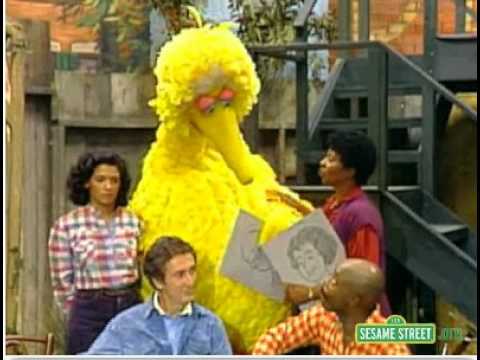
Big Bird, played by Carroll Spinney, surrounded by, left to right:
Maria (Sonia Manzano), Bob (Bob McGrath),
Susan (Loretta Long) and Gordon (Roscoe Orman)

For a few years by that point, Northern Calloway had played David (his last name was never mentioned), a young black man who had been Mr. Hooper's assistant. David inherited Hooper's Store. After that, David hired Gina Jefferson, a teenage girl played by Alison Bartlett-O'Reilly. But Calloway fell victim to mental illness, left the show in 1989, and died a year later.

The store was then bought by Mr. Handford, a black retired firefighter played by Leonard Jackson for one season, then by David L. Smyrl. Jackson played Mr. Handford as a grumpy old man, while Smyrl found the same balance between grumpy old man and kindly old gentleman that Lee had. (David's disappearance was explained as the character simply moving away, while the change in actor for Mr. Handford was less drastic, since the character wasn't original and beloved, as Mr. Hooper and, to a lesser extent, David were.)

In 1998, Smyrl left the show, and it was explained that Mr. Handford had sold the store to Alan (whose last name has never been revealed). Alan is played by Japanese-American actor Alan Muraoka, and has run the store ever since -- his 24 years in charge nearly twice as long as the 13 years we saw Mr. Hooper run it, although we have no way of knowing how long it was open before 1969.

But, to this day, the drawing of Mr. Hooper that Big Bird made, and showed in the farewell episode, rests adjacent to Big Bird's nest, as a reminder of Mr. Hooper, and of Will Lee.
Carroll Spinney, in his 80s, began to pull back, allowing Eric Jacobson to take over as Oscar in 2015, and Matt Vogel to replace him as Big Bird 2018. Spinney died the following year. But, like Oscar, Bert and Ernie, Grover, Cookie Monster, The Count, and all the rest, Big Bird lives. Which means he'll never see Mr. Hooper again -- barring the invention of a Star Trek-style holodeck or the intervention of an artificial intelligence setup that can simulate the character. 

*

November 24, 1983 was Thanksgiving Day, a Thursday. The NFL's usual suspects for the day both won. In the opener, on NBC, the Detroit Lions beat the Pittsburgh Steelers, 45-3 at the Silverdome in the Detroit suburb of Pontiac, Michigan. In the nightcap, on CBS, the Dallas Cowboys beat the football version of the St. Louis Cardinals, 35-17 at Texas Stadium in the Dallas suburb of Irving, Texas.

There was 1 college football game: Memphis State University (now the University of Memphis) beat the University of Louisville, 45-7 at Cardinal Stadium in Louisville.

At the time, I was in the 9th grade at Hammarskjold Junior High School in East Brunswick, Middlesex County, New Jersey. In East Brunswick, the High School is limited to 10th, 11th and 12th grades. EBHS played that day, away to Colonia High School in Woodbridge, the school's longest regular roadtrip, so I couldn't have gone even if I'd been aware of it at the time. EBHS won it, 21-7.

As usual, the NBA did not play on Thanksgiving. But the NHL did. The Quebec Nordiques beat the Boston Bruins, 6-3 at the Boston Garden. And the Winnipeg Jets and the Calgary Flames played to a 4-4 tie at the Saddledome in Calgary.

This was a little unusual, since 3 of the 4 teams that played on the day were in Canada. Canada does celebrate a Thanksgiving Day, on the 2nd Monday in October, when America celebrates Columbus Day.

And they do celebrate it with football: A nationally-televised doubleheader known as the Thanksgiving Day Classic. There's a game in the East, usually hosted by the Montreal Alouettes; and a game in the West, where the host varies. This year, the Alouettes beat the Ottawa Redblacks, 20-16 at Molson Stadium in Montreal; and, while Ontario is not exactly in Western Canada, the Toronto Argonauts beat the Hamilton Tiger-Cats, 24-23 at Tim Hortons Field in Hamilton.

Sunday, November 20, 2022

November 20, 1970: "Wall Street Week with Louis Rukeyser" Premieres

November 20, 1970: Wall Street Week with Louis Rukeyser premieres on PBS, broadcast from the studios of Maryland Public Television, led by WMPB-Channel 22, in the Baltimore suburb of Owings Mills.

Louis Richard Rukeyser was born on January 30, 1933 in Manhattan, and grew up in nearby New Rochelle, New York. His father, Merryle Rukeyser, was a financial journalist. At Princeton University, he wrote his senior thesis on Senator Joseph McCarthy, and his roommate was Wayne Rogers, who later starred on M*A*S*H. When Rogers became a high-powered investor after leaving acting, he was a frequent guest on Rukeyser's programs.

Rukeyser became a political and foreign correspondent for The Baltimore Sun, and became well-known enough in Baltimore for its PBS station to ask him to host a TV show about how international markets affected the American economy. The show, airing every Friday night at the close of a business week, was a hit, and became one nationally when PBS proper picked it up.

He took pride in creating the first television show which focused on the American stock markets, using a combination of erudition, plainspokenness, and panache to make the arcane workings of the stock market and the economy better known to the public. Like fellow PBS stars Fred Rogers and Julia Child, and later Carl Sagan, Bob Ross and Bob Vila, Rukeyser explained difficult things in a way that the average viewer could understand, without treating them like a child (or, in Mr. Rogers' case, he was talking to children, but treated them as though their feelings mattered.)

If he spoke well of a company on his Friday night broadcast, and it did well in trading the following Monday, it was said to benefit from "The Rukeyser Effect." Although an ardent capitalist, he was not a stereotypically stodgy old-time Wall Street conservative, reveling in humor. For example: In answering a letter on investing in a hairpiece manufacturer, he said, "If your money seems to be hair today and gone tomorrow, we'll try to make it grow back by giving the bald facts on how to get your investments toupee."

People magazine named him "the only sex symbol of the dismal science." (Historian Thomas Carlyle had labeled economics "the dismal science" in an 1849 essay.) In 1987, Jon Lovitz impersonated him on Saturday Night Live. In 1989, Wall Street Week was mentioned on an episode of the sitcom Family Ties; while Rukeyser himself was mentioned on a 1995 episode of Seinfeld.

By the 1990s, Wall Street Week faced increasing competition from rivals like CNBCIn 2002, acknowledging the fact that he was 69 years old -- but ignoring the fact that he was as popular as ever -- PBS executives wanted to replace him with a younger host to help boost ratings, offering him a 5-minute segment on a newly retooled version of the show, but he turned it down, with a rather pointed farewell on March 22, 2002.

Sensing a golden opportunity, CNBC offered him a new show, which was named Louis Rukeyser's Wall Street -- unless his PBS show, he now had top billing over Wall Street itself. But it didn't last long, as his health began to fail, and his absences and need for substitute hosts became more frequent. His last installment aired on December 31, 2004, and he died on May 2, 2006, at the age of 73.

His brother, William S. Rukeyser, was the founding managing editor of Money magazine in 1972, and the managing editor of Fortune, the financial magazine of Time, Inc.

PBS kept his old show going, under the name Wall Street Week with Fortune, going until June 24, 2005, hosted by Geoff Colvin and Karen Gibbs. It returned in 2015, on Fox Business Network, as simply Wall Street Week. Since 2020, it has been broadcast by Bloomberg Television, and hosted by David Westin.

*

November 20, 1970 was a Friday. Actress Sabrina Lloyd was born.

Baseball was out of season. There was 1 college football game played that night, and it was an upset: Number 14 San Diego State lost to Long Beach State, 27-11 at Anaheim Stadium. The school known then as "California State College, Long Beach," and renamed "California State University, Long Beach" in 1972, usually played its games at Veterans Memorial Stadium, but with Aztecs fans coming up from San Diego, they were able to sell 39,000 tickets at what's now named Angel Stadium of Anaheim.

There were 6 games in the NBA:

* The Boston Celtics beat the Cleveland Cavaliers, 116-112 at the Boston Garden.

* The Detroit Pistons beat the Philadelphia 76ers, 120-112 at The Spectrum in Philadelphia.

* The Baltimore Bullets beat the Phoenix Suns, 121-110 at the Baltimore Civic Center (now the CFG Bank Arena).

* The Milwaukee Bucks beat the Los Angeles Lakers, 117-100 at The Forum outside Los Angeles in Inglewood, California.

* The San Diego Rockets beat the Seattle SuperSonics, 121-106 at the San Diego Sports Arena (now the Pechanga Arena).

* And the San Francisco Warriors beat the Buffalo Braves, 123-108 at the Cow Palace outside San Francisco in Daly City, California.

There were 4 games in the American Basketball Association:

* The New York Nets lost to the Denver Rockets, 121-103 at the Denver Auditorium Arena.

* The Kentucky Colonels beat the Carolina Cougars, 100-98 at the Greensboro Coliseum in Greensboro, North Carolina.

* The Virginia Squires beat the Pittsburgh Condors, 151-113 at the Civic Arena in Pittsburgh. Charlie Scott of the Squires led all scorers on the night with 41 points.

* And the Texas Chaparrals beat the Indiana Pacers, 140-126 at the Moody Coliseum in the Dallas suburb of University Park, Texas.

There was 1 game in the NHL: The Vancouver Canucks beat the Los Angeles Kings, 7-1 at the Pacific Coliseum in Denver. The Canucks got 7 goals from 7 different players, the 1st from Pat Quinn, who went on to coach them to their 1st Stanley Cup Finals in 1982.

Thursday, November 10, 2022

November 10, 1969: "Sesame Street" Premieres

November 10, 1969: Sesame Street premieres on PBS. It became the greatest show in the history of children's television.

Three years earlier, TV producer Joan Ganz Cooney and Carnegie Foundation vice president Lloyd Morrisett met to discuss creating a children's television show that would "master the addictive qualities of television and do something good with them." In 1968, they founded the Children's Television Workshop (CTW), and received grants from the Carnegie Foundation (later the Carnegie Corporation of New York), the Ford Foundation, and the Corporation for Public Broadcasting.

The original title for the show was 123 Avenue B. Get it? 1, 2, 3, A, B: Counting and the alphabet. But this idea was discarded, because people would have sought out the actual address, off East 8th Street, across from Tompkins Square Park in Manhattan. At the time, the Lower East Side of Manhattan was a pretty rough neighborhood: No person aware of its conditions would have wanted to know how to get there, but kids, not knowing, would have begged their parents to take them.

So the title became Sesame Street. Sesame is a seed that is a source of oil, but, at this time, while McDonald's had introduced the Big Mac burger with its famed "sesame seed bun," the jingle mentioning it didn't debut until 1974. So most people knew the word "sesame" from "Open sesame," a line used in Ali Baba and the Forty Thieves. People would associate "sesame" with "open," with the idea that they were opening children's minds to learning.

Since what became known as "The Street" (Capital T, Capital S) was supposed to be in a generic neighborhood in New York City, where it was taped, the show was big on diversity from the start. The first character to appear on the show was Gordon Robinson, played by Matt Robinson. (His daughter became an actress: Holly Robinson Peete.) Gordon was a science teacher, who was married to Susan, a nurse, played by Loretta Long. Together, they owned the building that was the centerpiece of the show, with the address of 123 Sesame Street.

The producers wanted to show a black couple as successful and stable. Well, they got most of what they wanted: Long remained on the show until retiring in 2016, and the Gordon character was retired the following year; but there were 3 separate actors playing him. Matt Robinson left in 1972, ironically because he was behind the times: He left because of a creative difference, namely that he did not want Susan to be depicted as working outside the home. He was replaced by Hal Miller, who left in 1974 because he didn't like being on a children's show. Roscoe Orman then played the character for the next 43 years.

In 1976, Alaina Reed joined the cast as Olivia Robinson, Gordon's sister and a photographer. In 1985, Miles Orman, Roscoe's real-life son, joined the cast as Miles, the adopted son of Susan and Gordon.

Another original castmember was Will Lee, as Harold Hooper, operator of Hooper's Store, across from 123 Sesame. In a 1974 episode, "Mr. Hooper" (everybody called him that, except Big Bird -- more on that in a moment) was, like his portrayer, canonically revealed to be Jewish, when his phone rang, and he began speaking Yiddish. In a 1977 episode, he told Big Bird, "I grew up in a neighborhood where that was the only language a lot of people spoke." In the 1978 special Christmas Eve On Sesame StreetBob wished him a Happy Hanukkah.

Bob Johnson, a music teacher, was played by Bob McGrath. Along with Loretta Long, he was the last remaining original castmember, also retiring in 2016. Bob was white, and, aside from being as talented as the other characters, had nothing to make him stand out.

One particular song he sang was "I'm Going Somewhere," and challenged the audience: "Can you guess where?" He rattled off pretty much every way you could get there, concluding with subway and jeep, before sitting on the stoop of 123 Sesame, and singing, "I'm going... to sleep," and dozing off.

In 1971, in recognition of America's growing Hispanic community, Mexican-American actor Emilio Delgado was added, as Luis Rodriguez, owner of The Fix-It Shop, next-door to Hooper's Store. That same year, Bronx native Sonia Manzano was added as teenager Maria. In 1979, to celebrate the character's 21st birthday, the cast, Muppets included, went to Puerto Rico to meet Maria's family and celebrate.

The show combined human characters, both adults and children, with Jim Henson's "Muppet" puppets. It taught letters and the words those letters stood for, and numbers. Just as every episode began with the eventually iconic theme song (starting with "Sunny day, sweeping the clouds away" and concluding with "Can you tell me how to get, how to get to Sesame Street?"), every episode ended with a castmember saying, in a parody of sponsorship, that the show was brought to you by 2 letters and a number that were featured in it. Example: "Sesame Street has been brought to you today by the letters M and P, and by the number 4." (M and P are my initials, and 4 has always been my favorite number.)

Some of the Muppet characters became icons. Carroll Spinney both wore the costume as Big Bird, who represented childlike wonder (to this day, even after Spinney's retirement, replacement and death, the character is said to be 6 years old), and operated the character of Oscar the Grouch.

Several "monster" Muppets were introduced, to show kids that just because someone is different -- even a monster -- doesn't mean they're bad. Okay, Cookie Monster is a glutton, and Grover is a klutz, but they mean well.

There were Bert and Ernie, who debuted in the 1st episode. Contrary to popular belief, they are not a gay couple, and were never meant to be. (The Stonewall Riot happened just 5 months earlier.) Contrary to another popular belief, they were not named after Bert the cop and Ernie the cabdriver in the film It's a Wonderful Life.

But they were based on The Odd Couple, which had already been a Broadway play and a movie, but not yet a TV show: Bert was the "Felix," uptight with some strange hobbies; and Ernie was the "Oscar," sloppy and immature. The name and personality of Oscar the Grouch, who loved trash and lived in a trash can, may also have been a nod to Oscar of The Odd Couple.

Occasionally, Kermit the Frog, an original Jim Henson Muppet, would make an appearance. In 1976, Kermit became the "host" of The Muppet Show, which, at first, confused the heck out of me: I thought the Muppets meant Sesame Street, but he was the only Sesame Street character who appeared on it. (Eventually, Big Bird would make an appearance, and Bert and Ernie also would, but those were rare exceptions.)

And except for Kermit, no Muppet Show characters -- not Miss Piggy, not Fozzie Bear, and, thankfully, not Statler and Waldorf -- crossed over onto Sesame Street. At that age, I didn't know that the Muppets, including Kermit himself, went all the way back to 1955, and were regulars on The Ed Sullivan Show in the 1960s.

Some Muppets would be re-used. For example, TV game show host Guy Smiley was re-dressed as The Muppet Show's anchorman: "Here is a Muppet News Flash!" There was also a "Fat Blue" that was used for several early characters, including the bald, mustachioed restaurant customer who drove Grover, playing a waiter, crazy.

Let's see, I've mentioned Big Bird, Oscar, Cookie Monster, Grover, Bert, Ernie, Kermit, Guy and Fat Blue. That's one, two, three, four, five, six, seven, eight, nine! Nine nifty Muppets! Ah ah ah ah! (BOOM!) Oh yes, there was also "The Count": "Do you know why they call me The Count? Because I love to count things!" He was later given the full name of Count Von Count. He was a purple guy who looked like Count Dracula, but didn't bite anybody. (Come to think of it, while Cookie Monster would eat almost anything, not just cookies, he didn't bite anybody, either. Except for that one time when he tried to eat Guy Smiley's hand.)

The show also produced legendary songs. Kermit's "Bein' Green," meant to say that it's okay to be different; Ernie's bathtime song "Rubber Duckie"; and "Mah Na Mah Na" actually became hit records. (It was 1970. There were some considerably stranger songs on the charts in those days.) All were sung by Henson himself, who operated and voiced the corresponding Muppets.

(Officially, the hippie-looking guy who sings "Mah Na Mah Na" is named Bip Bippadotta, but everybody ended up calling him "Mahna Mahna," so that became his official name when he appeared on The Muppet Show, with "Bip" still being his Sesame Street name.)

Other songs that were featured on Sesame Street included Big Bird's alphabet song "Abcdefghijklmnopqrstuvwxyz" (pronounced "AB-ka-DEF-gee-JECK-le-min-OP-qwer-STOOV-wix-iz"), Cookie Monster's "C is for Cookie," Oscar's "I Love Trash," "Sing (Sing a Song)" and "One of These Things Just Doesn't Belong Here."

The 1st episode introduced 2 counting sequences: "Jazz Numbers," narrated by, of all people, Grace Slick of the Jefferson Airplane; and "Song of Ten," which always concluded with a baker, voiced by Henson but played by Alex Stevens, holding a tray full of desserts, whatever number of them that was the featured number, at the top of a staircase, and then falling down the stairs.

Starting in 1971, Paul Benedict, later part of the regular cast of The Jeffersons, played The Mad Painter, painting a particular number in places where it shouldn't have been. The animated "Pinball Number Count," which, unlike previous counting sketches, went past 10 to 12, debuted in 1977.

I was born just 38 days after Sesame Street debuted. The show and I grew up together. By 1978, it was big enough to get its own Christmas special, with Bert and Ernie having a storyline paralleling O. Henry's story The Gift of the Magi, except that Mr. Hooper came through to provide a happy ending. Also, Cookie Monster tried to contact Santa Claus, but every method -- his pencil, his typewriter, his phone -- reminded him of cookies, and he ate them.

And, in an unusual instance of Spinney's characters interacting, Oscar asked Big Bird how big fat Santa got down those skinny little chimneys on the roofs of city apartment buildings. Big Bird got worried that Santa might not be able to come to Sesame Street, and nobody would get any presents. Spoiler Alert: The presents showed up, and Big Bird was told that it didn't matter how it happened.

Also by that point, there were international versions of the show. It became Plaza Sesamo in Spanish-speaking countries; 1, rue Sésame in French-speaking countries; Sesam Strasse in German-speaking countries; and, from 1983 to 2015, in Israel, Rechov Sumsum, with the street in question being a safe place for Jewish and Muslim children to play together, a "neutral zone" apart from "the real world." Today, Sesame Street has variations shown in 150 different countries, in 70 languages.

Big Bird occasionally had a difficult relationship with the show's grownups. Starting in 1971, he had a friend, Mr. Snuffleupagus. This was a big thing with orange hair that looked like an elephant, with a long trunk, but without the large ears. He did, eventually, get a first name: Aloysius Snuffleupagus. But Big Bird usually just called him "Snuffy." Snuffy called him "Bird."

The Muppets and the show's kids could see him, but the grownups never did. Since they'd never heard of a snuffleupagus, and Snuffy never seemed to show up when Big Bird needed him to, they said there is no snuffleupagus, usually followed by, "Big Bird, you sure have some imagination!"

Times change, and the show had to change with it. By the mid-1980s, it began to dawn on the CTW's people that children might see that the grownups didn't believe Big Bird when he said Snuffy was "real," so they might not be believed about important things -- good or bad. So the decision was made to have them definitively see Snuffy.

The episode where it happened aired on November 18, 1985, the premiere of the show's 17th season. This was also the episode that introduced the character of Elmo, the little red monster Muppet, and he turned out to be instrumental in Snuffy's revelation. This is what I call the show's "hinge episode": Elmo proved so popular that he came to dominate the show. "Elmo's World" became a segment, but, at times, it seemed like the entire show was Elmo's world.

A quirk in Big Bird's character was that he always mispronounced Mr. Hooper's name, usually coming out "Mister Looper." I remember a "Mr. Dooper" and a "Mr. Stooper" -- that last one really annoyed Mr. Hooper. Even when Mr. Hooper got his GED, he was introduced at the ceremony -- by a grownup -- as "Harold Cooper."

On December 7, 1982, Will Lee died at age 74. The CTW had a dilemma. They based their whole show on the fact that kids were smart enough to learn things. So they knew that kids would notice if Mr. Hooper were played by a different actor, or if he stopped appearing altogether, and would need an explanation. Since it had been established on the show that he had a brother living in Chicago, they toyed with the idea of saying the character had retired and moved away.

In the end, they decided to tell the truth -- or, rather, write the actor's truth into the character's story. On November 24, 1983 -- Thanksgiving Day, a day when families were together, to help explain to the kids watching anything that the show might not have properly covered -- it was revealed that Mr. Hooper had died some time earlier (no cause was given), but that Big Bird still didn't grasp what this meant. He had to be told that it means, "Mr. Hooper's not coming back."

McGrath said of the human cast, "We barely got through that show." Spinney said, "The best episode we ever did was Mr. Hooper's death. Those were real tears. Will was the sweetest man."

In 1986, Manzano got married in real life. In 1988, she got pregnant. Now, the CTW had a very different adult issue on their hands. They couldn't have Maria disappear from the show until after Sonia's baby was born: Again, kids would notice, and ask what was going on.

So, since it had long been established that Maria worked for Luis at The Fix-It Shop, the writers wrote a story that had Luis and Maria falling in love, getting married, and having a baby. It was all above-board. It was a story that could have been told on TV, even 20 years earlier.

Except, by this point, I was an adult, and I thought it was kind of a creepy way around it. Sure, they were both Hispanic (the term "Latinx" for Hispanics of every gender identity wasn't used yet), and they already knew and liked each other. But Luis was old enough to be Maria's father! (Or so I thought. As it turned out, Manzano was 38 when the baby was born, and only 10 years younger than Delgado. But I didn't know that then.)

So, in the 1990s, Gordon and Susan's son Miles and Luis and Maria's daughter Gabi became the representatives of what could have been called Sesame Street: The Next Generation. By this point, with Northern Calloway, who played Mr. Hooper's assistant David, also having left the show (it wasn't a story I'd like to share, and he died soon thereafter), Hooper's Store was run by Alan, a Japanese-American played by Alan Muraoka, and Miles and Gabi went on to work there.

I guessed that the show would eventually write in a romance between them. This hasn't happened: When they graduated from high school (together, despite Miles being introduced as a baby 4 years earlier), and went off to college, the characters were written out of the show. 

Other difficult subjects were introduced. Deaf actress Linda Bove introduced the show's viewers to sign language and the difficulties of hearing impairments. Aristotle was introduced in 1981 as a blind Muppet, Julia in 2017 an autistic one, and Lily in 2011 as a poor one, revealed in 2018 to be homeless. Because he depended on his hearing more than any other character on the show, Aristotle is one of the few monster Muppets to have visible ears.

After September 11, 2001, an episode was written with as close a parallel to the terrorist attacks as the writers could safely come up with: Maria and Elmo are in Hooper's Store when a grease fire breaks out. Although Alan is able to put it out with his fire extinguisher, Maria still has to get Elmo out, and Elmo is traumatized by the event. And when the firefighters, wearing their full equipment, making them look bigger than people their size would normally be, try to talk to him, he's scared further. They explain things to them, and invite him to their firehouse, and he calms down.

Joan Ganz Cooney is still alive, and is scheduled to turn 93 on November 30. Lloyd Morrisett is also still alive, and turned 93 on November 2. He also co-created The Electric Company, which The CTW also ran, from 1971 to 1977. (UPDATE: Morrisett died on January 22, 2023.)

Sesame Street was originally taped at Reeves Teletape Studios, at 81st Street and Broadway, formerly CBS Studio 72. Also taped there were The Electric Company, and several other shows, for kids and adults alike. In 1986, Reeves Teletape was demolished, and Sesame Street moved production to Unitel Video, at 515 W. 57th Street, off 10th Avenue. Since 1993, they have taped at Kaufman Astoria Studios, on a block in Astoria, Queens bounded by 35th and 36th Avenues, and 35th and 36th Streets.

In 2000, The Children's Television Workshop was renamed Sesame Workshop. In 2016, Sesame Street left PBS, and moved to HBO, where it just began its 54th season. It remains relevant.

A 2015 episode of the YouTube series Epic Rap Battles of History featured "Epic" Lloyd Ahlquist as Stan Lee, against "Nice" Peter Shukoff as Muppets creator Jim Henson, with Zach Sherwin stepping in as Walt Disney, "taking over" the battle the way his company bought out both Marvel and the Muppets franchise. 

*

November 10, 1969 was a Monday. Actress Ellen Pompeo, and soccer legends Jens Lehmann of Germany and Faustino Asprilla of Colombia were born on this day.

The baseball season was over. And the NFL wouldn't start Monday Night Football until the following year.

There were 2 games played in each of the major basketball leagues of this period:

* In the NBA, the New York Knicks lost to the Los Angeles Lakers, 130-109 at The Forum outside Los Angeles in Inglewood, California. Dick Barnett led the Knicks with 26 points. For the Lakers, Elgin Baylor also scored 26, Jerry West 24 with 11 assists, and Wilt Chamberlain 21 with 21 rebounds. This turned out to be a preview of the 1969-70 season's NBA Finals, but the Knicks would win.

* And the Phoenix Suns beat the Detroit Pistons, 130-128 in overtime at the Arizona Veterans Memorial Coliseum in Phoenix.

* In the ABA, the New York Nets lost to the Minnesota Pipers, 118-96 at the Metropolitan Sports Center in the Minneapolis suburb of Bloomington, Minnesota.

* And the Oakland Oaks beat the Miami Floridians, 137-129 at the Miami Beach Convention Center.

And there were 4 games played in the NHL:

* The New York Rangers beat the Chicago Black Hawks, 4-2 at the Chicago Stadium. The Rangers got 4 different scorers: Jim Neilson, Bob Nevin, Jean Ratelle and Phil Goyette.

* The Boston Bruins and the St. Louis Blues played to a tie, 1-1 at the Boston Garden. This turned out to be a preview of the Stanley Cup Finals, which the Bruins would win.

* The Montreal Canadiens and the Detroit Red Wings played to a tie, 4-4 at the Olympia Stadium in Detroit.

* And the Toronto Maple Leafs beat the Oakland Seals, 3-1 at the Oakland Coliseum Arena.

* The Los Angeles Kings, the Minnesota North Stars, the Philadelphia Flyers and the Pittsburgh Penguins were not scheduled. 

Thursday, November 3, 2022

November 3, 1969: PBS Begins Broadcasting

November 3, 1969: The Public Broadcasting Service (PBS) begins operation, replacing National Educational Television (NET). A week later, on November 10, it began broadcasting Sesame Street. From NET, it inherited Mr. Rogers' Neighborhood. It later developed the kids' shows The Electric Company, Zoom! and 3-2-1 Contact.

For grownups, it inherited The French Chef with Julia Child, and would develop Masterpiece Theatre with Alistair Cooke, Mystery! with Vincent Price, Great Performances (nearly always featuring classical music) with several hosts, The Joy of Painting with Bob Ross, Nova with several hosts, Cosmos with Carl Sagan, Scientific American Frontiers with Alan Alda, and The American Experience with David McCullough. (Some of these shows would be hosted by others as their predecessors aged or died.)

PBS member stations include the following:

* WGBH-Channel 2, Boston.

* WNET-Channel 13, Newark, New Jersey, serving New York City.

* WHYY-Channel 12, Wilmington, Delaware, serving Philadelphia.

* WMPB-Channel 67, Baltimore.

* WETA-Channel 26, Washington, D.C.

* WUNC-Channel 4, Chapel Hill, North Carolina, serving Raleigh and Durham.

* WTVI-Channel 42, Charlotte.

* WGTV-Channel 8, Athens, Georgia, serving Atlanta.

* WJCT-Channel 7, Jacksonville.

* WUCF-Channel 24, Orlando.

* WEDU-Channel 3, Tampa.

* WPBT-Channel 2, Miami.

* WNPT-Channel 8, Nashville.

* WKNO-Channel 10, Memphis.

* WYES-Channel 12, New Orleans.

* KETA-Channel 13, Oklahoma City.

* KERA-Channel 13, Fort Worth, Texas, serving Dallas.

* KUHT-Channel 8, Houston.

* KLRU-Channel 18, Austin.

* KLRN-Channel 9, San Antonio.

* WNED-Channel 17, Buffalo.

* WQED-Channel 13, Pittsburgh.

* WVIZ-Channel 25, Cleveland.

* WOSU-Channel 34, Columbus.

* WCET-Channel 48, Cincinnati.

* WTVS-Channel 56, Detroit.

* WFYI-Channel 20, Indianapolis.

* WTTW-Channel 11, Chicago.

* WMVS-Channel 10, Milwaukee.

* KTCA-Channel 2, St. Paul, serving Minneapolis.

* KETC-Channel 9, St. Louis.

* KCPT-Channel 19, Kansas City.

* KRMA-Channel 6, Denver.

* KUED-Channel 7, Salt Lake City.

* KAET-Channel 8, Phoenix.

* KLVX-Channel 10, Las Vegas.

* KPBS-Channel 15, San Diego.

* KCET-Channel 28, Los Angeles.

* KQED-Channel 9, San Francisco.

* KVIE-Channel 8, Sacramento.

* KOPB-Channel 10, Portland, Oregon.

* KTCS-Channel 9, Seattle.

So when, in his 1982 hit "Pressure," Billy Joel sang, "All your life is Channel 13, Sesame Street, what does it mean?" he was referring specifically to the affiliate representing his hometown of New York, WNET. But because that station is the best-known PBS station, the phrase "Channel 13" has come to stand in for PBS in general, even in the vast majority of American cities where it's on a different channel.

*
November 3, 1969 was a Monday. This was also the night of President Richard Nixon's "Silent Majority" speech, and I have an entry for that as well.

The baseball season was over. There was no football: The NFL and ABC began partnering for Monday Night Football the following season. And while the NHL season had begun, no games where scheduled for that day.

Only 1 game was scheduled in the NBA: The New York Knicks beat the Milwaukee Bucks, 109-93 at the Milwaukee Arena. In 1974, it was renamed the Milwaukee Exposition, Convention Center and Arena, or "The MECCA." Since 2014, it has been named the UW-Panther Arena. Willis Reed scored 35 points, Bill Bradley 19, Dave DeBusschere 18, Dick Barnett 14, and Walt Frazier and Cazzie Russell each scored 10. Kareem Abdul-Jabbar, then a rookie and still using his birth name of Lew Alcindor, scored 17 for the Bucks.

There was 1 game in the American Basketball Association: The New Orleans Buccaneers beat the Washington Capitols, 125-115 at the New Orleans Municipal Auditorium. Neither team survived to be admitted to the NBA.

Tuesday, October 25, 2022

October 25, 1971: "The Electric Company" Premieres

Back row, left to right: Rita Moreno, Jim Boyd, Judy Graubart,
Morgan Freeman, Hattie Winston, Luis Ávalos,
Danny Seagren as Spider-Man, Skip Hinnant.
Front row, The Short Circus, left to right:
Réjane Magloire, June Angela, Janina Mathews,
Rodney Lewis, Todd Graff.

October 25, 1971: The Electric Company premieres on PBS. A companion piece to Sesame Street, it is geared toward kids a little older who were, by then, learning to read. As the closing tagline says, it is produced by the same production company: "The Electric Company gets its power from The Children's Television Workshop."

It is also backed by many of the same foundations that funded Sesame Street, including The Ford Foundation and The Carnegie Corporation of New York. And by the U.S. Department of Health, Education and Welfare (HEW), founded in 1953, and split in 1980 to form the Department of Education (DOE), and the Department of Health and Human Services (HHS).

Included in the original cast of this show are 2 performers who are already legends: Rita Moreno, 39; and Bill Cosby, 34. Not yet a star was Morgan Freeman, 34. Also in the original cast: Judy Grabuart, 28 and a veteran of the Second City comedy troupe; Lee Chamberlin, 33; and Joseph "Skip" Hinnant, 31.

All had done stage work in New York. Of note: Hinnant had appeared in the Broadway musical You're a Good Man, Charlie Brown, based on Charles Schulz's comic strip Peanuts: He had played Schroeder, the piano-playing catcher; while his brother, Bill Hinnant, played Snoopy, Charlie Brown's beagle who played shortstop and pretended to be a World War I flying ace.

Not onscreen, but providing voices, was Jim Boyd, about to turn 38. He, Wayland Flowers (the ventriloquist for Madame) and Cleavon Little (later Sheriff Bart in Blazing Saddles) had done puppetry and voices for The Surprise Show, a local New York kids' show.

Like the cast of Rowan & Martin's Laugh-In, still on the air at this point, the performers would often imitate the already-defunct mode of vaudeville. They used routines that emphasized a particular letter, group of letters, or sound to help kids with reading. Other sketches would be used for this as well. For example, on a few occasions, they would demonstrate that the letters "ie" could be pronounced like the letter E, or the letter I, as in "a piece of pie." Which, as you've probably guessed, involved someone getting hit in the face by a pie.

Freeman played a comic version of Count Dracula, who, like Sesame Street's Cookie Monster, would bite anything. (Although only once did I ever see Cookie Monster bite a person, and a Muppet at that.) He also played Mel Mounds, a disc jockey who would play songs by The Short Circus (more about whom later).

Most of all, he played Easy Reader, whose name was a play on Easy Rider. At first, Easy was an out-and-out hippie, looking like he had raided the wardrobe of the recently deceased Jimi Hendrix. As the show went on, he developed a look that was more urban cool cat: Shorter hair, sunglasses (sometimes even indoors), leather shoes, and a jacket-pants combo that was originally blue denim, and later brown suede. The jacket had a flower on the back and a light bulb on the sleeve.
Freeman also played Marcello, the perpetually-abused cue card man employed by Otto, a parody of an old-time movie director (named after Otto Preminger) played by Moreno. She also played Pandora, a naughty little girl.
She also played Millie the Helper (named after Millie Helper, a character from The Dick Van Dyke Show), whom Cosby kept trying and failing to train at various jobs. It seemed the only thing she was competent at was yelling, "Hey, you guys!"

It became the show's first catchphrase, and was even incorporated into the show's opening segment. When my sister was the age at which it was appropriate to start watching the show, she thought its name was Hey You Guyyyyyyyys! To this day, people who have never seen West Side Story or any other of Rita's roles see her and say, "Hey, you guys!"

In Season 2, 1972-73, Boyd became an onscreen performer for the first time, although not always recognizable. In Season 1, in a play on both "crank calling" and on the British film producer J. Arthur Rank, he played the angry voice of J. Arthur Crank.

In Season 2, the character of Crank was seen for the first time. His face, hair and mustache resembled those of Rank, but he dressed and acted like a slob, but not really a bad guy. Essentially, Crank was a parody of All In the Family's Archie Bunker, minus the bigotry, which was important on a show with black actors Cosby, Freeman and Chamberlin, and Hispanic actress Moreno.
Boyd also put on a gorilla suit to play Paul the Gorilla, alongside Graubart's Jennifer of the Jungle, a parody of both Tarzan and George of the Jungle, in which "Tarzan" and "Jane" were basically the same person, and Paul was her "Cheeta." 
Another letter combination with 2 different sounds.

Boyd also played a bumbling superhero named Blue Beetle, not connected to any of the 3 heroes who have used that name in comic books. He also continued to voice Maurice the talking plant and a talking chicken named Loreli Loverly. In addition to Jennifer, Graubart played a parody of PBS chef Julia Child, named Julia Grownup.

Also joining the cast at this time was Luis Ávalos, a Cuban-born actor then just 26, but already distinctively bald, but sometimes (not always) with a mustache. The mustache enabled his best-known character: A parody of the name of Dr. Dolittle and the characters played in 1930s film comedies by Groucho Marx, Dr. Doolots had a gigantic orange Afro. He also teamed with Morgan Freeman, as Igor to Freeman's Mad Scientist.
Boyd as Paul, Ávalos as Dr. Doolots, Graubart as Jennifer

Boyd and Ávalos could be added because Cosby left the show after Season 1, to devote more attention to his CBS Saturday morning cartoon Fat Albert and the Cosby Kids. Chamberlin, best known for playing Vi (presumably, short for Violet) of Vi's Diner -- as the song went, "and the homemade pies, and that is why we go to Vi's" -- left after Season 2 as well. Nevertheless, segments with each of them would appear on the show for the rest of its run.
Chamberlin as Vi, singing to a visiting Grover from Sesame Street

Hinnant played Fargo North, Decoder. He wore a trenchcoat and a fedora like a 1940s private detective, but the fedora was pink. And he was a bit of a bumbler, in the mold of Maxwell Smart, the spy played by Don Adams on Get SmartLike Easy, Fargo had his own theme music. Once, Fargo visited Dr. Doolots, and the sketch ended with Fargo's theme playing, and, in his best Groucho impression, Ávalos said, "What's your music doing in my office?"
Hinnant as Fargo, with a visiting Big Bird from Sesame Street

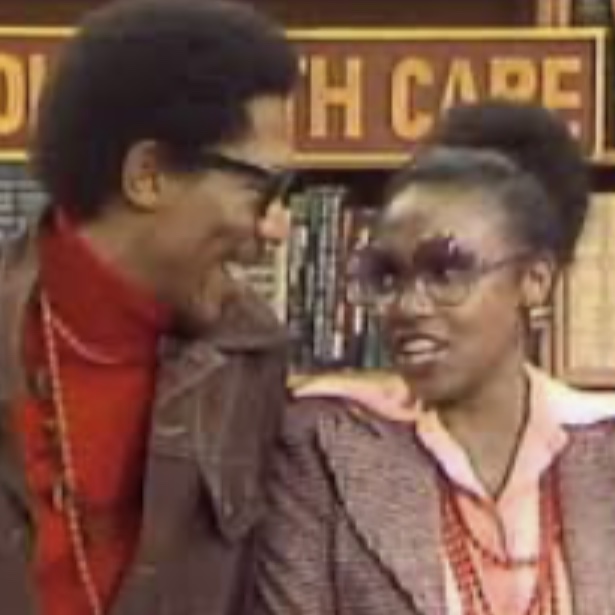
In Season 3, Chamberlin was replaced by another black New York stage actress, Hattie Winston, 28. She became Valerie the Librarian, who had playful banter with Easy Reader, suggesting (but never outright saying) that they might have been a couple.
Freeman and Winston as Easy and Valerie

Season 4 introduced Spidey Super Stories, with Danny Seagren, 31, a professional dancer who had previously appeared on Sesame Street, as the first ever live-action version of the Marvel Comics superhero Spider-Man. This Spidey didn't exactly "talk": Instead, his words were put on the screen in "word balloons," followed by a pause for the kids watching at home to try to read, before whoever he was talking to repeated it. Instead of Spidey's usual rogues' gallery -- no Green Goblin, Dr. Octopus, Electro and so on -- the various castmembers played one-shot villains, never seen before or since.

One edition showed Spidey attending Fargo's birthday party, along with Easy, Jennifer and Paul, interrupted by Ávalos as The Blowhard, a villain with destructive super-breath that Fargo -- apparently considerably more competent when we're not watching -- had once put in prison, and was seeking revenge. Just as he was about to blow them all away, Paul hit him in the face with Fargo's birthday cake, giving Spidey the chance to sling his web and trap him.

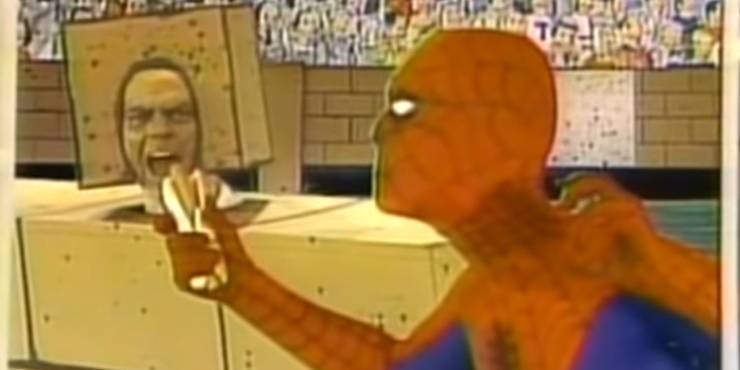
While Spidey's civilian persona, Peter Parker, was established as living in Queens, The Electric Company and Spider Super Stories was the initial establishment of him as a fan of the New York Mets, who (then as now) played in Queens. Marvel ran with it, and made Peter's Met fandom comic canon. 

Boyd played The Wall, disrupting a Met game that Spidey attended in costume: "Well, if it isn't the Wall-Crawler himself! Well, this is one Wall you'll never crawl!" Hinnant played an ill-fated outfielder, and Freeman a typically vision-impaired umpire.
I said the stories were titled "Super." I didn't say they were good.

There were animated segments as well. One had a character who never got an official name, so they just called him "Blond-Haired Cartoon Man." Mel Brooks did his voice. Satirical singer Tom Lehrer wrote and sang a series of songs featuring the "ly" and "sn" sounds, and "Silent E." Warner Brothers contributed some animated shorts featuring the Road Runner and Wile E. Coyote.

And before Spidey or the Blue Beetle were ever on the show, there was The Adventures of Letterman. Letterman was dressed like an old-time football player, with a "varsity letter" on his chest, which always happened to be just the letter needed to restore a word that had been changed by The Spellbinder, a villain who would use his magic wand to change a word and turn an item into something dangerous, or at least upsetting. Letterman was voiced by Gene Wilder, The Spellbinder by Zero Mostel, and the narrator was Joan Rivers, all of whom had worked with Brooks.
"Faster than a rolling O, stronger than Silent E,
able to leap Capital T in a single bound!
It's a word! It's a plan! It's Letterman!"

And there was the band, 5 teenagers named The Short Circus, a play on "short circuit." The original band of 1971 was June Angela, 12, as Julie, on tambourine; Irene Cara, 12, as Iris, on keyboards; Melanie Henderson, 14, as Kathy, on guitar; Douglas Grant, 12, as Zach, on guitar; and Steve Gustafson, 12, as Buddy, on drums.
Angela couldn't play an instrument, but, as the best singer they auditioned, they had to keep her, so she selected a tambourine, possibly a nod to Eddie Brigati of The Rascals and/or Mark Volman of The Turtles. She named her character after Julie Andrews. Gustafson, being a drummer, named his after Buddy Rich.

Since Cosby and Moreno were already stars, and Freeman didn't become a big star for many more years, until Driving Miss Daisy was released in 1989, Cara got the biggest boost to her career of any castmember, appearing in both the film Fame and the subsequent NBC show based on it, and having Number 1 hits from the themes from Fame and the film Flashdance.

Part of the problem with having teenage actors is that they grow up too fast, and sometimes it became hard for the little kids to relate to them. Cara left the show after the 1st season, and was replaced on keyboards by Denise Nickerson, 15 and already known for playing Violet Beauregarde in Willy Wonka and the Chocolate Factory, as Allison. In 1973, the keyboard position was eliminated, and Nickerson was replaced by Bayn Johnson, 15, as guitarist Kelly; and Grant was replaced by Gregg Burge, 14, as bass guitarist Dwayne.

In 1975, the entire band was replaced, except for Angela: Being short meant that she could still appear on the show at age 18. Henderson was replaced on guitar by Réjane Magloire, 11, as Samantha; 
Johnson on guitar by Janina Mathews, 12, as Gail; Burge on bass by Rodney Lewis, 12, as Charlie; and Gustafson on drums by Todd Graff, 16, as Jesse. 
Angela was the show's only Asian-American regular, while Cara was Hispanic, and Henderson, Grant, Burge, Magliore and Lewis were black.

On occasion, Short Circus members would interact with the adult castmembers, such as when they went to see Vi at the diner or Valerie at the library. Sometimes, a Spidey Super Story would be narrated by Angela, or feature another bandmember as the younger version of the villain, telling the brief origin story: "And so, he (or she) turned to a life of crime!"

The show made new episodes until 1977, and remained on the air in reruns until 1985. In 2009, PBS began airing a new show with the title, but, aside from the title and the use of Moreno's catchphrase, "Hey you guyyyyyyyys!" it bore no resemblance to the original. It lasted only 2 years.

Ironically, from the original show, the first castmember to die was one of The Short Circus, Burge, in 1998. Boyd died in 2013, Ávalos and Chamberlin in 2014, Grant in 2018, and Nickerson in 2019. The rest of the cast lived to see the show's 50th Anniversary -- although there will always be a cloud over Cosby, no matter how long he lives. Cara died in 2022.

UPDATE: Seagren died in 2025.

*

October 25, 1971 was a Monday. Baseball Hall of Fame pitcher Pedro Martinez was born. So were actor Craig Robinson, and classical violinist Midori Goto.

The baseball season had ended 8 days earlier, with the Pittsburgh Pirates beating the Baltimore Orioles in Game 7 of the World Series. Future Hall-of-Famer Pedro Martinez was born on this day.

Most of the NFL teams had played the day before, but on this night, ABC Monday Night Football aired the Minnesota Vikings beating the defending NFL Champion Baltimore Colts, 10-3 at Metropolitan Stadium in the Minneapolis suburb of Bloomington, Minnesota.

There was 1 NBA game played that night: The Boston Celtics beat the Atlanta Hawks, 136-116 at the Boston Garden. For the Celtics, Dave Cowens scored 27 points, and John Havlicek added 25. For the Hawks, Herm Gilliam scored 25 and Lou Hudson 23, but Pete Maravich was injured and didn't play. And there were no games scheduled that night for the ABA or the NHL.

December 31, 1999 & January 1, 2000: The Millennium

December 31, 1999:  The Millennium arrives. The people of planet Earth survived. At a terrible cost. But we hadn't destroyed ourselves. ...