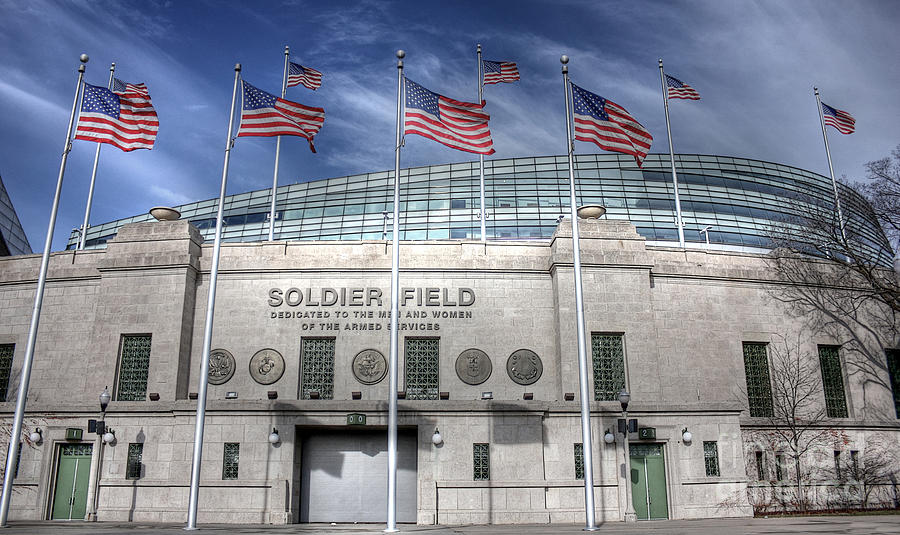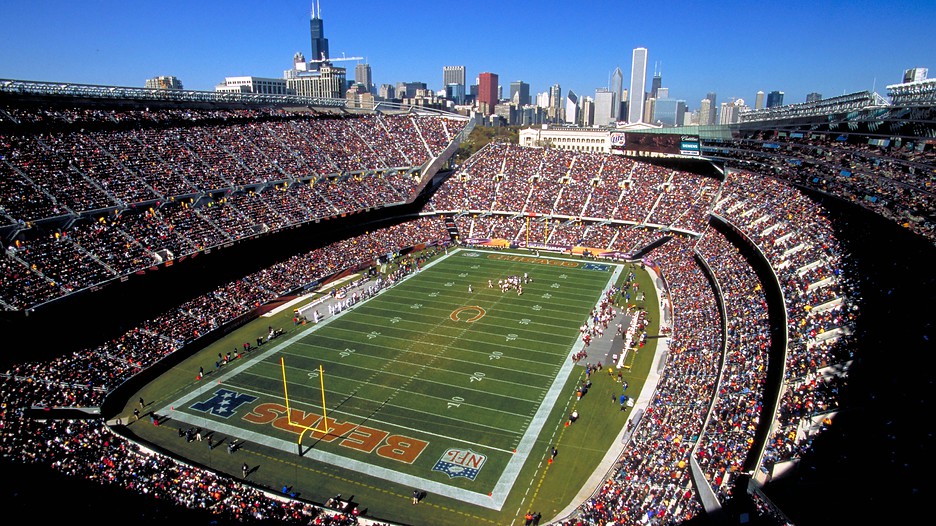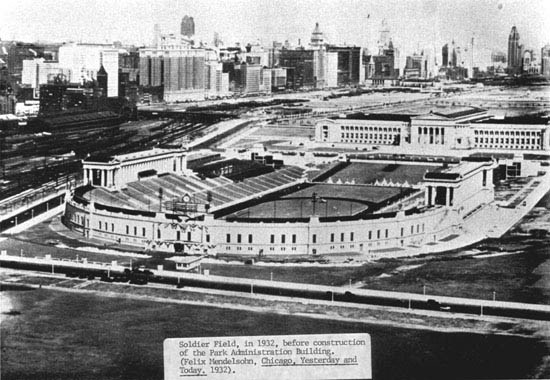
December 31, 1988: The Chicago Bears host the Philadelphia Eagles in an NFC Divisional Playoff at Soldier Field in Chicago. It was Mike Ditka coaching the team he'd led to a Super Bowl win 3 seasons before, against a team coached by Buddy Ryan, who'd been the defensive coordinator for those Bears, and with whom he'd never gotten along.
Chicago is known for nasty Winter weather, and plenty of games at Soldier Field, both at its 1924 original (as this one was) and at its 2003 replacement, have had bitter cold, or snow, or rain, or wind blasting in off Lake Michigan, just 2 blocks away, or some combination thereof.
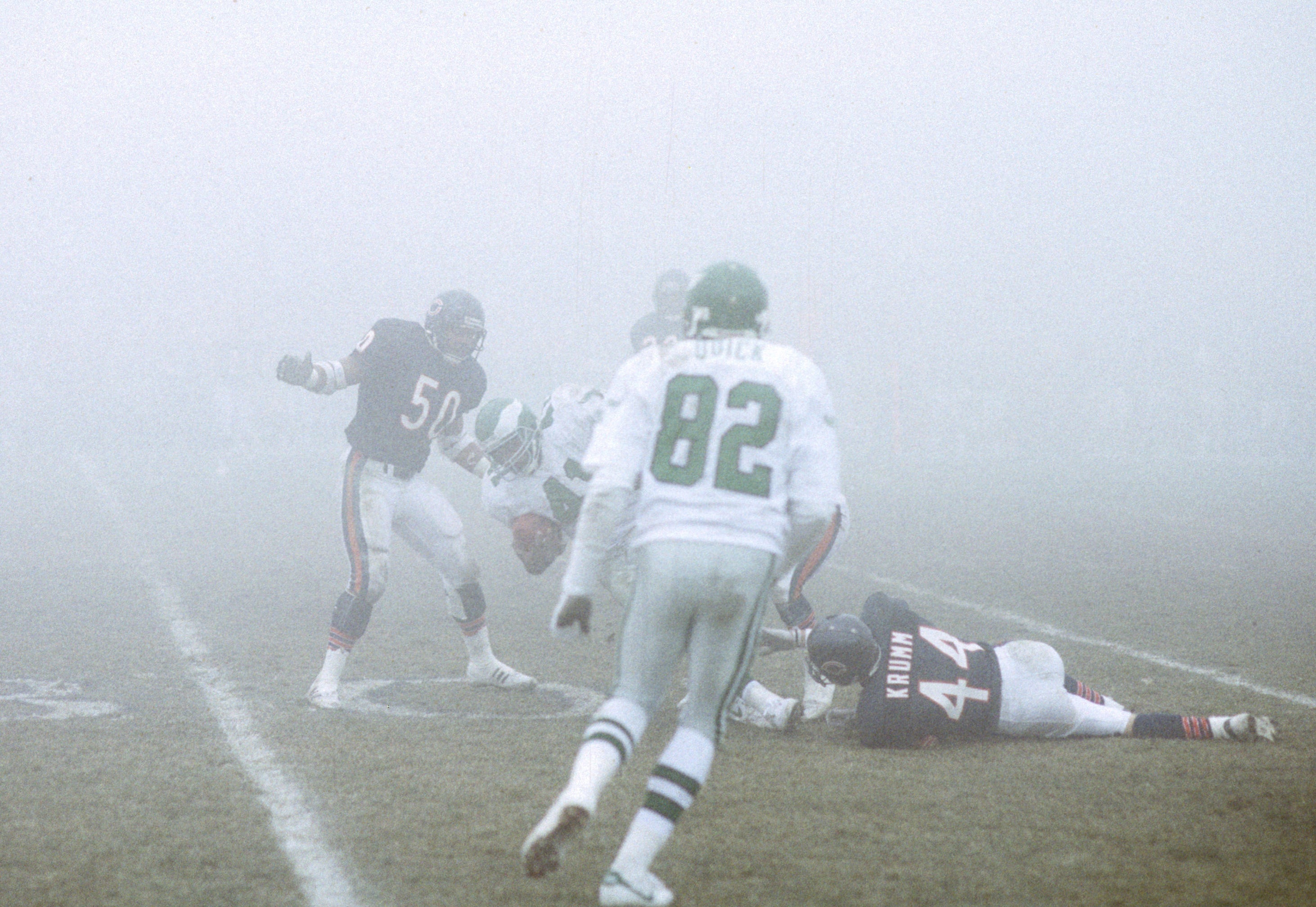
But they'd never been hit by fog before. San Francisco is the American city best known for fog, and while Giants games at Candlestick Park had to be called due to fog, 49ers games there never have. Cleveland Municipal Stadium had seen some Indians games called due to fog, but not Browns games. Chicago? Fog was one weather condition they were not used to.
At kickoff, the sky was a perfect, cloudless blue. Mike Tomczak threw a 64-yard touchdown pass to Dennis McKinnon, putting the Bears up, 7-0. The Eagles came right back, but only got to the 26-yard line, and Luis Zendejas missed a field goal attempt.
A Seth Joyner interception of Tomczak gave the Eagles a quick next chance, but they committed 2 penalties that nullified touchdowns. Coach Buddy Ryan, so great with defense but totally clueless on offense, went for the field goal again, and, this time, Zendejas converted, making it 7-3 Chicago.
Kevin Butler missed a field goal for the Bears. Randall Cunningham drove the Eagles down the field, and got to 4th & 1 on the Bear 4. He tried a quarterback sneak, but a measurement suggested that he didn't get it, turning the ball over. A fumble recovery early in the 2nd quarter gave the Eagles another chance, but, again, they could only get a field goal attempt out of it, and it was 7-6 Chicago.
Neal Anderson ran for a touchdown, increasing the Bears' lead to 14-6. A Butler field goal made it 17-6, with 2:03 left in the half. This was when the fog arrived, coming in off the Lake. The Eagles managed a field goal before the half, and the teams went into the locker rooms with the score Bears 17, Eagles 9.
CBS had hired a helicopter to provide aerial images. The copter was forced to land, because the fog was so thick. The right thing for the officials to do would have been to suspend the game until the fog lifted. But they didn't, deciding that the fog posed no danger to fans or players (unlike, say, lightning), and they sent the teams out for the 2nd half.
Tomczak and Cunningham couldn't see their receivers. Terry Bradshaw was CBS' color commentator, and he said it was the most frustrating game he had ever seen. I watched this game on CBS, and I couldn't see anything, either. I was reminded of one of the earliest games I'd ever seen, a Los Angeles Rams vs. Minnesota Vikings Playoff game that was so muddy, I couldn't tell which team was which, despite the contrast in their colors. (The Rams' blue and gold, the Vikings' purple and white.) Come to think of it, that game was also on a New Year's Eve, in 1978, exactly 10 years earlier. The Rams won it, 34-10.
The Eagles had the 1st drive of the 2nd half, getting to the Bear 12, but an interception put an end to that. The Bears drove, but stalled, and Butler missed another field goal. An interception was turned into Zendejas' 4th field goal of the game, and the Eagles closed to within 17-12 by the end of the 3rd quarter.
Tomczak was knocked out of the game with an injury, and former starter Jim McMahon was back. He got the Bears into field goal range, and Butler added the 3 points. Around this time, Dan Hampton, the Bears' Hall of Fame defensive end, asked referee Jim Tunney what the score was, because he couldn't see the scoreboard. Never mind read it well enough to make out the numbers, he couldn't see the board. After the game, Hampton told the media, "If I'd known it was only 20-12, I would've played harder!"
The Eagles had 1 last chance, but Cunningham threw his 3rd interception of the game. He threw for 407 yards, but no touchdowns.
There had been football games known as "The Fog Bowl" before. On December 1, 1962, the Grey Cup, the Championship game of the Canadian Football League, at Exhibition Stadium in Toronto, also off a Great Lake (Lake Ontario), was suspended and resumed the next day. The Winnipeg Blue Bombers beat the Hamilton Tiger-Cats, 28-27. And on December 28, 1974, steam rising off the frozen artificial turf at the Sun Bowl in El Paso, Texas resembled fog. Mississippi State beat North Carolina, 28-26.
Within half an hour of the final gun of this game at Soldier Field, the fog lifted. Eagle fans still believe that if the game had been suspended once the fog rolled in, and restarted once it lifted, their team would've won. I don't think so: These were still Ditka's Bears, and Ryan was a terrible head coach who would have found a way to lose. And even if they had won it, they would have had to play the NFC Championship game away to the 49ers at their Joe Montana-to-Jerry Rice peak. The Bears did play the 49ers, at Soldier Field (the Bears had the better record), and, with no weather issues, the 49ers won.
This game has been cited as part of "The Curse of Billy Penn": From 1983, when the Philadelphia 76ers won the NBA Championship, until 2008, when the Phillies won their next World Series, no Philadelphia professional sports team won a World Championship. The suggestion was that the construction of One Liberty Place in 1987, making it taller than the statue of William Penn atop City Hall, caused Penn's spirit to put a curse on the city's teams.
*
December 31, 1988 was a Saturday. One other NFL Playoff game was played: The Cincinnati Bengals beat the Seattle Seahawks, 21-13 at Riverfront Stadium in Cincinnati. The Bengals won the AFC Championship Game, and the 49ers beat them in Super Bowl XXIII.
There were no NBA games scheduled. But there were 9 NHL games, including all 3 New York Tri-State Area teams:
* The New Jersey Devils lost to the Pittsburgh Penguins, 8-6 at the Civic Arena in Pittsburgh. This was the game in which Mario Lemieux scored all 5 ways in which a player can score: Even-strength (at 4:17 of the 1st period), shorthanded (at 7:50 of the 1st), on the power play (at 10:59 of the 1st), a penalty shot (11:14 of the 2nd, and this was also shorthanded), and empty net (19:59 of the 3rd, in other words with 1 second left in regulation).

* The New York Rangers beat the Chicago Blackhawks, 4-1 at Madison Square Garden.
* The New York Islanders beat the Washington Capitals, 6-4 at the Nassau Coliseum
* The Philadelphia Flyers beat the Buffalo Sabres, 3-2 at the Buffalo Memorial Auditorium.
* The Toronto Maple Leafs beat the Quebec Nordiques, 6-1 at Maple Leaf Garden in Toronto, in the 1st half of CBC's Hockey Night In Canada doubleheader.
* The Hartford Whalers beat the Detroit Red Wings, 3-2 at the Joe Louis Arena in Detroit.
* The Minnesota North Stars beat the St. Louis Blues, 6-2 at the Metropolitan Sports Center in the Minneapolis suburb of Bloomington, Minnesota.
* The Winnipeg Jets played the Calgary Flames to a 4-4 tie, at the Olympic Saddledome in Calgary.
* And the Montreal Canadiens beat the Edmonton Oilers, 4-2 at the Nassau Coliseum, in the 2nd half of the CNBC doubleheader.