Showing posts with label royal navy. Show all posts

Thursday, November 24, 2022

November 25, 1914: The HMS Bulwark Explosion

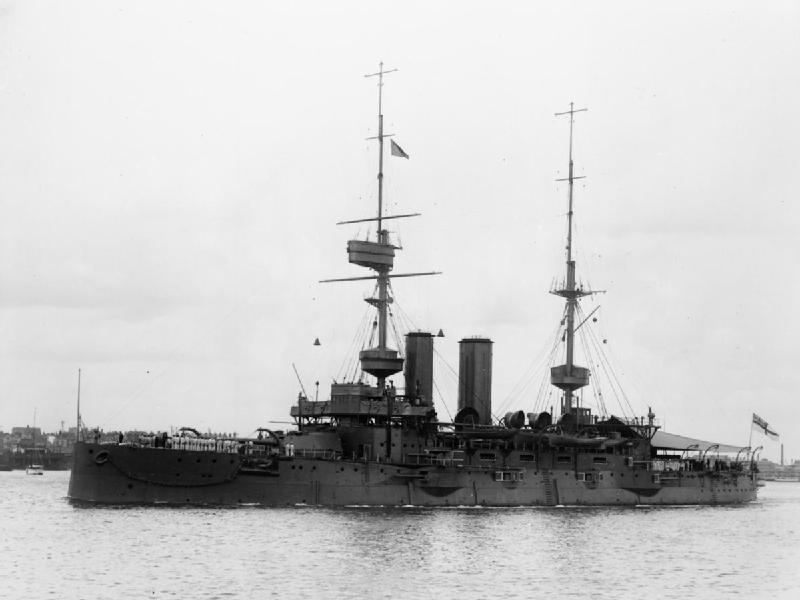
November 25, 1914: The HMS Bulwark, a British battleship, is destroyed in an onboard explosion off the coast of Sheerness, Kent, England. A total of 741 deaths are attributed to the blast, and only 12 men are said to have survived.

Bulwark was 1 of 5 London-class battleships built for the Royal Navy at the close of the 19th Century. Completed in 1902, she became the flagship of the Mediterranean Fleet. She served in the Channel Fleet starting in 1907, and, after that Fleet's dissolution in 1910, in reserve in the Home Fleet. With World War I starting in August 1914, the Channel Fleet was revived, and Bulwark was assigned to it.

The explosion was determined to have been caused by the overheating of cordite charges, placed near a boiler-room bulkhead. An investigation 3 days later ruled out an external cause, such as sabotage or a German torpedo or mine.

Unlike with the USS Maine 16 years earlier, there were no wild conspiracy theories. Of course, with the Maine, the United States was not yet at war with Spain. With the Bulwark, Britain was already at war with Germany, and already living with the effects of anti-German propaganda. There was no reason for the government to lie, or to allow others to lie, about the cause of the explosion.

There were 3 previous British ships named HMS Bulwark. A light fleet carrier served under the name from 1948 to 1984, and the current ship with the name is an amphibious assault ship launched in 2001.

*

November 25, 1914 was a Wednesday. In America, baseball icon Joe DiMaggio was born. But there was only 1 score on this historic day, the day before the American holiday of Thanksgiving, and it was in college football: Washburn beat Kansas State, 26-16 at Ahearn Field in Manhattan, Kansas.

The home team, then named Kansas State Agricultural College, became the Kansas State College of Agriculture and Applied Science in 1931, and Kansas State University in 1959. Their teams were known as the Aggies until 1920, when they became the Wildcats. Washburn University, based in Topeka, Kansas, downgraded their football program in 1930, and now play in NCAA Division II.

Tuesday, November 8, 2022

November 8, 1935: The Original Version of "Mutiny On the Bounty" Premieres

A mustache-less Gable (left) as Christian,
and Laughton as Bligh

November 8, 1935: The 1st film version of Mutiny On the Bounty premieres, based on the 1932 novel by Charles Nordhoff and James Norman Hall. I was based on historical events.

EDIT: This was actually the 3rd film based the story, and the 2nd to have been based on a novel about the story, by Charles Nordhoff and James Norman Hall. In the Wake of the Bounty premiered in 1933, starring the man who would become the king of seafaring movies, Errol Flynn, as Christian. A silent film, The Mutiny of the Bounty, was released in 1916, and is considered lost. It's easier for me to admit the error than it would be to change the title of the post, both on the post itself and in my records.

In 1788, the HMS Bounty set sail under the command of Lieutenant William Bligh, a 33-year-old native of Plymouth, in England's West Country, and a veteran of the 3rd voyage of Pacific explorer James Cook. It was to sail to Tahiti, in the South Pacific, to acquire breadfruit plants, which would then be taken to the British West Indies, as a cheap source of food for the region's slaves.

(Slavery was still legal in the British Empire until 1834. And while it was tradition in the Royal Navy, and became such in the U.S. Navy, for sailors to address their ship's commanding officer as "Captain," regardless of his actual rank, Bligh, at the time, was a Lieutenant -- and the British pronounce that "Lef-TEN-unt," instead of "Loo-TEN-unt.")
William Bligh

The original intent was to sail around Cape Horn, at the southern tip of South America. (In the era before the Panama Canal, this gave rise to the baseball term "around the horn," for a double play starting at the furthest position, 3rd base.) Bad weather prevented this, so, instead, they sailed east, rounding the southern tip of Africa, and crossing the Indian Ocean. This made the trip a lot longer.

During that voyage, Bligh demoted Sailing Master John Fryer, replacing him with Fletcher Christian, a 23-year-old native of Cumbria, in the North of England. This act caused dissension among the crew.
Fletcher Christian

The ship reached Tahiti after 10 months, and stayed 5 months. Bligh allowed the crew to live ashore and care for the potted breadfruit plants, and they became socialized to the customs and culture of the Tahitians. Many of the seamen and some of the "young gentlemen" had themselves tattooed in native fashion. Acting Lieutenant Christian married Maimiti, a Tahitian woman. Other warrant officers and seamen were also said to have formed "connections" with native women.

Bounty set sail with her breadfruit cargo on April 4, 1789. On April 28, about 1,300 miles west of Tahiti, near Tonga, a mutiny broke out. Despite strong words and threats heard on both sides, the ship was taken bloodlessly, and apparently without struggle by any of the loyalists except Bligh himself. 

The mutineers ordered Bligh, two midshipmen, the surgeon's mate, and the ship's clerk into the ship's boat. Several more men voluntarily joined Bligh rather than remain aboard. Of the 42 men on board aside from Bligh and Christian, 22 joined Christian in mutiny, two were passive, and 18 remained loyal to Bligh.

Bligh and his men sailed the open boat 30 miles to Tofua in search of supplies, but were forced to flee after attacks by hostile natives resulted in the death of one of the men. Bligh then undertook an arduous journey to the Dutch settlement of Coupang, over 3,500 miles from Tofua. He safely landed there 47 days later, having lost no men during the voyage except the one killed on Tofua.

The mutineers sailed for the island of Tubuai, where they tried to settle. After three months of bloody conflict with the natives, however, they returned to Tahiti. Sixteen of the mutineers – including the four loyalists who had been unable to accompany Bligh – remained there, taking their chances that the Royal Navy would not find them and bring them to justice.

HMS Pandora was sent out to capture the mutineers and bring them back to Britain to face a court martial. She arrived in March 1791, and captured fourteen men within two weeks. They were locked away in a makeshift wooden prison on Pandora's quarterdeck. The men called their cell "Pandora's box." They remained in their prison until August 29, 1791, when Pandora was wrecked on the Great Barrier Reef with the loss of 35 lives, including four mutineers.

As for the rest: On January 15, 1790, the Bounty reached Pitcairn Island. After the decision was made to settle on Pitcairn, livestock and other provisions were removed from Bounty. To prevent the ship's detection, and anyone's possible escape, the ship was burned on January 23. They were not found until 1808, when the last surviving mutineer, John Adams, and the surviving Tahitian women and their children were discovered by the Boston sealer Topaz

Adams lived on until 1829. He gave conflicting accounts of Christian's death to visitors on ships that subsequently visited Pitcairn. He was variously said to have died of natural causes, committed suicide, become insane or been murdered. Regardless, it appears to have happened in 1793, only 4 years after the mutiny.

Upon reaching British soil again, Bligh was court-martialed -- which was, and remains, a standard U.K. and U.S. procedure for a commander who loses his ship -- but was acquitted, and hailed as a hero. He was promoted to Commander, and eventually to Vice-Admiral. He commanded 11 ships after the Bounty, and from 1806 to 1808 served as the Governor of the Colony of New South Wales, now a State in Australia, which includes Sydney. William Bligh died in 1817, at the age of 63.

Nearly 100 years later, as First Lord of the Admiralty, Winston Churchill was accused of "destroying the traditions of the Royal Navy." He said, "And what are those? Rum, sodomy, and the lash." The last of these referred to sailors being whipped over minor offenses. Bligh was not an overly aggressive punisher: Indeed, he was known to be among the more tolerant commanding officers of his era.

The novel was a libel on his memory, and so have been the 3 major motion pictures made about the events. The 1935 film Mutiny On the Bounty starred Charles Laughton, already known for his portrayal of the wicked King Henry VIII, as a much meaner Bligh than actually existed; and Clark Gable as a considerably more dashing version of Fletcher Christian than actually existed. The last straw in starting the mutiny was cutting the crew's water rations, to provide more water for the breadfruit plants. Despite the inaccuracies, this was the highest-grossing film of 1935.

The film was remade in 1962, with Trevor Howard as Bligh and Marlon Brando as Christian. This one is more explicit, and is grossly inaccurate: Two men die in attempting to disobey Bligh's excessive orders, before Christian agrees to the mutiny. And it ends with Christian deciding to return to Britain to testify against Bligh, and the other mutineers burning the ship in order to prevent it, and Christian dying in an attempt to save it. Unlike the earlier film, this one was a box office flop.

The 1984 film The Bounty is not based on the novel. Anthony Hopkins played Bligh, and Mel Gibson played Christian. It was hailed as being considerably more historically accurate. Apparently, Gibson did not learn that lesson, and went on to make a bunch of historical films that were way off the mark.

note of interest: Movita Castaneda, an Arizona native of Mexican descent, played Tehani, the chief's daughter, in the 1935 film. She later married Marlon Brando. After their divorce, Brando starred in the 1962 version of the film, and married Tarita Teriʻipaia, who played Maimiti, the real Christian's wife. Brando kept a home in the South Pacific for the rest of his life.

In the 1986 film Star Trek IV: The Voyage Home, Doctor McCoy (DeForest Kelley) named the Klingon ship that the crew of the lost USS Enterprise had taken the HMS Bounty.

*

November 8, 1935 was a Friday. French actor Alain Delon was born. This was also the day that famed pilot Charles Kingsford Smith disappeared. I have a separate entry for that event.

Baseball was out of season. The NBA hadn't been founded yet. And the NHL season had started the night before, but no games were scheduled for this day.

Two college football games were played. George Washington University beat Davis & Elkins, 53-7 at Griffith Stadium in Washington. GWU dropped its football program after the 1966 season. Davis & Elkins College, of Elkins, West Virginia, now play in NCAA Division II.

And Texas Christian University (TCU) beat Loyola University, 14-0 at Loyola University Stadium in New Orleans. Loyola dropped their program after the 1939 season.

Monday, July 18, 2022

July 18, 1947: The Exodus 1947 Is Intercepted

July 18, 1947: The packet steamship SS Exodus 1947, containing 4,515 Jewish refugees, is refused entry at the port of Haifa, in what was then the British Mandate of Palestine. The refugees are returned to migrant camps in Europe.

The ship was launched in 1927, for the Baltimore Steam Packet Company and its parent company, the Seaboard Air Line Railroad. It was originally named the Florida. But when Seabord's president, S. Davies Warfield, died while it was being built, it was renamed the President Warfield. It was sold to the U.S. Navy during World War II, and was a support ship on D-Day.

In 1947, the Haganah, a Zionist paramilitary group, bought it, and renamed it Exodus 1947, in honor of the foundation myth of the Hebrew Exodus from Egypt, which, if it happened at all, is presumed to have happened around 1250 BC.

On July 11, Exodus left Sète, on the south coast of France, with 4,515 refugees, many of them Holocaust survivors. The crew said they were going to Istanbul, Turkey. She was shadowed by ships of Britain's Royal Navy, who noted that she was flying a Star of David flag. They denied her entry into Haifa.

The ship was sent back to France, which said it would accept any refugees willing to leave the ship. No one did. With some irony, they were sent to Germany, but to the port of Hamburg, then in the British Occupation Zone.

The British Mandate ran out 10 months later, at 12:01 AM on May 14, 1948. At that moment, the State of Israel declared its independence. It absorbed the Haganah, creating the Israel Defense Forces out of it. Many of the refugees who had been aboard Exodus were accepted. The ship itself burned in 1952, and was not preservable.

*

July 18, 1947 was a Friday. Magazine publisher Malcolm Stevenson Forbes Jr., a.k.a. 1996 and 2000 Republican Presidential candidate Steve Forbes, was born.

This was also the day that the Presidential Succession Act of 1947 was signed into law. I have a separate entry for that event.

These baseball games were played:

* The New York Yankees lost to the Detroit Tigers, 8-0 at Briggs Stadium (later Tiger Stadium) in Detroit. Fred Hutchinson pitched a 2-hit shutout, walking none, and striking out 8. The hits were a single by Joe DiMaggio in the 2nd inning, and a bunt single by George "Snuffy" Stirnweiss in the 7th. Hutchinson also went 3-for-4 with 2 RBIs in his own cause.

* The New York Giants beat the Cincinnati Reds, 8-3 at the Polo Grounds. Willard Marshall went 3-for-4 with 3 home runs and 5 RBIs. Johnny Mize and Bobby Thomson also homered for the Giants.

* The Brooklyn Dodgers beat the St. Louis Cardinals, 7-0 at Ebbets Field. Ralph Branca had a perfect game for 7 innings, until he allowed a single to Enos Slaughter and a walk to Whitey Kurowski the 8th. Stan Musial, who normally came through at Ebbets Field, to the point where Dodger fans would say, "Uh-oh, that man is back in town!" leading to his nickname, "Stan the Man," went 0-for-3 this time. Jackie Robinson went 2-for-4 with a home run and 3 RBIs.

* The Pittsburgh Pirates beat the Boston Braves, 2-1 at Braves Field in Boston. Kirby Higbe outpitched Bill Voiselle. Hank Greenberg went 1-for-3 with a walk and an RBI. Ralph Kiner went 1-for-2 with 2 walks.

* The Chicago Cubs beat the Philadelphia Phillies, 7-5 at Shibe Park in Philadelphia.

* The Cleveland Indians beat the Washington Senators, 6-0 at Cleveland Municipal Stadium. Don Black pitched a 5-hit shutout, outpitching Early Wynn.

* The Chicago White Sox beat the Philadelphia Athletics, 4-1 at Comiskey Park in Chicago.

* And the St. Louis Browns beat the Boston Red Sox, 9-8 at Sportsman's Park in St. Louis. Ted Williams went 5-for-5 with 2 home runs and 5 RBIs.


Friday, May 27, 2022

May 27, 1941: The Sinking of the Bismarck

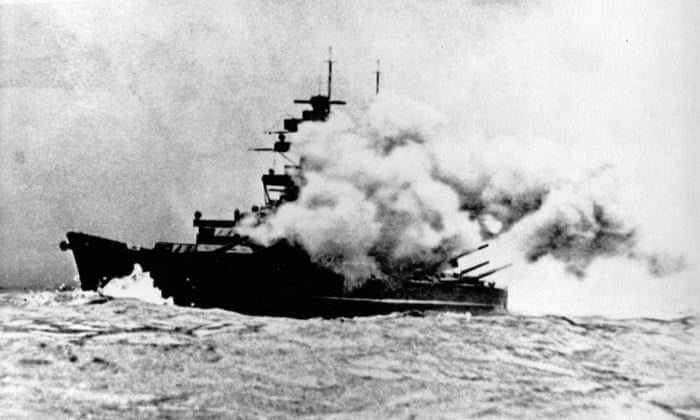
May 27, 1941: Britain's Royal Navy sinks the Bismarck, Germany's biggest battleship, a rare notable victory for the Allies in World War II before America got into it.

Named for Otto von Bismarck, the "Iron Chancellor" who defeated France in the Franco-Prussian War of 1870, and united the many small German states into the German Empire -- the Second Reich -- the Kriegsmarine, the navy of Nazi Germany, the Third Reich, planned the Bismarck class of battleships to defeat France's Richelieu class battleships. But by June 1940, at which point the class ship, the Bismarck, was nearing completion, the German Army, the Wehrmacht, made dealing with the French Navy unnecessary.

But Britain's Royal Navy, now alone, and waiting for America to enter the war, would have to deal with the thing. C.S. Forester, already the author of 3 novels in the Horatio Hornblower series by 1941 (the series would eventually stretch to 17 books), published The Last Nine Days of the Bismarck in 1959. The following year, it was made into the film Sink the Bismarck!

American singer Johnny Horton co-wrote and sang an accompanying song, though it was only used in American trailers for the film, and not used in the film itself. In the song, Horton wrote, "The Bismarck was the fastest ship that ever sailed the sea. On her deck were guns as big as steers, and shells as big as trees."

It was under the command of Admiral Günther Lütjens, known as "the Black Devil," yet a man opposed to the Nazis' anti-Semitic policies. He refused to give the Nazi salute, instead giving a traditional naval salute -- even to Chancellor Adolf Hitler himself.

On May 24, 1941 -- the day that singer Bob Dylan was born in Duluth, Minnesota -- the Battle of the Denmark Strait was fought. The Bismarck and its escort, the heavy cruiser Prinz Eugen, were caught by the Admiral class battlecruiser HMS Hood and the King George V class battleship HMS Prince of Wales in the Denmark Strait, between Greenland and Iceland.

(At the time, Britain had no Prince of Wales: King George VI had only daughters, no sons. The ship was named after the most recent Prince of Wales, the son of George V, who became King Edward VIII and then the Duke of Windsor -- who was seen by many as pro-Nazi.)

The song said that the Bismarck started firing from 15 miles away. That may have been dramatic license. Nevertheless, the Hood was sunk, and the Prince of Wales had to retreat. (For this role, the Hood became better known than its namesake, Admiral Samuel Hood, who commanded ships in the Wars of the American and French Revolutions.) However, the Prince of Wales managed to damage Bismarck enough that its mission was called off, and it sailed for occupied France for repairs.

The Royal Navy went after the wounded ship. The aircraft carrier HMS Ark Royal got close enough to send Fairey Swordfish "torpedo bombers" after it. On May 26, a hit rendered its steering gear inoperable. That night, Lütjens ordered a message radioed back to Germany: "Ship unmaneuverable. We will fight to the last shell. Long live the Führer."

The next morning, off the western coast of France, the Ark Royal, the King George V, and the cruiser HMS Sheffield caught up with Bismarck. Knowing that the battle damage would lead to its sinking anyway, Lütjens ordered that the ship be scuttled. Out of a crew of over 2,200 men, only 114 survived. Lütjens went down with the ship.

With the sinking of the Bismarck, the Kriegsmarine ended up building only 2 ships in that class, the other being the Tirpitz. That ship was sunk by Britain's Royal Air Force on November 12, 1944.

On August 7, 1941, HMS Prince of Wales hosted the 1st meeting between President Franklin D. Roosevelt and Prime Minister Winston Churchill, which produced the Atlantic Charter alliance. On December 9, 1941, 2 days after the Japanese attack on Pearl Harbor and several other American and British installations, Prince of Wales was sunk by the Japanese off the coast of Singapore. Although some men got off alive, 327 died.

On November 13, 1941, a German U-boat got revenge on the Ark Royal, sinking her in the Mediterranean Sea, off the coast of Spain, not far from the British naval base at Gibraltar. Two subsequent aircraft carriers have served the Royal Navy under the name, from 1950 to 1979, and from 1981 to 2011.

HMS Sheffield remained in Royal Navy service until being decommissioned in 1967. In 1971, a destroyer with that name was launched. In 1982, it was sunk by Argentina, becoming the most notable British loss of the Falkland Islands War.

HMS King George V remained in service until 1947. No new ship has been given the name. In 2017, a Queen Elizabeth II class aircraft carrier was launched, named HMS Prince of Wales. No new Royal Navy ships have been named Hood, although the TV series Star Trek: The Next Generation showed a starship of the Excelsior class named USS Hood.

In 1956, the Federal Republic of Germany (West Germany) was permitted by NATO to form a new Bundesmarine (Federal Navy). In 1990, it took on the Volksmarine (People's Navy) of the former German Democratic Republic (East Germany). In 1995, the Bundesmarine was renamed the Deutsche Marine (German Navy).

This Navy has never had a ship named Bismarck. But it had a ship named for the previous Bismarck's captain, the destroyer Lütjens, launched in 1967, and retired and decommissioned in 2003.

*

May 27, 1941 was Tuesday. These baseball games were played that day:

* The New York Yankees beat the Washington Senators, 10-8 at Griffith Stadium in Washington. Red Ruffing was the winning pitcher. Joe DiMaggio went 4-for-5 with a home run and 3 RBIs. Nobody noticed it yet, but it was his 12th straight game with at least 1 hit. There would be more.

* The New York Giants beat the Boston Braves, 2-1 at the Polo Grounds. Mel Ott went 2-for-4. Both Waner brothers had been traded to the Braves by the Pittsburgh Pirates. Paul went 0-for-4 in this game, but Lloyd singled as a pinch-hitter.

* The Brooklyn Dodgers beat the Philadelphia Phillies, 6-0 at Shibe Park in Philadelphia. Hugh Casey, who would become better known as a reliever, pitched a 7-hit shutout.

* A doubleheader was split at Fenway Park in Boston. The Boston Red Sox won the opener, 5-2. The Philadelphia Athletics won the nightcap, 11-1. Over the 2 games, Jimmie Foxx went 0-for-6 with a walk, and Ted Williams went 2-for-6 with a home run, a walk, and 2 RBIs.

* The Detroit Tigers beat the Cleveland Indians, 9-6 at League Park in Cleveland. Bruce Campbell -- no relation to the later Evil Dead actor of the same name -- hit 2 home runs. Hank Greenberg was already serving in the U.S. Army, and unavailable for the Tigers.

* The St. Louis Browns beat the Chicago White Sox, 5-2 at Comiskey Park in Chicago.

* The St. Louis Cardinals beat their arch-rivals, the Chicago Cubs, 3-2 at Sportsman's Park in St. Louis.

* And the Pittsburgh Pirates and the Cincinnati Reds were not scheduled for this day.
Saturday, April 23, 2022

April 23, 1915: The Death of Rupert Brooke

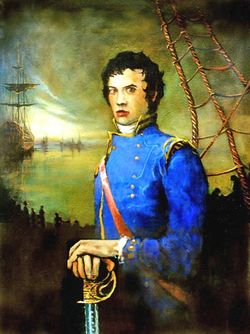
April 23, 1915: Rupert Brooke, already an admired poet, dies in the service of the Royal Navy, on a hospital ship in the Aegean Sea -- not from combat injuries, but from an infected mosquito bite. This was the era before antibiotics. He was only 27, and was buried on the nearby Greek island of Skyros.

Rupert Chawner Brooke was born on August 3, 1887 in Rugby, Warwickshire, England -- the town with the private school of the same name, where the sport of the same name was allegedly invented. Brooke attended the Rugby School, and King's College of Cambridge University.

At Cambridge, the Bloomsbury Group of writers was formed in 1912. Many of them, including Brooke, E.M. Forster and Virginia Woolf, were gay, some of them entering marriages of convenience that both parties understood to be open marriages.

He enlisted in the Royal Navy when World War I broke out in 1914. Having already had poems published in The Westminster Gazette, The Times Literary Supplement -- with the approval of the British government, which might have censored them had they not been complementary to the nation and its troops -- began publishing his war poems.

Brooke sailed with the British Mediterranean Expeditionary Force on February 28, 1915, but developed severe gastroenteritis while stationed in Egypt, followed by streptococcal sepsis from an infected mosquito bite. Antibiotics, which could have saved so many in World War I, had not yet been discovered.

French surgeons carried out two operations to drain the abscess, but he died of septicemia on April 23, on a French hospital ship. As the expeditionary force had orders to depart immediately, Brooke was buried in an olive grove on Skyros. His brother, William Alfred Cotterill Brooke, was killed on the Western Front on June 14.

Yes, that photo really is of Brooke. It's not Hugh Grant playing him in a movie. In fact, as of 2022, there is no film biography of him. Which is a little odd, since he was one of the earliest well-known creative artists to have died at the specific age of 27.

Among those that preceded him in the "27 Club" were Brazilian composer Alexandre Levy, of an unknown illness in 1892; Louis Chauvin, a ragtime composer from St. Louis, of neurosyphilitic sclerosis in 1908; and George Trakl, an Austrian poet, of a cocaine overdose in 1914.

*

April 23, 1915 was a Friday. This was early in the 2nd of the 2 seasons of 3 major leagues. In the American League:

* The Detroit Tigers beat the Cleveland Indians, 8-4 at League Park in Cleveland. Ty Cobb went 1-for-3 with 2 walks and a stolen base. Shoeless Joe Jackson went 0-for-5 for the Indians.

* The Chicago White Sox beat the St. Louis Browns, 4-3 at Comiskey Park in Chicago. Eddie Collins went 0-for-1 with 3 walks.

* The Boston Red Sox and the Philadelphia Athletics were rained out at Fenway Park in Boston. The game was made up as part of a doubleheader on June 30. The Sox swept, 10-5 and 10-7. Over the 2 games, Tris Speaker went 4-for-6 with 3 walks and an RBI. Babe Ruth, a rookie at the time, did not appear in either game.

* And the New York Yankees and the Washington Senators were rained out at the Polo Grounds. The game was made up as part of a doubleheader on July 3. The Senators won the opener, 8-7. George McBride hit a home run in the top of the 11th inning, and Walter Johnson came in to pitch the bottom of the 11th, getting the save, not that anybody knew what a "save" was back then. Johnson then started the nightcap, which the Yankees won, 4-1, as "The Big Train" was outpitched by Ray Caldwell.

In the National League:

* The Philadelphia Phillies beat the Boston Braves, 2-1 at Baker Bowl in Philadelphia. George "Possum" Whitted went 3-for-3, but both Phils runs came in the 3rd inning, on a double by Fred Luderus.

It was the Phillies' 8th straight win to open the season. The Braves beat them the next day, but the Phils went on to win their 1st Pennant, succeeding the Braves as NL Champions.

* The Cincinnati Reds beat the Pittsburgh Pirates, 2-1 at Forbes Field in Pittsburgh. Ivan "Ivy" Olson went 3-for-3 with a walk. Honus Wagner went 1-for-3 with a walk and a stolen base. He was 41 years old.

* The Chicago Cubs beat the St. Louis Cardinals, 8-4 at Robison Field in St. Louis. The interregnum where the Cubs' biggest rivals were the Giants had ended, and the Cards retook their former place as such.

* The Brooklyn Robins (as the Dodgers were known during Wilbert Robinson's managing of them, 1914 to 1931) and their arch-rivals, the New York Giants, were rained out at Ebbets Field. The game was made up as part of a doubleheader on July 3. The Robins won the 1st game, 2-1. The Giants won the 2nd game, 4-3.

And in the Federal League:

* The FL's 2 New York Tri-State Area teams played each other, with the Brooklyn Tip-Tops beating the Newark Peppers, 9-5 at Harrison Park in Harrison, New Jersey, across the Passaic River from Newark. Steve Evans went 3-for-5 with 2 RBIs for Brooklyn.

* The Baltimore Terrapins beat the Buffalo Blues, 6-5 at Federal League Park in Buffalo.

* The Pittsburgh Rebels beat the St. Louis Terriers, 5-2 at Handlan's Park in St. Louis. Former Detroit Tigers star Davy Jones went 3-for-5 with an RBI.

* And the Chicago Whales and the Kansas City Packers were rained out at Gordon and Koppel Field in Kansas City. The game was made up as part of a doubleheader 2 days later, a Sunday. The Whales won the 1st game, 10-3. The Packers won the 2nd game, 4-2.

Friday, February 4, 2022

February 4, 1937: Horatio Hornblower Debuts

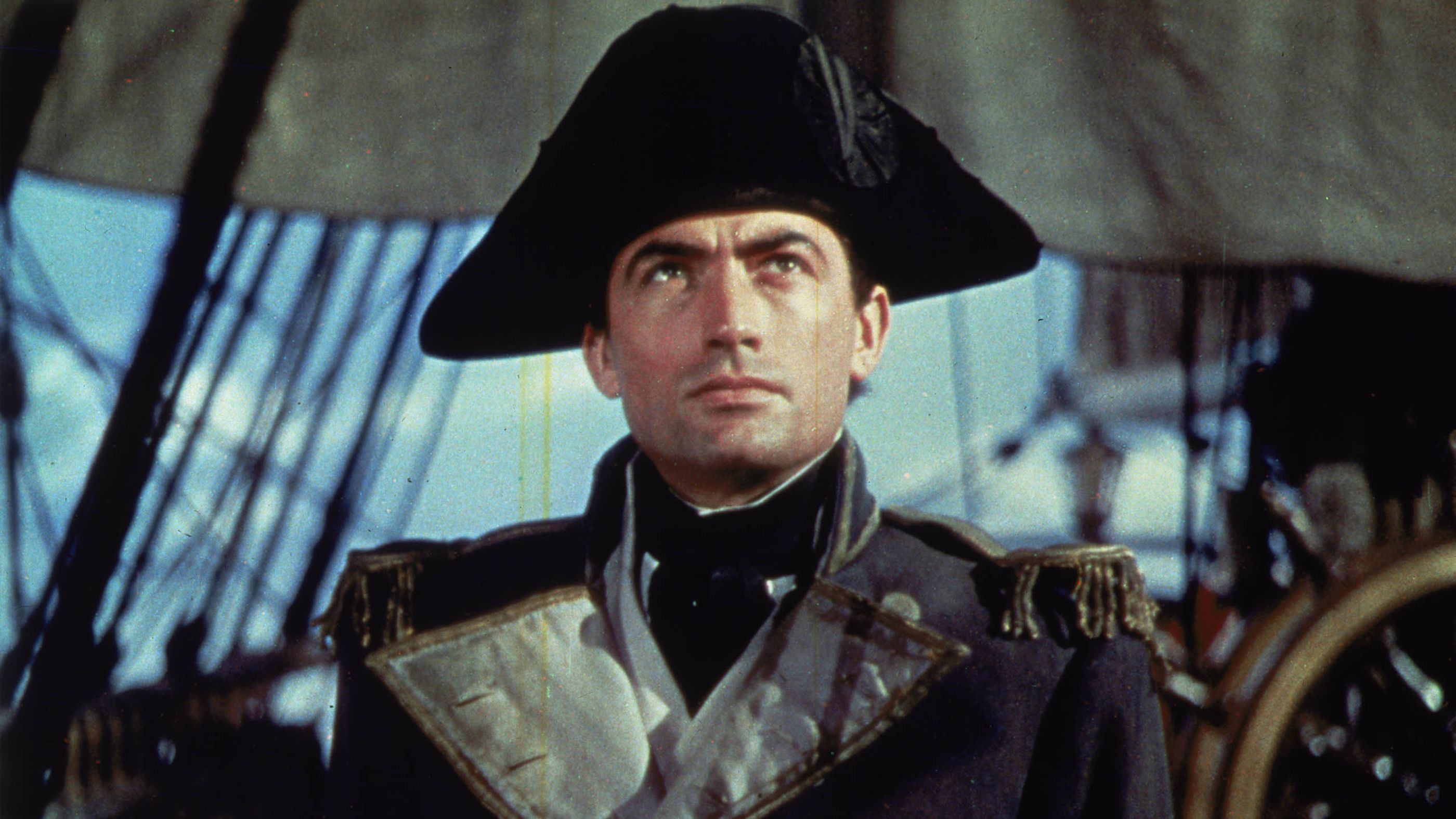
Gregory Peck starring in the film Captain Horatio Hornblower, 1951

February 4, 1937: The Happy Return, a novel by C.S. Forester, is published. It is the debut of one of the leading heroic characters in English-language literature: Horatio Hornblower.

Cecil Louis Troughton Smith was born on August 27, 1899 in Cairo, where his father was teaching English to Egyptian children. He dropped out of medical school, and was rejected for military service despite World War I going on.

He turned to writing, using the name "C.S. Forester." In addition to the Hornblower novels, of which there would eventually be 11, he wrote the 1935 novel The African Queen, turned into an Oscar-winning film in 1951. During World War II, he worked in propaganda for the British government, and convinced a co-worker, Roald Dahl, to start writing. He died on April 2, 1966.
C.S. Forester

The Happy Return takes place in 1808, at the height of the Napoleonic Wars. Hornblower is in command of the 36-gun frigate HMS Lydia, sailing to Nicaragua, then controlled by Spain, to aid the Spanish in the fight against France's dictatorial Emperor Napoleon Bonaparte. But Hornblower discovers that the Spanish lord he's supposed to aid has a god complex, and, as a matter of honor, Hornblower must oppose him. The story is similar to that of Joseph Conrad's 1899 novel Heart of Darkness.

After World War II, Forester lived in America, and, in later books, gave Hornblower a birthdate of July 4, 1776. He also gave him a humble beginning, showing that his rise in the Royal Navy is due to talent, not connections. To aid this, he gave Hornblower a classical education, making him a polyglot and a polymath.

In 1964, Gene Roddenberry pitched his idea for Star Trek to NBC by calling it "Hornblower in space," and later went out of his way to write the character of Captain James T. Kirk as not merely courageous and honorable (if a bit overly interested in women), but as brilliant, "a stack of books with legs."

Hornblower's career begins as a Midshipman in 1794, and ends it as Admiral of the Fleet, age 72, in 1848, in The Last Encounter, published a few weeks after Forester's death. Like Arthur Conan Doyle with Sherlock Holmes in His Last Bow, and Agatha Christie with Hercule Poirot in Curtain: His Last Case, Forester wanted to give Hornblower a definitive last story.

Gregory Peck starred in the 1951 film Captain Horatio Hornblower in 1951. Ioan Gruffudd starred in the ITV series Hornblower from 1998 to 2003, broadcast in American on A&E.

*

February 4, 1937 was a Thursday. Baseball and football were out of season. The NBA hadn't been founded yet. These games were played in the NHL:

* The New York Rangers played the Detroit Red Wings to a 2-2 tie at the Olympia Stadium in Detroit.

* The New York Americans lost to the Toronto Maple Leafs, 2-1 at the old Madison Square Garden.

* The Boston Bruins beat the Montreal Canadiens, 6-2 at the Montreal Forum.

* And the Montreal Maroons and the Chicago Black Hawks were not scheduled.

December 31, 1999 & January 1, 2000: The Millennium

December 31, 1999:  The Millennium arrives. The people of planet Earth survived. At a terrible cost. But we hadn't destroyed ourselves. ...