
A mustache-less Gable (left) as Christian,
and Laughton as Bligh
November 8, 1935: The 1st film version of Mutiny On the Bounty premieres, based on the 1932 novel by Charles Nordhoff and James Norman Hall. I was based on historical events.
EDIT: This was actually the 3rd film based the story, and the 2nd to have been based on a novel about the story, by Charles Nordhoff and James Norman Hall. In the Wake of the Bounty premiered in 1933, starring the man who would become the king of seafaring movies, Errol Flynn, as Christian. A silent film, The Mutiny of the Bounty, was released in 1916, and is considered lost. It's easier for me to admit the error than it would be to change the title of the post, both on the post itself and in my records.
In 1788, the HMS Bounty set sail under the command of Lieutenant William Bligh, a 33-year-old native of Plymouth, in England's West Country, and a veteran of the 3rd voyage of Pacific explorer James Cook. It was to sail to Tahiti, in the South Pacific, to acquire breadfruit plants, which would then be taken to the British West Indies, as a cheap source of food for the region's slaves.
(Slavery was still legal in the British Empire until 1834. And while it was tradition in the Royal Navy, and became such in the U.S. Navy, for sailors to address their ship's commanding officer as "Captain," regardless of his actual rank, Bligh, at the time, was a Lieutenant -- and the British pronounce that "Lef-TEN-unt," instead of "Loo-TEN-unt.")

William Bligh
The original intent was to sail around Cape Horn, at the southern tip of South America. (In the era before the Panama Canal, this gave rise to the baseball term "around the horn," for a double play starting at the furthest position, 3rd base.) Bad weather prevented this, so, instead, they sailed east, rounding the southern tip of Africa, and crossing the Indian Ocean. This made the trip a lot longer.
During that voyage, Bligh demoted Sailing Master John Fryer, replacing him with Fletcher Christian, a 23-year-old native of Cumbria, in the North of England. This act caused dissension among the crew.
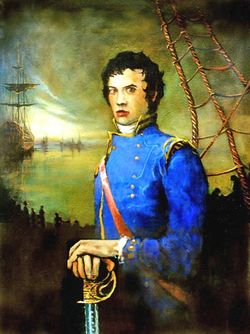
Fletcher Christian
The ship reached Tahiti after 10 months, and stayed 5 months. Bligh allowed the crew to live ashore and care for the potted breadfruit plants, and they became socialized to the customs and culture of the Tahitians. Many of the seamen and some of the "young gentlemen" had themselves tattooed in native fashion. Acting Lieutenant Christian married Maimiti, a Tahitian woman. Other warrant officers and seamen were also said to have formed "connections" with native women.
Bounty set sail with her breadfruit cargo on April 4, 1789. On April 28, about 1,300 miles west of Tahiti, near Tonga, a mutiny broke out. Despite strong words and threats heard on both sides, the ship was taken bloodlessly, and apparently without struggle by any of the loyalists except Bligh himself.
The mutineers ordered Bligh, two midshipmen, the surgeon's mate, and the ship's clerk into the ship's boat. Several more men voluntarily joined Bligh rather than remain aboard. Of the 42 men on board aside from Bligh and Christian, 22 joined Christian in mutiny, two were passive, and 18 remained loyal to Bligh.
Bligh and his men sailed the open boat 30 miles to Tofua in search of supplies, but were forced to flee after attacks by hostile natives resulted in the death of one of the men. Bligh then undertook an arduous journey to the Dutch settlement of Coupang, over 3,500 miles from Tofua. He safely landed there 47 days later, having lost no men during the voyage except the one killed on Tofua.
The mutineers sailed for the island of Tubuai, where they tried to settle. After three months of bloody conflict with the natives, however, they returned to Tahiti. Sixteen of the mutineers – including the four loyalists who had been unable to accompany Bligh – remained there, taking their chances that the Royal Navy would not find them and bring them to justice.
HMS Pandora was sent out to capture the mutineers and bring them back to Britain to face a court martial. She arrived in March 1791, and captured fourteen men within two weeks. They were locked away in a makeshift wooden prison on Pandora's quarterdeck. The men called their cell "Pandora's box." They remained in their prison until August 29, 1791, when Pandora was wrecked on the Great Barrier Reef with the loss of 35 lives, including four mutineers.
As for the rest: On January 15, 1790, the Bounty reached Pitcairn Island. After the decision was made to settle on Pitcairn, livestock and other provisions were removed from Bounty. To prevent the ship's detection, and anyone's possible escape, the ship was burned on January 23. They were not found until 1808, when the last surviving mutineer, John Adams, and the surviving Tahitian women and their children were discovered by the Boston sealer Topaz.
Adams lived on until 1829. He gave conflicting accounts of Christian's death to visitors on ships that subsequently visited Pitcairn. He was variously said to have died of natural causes, committed suicide, become insane or been murdered. Regardless, it appears to have happened in 1793, only 4 years after the mutiny.
Upon reaching British soil again, Bligh was court-martialed -- which was, and remains, a standard U.K. and U.S. procedure for a commander who loses his ship -- but was acquitted, and hailed as a hero. He was promoted to Commander, and eventually to Vice-Admiral. He commanded 11 ships after the Bounty, and from 1806 to 1808 served as the Governor of the Colony of New South Wales, now a State in Australia, which includes Sydney. William Bligh died in 1817, at the age of 63.
Nearly 100 years later, as First Lord of the Admiralty, Winston Churchill was accused of "destroying the traditions of the Royal Navy." He said, "And what are those? Rum, sodomy, and the lash." The last of these referred to sailors being whipped over minor offenses. Bligh was not an overly aggressive punisher: Indeed, he was known to be among the more tolerant commanding officers of his era.
The novel was a libel on his memory, and so have been the 3 major motion pictures made about the events. The 1935 film Mutiny On the Bounty starred Charles Laughton, already known for his portrayal of the wicked King Henry VIII, as a much meaner Bligh than actually existed; and Clark Gable as a considerably more dashing version of Fletcher Christian than actually existed. The last straw in starting the mutiny was cutting the crew's water rations, to provide more water for the breadfruit plants. Despite the inaccuracies, this was the highest-grossing film of 1935.
The film was remade in 1962, with Trevor Howard as Bligh and Marlon Brando as Christian. This one is more explicit, and is grossly inaccurate: Two men die in attempting to disobey Bligh's excessive orders, before Christian agrees to the mutiny. And it ends with Christian deciding to return to Britain to testify against Bligh, and the other mutineers burning the ship in order to prevent it, and Christian dying in an attempt to save it. Unlike the earlier film, this one was a box office flop.
The 1984 film The Bounty is not based on the novel. Anthony Hopkins played Bligh, and Mel Gibson played Christian. It was hailed as being considerably more historically accurate. Apparently, Gibson did not learn that lesson, and went on to make a bunch of historical films that were way off the mark.
A note of interest: Movita Castaneda, an Arizona native of Mexican descent, played Tehani, the chief's daughter, in the 1935 film. She later married Marlon Brando. After their divorce, Brando starred in the 1962 version of the film, and married Tarita Teriʻipaia, who played Maimiti, the real Christian's wife. Brando kept a home in the South Pacific for the rest of his life.
In the 1986 film Star Trek IV: The Voyage Home, Doctor McCoy (DeForest Kelley) named the Klingon ship that the crew of the lost USS Enterprise had taken the HMS Bounty.
*
November 8, 1935 was a Friday. French actor Alain Delon was born. This was also the day that famed pilot Charles Kingsford Smith disappeared. I have a separate entry for that event.
Baseball was out of season. The NBA hadn't been founded yet. And the NHL season had started the night before, but no games were scheduled for this day.
Two college football games were played. George Washington University beat Davis & Elkins, 53-7 at Griffith Stadium in Washington. GWU dropped its football program after the 1966 season. Davis & Elkins College, of Elkins, West Virginia, now play in NCAA Division II.
And Texas Christian University (TCU) beat Loyola University, 14-0 at Loyola University Stadium in New Orleans. Loyola dropped their program after the 1939 season.


No comments:
Post a Comment