Showing posts with label 1886. Show all posts

Saturday, December 10, 2022

December 11, 1886: The 1st Arsenal Match

Not quite the 1st Arsenal team, but perhaps the earliest known team photo,
1888, including some of the original players.

December 11, 1886: The Arsenal Football Club played its 1st game. It was on the Isle of Dogs, at a ground recently occupied by Millwall Football Club, against a team named Eastern Wanderers, which went out of business a few years later. The new club won, 6-0.

They were originally a works team -- what we in the U.S. would call a company team, as both the Chicago Bears and Green Bay Packers began -- at the Royal Arsenal (hence the nickname "The Gunners," which led to their fans later being tagged "The Gooners") in Woolwich (the 2nd W is silent), in what was then the county of Kent, but is now part of Southeast London (SE16).

They called themselves Dial Square Football Club, after the section of the Arsenal where they worked. On Christmas Day, December 25, 1886, they met at the nearby Royal Oak pub, to make things more official, and changed their name to the Royal Arsenal Football Club.

The 1st game under the new name, and the 1st game that could be called a "home game" for them, was on January 8, 1887, at Plumstead Common, 2 miles away, against a nearby club called Erith, and Royal Arsenal won, 6-1.
The Royal Arsenal at Woolwich. Photo dated 1960.

In 1893, they turned professional, and were admitted to England's Football League, but had to change their name, as Queen Victoria had signed a law that prohibited any professional sports team from having "Royal" in its name. (This is not the case in Spain, where there are professional soccer teams named Real Madrid, Real Mallorca, Real Betis, etc.)

And, of course, being professional, they had ceased to be a "club," even though the word remains part of the organization's name, and the fans continue to call their team "my club."

So they took on the name of their locality, and were Woolwich Arsenal from then until 1913, when they moved to a new stadium at Highbury in North London, "The Arsenal" until 1919 and "Arsenal Football Club" since, although "The Arsenal," Capital T, Capital A, is frequently still used, especially by the club's fans.

They could have changed their name to "Highbury Arsenal," or "Islington Arsenal," even though neither the Borough of Islington nor the Highbury neighborhood had any connection to the Royal Arsenal, aside from the club. As a result, Arsenal are 1 of only 2 professional clubs in England without a locality as part of their official name. The other is Port Vale, located in Stoke-on-Trent, Staffordshire.

Herbert Chapman was signed to manage Arsenal in 1925. He led them to win the Football Association Cup in 1930, and the Football League Division One in 1931 and 1933, before his death midway through the 1933-34 season. Under Joe Shaw, and then George Allison, the team he built went on to win the League again in 1934, 1935 and 1938, and the FA Cup in 1936. A rebuild after World War II, under manager Tom Whittaker, resulted in League titles in 1948 and 1953, and an FA Cup in 1950.

Like Chapman, Whittaker died in office, in 1956, and a down period resulted. The team's fortunes were turned around under Bertie Mee. In 1970, he guided the team to the Inter-Cities Fairs Cup, the tournament now known as the UEFA Europa League. In 1971, Arsenal took both the League and the FA Cup, "The Double." A mid-1970s rebuild under Terry Neill led to an FA Cup win in 1979.

In 1986, George Graham, one of the players from the '71 Double was named manager. He led the team to the 1987 League Cup, the 1989 and 1991 League titles, the 1st-ever English domestic "cup double" (the League Cup and the FA Cup) in 1993, and the European Cup Winners' Cup (a tournament that no longer exists) in 1994.

In 1996, Arsène Wenger was named the team's 1st manager not a native of the British Isles, and he revamped everything, from tactics to exercise to diet. In 1998, now in the era of the Premier League, he took Arsenal to another Double. He did it again in 2002. He led them to another FA Cup in 2003. And he led them through the entire 2003-04 Premier League season without losing a game: Played 38, won 26, drawn 2, lost exactly none. It had never been done before, and it hasn't been done since. The unbeaten string eventually reached 49 games.

(The 1st season of the Football League was in 1888-89, and Lancashire team Preston North End went through the 22-game season unbeaten, and also won the FA Cup. But 38 is a lot more games than 22.)

After another FA Cup win in 2005, Arsenal advanced to the Final of the UEFA Champions League in 2006, their last season at Highbury. With the opening of the new 60,000-seat Emirates Stadium, the construction debt had to be paid off, and Wenger had less of a budget than before. Still, he managed to keep the team in the Champions League places.

A small but loud and angry section of the fanbase began to demand that Wenger spend more money on "world-class players," because they believed that winning the League title was all that mattered. When Wenger ended a 9-year trophy drought by winning the 2014 FA Cup, this small but loud and angry section decided that it wasn't enough.

Nor was it enough when he did it again in 2015 and 2017. They demanded that he be fired for not giving them another League title -- as if he hadn't already given them 3, as many as any other Arsenal manager had ever done. (Allison had won 3; Chapman, Whittaker and Graham had each won 2, Shaw 1.)

By 2017, Arsenal had been surpassed by bigger-spending teams run by billionaire owners, and fell out of the Champions League places. Late in the 2018 season, Wenger announced he was leaving. It is still debated whether he was fired, or he quit due to even his great patience finally being worn out by the whiners.

New manager Unai Emery turned out to be a poor replacement, and was fired in favor of Mikel Arteta, the Spanish midfielder who had captained the 2014 and '15 Cup wins. His leadership led to victory in the 2020 FA Cup, and a 2nd-place finish and a return to Champions League qualification in 2022.

The Arsenal have a great past, and a promising future. The hope is that the team can, within a short time, return to its former heights.

Good old Arsenal, we're proud to say your name.
While we sing this song, we'll win the game!

There are no other scores on this historic day. England's Football League wouldn't be founded for another 2 years, and, given the distances involved in the pre-automobile era, scheduling was risky. In America, the baseball season was over, the college football season was also over, basketball hadn't been invented yet, and hockey hardly had been.

Thursday, October 27, 2022

October 28, 1886: The Statue of Liberty Is Dedicated

October 28, 1886: The Statue of Liberty is dedicated in New York Harbor, on Bedloe's Island, soon to be renamed Liberty Island. As the men who officially dedicated it dock at The Battery at the southern tip of Manhattan afterward, and walk back up to City Hall, men working in the buildings overlooking Broadway throw tape from stock tickers out the window, thus spontaneously inventing the ticker-tape parade.

It was intended as a gift from France to America on the 100th Anniversary of independence, in 1876. Unfortunately, while the French government was willing to supply the materials, the Americans would have to pay for their shipping across the Atlantic Ocean, and for their assembly. It took 10 years to raise enough money to do that.

The designer was Frédéric Auguste Bartholdi, age 52 when the statue was dedicated. It's been said that Lady Liberty's face was that of Bartholdi's mother, while her body was that of his mistress. He lived until 1904.

His actual name for the statue was La Liberté éclairant le monde: Liberty Enlightening the World, hence her right arm raised, holding a torch. In her left arm is a tablet, inscribed with JULY IV MDCCLXXVI -- the date on the Declaration of Independence, July 4, 1776. Under her sandaled feet are broken chains, symbolizing the abolition of slavery. France had abolished slavery in its African colonies in 1848, 17 years before America did so on her own shores.

The Statue became a symbol of hope to immigrants once the immigration station opened at adjacent Ellis Island in 1892. In 1903, a bronze plaque was mounted inside the pedestal's lower level, inscribed with the text of a poem written by Emma Lazarus, in 1883 in preparation for the statue: "The New Colossus." Comparing Lady Liberty to the Colossus of Rhodes, one of the long-gone Seven Wonders of the Ancient World, Lazarus wrote:

Not like the brazen giant of Greek fame,
With conquering limbs astride from land to land;
Here at our sea-washed, sunset gates shall stand
A mighty woman with a torch, whose flame
Is the imprisoned lightning, and her name
Mother of Exiles. From her beacon-hand
Glows world-wide welcome; her mild eyes command
The air-bridged harbor that twin cities frame.

"Keep, ancient lands, your storied pomp!" cries she
With silent lips. "Give me your tired, your poor,
Your huddled masses yearning to breathe free,
The wretched refuse of your teeming shore.
Send these, the homeless, tempest-tost to me,
I lift my lamp beside the golden door!"

Previously, America had been symbolized in feminine form by a generic woman named "Columbia," for Christopher Columbus. In time, Lady Liberty would become America's feminine form, the way Uncle Sam became its masculine form.

The Statue's outer shell is made of copper, so she started out a deep brown, which may have pissed off some white supremacists. Over time, however, as copper does, she turned a light green.

From those sandaled feet to the tip of her torch, Lady Liberty stands 151 feet, 1 inch high. From the bottom of the pedestal on the island to the tip of the torch, 305 feet, 1 inch.

Visitors can take a ferry from Lower Manhattan to Liberty Island, and ride to her crown, and look out over New York Harbor and the City. Access to the torch has been disallowed since 1916, when the Statue took shrapnel from the Black Tom Explosion in nearby Jersey City, New Jersey.

And while Liberty Island and adjacent Ellis Island are closer to New Jersey than to any part of the State of New York, officially, they are in the State of New York.

In 1984, a massive renovation project began. For nearly 2 full years, the Statue was covered by scaffolding. On July 4, 1986, the Statue was rededicated with a massive fireworks display.

Many movies use the Statue as an establishing shot to show that they're set in New York. Sometimes, this backfires: The 1st and 3rd Superman movies with Christopher Reeve appear to show the State of Liberty -- and also the original World Trade Center and the Empire State Building -- as being in Superman's fictional hometown of Metropolis.

And when movies want to suggest that disaster has struck New York, they use the Statue, either damaged (its head clawed off by the Cloverfield monster) or as part of a ruin (in the twist ending of the original 1968 version of Planet of the Apes).

*

October 28, 1886 was a Thursday. The baseball season was over. Football was in midweek. Hockey was still all-amateur. And basketball hadn't been invented yet. So there were no scores on this historic day.

Saturday, October 22, 2022

October 23, 1886: The $15,000 Slide

October 23, 1886: The St. Louis Browns, Champions of the American Association, win the World Championship of baseball, by beating the Chicago White Stockings, Champions of the National League, 4-3 in 10 innings at Sportsman's Park in St. Louis. They win the series, 4 games to 2.
Sportsman's Park, as it would have looked in 1886

Although the teams had played each other for the previous season's title, also won by the Browns, this game is the real beginning of the rivalry between the teams now known as the St. Louis Cardinals and the Chicago Cubs, respectively. This is sometimes considered the greatest rivalry in the National League, although more people think of the greatest as the Los Angeles Dodgers vs. the San Francisco Giants.

Pitching his 4th game in 6 days, John Clarkson holds the Browns hitless for 6 innings, as the White Stockings build a 3-0 lead. The Browns tie the game in the 8th, and in the 10th, Clarkson throws a wild pitch, Curt Welch scores "the $15,000 Run" on "the $15,000 Slide."

That figure was estimated in the press. In fact, when the Browns were presented with the entire gate receipts from the series, it comes to $13,920, about $413,000 in 2022 money. Each of the Browns' 12 players gets about $580 ($17,200, exceeding the originally-cited amount).

Despite having future Hall-of-Famers Clarkson, 1st baseman (and manager) Adrian "Cap" Anson and catcher Mike "King" Kelly, and stars 2nd baseman Fred Pfeffer, 3rd baseman Ned Williamson and center fielder George Gore, the White Stockings were beaten.

In addition to center fielder Welch, the Browns stars included pitcher "Parisian" Bob Caruthers, 1st baseman (and manager) Charlie Comiskey (yes, the man who would own the later American League team named the Chicago White Sox), shortstop Bill Gleason, 3rd baseman Walter Arlington "Arlie" Latham, and left fielder James O'Neill, whose nickname "Tip" led to a lot of men who spelled their names "O'Neill" being nicknamed Tip, including 1980s Speaker of the House Thomas P. O'Neill -- but not 1990s Yankee right fielder Paul O'Neill.

Latham, also nicknamed "The Freshest Man On Earth," was the last survivor of the 1886 St. Louis Browns, living until 1952. Welch didn't last nearly as long, drinking himself to death in 1896.

UPDATE: The Cardinals have a team Hall of Fame. However, from their founding period, 1882 until their 1st "real" World Series win in 1926, only Charlie Comiskey has been elected.

*

October 23, 1886 was a Saturday. There were no other baseball games played, hockey was still all-amateur, and basketball wouldn't be invented for another 5 years. But there were college football games played that day:

* The College of New Jersey, later to be renamed Princeton University, hosted the University of Pennsylvania, and won, 55-9. (Rutgers College played 4 games that season, none of them on this day.)

* Lafayette College went to Hoboken, New Jersey to play Stevens Institute, and won, 5-0.

* Harvard University went to Andover, Massachusetts to play Andover College, and won, 86-0.

* Yale University traveled to Williamstown, Massachusetts to play Williams College, and won, 76-0.

* Dartmouth College hosted Massachusetts Institute of Technology (MIT) at Hanover, New Hampshire, and won, 11-6.

* The University of Massachusetts and Amherst College, both located in Amherst, Massachusetts, played each other, and Amherst beat UMass, 13-0.

* Swarthmore College went to Carlisle, Pennsylvania to play Dickinson College, and won, 28-15.

Wednesday, October 5, 2022

October 6, 1886: The Rookie With 513 Strikeouts

October 6, 1886: The Baltimore Orioles beat the Pittsburgh Alleghenys, 6-0 at Recreation Park in Pittsburgh. This is a game in the American Association. It is virtually meaningless: The Alleghenys finished 12 games behind the Pennant-winning St. Louis Browns; the Orioles, 41 games back.

Both of these teams would go on to join the National League. The Alleghenys would be accused of a transaction that was "nothing but piratical," and became known as the Pittsburgh Pirates, and became a dominant team in the 1900s. The Orioles won the Pennant in 1894, 1895 and 1896, and nearly did so again in 1897, and then were broken up, to the point where their elimination from the NL after the 1899 season was just an afterthought.

In 1886, the Orioles gave no indication of being a dominant team later on. They won 48 games and lost 83. The winning pitcher in 29 of those games, and the losing pitcher in a league-leading 34 of them was Matt Kilroy, who pitched a no-hitter in the October 6 game.

Matthew Aloysius Kilroy was born on June 21, 1866 in Philadelphia. In 1885, the lefthander pitched for the Augusta Browns of the Southern League, and went 29-22 with an earned-run average of 0.97, and 363 strikeouts.

That got the Orioles' attention. In 1886, overhanded pitching was still relatively new, and the distance from home plate to the pitcher's mound was just 50 feet, not reaching the current 60 feet, 6 inches until 1893. "Matches" Kilroy, just 20 years old and a major league rookie, went 29-34, had an ERA of 3.37, and struck out 513 batters, still the all-time single season record. The 1893-onward record is 383 by Nolan Ryan in 1973, and Kilroy exceeded that by one-third.

But it ended up being almost half the strikeouts in his entire career. In 1887, the Orioles were better, and he went 46-19, and probably would have won the Cy Young Award, except that Cy Young hadn't yet made his major league debut. Kilroy won 127 games before turning 24 -- but he must have burned himself out, because he ended up just 141-133 for his career, with a 3.47 ERA.

He pitched only 13 major league games after turning 28. He did, however, pitch for the Boston Red Stockings team that won the one and only Players League Pennant, in 1890. (Alas, there was no World Series then, and his team, in an "outlaw" league, wouldn't have been eligible for it anyway.) After leaving baseball for good in 1898, he returned to Philadelphia, married, had 7 children, and owned a saloon.

He died on March 2, 1940, at the age of 73. He was buried at Holy Sepulchre Cemetery in Cheltenham, Pennsylvania, north of Philadelphia. Also buried there are baseball figures Connie Mack, Steve Yerkes and 1919 Black Sox scandal figure Billy Maharg; rowing Olympic medalists Jack Kelly Sr. and Jr., father and brother of Princess Grace Kelly; Pro Football Hall-of-Famer Bill Hewitt; and Philadelphia's legendary racist Mayor Frank Rizzo.

*

October 6, 1886 was a Wednesday. These other games were played in the American Association:

* The New York Metropolitans split a doubleheader with the Cincinnati Red Stockings at American Park in Cincinnati. Cincinnati won the opener, 12-6; while New York won the nightcap, 8-3. These are the modern Reds, but the other team is not the modern Mets.

* The Brooklyn Grays beat the Louisville Colonels, 7-4 at Eclipse Park in Louisville, Kentucky. The Grays eventually became the Dodgers.

* The St. Louis Browns, the team that would become the Cardinals, and the Philadelphia Athletics, not the team that would have that name in the American League, were not schedule.

In the National League:

* The New York Giants beat the Chicago White Stockings, the team that would become the Cubs, 4-1 at the original Polo Grounds in New York.

* The Boston Beaneaters, the team that would become the Braves, beat the St. Louis Maroons, who went out of business after the season, 11-5 at the original South End Grounds in Boston.

* The Kansas City Cowboys, who went out of business after the season, and the Philadelphia Philllies played to a 6-6 tie at the Jefferson Street Grounds in Philadelphia, before darkness stopped the game.

* And the Detroit Wolverines beat the Washington Nationals, 2-1 at the Swampoodle Grounds in Washington. Neither team would survive to the 20th Century.

Saturday, September 3, 2022

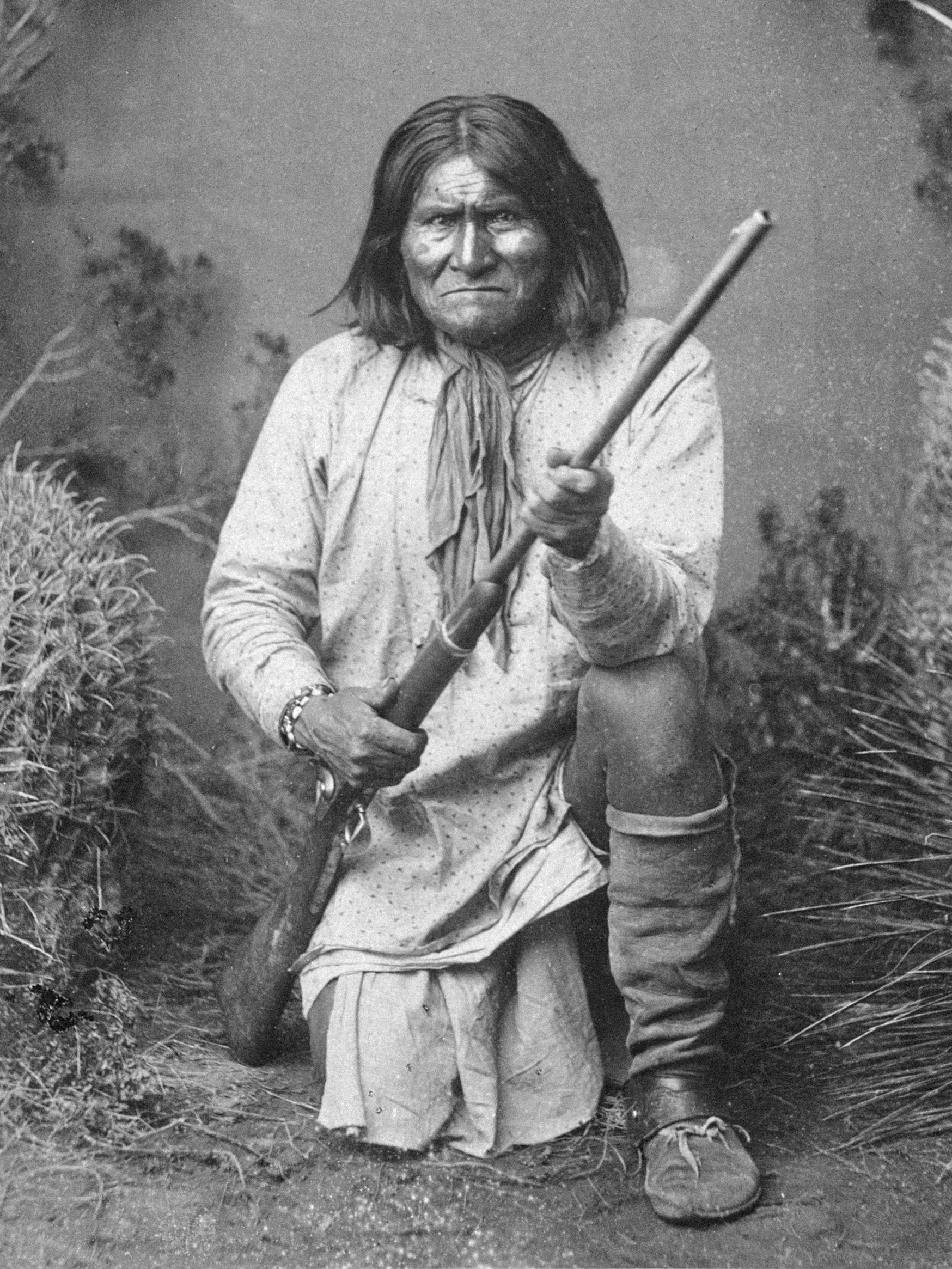
September 4, 1886: Geronimo Surrenders

The best-known image of Geronimo, 1887

September 4, 1886: Geronimo surrenders to the U.S. Army. The last great at-large Native American opponent of "the white man" gives up the fight.

He was born to the Apache tribe on June 16, 1829, in No-doyohn Cañon, Arizona, then a part of Mexico, with the name Goyaałé, meaning "The One Who Yawns." No one should be stuck with what he was called as a baby, but he wouldn't have to be.

In 1851, with the Apaches having to move south following the Mexican-American War, they were attacked by the Mexican Army, and another Apache heard a Mexican soldier that Goyaałé was killing yell, ¡Jerónimo!" invoking his patron saint, St. Jerome, for help. The warrior was known as "Geronimo" from then on.

Reservation life was confining to the free-moving Apache people, and they resented restrictions on their customary way of life. Geronimo led breakouts from the reservations, in attempts to return his people to their previous nomadic lifestyle.

While well-known, Geronimo was not a chief of the Bedonkohe band of the Central Apache, but a shaman. However, since he was a superb leader in raiding and warfare, he frequently led large numbers of 30 to 50 Apache men.

In 1886, after an intense pursuit in northern Mexico by American forces that followed his 3rd 1885 reservation breakout, Geronimo surrendered for the last time, at Skeleton Canyon, Arizona, to Lieutenant Charles B. Gatewood. Geronimo and 27 other Apaches were later sent to join the rest of the Chiricahua tribe.

While holding him as a prisoner, the United States capitalized on Geronimo’s fame among non-Indians by displaying him at various fairs and exhibitions. In 1905, the Indian Office provided Geronimo for use in a parade at the Inauguration of President Theodore Roosevelt. He and Geronimo admired each other, as Geronimo admitted in a memoir published later that year.

He died on February 17, 1909, of pneumonia, at the age of 79, at the Army hospital at Fort Sill, Oklahoma, still a prisoner of war, and was buried at the Fort Sill Indian Agency Cemetery, among the graves of relatives and other Apache prisoners of war. He has living descendants today.

In 1939, Victor Daniels, who claimed to be of Cherokee ancestry, acted under the name Chief Thundercloud, and was the 1st actor to play Tonto in a Lone Ranger film, starred in the film Geronimo: The Story of a Great Enemy. Inspired by the film, U.S. Army paratroopers, testing the practice of parachuting from planes, began a tradition of shouting "Geronimo!" to show they had no fear of jumping out of an airplane.

Geronimo has also been played by John Doucette in the 1958 ABC movie Tombstone Territory, Chuck Connors in the 1962 film Geronimo!, Enrique Lucero in the 1979 CBS miniseries Mr. Horn, and in 2 films in 1993, both with Native American actors in the role: Geronimo, starring Joseph Runningfox; and Geronimo: An American Legend, starring Wes Studi.

*

September 4, 1886 was a Saturday. The only professional team sport in America at the time was baseball. In the National League:

* The New York Giants lost to the Detroit Wolverines, 7-1 at Recreation Park in Detroit.

* The Chicago White Stockings (forerunners of the Cubs) beat the Washington Nationals, 13-6 at West Side Park in Chicago.

* The St. Louis Maroons beat the Boston Beaneaters (forerunners of the Braves), 12-2 at an early version of Sportsman's Park in St. Louis.

* The Philadelphia Quakers (forerunners of the Phillies) beat the Kansas City Cowboys, 3-0 at Association Park in Kansas City.

And in the American Association:

* The New York Metropolitans, nicknamed the Mets, beat the Baltimore Orioles, 6-2 at the Polo Grounds. Neither of these teams has any connection to the teams using those names today.

* The Brooklyn Grays lost to the Philadelphia Athletics, 15-2 at the original Washington Park in Brooklyn.

* The Pittsburgh Alleghenys (forerunners of the Pirates) beat the Cincinnati Red Stockings (forerunners of the Reds, but not connected to the 1869-70 team of the same name), 1-0 at Recreation Park in Pittsburgh.

* The St. Louis Browns (forerunners of the Cardinals) beat the Louisville Colonels, 11-4 at Eclipse Park in Louisville.

Saturday, July 2, 2022

July 3, 1886: The 1st Automobile

July 3, 1886: Karl Benz publicly unveils for his Benz Patent-Motorwagen in Mannheim, Baden-Württemberg, Germany. It is a motor tricycle with a rear-mounted 58.2 cubic-inch internal-combustion engine. He drives it on the Ringstrasse, at 10 miles per hour.

It is the first automobile. It was financed by the dowry of his wife, the former Bertha Ringer.

Karl Friedrich Michael Vaillant was born on November 25, 1844 in Mühlburg, Baden-Württemberg. His parents, Josephine Vaillant and Johann Georg Benz, were not yet married at the time of his birth. After their marriage, he was renamed Karl Friedrich Benz.

Although he was only 2 years old when his father died, Karl followed him into the profession of locomotive engineering. He combined this with his love of bicycles, and looked for a way to combine them into a single vehicle. The Benz Patent-Motorwagen was the result.
In 1888, Bertha Benz drove Benz Patent-Motorwagen Number 3 from Mannheim to Pforzheim, Baden-Württemberg -- 121 miles. She did this without telling her husband. This drive, and the Number 3's display at the 1889 World's Fair in Paris, helped to popularize the automobile.

Gottlieb Daimler was working on an automobile as early as 1885, and made his first successful one in 1892. His engineering partner was Emil Jellinek, who had a daughter named Mercedes. Daimler died in 1900, and he and Benz never met. Nevertheless, in 1926, 3 years before Karl Benz died, the companies merged as Daimler Benz. "Mercedes-Benz," or just "Mercedes," would become renowned as the greatest automobiles in the world -- even if German competitors BMW (Bavarian Motor Werks) would call their car, in commercials airing in America, "the ultimate driving machine."

*

July 3, 1886 was a Saturday. These games were played in baseball's National League:

* The New York Giants beat the Chicago White Stockings, 7-3 at West Side Park in Chicago. The White Stockings became the Cubs in 1903, although their former name would be taken up by an AL team in 1901, later shortened to "White Sox."

* The Detroit Wolverines beat the Boston Beaneaters, 7-5 at Recreation Park in Detroit. The Wolverines would win the Pennant in 1887, but rising costs forced them out of business after the next season. The Beaneaters would go through a few name changes, before becoming the Braves in 1912.

* The St. Louis Maroons beat the Washington Nationals, 3-2 at an early version of Sportsman's Park in St. Louis. This would be the last season for the Maroons. The Nationals were consolidated out of existence after the 1899 season, although their name would be taken up by the moved Montreal Expos in 2005.

* The Philadelphia Quakers beat the Kansas City Cowboys, 8-2 at Association Park in Kansas City. This would be the only season for the Cowboys. The Quakers became the Phillies in 1891.

And in the American Association:

* The New York Metropolitans beat the Louisville Colonels, 15-7 at Eclipse Park in Louisville, Kentucky. The Metropolitans, like the NL team founded in 1962, were called the Mets for short, but only lasted 1 more season. The Colonels joined the NL in 1892, but were consolidated out of existence after the 1899 season.

* The Brooklyn Grays lost to the St. Louis Browns, 4-0 at Sportsman's Park. The Grays joined the NL in 1890, the Browns in 1892. The Browns would become the Cardinals in 1900, although their former name would be taken up by an AL team in 1902. The Grays would go through a few name changes, and became the Dodgers in 1911.

* The Baltimore Orioles beat the Pittsburgh Alleghenys, 12-3 at Recreation Park in Pittsburgh. The Alleghenys joined the NL in 1887, the Orioles in 1892. The Alleghenys became the Pirates in 1891. The Orioles were consolidated out of existence after the 1899 season, although their name would be taken up by the St. Louis Browns when they moved to Baltimore in 1954.

* The Cincinnati Red Stockings beat the Philadelphia Athletics, 8-2 at American Park in Cincinnati. The Red Stockings joined the NL and changed their name to the Reds, both in 1890. That same year, this version of the Athletics folded, though their name would be taken up by an AL team in 1901.

Wednesday, June 1, 2022

June 2, 1886: President Grover Cleveland Marries Frances Folsom

Artist's depiction. No photograph was taken.

June 2, 1886: A wedding ceremony is held at the White House. And the groom is the President himself.

There had been previous Presidents who came to the office without wives. Thomas Jefferson, Andrew Jackson, Martin Van Buren and Chester Arthur were widowers. And James Buchanan was a lifelong bachelor.

In the places of the late would-have-been First Ladies, Martha Jefferson, Rachel Jackson, Hannah Van Buren and Ellen Arthur, were, respectively: Daughter Martha Jefferson Randolph, niece Emily Donelson and daughter-in-law Sarah Jackson, daughter-in-law Sarah Van Buren, and sister Mary Arthur McElroy.

John Tyler was widowed when his wife Letitia died on September 10, 1842. He married the much-younger Julia Gardiner on June 26, 1844, at the Church of the Ascension in New York. In the interim, the First Lady had been his daughter-in-law, Priscilla Tyler. This 2nd marriage for Tyler lasted until his death on January 18, 1862.

And there had been previous weddings at the White House:

* March 29, 1812: Lucy Payne Washington, sister of First Lady Dolley Madison, married Supreme Court Justice Thomas Todd. Despite Dolley's late previous husband having been named John Todd, Thomas Todd was not a relative.

* March 9, 1820: Maria Hester Monroe, daughter of President James Monroe, married her 1st cousin, Samuel L. Gouverneur, who was the President's Private Secretary. He later served in the New York State Assembly.

* February 25, 1828: John Adams II, son of President John Quincy Adams and grandson of President John Adams, married his first cousin, Mary Catherine Hellen. John was his father's Private Secretary. Unfortunately, both he and his brother, George Washington Adams, fell victim to alcoholism and died young.

* April 10, 1832: Mary A. Eastin, niece of Rachel Jackson, the late wife of Andrew Jackson, married Lucius J. Polk. Lucius appears not to have been related to eventual President James K. Polk, another Tennessee politician, who was something of a Jackson protégé.

* November 29, 1832: Mary Anne Lewis, daughter of a close friend of Jackson's, married Alphonse Pageot.

* January 31, 1842: Elizabeth Tyler, daughter of President John Tyler, married William Waller.

* May 21, 1874: Nellie Grant, daughter of President Ulysses S. Grant, married Algernon Sartoris.

* June 19, 1878: Emily Platt, niece of President Rutherford B. Hayes,  married Russell Hastings.

Grover Cleveland was a bachelor when he was inaugurated on March 4, 1885. His sister, Rose, stood in as First Lady. But he was biding his time. On June 2, 1886, at the White House, he married Frances Folsom, the daughter of Oscar Folsom, his former law partner. Oscar died in a carriage accident in Buffalo in 1875, and had left Frances' guardianship to Grover.

She was 21 when they married in 1886, making her by far the youngest First Lady ever (still). Byron Sunderland, a Presbyterian minister, performed the ceremony.

She was 21, pretty and petite. He was 49 and fat. But, as icky as their relationship sounds, it lasted for the rest of his life, until 1908. And she was actually considered a close political advisor to him. After he was defeated for re-election in 1888, Frances was the one who convinced him to run to regain the office in 1892, and he won.
The Cleveland family, 1907. Left to right: Esther, Francis,
Frances, Marion, Richard & Grover. 

Grover and Frances Cleveland had 5 children: Ruth, Esther, Marion, Richard and Francis. Ruth was not, as the legend says, the namesake of the Baby Ruth candy bar. She died of diphtheria at age 12. The rest all lived until at least 1974, and Francis lived until 1995, 111 years after his father was first elected President. (It would be as if, in 2022, a child of Woodrow Wilson were still alive, or if Malia or Sasha Obama were to live until 2119.)

Frances Cleveland married Thomas J. Preston Jr., an archaeology professor, in 1913, and was still married to him when she died on October 29, 1947, 50 years after leaving the White House, a record for a former First Lady; and 39 years after being widowed, short of Sarah Polk's record of living 42 years after James K. Polk died.

Millard Fillmore was President from the death of Zachary Taylor on July 9, 1850 until the Inauguration of Franklin Pierce on March 4, 1853. Just 26 days later, on March 30, his wife, Abigail, died, making her the First Lady with the shortest post-White House life. Fillmore became the 1st President to remarry, marrying Caroline Carmichael on February 10, 1858. This marriage lasted until he died on March 8, 1874.

On October 25, 1892, shortly before Cleveland regained the Presidency from Benjamin Harrison, First Lady Caroline Harrison died. Her husband did not get a sympathy vote. His daughter, Mary Harrison McKee, served as First Lady for the last 4 months of the Harrison Administration. On April 6, 1896, Benjamin Harrison married Mary Dimmick. She was Caroline's niece, so their pre-marriage relationship was every bit as "Okay for the time, but pretty cringey today" as Grover and Frances'. They remained married until Benjamin died on March 13, 1901.

On August 6, 1914, Ellen Wilson, wife of Woodrow Wilson, died. She remains the last First Lady to have died "in office." Their daughter, Margaret Wilson, served as First Lady until the President married Edith Galt on December 18, 1915, at Edith's home in Washington, not at the White House. That marriage lasted until Woodrow Wilson died on February 3, 1924.

Weddings at the White House since the Folsom-Cleveland wedding:

* February 17, 1906: Alice Roosevelt, daughter of President Theodore Roosevelt, married Nicholas Longworth. Happy to give the bride away, TR had once said, "I can run the country, or I can control Alice. I cannot do both." Already a Congressman from Ohio, Nick later served as Speaker of the House of Representatives.

* November 25, 1913: Jessie Wilson, daughter of Woodrow, married Francis B. Sayre, then a prosecutor in the District Attorney's office in New York City. He later served as High Commissioner to the Philippines.

* May 7, 1914: Eleanor Wilson, another daughter of Woodrow, married William Gibbs McAdoo. A Tennessee lawyer, he had led the building of the Hudson Tubes rail project (now the PATH system connecting Manhattan and northern New Jersey), and was Wilson's Secretary of the Treasury. In 1920, McAdoo was Wilson's 1st choice to succeed him as President, but couldn't get the nomination then, or on his 2nd try in 1924. He later served as a U.S. Senator from California. Wilson's other daughter, Margaret, who filled in as First Lady between her father's marriages, never married.

(Under current law, changed after John F. Kennedy made his brother Robert the Attorney General, if the Wilson-McAdoo marriage had happened first, that appointment could not have been made.)

* August 7, 1918: Alice Wilson, niece of Woodrow, married Isaac Stuart McElroy, Jr., a minister.

* July 30, 1942: Harry Hopkins, advisor to President Franklin D. Roosevelt, married Louise Gill Macy.

* December 9, 1967: Lynda Bird Johnson, daughter of President Lyndon B. Johnson, married Charles S. Robb, then a Marine Corps officer, and later Governor of Virginia and a U.S. Senator.

* June 12, 1971: Tricia Nixon, daughter of President Richard Nixon, married Edward F. Cox. This was the 1st outdoor wedding on the grounds of the White House. Cox was a corporate lawyer, and later served as Chairman of the Republican Party of the State of New York. Nixon's other daughter, Julie, married David Eisenhower, grandson of President Dwight D. Eisenhower, on December 22, 1968, at Marble Collegiate Church in New York, with the famous minister and author Norman Vincent Peale presiding.

* May 28, 1994: Tony Rodham, brother of First Lady Hillary Clinton, married Nicole Boxer, a film producer, and daughter of U.S. Senator Barbara Boxer of California.

* October 19, 2013: Pete Souza, the Chief Official White House Photographer, married Patti Lease.

(UPDATE: November 19, 2022: Naomi Biden, granddaughter of President Joe Biden, married Peter Neal.)

*

June 2, 1886 was a Wednesday. These games were played in baseball's National League:

* The New York Giants beat the Kansas City Cowboys, 7-3 at the original Polo Grounds in Harlem, Manhattan. The Cowboys only played in the NL in this 1886 season, and folded.

* The Philadelphia Quakers beat the St. Louis Maroons, 8-6 at Recreation Park in Philadelphia. After this season, the Maroons moved, becoming the Indianapolis Hoosiers, and folded after the 1889 season. At that point, the Quakers, already being unofficially called the Phillies (short for "Philadelphias"), made the name change official.

* The Chicago White Stockings beat the Boston Beaneaters, 9-0 at the original South End Grounds in Boston. Today, these teams are known as the Chicago Cubs and the Atlanta Braves.

* The Detroit Wolverines beat the Washington Nationals, 6-4 at the Swampoodle Grounds in Washington. The Wolverines won the NL Pennant the next year, but folded the year after that. The Nationals folded the year after that, and bear no connection to the current franchise of that name.

And in the American Association:

* The New York Metropolitans beat the Louisville Colonels, 7-1 at the St. George Cricket Grounds on Staten Island. Yes, the Metropolitans were often called the Mets, and the later team was named in part for them. They played from 1880 to 1887. The Colonels joined the NL in 1892, after the AA folded, but folded themselves in after the 1899 season.

* The Brooklyn Grays lost to the Cincinnati Reds, 6-2 at Washington Park in Brooklyn. The Grays would join the NL in 1890, the Reds in 1892. The Grays became the Dodgers in 1911.

* The Pittsburgh Alleghenies beat the Philadelphia Athletics, 6-1 at the Jefferson Street Grounds in Philadelphia. The Alleghenies joined the NL in 1890, and became the Pirates. An American League team would later take up the Philadelphia Athletics name.

* And the St. Louis Browns beat the Baltimore Orioles, 6-4 at the original Oriole Park in Baltimore. Both teams joined the NL in 1892. These Orioles folded after the 1899 season. At that point, the St. Louis team was renamed the Cardinals. The AL had a team called the St. Louis Browns, but in 1954, they moved, becoming... the Baltimore Orioles.

Saturday, May 14, 2022

May 15, 1886: "A Sunday Afternoon on the Island of La Grande Jatte" Debuts

May 15, 1886: An exhibition of Impressionist Art begins at 1 Rue Laffitte in Paris. Among the paintings displayed is Un dimanche après-midi à l'Île de la Grande Jatte -- which translates to "A Sunday Afternoon on the Island of the Big Bowl" -- by Georges Seurat.

Georges Pierre Seurat was born on December 2, 1859 in Paris. He devised the painting techniques known as chromolumaniarism and pointillism, and used Conté crayons for drawings on paper with a rough surface.

He completed la Grande Jatte in 1884, and it became a sensation with this exhibition, and another in August of that year. He died in Paris on March 29, 1891, only 31 years old. The cause has never been determined. To make matters worse, his son died just 2 weeks later. To make matters worse still, his wife Madeleine was pregnant, and that child died shortly after birth.

So Seurat has no known descendants. This fact was ignored for the 1984 musical Sunday in the Park with George by Stephen Sondheim and James Lapine. In Act I, it tells a fictionalized story of the painting's creation. Act II takes place in the present day, and is about Seurat's fictional great-grandson, also a painter named George. In the original Broadway production, both roles were played by Mandy Patinkin. Because of the musical, the painting is often erroneously called "Sunday in the Park."

The original painting is now in the Art Institute of Chicago. In the 1986 film Ferris Bueller's Day Off, Ferris (played by Matthew Broderick), Sloane Peterson (Mia Sara) and Cameron Frye (Alan Ruck) visit the Art Institute, and Cameron fixates on the painting, with the camera getting closer and closer on the face of the little girl in the middle, next to the woman with the red umbrella (presumably, her mother), until there's only Seurat's dots shown.

As with many other notable works of art, this painting has been parodied many times.

*

May 15, 1886 was -- no, not a Sunday, a Saturday. The poet Emily Dickinson died on this day, at her home in Amherst, Massachusetts, from the kidney disorder Bright's disease, at the age of 55.

In North America at the time, the only professional sport was baseball. Two games were played in the National League:

* The Detroit Wolverines beat the Boston Beaneaters, 9-2 at Recreation Park in Detroit. The Wolverines won the Pennant in 1887, but folded after just 1 more season. The Beaneaters went through a few name changes, finally becoming the Braves in 1912, moving to Milwaukee in 1953, and then to Atlanta in 1966.

* And the Philadelphia Quakers beat the St. Louis Maroons, 13-5 at an early version of Sportsman's Park in St. Louis. The Maroons folded after the 1889 season. The Quakers became the Phillies in 1890.

And there were 2 games in the American Association:

* The Louisville Colonels beat the Pittsburgh Alleghenys, 6-2 at Recreation Park in Pittsburgh. The Alleghenys joined the NL the next year, and changed their name to the Pirates in 1891. Because of the league switch, the present-day Pirates consider 1887, not 1882, their founding date. The Colonels joined the NL in 1892, but were bought by the Pirates after the 1899, and contracted out of the NL.

* And the Cincinnati Red Stockings beat the St. Louis Browns, 8-2 at American Park in Cincinnati. The Red Stockings became the Reds in 1890, and the Browns became the Cardinals in 1900. Both teams joined the NL in 1892.

Wednesday, May 4, 2022

May 4, 1886: The Haymarket Bombing

May 4, 1886: They Haymarket Bombing -- also known as the Haymarket Affair, the Haymarket Massacre, and the Haymarket Riot -- takes place.

Haymarket Square was bounded by Lake Street, Des Plaines Street, Randolph Street and Halsted Street, 4 blocks west of the Chicago River. It was known as a produce market, and as a site for political demonstrations.

Which was the case on May 4, 1886. It started out as a peaceful rally, in support of workers who were striking for an 8-hour workday. The day before, police had fired onto demonstrators, killing 1 and injuring a few others.

As a light rain fell, August Spies, a 30-year-old native of Hesse, Germany who was publishing a radical newspaper, stood on an open wagon on the Des Plaines Street side, addressed a crowd, whose estimates ranged from 600 to 3,000, not counting uniformed police officers. Also in attendance was the Mayor of Chicago, Carter Harrison, a cousin of William Henry Harrison (President of the United States for a month before dying in 1841) and Benjamin Harrison (elected President in 1888). Spies stated that the mission of the rally was to peacefully support the strikers and their cause.

Next to speak was Albert Parsons, 37, from Montgomery, Alabama, and also publisher of a radical newspaper. He spoke for an hour. Apparently, his speech was considerably weaker than Spies' was, causing the Mayor to leave in boredom. He wouldn't even be a witness to what happened later. As he left, he told the police to leave the demonstrators alone.

The last speaker was Samuel Fielden, a 39-year-old English Socialist. As the rain got harder, and more people began to leave, his speech, over the course of 20 minutes, "grew wilder and more violent as he proceeded," according to an article in The New York Times. Those who stayed grew agitated.

So when Fielden was finished, the police tried to disperse the crowd. And someone -- to this day, never definitively identified -- threw a dynamite bomb at the police. The explosion killed 8 officers; and 4 civilians, wounding dozens of others.

The 8 dead policeman: Mathias Degan, 34; John Barrett, also 34; George Miller, 28; Timothy Flavin, 27; Michael Sheehan, 29; Thomas Redden, 50; Timothy Sullivan, 51; and Nels Hansen, 50. Hansen was of Danish descent, the rest, like the vast majority of big-city policemen in America at that point, where of Irish descent or immigrants from Ireland.

The investigation convinced one potential suspect to rat his co-conspirators out, and, on June 4, 7 men were indicted, not for throwing the bomb -- no one was ever charged with that -- but for being accessories to the murder of Officer Degan. Spies and Fielden were among them, but were the only 2 of the 7 who were at the scene at the time of the explosion. Parsons and Adolph Fischer were at the scene, but left before the explosion.

Also arrested, but not at the Square at all that day, were Michael Schwab, Spies' assistant editor; Louis Lingg, who was believed to have made the bomb; and George Engel.

Spies, Fischer, Schwab, Lingg and Engel were immigrants from Germany. Fielden was an immigrant from England. Only Parsons was born in the U.S., and only Fielden and Parsons were raised speaking English, and could speak it without a German accent. So the Haymarket Affair pitted not only native-born vs. immigrant, but immigrant groups vs. others.

The trial began on June 21. On August 11, a verdict was reached. Take a wild guess as to what it was. All were convicted, and all were sentenced to death.

On November 10, 1887, the day before the 7 men were to be executed, Governor Richard J. Oglesby of Illinois commuted the sentences of Fielden and Schwab to life in prison.

He did not do so for Lingg, who, upon hearing this, committed suicide in his cell. Someone had smuggled in a blasting cap that he held in his mouth like a cigar. Unfortunately for him, he lived for 6 hours with half his face blown off. He would have been better off accepting his hanging, which would have ended his life within a minute. He was 23 years old.

The next day, November 11, 1887, Spies, 31; Fischer, 29; Engel, 51; and Parsons, 39, were taken to the gallows. At a time when "The Internationale," composed in 1871, had not yet been accepted as the worldwide anthem of left-of-center politics, they sang what then was, the French national anthem, "Le Marseillaise."

With the noose around his neck, Spies yelled to the crowd, "The time will come when our silence will be more powerful than the voices you strangle today!" Engel and Fischer yelled out, "Hurrah for anarchism!" Parsons never got any last words out, as the 4 men were then hanged.

In 1893, Governor John P. Altgeld of Illinois pardoned Fielden and Schwab, and they were released after 6 years. Schwab's health had already been compromised, and he died in 1898, age 44. Fielden bought a ranch in Colorado, and prospered there until he died in 1922, just before his 75th birthday.

The Haymarket Affair is often considered a landmark moment in the history of the American labor movement. It was not: Little progress was made for years. Various industries established 8-hour workdays over the years to come, but it wasn't until 1916, when Congress passed the Adamson Act, that it became nationwide.

Since the late 1950s, the western edge of the Square has been taken up by Interstate 90. It opened as the Northwest Expressway in 1960, and was renamed the John F. Kennedy Expressway shortly after the 35th President was assassinated in 1963.

*

May 4, 1886 was a Tuesday. The only team sport in America that was professional was baseball. In the National League: 

* The New York Giants lost to the Philadelphia Quakers, 11-4 at Recreation Park in Philadelphia. The Quakers became the Philadelphia Phillies in 1890.

* The Boston Beaneaters beat the Washington Nationals, 8-3 at the Swampoodle Grounds in Washington. The Beaneaters eventually became the Braves. This version of the Washington Nationals folded after the 1889 season. The Swampoodle neighborhood of D.C. no longer exists: Union Station was built on the site in 1907.

* The St. Louis Maroons beat the Chicago White Stockings, 6-5 at Sportsman's Park in St. Louis. The White Stockings would become the Cubs. The Maroons could not compete with the local team in the American Association, and folded after the 1889 season.

Speaking of the American Association, these games were played there on that day:

* The New York Metropolitans lost to the Baltimore Orioles, 10-3 at the original Polo Grounds, at 111th Street and 5th Avenue. Yes, the Metropolitans were called "the Mets" for short. They ran out of money and folded in 1887. Their name was revived for the 1962 National League expansion team: To this day, the corporate name of the New York Mets is "Metropolitan Baseball Club, Incorporated."

This version of the Baltimore Orioles joined the NL in 1892; won its Pennant in 1894, 1895 and 1896; but lost money in 1899, and were contracted. They bear no connection to the current American League team of the same name.

* The Brooklyn Grays beat the Philadelphia Athletics, 3-1 at Washington Park in Brooklyn. The Grays would join the NL in 1890, and would eventually become the Dodgers. This version of the Athletics folded after "the Players' League War" of 1890, and bears no relationship to the AL team of the same name founded in 1901.

* The St. Louis Browns beat the Pittsburgh Alleghenys, 14-7 at Exposition Park in Pittsburgh. Soon, the Alleghenys would make a transaction that would be publicly called "nothing but piratical." The team ran with the name, and became the Pittsburgh Pirates. (The alliteration helped.) They joined the NL in 1887.

The Browns did so in 1892, after the AA collapsed, and eventually became the Cardinals. As with the Baltimore Orioles and the Chicago White Stockings, an AL team adopted the NL team's former name.

* And the Cincinnati Red Stockings beat the Louisville Colonels, 5-2 at League Park in Cincinnati. The Reds-to-be joined the NL in 1892. The Colonels were contracted after the 1899 season. 

Saturday, January 15, 2022

January 16, 1886: The 1st College Football Game On the West Coast

The Cal football team, 1886

January 16, 1886: For the 1st time, a college football game is played on America's West Coast. The game is played at West Field, on the campus of the University of California's main campus in Berkeley, in the San Francisco Bay Area's East Bay region. The University -- usually known as "Cal" for sports purposes, and as "Berkeley" for everything else -- beat a club team named the Wasps, 20-2.

In 1891, Stanford University opened in Palo Alto, across the Bay, on the Peninsula between San Francisco and San Jose. The following year, March 19, 1892, Cal and Stanford played each other in football for the 1st time. Stanford won, 14-10. The game was played in San Francisco, at Recreation Park, every year until 1903. Thereafter, "The Big Game" has been held in Berkeley in even-numbered years, and Palo Alto in odd-numbered years.

In 1915, Cal became a founding member of the Pacific Coast Conference, along with the Universities of Oregon and Washington, and Oregon State College (renamed Oregon State University in 1961). Washington State College joined in 1917 (and was renamed Washington State University in 1959). Stanford joined in 1918. The University of Southern California (USC) and the University of Idaho joined in 1922, the University of Montana in 1924, and the University of California at Los Angeles (UCLA) in 1928.

In 1959, the Athletic Association of Western Universities (AAWU) was founded, with Cal, UCLA, USC and Washington as charter members. Stanford joined shortly thereafter, and the league was informally named the Big Five. Washington State joined in 1962, making it (still unofficially) the Big Six.

In 1964, Oregon and Oregon State joined, and the name was officially changed to the Pacific 8, or Pac-8. (Unlike the Big Eight, the Big Ten and the Big Twelve, the name has always officially had the numeral, not the word for the number.) In 1978, Arizona and Arizona State joined from the Western Athletic Conference (WAC), and the league became the Pacific-10 or Pac-10. In 2011, the Universities of Colorado (from the Big 12) and Utah (from the Mountain West) joined, making it the Pacific-12 or Pac-12.

In terms of National Championships, across all sports, the Pac-12 was the most successful college sports league. Emblematic of this was USC in football, UCLA in basketball, and Oregon in track & field. And it had some of the best rivalries, especially in football: The aforementioned Big Game between Cal and Stanford, the USC-UCLA rivalry, the Duel in the Desert between the Arizona schools, the Civil War between the Oregon schools, and the Apple Cup between the Washington schools.

UPDATE: Money talks, and it pronounced a death sentence on the Pac-12. In 2022, UCLA and USC, long the leaders of Pac-10 and -12 football in the Rose Bowl against the Big 10 Champions, announced they would leave the Pac-12 for the Big 10, starting in 2024. In 2023, all also for 2024: Oregon and Washington announced they would also bolt for the Big 10; while Arizona, Arizona State and Utah announced they were going to the Big 12; and, perhaps most ridiculous of all, given the geography and the nomenclature, Cal and Stanford announced they were joining the Atlantic Coast Conference.

This leaves Oregon State and Washington State as the only teams left in the league still officially known as the Pac-12. As of December 1, 2023, it was not yet known whether the former "Power Five conference" would be able to take in schools from what college basketball fans would call "mid-major" leagues.

*

January 16, 1886 was a Saturday. Baseball and football were out of season. Basketball did not yet exist, and hockey barely did. Even England's Football League hadn't been formed yet. There were, however, FA Cup games, in the 5th round. Small Heath Alliance, the team that would become Birmingham City, bean Davenham, 2-1 in Davenham, Cheshire. Swifts, of Slough, Berkshire beat Church, 6-2 in the town of Church, Lancashire.

And Burslem Port Vale, the Stoke-on-Trent team now known as simply Port Vale, beat Brentwood, of Brentwood, Essex, 2-1. However, that match was declared void. Two weeks later, the replay ended 4-4. Port Vale chose not to play a 2nd replay, and Brentwood advanced to the Quarterfinals.

Blackburn Rovers, of Lancashire, won the tournament.

December 31, 1999 & January 1, 2000: The Millennium

December 31, 1999:  The Millennium arrives. The people of planet Earth survived. At a terrible cost. But we hadn't destroyed ourselves. ...