Showing posts with label johannesburg. Show all posts

Monday, July 11, 2022

July 11, 2010: The Battle of Soccer City

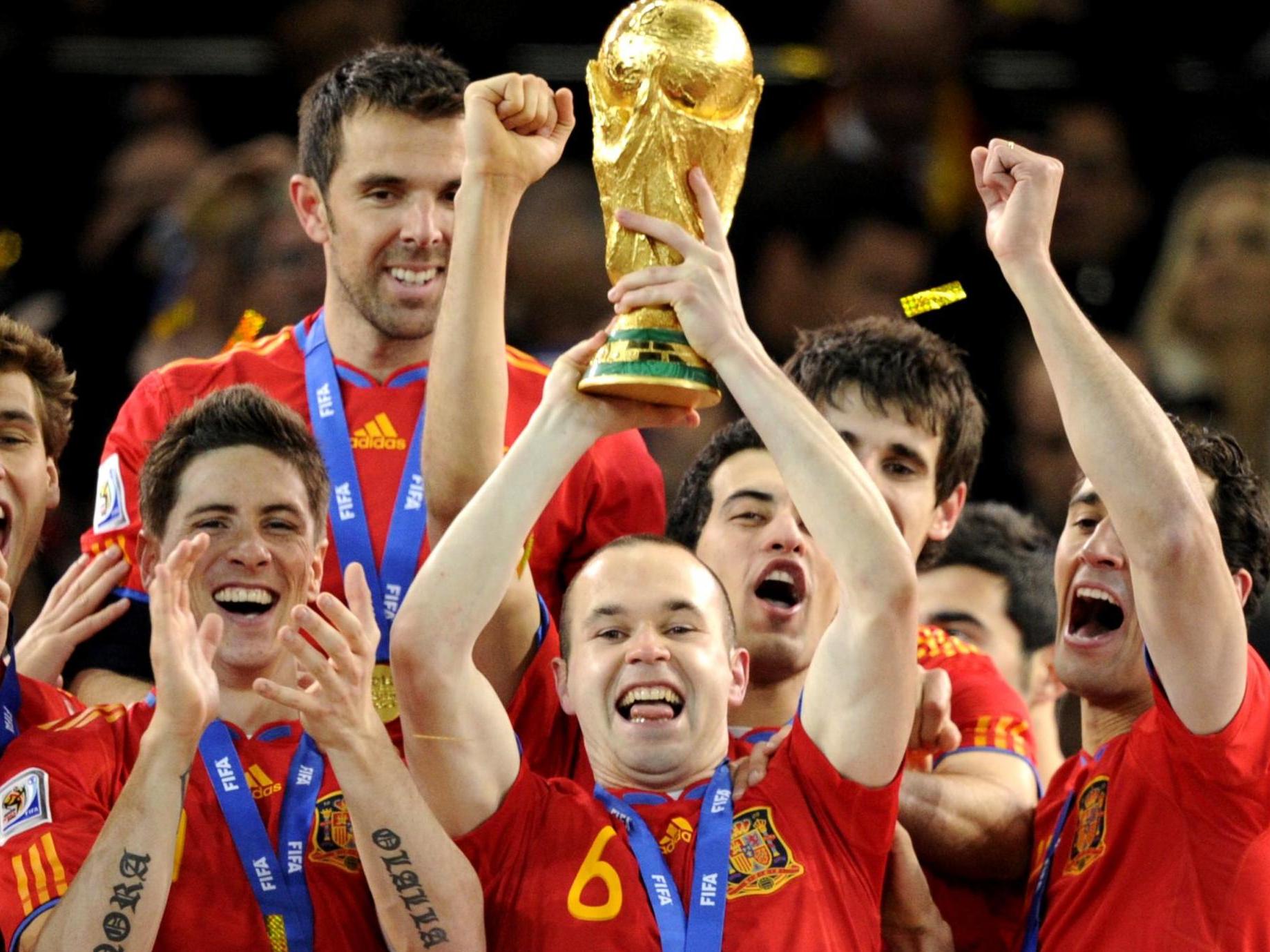
Andrés Iniesta with the World Cup

July 11, 2010: The World Cup Final is held at Soccer City in Johannesburg, South Africa. For sponsorship reasons, it is known as First National Bank Stadium, or FNB Stadium. But since the World Cup prohibits corporate names on stadiums, it was referred to as "Soccer City." It was built in 1989, on the edge of the Soweto township, a key location in black South Africans' struggle for equality. It is also the home of one of the country's top soccer teams, Kaizer Chiefs.

ABC broadcast it in America, including the constant annoyance of the fans with their native musical instrument, the vuvuzela. Given the countries competing in the game, it should have been a beautiful Final for the world championship of what Pelé called "The Beautiful Game": Spain vs. the Netherlands.

It wasn't. It was the ugliest Final in World Cup history, even more so than the tainted Final of 1978 in which Argentina, on Fascist-controlled home soil, beat the Netherlands.

The Spain side was managed by former Real Madrid boss Vicente del Bosque, and was dominated by 2 of the most-cheating teams in soccer, brought together for a common purpose: Real Madrid and FC Barcelona. From Real Madrid came goalkeeper Iker Casillas (Captain of club and country), defenders Sergio Ramos (maybe the dirtiest player in the sport at the time), Raúl Albiol and Álvaro Arbeloa; and midfielder Xabi Alonso.

From "Barça" came defenders Carles Puyol (their Captain), a dirty tackler, and Gerard Piqué, a notorious diver; midfielders Andrés Iniesta, Xavi Hernández (known by just his first name) and Sergio Busquets (another diver); forward Pedro Rodríguez (also known by his first name); and backup goalkeeper Victor Valdés.

From Valencia CF came forward David Villa; midfielders Juan Mata (yet another diver) and David Silva; and defender Carlos Marchena. From Villareal CF came defender Joan Capdevila. From Sevilla FC came midfielder Jesús Navas. From Athletic Bilbao came forward Fernando Llorente and midfielder Javi Martínez. And 3 players came from England's Premier League. From Liverpool FC were forward Fernando Torres and goalkeeper Pepe Reina. And from North London team Arsenal FC was former Barcelona midfielder Cesc Fàbregas.

And the Dutch? This was not your father's Oraanje. No Total Football, no brilliant passing, no stylish goalscoring. They were more like a sledgehammer. They were managed by Bert van Marwijk, who once managed Rotterdam side Feyenoord. As usual, the Dutch team was dominated by players who had come from the Netherlands' "Big Three" Feyenoord, Amsterdam team Ajax, and Eindhoven team PSV. But, as the Dutch top league, the Eredivisie, doesn't pay as well as the leagues of neighboring countries like England, Spain, France and Germany, not all of them had stayed with those teams:

From Ajax: Goalkeeper Maarten Stekelenburg; defenders Gregory van der Wiel, John Heitinga (then with Liverpool team Everton FC); midfielders Demy de Zeeuw, Nigel de Jong (then with Manchester City), Wesley Sneijder (who had played with Real Madrid, but was then with Internazionale Milano) and Rafael van der Vaart (then, ironically, with Real Madrid); and forward Ryan Babel (then with Liverpool).

From Feyenoord: Defender Giovanni van Bronckhorst (Captain); and forwards Dirk Kuyt (then with Liverpool) and Robin van Persie (then with Arsenal).

From PSV: Defender André Ooijer; midfielders Ibrahim Afellay, Mark van Bommel (who had played for Barcelona, but was then with Bayern Munich); and forwards Arjen Robben (who had played with Real Madrid, but was then with Bayern) and Klaas-Jan Huntelaar (who had also played for Ajax and Real Madrid, but was then with AC Milan).

From AZ Alkmaar: Defender Joris Mathijsen (then with Hamburger SV); midfielder Stijn Schaars.

From Enschede side FC Twente: Backup goalkeeper Sander Boschker; defender Edson Braafheid (then with Glasgow, Scotland team Celtic); and forward Eljero Elia (then with Hamburger).

From RKC Waalwijk: Defender Khalid Boulahrouz (then with VfB Stuttgart).

From FC Utretcht: Backup goalkeeper Michael Vorm, who led to the soccer-themed pun: "Vorm is temporary, class is permanent."

The Netherlands slogged through their Group, winning all 3 games, but not particularly distinguishing themselves in any of them, beating Denmark 2-0, Japan 1-0, and Cameroon 2-1. Spain opened their run by getting upset 1-0 by Switzerland, but rebounded to beat former colonies Honduras 2-0 and Chile 2-1.

In the Round of 16, the Netherlands beat Slovakia, 2-1 in Durban; while Spain beat neighboring Portugal, 1-0 in Cape Town. In the Quarterfinals, 2 goals by Sneijder turned an early 1-0 Brazil lead into a 2-1 Dutch win in Port Elizabeth; while Spain left it late, with Villa scoring in the 83rd minute, to beat Paraguay, 1-0 in Johannesburg. In the Semifinals, the Netherlands hung on to beat Uruguay, 3-2 in Cape Town; while Spain got a goal from Captain Puyol in the 73rd to beat Germany, 1-0 in Durban.

The referee for the Final was Howard Webb, the English former police officer infamous for his bald head and his apparent favoritism for Manchester United. To be assigned as the top official for a World Cup Final should be the greatest honor any sports official can ever receive, but Webb did not live up to the distinction. To say that he lost control of the match would suggest that he even tried to exert any control. The 14 yellow cards he gave out -- 9 to the Netherlands, 5 to Spain -- were more than double the previous record.
Howard Webb

Spain had the 1st serious chance of the game just 5 minutes in, when Stekelenburg made a diving save of a Ramos header. Shortly thereafter, the Dutch had their 1st chance, but Casillas saved from Kuyt. Heitinga deflected a Ramos shot over the crossbar in the 11th. Casillas stopped a screamer of a free kick from Sneijder.

In the 28th minute, with Webb having already given each side 2 yellow cards, de Jong kicked Alonso in the chest. For this, Webb should have shown him a straight red card and sent him off, but he only gave de Jong a yellow. As if the match wasn't rough enough, Casillas did Spain no favors by colliding with Puyol and injuring him in the 33rd. Puyol was able to carry on. Just before halftime, Casillas saved a shot by Robben, and it remained 0-0.

In the 50th minute, Spain did what Barcelona usually do when they think they should be awarded a penalty, and surrounded the ref in an attempt to intimidate him. Webb, used to such behavior from Premier League teams Man United and Chelsea, refused to give in. Two minutes later, Casillas saved a van Persie shot.

Heitinga was booked for a foul on Villa in the 56th. In the 62nd, Robben had a one-on-one with Casillas, but shot too low, and Casillas deflected it. In the 70th, Villa had an equally good chance, and an equally bad shot, deflected by Stekelenburg. Ramos had a great chance in the 77th, but fired over the crossbar. Casillas made a brilliant stop on Robben in the 83rd. Regulation play ended with the game still scoreless.

On to extra time. In the 92nd, Xavi went down a little too easy after a collision with Heitinga, and, again, the Spaniards demanded a penalty. Again, they didn't get it. Apparently, their reputation preceded them. Fàbregas had come on as a substitute for Alonso, and had a shot in the 95th, saved by Stekelenburg. In the 101st, Navas fired a shot that had the stadium roaring, thinking it was a goal, but it only hit the side netting. In the 104th, Fàbregas just missed, slightly wide of the goalpost. Still 0-0 as the match headed into the 2nd half of extra time.

In the 109th, Xavi was brought down by Heitinga. This earned him a 2nd yellow, equivalent to a red. Neither of his yellow card offenses was especially bad, but there were 2 of them, and, given the rules, he, rather than the much rougher de Jong -- or any of the Spanish players -- was off, and the Dutch were down to 10 men.

In the 115th minute, Webb made a call that may have changed the outcome of the game. He rightly awarded the Netherlands a free kick, which Sneijder took, and Casillas tipped it behind the goal. That should have resulted in a corner for the Netherlands. Instead, Webb awarded Spain a goal kick.

Torres took the kick, took the ball up the pitch, and passed it to Fàbregas, who passed it to Iniesta, who scored. His goal in the 116th minute remains the latest ever scored in a World Cup Final. The Dutch complained to Webb about his decisions, both the awarding of the goal kick and his failure to call a foul on Elia. Mathijsen slammed the ball on the grass in anger, and Webb booked him instead. But Spain held on for the 1-0 win.

Two days later, on July 13, Spain held its World Cup celebration in the capital of Madrid. Barcelona players pull an FC Barcelona shirt over the head of Fàbregas, calling him "The future of Barcelona, the future of Spain," as if he were only on loan to Arsenal, and that he had to be sent back to his boyhood club.

He did not immediately remove the shirt and tell his national team mates to respect his contract. A year later, he proved that he didn't respect his contract, either: He went on strike and faked an injury. Soon, he was sold back to Barcelona.

Had I been the manager of Arsenal, I would have sold Fàbregas to Real Madrid, Barcelona’s arch-rivals, the next day. For one pound. It would have sent multiple messages. To Fàbregas: You are a traitor, and are being punished for it. To Barcelona: Do not mess with The Arsenal. To the Arsenal players: No one is irreplaceable. And to the Arsenal fans: I know you love him, and that I didn't get any money for him, but there are things more important than money. Alas, the manager of Arsenal was Arsène Wenger, and he had too much class to do this.

Howard Webb retired from refereeing in 2014. In 2022, he was named the head of the Professional Game Match Officials Limited (PGMOL) is the body responsible for refereeing games in English soccer. He replaced Mike Riley, who had also been known for calls favoring Manchester United, both as a referee himself and in upholding the calls and cards of the referees he governed.

An article for ESPN.com, published after the 2026 World Cup, ranking all 23 tournaments, rated this one 17th, citing the rough play, the cheating, and those damn vuvuzelas.

*

July 11, 2010 was a Sunday. These Major League Baseball games were played:

* The New York Yankees beat the Seattle Mariners, 8-2 at Safeco Field (now T-Mobile Park) in Seattle. CC Sabathia was the winning pitcher. Marcus Thames hit a home run. Mark Teixeira went 4-for-5 with an RBI. Derek Jeter went 1-for-5 with 2 RBIs. Alex Rodriguez went 0-for-5.

* The New York Mets beat the Atlanta Braves, 3-0 at Citi Field. Johan Santana allowed 5 hits over 7 innings, and Bobby Parnell and Francisco Rodríguez completed the 5-hit shutout.

* The Philadelphia Phillies beat the Cincinnati Reds, 1-0 at Citizens Bank Park in Philadelphia. Cole Hamels allowed 6 hits over 7 2/3rds innings, and José Contreras, J.C. Romero and Brad Lidge finished the 6-hit shutout. The only run came in the 3rd inning, when Jimmy Rollins singled Carlos Ruiz home.

* The San Francisco Giants beat the Washington Nationals, 6-2 at Nationals Park in Washington.

* The Boston Red Sox beat the Toronto Blue Jays, 3-2 at the Rogers Centre in Toronto. David Ortiz * and Darnell McDonald hit home runs.

* The Tampa Bay Rays beat the Cleveland Indians, 6-5 at Tropicana Field in St. Petersburg, Florida. Jason Bartlett singled Carl Crawford home with the winning run in the bottom of the 10th inning.

* The Minnesota Twins beat the Detroit Tigers, 6-3 at Comerica Park in Detroit.

* The Chicago White Sox beat the Kansas City Royals, 15-5 at U.S. Cellular Field (now Rate Field) in Chicago.

* The Milwaukee Brewers beat the Pittsburgh Pirates, 6-5 at Miller Park (now American Family Field) in Milwaukee.

* The Baltimore Orioles beat the Texas Rangers, 4-1 at Rangers Ballpark (now Choctaw Stadium) in the Dallas suburb of Arlington, Texas.

* The St. Louis Cardinals beat the Houston Astros, 4-2 at Minute Maid Park (now Daikin Park) in Houston.

* The San Diego Padres beat the Colorado Rockies, 9-7 at Coors Field in Denver.

* The Florida Marlins beat the Arizona Diamondbacks, 2-0 at Chase Field in Phoenix. How many Marlin pitchers does it take to pitch an 8-hit shutout? This time, 6: Alex Sanabia allowed 5 hits over 3 1/3rd innings, Burke Badenhop none in 2/3rds of an inning and credited as the winning pitcher, Brian Sanches none over 2, José Veras none in 1, Clay Hensley 2 in 1, and Juan Carlos Oviedo 1 in 1.

* The Los Angeles Dodgers beat the Chicago Cubs, 7-0 at Dodger Stadium in Los Angeles. Vicente Padilla allowed 2 hits over 8 innings, and Hung-Chih Kuo completed the 4-hit shutout.

* And the Oakland Athletics beat the Los Angeles Angels, 5-2 at the Oakland Coliseum.

Friday, June 24, 2022

June 24, 1995: The Rugby Match That United a Nation

Nelson Mandela and Francois Pienaar

June 24, 1995: A nation in search of reconciliation finds a moment to rally around -- as its President knew it could.

During the years of apartheid in South Africa, soccer was seen as the sport of the nation's black people, while cricket and rugby were the sports of its white people. Cricket appealed to the white people of British descent, while rugby appealed to both them and the people of Dutch descent, the Afrikaners whose Afrikaans language was a derivation of Dutch.

But Nelson Mandela, elected President in the country's 1st all-races election in 1994, saw that he was going to host the Rugby World Cup the following year. He knew that sport had the power to bring people together. In some cases -- soccer in Germany in 1954 and England in 1966, hockey in Canada in 1972 and America in 1980 -- it could bring an entire country together, or even the entire world.
So he wanted South Africa's famed rugby team, the green-and-gold-clad "Springboks" (a springbok is an antelope native to southern and western Africa), to bring the country together, by becoming racially integrated for the 1st time in its history, and face the other world powers of rugby, all integrated, and beat them on home soil.

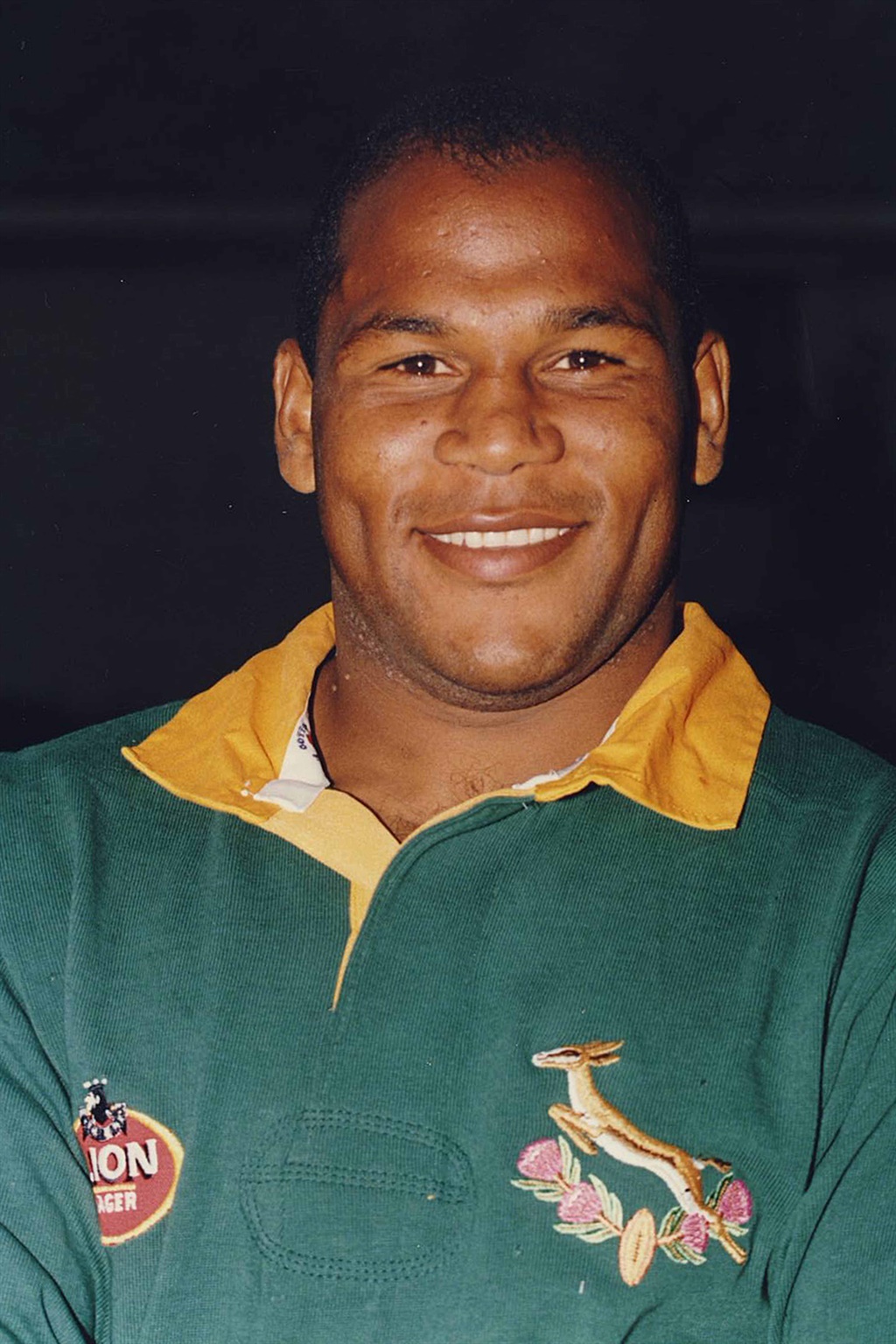
Chester Williams, a 24-year-old left wing from Cape Town, was the 1st black Springbok. In club matches, some opponents had made racist remarks about him. That was not the case when those opponents joined him on the national side: "When we were together as a team, the team-spirit was good. We partied together, we had fun together, we stuck by one another. Those other things happened while we were playing against one another in the Currie Cup, or domestic competitions. But that's in the past now. We have all moved on, and everybody's happy." Mandela could be seen in the stands wearing Williams' Number 11 shirt.
Chester Williams

South Africa were put in a group with Australia, Romania and Canada, but beat them all. They beat Western Samoa in the Quarterfinal, 42-14; and a tough France team in the Semifinal, 19-15. They would host the Final on June 24, at Ellis Park in Johannesburg, the home of South African rugby.

But they would have to play New Zealand. They are known as the All Blacks, referring to their uniforms, as they are multicultural, with players of Samoan descent often leading them in a fierce-looking pregame haka dance. (The New Zealand soccer team is the All Whites, again for their uniforms, not their racial makeup.)

The All Blacks had won the 1st Rugby World Cup, in 1987; and finished 3rd in 1991. They came into this edition as the favorites, mainly because they had the man then regarded as the best player in the world: Jonah Lomu. Scotland player Kenny Logan put it this way: "You could talk about Lionel Messi or Cristiano Ronaldo, that's what Jonah was, someone who could change games if you gave him the ball, wherever he was."

A New Zealander of Tongan ancestry, Lomu had been an all-around track and field star as well. At 6-foot-5 and 262 pounds of solid muscle, Lomu was so effective, his playing style attracted attention from NFL scouts and suggested that he might be able to make the transition to American football. He never tried it, though.
Jonah Lomu

(While a few NFL players had played rugby at a scholastic or collegiate level, only 1 professional rugby player has ever played in the NFL: Hayden Smith, an Australian who played 8 seasons for Saracens in London, and 5 games as a tight end for the New York Jets in 2012. Most of those who've tried out have been cut, or only made the practice squad, never getting into a game.)

New Zealand beat Ireland, Wales and Japan in the Group Stage, their win over Japan being a shocking 145-17. They beat Scotland in the Quarterfinal, and England in the Semifinal. So they had beaten all 4 of the United Kingdom's "Home Nations," given that the Ireland team was a combination of players from the Republic of Ireland and British-controlled Northern Ireland. The Semifinal win over England was 45-29, and that 16-point margin was the closest anyone had come to beating them. Lomu scored 4 tries (touchdowns) in that game. He and teammate Mark Ellis had each scored 7 over the course of the tournament.

(For the sake of perspective: In the Spring tournament then known as the Five Nations Championship, England went 4-0, Scotland 3-1, France 2-2, Ireland 3-1, and Wales 0-4. In 2000, Italy were admitted to the competition, giving it the current name: The Six Nations Championship.)

Essentially, it looked like a battle of a great offense against a great defense: New Zealand had outscored their opponents, 315-104; while South Africa had outscored theirs, 129-55. Average that out, and you get New Zealand 180, South Africa 116. Of course, sports usually doesn't work out anywhere near that way, but enough people thought it would that, despite the Springboks being the hosts, the All Blacks were the worldwide betting favorites. The match kicked off at 1:30 PM local time -- 11:30 AM in London, 6:30 AM on the U.S. East Coast, and 11:30 PM in New Zealand.

South Africa played their own game, relying on their defense. This led to Ruben Kruger, Mark Andrews and Joost van der Westhuizen preventing much progress. Nevertheless, Andrew Mehrtens scored a penalty just 6 minutes in, giving New Zealand a 3-0. In the 11th minute, Joel Stransky tied the game. Each of these men added another penalty to make it 6-6, and in the 32nd minute, Stransky added another, allowing South Africa to take a 9-6 lead into halftime. The policy of "bend, but don't break" seemed to be working.

In the 55th minute, Mehrtens scored another drop goal, to tie it at 9-9. He just missed another late in regular time, but it was still tied at full time, putting the game into extra time. According to the rules, if extra time finished with scores still level, with no side having scored more tries than the other, then the team with the better overall disciplinary record during the tournament would win. That tiebreaker belonged to New Zealand. So South Africa had to score.

But early in the first half, the Springboks were penalized for chasing a Stransky kick from an offside position. From just inside the half-way line, Mehrtens kicked truly to give New Zealand a 12–9 lead. As half-time approached, Stransky put a high kick for his teammates to chase, and from the resultant play, referee Morrison penalized the All Blacks for diving to the ground near the tackle. Right on the stroke of half-time of extra time, Stransky levelled the scores at 12–12.
Joel Stransky

With 7 minutes remaining, Stransky scored a drop goal from 30 meters out (about 33 yards, in U.S. football terms). No tries were scored in the entire match, but South Africa had won, 15-12. They had held a team that had averaged 63 points a match thus far to 1/5th of that.

After the match, Mandela, wearing a Springbok jersey and cap, as head of state for the host nation, presented the Webb Ellis Cup to Captain Pienaar, to the delight of the diverse crowd of 59,870 people.

The story was depicted in the book Playing the Enemy: Mandela and the Game that Made a Nation, by British journalist John Carlin. A screenplay based on that book was filmed as Invictus in 2009, with Clint Eastwood directing. Morgan Freeman as Mandela, Matt Damon as Pienaar, McNeill Hendricks (who had played 2 matches for the Springboks) as Williams, Eastwood's son Scott Eastwood as Stransky; and Isaac Fe'aunati (credited as Zak Fe'aunati), who made 13 appearances for the Samoa national team, as Lomu.

A surprising number of players from that Final have died young: Ruben Kruger from cancer in 2010, at 39; Joost van der Westhuizen from ALS (known in British Commonwealth countries as "motor neurone disease" and in America as "Lou Gehrig's disease) in 2017, at 45; both James Small and Chester Williams from heart attacks in 2019, at 50 and 49, respectively. South Africa's manager, George "Kitch" Christie, died in 1998, from leukemia, at 58. Mandela died in 2015, at 95.

New Zealand star Jonah Lomu married a white South African woman, but it didn't last. Despite all his fame, and an ability to speak 7 languages, he suffered from kidney disease and lost all his money trying to treat it. He died in 2015, only 40 years old.

*

June 24, 1995 was a Saturday. On this same day, the New Jersey Devils beat the Detroit Red Wings, 5-2, at the Brendan Byrne Arena at the Meadowlands in East Rutherford, New Jersey. This completed a 4-game sweep, and gave the Devils their 1st Stanley Cup. I have a separate entry for this event.

And these Major League Baseball games were played:

* The New York Yankees beat those pesky Toronto Blue Jays, 10-2 at Yankee Stadium. The only home run in the game was hit by the Jays' Joe Carter. But, for the Bronx Bombers, Luis Polonia, Wade Boggs and Dion James each got 2 hits. Boggs got 3 RBIs, and James and Paul O'Neill each got 2. This was in support of Melido Perez.

* The New York Mets, as they so often did in those days, lost to the Atlanta Braves, 5-4 at Atlanta-Fulton County Stadium.

* The Montreal Expos beat the Pittsburgh Pirates, 5-0 at the Olympic Stadium in Montreal. Carlos Perez, brother of Melido and Pascual, pitched a 6-hit shutout.

* The Boston Red Sox beat the Baltimore Orioles, 6-5 at Camden yards in Baltimore.

* The Cincinnati Reds beat the Florida Marlins, 5-2 at Riverfront Stadium in Cincinnati.

* The Detroit Tigers beat the Milwaukee Brewers, 7-2 at Tiger Stadium in Detroit.

* The Chicago White Sox beat the Cleveland Indians, 8-3 at the new Comiskey Park (now Rate Field) in Chicago.

* The Philadelphia Phillies beat the St. Louis Cardinals, 10-9 at Busch Memorial Stadium.

* The Minnesota Twins beat the Kansas City Royals, 6-5 at Kauffman Stadium in Kansas City.

* The Texas Rangers beat the Oakland Athletics, 6-5 at The Ballpark (now Choctaw Stadium) in the Dallas suburb of Arlington, Texas.

* The Chicago Cubs beat the Houston Astros, 5-2 at the Astrodome in Houston.

* The San Diego Padres beat the Colorado Rockies, 2-0 at Jack Murphy Stadium in San Diego. Joey Hamilton pitched a 4-hit shutout.

* The Los Angeles Dodgers beat their arch-rivals, the San Francisco Giants, 7-0 at Dodger Stadium in Los Angeles. Hideo Nomo had the night's best pitching performance, pitching a 2-hit shutout and striking out 13.

* And the Seattle Mariners beat the California Angels, 3-2 at the Kingdome in Seattle.

Wednesday, April 20, 2022

April 20, 1964: Nelson Mandela Says He Is Prepared to Die

April 20, 1964: Nelson Mandela is on trial for treason in Johannesburg, South Africa. He tells the judge about his ideal, "My lord, if it needs be, it is an ideal for which I am prepared to die."

He was born on July 18, 1918, in Mvezo, in the Eastern Cape province of what was then known as the Union of South Africa, a self-governing dominion of the British Empire (and, after 1947, the British Commonwealth). As a result, the white minority, a combination of British and Dutch-ancestry "Boers" or "Afrikaners," instituted policies of racial segregation, called "apartheid," far beyond what Great Britain ever had.

Mandela claimed to have inherited a "proud rebelliousness" and a "stubborn sense of fairness" from his father. He was at university when World War II broke out, and supported the British Empire and opposed Nazi Germany. He became a lawyer, and rose through the ranks of the African National Congress, the leading advocacy organization for black South Africans. In 1958, his work with the ANC got him charged with treason. The charges were dropped, but, at the age of 40, he was already on the apartheidists' radar.

On October 5, 1960, a referendum -- with only white people voting -- to become the Republic of South Africa was narrowly approved, and the country officially left the British Commonwealth on May 31, 1961. This permitted a tightening of the apartheid laws.

In response to these whites-only actions, the ANC passed a resolution declaring "No Constitution or form of Government decided without the participation of the African people who form an absolute majority of the population can enjoy moral validity or merit support either within South Africa or beyond its borders." Mandela himself wrote:

The adoption of this part of the resolution did not mean that conference preferred a monarchy to a republican form of government. Such considerations were unimportant and irrelevant. The point at issue, and which was emphasized over and over again by delegates, was that a minority Government had decided to proclaim a White Republic under which the living conditions of the African people would continue to deteriorate.

In response to this, the government cracked down as never before. Mandela and 2 others founded uMkhonto we Sizwe, meaning "Spear of the Nation," or "MK" for short. Inspired by the success of Fidel Castro's revolution in Cuba -- and, in spite of his virtues, Castro and Mandela would be lifelong friends -- the group carried out a bombing campaign in December 1961.

On August 5, 1962 -- the day Marilyn Monroe died -- Mandela was arrested, and was held prisoner in Pretoria, the administrative capital of South Africa, before his trial. (Unusually, the nation has three capitals. Cape Town is the legislative capital, and Bloemfontein is the judicial capital. Johannesburg is the largest city, and the unofficial capital of South African culture, but not in any official way a capital.)

On April 20, 1964, in what became known as the Rivonia Trial, Mandela testified on his own behalf, delivering what became known as the "I Am Prepared to Die Speech." He closed:

I have dedicated my life to this struggle of the African people. I have fought against white domination, and I have fought against black domination. I have cherished the ideal of a democratic and free society in which all persons will live together in harmony and with equal opportunities. It is an ideal for which I hope to live for and to see realized. But, My Lord, if it needs to be, it is an ideal for which I am prepared to die.

On June 12, Mandela was convicted. The prosecution asked for the death penalty. Instead, the presiding judge, Justice Quartus de Wet, sentence him to life in prison. Mandela was taken to Robben Island.

His speech was published worldwide, and many people who came to admire him for it feared that it would be the last they ever heard from him. He served 27 years.

*

April 20, 1964 was a Monday. Actors Crispin Glover and Andy Serkis were born. So was longtime NFL placekicker John Carney.

Football was out of season. The Stanley Cup Finals were between Games 4 and 5. The Toronto Maple Leafs would beat the Detroit Red Wings in 7 games. Game 2 of the NBA Finals was played. The Boston Celtics beat the San Francisco Warriors, 124-101 at the Boston Garden. Wilt Chamberlain scored 32 points and had 25 rebounds, but, as usual, the Red Auerbach-coached, Bill Russell-led Celtics were the better team. They won the series in 5 games.

And there were 4 baseball games played:

* The New York Yankees lost to the Boston Red Sox, 4-0 at Fenway Park. Bill Monbouquette allowed 7 hits over 8 innings, but no runs, and Dick Radatz allowed 2 more hits but finished the shutout. Carl Yastrzemski went 1-for-4, and Tony Conigliaro hit his 2nd career home run.

Bob Meyer had a poor start for the Yankees, and was traded to the Los Angeles Angels 2 months later. Bobby Richardson got 3 hits, Mickey Mantle and Elston Howard 2 each, Tom Tresh and Joe Pepitone 1 each, and that was it.

* The Houston Colt .45s beat the St. Louis Cardinals, 7-1 at Colt Stadium in Houston. The Colts became the Houston Astros the next season.

* The Milwaukee Braves beat the Los Angeles Dodgers, 7-1 at Dodger Stadium in Los Angeles. Hank Aaron went 0-for-5.

* And the San Francisco Giants beat the Cincinnati Reds, 5-2 at Candlestick Park in San Francisco. Willie Mays went 3-for-4 with an RBI. Willie McCovey hit a home run. Frank Robinson went 1-for-5. Pete Rose went 0-for-4 with a walk.

December 31, 1999 & January 1, 2000: The Millennium

December 31, 1999:  The Millennium arrives. The people of planet Earth survived. At a terrible cost. But we hadn't destroyed ourselves. ...