Showing posts with label university of pennsylvania. Show all posts

Monday, November 7, 2022

November 7, 1908: The Deaths (?) of Butch Cassidy & the Sundance Kid

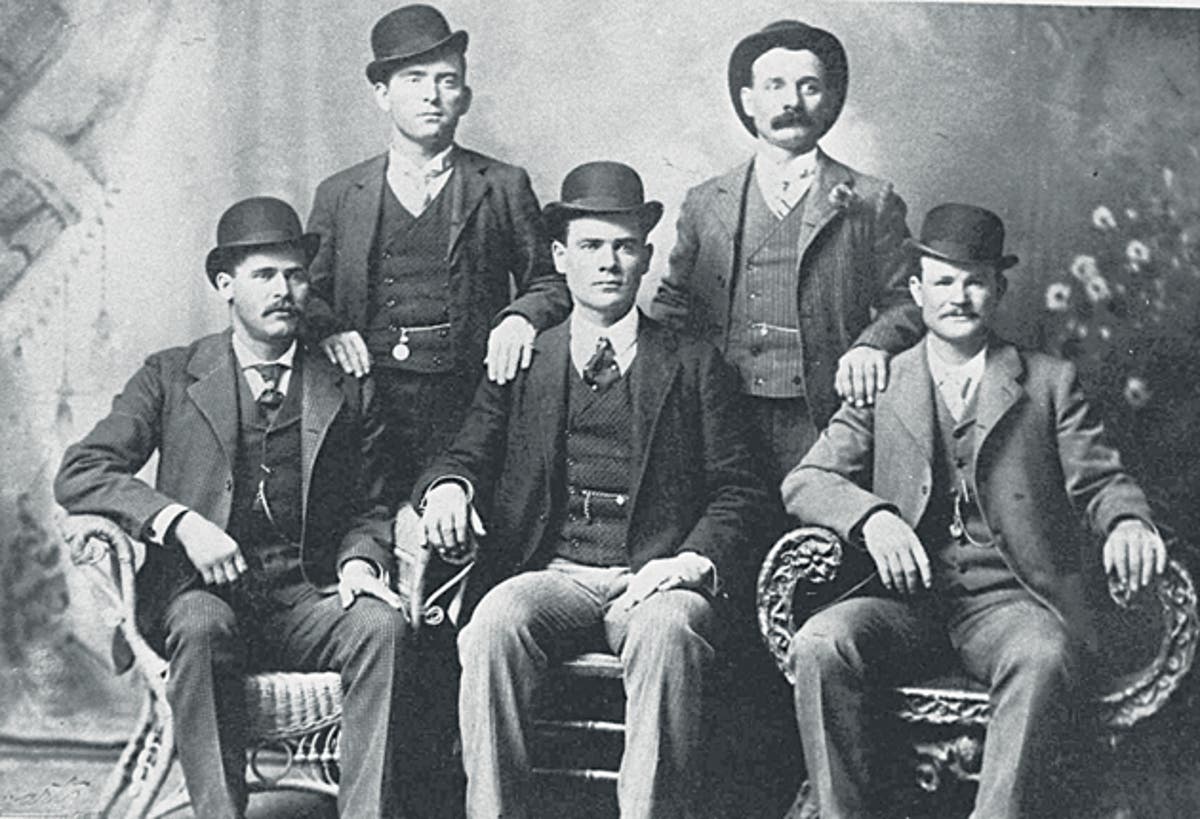
The 1899 "Fort Worth Five" photo.
Top row, left to right: William Carver and Harvey Logan.
Bottom row, left to right: Harry Longabaugh (the Sundance Kid),
Ben Kilpatrick, and Robert Parker (Butch Cassidy).

November 7, 1908: In San Vicente, Bolivia, soldiers engage in a shootout with 2 men who had robbed the payroll of a silver mine. The robbers were found dead: Apparently, with both men wounded, one shot the other to put him out of his misery, and then used his last bullet on himself.
The local authorities confirmed that these men were the robbers, but they did not know the men's names. The widely-accepted story is that the men were Robert Leroy Parker and Harry Alonzo Longabaugh -- a.k.a. the American outlaws known as Butch Cassidy and the Sundance Kid, respectively.
Butch and Sundance were the last of the major Wild West outlaws. From 1889 to 1901, with their Wild Bunch gang, they robbed banks and trains throughout the Rocky Mountain States, especially Parker's native Utah (which gained Statehood in 1896). In 1901, along with Longabaugh's girlfriend Etta Place, they escaped to New York, and then took a ship to South America: First to Argentina, then to Chile, and finally to Bolivia, in the hopes of becoming respectable ranchers.
But they couldn't make an honest living, so they turned back to robbery, which is why they had to leave Argentina and then Chile. Finally, in 1906, Place got tired of living on the run, and went back to America. History loses track of her after that.
Attempts to determine whether Butch and Sundance actually were the men killed in the San Vicente shootout have thus far failed. It has been alleged, including by Cassidy's sister, that Butch left Bolivia and was still alive as late as 1937. (He would have been 72.) A suggestion that Sundance was still alive as late as 1936 has been proven by DNA testing to be false, but, so far, that's as close as DNA testing has come to proving anything. Among the stories, it has been suggested that Etta may have been alive as late as 1966.
For all we know, the old Utah and Wyoming bank and train robbers of the 1890s may well have had a good laugh about it all for a long time thereafter.
Among the depictions of Butch and Sundance: The 1951 film The Texas Rangers (played by John Doucette and Ian MacDonald, respectively), the 1956 film The Three Outlaws (Neville Brand and Alan Hale Jr.), a 1958 episode of Tales of Wells Fargo (only Butch appears, played by a young Charles Bronson), the 1969 film Butch Cassidy and the Sundance Kid (Paul Newman and Robert Redford, with Katharine Ross as Etta), the 1979 film Butch and Sundance: The Early Days (Tom Berenger and William Katt), the 1994 TV-movie The Gambler V: Playing for Keeps (Scott Paulin and Brett Cullen, with Mariska Hargitay as Etta), and the 2004 TV-movie The Legend of Butch & Sundance (David Clayton Rogers and Ryan Browning, with Rachelle Lefevre as Etta).
*
November 7, 1908 was a Saturday. Baseball was out of season. Basketball and hockey were not yet professional. But there was college football to be played. Among the games:
* The Polo Grounds in New York hosted a crowd of 10,000, as undefeated Dartmouth (5-0-1) beat previously undefeated Princeton (5-0-3), 10-6.
* Harvard and the Carlisle Indian School (with Jim Thorpe not yet playing) were both 6-0-1 when facing each other in Cambridge, Massachusetts, and Harvard won, 17-0.
* Yale, undefeated, blew a 10-0 lead at home in New Haven, Connecticut, and escaped with a 10-10 with Brown.
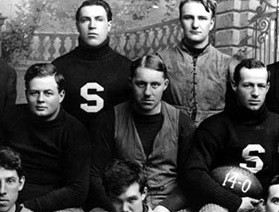
* The University of Pennsylvania beat Lafayette, 34-4 at the original Franklin Field (built in 1895, replaced in 1922) in Philadelphia. They finished 11-0-1, and were recognized as the National Champions. A 6-6 tie with Carlisle was the only blemish on their record, though it should be noted that they didn't play either Harvard, Yale or Princeton. They did go on to beat Michigan, though.
* The University of Pittsburgh undefeated, stayed that way, beating the school that would become their arch-rivals, West Virginia, 11-0 at Exposition Park, home of baseball's Pirates. In their 1st 7 games, Pitt had outscored their opponents 128-4. But they lost 3 of their last 4 games, all at home.
* Army beat Springfield, 6-5 at West Point, New York.
* Navy beat Villanova, 30-6 at Annapolis, Maryland.
* Michigan beat Kentucky, 62-0 at Ann Arbor, Michigan.
* Notre Dame beat Indiana, 11-0 at Washington Park in Indianapolis.
* New York University lost to Rensselaer Polytechnic Institute. RPI beat NYU, 11-0 in Troy, New York.
* And Rutgers could only manage a 6-6 tie with Delaware.

Friday, November 4, 2022

November 4, 1922: The South's 1st Successful Invasion of Northern College Football

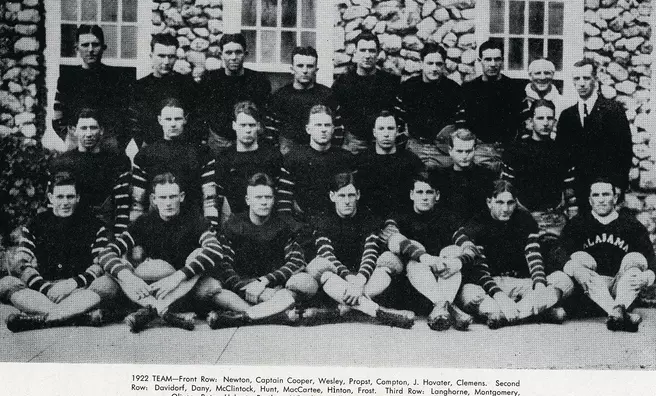
November 4, 1922: The football team at the University of Alabama goes to Philadelphia, and beats the University of Pennsylvania, 9-7 at Franklin Field.

This upset of an Ivy League school is considered a landmark day in the history of Southern football, and it helped launch 'Bama on a run of success that continued throughout the 1920s and '30s and established the school's legend, before Paul "Bear" Bryant was even a player at 'Bama (and while he was one), much less their head coach.

Three weeks earlier, on October 14, Alabama went to Atlanta to play Georgia Tech, and lost 33-7. Tech's head coach, Bill Alexander (for whom their basketball arena is named), told the Alabama fans, "Your football team isn't worth a nickel, but you have a million-dollar band." The 'Bama band has been "The Million Dollar Band" ever since. 'Bama finished the season 6-3-1, so Alexander was wrong about the quality of the team.

*

November 4, 1922 was a Saturday. These other notable college football games were played:

* Army beat St. Bonaventure, 53-0 on The Plain at West Point, New York. The day before, Navy beat Penn State, 14-0 at American League Park in Washington. Three weeks later, Army beat Navy, 17-14 at Franklin Field.

* In another Ivy League vs. South game, Harvard beat Florida, 24-0 at Harvard Stadium in Boston.

* Alabama Tech, renamed Auburn in 1960, beat Georgia, 7-3 at Memorial Stadium in Columbus, Georgia, about halfway between the schools.

* Rivalry: Vanderbilt beat Tennessee, 14-6 at Shields-Watkins Field (now vastly expanded into Neyland Stadium) in Knoxville, Tennessee. From 1892 to 1926, Vanderbilt were 18-2-3 against Tennessee. Since then, Tennessee have led the rivalry, 77-14-2.

* Rivalry: Michigan beat Michigan Agricultural College, 63-0 at Ferry Field in Ann Arbor. MAC became Michigan State College in 1925, and Michigan State University in 1955.

* Notre Dame beat Indiana, 27-0 at Cartier Field in South Bend, Indiana.

* Not yet a big rivalry, but it would become one: Illinois beat Northwestern, 6-3 at Illinois Field in Champaign, Illinois.

* Rivalry: Wisconsin beat Minnesota, 14-0 at Northrop Field in Minneapolis.

* Rivalry: Colorado beat Colorado A&M, 7-0 at Gamble Field in Boulder, Colorado. A&M became Colorado State in 1957.

* The University of California beat Washington State, 61-0 at the new California Memorial Stadium in Berkeley.

* Among New York City teams, Columbia lost to Cornell (who went undefeated that season), 56-0 at Schoellkopf Field in Ithaca, New York; Fordham lost to Springfield College, 17-0 at Fordham Field in The Bronx; NYU beat Trinity College of Connecticut, 13-0 at Ohio Field in The Bronx; and CCNY beat New York Aggies (now SUNY-Farmingdale), 14-7 at Lewisohn Stadium in Upper Manhattan.

* In New Jersey, Princeton beat Swarthmore, 22-13 at Palmer Stadium in Princeton. Rutgers had the week off.

And in English soccer, Arsenal, the North London team I would one day support, went to Liverpool, and lost to Everton, 1-0 at Goodison Park.

Friday, October 7, 2022

October 7, 1905: The Game That Made the NCAA

Robert "Tiny" Maxwell, center

October 7, 1905: The University of Pennsylvania hosts nearby Swarthmore College in a football game at the original Franklin Field in Philadelphia. (Built in 1895, it was replaced by the current structure in 1922.) Penn won the game, 11-4.

Swarthmore guard Robert Maxwell, known as Tiny for being so big and fat, got his nose broken, but played both ways the whole game. It was the only game Swarthmore lost all season, and it would probably be forgotten today, especially since Swarthmore is now a Division III school.

Except a photograph was taken of Maxwell's bloody face, and the wire services put it on the front pages of newspapers all over the country. One of them made its way to President Theodore Roosevelt. A former athlete himself -- he had been on the Harvard boxing team in 1880, and played tennis even while President -- he requested figures, and found out that 18 young men had died playing college football in 1904.

So the Rough Rider hauled the presidents of Harvard, Yale and Princeton -- then the nation's leading football-playing universities -- into the White House, and, in a meeting on October 9, told them point-blank: Either you do something to make football safer, or I will take action.

TR -- he did not like the nickname "Teddy" -- didn't have to actually threaten to ban the sport. Given his reputation as a man who got things done and didn't let anything stand in his way, just the possibility that he would be taking over their sport, taking their power away, was enough to spur them into action. The safety measures they took over the next year are now considered the founding of the National Collegiate Athletic Association (NCAA).

One move that was made in the interest of safety was the invention of hashmarks, putting the ball at the yard-line where the last play ended, but closer to the middle of the field, instead of putting the ball exactly where the play ended every time.

Another suggestion was widening the field. But Harvard shot this idea down, since they had only opened Harvard Stadium in 1903, and they didn't have room to widen their field, and they weren't going to tear down half of their new stadium just to accommodate everyone else. In those days, what Harvard wanted, Harvard got. So an alternative was thought up: The legalization of the forward pass. It would take a few years, but football became considerably more exciting because of it.

This may have been the moment that saved the game Americans call "football," making the college game that became big business, and the NFL that was founded, both in the 1920s, possible. It may also have been the moment that prevented soccer, the sport that most of the rest of the world calls "football" or some linguistic variant, from becoming popular in America. Had the gridiron game been stopped in the Progressive Era, the world's game might have caught on, and, like so many other things that began elsewhere, been given an American touch, so it wouldn't have carried the "foreign" label.

What happened to Tiny Maxwell? He shrugged off his injury, and played early pro football in Ohio and Pennsylvania in the next few years. Oddly, he later served as an assistant coach at both Swarthmore and Penn. He became one of the most respected referees in the game, with his size and his vast knowledge of the rules both cowing players into submission. But he was killed in a car crash in 1922.

In 1937, a group of Philadelphia sportswriters founded the Maxwell Football Club in his memory. Ever since, it has presented the Maxwell Award to the best player in the country. It is considered secondary to the Heisman Trophy, but 40 out of its 70 awards, including the last 4, have gone to the player who also won the Heisman; 2 others have gone to a player who would win the Heisman in a different year.

*

October 7, 1905 was a Saturday. These other notable college football games were played that day:

* Harvard beat Maine, 22-0 at Harvard Stadium in Boston.

* Yale beat Syracuse, 15-0 at Yale Field in New Haven, Connecticut.

* Army beat Colgate, 18-6 at The Plain in West Point, New York.

* Navy beat Virginia Military Institute (VMI), 34-0 at Worden Field in Annapolis, Maryland.

* In New York City, New York University (NYU) lost to Lehigh, 11-2 at Ohio Field. Fordham did not play.

* In New Jersey, Princeton beat Georgetown, 34-0 at University Field in Princeton.

* Rutgers lost to Trinity College (now a Division III school), 11-0 in Hartford, Connecticut.

* Vanderbilt beat Alabama, 34-0 at Dudley Field in Nashville, Tennessee. At the time, this was not considered out of the ordinary. At pretty much any time in the last 100 years, though, it would be a huge story.

* The University of Texas beat Texas Christian University (TCU), 11-0 at Clark Field in Austin, Texas.

* The University of Michigan beat Case University, 36-0 at Regents Field in Ann Arbor, Michigan. Case, in Cleveland, is now Case Western Reserve University.

* And the University of Chicago beat the University of Iowa, 42-0 at Marshall Field in Chicago. (Marshall Field, who founded the department store that bore his name, also funded UC's stadium, and his name happened to fit.)

Actor Andy Devine was born on this day.

Tuesday, April 19, 2022

April 20, 1895: Franklin Field Opens

April 20, 1895: Franklin Field opens, on the campus of the University of Pennsylvania in Philadelphia, and named for the University's founder, Benjamin Franklin. Its 1st event is the Pennsylvania Relay Carnival: The Penn Relays.

The Penn football team, the Quakers, played their 1st game there on October 1, 1895, beating Swarthmore, 40-0. This 1st Franklin Field featured the 1st scoreboard used in any college football stadium, on the wall of Weightman Hall, the gymnasium at the open northwest end of the horseshoe. A 2nd Franklin Field was built on the site, for the 1922 season. This was the nation's 1st double-decked college football stadium. The 1st game was a 14-0 win over Franklin & Marshall.

Although it's not the oldest continuously-used stadium in NCAA Division I -- the oldest part of Grant Field at Bobby Dodd Stadium in Atlanta, home of Georgia Tech, dates to 1913 -- it is the oldest continuously used site in college football. And the Penn Relays have still been held there every year, except for 2020 and 2021, when COVID restrictions forced the University to call them off.

In 1927, The Palestra, Penn's basketball arena, was built next-door. In 1931, the Convention Hall of the Philadelphia Civic Center opened a block away, on the other side. (It was demolished in 2005, but The Palestra is still in use.) In 1936, following nomination for a 2nd term by the Democratic National Convention at the Civic Center, President Franklin D. Roosevelt gave his acceptance speech at Franklin Field.

The Philadelphia Eagles played home games there from 1958 to 1970, including the 1960 NFL Championship Game, in which they beat the Green Bay Packers, 17-13. This was the only World Championship won by the Eagles between the 1949 and 2017 seasons.

The Army-Navy Game was played at Franklin Field 18 times between 1899 and 1935, before moving to the larger Municipal Stadium in South Philadelphia in 1936. That stadium was renamed John F. Kennedy Stadium in 1964. Temple University played some home games there from 1978 to 2002.

Franklin Field was also used by the Philadelphia Bell of the World Football League in 1975, and for Playoff games in the United States Football League by the 1984 Philadelphia Stars, due to the Phillies having scheduling priority at Veterans Stadium. In the North American Soccer League, the Philadelphia Atoms played home games at Franklin Field in 1976, and the Philadelphia Fury played 2 games there in 1979.

The natural grass field was replaced with AstroTurf in 1969, and that one was replaced by Sprinturf in 2004. Lights were added in 1972. Seating capacity has been listed as high as 67,000, with standees making some crowds over 80,000. Since a 2003 modernization, capacity has been listed as 52,958.

*

April 20, 1895 was a Saturday. At this point, America's only professional sports league was baseball's National League. These games were played:

* The New York Giants beat their rivals, the Brooklyn Bridegrooms, 10-5 at the 1891-1911 edition of the Polo Grounds. The former Brooklyn Grays took that name in the 1887-88 off-season, when 6 players got married. They became the Dodgers in 1911, the year the Polo Grounds burned down and was replaced by the last and most famous stadium with that name.

* The Baltimore Orioles beat the Philadelphia Phillies, 23-4 at Union Park in Baltimore.

* The Boston Beaneaters beat the Washington Senators, 12-4 at Boundary Field in Washington. The Beaneaters became the Braves in 1912.

* The Cincinnati Reds beat the Cleveland Spiders, 14-8 at League Park in Cincinnati.

* The Pittsburgh Pirates beat the Louisville Colonels, 16-9 at Eclipse Park in Louisville, Kentucky. After the 1899 season, the NL consolidated from 12 teams to 8. The Colonels were essentially absorbed by the Pirates, while the Orioles, the Senators and the Spiders were folded.

* And the Chicago Colts beat the St. Louis Browns, 11-5 at Sportsman's Park in St. Louis. In 1900, the Browns became the Cardinals. In 1903, the Colts became the Cubs. They are still arch-rivals.

And in English soccer, the FA Cup Final was held on this day, at the Crystal Palace stadium in South London. Birmingham team Aston Villa beat nearby team West Bromwich Albion, 1-0. Bob Chatt scored only 30 seconds into the match, a Final record that stood for 104 years.

Thursday, March 24, 2022

March 25, 1908: College Basketball's 1st Great Team

March 25, 1908: Perhaps the 1st great college basketball team wins perhaps the 1st great college basketball game. John Schommer hits an 80-foot shot with seconds remaining, and the University of Chicago closes its season with a 16-15 victory over the University of Pennsylvania, in Philadelphia.

The season before, on March 23, 1907, Chicago beat the Central YMCA, 22-19 at the Bartlett Gymnasium on the UC campus. This was the early days of basketball, which was founded at a YMCA in Springfield, Massachusetts, only a little over 15 years before. Such a matchup would never be scheduled today.

Nevertheless, the Chicago Maroons completed their season, with a record of 15-2. Their only 2 losses had been on March 6, away to the University of Wisconsin; and on March 16, home to the University of Minnesota.

This was their 1st season under head coach Joseph Raycroft. John Schommer and Albert Houghton were named All-Americans. At the time, freshmen were allowed to play on the varsity, which would later be banned, except for wartime conditions and other unusual circumstances (such as disasters), until 1972.

In 1907-08, with Schommer leading the way as a junior, the Maroons went 23-2, losing on January 21, away to the aforementioned Central YMCA; and on January 31, again away to Wisconsin. Known as "Mr. Everything," Schommer also lettered in baseball, football and track.
John Schommer

In 1908-09, they went 12-0, completing a 3-year run of 50-4. Schommer became the 1st-ever 4-time basketball All-American, with Pat Page also making the team. In each of those 3 seasons, Chicago won the title in the Western Conference, the league that would become known as the Big Ten; and were, decades later, retroactively recognized as National Champions by the Helms Foundation.

Schommer succeeded Raycroft as head coach, but only coached in the 1911-12 season. But there was no professional league in which he could play, so he refereed Big 10 basketball games until 1940. In 1959, he became 1 of the 1st 4 players elected to the Basketball Hall of Fame. He died in 1960. Raycroft later led Princeton University's Department of Health and Physical Education. He died on September 30, 1955, the same day as James Dean.

In 1939, Robert Maynard Hutchins, president of the University of Chicago dropped varsity sports, believing it to have become overemphasized. Michigan State eventually took Chicago's place in the Big 10. A sports program was revived at UC in 1973, at the NCAA Division III level.

*

March 25, 1908 was a Wednesday. Baseball was in Spring Training. Football was out of season. Professional basketball barely existed. And the Stanley Cup Finals was won earlier in the month by the Montreal Wanderers, the team known as "The Little Men of Iron" winning their 3rd Cup, in a run of 5 out of 6.

Monday, February 14, 2022

February 14, 1946: ENIAC Begins Operation

February 14, 1946: The 1st programmable, electronic, general-purpose digital computer goes online.

It is the Electronic Numerical Integrator And Computer, or ENIAC. It was built and operated by the University of Pennsylvania, at their Department of Computer and Information Science, at 3330 Walnut Street, in the University City section of West Philadelphia, just around the corner from Penn's basketball arena, The Palestra, and its football stadium, Franklin Field. The original building has been replaced by a new one, hosting Penn's School of Engineering and Applied Sciences. A historical marker denoting ENIAC is outside.

ENIAC cost $487,000 to build, or about $6.75 million today. It was 100 feet long, nearly 8 feet high, and nearly 3 feet deep, and contained 17,468 vacuum tubes. (The invention of the transistor was nearly 2 years away, 85 miles to the northeast in Berkeley Heights, New Jersey.) It was said to be able to make a calculation in 30 seconds that took a human being 20 hours.

As with so many other useful things, ENIAC's primary purpose was for use in warfare. It was designed to calculate artillery firing tables for the U.S. Army's Ballistic Research Laboratory. But its 1st program was a study of the feasibility of a thermonuclear weapon -- which, 3 years later, was successfully tested: The hydrogen bomb, or H-bomb.

In July 1946, Penn handed ENIAC over to the Army Ordnance Corps. On July 29, 1947, it was put into operation at the Aberdeen Proving Ground outside Aberdeen, Maryland. It remained in continuous use until October 2, 1955.

It was disassembled, and parts of it are on public display at several locations, including, among others, Penn, Aberdeen, the Smithsonian Institution in Washington, the U.S. Military Academy in West Point, New York, and the Computer History Museum in Mountain View, California.

*

February 14, 1946 was a Thursday. Baseball and football were out of season. The NBA hadn't been founded yet. There was 1 game played that day in the NHL: The New York Rangers and the Boston Bruins played to a 2-2 tie at the old Madison Square Garden. 

Saturday, January 1, 2022

January 1, 1927: The Palestra Opens

January 1, 1927: The Palestra opens on the campus of the University of Pennsylvania, next-door to the school's football stadium, Franklin Field. It become known as "The Cathedral of College Basketball."

William N. Bates, a Penn professor, named the building after the ancient Greek term palaestra, meaning a rectangular enclosure attached to a gymnasium where athletes would compete in various sports in front of an audience. 

There is one level of seats, 8,725 of them. The seats do not have backs. Also, if you're in the back row, you could end up sitting next to a hot radiator. But it really does resemble a cathedral: There are stained-glass windows. And there are no luxury boxes: Ivy League bankers and lawyers have to sit next to kids from the street. This is what Philadelphia, the birthplace of the country, the Declaration of Independence and the Constitution, is all about.
Starting in 1955, the "Big Five" has been Penn, Temple University, La Salle University, St. Joseph's University and Villanova University. The Palestra became nationally famous for its Big 5 doubleheaders, with 4 out of the 5 teams playing. Temple used it as its home court from 1955 until the 1969 opening of McGonigle Hall, and St. Joe's used it in the 2008-09 season, while Alumni Fieldhouse/Hagan Arena was renovated.

*

January 1, 1927 was a Saturday. In the Rose Bowl, in the stadium of the same name in the Los Angeles suburb of Pasadena, California, Stanford University and the University of Alabama played to a 7-7 tie. The schools were retroactively recognized as sharing the National Championship. It was the 1st sporting event broadcast on nationwide radio, on NBC.

It was a big day in the history of football for another reason, although that wouldn't be known for another 20 years: Doak Walker was born on this day.

There were 4 games played in the NHL:

* The New York Rangers beat the Chicago Black Hawks, 4-0 at the Chicago Coliseum.

* The Ottawa Senators beat the Montreal Canadiens, 2-1 at the Ottawa Auditorium.

* The Montreal Maroons beat the Toronto Maple Leafs, 3-0 at the Mutual Street Arena in Toronto.

* And the Pittsburgh Pirates beat the Detroit Cougars, 3-2 at the Border Cities Arena (now the Windsor Arena) in Windsor, Ontario.

And in English soccer, Arsenal lost to Welsh team Cardiff City, 3-2 at the Arsenal Stadium, nicknamed Highbury for its North London neighborhood. It was no fluke: Cardiff City would also defeat Arsenal in that season's FA Cup Final.

December 31, 1999 & January 1, 2000: The Millennium

December 31, 1999:  The Millennium arrives. The people of planet Earth survived. At a terrible cost. But we hadn't destroyed ourselves. ...