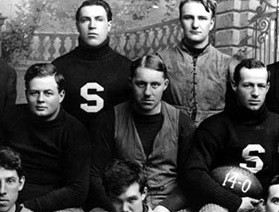
Robert "Tiny" Maxwell, center
Swarthmore guard Robert Maxwell, known as Tiny for being so big and fat, got his nose broken, but played both ways the whole game. It was the only game Swarthmore lost all season, and it would probably be forgotten today, especially since Swarthmore is now a Division III school.
Except a photograph was taken of Maxwell's bloody face, and the wire services put it on the front pages of newspapers all over the country. One of them made its way to President Theodore Roosevelt. A former athlete himself -- he had been on the Harvard boxing team in 1880, and played tennis even while President -- he requested figures, and found out that 18 young men had died playing college football in 1904.
So the Rough Rider hauled the presidents of Harvard, Yale and Princeton -- then the nation's leading football-playing universities -- into the White House, and, in a meeting on October 9, told them point-blank: Either you do something to make football safer, or I will take action.
TR -- he did not like the nickname "Teddy" -- didn't have to actually threaten to ban the sport. Given his reputation as a man who got things done and didn't let anything stand in his way, just the possibility that he would be taking over their sport, taking their power away, was enough to spur them into action. The safety measures they took over the next year are now considered the founding of the National Collegiate Athletic Association (NCAA).
One move that was made in the interest of safety was the invention of hashmarks, putting the ball at the yard-line where the last play ended, but closer to the middle of the field, instead of putting the ball exactly where the play ended every time.
Another suggestion was widening the field. But Harvard shot this idea down, since they had only opened Harvard Stadium in 1903, and they didn't have room to widen their field, and they weren't going to tear down half of their new stadium just to accommodate everyone else. In those days, what Harvard wanted, Harvard got. So an alternative was thought up: The legalization of the forward pass. It would take a few years, but football became considerably more exciting because of it.
This may have been the moment that saved the game Americans call "football," making the college game that became big business, and the NFL that was founded, both in the 1920s, possible. It may also have been the moment that prevented soccer, the sport that most of the rest of the world calls "football" or some linguistic variant, from becoming popular in America. Had the gridiron game been stopped in the Progressive Era, the world's game might have caught on, and, like so many other things that began elsewhere, been given an American touch, so it wouldn't have carried the "foreign" label.
What happened to Tiny Maxwell? He shrugged off his injury, and played early pro football in Ohio and Pennsylvania in the next few years. Oddly, he later served as an assistant coach at both Swarthmore and Penn. He became one of the most respected referees in the game, with his size and his vast knowledge of the rules both cowing players into submission. But he was killed in a car crash in 1922.
What happened to Tiny Maxwell? He shrugged off his injury, and played early pro football in Ohio and Pennsylvania in the next few years. Oddly, he later served as an assistant coach at both Swarthmore and Penn. He became one of the most respected referees in the game, with his size and his vast knowledge of the rules both cowing players into submission. But he was killed in a car crash in 1922.
In 1937, a group of Philadelphia sportswriters founded the Maxwell Football Club in his memory. Ever since, it has presented the Maxwell Award to the best player in the country. It is considered secondary to the Heisman Trophy, but 40 out of its 70 awards, including the last 4, have gone to the player who also won the Heisman; 2 others have gone to a player who would win the Heisman in a different year.
*
October 7, 1905 was a Saturday. These other notable college football games were played that day:
* Harvard beat Maine, 22-0 at Harvard Stadium in Boston.
* Yale beat Syracuse, 15-0 at Yale Field in New Haven, Connecticut.
* Army beat Colgate, 18-6 at The Plain in West Point, New York.
* Navy beat Virginia Military Institute (VMI), 34-0 at Worden Field in Annapolis, Maryland.
* In New York City, New York University (NYU) lost to Lehigh, 11-2 at Ohio Field. Fordham did not play.
* In New Jersey, Princeton beat Georgetown, 34-0 at University Field in Princeton.
* Rutgers lost to Trinity College (now a Division III school), 11-0 in Hartford, Connecticut.
* Vanderbilt beat Alabama, 34-0 at Dudley Field in Nashville, Tennessee. At the time, this was not considered out of the ordinary. At pretty much any time in the last 100 years, though, it would be a huge story.
* The University of Texas beat Texas Christian University (TCU), 11-0 at Clark Field in Austin, Texas.
* The University of Michigan beat Case University, 36-0 at Regents Field in Ann Arbor, Michigan. Case, in Cleveland, is now Case Western Reserve University.
* And the University of Chicago beat the University of Iowa, 42-0 at Marshall Field in Chicago. (Marshall Field, who founded the department store that bore his name, also funded UC's stadium, and his name happened to fit.)
Actor Andy Devine was born on this day.


No comments:
Post a Comment