Showing posts with label vienna. Show all posts

Friday, November 4, 2022

November 4, 1899: Sigmund Freud publishes "The Interpretation of Dreams"

November 4, 1899: Dr. Sigmund Freud publishes Die Traumdeutung -- "The Interpretation of Dreams." It becomes his signature work, and marks him as "the father of psychoanalysis."

"Insight such as this falls to one's lot but once in a lifetime," he said, throwing all modesty to the wind.

Freud suggested that dreams are formed as the result of two mental processes. The first process involves unconscious forces that construct a wish that is expressed by the dream, and the second is the process of censorship that forcibly distorts the expression of the wish. In Freud's view, all dreams are forms of "wish fulfillment."

Freud advanced the idea that an analyst can differentiate between the manifest content and latent content of a dream. The manifest content refers to the remembered narrative that plays out in the dream itself. The latent content refers to the underlying meaning of the dream. During sleep, the unconscious condenses, displaces, and forms representations of the dream content, the latent content of which is often unrecognizable to the individual upon waking.

If there's two things that people think they know about Freud, it's "He thought everything was about sex," and "He blamed every psychological issue on a person's mother." Critics have argued that Freud's theory of dreams requires sexual interpretation. Freud, however, contested the former of these criticisms: "The assertion that all dreams require a sexual interpretation, against which critics rage so incessantly, occurs nowhere in my Interpretation of Dreams. It is not to be found in any of the numerous editions of this book and is in obvious contradiction to other views expressed in it."

And while he used cigars and tunnels as metaphors for sex, he also famously said, "Sometimes, a cigar is just a cigar."

A 2019 episode of the YouTube series Epic Rap Battles of History featured "Nice" Peter Shukoff playing Freud, an atheist who seemed to be obsessed with sex; and Cara Francis, who wears aging makeup and plays "Rapping Grandma," playing Mother Teresa, a Catholic nun. Freud enjoyed writing about humor, and, as played by Peter, he found it funny that she not only was celibate, but was unattractive enough for him to say, "Jokes I could make about your appearance, abundant. Your chastity vow, redundant."

*

November 4, 1899 was a Saturday. Baseball season was over. Professional hockey didn't exist. Basketball barely existed at all. But, among others, these college football games were played:

* Yale beat Army, 24-0 on The Plain at West Point, New York.

* Princeton beat Brown, 18-6 at Osborne Field in Princeton.

* Amherst beat MIT, 12-5 at Pratt Field in Amherst, Massachusetts.

* Lafayette beat arch-rival Lehigh, 17-0 at March Field in Easton, Pennsylvania.

* Bucknell beat Penn State, 5-0 it Lewisburg, Pennsylvania.

* Harvard beat Penn, 16-0 at the original Franklin Field in Philadelphia.

* Navy beat North Carolina, 12-0 at Worden Field in Annapolis, Maryland.

* Michigan beat Virginia, 38-0 at Regents Field in Ann Arbor, Michigan.

* Notre Dame beat Rush Medical, 17-0 at Cartier Field in South Bend, indiana.

* Indiana beat the University of Cincinnati, 35-0 at Jordan Field in Bloomington, Indiana.

* The University of Chicago beat Purdue, 44-0 at Marshall Field in Chicago.

* Northwestern beat Minnesota, 11-5 at Northrop Field in Minneapolis.

* And Iowa beat Nebraska, 30-0 at Antelope Field in Lincoln, Nebraska.

Also, Woolwich Arsenal lost 2-0 to Newton Heath, at Bank Street in Manchester. In 1902, Newton Heath was renamed Manchester United. In 1910, they moved from Bank Street, which was adjacent to an open sewer and thus unacceptable, to Old Trafford in Salford. In 1913, Woolwich Arsenal moved from Plumstead in Kent (now in Southeast London) to Highbury in North London. In 1914, they dropped the locality from their name, and became simply "Arsenal."

Monday, October 17, 2022

October 17, 1973: The OPEC Oil Shock

October 17, 1973: The Organization of Petroleum Exporting Countries (OPEC) proclaims an oil embargo at its meeting in Vienna, Austria. It is targeted at nations perceived as supporting Israel during the Yom Kippur War, which was ongoing at this point. (OPEC's headquarters has been in Vienna since 1965, even though Austria is not a member.)

The OPEC member nations are the Middle East nations of Saudi Arabia, Iraq, Iraq, Kuwait, Qatar and Libya; the East Asian nation of Indonesia; and the South American nation of Venezuela. For those of you old enough to remember the 1990s, it may seem shocking to see Iraq and Kuwait working together. For those of you, like me, old enough to remember the 1980s (if not quite 1973), it may seem shocking to see Iraq and Iran working together. But it would take until 1979 for the Islamic Revolution to take over in Iran, and the same year for Saddam Hussein to do so in Iraq.

The targeted nations are America, Britain, Canada, Japan and the Netherlands. It is later extended to Portugal, and the apartheid nations of South Africa and Rhodesia.

In America, this drives the price of gasoline way up, and they had already gone up a lot this year, as a general inflation jacked up the prices of everything. It didn't help that President Richard Nixon was paying more attention to defending himself in the Watergate scandal than to the economy. Three days later came his firing of Special Prosecutor Archibald Cox, and of 2 aides who refused to help him do it, an event known as "the Saturday Night Massacre."

The embargo ended in March 1974, with the price of oil per barrel having gone up from $3 to almost $12. This had such an effect on the American economy that, when Time magazine named its Man of the Year for 1974, 9 months after the end of the embargo and 4 months after Nixon was forced to resign the Presidency, it didn't name Nixon; or his replacement, Gerald Ford; or any of Nixon's opponents, such as the new Special Prosecutor Leon Jaworski, or House Judiciary Committee Chairman Peter Rodino, or, collectively, the U.S. Supreme Court. It named King Faisal of Saudi Arabia.

One of the ways America dealt with the gas shortage was to institute the 55-mile-per-hour speed limit. Another was to ration gas: If your license plate ended with an odd number, you could buy gas on an odd-numbered day; if it ended with an even number, you could buy it on an even-numbered day. This policy would be adopted again in 1979, the next time an oil embargo was launched.

But there was another way America dealt with the oil embargo, which had nothing to do with cars: An additional reliance on nuclear energy. In 1979, a near-disaster at Three Mile Island in Pennsylvania showed why that idea was so dumb.

UPDATE: It took me until 2024 to think of this, but the 1970s were Schrödinger's Decade. There was too much oil, and, at the same time, not enough of it.

*

October 17, 1973 was a Wednesday. On the same day, Motorola engineer Marty Cooper was granted the patent for the handheld mobile telephone.

It was midweek for the NFL and college football. But Game 4 of the World Series was played at Shea Stadium. The New York Mets evened the Series at 2 games apiece with a 6-1 win over the Oakland Athletics at Shea Stadium. In support of Met starting pitcher Jon Matlack, Rusty Staub went 4-for-4 with a homer and 5 RBI. The New Orleans chef was really cooking that night.

A's manager Dick Williams was tired of team owner Charlie Finley's meddling, and told his players that, win or lose, he would resign when the Series was over. In the 8th inning, as a pinch-hitter, he sent Mike Andrews, the 2nd baseman whose 2 errors in the 12th inning of Game 2 at the Oakland Coliseum gave the Mets a win, and whom Finley had unsuccessfully tried to have removed from the World Series roster. The Met fans, showing an intelligence for which I tend credit them, gave him a standing ovation. He grounded out. It turned out to be his last major league at-bat.

There were 2 NBA games played that day:

* The Milwaukee Bucks beat the Golden State Warriors, 109-95 at the Milwaukee Arena. In 1974, it was renamed the Milwaukee Exposition, Convention Center and Arena, or "The MECCA." Since 2014, it has been named the UW-Panther Arena.

* And the Kansas City-Omaha Kings beat the Seattle SuperSonics, 108-106 at the Seattle Center Coliseum.

There were 3 ABA games played:

* The Kentucky Colonels beat the Virginia Squires, 116-106 at Freedom Hall in Louisville.

* The Carolina Cougars beat the Memphis Tams, 108-95 at the Mid-South Coliseum in Memphis.

* And the Denver Rockets beat the Utah Stars, 112-97 at the Auditorium Arena in Denver. The Rockets would become the Denver Nuggets at the start of the 1974-75 season.

There were 6 NHL games played:

* The New York Rangers beat the St. Louis Blues, 4-0 at Madison Square Garden. Eddie Giacomin had the shutout, and was backed by goals from Bruce MacGregor, Steve Vickers, Rod Gilbert and Jim Neilson.

* The Toronto Maple Leafs beat the Montreal Canadiens, 5-3 at Maple Leaf Gardens in Toronto.

* The Atlanta Flames beat the Boston Bruins, 4-3 at The Omni in Atlanta.

* The Chicago Black Hawks beat the Vancouver Canucks, 5-0 at the Chicago Stadium. The team's name was always written as 2 words, "Black Hawks," until 1986, when their original NHL charter document was found, and it was seen that the name had been written as 1 word, "Blackhawks," and that's how they've officially written it since.

* The Pittsburgh Penguins beat the Minnesota North Stars, 4-2 at the Metropolitan Sports Center in the Minneapolis suburb of Bloomington, Minnesota.

* And the Philadelphia Flyers beat the California Golden Seals, 5-1 at the Oakland Coliseum Arena. Finley owned them, too, and they went out of business, but not before playing the 1976-77 and 1977-78 seasons as the Cleveland Barons.

There were 2 games in the World Hockey Association:

* The Winnipeg Jets beat the New England Whalers, 3-1 at the Boston Garden.

* And the Houston Aeros, with 44-year-old Gordie Howe leading a line with his sons Mark and Marty, beat the Vancouver Blazers, 7-2 at the Pacific Coliseum in Vancouver.

There was one more sporting event on this day that I should mention: The England national soccer team can only manage a 1-1 draw against Poland in a European qualifying match for the 1974 World Cup at the old Wembley Stadium in London. It means that England won't even qualify for the World Cup, and manager Sir Alf Ramsey, who guided them to the 1966 World Cup, is soon fired. Poland will go on to reach the Semifinals, their best performance ever. (They would match that in 1982, but have yet to surpass it.)

I have a separate entry for that event.

Monday, September 19, 2022

September 19, 1984: The Film Version of "Amadeus" Premieres

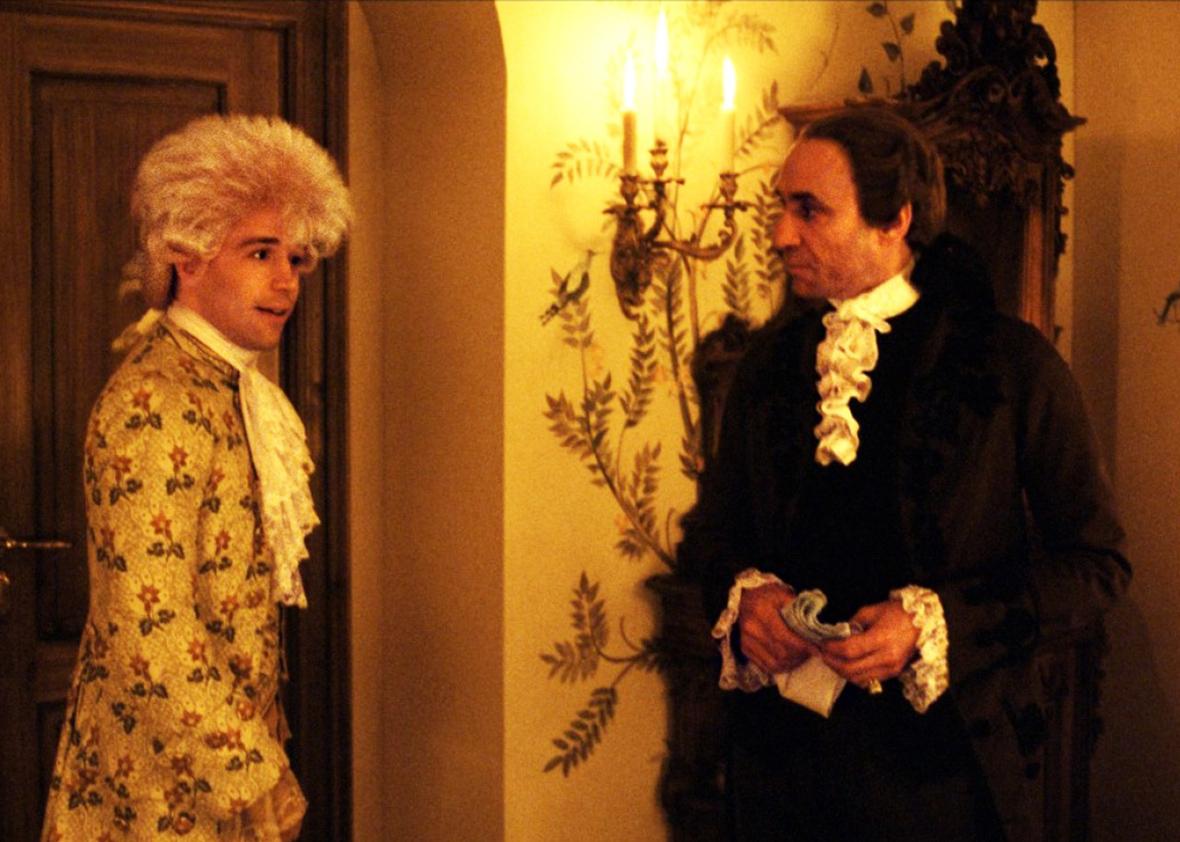
Hulce (left) as Mozart, and Abraham as Salieri

September 19, 1984: The film Amadeus premieres, directed by Miloš Forman, and based on the 1979 play by Peter Shaffer. In the play, Simon Callow, best known in America as Gareth in Four Weddings and a Funeral, played the laughing lunatic but genius Wolfgang Amadeus Mozart (1756-1791); and Paul Scofield, who played Sir Thomas More in the film version of A Man for All Seasons, played Italian composer Antonio Salieri (1750-1825).

It's the movie, far more than the play, that brought Mozart back to the public mind as the greatest composer of all time, with the comic strip Peanuts having raised Mozart's -- and Salieri's -- former student, Ludwig van Beethoven, to a higher point up until then.

But it's also the film that gave the public a story about Mozart and Salieri that is mostly bogus. And not even original: The great Russian writer Alexander Pushkin had written the play Mozart and Salieri in 1830, and Nikolai Rimsky-Korsakov turned that into an opera in 1897.

This was a musical biopic in which the title character is not really the main character. F. Murray Abraham -- he added the F., as a stand-in for his father's name, Frederick -- played Salieri, and was nominated for an Oscar for Best Actor in a Leading Role, which he won. As Mozart, Tom Hulce was nominated for Best Supporting Actor, but lost to Dr. Haing S. Ngor for The Killing Fields.
Wolfgang Amadeus Mozart

For the record, there was no contemporary evidence of Mozart and Salieri having anything resembling a rivalry; there were no contemporary accounts that Mozart's death at age 36 was due to anything other than illness; and the idea that Salieri was responsible is completely ridiculous. It would be like somebody suggesting in the year 2170 that Cliff Richard hired Mark Chapman to kill John Lennon. But it makes a great story. (The parts about Mozart having daddy issues and a fascination with ribaldry, especially with human solid waste, those have been documented as being true.)
Antonio Salieri

Despite his brief life, Mozart was incredibly prolific. He wrote 41 symphonies. His operas The Marriage of Figaro (1786), Don Giovanni (1787, the same year he wrote A Little Night Music) and The Magic Flute (1791, just 2 months before his death) made him a legend in his own time.

In a 2013 episode of the YouTube series Epic Rap Battles of History, "Nice" Peter Shukoff played Mozart, while "Epic" Lloyd Ahlquist played electronic "musician" Sonny "Skrillex" Moore.
*
September 19, 1984 was a Wednesday. These Major League Baseball games were played:

* The New York Yankees beat the Baltimore Orioles, 6-5 at Yankee Stadium. Joe Cowley outpitched Mike Boddicker. Mike Pagliarulo hit a home run. Don Mattingly went 3-for-4 with 3 RBIs, while Dave Winfield did not play.

* The New York Mets lost to the Philadelphia Phillies, 13-5 at Veterans Stadium in Philadelphia. Steve Carlton was the winning pitcher, while Ron Darling didn't get out of the 2nd inning. Jeff Stone and Von Hayes each had 4 hits. For the Mets, Kelvin Chapman went 3-for-5 with 3 RBIs.

* The Cincinnati Reds beat the Atlanta Braves, 4-2 at Atlanta-Fulton County Stadium. Reds player-manager Pete Rose went 1-for-4 with an RBI.

* The Boston Red Sox beat the Toronto Blue Jays, 10-4 at Exhibition Stadium in Toronto.

* The Detroit Tigers beat the Milwaukee Brewers, 4-2 at Tiger Stadium in Detroit. Jack Morris outpitched knuckleballer Tom Candiotti. Nelson Simmons went 3-for-4. Robin Yount went 2-for-5 with an RBI, while Paul Molitor did not play. The Tigers clinched the American League Eastern Division title the day before, and went on to win the World Series.

* The Pittsburgh Pirates beat the Chicago Cubs, 11-6 at Wrigley Field in Chicago.

* The Chicago White Sox beat the Minnesota Twins, 7-3 at the Metrodome in Minneapolis.

* The St. Louis Cardinals beat the Montreal Expos, 1-0 at Busch Memorial Stadium in St. Louis. Danny Cox pitched a 3-hit shutout, outpitching Steve Rogers.

* The Los Angeles Dodgers beat the Houston Astros, 3-1 at the Astrodome in Houston.

* The San Diego Padres beat the San Francisco Giants, 5-4 at Jack Murphy Stadium in San Diego. In the bottom of the 10th inning, Garry Templeton attempted a bunt, bunt Giant catcher Bob Brenly threw it away, allowing Eddie Miller to score.

* The California Angels beat the Kansas City Royals, 4-3 at Anaheim Stadium (now Angel Stadium of Anaheim). Bobby Grich singled Rick Burleson home with the winning run in the bottom of the 11th inning. Reggie Jackson went 0-for-3 with 2 walks. Rod Carew did not play.

* The Oakland Athletics beat the Texas Rangers, 8-7 at the Oakland Coliseum. Rickey Henderson went 0-for-3 with 2 walks and a stolen base.

* And the Seattle Mariners beat the Cleveland Indians, 4-3 at the Kingdome in Seattle.

Saturday, June 4, 2022

June 4, 1961: The Vienna Summit

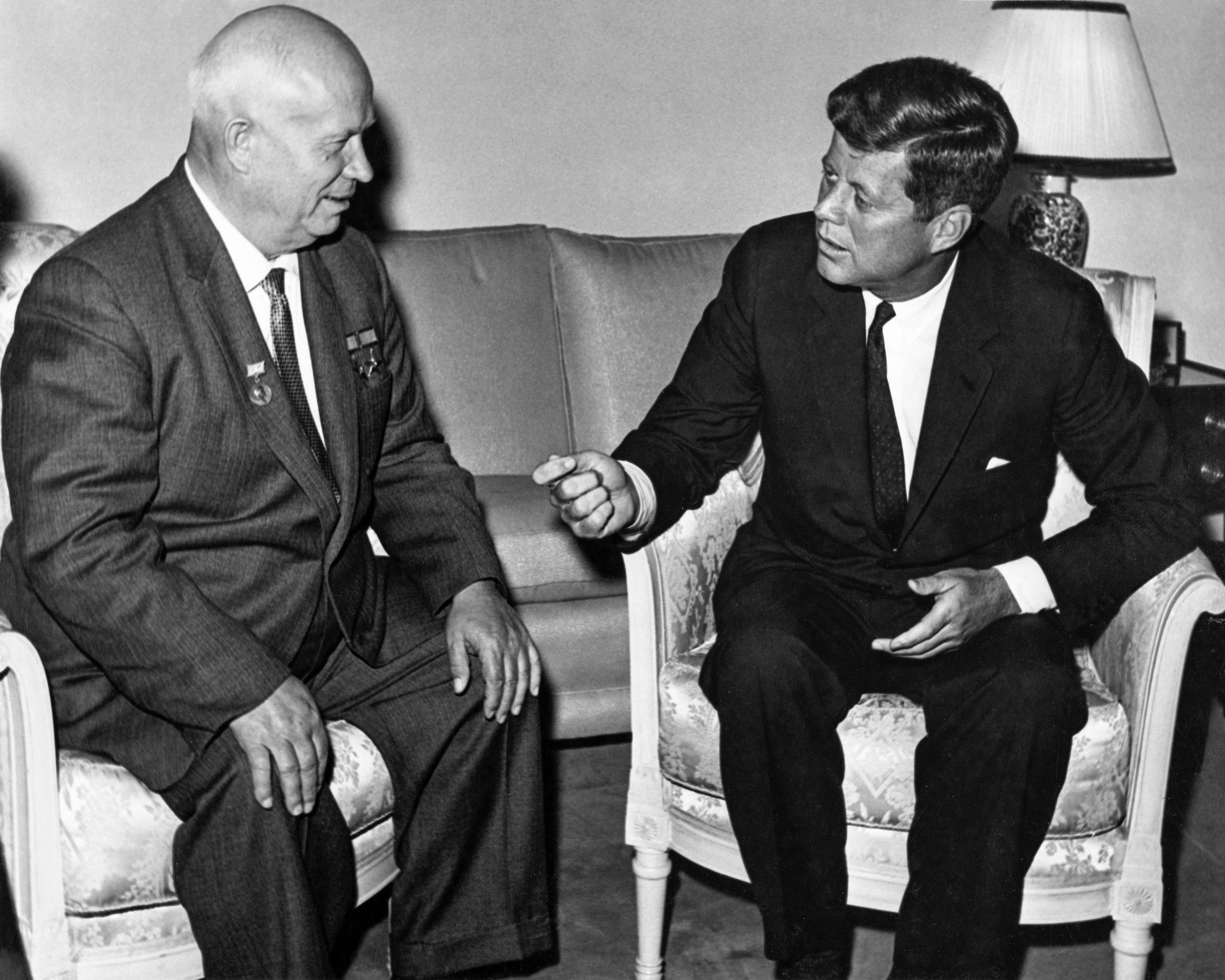
June 4, 1961: The Vienna Summit marks the only meeting between American President John F. Kennedy and Soviet Premier Nikita Khrushchev.

This was part of a European trip on which JFK and his wife, the former Jacqueline Bouvier, of French descent and fluent in French, also visited France and met with President Charles de Gaulle in Paris. de Gaulle, 27 years older than JFK, and a tough guy who had been through a lot in 2 World Wars, was officially an ally of America's, and found both Kennedys very charming.

JFK knew just how valuable Jackie was to him in Europe. At a news conference at the Palais Chaillot on June 2, he said, "I do not think it altogether inappropriate to introduce myself to this audience: I am the man who accompanied Jacqueline Kennedy to Paris, and I have enjoyed it." Everyone laughed -- including Jackie.

Khrushchev was the leader of America's adversary, and would thus be another matter entirely. He was 23 years older, had also been through both World Wars, and was every bit as tough as de Gaulle. He thought he could intimidate JFK. He was right: Jack was outmatched on the international stage by the more experienced man, who had toyed with President Dwight D. Eisenhower the previous year, after the U-2 spy-plane incident.

Sensing Kennedy's weakness, Khrushchev made a move on Berlin the next month, and Kennedy had to scramble to make sure it didn't escalate into World War III. By July, he was calling up U.S. Army Reserve units to send to West Berlin, because Khrushchev was doing the same on his side.

Khrushchev responded by having East Germany build the Berlin Wall, surrounding the western part of the city. The Warsaw Pact, dominated by the Soviets with East Germany as its 2nd-ranking partner, called the Wall "the Antifascist Protection Rampart." The idea was that it was supposed to keep America and its NATO allies, including Britain and France, out. This was a cover: So many people were fleeing from East Berlin to West Berlin that the Pact was willing to put up Der Berliner Mauer, heavily guarded by sniper towers, to stop them.

Kennedy didn't like this, but he knew that a wall was better than a war.

The following year, Khrushchev thought he could push Kennedy around in regard to Cuba. That turned out not to be true. Kennedy got Khrushchev to back down. After that, there seemed to a thawing in the Cold War, what would later be called détente, a French word meaning "relaxation." They were on considerably better terms following the Nuclear Test Ban Treaty of 1963. But they would never meet again: By mid-October 1964, neither would be in power any longer.

*

June 4, 1961 was a Sunday. Singer Eldra "El" DeBarge was born. And these baseball games were played:

* The New York Yankees beat the Chicago White Sox, 10-1 at Comiskey Park in Chicago. Bill Stafford went the distance for the win, while Billy Pierce didn't get out of the 1st inning. Roger Maris went 2-for-4 with a solo home run and a walk. Mickey Mantle went 1-for-3 with 2 walks and an RBI. The only White Sox run came on a home run by Wes Covington.

* The Boston Red Sox beat the Baltimore Orioles, 6-5 at Fenway Park in Boston. Brooks Robinson went 2-for-4 with a walk and 2 RBIs. Rookie Carl Yastrzemski did not play for the Red Sox.

* The Kansas City Athletics beat the Washington Senators, 8-5 at Griffith Stadium in Washington.

* The Philadelphia Phillies beat the Pittsburgh Pirates, 5-0 at Forbes Field in Pittsburgh. Don Ferrarese pitched a 5-hit shutout. Roberto Clemente went 1-for-4.

* The Cleveland Indians swept a doubleheader from the Los Angeles Angels, 5-3 and 8-4 at Cleveland Municipal Stadium.

* A doubleheader was split at Crosley Field in Cincinnati. The Cincinnati Reds won the opener, 3-1. The Chicago Cubs won the nightcap, 8-2. Over the 2 games, Frank Robinson went 2-for-8 with a home run and 2 RBIs, and Ernie Banks went 1-for-7 with a home run and 2 walks.

* The Detroit Tigers swept a doubleheader from the Minnesota Twins, 10-4 and 9-3 at Tiger Stadium in Detroit. Over the 2 games, Al Kaline went 1-for-7 with a walk, and Harmon Killebrew went 2-for-7 with a walk.

* The Milwaukee Braves beat the St. Louis Cardinals, 7-1 at Milwaukee County Stadium. Warren Spahn outpitched Bob Gibson. Hank Aaron went 1-for-3 with a walk. Stan Musial went 0-for-3.

* And the San Francisco Giants beat their arch-rivals, the Los Angeles Dodgers, 4-2 at the Los Angeles Memorial Coliseum. Willie Mays went 1-for-4 with an RBI. Duke Snider went 0-for-4.

Friday, May 27, 2022

May 27, 1964: Il Grande Inter

May 27, 1964: F.C. Internazionale Milano, a.k.a. Inter Milan, defeat Real Madrid 3-1 at the Praterstadion in Vienna, Austria, and win the European Cup for the first time.

The Nerazzurri (Black & Blues), also known as La Grande Inter, were managed by Italo-Argentine Helenio Herrera. They were led by 2 goals from midfielder Sandro Mazzola, possibly the best player in club history, and the son of Valentino Mazzola, one of the leaders of the great Torino team that was killed in the Superga air disaster of 1949.

Inter succeeded their intra-city rivals, AC Milan, as Champions of Europe. Milan had won the 1963 edition with a tight defense, but Inter's was even better. The style became known as "catenaccio," meaning "padlock." With Giuliani Sarti in goal, Tarcisio Burgnich at right back, Giacinto Facchetti at left back, Carl Tragnin as a defensive midfielder, Aristide Guarneri at centerback, and Armando Picchi as sweeper and Captain, it might have been the best defense the world had ever seen to that point.
Built in 1931, the Praterstadion was renamed
the Ernst-Happel-Stadion in 1992.

The offense was also sensational. Mazzola was in central midfield, along with Spaniard Luis Suárez. No relation to the later Uruguayan star known for his diving and his biting of opponents, this one had previously starred for FC Barcelona. They were bracketed by Brazilian right wing Jair da Costa and Italian left wing Mario Corso, who was nicknamed "Mandrake the Magician" and "God's Left Foot." Up top was forward Aurelio Milani.

May 27, 1965, 1 year later to the day: Inter won the European Cup Final on home soil, at the San Siro in Milan, defeating S.L. Benfica of Lisbon, Portugal 1-0. Brazilian star Jair da Costa scored the only goal, despite Benfica having the great Mozambican player Eusébio.
The San Siro, as it would have appeared in 1965

They won Serie A, the Italian national league, again in 1966, and again in 1971. But they then went into a terrible decline, made all the worse by the glories of their San Siro housemates and the team both of them loved to hate, Turin's Juventus. Inter would only win 2 of the next 24 Serie A titles, in 1980 and 1989, and that 1980 title was largely seen as aided by a scandal that got AC Milan temporarily relegated to Serie B. Inter had won the Coppa Italia, Italy's version of the FA Cup, in 1939, but they didn't win it again, not even in their Grande Inter years, until 1978, then again in 1982, and then not again for another 23 years.

They reached the European Cup Final again in 1967, but were unable to make it 3 out of 4 titles, as they lost to Glasgow Celtic. They made it again in 1972, but lost to AFC Ajax of Amsterdam, the stodginess of Catenaccio defeated by the creativity and joy of Total Football. They won the UEFA Cup, European soccer's secondary tournament, in 1991, 1994 and 1998, but it wasn't the same thing.

AC Milan fans, Juventus fans, fans of pretty much every club in Italy, including those who, themselves, never or rarely won began to taunt them with a chant: "Non vincerai mai!" (You never win.) It would take the arrival of Jose Mourinho before they once again won the Coppa Italia in 2005, won 5 straight Serie A titles starting in 2006, and won the rebranded European Cup, the UEFA Champions League, as part of the first-ever "European Treble" won by an Italian team, in 2010.

*

May 27, 1964 was a Wednesday. Talk show host Adam Carolla was born. The the 1st Prime Minister of India, Jawaharlal Nehru, died.

These baseball games were played:

* The New York Yankees beat the Cleveland Indians, 7-2 at Yankee Stadium. Al Downing went the distance for the win. Roger Maris and Clete Boyer hit home runs. Mickey Mantle was rested, since it was a day game after a night game.

* The New York Mets lost to the Chicago Cubs, 7-1 at Wrigley Field in Chicago. Ernie Banks went 3-for-4 with an RBI.

* The Washington Senators beat the Boston Red Sox, 9-8 at Fenway Park in Boston. Dick Phillips singled Jim King home with the winning run in the top of the 11th inning. The Senators got home runs from former Yankee Bill "Moose" Skowron and Chuck Hinton. Dick Stuart hit 2 home runs, and "Dr. Strangeglove" did not make an error at 1st base. Carl Yastrzemski went 1-for-5 with a walk and an RBI.

* The Detroit Tigers beat the Baltimore Orioles, 6-3 at Memorial Stadium in Baltimore. Al Kaline hit a home run. Brooks Robinson went 1-for-5.

* The Philadelphia Phillies beat the Pittsburgh Pirates, 2-0 at Forbes Field in Pittsburgh. Art Mahaffey pitched a 4-hit shutout. Roberto Clemente went 0-for-4.

* The Cincinnati Reds beat the Los Angeles Dodgers, 1-0 at Crosley Field in Cincinnati. Joe Nuxhall pitched a 6-hit shutout, outpitching Sandy Koufax. Frank Robinson went 0-for-1 with 2 walks. Pete Rose went 0-for-2 with 2 walks.

* The Milwaukee Braves beat the Houston Colt .45s, 2-0 at Milwaukee County Stadium. Hank Fischer pitched a 4-hit shutout. Hank Aaron went 0-for-3. The Colts became the Houston Astros the next year.

* The San Francisco Giants beat the St. Louis Cardinals, 2-1 at the 1st Busch Stadium (formerly the last Sportsman's Park) in St. Louis. Juan Marichal allowed 7 hits, but no walks, and struck out 11, outpitching Bob Gibson. Willie Mays went 0-for-3. Willie McCovey went 0-for-4. Duke Snider, running out the string with, of all teams, the Giants, hit his 405th career home run. He would hit just 2 more.

* A doubleheader was split at Dodger Stadium, where the Los Angeles Angels were groundsharing with the Dodgers until their Anaheim stadium could open. The Angels won the opener, 4-1. The Minnesota Twins won the nightcap, 4-3. Don Mincher won it with a home run in the top of the 13th inning. Over the 2 games, Harmon Killebrew went 3-for-8 with a solo home run.

* And the Chicago White Sox and the Kansas City Athletics were rained out at Kansas City Municipal Stadium. The game was made up as part of a doubleheader on July 13. The ChiSox won the opener, 8-6. The A's won the nightcap, 8-7. Wayne Causey singled Dick Green home with the winning run in the bottom of the 9th.

Tuesday, May 24, 2022

May 24, 1995: Patrick Kluivert Saves Ajax

May 24, 1995: The UEFA Champions League Final is held at Ernst-Happel-Stadion in a rainy Vienna, Austria. A.C. Milan, the defending Champions, had done well the last few years with Dutch players, such as Marco van Basten, formerly of Amsterdam team AFC Ajax; Frank Rijkaard, and Ruud Gullit.

But this time, they were almost entirely Italian, including Captain Franco Baresi and Alessandro Costacurta at centreback, Paolo Maldini at left back, and Roberto Donadoni in midfield. The only non-paesans were black Frenchman Marcel Desailly and Croatian Zvonimir Boban in midfield.

Perhaps their drift away from Dutch total football made it poetic justice that they would play Ajax in the Final. Aside from a pair of Nigerian forwards, starter Finidi George and backup Nwankwo Kanu, and Finnish midfielder Jari Litmanen, they were all Dutch, including a returned Rijkaard, goalkeeper Edwin van der Sar, centreback and Captain Danny Blind, twin brothers Frank de Boer at left back and Ronald de Boer at forward, Clarence Seedorf and Edgar Davids in midfield, and Marc Overmars at forward.
Ernst-Happel Stadion

The game turned out to be less modern Dutch total football and more old Italian catenaccio: It was 0-0 until the 85th minute. It was a substitute, Patrick Kluivert of Ajax, who scored the game's only goal. Ajax were 1-0 winners, and claimed their 4th European Cup, after the 3 straight with Johan Cruijff in 1971, '72 and '73.

But as has so often happened, Ajax were able to build a great team, but not keep it together: van der Sar would later star for Manchester United; Kluivert, Rijkaard, the de Boer twins and Winston Bogarde for Barcelona; Davids for Juventus, Overmars and Kanu for Arsenal, George for Real Betis; and Seedorf, with some irony, for Milan. Ajax returned to the Champions League Final the next season, and the Semifinal the year after that, but lost to Juventus both times. They've only gotten as far as the Semifinals once since, in 2019.

*

May 24, 1995 was a Wednesday. This was also the day the film Braveheart premiered. I have a separate entry for that event.

These Major League Baseball games were played:

* The New York Yankees lost to the California Angels, 3-1 at Anaheim Stadium (now Angel Stadium of Anaheim). Jack McDowell blew a 1-0 lead as the Halos scored 3 runs in the bottom of the 8th inning. Don Mattingly went 0-for-4.

* The New York Mets lost to the Los Angeles Dodgers, 5-0 at Shea Stadium. Pedro Astacio pitched a 6-hit shutout.

* The Montreal Expos beat the San Diego Padres, 3-2 at the Olympic Stadium in Montreal. Tony Gwynn was 2-for-5 with an RBI.

* The Philadelphia Phillies beat the San Francisco Giants, 2-1 at Veterans Stadium in Philadelphia.

* The Kansas City Royals beat the Toronto Blue Jays, 8-5 at the SkyDome (now the Rogers Centre) in Toronto.

* The Milwaukee Brewers beat the Cleveland Indians, 7-5 at Jacobs Field (now Progressive Field) in Cleveland.

* The Cincinnati Reds beat the Houston Astros, 4-2 at Riverfront Stadium in Cincinnati.

* The Detroit Tigers beat the Minnesota Twins, 14-3 at Tiger Stadium in Detroit.

* A doubleheader was split at the new Comiskey Park (now Rate Field) in Chicago. The Chicago White Sox won the opener, 10-8. The Texas Rangers won the nightcap, 13-6.

* The Atlanta Braves beat the St. Louis Cardinals, 9-5 at Busch Stadium in St. Louis.

* The Chicago Cubs beat the Colorado Rockies, 5-3 at Coors Field in Denver.

* The Oakland Athletics beat the Baltimore Orioles, 5-3 at the Oakland Coliseum. It looked like Mike Mussina would outpitch Dave Stewart, but the A's scored 2 runs in the 7th and 2 in the 8th to win it, making a winning pitcher out of Jim Corsi. Rickey Henderson went 1-for-4. Cal Ripken went 0-for-4.

* And the Seattle Mariners beat the Boston Red Sox, 15-6 at the Kingdome in Seattle. Ken Griffey Jr. went 2-for-3 with 2 walks. Alex Rodriguez went 1-for-5 with an RBI.

Football was out of season. There was 1 game in the NBA Playoffs: The Houston Rockets beat the San Antonio Spurs, 106-95 at the Alamodome in San Antonio. Hakeem Olajuwon scored 41 points and grabbed 16 rebounds.

And there were 2 games in the Stanley Cup Playoffs, both Eastern Conference Semifinals, within 7 miles of each other. The Philadelphia Flyers beat the New York Rangers, 5-2 at Madison Square Garden. And the New Jersey Devils beat the Pittsburgh Penguins, 5-1 at the Brendan Byrne Arena in the Meadowlands.

Sunday, April 3, 2022

April 3, 1938: The Austrian Wunderteam Goes Out With a Bang

Matthias Sindelar

April 3, 1938: The national soccer team of Austria, known as the Wunderteam, plays its last game before being absorbed by Nazi Germany. The result meant another kind of farewell, for its greatest player: Matthias Sindelar.

Matěj Šindelář was born on February 10, 1903, in Kozlov, in what was then Moravia, in the Austrian Empire. It is now in Czechia, a.k.a. the Czech Republic, and he was of Czech descent. But his citizenship was Austrian, so the name was Germanized as "Matthias Sindelar."

He remains the greatest soccer player in the history of the Austrian nation. A forward, he played for the country's most successful team, Fußballklub Austria Wien AG -- known in English as Austria Vienna, but so well-known in its own country that it is usually called by the name of the country: "Austria" (or, in German, "Österreich," meaning "Eastern realm," even though it's actually to the south of modern Germany proper).

In 1924, having won the 1st of what is now a record 24 Austrian Bundesliga (national league) titles, and also the Austrian Cup for a "Double," Austrian Vienna signed Sindelar from Hertha Vienna. At 21, he was already known for his ability "to dodge and dribble at will his opponents, and to squeeze with disconcerting ease within the opposing defenses.” He was nicknamed “Der Papierene”: “The Man of Paper.” That might not make sense to modern American eyes, although, if your team's defense is like a rock, then you wouldn't want to face him, because Paper covers Rock.

He led Austria Vienna to the league title in 1926. While they never won another with him -- their next title cam after World War II, in 1949 -- he also led them to the Austrian Cup in 1925, 1926 (another Double), 1933, 1935 and 1936. In 1933 and 1936, he led them to the Mitropa Cup, meaning "Middle Europe," probably the closest thing then available to a continent-wide championship that the European Cup would become in 1955 (its name changed to the UEFA Champions League in 1992).

Hugo Meisl managed the Austrian national team, known as the Wunderteam (Wonder Team), and, with Sindelar leading the way, they won the 1932 Central European International Cup, and reached the Semifinal of the 1934 World Cup, losing to Italy, when then won the Final on home soil. Like Hungary in the 1950s, the Netherlands in the 1970s, and both Brazil and France in the 1982 World Cup, they were hailed for attractive play but couldn't quite go all the way.

Meisl died of a heart attack in 1937, sparing him what was to come. Austria (the national team, not the Vienna club) qualified for the 1938 World Cup. But before that tournament could be played, Nazi Germany annexed Austria, birth nation of their Chancellor, Adolf Hitler, in what became known as the Anschluss. And a "farewell match," the Anschlussspiel (that's right: 3 consecutive S's), was set for April 3, 1938, at the Praterstadion in Vienna, against Germany. After this, Austria's players would play their international football for the Third Reich, or they wouldn't play at all.

Accounts of the game suggest that the Austria team missed some sitters on purpose. But in the last 20 minutes, Sindelar scored, and celebrated in front of the Nazi dignitaries. Shortly thereafter, Karl Sesta, an Austria Vienna teammate of Sindelar's, also scored. Austria went out on a high note, beating Germany, 2-0.

By this point, Sindelar was 35 years old. Even then, that was considered old for a forward. But he never played another international match. He had little choice: He either had to play for Germany, or defect to another country, and hope that FIFA, the governing body for world soccer, would allow him to play for his new home country.

At any rate, he refused to play for Germany, citing his age and his injuries. And he had already embarrassed the Germans in the Anschlussspiel. But he refused to leave his homeland, putting himself at risk for retribution by the Nazis. He also ran a small restaurant, and he didn't want to abandon it.

Of the 22 players on Germany's roster for the 1938 World Cup, held in France, 8 had previously played for Austria, and 9 were then playing for Austrian clubs. And yet, the addition of Austrian players did not help: They went out in the 1st round, losing on penalties to Switzerland -- a country whose majority speaks German. (As of 2022, 63 percent of Swiss residents speak German as their 1st language, 23 percent speak French, 8 percent speak Italian, and 6 percent primarily speak another language.)

Defending Champions Italy won. They beat Hungary, eventually a member of the Axis, in the Final. In the Semifinal, Italy beat Brazil, which then had a right-wing government, though not one officially allied with the Axis; and Hungary beat Sweden, who remained neutral through the conflict, as it had through World War I. In the Quarterfinals, Brazil beat Czechoslovakia, which Germany would take over within a year; Italy beat hosts France, which the Germans would take over a year after that; and Hungary beat Switzerland, which remained neutral, as it had through World War I.

So, if there had been a 1942 World Cup (with the last 2 having been in Europe, Brazil was considered the favorite to host it), both returning Finalists, 3 out of 4 Semifinalists, and 4 out of 8 Quarterfinalists would have been in the Axis. And with Britain's "home nations" refusing to play until 1950 due to a dispute with FIFA, it seems unlikely that England, or any other nation, would have been able to prevent a Germany-Italy Final, with Hitler and Mussolini both in the stands. I wonder if they would have sat in the same box?

On January 23, 1939, Sindelar and his girlfriend, Camilla Castagnola, were found dead in their apartment in Vienna. Officially, the cause was carbon monoxide poisoning, due to a defective chimney. Most people who knew him believed it was not an accident. A suicide was also unlikely. The Gestapo had a file on Sindelar, and kept him and his restaurant under surveillance.

In 1999, the International Federation of Football History & Statistics (IFFHS) ranked him 22nd on their list of the greatest soccer players of the 20th Century, and 1st among Austrians.

Karl Sesta was not punished by the Nazis. He remained with Austria Vienna until 1943, retired from the game in 1946, and lived until 1974.

*

April 3, 1938 was a Sunday. Jeff Barry, who wrote several hit songs with his wife, Cythia Weil, in the 1960s, was born on this day.

Baseball and football were in the off-season. The National Basketball League season was underway, but getting scores for specific days from that league has proven difficult. NHL scores are easy to find, but only 1 game was played that day, a Stanley Cup Semifinal: The Chicago Black Hawks beat the New York Americans, 3-2 at Madison Square Garden. The Hawks thus advanced to the Stanley Cup Finals, where they beat the Toronto Maple Leafs.

Sunday, February 13, 2022

February 14, 1896: Theodor Herzl Publishes "Der Judenstaat"

February 14, 1896: Theodor Herzl publishes his pamphlet Der Judenstaat, meaning The Jewish State, in Leipzig, Germany.

Born on May 2, 1860 in Pest, in the Austrian Empire -- now the east bank of the Danube River in Budapest, Hungary -- Herzl had a brief legal career in the Austrian capital of Vienna. He became the Paris correspondent for the Viennese newspaper Neue Freie Press (The New Free Press). Confronted with anti-Semitic events in Vienna, he reached the conclusion that anti-Jewish sentiment would make Jewish assimilation impossible, and that the only solution for Jews was the establishment of a Jewish state.

The term "Zionism" had been coined by Austrian journalist Nathan Birnbaum in 1890, to mean the struggle for a secure homeland for the Jewish people. Ironically, later in life, Birnbaum became an Orthodox Jew, and a fervent anti-Zionist. It would be Herzl who popularized the term.

In Der Judenstaat, Herzl elaborated his visions of a Jewish homeland. He envisioned the founding of a future independent Jewish state at some point during the coming 20th Century, thinking it the best way to avoid anti-Semitism in Europe. He encouraged Jews to purchase land in the land then known as Palestine, the historic homeland of the Jews, then controlled by the Ottoman Empire. His ideas attracted international attention, and rapidly established him as a major figure in the Jewish world.

The book was published while the Dreyfus Affair was ongoing in France. So Herzl was being direct when he wrote:

The Jewish question persists wherever Jews live in appreciable numbers. Wherever it does not exist, it is brought in together with Jewish immigrants. We are naturally drawn into those places where we are not persecuted, and our appearance there gives rise to persecution. This is the case, and will inevitably be so, everywhere, even in highly civilised countries -- see, for instance, France -- so long as the Jewish question is not solved on the political level.

He concluded the book as follows:

Therefore I believe that a wondrous generation of Jews will spring into existence. The Maccabeans will rise again.

Let me repeat once more my opening words: The Jews who wish for a State will have it.

We shall live at last as free men on our own soil, and die peacefully in our own homes.

The world will be freed by our liberty, enriched by our wealth, magnified by our greatness.

And whatever we attempt there to accomplish for our own welfare, will react powerfully and beneficially for the good of humanity.

Herzl planned to deliver his pamphlet as a speech to the Rothschild family, well-known throughout the world as bankers and among world's the best-known Jews, then based in Boulogne, France. But, though himself a Zionist, Baron Edmond de Rothschild rejected Herzl's plan, feeling that it threatened Jews in the Diaspora. He also thought it would put his own settlements in Palestine at risk.

In 1897, Herzl convened the First Zionist Congress at the Stadtcasino in Basel, Switzerland, and was elected president of the Zionist Organization. He began a series of diplomatic initiatives to build support for a Jewish state, appealing unsuccessfully to German Kaiser Wilhelm II and Ottoman Sultan Abdul Hamid II.

He sought out seemingly friendly ears in the South American nation of Argentina and the African nation of Uganda -- which will sound ironic to people familiar with the former's welcome of Nazi war criminals after World War II and the latter's dictatorship of Idi Amin and his alliance with the Palestine Liberation Organization. Neither country was willing to listen.

On January 26, 1904, Herzl visited Rome, and met with Pope Pius X. The Pope received Herzl with respect, but declined to help. Herzl was soon diagnosed with a heart ailment, and died on July 3, only 44 years old. In Reichenau an der Rax, Austria. He was buried in Vienna.

Further Zionist attempts to negotiate with the Ottoman authorities failed, but with the collapse of the Ottoman Empire at the end of World War I, and the subsequent creation of Mandatory Palestine under the control of Britain, the Zionists gained success: Britain issued the Balfour Declaration that supported the creation of a Jewish homeland in Palestine.

In 1948, the British Mandate of Palestine ran out, and the State of Israel was declared. Ever since, "Zionism" has meant the protection of what that country already had, and the repatriation of formerly Jewish lands nearby, which was satisfied with the Six-Day War of 1967. In 1949, Herzl's remains were taken to Israel, and reinterred on a location renamed Mount Herzl.

*

February 14, 1896 was a Friday. Baseball and football were out of season, and basketball barely existed. But there was 1 notable hockey game played: The Winnipeg Victorias beat the Montreal Victorias, 2-0 at the Victoria Skating Rink in Montreal, and won the Stanley Cup.

December 31, 1999 & January 1, 2000: The Millennium

December 31, 1999:  The Millennium arrives. The people of planet Earth survived. At a terrible cost. But we hadn't destroyed ourselves. ...