Showing posts with label hank greenberg. Show all posts

Thursday, November 3, 2022

November 3, 1953: No More Gloves On the Field

November 3, 1953: Baseball's rules committee restores the pre-1939 rule which says that a sacrifice fly is not charged as a time at bat.
Also‚ the committee votes for the "no gloves on the field rule." Hank Greenberg‚ the Hall of Fame-to-be slugger who is now the general manager of the Cleveland Indians, had proposed the change‚ saying, "Aside from the possibility of hindering the play‚ gloves on the field look sloppy." It also made it easy for opposing players to sneak creepy-crawly or otherwise disgusting things into the glove of an easily scared player, such as the Yankees' Phil Rizzuto.
The committee also makes a rule that any runner will be called out for deliberately running the bases backwards, or even taking a lead off the base in the wrong direction.
A new balk rule is instituted which gives the batter an option: If he gets a hit after a balk is called‚ he has the option of accepting the outcome of the pitch‚ instead of being limited to the advance of the runner(s). This is the baseball equivalent of a football team that is the beneficiary of a penalty having the option to decline it, if the outcome of such is more advantageous to them than the outcome of the penalty.
Rule suggestions that are rejected include the re-legalization of the spitball‚ 2 bases for an intentional walk‚ and the option of declining ball 4. None of these ideas have been picked up since.
*
November 3, 1953 was a Tuesday. The baseball season was over. Football was in midweek. And while the NBA and NHL seasons had begun, neither scheduled any games. So while this was a notable day in baseball history, there were no scores, in any sport, on this historic day.

Monday, October 10, 2022

October 10, 1945: Hal Newhouser vs. Hank Borowy

Hal Newhouser

October 10, 1945: Game 7 of the World Series is played at Wrigley Field in Chicago. It would be the last game in what would later be called Major League Baseball to be affected by the manpower drain of World War II, as V-J Day had come 2 months earlier, but many players were still in the service.
How drained was the game at this point? Frank Graham, the sports columnist for the New York Journal-American, called it "the fat men versus the tall men at the office picnic." Warren Brown, writing for the Chicago Herald-American, wrote, "I don't think either one of them can win it." A year later, he published a book titled Win, Lose or Draw, in which he called this contest the "World's Worst Series."
Wartime travel restrictions, which led to the cancellation of the All-Star Game for the 1st time (it wouldn't happen again until the COVID shutdown of 2020), meant that the location of the Series would shift only once, regardless of length, instead of a potential twice: The 1st 3 games would be played at the home of the American League Champions, and any games after that would be played at the home of the National League Champions.
The AL Pennant-winners turned out to be the Detroit Tigers, for the 4th time in a 12-season span. Hank Greenberg, the slugging 1st baseman who had been the 1st major league player to enlist in the armed forces, was one of the earliest to be discharged, and had hit a grand slam on the last day of the season to clinch the Pennant.
In 1944, Tiger ace Hal Newhouser went 29-9 with a 2.22 ERA. In 1945, he went 25-9 with a 1.89 ERA. There was no Cy Young Award at the time, but, both times, he was named the AL's Most Valuable Player. Fans arguing that he was merely taking advantage of war-strapped teams were silenced in 1946, when, against fully-restocked teams, he went 26-9 with a 1.94 ERA, and finished 2nd in the MVP vote behind Ted Williams of the Pennant-winning Boston Red Sox. It capped a 3-year stretch in which he went 80-27.
The NL Champions were the Chicago Cubs. Their 1st baseman, Phil Cavarretta, batted .355 to win the batting title, and was named the NL's MVP. Hank Wyse went 22-10, but a bigger story was Hank Borowy: The native of Bloomfield, Essex County, New Jersey had been a big reason why the New York Yankees won the 1943 World Series. But on July 27, the Cubs paid $97,000 to get him from the Yankees. Having gone 10-5 for the Yankees, he went 11-2 for the Cubs the rest of the way, finishing 21-7.
Hank Borowy

The Series began on October 3, at Briggs Stadium (later renamed Tiger Stadium) in Detroit. Borowy pitched a 6-hit shutout, outpitching Newhouser. Cavarretta hit a home run, and the Cubs won, 9-0. A Greenberg homer gave the Tigers a 4-1 win in Game 2. Claude Passeau pitched a 1-hit shutout in Game 3, the only hit a single by Rudy York in the 2nd inning, and the Cubs won, 3-0, taking a 2-1 into the Detroit phase of the Series.
*
Game 4, at Wrigley Field, was the source of "The Curse of the Billy Goat." William "Billy Goat" Sianis, owner of the Billy Goat Tavern, across from Chicago Stadium, bought 2 tickets to this game: One for himself, and one for his bar's mascot, a goat. At the time, there was no rule against bringing an animal into the ballpark. But fans around him complained to the ushers that the goat smelled bad, and Sianis and his goat were kicked out of the ballpark.
A Greek immigrant and a superstitious man, Sianis put a curse on the Cubs. The Tigers won the game, 4-1, with all their runs coming in the 4th inning, after Sianis and the goat were kicked out.
Newhouser outpitched Borowy in Game 5, and the Tigers won, 8-5, taking a 3-2 lead. In Game 6, the Tigers scored 4 runs in the top of the 8th, and the game went to extra innings. Stan Hack doubled Bill Schuster home in the bottom of the 12th, giving the Cubs an 8-7 win, and forcing a Game 7 on their home field.
Cubs manager Charlie Grimm used Borowy, on no rest, for the last 4 innings of Game 6, making him the winning pitcher. Game 7 was pushed back a day due to rain, and Grimm decided that, despite having pitched 18 innings in the preceding 7 days, Borowy was his best choice to pitch Game 7. Tiger manager Steve O'Neill went with Newhouser, who had pitched 12 innings to that point, but would be on 2 days' rest. Maybe Warren Brown was right: Neither team could win.
The game was decided before Newhouser faced a single batter. Borowy had gotten the Cubs to within 1 win of a title, but he had nothing left to give: He began the game by giving up singles to Skeeter Webb, Eddie Mayo and Doc Cramer.
Already down 1-0, Grimm took the exhausted Borowy out, and brought in Paul Derringer, who'd helped the Cincinnati Reds win the 1940 World Series. He got an out, then Grimm ordered an intentional walk to load the bases and set up a play at any base, and Derringer got a 2nd out. But a bases-loaded walk made it 2-0, and Paul Richards hit a bases-clearing double to make it 5-0.
Cavarretta singled a run home in the bottom of the 1st, but that was as close as the Cubs would get. Newhouser went the distance, striking out 10 batters, and the Tigers won, 9-0. Within minutes of the last out, Billy Sianis sent a telegram to Cubs owner Philip K. Wrigley, asking, "Who stinks now?"
This also remained, for 71 years, the last World Series game the Chicago Cubs had ever played. Left fielder Ed Mierkowicz was the last survivor from the '45 Tigers, while shortstop Lennie Merullo was the last survivor from the '45 Cubs. From Merullo's death on May 30, 2015 until October 25, 2016, there were no living people who had played in a World Series game for the Chicago Cubs.
Newhouser's 170 wins during the 1940s made him the winningest pitcher of the decade. Later, as a scout, he discovered Jim Palmer, whose 186 wins during the 1970s made him the winningest pitcher of that decade.
UPDATE: The Cubs have a team Hall of Fame. Inducted from their 1945 Pennant winners have been 1st baseman Phil Cavarretta, 3rd baseman Stan Hack, left fielder Andy Pafko, manager Charlie Grimm, team owner Philip K. Wrigley, executive Margaret Donahue, clubhouse manager Yosh Kawano and public address announcer Pat Pieper.
It says a lot about the Cubs that the only member of their team Hall of Fame from between their 1945 Pennant and their 1969 near-miss was outfielder Hank Sauer.
The Tigers do not have a team Hall of Fame, but they honor their Hall of Fame players on the outfield wall at Comerica Park. From the 1945 World Champions, they honor 1st baseman Hank Greenberg and pitcher Hal Newhouser. Along with left fielder Rudy York, center fielder Barney McCoskey, pitchers Virgil Trucks and Billy Pierce, team owner Walter Briggs, scout Wish Egan, and broadcaster Edwin "Ty" Tyson, they are also in the Michigan Sports Hall of Fame.

From between their 1945 and 1968 World Series wins, the Tigers honor 3rd baseman George Kell and pitcher Jim Bunning. They are in the Michigan Sports Hall of Fame, along with right fielders Vic Wertz and Don Lund, left fielder Charlie "Paw Paw" Maxwell, and broadcaster Van Patrick.

*
October 10, 1945 was a Wednesday. Football was in midweek. The NBA hadn't been founded yet. And the NHL season didn't start for another 18 days. So there were no other scores on this historic day.

Saturday, October 8, 2022

October 8, 1940: Red and Black In Cincinnati

Jimmie Wilson

October 8, 1940: Game 7 of the World Series is played at Crosley Field in Cincinnati. Paul Derringer of the Cincinnati Reds and Alva "Bobo" Newsom of the Detroit Tigers get into a pitchers' duel, and the Tigers lead 1-0 in the bottom of the 7th.

But leadoff doubles by Frank McCormick and Jimmy Ripple tie the score, followed by a sacrifice bunt and Billy Myers' sacrifice fly, for the run that wins the game and the Series, 2-1 to Cincinnati. The game lasts just 1 hour and 47 minutes.

The Reds' Bill McKechnie becomes the 1st manager to win a World Series with 2 different teams. "The Deacon" also piloted the Pirates to the 1925 World Championship.

With NL batting champion Ernie Lombardi injured down the stretch, and backup catcher Willard Hershberger becoming (as far as can be proven) the only big-leaguer ever to commit suicide during the season -- slashing his throat on in a Boston hotel room during a roadtrip on August 3 -- 40-year-old coach Jimmie Wilson was signed to a playing contract, and was one of the factors in this World Series. So was an injury to Tiger star Hank Greenberg.

Newsom, a native of Hartsville, South Carolina, was one of the great characters of the game, wearing out his welcome multiple times. He started his career with the Brooklyn Dodgers' "Daffiness Boys" in 1929, and spent most of the 1932 season in the minor leagues, though he made 1 appearance for the Chicago Cubs, who on the NL Pennant. They did not include him on their World Series roster.

He had started and won Game 1, with his father in attendance. But his father died during the Series. Before Game 5, Newsom said, "I'll win this one for my Daddy," and he did. Tiger manager Del Baker risked him on short rest for Game 7, he was asked by reporters, "will you win this one for your Daddy too?" He said, "Why, no, I think I'll win this one for old Bobo." "Old Bobo" was 33 years old, and while he went the distance and held a back-to-back Pennant-winning team to 2 runs, it was in defeat.
Bobo Newsom

Newsom ended up pitching for 9 of the 16 franchises then in the major leagues, including 4 separate tenures with the Washington Seantors, 3 with the St. Louis Browns, and 2 each with the Dodgers and the Philadelphia Athletics, with whom he closed his career in 1953. He did win a World Series, with the New York Yankees in 1947. They obtained him from the Senators in midseason, and he went 7-5 for them down the stretch, starting and losing Game 3 of the Series, at the age of 39.

He finished with a career record of 211-222, with a 3.98 ERA and 2,082 strikeouts. That included 2 20-win seasons for the Browns, and 21 for the Tigers in the 1940 regular season. That suggests that, had he spent most of his career with good teams, he would have had more batting support and a lot more wins. He drank himself to death in 1962, only 55 years old.

In 1949, Ogden Nash, my grandmother's favorite poet, wrote "Line-Up for Yesterday" for Sport magazine, an alphabetical list of star players. For the letter N, he honored Newsom, the only player he mentioned who was still active, and the only one who ended up not making the Hall of Fame. He wrote:

N is for Newsom,
Bobo's favorite kin.
You ask how he's here,
He talked himself in.

The Tigers bounced back from their 1940 defeat, and won the Series again 5 years later. The Reds would need another 35 years, going 0-for-3 in World Series play, 5-12 in games, before triumphing in 1975.

UPDATE: The Reds have a team Hall of Fame. Elected from this 1940 team have been 1st baseman Frank McCormick, 2nd baseman Lonny Frey, shortstop Billy Myers, 3rd baseman Billy Werber, left fielder Mike McCormick, center fielder Harry Craft, right fielder Ival Goodman, catcher Ernie Lombardi; pitchers Bucky Walters, Paul Derringer and Johnny Vander Meer; manager Bill McKechnie, and general manager Warren Giles. But team owner and ballpark namesake Powel Crosley has not been inducted.

*

October 8, 1940 was a Tuesday. Football was in midweek. The NBA hadn't been founded yet. And the NHL season started over a month later. So there were no other scores on this historic day.

Sunday, October 2, 2022

October 2, 1938: Hank Greenberg vs. Bob Feller

Bob Feller (left) and Hank Greenberg

October 2, 1938: Cleveland Indians fireballer Bob Feller, just 20 years old, strikes out 18 Detroit Tigers at Cleveland Municipal Stadium, setting a new major league record for strikeouts in a game, surpassing the 17 notched in games by himself and Dizzy Dean. But the Tigers win, 4-1. Twice, Hank Greenberg is a strikeout victim of Feller's.

It was the 1st game of a doubleheader, on the last day of the regular season. The Tigers won the 2nd game as well, 10-8. Greenberg went 3-for-3 with a walk and an RBI, but did not hit a home run. He thus finished the season with 58 home runs, the 3rd time someone has come close to Babe Ruth's record of 60 set in 1927. (Jimmie Foxx, who hit 50 this year, had hit 58 in 1932. Hack Wilson had hit 56 in 1930.)

Some people have argued that, due to Greenberg being Jewish, he was frequently walked (intentionally or "not"), so that he wouldn't break the Babe's record. Hank would go to his grave maintaining his belief that pitchers had pitched to him fairly.

I've seen film from this game, and I believe him: Feller, then wearing Number 14 rather than the 19 for which he would later become better associated, was certainly challenging the original Hammerin' Hank, throwing hard, choosing to, as they would say in Jim Bouton's Ball Four, smoke him inside.

Despite the significance of the 1st game, its status as part of a doubleheader, and its being played on a Sunday, only 26,818 fans came to the 86,000-seat Municipal Stadium.

The next day, in the wake of the Munich Agreement, Nazi Germany moved troops into the Sudetenland region of Czechoslovakia. In 1941, Greenberg would go on to become the 1st player of All-Star caliber to enlist in World War II. Feller would enlist the day after the attack on Pearl Harbor. Each would miss nearly 4 prime seasons, but beating the Nazis was more important than such milestones as hitting 60 home runs in a season or 500 in a career -- or, in Feller's case, 300 wins or 3,000 strikeouts.

In a manner of speaking, they would later become teammates: Following the 1947 season, Greenberg retired as a player, and Bill Veeck, by then the owner of the Indians, hired him as the team's farm system director. Together, Veeck, Greenberg and Feller were 1948 World Champions. When Veeck sold the team after the 1949 season, Greenberg was promoted to general manager, holding the post until 1957, the year after Feller retired as a player.

*

October 2, 1938 was a Sunday. These other baseball games were played that day:

* The New York Yankees beat the Boston Red Sox, 6-1 at Fenway Park in Boston. Lou Gehrig went 1-for-4. Joe DiMaggio hit a home run. Lefty Gomez pitched just 3 innings, and was removed despite shutting the Sox out. He wasn't hurt: Just 4 days later, he started and won Game 2 of the World Series.

* The New York Giants beat the Boston Bees, 3-2 at the Polo Grounds. (The Braves were known as the Bees from 1936 to 1940.) Mel Ott went 1-for-3 with a walk and an RBI.

* The Brooklyn Dodgers swept a doubleheader from the Philadelphia Phillies, 7-3 and 7-2 at Shibe Park in Philadelphia.

* A doubleheader was split at Griffith Stadium in Washington. The Washington Senators won the opener, 5-2. The Philadelphia Athletics won the nightcap, 4-2.

* The Cincinnati Reds beat the Pittsburgh Pirates, 5-4 at Crosley Field in Cincinnati.

* A doubleheader was split at Comiskey Park in Chicago. The St. Louis Brown won the 1st game, 4-3. The Chicago White Sox were leading the 2nd game, 3-0, when it was called due to darkness after 6 innings. Comiskey Park got lights the next season.

* And the St. Louis Cardinals beat their arch-rivals, the Chicago Cubs, 7-5 at Sportsman's Park in St. Louis. It didn't matter: The Cubs had won the National League Pennant.

It was also an NFL gameday. These games were played:

* The football version of the Brooklyn Dodgers beat the Chicago Cardinals, 13-0 at Ebbets Field.

* The Chicago Bears beat the Philadelphia Eagles, 28-6 at Municipal Stadium (later renamed John F. Kennedy Stadium) in Philadelphia.

* The Cleveland Rams beat the Detroit Lions, 21-17 at Shaw Stadium in Cleveland.

* The next day, on an afternoon but an apparent precursor to "Monday Night Football," the New York Giants lost to the Pittsburgh Pirates, 13-10 at the Polo Grounds. The football Pirates renamed themselves the Steelers in 1940.

* And the Green Bay Packers and the Washington Redskins were not scheduled. 

Friday, September 30, 2022

September 30, 1946: The Feller-Paige Tour

September 30, 1946: One of baseball's biggest postseason "barnstorming tours" begins. It is the end of one era, and the start of another.

Before World War II, Bob Feller of the Cleveland Indians was the best pitcher in baseball -- in the all-white major leagues, anyway. Leroy "Satchel" Paige was the best pitcher in the all-black Negro Leagues.

Feller missed most of 4 seasons in the war, and came back strong. At the age of 28, was as good as any pitcher ever: In the 1946 season, he went 26-15, had a 2.18 ERA, pitched a no-hitter against the New York Yankees -- the 2nd of 3 he would go on to pitch -- and struck out 348 batters.

For a while, that was believed to be a major league record, as Rube Waddell was believed to have topped out at 343 in 1904. A later check of the records revealed that Waddell had actually struck out 349, but that wasn't found out until after Sandy Koufax with 382 in 1965, and then Nolan Ryan with 383 in 1973, had surpassed Feller's total. So when Koufax broke the record, everyone thought it was Feller's.

Also happening in that 1946 season was the debut of Jackie Robinson with the Montreal Royals, the top farm team of the Brooklyn Dodgers. Feller had gone on record as saying that, if Robinson were white, he "would not be big-league material." He spent the rest of his life trying to make up for that misjudgment. As it turned out, in 1962, he and Robinson were elected to the Baseball Hall of Fame together.

But he had already had an idea, before his discharge from the U.S. Navy, of having a tour of two opposing teams, one white, one black. In an interview with William Marshall, for his book, Baseball's Pivotal Era, 1945-1951, he said, “I knew what I was going to do, and I knew the people personally that I was going to have get the black clubs together: The Kansas City operator, Mr. Wilkinson, and Satchel Paige, and many others that I wanted to oppose us.”

It was in mid-July of Feller’s stellar comeback campaign that he announced plans for a coast-to-coast exhibition tour featuring an all-star squad made up of players from both the American and National leagues and a team of the nation’s finest Negro League players.

He obtained from Commissioner Albert B. "Happy" Chandler's permission to carry the tour beyond the 10-day barnstorming limit. And he contacted J.L. Wilkinson, owner of the Kansas City Monarchs, correctly thinking him the man to be the go-between with the other Negro League owners, who would let their players go on this tour.

The 27-game tour began on September 30, at Forbes Field in Pittsburgh, with the itinerary including stops in such outposts as Cleveland, Chicago, Cincinnati, Baltimore, Newark, New York, Columbus, Dayton, Louisville, Davenport, Des Moines, St. Paul. Omaha, Wichita, St. Louis, Kansas city, Denver, Los Angeles, San Diego, Vancouver, San Francisco, Seattle, Portland and Tacoma. It ran concurrent with the World Series, which ran from October 6 to 15, and the St. Louis Cardinals beat the Boston Red Sox in 7 games.

No Red Sox, including Ted Williams winning what turned out to be his only Pennant despite retiring 14 years later, and no Cardinals, including Stan Musial, winning what turned out to be the last of his 4 Pennants despite retiring 17 years later, were available -- at least at first.

Musial joined in mid-tour. Williams did not: According to Feller's memoir, Red Sox owner Tom Yawkey offered him $10,000 not to go, and Detroit Tigers owner Walter "Spike" Briggs offered his star, Hank Greenberg, a similar amount. Part of the issue was that Feller had rented planes, and the players would be flying, and the team owners didn't want their players dying in plane crashes. Feller, himself a licensed pilot understood the danger, and heavily insured the tour.

Because the Yankees did not win the Pennant, it made their players available, and left fielder Charlie Keller, shortstop Phil Rizzuto and pitcher Spurgeon "Spud" Chandler joined Bob Feller's All-Stars. So did Feller's Indian teammates, pitcher Mel Harder and Bob Lemon; Boston Braves pitcher Johnny Sain; and Washington Senators 1st baseman Mickey Vernon.

In his memoir, Buck O'Neil wrote. "I was excited to be chosen for the Satchel Paige All-Stars, along with guys like Hilton Smith, Gene Benson and Quincy Trouppe, because I knew I'd be making more money in one month than I had made in the last six. And I was excited to able to play against guys like Mickey Vernon, Phil Rizzuto, Johnny Sain and Stan Musial right after the big-league World Series.

"I also felt that, even though it was black against white, this tour was an event that could have a real effect on big-league integration, because it took place after Jackie had proven himself, and if a lot of us weren't that lucky, we could at least prove ourselves against big-leaguers in these games."

In addition to the preceding, Satchel Paige's All-Star included Negro League stars Max Manning, Barney Brown, Hank Thompson, Art Wilson and Howard Easterling.

The itinerary:

* September 30, Forbes Field, Pittsburgh: Paige 3, Feller 1.
* October 1, Idora Park, Youngstown, Ohio: Feller 11, Paige 2.
* Later on October 1, Cleveland Municipal Stadium: Feller 5, Paige 2.
* October 2, Comiskey Park, Chicago: Feller 6, Paige 5.
* October 3, Crosley Field, Cincinnati: Feller 3, Paige 0.
* October 4, Yankee Stadium, New York: Feller 4, Paige 2.
* October 5, Ruppert Stadium, Newark, New Jersey: Feller 13, Paige 10.
* October 6, Yankee Stadium: Paige 4, Feller 0.
* Later on October 6, Bugle Field, Baltimore: Paige 7, Feller 4.
* October 7, Red Bird Stadium (later renamed Cooper Stadium), Columbus, Ohio: Paige 4, Feller 3.
* October 8, Hudson Field, Dayton, Ohio: Feller 7, Paige 6.
* October 9, a day off.
* October 10, Municipal Stadium, Richmond, Indiana: Feller 7, Paige 5.
* October 12, American Legion Park, Council Bluffs, Iowa: Feller 3, Paige 2.
* Later on October 12, Lawrence Field, Wichita, Kansas: Feller 5, Paige 3.
* October 13, Kansas City Municipal Stadium: Paige 3, Feller 2.
* October 14, K.C. Municipal Stadium: Feller 4, Paige 1.
* October 15, a day off.
* October 16, Wrigley Field, Los Angeles: Feller 4, Paige 3.
* October 17, Lane Field, San Diego: Feller 2, Paige 0.
* October 18 to 22: Time off.
* October 23, Sam Lynn Park, Bakersfield, California: Feller 12, Paige 4.

Overall record: Feller 14, Paige 5. So while the argument that the best black players could play in the white major leagues held up, the argument that the Negro Leagues were the equal of the white majors does not.

Two years later, Indians owner Bill Veeck signed Paige, despite his age being apparently 42. He helped Feller and the Indians win the World Series.

In 1990, the Yankees visited Cleveland for their Old-Timers Day, and their old-timers' game was held between games of a doubleheader. Rizzuto, by this point, was the Yankees aging, quirky broadcaster, and had former Met ace Tom Seaver in the booth with him. He asked Feller to interview, and Rizzuto brought up the tour. As patriotic as Feller was, he was also honest, telling the WPIX-Channel 11 audience, "We did the tour for one reason: To make money. I'm not going to kid you about that. We lost a lot of money during the war."

And when former Commissioner Francis T. "Fay" Vincent wrote a book, he interviewed Feller for it. He wouldn't change his story: "We were interested in one thing, making money. I mean, what else is there? Yes we put on a good show. There was racial rivalry, not amongst the players, but amongst the fans. And we got a few laughs. They're great friends of mine. They love me dearly. I love them dearly. I know all the guys. We made more money in that month of October than we made all year round."

By the time the tour concluded, approximately a quarter of a million fans had witnessed this unprecedented tour.

*

September 30, 1946 was a Monday. Baseball's regular season was almost over, and no games were played on this day. Nor in football: Monday Night Football was still 24 years away. And basketball and hockey were out of season. So there were no scores on this historic day.

September 30, 1945: Lieutenant Hank Greenberg Clinches the Pennant

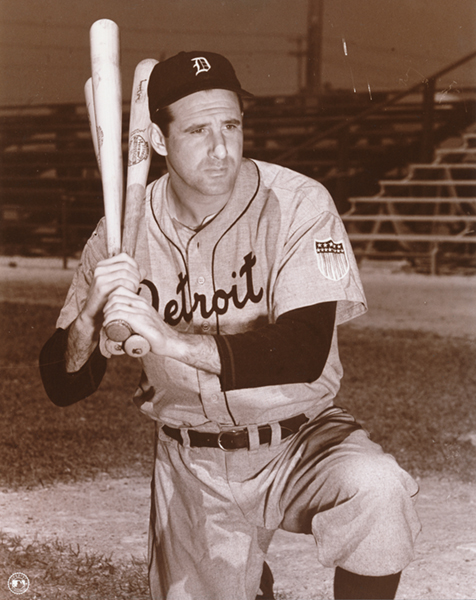
Swinging two bats in the on-deck circle
was a common sight before the Yankees' Elston Howard
invented the "bat donut" in the 1960s.
Hank Greenberg was one of the few players
who was strong enough to swing three bats.

September 30, 1945: Hank Greenberg, recently discharged from the U.S. Army, hits a grand slam off Nelson Potter in the top of the 9th inning, and gives the Detroit Tigers a 6-3 win over the St. Louis Browns at Sportsman's Park, clinching the American League Pennant, which the Browns had won the previous season, for the only time in their history. The Tigers go on to win the World Series over the Chicago Cubs in 7 games.
The 1st player to go into the service was Philadelphia Phillies pitcher Hugh Mulcahy, drafted on March 8, 1941, and he served for the duration of The War. As my grandmother taught me, she and everyone else who lived through it, even if they never left "the home front," always called it "The War," Capital T, Capital W. 
Greenberg had been the 1st major baseball star to volunteer for the U.S. armed forces in preparation for World War II, inducted into the Army on May 7, 1941. So it was only natural that he was the 1st player to return, discharged on June 14, 1945, with Nazi Germany having surrendered, but not, as yet, Imperial Japan. He had scouted bombing targets for B-29 bombers in the China/India/Burma Theater of Operations, and was discharged with the rank of 1st Lieutenant.
Already known as Hammerin' Hank before Henry Aaron was even born, he had lost his seasons of age 31, 32 and 33, and the 1st half of his age 34 season. He finished his career with a lifetime batting average of .313 and 331 home runs. He should have had at least 150 more home runs. He never regretted it, saying, "My country comes first."
Nor did Chief Petty Officer Bob Feller, U.S. Navy, who lost his seasons of ages 23, 24, 25 and most of 26. He won 266 games and struck out 2,581 batters, all for the Cleveland Indians. Based on his 1941 and 1946 performances, he should have had at least another 90 wins and 1,000 strikeouts, which could have made him the all-time strikeout leader, and, with another 98 wins, the pitcher with the most in the post-1920 Lively Ball Era.
He knew The War was more important. He also knew that people like Ty Cobb and Ohio State football coach Woody Hayes, who compared sports to war, were blowhards, saying, "Anybody who says sports is war has never been in a war."
Warren Spahn had appeared in 4 games before going into the service, and was the winning pitcher in exactly none of them. By the time he rejoined the Boston Braves, 1st Lieutenant Warren Spahn, U.S. Army, had missed his age 22, 23 and 24 seasons, and had gotten frostbite in the Battle of the Bulge and been wounded at the Remagen Bridge.
But his wartime experience may have matured him. From age 25 to 44, he did become the Lively Ball Era's winningest pitcher, and the winningest lefthanded pitcher regardless of era, with 363. So maybe his stats didn't suffer.
The stats of Sergeant Joe DiMaggio, U.S. Army Air Force, did suffer, as he lost his age 28, 29 and 30 seasons. He finished with a .325 batting average, and 2,214 hits including 361 home runs. He should have had at least another 550 hits and another 75 home runs.
And then there was Ted Williams, who served as a flight instructor in World War II and a fighter pilot in the Korean War. By the time he left the service for the last time in 1953, Captain Theodore S. Williams, U.S. Marine Corps, had damaged hearing, and had lost his seasons of age 24, 25 and 26, and most of those of age 33 and 34.
He batted .344 for his career, with 2,654 hits and 521 home runs. It shouldn't surprise people who know a little about baseball history that Ted reached 500 homers, only the 4th to do so after Babe Ruth, Jimmie Foxx and Mel Ott. But it is surprising that the man often called "The Greatest Hitter Who Ever Lived" didn't even get close to 3,000 hits. (He also never got 200 hits in a season.) By missing 4 1/2 prime seasons, he may have missed out on as many as 600 hits and 200 home runs, which would have put him past the 714 of Ruth, the record before Aaron reached 755.
In contrast, Ruth only missed 1 month due to World War I, September 1918, and that was because everybody missed at least that much, since the season was cut short. And Aaron was never drafted. Mickey Mantle was classified 4-F, medically unfit for service.
Willie Mays did serve in the Korean War, missing most of his age 21 season and all of his 22, probably costing him around 350 hits on top of his 3,293, and at least 50 homers on top of his 660, meaning he might have gotten to 715 before Aaron did. Yankee pitcher Whitey Ford (1951 and '52) and Brooklyn Dodger pitcher Don Newcome (1952 and '53) also missed 2 seasons serving in Korea.)
Seaman 1st Class Stan Musial, U.S. Navy, the best hitter in the National League while Ted was the best in the American League, only missed 1945, his age 24 season, due to World War II. He had 3,630 hits and 475 home runs, so he may have missed 200 hits and maybe the 25 homers that would have put him over 500.
One man was a veteran of both D-Day and Major League Baseball. In his case, he was just 19 when he was in a U.S. Navy ship off the coast of Normandy, and his service probably didn't delay his entry into the major leagues by much. He may have been the calmest man in the battle, later saying that the exploding shells looked like fireworks. He was Seaman 2nd Class Lawrence Peter Berra. Yogi.
Yankee shortstop and Seaman 1st Class Phil Rizzuto missed his age 25, 26 and 27 seasons due to those huckleberries Hitler and Tojo. His Dodger counterpart, Chief Petty Officer Harold "Pee Wee" Reese, missed his age 24, 25 and 26 seasons. And Army 1st Lieutenant Jack Roosevelt Robinson missed his age 24, 25 and 26 seasons in the Army. Of course, at that point, he had no idea that he would ever play professional baseball in any capacity, much less the one that would make him the most important player of all time.
UPDATE: Bobby Shantz, who turned 100 on September 26, 2025, became the last remaining veteran of both World War II and Major League Baseball. 
*
September 30, 1945 was a Sunday. These other baseball games were played that day:
* The New York Yankees beat the Boston Red Sox, 12-2 at Yankee Stadium. Tuck Stainback and Charlie Keller hit home runs. Keller had also recently returned, from the U.S. Merchant Marine. Joe Page, who would go on to be much better known as a reliever, started and went the distance for the win.
* The New York Giants beat the Boston Braves, 1-0 at Braves Field in Boston, in the 1st game of a doubleheader. Napoleon "Nap" Reyes, a 3rd baseman, light-skinned enough to be allowed to play even though he was Hispanic, and from Cuba so he wouldn't be drafted to fight in The War, hit a home run in the top of the 13th inning. Don Fisher pitched all 13 innings for the shutout. The nightcap was tied 2-2 after 7 innings, when Massachusetts' 7:00 PM curfew for Sunday sports kicked in and stopped the game.
* The Brooklyn Dodgers beat the Philadelphia Phillies, 4-1 at Shibe Park in Philadelphia.
* The Chicago Cubs beat the Pittsburgh Pirates, 5-3 at Forbes Field in Pittsburgh.
* The St. Louis Cardinals beat the Cincinnati Reds, 3-2 at Crosley Field. Del Rice won the game with a home run in the top of the 12th inning.
* The Washington Senators completed their 154-game schedule, but played their 154th game on September 23, a week before the regular season was supposed to end. Wartime travel restrictions, and the desire to get Griffith Stadium ready for the NFL's Washington Redskins, led to the Senators' condensed schedule. As a result, when their season ended, the Senators were 1 game behind the Tigers for the AL Pennant; but when the season finally ended, the Tigers were a game and a half ahead.
* The Chicago White Sox played their 149th game on September 25, and never played their last 5 games. The Philadelphia Athletics played their 150th game on September 27, and never played their last 4. The Cleveland Indians played their 145th game on September 28, and never played their last 9. Most likely, these were also due to wartime travel restrictions, even though The War had ended with the Japanese' official surrender on September 2 (following their unofficial surrender on August 14, which is recognized as V-J Day).
There were 2 NFL games played that day. The Green Bay Packers beat their arch-rivals, the Chicago Bears, 31-21 at Green Bay City Stadium. And the Cleveland Rams beat the Chicago Cardinals, 21-0 at League Park in Cleveland.
And Ehud Olmert, who served as Prime Minister of Israel from 2006 to 2009, was born on this day.

Monday, September 19, 2022

September 19, 1934: Hank Greenberg Does Not Play On Yom Kippur

September 19, 1934: The Detroit Tigers take the field at their home ballpark of Navin Field. They do so against what is, aside from themselves, the best team in the American League, the New York Yankees. What's more, they do so without their best player, 1st baseman Hank Greenberg.

The Tigers went into the game 7 1/2 games ahead of the Yankees, 8 in the loss column, with 11 games left for them and 10 left for the Yankees. No one thought in terms of a "magic number" to clinch in those days, but the Tigers' was 4: Any number of Tiger wins and Yankee losses the rest of the way, adding up to 4, and the Tigers would win the AL Pennant.

But they hadn't wrapped it up yet. There hadn't yet been a team with a significant lead in September that ended up blowing it. This was before the 1951 Brooklyn Dodgers, the 1964 Philadelphia Phillies, the 1969 Chicago Cubs, the 1978 Boston Red Sox, the 1987 Toronto Blue Jays, the 1995 California Angels, and the 2007 New York Mets. (Indeed, the Jays, the Angels and the Mets didn't even exist yet.)

But the New York Giants, winners of the previous year's World Series, had led the National League by 7 games as late as September 6, and now led the St. Louis Cardinals by only 3 1/2 games, and did end up blowing it in the last 2 days of the regular season. So such a collapse was already considered possible.

And the idea that Greenberg might not play in this game worried Tiger fans. But, as a series of TV commercials for Hebrew National Kosher hot dogs would say, decades later, he answered to a higher authority.

Henry Benjamin Greenberg was born on January 1, 1911 in Manhattan. He grew up in The Bronx, attended James Monroe High School, and became the Tigers' starting 1st baseman in 1933. Henry Aaron was born on February 5, 1934, and would go on to become baseball's all-time home run leader. But his nickname, "Hammerin' Hank," was first given to Hank Greenberg.

On September 18, 1934, Greenberg hit a home run, his 25th of the season, off fellow future Hall-of-Famer Red Ruffing, and the Tigers beat the Yankees, 2-0, as Lynwood "Schoolboy" Rowe pitched a 6-hit shutout.

But, in 1934, from sunset on September 18 to sunset on September 19, was Yom Kippur, the Day of Atonement, the holiest day on the Jewish calendar, the conclusion of Judaism's "high holy days" that begins with the start of the Jewish New Year, Rosh Hashanah.

And Greenberg was Jewish. Rosh Hashanah fell on September 10 and 11 that year, and Greenberg did play on the afternoon of the 11th. (The Tigers' ballpark wouldn't get lights until 1948, making it the last in the AL to do so.) The Tigers lost that game to the Boston Red Sox, 4-3 in 11 innings, as Hall-of-Famer Lefty Grove pitched 3 innings of scoreless relief for the win, and Greenberg went 0-for-3, although he did walk twice and was driven in both times.

Some Jewish people suggested that the defeat, and Greenberg's hitless performance -- few people thought in terms of on-base percentage in those days -- was God's punishment for playing on the holy day. So, with Yom Kippur coming up, he was facing pressure from both sides: Tiger fans who wanted him to play on September 19, and Jews who didn't want him to play.

He announced that he would not play. On the morning of the 19th, he attended a service at a synagogue: Congregation Shaarey Zedek, whose name translates to "Gates of Righteousness." It was located at 2900 Chicago Avenue. Clinton Street Greater Bethlehem Temple Church occupies the site now. In 1962, Shaarey Zedek moved to their current location, is now in suburban Southfield, Michigan, at 27375 Bell Road.

And when the Tigers took the field against the Yankees, their 1st baseman was Frank Doljack. He did reach base twice, with a single and a walk. It was the Tigers' other stars who fell short that day. Between them, Greenberg, 2nd baseman Charlie Gehringer, and left fielder Leon "Goose" Goslin were known as the "G-Men," in this year that was the 1st of big publicity for the FBI, whose agents were also called that (the G standing for "Government men"). Goslin went 0-for-4. Gehringer went 0-for-3 with a walk. And Mickey Cochrane, both the Tigers' manager and their catcher, only appeared as a pinch-hitter, although he had an RBI on a sacrifice fly.

So they had 3 future Hall-of-Famers in their lineup, instead of the usual 4. That, along with their other regulars, should have been enough to help them win. Especially since the Yankees did not have Babe Ruth in this game. (It would be his last season with them.)

But the Yankees did have Lou Gehrig, on his way to becoming the 1st Yankee ever to win the Triple Crown. (In spite of this, Cochrane would be named the AL's Most Valuable Player.) Gehrig went 0-for-3. But they had another Hall-of-Famer, Tony Lazzeri, and his 2-run double in the 6th inning made the difference, and the Yankees won, 5-2.

All over America, Jews celebrated Greenberg for sacrificing an important game for the sake of his faith. Tiger fans? Their concerns faded, and a doubleheader sweep of the Chicago White Sox on September 26 gave the Tigers their 1st Pennant in 25 years. Greenberg became a hero to anyone who wasn't an anti-Semite.

The Tigers lost the World Series to the Cardinals. The next season, they won the Pennant again, with Greenberg being named AL MVP, and won the World Series against the Chicago Cubs, the 1st World Championship for a Detroit baseball team since the 1887 Wolverines, 48 years earlier.

Greenberg would have 184 RBIs in 1937, falling 1 short of Gehrig's AL record. In 1938, he hit 58 home runs, falling 2 short of Ruth's major league record. In 1940, he led the Tigers to another Pennant, having been moved from 1st base to left field, and becoming the 1st player ever to be named MVP at 2 different positions. But he got hurt in the World Series, and they lost to the Cincinnati Reds.

In 1941, he became the 1st major league player to enlist in the U.S. Army, as World War II threatened to drag America into it. He was discharged in 1945, between V-E Day and V-J Day, and returned to the Tigers to hit a grand slam on the last day of the season, to clinch their 4th Pennant with him, and beat the Cubs to win another World Series.

A bad back convinced Greenberg to retire after the 1946 season, but the Pittsburgh Pirates asked him to come back, so he could tutor their young slugger Ralph Kiner. They offered him baseball's 1st $100,000-a-year salary. (With inflation, it would be worth $1.33 million in 2022.) He took it on the condition that it be his last season. Kiner never forgot Greenberg's kindness.

Nor did Jackie Robinson, whose 1st season was Greenberg's last. Facing anti-Semitism on a greater scale than any player ever had, Greenberg was the one player who could, and did, truthfully say to modern baseball's 1st black player, "I know what you're going through."

On May 17, 1947, when the Pirates played the Brooklyn Dodgers, Robinson laid down a bunt, and, in his effort to reach 1st base, collided with Greenberg. Neither man was hurt. Later in the game, Greenberg walked, and, as Robinson was also playing 1st that season (moving to 2nd the next year), they had a chance to talk:

Greenberg, then: "Don't pay attention to these guys who are trying to make it hard for you. Stick in there... I hope you and I can get together for a talk. There are a few things I've learned down through the years that might help you and make it easier."

Robinson, to the press after the game: "Class tells. It sticks out all over Mr. Greenberg."

Despite being just short of 37 years old, due to his injury, Greenberg did indeed retire after the 1947 season. Lifetime batting average: .331. OPS+: 158. Hits: 1,628, including 379 doubles (including 63, 4 off the all-time record, in 1934) and 331 home runs (including the 58 in 1938). RBIs: 1,276 (including the 184 in 1937). All this in what amounted to just 10 full seasons. If he'd been exempt from military service and had been able to play until he was 40, he would have had about 600 home runs, might have collected 3,000 hits, and perhaps joined Ruth and Aaron, Alex Rodriguez and Albert Pujols as the only men with 2,000 RBIs.

In 1999, The Sporting News placed him at Number 37 on its list of the 100 Greatest Baseball Players, in spite of his abbreviated career. In his book Ted Williams' Hit List, Williams named his Top 20 Hitters, and he put Greenberg at Number 11. Whether he was ranked that high (ahead of Tris Speaker and Mickey Mantle) due to peak value or to their friendship, I don't know. But Ted always said Hank was a wonderful guy.

Bill Veeck, owner of the Cleveland Indians, offered him a front-office position, and together they helped make the Indians the 1948 World Champions. Greenberg tutored another young slugger, a Jewish one like himself, third baseman Al Rosen. When Veeck sold the team, the new owners kept Greenberg, promoting him to general manager, and another Pennant-winner was built in 1954. When Veeck bought the Chicago White Sox, he brought in Greenberg as a part-owner, and another Pennant-winner was built in 1959.

That was Greenberg's last job in organized baseball, although his son Steve later played in the minors, not making it to the majors due to injury. Steve later founded Classic Sports Network, bought by ESPN and turned into ESPN Classic, one of the great treasures of American broadcasting.

In one of the weirdest occurrences in baseball history, Hank Greenberg, Ralph Kiner and Al Rosen all retired sooner than they could have due to bad backs. It didn't keep Greenberg out of the Hall of Fame: He was elected in 1956. It almost kept Kiner out: He was elected in 1975, his 15th and last year of eligibility under the baseball writers' vote. It has, thus far, kept Rosen out, although he later went on to become, like Greenberg, one of baseball's finest executives, building postseason teams in New York (the 1978 World Champion Yankees), Houston (the 1986 National League Western Division Champion Astros) and San Francisco (the 1989 NL Champion Giants).
Greenberg never hesitated to speak of his admiration for his heroes, including Babe Ruth, Lou Gehrig, his teammate and manager in Detroit Mickey Cochrane, and, even though he was several years younger, Jackie Robinson. As Jackie said, class tells: Men such as Robinson, Williams, Kiner and Rosen spent the rest of their lives telling of Greenberg's hitting talent and his great decency. Greenberg died on September 4, 1986, at the age of 75.

Tigers principal owner Frank Navin died on November 19, 1935. This made Walter Briggs the team's sole owner. In the 1937-38 off-season, Briggs expanded the ballpark into what became its familiar configuration, and renamed it Briggs Stadium. He died in 1952, and his son Walter Jr., a.k.a. Spike Briggs, inherited the team. In 1956, Spike sold the Tigers to a group led by John Fetzer. In 1961, Fetzer renamed the ballpark Tiger Stadium. The Tigers remained there until the 1999 season, and then moved into their current home, Comerica Park.

In 1965, Sandy Koufax of the Los Angeles Dodgers, then the best pitcher in baseball, refused to start Game 1 of the World Series because it fell on Yom Kippur. The Dodgers lost to the Minnesota Twins, and when manager Walter Alston came to take their other Hall of Fame pitcher, Don Drysdale, out of the game, Drysdale said, "I bet you wish I was Jewish, too!"

To make matters worse, Koufax lost Game 2. But the Dodgers came back, and Koufax pitched shutouts in Games 5 and 7 to win the Series. The fact that Koufax took a bigger risk, and the fact that, unlike Greenberg, a star of radio and black & white newsreels, his sacrifice took place in the era of TV and color film, made Koufax an even bigger legend than Greenberg.

On September 26, 2001, following the example of Greenberg and Koufax, Dodger right fielder Shawn Green sat out a game that fell on Yom Kippur – and also donated his day's pay of $75,000 to a charity for 9/11 survivors. The Dodgers lost the game to their arch-rivals, the San Francisco Giants, 6-4 at Dodger Stadium. It had little effect on the Playoff race: Neither team made it.

But Greenberg did it first. As with anything else, the first one to do something will always be special.

*

September 19, 1934 was a Wednesday. Yom Kippur does not prohibit the birth of Jewish babies, and, in Liverpool, England, Brian Epstein, the man who would go on to manage The Beatles, was born on this day.

These other baseball games were played that day:

* The New York Giants beat the Cincinnati Reds, 6-3 at the Polo Grounds. Bill Terry, the Giants' manager and 1st baseman, went 4-for-5 with an RBI. Mel Ott went 2-for-4.

* The Brooklyn Dodgers swept a doubleheader from the Pittsburgh Pirates at Ebbets Field, 4-1 and 8-4.

* The Philadelphia Phillies beat the Chicago Cubs, 5-4 at Baker Bowl in Philadelphia.

* The Washington Senators beat the Cleveland Indians, 5-2 at League Park in Cleveland.

* The Philadelphia Athletics swept a doubleheader with the Chicago White Sox at Comiskey Park in Chicago. The A's won the opener, 5-3, when Eric McNair and Frankie Hayes hit home runs in the top of the 10th inning. They won the nightcap, 14-0, with Joe Cascarella pitching a 3-hit shutout, and future Hall-of-Famer Ted Lyons getting knocked out of the box after 4 innings. Jimmie Foxx (another Hall-of-Famer), Bob Johnson and Pinky Higgins hit home runs.

* The St. Louis Browns beat the Boston Red Sox, 3-2 at Sportsman's Park in St. Louis.

* And the St. Louis Cardinals and the Boston Braves, intending to make up a game at Braves Field in Boston that had been rained out, were rained out again. They played a doubleheader the next day, and the Cards swept, 4-1 and 1-0. As was their scrappy style, the team that would be nicknamed "The Gashouse Gang" the next season won both games without hitting a home run. Neither game was won by either of the Dean brothers, Jay a.k.a. Dizzy or Paul a.k.a. Daffy. Bill Walker pitched an 8-hit shutout in the 2nd game.

December 31, 1999 & January 1, 2000: The Millennium

December 31, 1999:  The Millennium arrives. The people of planet Earth survived. At a terrible cost. But we hadn't destroyed ourselves. ...