Showing posts with label warren spahn. Show all posts

Monday, October 24, 2022

October 24, 1999: The Major League Baseball All-Century Team

Top row, left to right: Johnny Bench, Willie Mays, Stan Musial.
Middle row: Mike Schmidt, Brooks Robinson,
Ken Griffey Jr., Sandy Koufax and Nolan Ryan.
Bottom row: Bob Gibson, Yogi Berra, Cal Ripken, Warren Spahn,
then-Commissioner Bud Selig, Roger Clemens and Hank Aaron.

October 24, 1999: The New York Yankees beat the Atlanta Braves, 7-2 at Turner Field (now Center Parc Stadium), behind the pitching of David Cone and 3 hits from Bernie Williams, and take a 2 games to 0 lead in the World Series.

Before the game, the winners in the fan balloting for the Major League Baseball All-Century Team were introduced. With some older players overlooked by young fans, some "wild cards" were added by a "select panel."

Pitchers
* Cy Young, born in 1867, pitched for several teams from 1890 to 1911. He died in 1955.
Christy Mathewson, born in 1880, New York Giants, 1900-16. He died in 1925, and was added by the panel.
Walter Johnson, born in 1887, Washington Senators, 1907-27. He died in 1946.
Robert "Lefty" Grove, born in 1900, Philadelphia Athletics and Boston Red Sox, 1925-41. He died in 1975, and was added by the panel.
* Warren Spahn, born in 1921, Boston/Milwaukee Braves, 1942-65. He was added by the panel. He was on hand for the ceremony, and threw out the ceremonial first ball before Game 1, even though he never pitched for the Braves in Atlanta. He died in 2003.
* Sandy Koufax, born in 1935, Brooklyn/Los Angeles Dodgers, 1955-66. He was on hand, making a rare public appearance, and joked that Spahn had to be added to the All-Century Team, "because he pitched for most of the century." As of October 24, 2022, he is still alive.
* Bob Gibson, born in 1935, St. Louis Cardinals, 1959-75. He was on hand for the ceremony, and died in 2020.
* Nolan Ryan, born in 1947, and pitched his best years with the California Angels and Houston Astros, pitching overall 1966-93. He was on hand, and is still alive.
* Roger Clemens, born in 1963, pitched his best years with the Boston Red Sox, was then still active with the Yankees, and would start and win Game 4. His career lasted 1986-2007. He was on hand, and is still alive.

Catchers
* Lawrence "Yogi" Berra, born in 1925, Yankees, 1946-63. He was on hand, and died 2015.
* Johnny Bench, born in 1947, Cincinnati Reds, 1967-83. He was on hand, and is still alive.

1st Basemen
* Lou Gehrig, born in 1903, Yankees, 1923-39. He died in 1941.
* Mark McGwire, born in 1963, Oakland Athletics and St. Louis Cardinals, 1986-2001. He was on hand, and then still active. He is still alive.

2nd Basemen
* Rogers Hornsby, born in 1896, best years with the St. Louis Cardinals, 1917-37. He died 1963.
* Jackie Robinson, born in 1919, Brooklyn Dodgers, 1947-56. He died in 1972. Joe Morgan, one of the finalists on the ballot, was part of the NBC broadcasting crew for this Series, and said that if he were one of the 2nd basemen chosen, and Robinson was not, he would forfeit his place to Robinson. Morgan finished 3rd in the 2B voting, so it wasn't necessary.

Shortstops
* John "Honus" Wagner, born in 1874, Pittsburgh Pirates, 1897-1917. He died in 1955, and was added by the panel.
* Ernie Banks, born in 1931, Chicago Cubs, 1953-71. He was on hand, and died in 2015.
* Cal Ripken Jr., born in 1960, Baltimore Orioles, 1981-2001. He was then still active, was on hand, and is still alive.

3rd Basemen
* Brooks Robinson, born in 1937, Baltimore Orioles, 1955-77. He was on hand, and is still alive.
* Mike Schmidt, born in 1948, Philadelphia Phillies, 1972-89. He was on hand, and is still alive.

Outfielders
* Ty Cobb, born in 1886, Detroit Tigers, 1905-28. He died 1961.
* Babe Ruth, born in 1895, Yankees, 1914-35. He died in 1948.
* Joe DiMaggio, born in 1914, Yankees, 1936-51. He had died earlier in 1999.

* Ted Williams, born in 1918, Boston Red Sox, 1939-60. He was on hand despite already being ill, and it turned out to be his last appearance in a big-league ballpark, following his emotional appearance at that season's All-Star Game at Fenway Park in Boston, his former home field. As he did on that occasion, he tipped his cap to the fans. He died in 2002.
* Stan Musial, born in 1920, St. Louis Cardinals, 1941-63. He was added by the panel. He was on hand, and died in 2013.
* Mickey Mantle, born in 1931, Yankees, 1951-68. He died in 1995.
* Willie Mays, born in 1931, New York/San Francisco Giants, 1951-73. He was on hand, and is still alive.
* Hank Aaron, born in 1934, Milwaukee/Atlanta Braves, 1954-76. He was on hand, and threw out the first ball that night. He died in 2021.
* Pete Rose, born in 1941, Cincinnati Reds and Philadelphia Phillies, 1963-86. He is probably better known as a 3rd baseman or a 1st baseman. Despite having been permanently banned from baseball, for betting on baseball games while a manager, he was permitted to attend, and did. He is still alive.
* Ken Griffey Jr., born 1969, Seattle Mariners and Cincinnati Reds, 1989-2010. He was still active, was on hand, and is still alive.

(UPDATE: Mays and Rose both died in 2024.)

With the steroid accusations against Clemens and McGwire, the ban on Rose, and the "kid vote" for Griffey in mind, the next-highest vote getters at the positions in question were Greg Maddux (who was on hand as an active Brave) for Clemens' spot, Jimmie Foxx (who died in 1967) for McGwire's, and Roberto Clemente (who died in 1972) for Griffey's and Shoeless Joe Jackson (who died in 1951) for, with some irony, Rose's. So if Jackson, also banned permanently for gambling-related offenses, is also removed, the next-highest outfielder was Reggie Jackson (who was on hand, being a Yankee front-office man).

*

October 24, 1999 was a Sunday. These NFL games were played that day:

* The New York Giants beat the New Orleans Saints, 31-3 at Giants Stadium in the Meadowlands.

* The New York Jets lost to the Oakland Raiders, 24-23 at the Oakland Coliseum (then named the Network Associates Coliseum).

* The New England Patriots beat the Denver Broncos, 24-23 at Foxboro Stadium in the Boston suburb of Foxborough, Massachusetts.

* The Detroit Lions beat the Carolina Panthers, 24-9 at Ericsson Stadium (now Bank of America Stadium) in Charlotte.

* The Tampa Bay Buccaneers beat the Chicago Bears, 6-3 at Raymond James Stadium in Tampa.

* The Miami Dolphins beat the Philadelphia Eagles, 16-13 at Pro Player Stadium (now Hard Rock Stadium) in Miami Gardens, Florida.

* The Indianapolis Colts beat the Cincinnati Bengals, 31-10 at the RCA Dome in Indianapolis.

* The Minnesota Vikings beat the San Francisco 49ers, 40-16 at the Metrodome in Minneapolis.

* The St. Louis Rams beat the Cleveland Browns, 34-3 at the TWA Dome (now the Dome at America's Center) in St. Louis.

* The Dallas Cowboys beat their arch-rivals, the Washington Redskins, 38-20 at Texas Stadium in the Dallas suburb of Irving, Texas.

* The Green Bay Packers beat the San Diego Chargers, 31-3 at Qualcomm Stadium in San Diego.

* The Seattle Seahawks beat the Buffalo Bills, 26-16 at the Kingdome in Seattle.

* The preceding Thursday, the Kansas City Chiefs beat the Baltimore Ravens, 35-8 at PSINet Stadium (now M&T Bank Stadium) in Baltimore.

* The next night, on ABC Monday Night Football, the Pittsburgh Steelers beat the Atlanta Falcons, 13-9 at Three Rivers Stadium in Pittsburgh.

* And the Arizona Cardinals, the Jacksonville Jaguars and the Tennessee Titans all had a bye week.

The NBA season started 9 days later. There were 4 games in the NHL:

* The New York Rangers lost to the Vancouver Canucks, 3-0 at Madison Square Garden.

* The Philadelphia Flyers beat the Florida Panthers, 2-0 at the First Union Center (now the Xfinity Mobile Arena) in Philadelphia.

* The Boston Bruins beat the Mighty Ducks of Anaheim, 3-2 at the Arrowhead Pond of Anaheim (now the Honda Center).

* And the Los Angeles Kings beat the San Jose Sharks, 4-3 at the brand-new Staples Center (now the Crypto.com Arena) in Los Angeles.

Saturday, October 1, 2022

October 1, 1965: The Indonesia Coup Attempt

October 1, 1965: Members of the 30 September Movement assassinate 6 Indonesian Army Generals in an abortive coup d'état in the national capital of Jakarta.

At 7:00 AM, Radio Republik Indonesia broadcast a message from Lieutenant-Colonel Untung Syamsuri, the commander of the Presidential guard, stating that the 30 September Movement, an internal army organization, had taken control of strategic locations in Jakarta, with the help of other military units, in order to forestall a coup attempt by a "General's Council" aided by America's Central Intelligence Agency (CIA), intent on removing President Sukarno on 5 October, which Indonesia celebrates as "Army Day."

Sukarno took up residence in the Bogor Palace, a presidential palace in Bogor, East Java, while Omar Dhani and D.N. Aidit, implicated in the coup, fled the country. Led by Suharto, commander of the Army's Strategic Reserve, the army regained control of all the installations previously held by forces of the 30 September Movement.

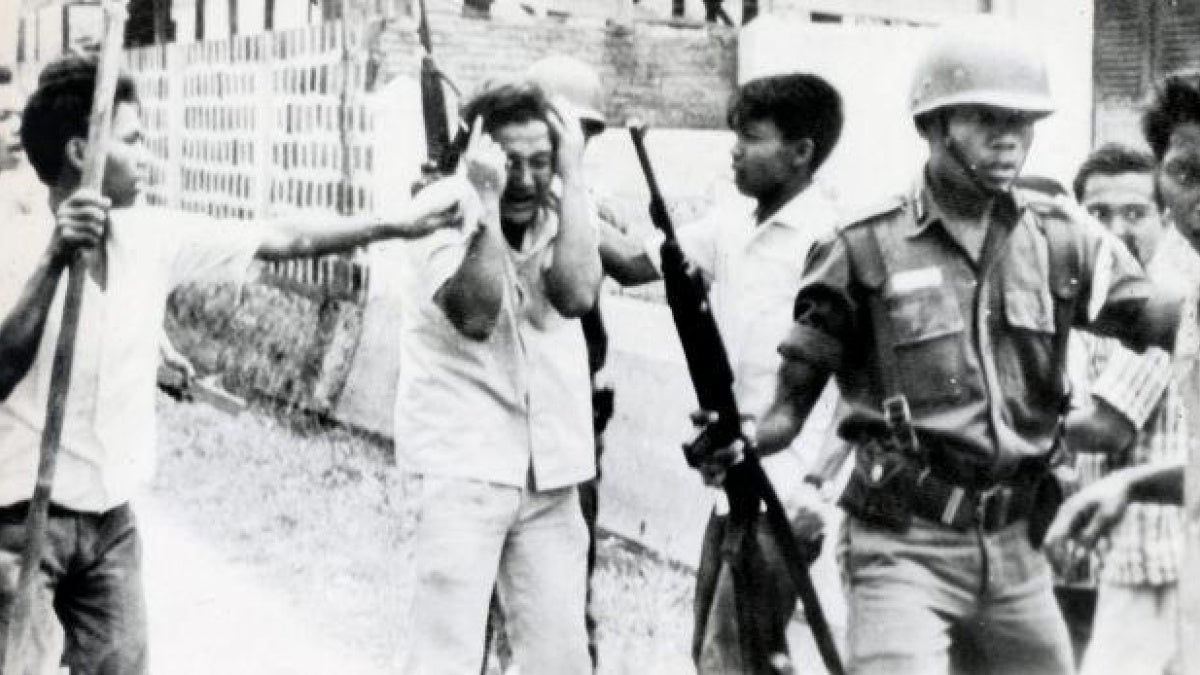
In the days and weeks that followed, the army, socio-political, and religious groups blamed the coup attempt on the Communist Party of Indonesia (PKI). Soon, a mass purge was underway, which resulted in the imprisonment and deaths of actual or suspected Communist Party members and sympathizers. It is believed that at least 500,000 people were killed as a result of these reprisals. (The country's population was about 100 million at the time; in 2022, it's about 275 million.)

The United States and other Western states have steadfastly denied any responsibility for the terrible violence that followed the attempted coup of October 1, 1965. That violence, they have maintained, was the product of domestic political forces over which outside powers had little, if any, influence. Later evidence proved this to be a lie.

In 1978, Australian novelist Christopher Koch published The Year of Living Dangerously, about the experiences of his brother, journalist Philip Koch, during those events. In 1982, another Australian, director Peter Weir, filmed a movie version.

The legacy of Kusno Sosrodihardjo, a.k.a. Sukarno, the 1st President of Indonesia, is, to say the least, complicated. He sided with Japan in World War II, because they were fighting the natives' Dutch colonial overlords. Once The War ended, he declared independence, with himself as President, but it took 4 years for the Netherlands to agree to let what they called "the Dutch East Indies" go.

But it was hard to keep such a large, diverse, spread-out island nation together. In 1959, Sukarno introduced what he called "Guided Democracy," which was a lot more guided than democratic. The 1965 coup sent the nation into chaos. Finally, in 1967, General Suharto removed Sukarno from power, and he was still under house arrest when he was hospitalized prior to his death in 1970. Suharto was even worse, and had to resign under pressure in 1998, living until 2008.

*

October 1, 1965 was a Friday. Basketball and hockey seasons were a few days away. No games were played in the NFL or the AFL. There was 1 notable college football game played: The University of Southern California (USC) beat Oregon State, 26-12 at the Los Angeles Memorial Coliseum.

And these baseball games were played:

* The Pittsburgh Pirates beat the Chicago Cubs, 2-1 at Forbes Field in Pittsburgh. Roberto Clemente went 1-for-4. Ernie Banks went 0-for-4.

* A doubleheader was split at Cleveland Municipal Stadium. The Baltimore Orioles won the opener, 2-0. Dave McNally pitched a 2-hit shutout. The Cleveland Indians won the nightcap, 3-2. Between the 2 games, Brooks Robinson went 2-for-7 with a walk and an RBI.

* The Chicago White Sox beat the Kansas City Athletics, 6-1 at Comiskey Park in Chicago.

* The Houston Astros beat the St. Louis Cardinals, 4-2 at the Astrodome in Houston. Lou Brock went 0-for-4. Steve Carlton pitched a scoreless 8th inning.

* The Milwaukee Braves beat the Los Angeles Dodgers, 2-0 at Dodger Stadium in Los Angeles. Denny Lemaster pitched a 5-hit shutout. Hank Aaron went 0-for-1 with 2 walks. The next day, though, the Dodgers beat the Braves, and clinched the National League Pennant.

* The Cincinnati Reds beat the San Francisco Giants, 17-2 at Candlestick Park in San Francisco. A bad loss for the Giants, worse in terms of the Pennant chase than it was in terms of the final score. The Reds got home runs from Frank Robinson, Gordy Coleman, Deron Johnson and Pete Rose. 

For the Giants, Willie Mays went 1-for-3 with a walk. Warren Spahn pitched to 3 batters in the top of the 17th inning. He walked Johnny Edwards, Leo Cardenas reached on an error, and Sammy Ellis singled. Those would be the last batters Spahn ever faced.

* The New York Mets and the Philadelphia Phillies were rained out at Shea Stadium. The game was made up as part of a doubleheader the next day. The Phillies won the 1st game, 6-0. Jim Bunning pitched a 2-hit shutout. The 2nd game went 18 innings, before the rain came back and the umpires called it. In other words, in 1 day, the Mets played 27 innings, and didn't score 1 single solitary run.

* The Detroit Tigers and the Washington Senators were rained out at District of Columbia Stadium in Washington. (It was renamed Robert F. Kennedy Memorial Stadium in 1969.) The game was made up as part of a doubleheader the next day. The Tigers swept, 9-1 and 6-2. Al Kaline was injured, and did not play in either game.

* And the New York Yankees, the Boston Red Sox, the Los Angeles Angels and the Minnesota Twins were not scheduled.

Friday, September 30, 2022

September 30, 1945: Lieutenant Hank Greenberg Clinches the Pennant

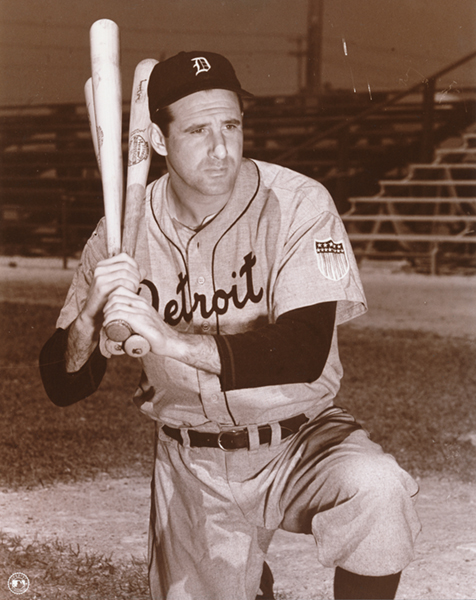
Swinging two bats in the on-deck circle
was a common sight before the Yankees' Elston Howard
invented the "bat donut" in the 1960s.
Hank Greenberg was one of the few players
who was strong enough to swing three bats.

September 30, 1945: Hank Greenberg, recently discharged from the U.S. Army, hits a grand slam off Nelson Potter in the top of the 9th inning, and gives the Detroit Tigers a 6-3 win over the St. Louis Browns at Sportsman's Park, clinching the American League Pennant, which the Browns had won the previous season, for the only time in their history. The Tigers go on to win the World Series over the Chicago Cubs in 7 games.
The 1st player to go into the service was Philadelphia Phillies pitcher Hugh Mulcahy, drafted on March 8, 1941, and he served for the duration of The War. As my grandmother taught me, she and everyone else who lived through it, even if they never left "the home front," always called it "The War," Capital T, Capital W. 
Greenberg had been the 1st major baseball star to volunteer for the U.S. armed forces in preparation for World War II, inducted into the Army on May 7, 1941. So it was only natural that he was the 1st player to return, discharged on June 14, 1945, with Nazi Germany having surrendered, but not, as yet, Imperial Japan. He had scouted bombing targets for B-29 bombers in the China/India/Burma Theater of Operations, and was discharged with the rank of 1st Lieutenant.
Already known as Hammerin' Hank before Henry Aaron was even born, he had lost his seasons of age 31, 32 and 33, and the 1st half of his age 34 season. He finished his career with a lifetime batting average of .313 and 331 home runs. He should have had at least 150 more home runs. He never regretted it, saying, "My country comes first."
Nor did Chief Petty Officer Bob Feller, U.S. Navy, who lost his seasons of ages 23, 24, 25 and most of 26. He won 266 games and struck out 2,581 batters, all for the Cleveland Indians. Based on his 1941 and 1946 performances, he should have had at least another 90 wins and 1,000 strikeouts, which could have made him the all-time strikeout leader, and, with another 98 wins, the pitcher with the most in the post-1920 Lively Ball Era.
He knew The War was more important. He also knew that people like Ty Cobb and Ohio State football coach Woody Hayes, who compared sports to war, were blowhards, saying, "Anybody who says sports is war has never been in a war."
Warren Spahn had appeared in 4 games before going into the service, and was the winning pitcher in exactly none of them. By the time he rejoined the Boston Braves, 1st Lieutenant Warren Spahn, U.S. Army, had missed his age 22, 23 and 24 seasons, and had gotten frostbite in the Battle of the Bulge and been wounded at the Remagen Bridge.
But his wartime experience may have matured him. From age 25 to 44, he did become the Lively Ball Era's winningest pitcher, and the winningest lefthanded pitcher regardless of era, with 363. So maybe his stats didn't suffer.
The stats of Sergeant Joe DiMaggio, U.S. Army Air Force, did suffer, as he lost his age 28, 29 and 30 seasons. He finished with a .325 batting average, and 2,214 hits including 361 home runs. He should have had at least another 550 hits and another 75 home runs.
And then there was Ted Williams, who served as a flight instructor in World War II and a fighter pilot in the Korean War. By the time he left the service for the last time in 1953, Captain Theodore S. Williams, U.S. Marine Corps, had damaged hearing, and had lost his seasons of age 24, 25 and 26, and most of those of age 33 and 34.
He batted .344 for his career, with 2,654 hits and 521 home runs. It shouldn't surprise people who know a little about baseball history that Ted reached 500 homers, only the 4th to do so after Babe Ruth, Jimmie Foxx and Mel Ott. But it is surprising that the man often called "The Greatest Hitter Who Ever Lived" didn't even get close to 3,000 hits. (He also never got 200 hits in a season.) By missing 4 1/2 prime seasons, he may have missed out on as many as 600 hits and 200 home runs, which would have put him past the 714 of Ruth, the record before Aaron reached 755.
In contrast, Ruth only missed 1 month due to World War I, September 1918, and that was because everybody missed at least that much, since the season was cut short. And Aaron was never drafted. Mickey Mantle was classified 4-F, medically unfit for service.
Willie Mays did serve in the Korean War, missing most of his age 21 season and all of his 22, probably costing him around 350 hits on top of his 3,293, and at least 50 homers on top of his 660, meaning he might have gotten to 715 before Aaron did. Yankee pitcher Whitey Ford (1951 and '52) and Brooklyn Dodger pitcher Don Newcome (1952 and '53) also missed 2 seasons serving in Korea.)
Seaman 1st Class Stan Musial, U.S. Navy, the best hitter in the National League while Ted was the best in the American League, only missed 1945, his age 24 season, due to World War II. He had 3,630 hits and 475 home runs, so he may have missed 200 hits and maybe the 25 homers that would have put him over 500.
One man was a veteran of both D-Day and Major League Baseball. In his case, he was just 19 when he was in a U.S. Navy ship off the coast of Normandy, and his service probably didn't delay his entry into the major leagues by much. He may have been the calmest man in the battle, later saying that the exploding shells looked like fireworks. He was Seaman 2nd Class Lawrence Peter Berra. Yogi.
Yankee shortstop and Seaman 1st Class Phil Rizzuto missed his age 25, 26 and 27 seasons due to those huckleberries Hitler and Tojo. His Dodger counterpart, Chief Petty Officer Harold "Pee Wee" Reese, missed his age 24, 25 and 26 seasons. And Army 1st Lieutenant Jack Roosevelt Robinson missed his age 24, 25 and 26 seasons in the Army. Of course, at that point, he had no idea that he would ever play professional baseball in any capacity, much less the one that would make him the most important player of all time.
UPDATE: Bobby Shantz, who turned 100 on September 26, 2025, became the last remaining veteran of both World War II and Major League Baseball. 
*
September 30, 1945 was a Sunday. These other baseball games were played that day:
* The New York Yankees beat the Boston Red Sox, 12-2 at Yankee Stadium. Tuck Stainback and Charlie Keller hit home runs. Keller had also recently returned, from the U.S. Merchant Marine. Joe Page, who would go on to be much better known as a reliever, started and went the distance for the win.
* The New York Giants beat the Boston Braves, 1-0 at Braves Field in Boston, in the 1st game of a doubleheader. Napoleon "Nap" Reyes, a 3rd baseman, light-skinned enough to be allowed to play even though he was Hispanic, and from Cuba so he wouldn't be drafted to fight in The War, hit a home run in the top of the 13th inning. Don Fisher pitched all 13 innings for the shutout. The nightcap was tied 2-2 after 7 innings, when Massachusetts' 7:00 PM curfew for Sunday sports kicked in and stopped the game.
* The Brooklyn Dodgers beat the Philadelphia Phillies, 4-1 at Shibe Park in Philadelphia.
* The Chicago Cubs beat the Pittsburgh Pirates, 5-3 at Forbes Field in Pittsburgh.
* The St. Louis Cardinals beat the Cincinnati Reds, 3-2 at Crosley Field. Del Rice won the game with a home run in the top of the 12th inning.
* The Washington Senators completed their 154-game schedule, but played their 154th game on September 23, a week before the regular season was supposed to end. Wartime travel restrictions, and the desire to get Griffith Stadium ready for the NFL's Washington Redskins, led to the Senators' condensed schedule. As a result, when their season ended, the Senators were 1 game behind the Tigers for the AL Pennant; but when the season finally ended, the Tigers were a game and a half ahead.
* The Chicago White Sox played their 149th game on September 25, and never played their last 5 games. The Philadelphia Athletics played their 150th game on September 27, and never played their last 4. The Cleveland Indians played their 145th game on September 28, and never played their last 9. Most likely, these were also due to wartime travel restrictions, even though The War had ended with the Japanese' official surrender on September 2 (following their unofficial surrender on August 14, which is recognized as V-J Day).
There were 2 NFL games played that day. The Green Bay Packers beat their arch-rivals, the Chicago Bears, 31-21 at Green Bay City Stadium. And the Cleveland Rams beat the Chicago Cardinals, 21-0 at League Park in Cleveland.
And Ehud Olmert, who served as Prime Minister of Israel from 2006 to 2009, was born on this day.

Saturday, July 2, 2022

July 2, 1963: Warren Spahn vs. Juan Marichal

Marichal (left) and Spahn after the game

July 2, 1963: Former Sports Illustrated writer Jim Kaplan, who has written many books on baseball, wrote a dual biography of the opposing pitchers in the game played at Candlestick Park in San Francisco on this day, focusing on this game. He titled his book The Greatest Game Ever Pitched: Juan Marichal, Warren Spahn, and the Pitching Duel of the Century.

Spahn, 42 years old and a native of Buffalo, New York, was a lefthanded pitcher, and had been decorated for his service in the Battle of the Bulge in World War II. He had helped the Braves win National League Pennants in Boston in 1948, and in Milwaukee in 1957 and 1958, winning the 1957 World Series. He would finish his career with 363 wins, the most of any lefthanded pitcher ever, and the most of any pitcher of either hand in the post-1920 Lively Ball Era.

Marichal, 25 and from the Dominican Republic, was righthanded, but was already building a career that would make him the all-time winningest pitcher among Latin Americans, with 243. (He has since been surpassed by Dennis Martínez and Bartolo Colón.) He had helped the San Francisco Giants win the 1962 Pennant. He didn't seem to have much in common with Spahn, outside of talent. But each man was known for a windup with a very high leg-kick.

Marichal allowed a single to Frank Bolling in the 1st inning. Also, an error by 3rd baseman Harvey Kuenn allowed Del Crandall to reach 2nd base in the 2nd. In the 4th, he walked Norm Larker, and allowed singles to Mack Jones and Crandall, but Larker tried to score on Crandall's single, and Willie Mays threw him out at the plate.

He walked Lee Maye in the 5th, and Maye stole 2nd, but was stranded there. Denis Menke singled and stole 2nd in the 6th, but was stranded. In the 7th, Crandall led off the 7th with a single, but was caught stealing. Spahn took matters into his own hands, and doubled, but was stranded. Marichal walked Aaron in the 8th, but stranded him.

In the 2nd, Spahn allowed a single to Orlando Cepeda, who stole 2nd and advanced to 3rd on a flyout. He allowed a single to Willie McCovey in the 4th. In the 7th, he allowed singles to Cepeda and Ed Bailey, but they couldn't score. The Giants had a chance to win it in the bottom of the 9th, when Felipe Alou singled with 2 outs, but Cepeda popped up. Both Spahn and Marichal had pitched shutouts, and it was on to extra innings.

In the bottom of the 10th, Ernie Bowman bunted his way onto 1st base, but Spahn stranded him. Neither pitcher allowed a baserunner in the 11th or the 12th. The pitchers had the opposite motivation: Spahn said he didn't want a kid to beat him, and Marichal said he didn't want an old man to beat him.

Frank Bolling singled with 2 out in the top of the 13th, but was stranded. Bowman led off the bottom of the 13th with a single, but Spahn picked him off 1st base. In the top of the 14th, Marichal walked Larker, but stranded him. Spahn ran into real trouble in the bottom of the 14th. Kuenn led off with a double. With 1st base open, Mays was intentionally walked -- his run meant nothing. Spahn got Willie McCovey to pop up, and Felipe Alou to fly out. Cepeda grounded to Menke at 3rd, but he made an error, loading the bases. But Spahn got Bailey to fly out.

Both pitchers went 1-2-3 in the 15th inning. With 2 outs in the top of the 16th, Menke singled, but Marichal got Larker to ground back to him. In the bottom of the 16th, Spahn got Kuenn to fly to center. Maybe he should have walked Mays intentionally again, because, at 12:31 AM on July 3, Mays hit a long home run to left field.
Giants 1, Braves 0. There's no record of how many pitches each man threw, but Marichal faced 59 batters, Spahn 56. Marichal had 10 strikeouts, Spahn only 2; however, Spahn walked only 1 batter, Marichal 4; Marichal allowed 8 hits, Spahn 9. For the game, Spahn had a WHIP -- Walks plus Hits, and that total divided by Innings Pitched -- of 0.652, while Marichal's was 0.750. Spahn's ERA for the game was 0.56, while Marichal's, of course, was 0.00.

The game lasted 4 hours and 10 minutes. It wasn't well-reported outside of the West Coast, because it ended at 2:30 AM Pacific Time, 5:30 Eastern Time. But as both men's reputations grew, so did that of the game.

It was 30 years to the day after New York Giants starter Carl Hubbell pitched 18 innings for a 1-0 win over the St. Louis Cardinals. Cards starter Tex Carleton pitched 16 innings as well.

Spahn won 202 games during the 1950s, making him the winningest pitcher of the decade. Marichal won 191 games during the 1960s, more than any other pitcher, including Sandy Koufax, Don Drysdale and Bob Gibson.

*

July 2, 1963 was a Tuesday. Marvel Comics published X-Men #1 on this day. I have a separate entry for that event.

These other baseball games were played that day:

* The New York Yankees beat the Chicago White Sox, 3-0 at Yankee Stadium. Al Downing allowed just 1 hit, a single to Cam Carreon in the 7th inning. He also walked 6 batters, but struck out 10. Hector Lopez hit a home run. Roger Maris went 1-for-3. Mickey Mantle was injured. Yogi Berra, in his last full season as a player, also did not play.

* The New York Mets lost to the Chicago Cubs, 4-1 at Wrigley Field in Chicago. Ernie Banks went 1-for-3 with a walk for the Cubs. Duke Snider did the same for the Mets.

* The Pittsburgh Pirates beat the Philadelphia Phillies, 3-2 at Connie Mack Stadium in Philadelphia. Roberto Clemente went 1-for-3 with a walk and an RBI.

* The Baltimore Orioles beat the Los Angeles Angels, 4-3 at Memorial Stadium in Baltimore. Brooks Robinson went 1-for-4.

* The Washington Senators beat the Kansas City Athletics, 7-2 at District of Columbia Stadium in Washington. D.C. Stadium was renamed Robert F. Kennedy Memorial Stadium in 1969.

* The Boston Red Sox beat the Cleveland Indians, 6-1 at Cleveland Municipal Stadium. Carl Yastrzemski went 2-for-4 with a walk and 2 RBIs.

* The Minnesota Twins beat the Detroit Tigers, 7-4 at Tiger Stadium in Detroit. Harmon Killebrew went 1-for-4 with a walk. Al Kaline went 2-for-3 with a home run, a walk and an RBI.

* The Cincinnati Reds beat the Houston Colt .45s, 6-4 at Colt Stadium in Houston. Frank Robinson did not play for the Reds, but rookie Pete Rose did, and went 3-for-5. The Colts became the Houston Astros in 1965.

* And the Los Angeles Dodgers beat the St. Louis Cardinals, 1-0 at Dodger Stadium in Los Angeles. Don Drysdale pitched a 5-hit shutout, outpitching Curt Simmons. Stan Musial, in his final season, got a hit as a pinch-hitter.

Saturday, May 28, 2022

May 28, 1951: Willie Mays Says Hello

May 28, 1951: Willie Mays makes his real major league debut.

Not his actual major league debut. Depending on how you measure it, that was either sometime in 1948, or on May 25, 1951. It was 3 days after that latter date that he began to show the wider world what he could do.

Willie Howard Mays Jr. was born on May 6, 1951 in Westfield, Alabama, and grew up in nearby Fairfield, both outside Birmingham. His father, Willie Sr., nicknamed Kitty-Kat, had played semi-pro baseball, though not officially in what became known as the Negro Leagues. Willie Jr. was signed to play in those, in 1948, by the Birmingham Black Barons. He was just 17, but was good enough to help them win the Pennant, before losing the Negro World Series to the Pittsburgh-based Homestead Grays.

While playing with the Black Barons in 1949, he was pursued by several teams. He could have ended up with the Brooklyn Dodgers, on the same team with Jackie Robinson and Roy Campanella. He would have played center field, and the Dodgers would have solved their left field problem by moving Duke Snider over.

But the Dodgers didn't make the deal, because an official in their front office, Wid Matthews, had seen him play, and told team president Branch Rickey that he could not hit a curveball. Matthews was a former outfielder, who had played all of 192 games in the major leagues in the 1920s. Who couldn't hit a curveball? Well, maybe we shouldn't be too hard on Wid: It was he who told Branch Rickey, president of the Dodgers, in 1945 that Robinson had a good ability to "protect the strike zone."

Mays could have ended up with the Boston Red Sox, because they had offered him a tryout, because they had offered his manager in Birmingham, Piper Davis, a contract. But a Sox scout told team owner Tom Yawkey the same thing that Matthews had told Rickey: That Mays "couldn't hit a curveball."

He was 18 years old, and had never yet attempted to hit a white man's curveball. And Davis was too old to keep, and was released. And that's why the Red Sox became the last major league team to integrate, in 1959. And that's also how the Red Sox could have ended up with Ted Williams in left field and Willie Mays in center field, but didn't.

The Boston Braves were also interested in Mays. But they had a quota on the number of black players in their system, and they'd already hit it. So they could have had Willie Mays in center field and Hank Aaron in right field -- perhaps not soon enough to save them from moving to Milwaukee in 1953, but the Braves could have dominated the National League for years to come.

Or, the New York Giants could have. Because their scout, Ed Montague, signed Willie, and they were also interested in Hank. "I had the Giants' contract in my hand," Aaron would later say, "but the Braves offered $50 a month more. That's the only thing that kept Willie Mays and me from being teammates: Fifty dollars." $50 in 1952, with inflation, is about $552 in 2022 money. Doesn't sound like much, does it? On such hinge moments does the history of a sport sometimes hang in the balance.

For 1950, the Giants assigned Mays to their Class A team, the Trenton Giants. This was the end of the line for minor-league baseball in New Jersey: The Giants moved both their Trenton and their Jersey City farm teams after the season, while the New York Yankees moved their Newark Bears farm team a year earlier. The Negro Leagues' Newark Eagles folded after 1951.

Negro League stars being picked up by the white majors hurt them, but what really killed the Negro Leagues and many of the minor-league teams, and in some cases entire minor leagues, was television: Why should a fan get in his car and drive 20 miles, and then pay to get in, to watch a minor-league team when he could stay home, and watch the closest major league team for free, on a TV set he'd already paid for, with food and drinks he'd already paid for and didn't have to stand on line for?

Mays did well enough with Trenton that he was promoted to the Giants' top farm team for 1951, the Class AAA Minneapolis Millers. He was batting .477, and had just turned 20. Clearly, he could hit a major league white man's curveball. So, on May 25, 1951, he made his debut with the Giants. Wearing Number 14, playing center field and batting 3rd, he went 0-for-5 against the Philadelphia Phillies at Shibe Park in Philadelphia. The Giants won, anyway, 8-5.

The next day, against Phils ace Robin Roberts, he went 0-for-3 with 2 walks. The Giants won, anyway, 2-0. The next day, he went 0-for-4. The Giants won, anyway, again 2-0. He had played flawlessly in center field. But at the plate, he was 0-for-12. His batting average was .000. His slugging percentage was .000. Counting the 2 walks, his on-base percentage was .143.

He told Giant manager Leo Durocher that he didn't think he was ready. Leo showed confidence in him, saying, "I don't care if you go 0-for-50. I'm the manager, and you're my center fielder."

The next night, May 28, was Mays' 1st home game, at the Polo Grounds at 157th Street and 8th Avenue in Upper Manhattan, with Harlem to the south, Washington Heights to the west, and the Harlem River and The Bronx to the north and east -- including Yankee Stadium, one mile due east. The Giants were starting a series with the Boston Braves. For this game, Mays was given a new uniform number, 24.

In the 1st inning, the Braves -- who did not yet have Aaron, or their other Hall of Fame hitter of the era, Eddie Mathews -- tagged Sheldon Jones for 3 runs in the top of the 1st inning. In the bottom of the 1st, batting 3rd for the 4th game in a row, was Mays. The Braves' starting pitcher was Warren Spahn, also a future Hall-of-Famer.

The distance from the middle of the pitching rubber to the middle of home plate is 60 feet 6 inches. Spahn threw Mays a fastball, and, after the game, told the press, "For the 1st 60 feet, that was a hell of a pitch." Mays hit it over the left field roof. It was the 1st of 3,283 career hits, the 1st of 660 home runs, and the 1st of 1,903 runs batted in. But it was the only run Spahn allowed, as the Braves won, 4-1.

Mays finished the game 1-for-4. He was now batting .063, on-base .261, slugging .250. Many years later, years in which Mays had terrorized the National League with his hitting, running and fielding, at an All-Star Game, with Mays within earshot, Stan Musial of the St. Louis Cardinals jokingly told Spahn, "If you'd just struck him out, we might have been rid of him forever!"

Mays' performance in the field had led to the moving of Bobby Thomson from center field to 3rd base. When Thomson hit "The Shot Heard 'Round the World" to give the Giants the Pennant, a little more than 4 months later, Mays was on deck. He had finished a season in which he batted .274 with 20 home runs, 61 runs batted in, and some sensational catches, which led to him telling his teammates, "Say, hey, didn't you see that play?" Which led to him being nicknamed "The Say Hey Kid." He was named the NL's Rookie of the Year.

Willie Mays had said hello to America. When he announced his retirement 22 years later, he told the crowd that he had realized that the time had come to tell himself, "Willie, say goodbye to America."

*

May 28, 1951 was a Monday. Had today's law been in effect, it would have been Memorial Day. But, until 1970, it was held on May 30 every year. Starting in 1971, it's been the last Monday in May. Memorial Day has traditionally meant doubleheaders in baseball. But on this last Monday in May, there wasn't even a full slate of games. These other games were played:

* The New York Yankees lost to the Boston Red Sox, 3-2 at Fenway Park in Boston. Joe DiMaggio went 1-for-4. Ted Williams went 0-for-4. Mel Parnell outpitched Allie Reynolds. Four months later, the Yankees swept a doubleheader from the Red Sox at Yankee Stadium. In the opener, Reynolds pitched a no-hitter, getting Williams to pop up for the last out. In the nightcap, the Yankees clinched the Pennant.

* The Brooklyn Dodgers beat the Philadelphia Phillies, 4-3 at Shibe Park in Philadelphia. Ralph Branca outpitched Ken Heintzelman. Gil Hodges and Carl Furillo hit home runs. Jackie Robinson went 2-for-4.

* The Cleveland Indians beat the Detroit Tigers, 9-0 at Briggs Stadium (later Tiger Stadium) in Detroit. Bob Feller pitched a 6-hit shutout.

* The Chicago White Sox beat the St. Louis Browns, 4-2 at Comiskey Park in Chicago.

* The St. Louis Cardinals beat the Pittsburgh Pirates, 6-5 at Sportsman's Park in St. Louis. Stan Musial went 2-for-4 with a home run and 3 RBIs. Red Schoendienst singled Del Rice home with the winning run in the bottom of the 10th inning.

* The Philadelphia Athletics and the Washington Senators were rained out at Griffith Stadium in Washington. The game was made up as part of a doubleheader on July 8. The Senators swept, 3-1 and 8-2.

* And the Chicago Cubs and the Cincinnati Reds were rained out at Crosley Field in Cincinnati. The game was made up on August 16. The Cubs won, 8-4. The Reds' bullpen collapsed in the top of the 10th inning.

Friday, March 18, 2022

March 18, 1953: Baseball On the Move

Milwaukee County Stadium, as it appeared during the Braves' tenure

March 18, 1953: For the 1st time in 50 years, a major league baseball team moves from one city to another. And it does so right on the heels of a new season.

For years, several cities in "the high minors" had tried to get the major leagues to put a team there. Milwaukee, where the Boston Braves had their top farm team, was the first to break through. Moving there meant that they already owned the rights to have a major league team there, and wouldn't have to pay someone else a territorial indemnification fee.

The case for the Braves staying in Boston was actually stronger than you might think. They had won the National League Pennant as recently as 1948. They still had Warren Spahn, a Hall of Fame pitcher. They had Eddie Mathews, who turned out to be a Hall of Fame 3rd baseman, coming off a good rookie season. They had Hank Aaron, who turned out to be a Hall of Fame right fielder, in their farm system. Many of the other players who would win Pennants in Milwaukee in 1957 and '58 were also in their farm system.

In contrast, the American League's Boston Red Sox had one bankable star: Ted Williams. At the end of the 1952 season, Williams was in the U.S. Marine Corps, flying a jet in the Korean War. He wouldn't be back until late 1953 -- and no one knew that would be the case in the preceding Winter. For all they knew, he could have ended up missing all of '53, '54, and so on... maybe even retire.

The Red Sox had Fenway Park. But Fenway wasn't considered special in the early Fifties. Its Fenway's age (40 years old) didn't make it special: 8 of the other 13 major league ballparks (2 of them having 2 teams sharing) opened in April 1912 or earlier. Nor did the other things that are now considered to make Fenway "special": Other parks had big, close walls, and most had a hand-operated scoreboard. The CITGO sign? Didn't go up until 1965. The bleachers on top of the Green Monster? 2002.

No, the Red Sox weren't special because of their players, or their ballpark, or their history. They hadn't won the World Series since 1918, and as for their 1946 Pennant, well, the Braves had won one more recently. Neither team was a glamour team, but the Braves were, at the least, not far behind the Sox by that measure.

If the Braves had just hung on in Boston one more season, they would have had Mathews' 47 home runs (or thereabouts; Braves Field was roughly as hitter-pitcher balanced as Milwaukee County Stadium), and the attendance would have gone up. One more, and Aaron would have arrived. The team was getting better.

Despite the manpower shortage of World War II, and having a really inadequate ballpark in Borchert Field (it was older than any major league park, and its dimensions were similar to those of the Polo Grounds), the minor-league version of the Milwaukee Brewers drew rather well.

This was mainly because they were winning. They won the American Association Pennant in 1943, '44 and '45. They also had success because their owner was Bill Veeck, and this was where he became the king of the baseball promotion. This included starting games at 8:00 in the morning so people working the overnight shift at Milwaukee-area defense plants could come to a ballgame right from work.

But Veeck and his Brewers proved that Milwaukee could support a major league team. So the County of Milwaukee began building a stadium, confident that they could get a team. By then, Veeck had owned the Cleveland Indians, and was owning the St. Louis Browns, and intended to move them to Milwaukee. There was also a group trying to buy the St. Louis Cardinals from Fred Saigh, who had to go to prison and sell the team due to tax fraud, and move them to Milwaukee.

So if the Braves hadn't exercised their option before the 1953 season, some major league team would surely have been playing home games at Milwaukee County Stadium in April 1954. But the Braves, literally and figuratively, made their move. Gussie Busch bought the Cardinals, keeping them in St. Louis. Veeck tried to move the Browns to Baltimore, but MLB voted that the move could only go forward with another owner, so he sold them, and they became the Baltimore Orioles.

Milwaukee was a good market. The Braves ended up bringing in more fans in their 1st 13 home games in Milwaukee in 1953, 312,936, than they did in all 77 games in Boston in 1952, 281,281. In 1954, they set an NL record for highest attendance, and did it again in 1957. O'Malley got jealous of the attendance and the parking spaces, and the rest is history.
Downtown Milwaukee, circa 1957

Oddly, the Braves made their move during Spring Training, with 45 days before the regular season opened. On April 14, 1953, they played, interestingly enough, the Cardinals, and beat them, 3-2 in 10 innings. Spahn went the distance, and Billy Bruton hit a home run off Gerry Staley to win it.

The Braves broke the ice:

* 1953-54: The St. Louis Browns moved, becoming the Baltimore Orioles.
* 1954-55: The Philadelphia Athletics moved, becoming the Kansas City Athletics.
* 1957-58: The Brooklyn Dodgers moved, becoming the Los Angeles Dodgers. Horace Stoneham, owner of the New York Giants, was preparing to move his team to Minneapolis, where they had their top farm team. But, needing a reasonably close team to cut down on travel costs, Dodger owner Walter O'Malley talked him into San Francisco instead.
* 1960-61: The Washington Senators moved to Minneapolis, becoming the Minnesota Twins. The AL expanded, creating a new Washington Senators, and the Los Angeles Angels.
* 1961-62: The New York Mets and the Houston Colt .45s began play. In 1965, the Colt .45s changed their name to the Houston Astros.
* 1965-66: The bloom had come off the rose for the Braves, who moved to Atlanta.
* 1967-68: After threatening to move to Dallas and Louisville, Charlie Finley moves the Kansas City Athletics to Oakland.
* 1969: Another expansion creates the Kansas City Royals, the Seattle Pilots, the Montreal Expos and the San Diego Padres.
* 1969-70: After a disastrous first season in Seattle, the Pilots move, becoming the Milwaukee Brewers. The Chicago White Sox had been threatening to move to Milwaukee.
* 1971-72: The "new" Washington Senators move to the Dallas area, where they became the Texas Rangers. The White Sox threaten to move to Denver.
* 1973-74: The Padres nearly move to Washington, before they are sold.
* 1975-76: The White Sox again threaten to move, this time to Seattle, before being sold and kept in Chicago.
* 1976-77: The San Francisco Giants nearly move to Toronto, leading to the creation of 2 new expansion teams, the Toronto Blue Jays and the Seattle Mariners.
* 1977-78: Finley nearly moves the A's to Denver.
* 1978-79: Finley nearly moves the A's to New Orleans. He sells them in 1980.

The Tampa Bay nearly got the White Sox for 1989 and the Giants for 1993, before last-minute moves kept those teams where they were. Denver and Miami finally got teams in 1993, the Colorado Rockies and the Florida Marlins (later the Miami Marlins). In 1998, the Tampa Bay Rays and the Arizona Diamondbacks were created. In 2004-05, the Expos moved, becoming the Washington Nationals.

Mathews played until 1968, making him the last active former Boston Braves. Catcher Del Crandall was the last living former Boston Brave, living until May 5, 2021.

UPDATE: The Atlanta Braves have a team Hall of Fame. The Boston Braves they've inducted into it are Harry Wright, Kid Nichols, Herman Long, Hugh Duffy, Fred Tenney, Rabbit Maranville, Wally Berger, Johnny Sain, Tommy Holmes and Warren Spahn. The Milwaukee Braves they've inducted are Spahn, Hank Aaron, Eddie Mathews, Del Crandall, Joe Adcock and Joe Torre.

Aaron, Spahn, Mathews and Braves broadcaster Earl Gillespie have been elected to the Wisconsin Athletic Hall of Fame.

*

March 18, 1953 was a Wednesday. As I said, baseball was in Spring Training. Football was out of season. One game was played in the NBA: The Indianapolis Olympians beat the Milwaukee Hawks, 74-69 at the Milwaukee Arena. In 1974, it was renamed the Milwaukee Exposition, Convention Center and Arena, or "The MECCA." Since 2014, it has been named the UW-Panther Arena.

Ironically, just 2 years after getting the Braves, and only 4 years after getting the Hawks, Milwaukee would lose the Hawks: They moved to St. Louis in 1955, and then to Atlanta in 1968, the year Milwaukee got a new NBA team, the Bucks.

There were 2 games in the NHL. The Boston Bruins beat the New York Rangers, 2-1 at the old Madison Square Garden. And the Toronto Maple Leafs beat the Chicago Black Hawks, 4-3 at Maple Leaf Gardens in Toronto. The Montreal Canadiens and the Detroit Red Wings were not scheduled.

December 31, 1999 & January 1, 2000: The Millennium

December 31, 1999:  The Millennium arrives. The people of planet Earth survived. At a terrible cost. But we hadn't destroyed ourselves. ...