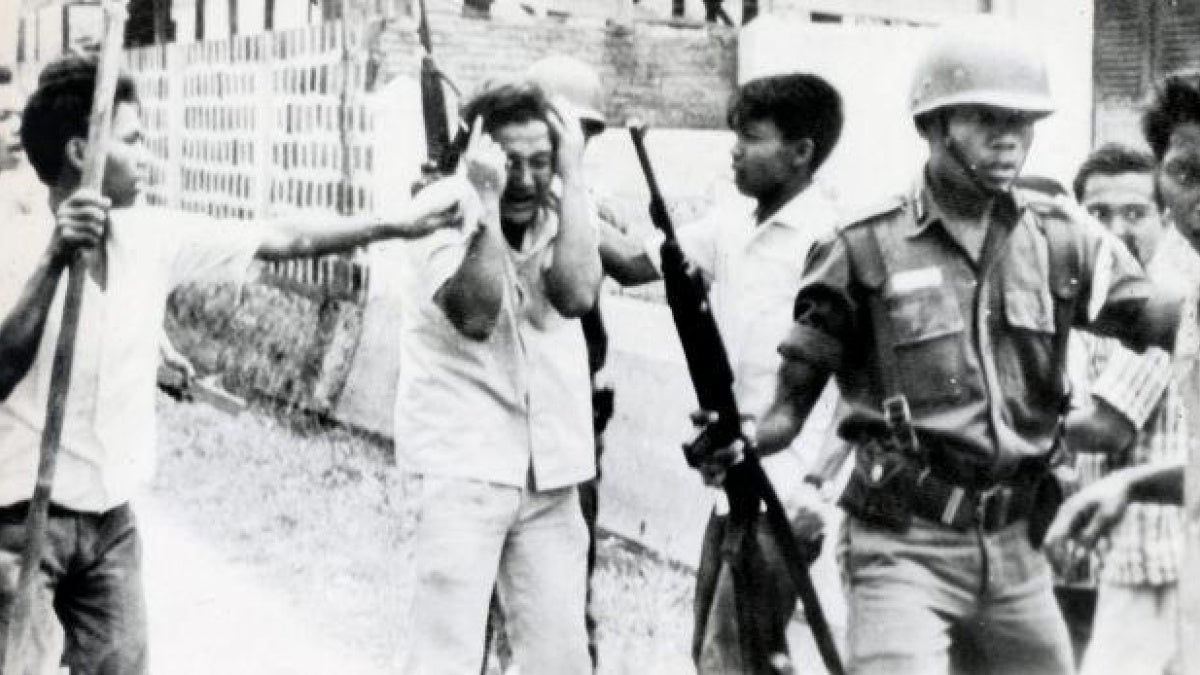
October 1, 1965: Members of the 30 September Movement assassinate 6 Indonesian Army Generals in an abortive coup d'état in the national capital of Jakarta.
At 7:00 AM, Radio Republik Indonesia broadcast a message from Lieutenant-Colonel Untung Syamsuri, the commander of the Presidential guard, stating that the 30 September Movement, an internal army organization, had taken control of strategic locations in Jakarta, with the help of other military units, in order to forestall a coup attempt by a "General's Council" aided by America's Central Intelligence Agency (CIA), intent on removing President Sukarno on 5 October, which Indonesia celebrates as "Army Day."
Sukarno took up residence in the Bogor Palace, a presidential palace in Bogor, East Java, while Omar Dhani and D.N. Aidit, implicated in the coup, fled the country. Led by Suharto, commander of the Army's Strategic Reserve, the army regained control of all the installations previously held by forces of the 30 September Movement.
In the days and weeks that followed, the army, socio-political, and religious groups blamed the coup attempt on the Communist Party of Indonesia (PKI). Soon, a mass purge was underway, which resulted in the imprisonment and deaths of actual or suspected Communist Party members and sympathizers. It is believed that at least 500,000 people were killed as a result of these reprisals. (The country's population was about 100 million at the time; in 2022, it's about 275 million.)
The United States and other Western states have steadfastly denied any responsibility for the terrible violence that followed the attempted coup of October 1, 1965. That violence, they have maintained, was the product of domestic political forces over which outside powers had little, if any, influence. Later evidence proved this to be a lie.
In 1978, Australian novelist Christopher Koch published The Year of Living Dangerously, about the experiences of his brother, journalist Philip Koch, during those events. In 1982, another Australian, director Peter Weir, filmed a movie version.
The legacy of Kusno Sosrodihardjo, a.k.a. Sukarno, the 1st President of Indonesia, is, to say the least, complicated. He sided with Japan in World War II, because they were fighting the natives' Dutch colonial overlords. Once The War ended, he declared independence, with himself as President, but it took 4 years for the Netherlands to agree to let what they called "the Dutch East Indies" go.
But it was hard to keep such a large, diverse, spread-out island nation together. In 1959, Sukarno introduced what he called "Guided Democracy," which was a lot more guided than democratic. The 1965 coup sent the nation into chaos. Finally, in 1967, General Suharto removed Sukarno from power, and he was still under house arrest when he was hospitalized prior to his death in 1970. Suharto was even worse, and had to resign under pressure in 1998, living until 2008.
*
October 1, 1965 was a Friday. Basketball and hockey seasons were a few days away. No games were played in the NFL or the AFL. There was 1 notable college football game played: The University of Southern California (USC) beat Oregon State, 26-12 at the Los Angeles Memorial Coliseum.
And these baseball games were played:
* The Pittsburgh Pirates beat the Chicago Cubs, 2-1 at Forbes Field in Pittsburgh. Roberto Clemente went 1-for-4. Ernie Banks went 0-for-4.
* A doubleheader was split at Cleveland Municipal Stadium. The Baltimore Orioles won the opener, 2-0. Dave McNally pitched a 2-hit shutout. The Cleveland Indians won the nightcap, 3-2. Between the 2 games, Brooks Robinson went 2-for-7 with a walk and an RBI.
* The Chicago White Sox beat the Kansas City Athletics, 6-1 at Comiskey Park in Chicago.
* The Houston Astros beat the St. Louis Cardinals, 4-2 at the Astrodome in Houston. Lou Brock went 0-for-4. Steve Carlton pitched a scoreless 8th inning.
* The Milwaukee Braves beat the Los Angeles Dodgers, 2-0 at Dodger Stadium in Los Angeles. Denny Lemaster pitched a 5-hit shutout. Hank Aaron went 0-for-1 with 2 walks. The next day, though, the Dodgers beat the Braves, and clinched the National League Pennant.
* The Cincinnati Reds beat the San Francisco Giants, 17-2 at Candlestick Park in San Francisco. A bad loss for the Giants, worse in terms of the Pennant chase than it was in terms of the final score. The Reds got home runs from Frank Robinson, Gordy Coleman, Deron Johnson and Pete Rose.
For the Giants, Willie Mays went 1-for-3 with a walk. Warren Spahn pitched to 3 batters in the top of the 17th inning. He walked Johnny Edwards, Leo Cardenas reached on an error, and Sammy Ellis singled. Those would be the last batters Spahn ever faced.
* The New York Mets and the Philadelphia Phillies were rained out at Shea Stadium. The game was made up as part of a doubleheader the next day. The Phillies won the 1st game, 6-0. Jim Bunning pitched a 2-hit shutout. The 2nd game went 18 innings, before the rain came back and the umpires called it. In other words, in 1 day, the Mets played 27 innings, and didn't score 1 single solitary run.
* The Detroit Tigers and the Washington Senators were rained out at District of Columbia Stadium in Washington. (It was renamed Robert F. Kennedy Memorial Stadium in 1969.) The game was made up as part of a doubleheader the next day. The Tigers swept, 9-1 and 6-2. Al Kaline was injured, and did not play in either game.
* And the New York Yankees, the Boston Red Sox, the Los Angeles Angels and the Minnesota Twins were not scheduled.


No comments:
Post a Comment