Showing posts with label san francisco 49ers. Show all posts

Friday, December 2, 2022

December 2, 2007: The Oldest Starting Quarterback to Win an NFL Game

December 2, 2007: The Carolina Panthers beat the San Francisco 49ers, 31-14 at Bank of America Stadium in Charlotte, North Carolina. The Panthers' starting, and winning, quarterback was Vinny Testaverde. He had just turned 44. This made him the oldest starting quarterback ever to win an NFL game.

George Blanda had thrown passes at the ages of 45, 46, 47 and 48, making him the oldest quarterback, and the oldest player, in NFL history. But Testaverde broke his record as the oldest starting quarterback.

Vincent Frank Testaverde was born on November 13, 1963 in Brooklyn, and grew up in Floral Park, Long Island, New York. (There's also a Floral Park in neighboring Queens.) He won the Heisman Trophy with the University of Miami in 1986, but his pro career seemed to be a bust, as he failed with the Tampa Bay Buccaneers and the Cleveland Browns/Baltimore Ravens franchise.

But in 1998, he came home, and led the New York Jets into the AFC Championship Game for only the 3rd time in their history. (They've since gotten back twice more.) At 35, it seemed like he was ready to lead the Jets into the future. But in the opening game of the 1999 season, he tore his Achilles tendon, and that was it for the Jets. He was reduced to a backup role with the Jets, was cut in 2004, signed with the Dallas Cowboys, played that season with them as Tony Romo's backup, returned to the Jets as a backup in 2005, and backed up Tom Brady on the New England Patriots in 2006.

After the Panthers lost quarterbacks Jake Delhomme and David Carr due to injury, the Panthers gave Testaverde another shot midway through the 2007 season. On October 14, he led them to victory over the Arizona Cardinals, making him the oldest quarterback ever to lead an NFL team to victory. The Panthers lost their next 5, although Testaverde did not play in 2 of them, before he broke his record against the 49ers on December 2. After a bad performance the next week, the Panthers turned to another backup, Matt Moore. He won the week after that, but the team finished 7-9 and missed the Playoffs. They went 3-3 with Testaverde as their starter.

He lost more games than any starting quarterback in NFL history, 123; and threw 267 interceptions, 4th all-time at the time of his retirement. But he also won 90 games. He passed for over 46,000 yards, then 7th all-time. He threw 275 touchdown passes, then 8th all-time. He threw touchdown passes to 70 different players, a record until broken by Brady in 2018. And he's still the oldest starting quarterback to win an NFL game. Think about that: Here's a guy who was born before the Kennedy assassination, and he was still playing quarterback in the NFL near the end of the Bush tenure in the White House.

He was elected to the College Football Hall of Fame, although he will probably never get into the Pro Football Hall. He has also been elected to the Long Island and Florida Sports Halls of Fame. He has moved back to Tampa, and is an assistant coach at Jesuit High School, where son Vincent Jr. played quarterback, going on to play in the Canadian and Arena Football Leagues.

*

December 2, 2007 was a Sunday. These other NFL games were played that day:

Houston, New Orleans, Tampa Bay, Tennessee

* The New York Giants beat the Chicago Bears, 21-16 at the new Soldier Field in Chicago.

* The New York Jets beat the Miami Dolphins, 40-13 at Dolphin Stadium in Miami Gardens, Florida.

* The Seattle Seahawks beat the Philadelphia Eagles, 28-24 at Lincoln Financial Field in Philadelphia.

* The Buffalo Bills beat the Washington Redskins, 17-16 at FedEx Field (now Northwest Stadium) in the Washington suburb of Landover, Maryland.

* The Tennessee Titans, formerly the Houston Oilers, beat the Houston Texans, 28-20 at LP Field in Nashville.

* The Tampa Bay Buccaneers beat the New Orleans Saints, 27-23 at the Superdome in New Orleans.

* The Pittsburgh Steelers beat the Cincinnati Begnals, 24-10 at Heinz Field (now Acrisure Stadium) in Pittsburgh.

* The Indianapolis Colts beat the Jacksonville Jaguars, 28-25 at the RCA Dome (formerly the Hoosier Dome) in Indianapolis.

* The Minnesota Vikings beat the Detroit Lions, 42-10 at the Metrodome in Minneapolis.

* The St. Louis Rams beat the Atlanta Falcons, 28-16 at the Edward Jones Dome (now The Dome at America's Center) in St. Louis.

* The San Diego Chargers beat the Kansas City Chiefs, 24-10 at Arrowhead Stadium in Kansas City.

* The Oakland Raiders beat the Denver Broncos, 34-20 at the Oakland Coliseum (then the McAfee Coliseum).

* The Arizona Cardinals beat the Cleveland Browns, 27-21 at the University of Phoenix Stadium (now State Farm Stadium) in the Phoenix suburb of Glendale, Arizona.

* The previous Thursday night, the Dallas Cowboys beat the Green Bay Packers, 37-27 at Texas Stadium in the Dallas suburb of Irving, Texas.

* And the next night, on ESPN Monday Night Football, the New England Patriots beat the Baltimore Ravens, 27-24 at M&T Bank Stadium in Baltimore.

Baseball was out of season. There were 8 games played in the NBA:

* The New York Knicks lost to the Phoenix Suns, 115-104 at Madison Square Garden.

* The New Jersey Nets lost to the Detroit Pistons, 118-95 at The Palace in the Detroit suburb of Auburn Hills, Michigan.

* The Boston Celtics beat the Cleveland Cavaliers, 80-70 at the TD Banknorth Garden (now the TD Garden) in Boston.

* The San Antonio Spurs beat the Portland Trail Blazers, 100-79 at the AT&T Center (now the Frost Bank Center) in San Antonio.

* The Denver Nuggets beat the Miami Heat, 115-89 at the Pepsi Center (now the Ball Arena) in Denver.

* There was a doubleheader at the Staples Center (now the Crypto.com Arena) in Los Angeles. At 12:30 PM, Pacific Time, the Los Angeles Clippers lost to the Indiana Pacers, 101-95. And at 6:30 PM, the Los Angeles Lakers lost to the Orlando Magic, 104-97.

* And the Golden State Warriors beat the Seattle SuperSonics, 109-96 at the KeyArena in Seattle.

And there were 3 games in the NHL:
 
* The New Jersey Devils beat the Atlanta Thrashers, 3-2 in a shootout at the Prudential Center.

* The Minnesota Wild beat the Vancouver Canucks, 2-1 at the Xcel Energy Center (now the Grand Casino Arena) in St. Paul, Minnesota.

* And the Edmonton Oilers beat the Anaheim Ducks, 4-0 at the Honda Center in Anaheim.

Thursday, December 1, 2022

December 1, 1986: "The Dark Knight Returns" is Published

December 1, 1986: Batman: The Dark Knight Returns #4 is released by DC Comics, written by Frank Miller, drawn by Klaus Janson, and colored by Lynn Varley. It concludes Miller's story of Bruce Wayne coming out of retirement, as his hometown of Gotham City has fallen apart without him to watch over it as the Caped Crusader. As far as I know, this is the first publication to call Batman "the Dark Knight."

DKR (for short) #1, titled "The Dark Knight Returns," tells of Bruce realizing that he has to get back out there, despite being 55 years old and having no Robin: He and his original Dynamic Duo partner, Dick Grayson, are estranged; and Dick's replacement, Jason Todd, had been killed in action some time before, implied to be the reason Bruce hung up the cowl. (Note: This story was published 2 years before DC showed Jason being killed by the Joker in the storyline Batman: A Death in the Family.)

Batman manages to foil a terrorist plot by Harvey Dent, the former District Attorney known as Two-Face: Although his disfigurement has been cured and his face restored, Harvey has totally given in to the bad side of his personality.

DKR #2, "The Dark Knight Triumphant," shows Batman taking on the Mutants, the gang that has taken control of the streets of Gotham, but he's too old, and their gigantic leader kicks his ass. (Note: This story was published 7 years before DC introduced the huge villain Bane, who wore Batman down physically and psychologically, before breaking his back in the storyline Batman: Knightfall.)

He is saved by Carrie Kelley, a 13-year-old girl who idolizes him, and has taken to fighting crime wearing a copy of a Robin costume. Avoiding the Mutants' notice, she drags him back to the Batmobile, and, with a now-elderly butler Alfred Pennyworth guiding her over the phone, gets Bruce back to the Batcave. Bruce recovers, goes out, and wins a rematch. (Batman fans like to say, "Batman always wins." He loses occasionally, but always seems to win the rematches.) Now, predictably, "The Mutants" are "The Sons of the Batman."

DKR #3, "Hunt the Dark Knight," shows that it's now the world that's falling apart. In a story that resembles the Cuban Missile Crisis, the Caribbean island of Corto Maltese is a flashpoint in the Cold War. (Remember: Despite Batman being old, the story is set in what was then the present day, so the Soviet Union is still a threat.) And the President, a thinly-veiled caricature of the real-life President at the time, Ronald Reagan (he keeps a jar of mints on his desk instead of jelly beans), is in over his head.

Fortunately, the U.S. government has an ace in the hole, to protect their interests. At some point in the past, something like the later Marvel Comics' "Superhero Registration Act" had been passed, ordering all costumed crimefighters to either work for the government, retire, or be considered outlaws. Most retired. Only one chose to work for the government: Superman. Batman doesn't like this.

But Batman has a bigger problem: The Joker has broken out of Arkham Asylum, and the final battle he had long feared -- and the Joker seemed to want -- has come: Kill or be killed. Batman breaks the Joker's neck, leaving him paralyzed, but alive. The Joker expresses his disappointment, and twists his head to finish the job, making it look like Batman actually did it. And now, he's on the run.

DKR #4 is titled "The Dark Knight Falls." Miller had said that every hero's journey has an ending, using the examples of medieval figures King Arthur and Beowulf sacrificing themselves in a final battle, and wrote this chapter as a "last Batman story." The police, no longer under the command of the retired Commissioner Jim Gordon, and the federal government both want Batman in custody, and the feds are ready to send Superman after him.

But the Cold War turns hot, and a nuclear missile heads toward America. Superman stops it, but is seriously weakened. Still, the electromagnetic pulse set off by the explosion knocks out America's electricity, and Batman takes Carrie/Robin and the Sons of the Batman to the Wayne Manor stables, and the horses become the new Batmobiles as Bruce leads them in settling things down in Gotham.

The final showdown takes place in Crime Alley, where Batman's parents had been gunned down 46 years earlier. (Bruce's age when Thomas and Martha had been killed had been hinted at before, but, while this story is not canon in the main DC storyline, his age at the time is given in this story as 9.) Bruce has decided to die where "Batman was born." He stands in an armored version of his Batsuit, and attacks Superman with high-voltage electricity. Even against a weakened Superman, this doesn't work, and Superman smashes his helmet, and another punch breaks 3 of his ribs.

Correctly guessing this, Batman is properly prepared. He cheats. He has Green Arrow fire an arrow at Superman. It explodes, spraying him with Kryptonite dust. And Batman beats Superman to a pulp. And he says, "I want you to remember, Clark. In all the years to come, in your most private moments, I want you to remember, my hand, at your throat. I want you to remember the one man who beat you."
And then Batman has a heart attack and drops dead. This follows the destruction of Wayne Manor, meant to cover up all his secrets (which doesn't work, as Bruce is exposed as Batman anyway), and the death of Alfred from a stroke, as his boss dies. Alfred's last thought: "Of course, how utterly proper."

Batman wins. Some victory, huh?

As Clark Kent, still with a bruised face, Superman attends the funeral of Bruce Wayne. The body had been claimed by "his one living relative, a cousin." Selina Kyle, the former Catwoman, accuses Clark of killing Bruce, and has to be restrained by Gordon. (Apparently, both Jim and Selina already knew Clark's secret identity, as well as Bruce's.)

Clark starts to walk away, but then, his super-hearing picks up a heartbeat. He turns, and comes face-to-face with the cousin. No, not Kate Kane, a.k.a. Batwoman. (That character wouldn't debut for another 20 years.) But it is a young woman with red hair, wrapped in black. It's no cousin: It's Carrie. He winks at her, to let her know that he knows, and that he's okay with it. We can't tell, but maybe Carrie is smiling under her veil. 

(The wink may also be a nod to a story that had been published earlier in the year: Whatever Happened to the Man of Tomorrow?, the farewell to the pre-Crisis On Infinite Earths Earth-1 Superman, set 10 years after Superman's alleged death, with him having a new identity, married to Lois Lane, and having a son who shows a sign of having superpowers.)

And the last scene is in the Batcave, or what's left of it: Bruce, very much alive, with Carrie by his side, discussing strategy for rebuilding and protecting Gotham with the Sons of the Batman. After a few mentions throughout the story of "This would be a good death... ," he says, "This will be a good life. Good enough."

In other words, after making a big deal of wanting Batman to have a final battle and die, Miller copped out, and kept Batman alive.

And the story has since been ruined by sequels, each installment more ridiculous than the last, betraying the sensibility of this story.

*

DKR is an "Elseworlds" story, taking place outside the official DC Comics canon, although the Elseworlds imprint wouldn't debut until 1989, with Batman: Gotham By Gaslight, showing Batman in 1889, taking on, while being accused of being, Jack the Ripper.

DKR was the story that Batman fans had waited their whole lives for: The story that made Batman, not Superman, the Number 1 superhero. The story that showed that "Batman always wins." The story that proved that Batman could even beat Superman. That Batman was better than Superman, because Superman is a "boy scout" (to use the old insult against him). That Superman, as Batman puts it in this story, "always said yes to anybody with a badge or a flag." That Batman was the ultimate badass.

Let's get something straight: Batman can't beat Superman. There is no way in hell that it could ever happen.

Batfans who want their guy to beat Superman always cite the fight scene at the end of DKR. And, I have to admit, the Superman in that story (not the one we know, as things have changed tremendously from canon) is a bit of a jerk, who deserved to be taught a lesson.

But here's how that scene would have played out, if Frank Miller understood Superman:

* Batman fires a laser cannon at Superman. Superman is knocked back, but gets up, and says, "Bruce, is that the best you can do?"

* Batman zaps Superman with millions of volts of electricity. (Ripped off from an early Fantastic Four story where The Thing did it to The Hulk, after The Hulk shoved him down a manhole.) Superman is surprised, but says, "Seriously? I just survived a nuke, Bruce."


* Green Arrow launches his arrow. Superman's super-hearing picks up the sound. His telescopic vision sees the arrow, and his X-ray vision sees what's inside. He can do this faster than a speeding bullet, let alone a speeding arrow, because his senses have the same super-speed as the rest of him. He gets out of the way, the arrow lands harmlessly, and he blows the Kryptonite dust out of the way.

* Batman is screwed. His ace in the hole is completely wasted, and he has no weapons left except his mind and his hand-to-hand combat abilities. Both of which are completely wasted on a Kryptonian.


Batfans believe "Batman always wins." Why? Because he's smarter, and "Because he's the goddamn Batman, that's why."

Except Batman isn't smarter than Superman. The yellow Sun of the Earth, compared with the red sun of Krypton, makes Superman's brain a supercomputer, the likes of which no Batman or Batcomputer can match.

You want to know what would happen if they tried to solve the same crime? Batman would sit on a rooftop, waiting for the bad guys to show up. Except they wouldn't, because Superman has used his super-senses to track them down, and has already taken them to jail.

You want to know what would happen if they played each other in chess? I asked my father this question, not long before he died. He was a comic book fan going back to his youth in the 1950s, had 2 science degrees from the school now known as the New Jersey Institute of Technology, and (unlike myself, to whom he never seemed to be able to pass on this part of his knowledge) was a decent chess player.

Dad reminded me of Superman's Sun-aided brain, and his super-speed. He said that Batman would be ready to pull all kinds of maneuvers, except that, in the time it took Batman to set up the board, Superman could have read a dozen books on chess strategy, and would know every move that Batman could make.

It's no contest. And even if Batman were smarter than Superman, which he isn't, he still wouldn't win a fight. A big part of Batman's schtick is sneaking up on his opponents. You can't sneak up on someone with super-speed. Or super-hearing, for that matter. And Batman's martial arts expertise is useless against Superman's quickness, and his invulnerability.

Trying to attack Superman from a distance wouldn't help. What's Batman going to do, throw a Batarang at Superman? His speed would allow him to see it, and, whether laced with Kryptonite or anything else, he'd use his heat vision to melt it, or his super breath to freeze it.

And let's be very clear about this: Kryptonite is not an ace in the hole. Superman sometimes faces a guy named Kryptonite Man, and another guy named Metallo, who has a human brain but a robot body powered by Kryptonite. Superman fights these guys, and he still finds a way to win.

And Kryptonite doesn't kill a Kryptonian instantly. It hurts him. It weakens him. But even if Superman had just 1 percent of his strength left, in spite of the pain he would be in, he would still be far stronger than an average human, and Batman would still be pathetically overmatched.

So any Kryptonite that Batman might have only has the power that the writers give it, so it's not a guaranteed knockout. The "ace" can be a higher card than a king, but it could be no better than a one, like every other attack Batman could use.

DKR has been adapted for an animated film. Elements of it were used for the 2012 film The Dark Knight Rises (although no other superhero appeared in it), the 2016 film Batman v. Superman: Dawn of Justice, and The CW's TV adaptation of Crisis On Infinite Earths, showing an alternate Earth where Batman took it one step further, and killed Superman, using the "badge or a flag" line to explain it to Supergirl and Batwoman.

*

December 1, 1986 was a Monday. Baseball was out of season. There were no NBA games played that day. Two games were played in the NHL, both in Quebec. The Washington Capitals beat the Montreal Canadiens, 2-1 at the Montreal Forum. Alan Haworth scored the winning goal, 1:48 into overtime. And the Quebec Nordiques beat the Hartford Whalers, 4-1 at the Colisée de Québec.

And on ABC Monday Night Football, the New York Giants beat the San Francisco 49ers, 21-17 at Candlestick Park in San Francisco. Also in football, DeSean Jackson was born on this day.

Tuesday, November 29, 2022

November 29, 1976: Reggie Jackson Brings His Star to New York

Left to right: Thurman Munson,
Reggie Jackson, Roy White

November 29, 1976: The New York Yankees sign the biggest available free agent, Reggie Jackson. The contract is for $2,960,000 over 5 years – $592,000 a year, or about $3.04 million in today's money.

This was the 1st off-season in which free agency was widespread. Charlie Finley, Reggie's boss with the Kansas City and Oakland Athletics from his 1966 signing (including his 1967 major league debut) until the previous April, was not going to sign him to a big contract. Finley wasn't going to sign anybody, because, as Reggie himself said in his memoir, "Lord, but the man was cheap."

Just before the start of the 1976 regular season, Finley had traded Reggie to the Baltimore Orioles. But their owner, Jerry Hoffberger, wasn't going to sing him, either.

Three team owners were willing to sign Reggie: Shipbuilding tycoon George Steinbrenner of the Yankees, McDonald's head honcho Ray Kroc of the San Diego Padres, and Seagram's whiskey baron Charles Bronfman of the Montreal Expos. Reggie thought about it, and decided that he didn't want to deal with the Canadian exchange rate -- or to learn French, and narrowed it down to the Yanks and Padres.

"George Steinbrenner hustled me," Reggie said at the press conference for his signing. He told George that Kroc was offering him more money to go to San Diego. George revealed that, whatever Kroc intended, the promise of more money was a half-truth: "Kroc is offering you more salary to go to San Diego." George reminded Reggie that New York was the media capital of the world, including the advertising capital of the world. Between salary, endorsements, and the glory that would come with winning with the New York Yankees, Reggie could get a lot more from George Steinbrenner than he ever could from Ray Kroc.

The press conference was held at the Versailles Terrace at the Americana Hotel. Reggie posed for pictures with George, with coaches Yogi Berra and Elston Howard, and with new teammates Thurman Munson and Roy White. One notable Yankee not there was manager Billy Martin. He didn't want Reggie, for reasons both professional (if misguided) and personal.

A 1974 Sports Illustrated cover had called Reggie, then the reigning Most Valuable Player of the American League and the World Series, a "Superduperstar." So he wasn't kidding when he told the New York media, "I didn't come to New York to be a star. I'm bringing my star with me."

A lot of people didn't like that. Munson was one of them: George had promised him he would be the highest-paid Yankee as long as he was on the team. George had already broken that promise once, 2 years earlier, when the chance to sign the best pitcher in baseball at the time, Reggie's former Oakland teammate Jim "Catfish" Hunter, came up. Thurman understood then. But breaking the promise again?

And a SPORT magazine article printed early in the 1977 season, with quotes -- or perhaps misquotes, or perhaps simply made-up quotes -- from Reggie about himself, and about Thurman, further drove a wedge between them. Things got ugly.

Two million, nine hundred and sixty thousand dollars? In Jerry Ford dollars? Bargain. Reggie defined an era in baseball, earning the nickname Mr. October. In 5 seasons, he got the Yankees to 4 postseasons, winning 3 Pennants and 2 World Series, and making them the biggest show in baseball.

Finley's other stars that he cheaply let get away?

* Kroc signed relief pitcher Rollie Fingers and 1st baseman Gene Tenace. He got no Playoff berths as a result, as the Dodgers were too strong. But at least he tried.

* Gene Autry, the entertainment legend who owned the team then known as the California Angels, signed A's left fielder Joe Rudi and designated hitter Don Baylor, along with former Oriole 2nd baseman Bobby Grich. He got 2 Division titles, but no Pennants.

* Allan "Bud" Selig, the used car dealer who owned the Milwaukee Brewers, signed 3rd baseman Sal Bando, and would later acquire Fingers in a trade. He won a Pennant, but no World Series.

* Brad Corbett, the oil executive who owned the Texas Rangers, signed shortstop Bert Campaneris, and made some other notable acquisitions. He got no Playoff berths as a result.

* And real estate tycoon Bob Lurie, who owned the San Francisco Giants, was the final landing spot for pitcher Vida Blue, after Finley had previously tried to sell Blue to the Yankees and trade him to the Cincinnati Reds. Both of those teams did better without the increasingly drug-addled Blue than the Giants did: They didn't make the Playoffs again until 1987.

Minnesota Twins owner Calvin Griffith, was not only nearly as cheap as Finley, but also blatantly racist. He refused to lift a finger to re-sign pitcher Bill Campbell. He went to the free-spending Boston Red Sox, who thought that having a lockdown reliever would have made the difference in the 1975 World Series against the Reds and the 1977 AL Eastern Division race against the Yankees. But the Yankees had also improved.

And pitcher Wayne Garland, who went 20-7 for the Orioles in 1976, was signed by the Cleveland Indians for $2.3 million over 10 years. But he wrecked his shoulder in Spring Training, and went 13-19 in 1977. He had won 40 games in the major leagues before his 27th birthday. He won 15 games after it.

*

November 29, 1976 was a Monday. Actors Chadwick Boseman and Anna Faris were born on this day.

Baseball was out of season. No games were played in the NBA, the NHL or the WHA. On ABC Monday Night Football, the San Francisco 49ers beat the Minnesota Vikings, 20-16 at Metropolitan Stadium in the Minneapolis suburb of Bloomington, Minnesota.

Sunday, November 27, 2022

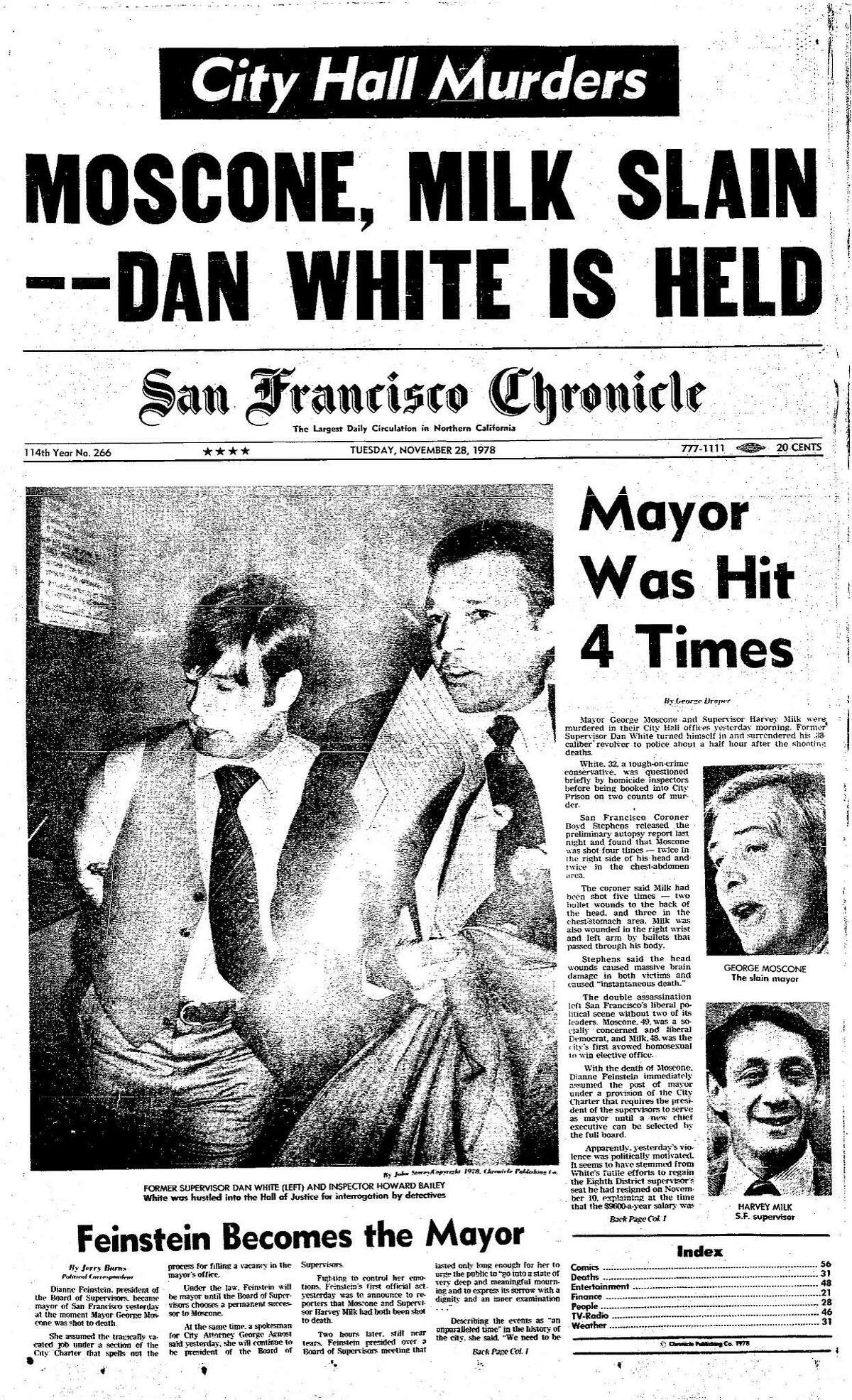
November 27, 1978: The Moscone-Milk Assassination

Harvey Milk (left) and George Moscone

November 27, 1978: A city still reeling from losing hundreds of its citizens in a cult suicide the week before suffers a shocking double assassination.

On November 18, nearly 1,000 people, most of them from the San Francisco Bay Area, died in a mass suicide ordered by the Rev. Jim Jones in the South American nation of Guyana. By the 27th, there were still funerals to conduct, when the next awful thing happened.

Before his descent into paranoia, Jones had been active in city politics, and had been helpful in the election of George Moscone as Mayor in 1975, and that of Harvey Milk to the Board of Supervisors, San Francisco's version of a City Council, in 1977.

Moscone served in the U.S. Navy in the Korean War, became a lawyer, and an ally of the Burton family's Democratic political machine in San Francisco. He was elected to the Board of Supervisors in 1962, and to the State Senate in 1966, rising to the rank of Majority Leader.

He was known for his support of poor people, minorities, small business owners, and, before most politicians dared, gay rights. He also helped block construction of a freeway that would have cut the city in half and destroyed Golden Gate Park and some neighborhoods. He sponsored bills creating a State school lunch program and legalizing abortion in the State. And both of these bills were signed into law by Governor Ronald Reagan.

He wanted to run for Governor of California in 1974, but was talked out of it, in favor of Jerry Brown, who won. (Jerry's father, Pat Brown, had been elected in 1958, and had beaten Richard Nixon in 1962, but had lost to Reagan in 1966.) Moscone was rewarded for this by being elected Mayor in 1975. Within weeks of taking office, he was instrumental in preventing the San Francisco Giants from moving to Toronto.

He also led the move away from the Board of Supervisors having all at-large seats to having neighborhood seats. This led to the 1977 election of Milk, the 1st openly gay elected official in America; Gordon Lau, the 1st Asian-American elected official in San Francisco; and Dan White, a cop-turned-fireman.

Milk was Jewish, and a native of Bay Shore, Long Island, outside New York City. Like Moscone, he served in the Navy during the Korean War. Unlike Moscone, he was gay, and this was discovered, so had to accept an "other than honorable" discharge. He returned to Long Island and taught in high school, then worked as an insurance actuary in Manhattan.

In 1970, he left New York, and arrived in San Francisco. In 1973, he opened a camera shop on Castro Street, the center of the Castro District, the city's premier gay neighborhood. In 1973, he ran for the Board of Supervisors, but finished 10th among 32 candidates for the at-large seats. In 1975, he ran again, and finished 7th. Under the old system, he had to finish at least 6th.

But with the new system in place in 1977, he only had to finish 1st in his own District, and he did. Part of it was leading the fight against singer Anita Bryant's move to ban gay people from teaching in Florida's public schools. This meant a boycott of the product for which Bryant was a spokeswoman: Florida oranges.

In 1978, Milk was among the leaders of the fight to stop a similar move in California, Proposition 6. He began to get death threats. He made a public statement: "If a bullet should enter my brain, let that bullet destroy every closet door."

Milk had clashed with White on a few issues. White got more and more frustrated in his job, and, on November 10, he resigned, saying a salary of $9,600 -- $43,000 in 2022 money -- was not enough to support his family.

But on November 15, he changed his mind, and asked Moscone to reinstate him. At first, Moscone was willing. But the other Supervisors, including Milk and the Board's President (and thus next in line to be Mayor), Dianne Feinstein, talked him out of it.

The Peoples Temple suicide happened on November 18, and word reached San Francisco on November 19. White told his aides, "One day, I'm on the front page; and the next, I'm swept right off."

Moscone announced a press conference for November 27, at which he would announce his appointment to serve as an interim holder of White's seat, until a special election could be held. White went to City Hall, with its dome making it look more like a State Capitol, and got in through a basement window, avoiding metal detectors. Because he had a gun, his former police issue revolver.
San Francisco City Hall

He went to Moscone's office. People nearby heard shouting, then gunshots. White shot Moscone in the shoulder, then the chest, and then finished him off with 2 shots to the head. White then walked over to his former office, and reloaded his gun. He walked into the corridor, and came face to face with Milk. From her office, Feinstein heard gunshots, and called the police. She went into the corridor, and found Milk down, shot 5 times -- like Moscone, twice in the head.
Moscone had just turned 49 years old. Milk was 48. Feinstein was 45. White was 33.

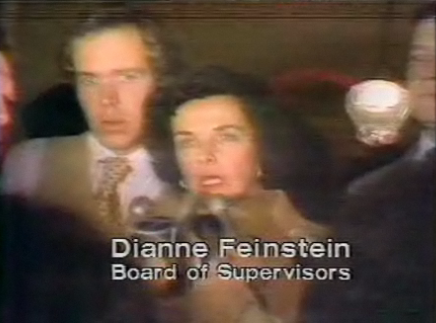
Now the Acting Mayor, the 1st woman and the 1st Jewish person to hold that post, Feinstein was forced to call a press conference to announce the assassinations, and say that White the suspect. White turned himself in after about an hour.
Flowers were left on the steps of City Hall, and when darkness fell, 40,000 people marched in a candlelight vigil from Castro Street to City Hall. The next day, both men lay in state in City Hall's rotunda.

White's trial was fixed. There were no gay people on the jury, nor any ethnic minorities, nor poor people. It was all white middle-class people, most of them Catholic. White's attorney blamed the dual assassination on his mistreatment by his colleagues, and also on a junk-food binge that messed with his blood sugar. Although Hostess' Twinkies were never mentioned, this became known as "the Twinkie defense." (This dovetailed with the Jonestown Massacre: The tainted drink was Flavor Aid, but everybody remembers it as Kool-Aid.)

On May 21, 1979, White was found not guilty on both counts of first degree murder, and found guilty on two counts of voluntary manslaughter. He was sentenced to 7 years in prison. Seven years for murdering two men -- and the Mayor and another major politician of his hometown, no less.

The sadness of the gay community 6 months earlier turned to rage. People began throwing rocks at the front doors of City Hall. Allies of Milk tried to reason with them, but there was no listening. Several downtown buildings were damaged, and a police car was set on fire. It became known as the White Night Riot. When a reporter asked a rioter why they were "destroying parts of the city," the rioter said, "Just tell people that we ate too many Twinkies."

San Francisco-based punk rocker Eric Boucher, taking the stage name Jello Biafra and fronting a band named for assassinated politicians, the Dead Kennedys, ran for Mayor in the 1979 election. A part of his platform was for a statue to be erected to Dan White, and to supply eggs, tomatoes and stones nearby, to give people something to throw at it. Apparently, despite being only 21 years old, he was serious about his campaign.

Appearing on the ballot with both his real name and his stage name, as "Eric 'Jello Biafra' Boucher," he actually finished 4th, with 6,591 votes, a little less than 4 percent of the vote, ahead of 6 other people who were on the ballot. Feinstein barely won, with 46.6 percent of the vote to the 44.7 of Supervisor Quentin Kopp, a margin of 3,331 votes. Kopp was later elected to the State Senate.

Things would get worse. The 1980s would bring the AIDS epidemic. It would take pretty much the entire decade for the disease to be stripped of its stigma as "gay cancer," or as "God's punishment for homosexuals." Per capita, San Francisco was hit harder by the disease than even the much larger cities of New York and Los Angeles.

In 1981, a Convention Center for which Moscone had lobbied was finished. It was named for him, and it hosted the 1984 Democratic National Convention. It remains the last building smaller than a professional sports arena to host a Democratic Convention.
The George R. Moscone Convention Center

Also in 1984, White was released from prison, having served a little over 5 years -- for murdering 2 men. On October 21, 1985, having won his case, but having lost pretty much everything else, including his wife to divorce, he committed suicide. He was 39 years old.

Feinstein was re-elected in 1983. Leaving office at the beginning of 1988, she ran for Governor in 1990, losing to Senator Pete Wilson. In 1992, she was elected to an unexpired term in the U.S. Senate, and was re-elected in 1994, 2000, 2006, 2012 and 2018. She is still alive, 89 years old, and still fighting for the rights of all Americans. It is not yet known if she will run for re-election in 2024, and people who hate her -- being female, Jewish, liberal, and outspoken, she pushes a lot of buttons -- claim that she has dementia. There is no reliable evidence of this. (UPDATE: She died in office in 2023.)

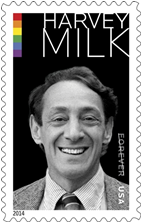
Milk has gone down in history as a pioneer of gay rights, a "Martin Luther Queen." In 2014, the U.S. Postal Service made him the 1st openly gay American politician to be honored with a postage stamp.
In 1980, Representative Robert Bauman, Republican of Maryland, was outed, making him the 1st member of Congress known to be gay. What's more, he was caught soliciting a teenage male prostitute. He was the 1st Republican politician, but by no means the last, to blame his indiscretion on alcoholism. He apologized for said indiscretion, but lost his bid for re-election. As of November 27, 2022, he is still alive.

In 1983, Representative Gerry Studds, Democrat of Massachusetts, was outed, and had his relationship with a 17-year-old Congressional page exposed. He was censured, but won re-election in 1984, making him the 1st openly gay person to win an election for Congress. He continued to serve his District -- which includes Cape Cod, which includes Provincetown, one of the most gay-friendly places in America -- until retiring in 1996, and died in 2006.

In 1998, Tammy Baldwin of Wisconsin was elected to Congress, the 1st openly gay non-incumbent to be elected, and the 1st openly gay woman to serve. In 2012, she became the 1st openly gay person elected to the U.S. Senate.

In 2004, Governor Jim McGreevey, Democrat of New Jersey, exposed as having appointed an unqualified lover to public office, came out, and resigned. He has never run for public office again. In 2018, Jared Polis, Democrat of Colorado, having previously been elected to Congress, was the 1st openly gay person elected Governor of any State. (UPDATE: In 2023, McGreevey announced that he was running for Mayor of his birthplace, Jersey City, in the 2025 election.)

In 2020, Mayor Pete Buttigieg of South Bend, Indiana became the 1st openly gay person to win delegates for a Presidential nomination. When Joe Biden was elected President, he appointed Buttigieg to be Secretary of Transportation, making him the 1st openly gay member of a President's Cabinet. And a few transgender politicians have been elected to local and State offices, though not yet to Congress or Governorships.

One last thing. I was 8 years old, almost 9, in November 1978. I remember seeing the Jonestown story on the news, dominating coverage for a few days, leading into Thanksgiving weekend, November 23 to 26. But I have no memory of seeing the national news cover the assassinations of Moscone and Milk on the 27th. I knew Moscone's name from having watched the 1984 Democratic Convention. But I don't recall hearing Milk's name until I was already out of high school. And I have no idea why that is.

*

November 27, 1978 was a Monday. The White Shadow, perhaps the best sports-themed TV show of all time, premiered on this night.

Baseball was out of season, although there was a notable event in the sport that day: Jimmy Rollins, Captain of the Philadelphia Phillies' 2007-11 quasi-dynasty, including the 2008 World Series win, was born, in Oakland, California, and grew up in neighboring Alameda.

There were no games scheduled that day for the NBA, the NHL, or the World Hockey Association. But Monday Night Football aired on ABC. And in the "You can't make this stuff up" department, the game that night happened to be set for Candlestick Park, between the San Francisco 49ers and the Pittsburgh Steelers.

Pete Rozelle, Commissioner of the NFL, and a former publicity director for the University of San Francisco, had been through this before. In 1963, President John F. Kennedy had been assassinated about 48 hours before NFL games were to kick off. Knowing that some teams scheduled to play on the road were already at their respective airports, and may even have been in the air, he decided to let the games go ahead as scheduled. He later called that his biggest mistake of his career.

This time, with only a few hours to make a decision, he decided to let the game be played, but ordered a moment of silence in memory of Moscone and Milk, to be held right before the National Anthem. But right between them, a truck backed into a wooden flagpole near the south end zone. The sound the pole made when it hit the ground unnerved many people who had been on edge, some for a few hours, some for a few days. At any rate, the Steelers, on their way to winning Super Bowl XIII, won the game, 24-7.

Friday, November 25, 2022

November 25, 2001: Don't Talk to Jim Mora About Playoffs

November 25, 2001: The Indianapolis Colts lose to the San Francisco 49ers, 40-21 at the RCA Dome in Indianapolis. It's the team's 3rd straight loss, and they fall 4-6.

The Colts' coach, Jim Mora is rightly upset. He was 66 years old, a football lifer, from the Los Angeles area. He'd been the head coach at Occidental College in L.A., and served on Dick Vermeil's staff at UCLA and Don James' staff at Washington. He coached the Philadelphia/Baltimore Stars to all 3 USFL Championship Games, winning 2 of them. He coached the New Orleans Saints for 11 seasons, including the franchise's 1st 4 Playoff berths. He was now in his 4th season as head man in Indianapolis, having made the Playoffs the preceding 2 years.

He had seen it all. He now acted like he'd seen enough, and launched into one of the press conference tirades he was known for occasionally giving:

Well, I'll start off by saying this: Do not blame that game on the defense, okay? I don't care who you play, whether it's a high school team, a junior college team, a college team, much less an NFL team: When you turn the ball over 5 times, 4 interceptions, 1 for a touchdown, 3 others in field position to set up touchdowns, you ain't gonna beat anybody I just talked about, anybody. All right?

And that was a disgraceful performance in my opinion. We threw that game. We gave it away by doing that. We gave 'em the friggin' game. In my opinion, that sucked.

Uh, you know, you can't turn the ball over 5 times like that. Holy crap, I don't know who the hell we think we are, when we do something like that. Unbelievable. Five turnovers. One of 'em for -- We threw 4 interceptions for touchdowns this year. That might be an NFL record. That's pitiful. I mean, it's absolutely pitiful, to perform like that. Pitiful.

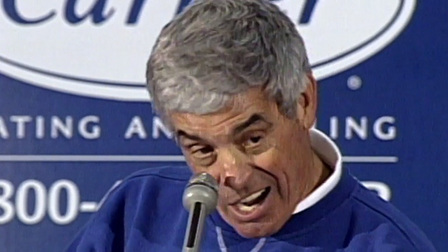
At this point, Tim Bragg of WRTV-Channel 6, the ABC affiliate in Indianapolis, asked Mora if he thought his team could still make the Playoffs. His response might be the most famous coach's press conference rant of all time:

What's that? Ah -- Playoffs? Don't talk about -- Playoffs? You kiddin' me? Playoffs? I just hope we can win a game! Another game!"

Mora was right to worry: The Colts won only 2 of their last 6 games, finishing 6-10, and missing the Playoffs. The Colts averaged 30.4 points per game, more than any team in the NFL. So, maybe he should have blamed the defense.

Mora was fired, and has never coached again. Although his regular-season record was an impressive 125-106, and he won a Division title with New Orleans and another in Indianapolis, he went 0-6 in the... Playoffs!

The Colts replaced him with Tony Dungy. He was able to get more out of Mora's former quarterback, Peyton Manning. But, as a defensive back who played on the Pittsburgh Steelers' Super Bowl teams of the 1970s, Dungy also built a better defense. As a result, he coached them for 7 years, and, every season, made the Playoffs, including the 2006 season, which ended with him leading them to win Super Bowl XLI.

Mora's son, usually listed as Jim L. Mora, served on his father's staff in New Orleans, and as head coach of the Atlanta Falcons and the Seattle Seahawks, and at UCLA, winning an NFC South Division with the Falcons and a Pac-12 South Division with UCLA. As of November 25, 2022, Jim Mora is still alive, age 87; and Jim L. Mora, 61, is the head coach at the University of Connecticut.

On September 17, 2013, while writing my original blog, Uncle Mike's Musings, I discovered that, if you Google just that one word, "playoffs," the first thing that came up was Mora's rant. Not a link to any sport's postseason. I checked again while writing this post, and found that that was no longer the case. Still, it held up for at least 12 years.

*

November 25, 2001 was a Sunday. These other NFL games were played that day:

* The New York Giants lost to the Oakland Raiders, 28-10 at Giants Stadium at the Meadowlands.

* The Washington Redskins beat the Philadelphia Eagles, 13-3 at Veterans Stadium in Philadelphia.

* The Atlanta Falcons beat the Carolina Panthers, 10-7 at Bank of America Stadium in Charlotte.

* The Baltimore Ravens beat the Jacksonville Jaguars, 24-21 at Alltel Stadium (now EverBank Stadium) in Jacksonville.

* The Pittsburgh Steelers beat the Tennessee Titans, 34-24 at the Adelphia Coliseum (now Nissan Stadium) in Nashville.

* The New England Patriots beat the New Orleans Saints, 34-17 at Foxboro Stadium in the Boston suburb of Foxborough, Massachusetts.

* The Miami Dolphins beat the Buffalo Bills, 34-27 at Ralph Wilson Stadium (formerly Rich Stadium) in the Buffalo suburb of Orchard Park, New York.

* The Cleveland Browns beat the Cincinnati Bengals, 18-0 at Cleveland Browns Stadium (now named Huntington Bank Field).

* The Chicago Bears beat the Minnesota Vikings, 13-6 at the Metrodome in Minneapolis.

* The Arizona Cardinals beat the San Diego Chargers, 20-17 at Qualcomm Stadium in San Diego.

* The Kansas City Chiefs beat the Seattle Seahawks, 19-7 at Husky Stadium in Seattle.

* Three days earlier, on Thanksgiving Day, the Green Bay Packers beat the Detroit Lions, 29-27 at the Silverdome in the Detroit suburb of Pontiac, Michigan.

* Also on Thanksgiving, the Denver Broncos beat the Dallas Cowboys, 26-24 at Texas Stadium in the Dallas suburb of Irving, Texas.

* The next night, on ABC Monday Night Football, the Tampa Bay Buccaneers beat the St. Louis Rams, 24-17 at The Dome at America's Center in St. Louis. (That stadium has gone through some name changes, but now has that name again.)

* And, in this last of 3 seasons between the arrival of the reborn Cleveland Browns and that of the Houston Texans, when the NFL had 31 teams, the New York Jets had a bye week.

The Grey Cup, the championship game of the Canadian Football League, was played at the Olympic Stadium in Montreal. The Calgary Stampeders beat the Winnipeg Blue Bombers, 27-19.

Baseball was in the off-season. There were 5 games played in the NBA:

* The New Jersey Nets lost to the Golden State Warriors, 101-85 at the Oakland Coliseum Arena (then named The Arena in Oakland).

* The Toronto Raptors beat the Philadelphia 76ers, 107-88 at the Air Canada Centre (now the Scotiabank Arena) in Toronto.

* There was a doubleheader at the Staples Center (now the Crypto.com Arena) in Los Angeles. In the opener, the Los Angeles Clippers beat the Houston Rockets, 90-83.

* In the nightcap, the Los Angeles Lakers beat the Denver Nuggets, 105-98. Nick Van Exel led all scorers on the day with 34 points.

* And the Seattle SuperSonics beat the Indiana Pacers, 99-88 at the KeyArena in Seattle.

And there were 6 games played in the NHL:

* The New York Rangers lost to the Mighty Ducks of Anaheim, 3-2 at Madison Square Garden.

* The Vancouver Canucks lost to the Philadelphia Flyers, 4-1 at the First Union Center (now the Xfinity Mobile Arena) in Philadelphia.

* The Tampa Bay Lightning beat the Carolina Hurricanes, 4-0 at the Raleigh Entertainment & Sports Arena (now the Lenovo Center).

* The Columbus Blue Jackets beat the Calgary Flames, 4-3 at the Nationwide Arena in Columbus.

* In an "Original Six" matchup, the Chicago Blackhawks and the Detroit Red Wings, arch-rivals, played to a 4-4 tie at the Joe Louis Arena in Detroit.

* And the Dallas Stars beat the Minnesota Wild, 4-3 at the Xcel Energy Center in St. Paul, Minnesota.

And in English soccer, Arsenal beat Manchester United, 3-1 at Highbury in North London.

Friday, November 11, 2022

November 11, 1985: Pelle Lindbergh Is Killed

November 11, 1985: Pelle Lindbergh is killed in a drunken driving crash, ending his life and his hockey career at the age of 26.

Göran Per-Eric Lindbergh was born on May 24, 1959 in Stockholm, the capital of Sweden. He starred as the goaltender for hometown hockey teams Hammarby and AIK, and helped his country win the Bronze Medal at the 1980 Winter Olympics in Lake Placid, New York. (It gets forgotten in the wake of the wins over the Soviet Union in the Semifinal and Finland in the Final, but Sweden actually came closer to beating the U.S. team than any other, with a tie in the opening game.)

In 1979, Pelle became the 1st European-born goalie to be selected in the NHL Entry Draft, by the Philadelphia Flyers. He made his NHL debut toward the end of the 1981-82 season, and was selected to the NHL All-Rookie Team and the NHL All-Star Game the following season.

The Flyers won the Stanley Cup in 1974 and 1975, and reached the Finals in 1976, with Hall-of-Famer Bernie Parent in goal. They remained strong through 1978-79, but late in that season, Parent took a stick through the eyehole in his mask, permanently damaging his vision, and he never played again.

And, ever since, the Flyers have had some talent, but they haven't found that lockdown goalie. With Pete Peeters, they reached the Finals in 1980, but lost. Lindbergh looked like the answer, especially in 1985, when he made his 2nd All-Star Game, became the 1st European to receive the Vezina Trophy as the NHL's top goalie, and helped get the Flyers into the Finals again, losing to the Edmonton Oilers' dynasty.

While the Oilers seemed to have a hammerlock on the Clarence Campbell Conference (now the Western Conference), the Prince of Wales Conference (now the Eastern Conference) looked wide-open. The Montreal Canadiens' dynasty of 1976-79 had gotten old, and the New York Islanders' dynasty of 1980-84 was already starting to break up due to injury.

There was room for a new dominant team in the East, and with Lindbergh in goal; Mark Howe, Brad Marsh, Brad McCrimmon and Ed Hospodar as defensemen; and forwards like Dave Poulin, Peter Zezel, Brian Propp, Tim Kerr, Dave Brown, Rick Tocchet, and the twins Ron and Rich Sutter, the Flyers looked like they could become that team.

On November 9, 1985, the Flyers hosted a team party at the Coliseum, their practice facility in Voorhees, Camden County, New Jersey. Part of the stereotype of hockey players is that they like to drink, and Lindbergh drank a lot that night. Unfortunately, he got into his car, a customized Porsche 930 Turbo, and headed back toward his apartment across the Delaware River in Philadelphia.

He didn't even make it 2 miles: He crashed into a wall in front of Somerdale Park School, damaging his brain stem and his spinal cord. His blood-alcohol content was .24, and the legal limit in New Jersey was then .10. He had 2 passengers, not easy in a 2-seater, not players but friends of players: Edward Parvin had a fractured skull, and Kathy McNeal had a broken pelvis, a ruptured liver and a ruptured spleen.
They both survived. Lindbergh was brain-dead. His family was brought in from Sweden, and he was kept on life support long enough for them to arrive and say their goodbyes. The machines were turned off on November 11, and his parents gave their permission to have his organs harvested for donation.

Lindbergh received the most votes in the fan balloting for the 1986 NHL All-Star Game. It was the 1st time an athlete was posthumously voted to an All-Star Game. It's only happened once since, with Sean Taylor of the Washington Redskins being selected to the 2008 Pro Bowl.

Given his early death, the Flyers have never again given out his uniform Number 31. But, given the cause of his death, they can't officially retire it. They have instituted the Pelle Lindbergh Memorial Trophy, given to their most improved player. He hasn't been elected to the Hockey Hall of Fame, but he has been elected to the Swedish Hockey Hall of Fame.

The Flyers played the rest of the season in a daze. But they made Ron Hextall their new starting goalie, and he got them into the Stanley Cup Finals in 1987. They reached the Finals again in 1997 and 2010. But they've never won another Cup. Given Hextall's performance in the 1987 Finals, it's hard to say Lindbergh would have made the difference that time. But in 1997, when they got swept by the Detroit Red Wings, Lindbergh would have been 38 years old, which is hardly too old to be a Cup-winning goalie.

UPDATE: In 1988, the Flyers established a team Hall of Fame. As of the 2025-26 season, from their 1985 and '87 Stanley Cup Finalists, they have elected Tim Kerr, Brian Propp, Mark Howe, Dave Poulin and Ron Hextall. Kerr, Propp, Howe, Hextall were also elected to the Philadelphia Sports Hall of Fame. Pelle Lindbergh has been elected to neither. Nor has he been elected to the Hockey Hall of Fame in Toronto.

*

November 11, 1985 was a Monday. The baseball season was over. On ABC Monday Night Football, the Denver Broncos beat the San Francisco 49ers, 17-16 at Mile High Stadium in Denver. And there was 1 game played in the NBA: The New Jersey Nets lost to the San Antonio Spurs, 111-104 at the HemisFair Arena in San Antonio.

And there were 2 games scheduled for the NHL that night, neither of them involving the Flyers. In an "Original Six" matchup, the New York Rangers lost to the Chicago Black Hawks, 5-4 at Madison Square Garden. Bob Murray scored the winner for the Hawks, 53 seconds into overtime. And the Vancouver Canucks beat the Detroit Red Wings, 5-0 at the Pacific Coliseum in Vancouver.

Sunday, November 6, 2022

November 6, 1989: An "Honor Killing" On American Soil

November 6, 1989: She called herself Tina Isa. "Tina" was short for the name her father gave her, "Palestina." That should have been the first sign that her story was going to come to a horrible end.

She was born in Brazil in 1972. Her mother, Maria, was a Brazilian Catholic; her father, Zein Isa, a Jordanian Muslim who called himself a "Palestinian." They moved to St. Louis, and she became an American citizen. Like most children who had no say in becoming immigrants, she wanted to fit in with her new country, and so got good grades, and made the honor roll. But she also listened to hip-hop, and liked talking about boys with her girl friends.

Her parents didn't like that. They wouldn't let her go out for school sports teams. They wouldn't let her go on school trips. They wouldn't let her get a job. They wouldn't let her date. Her father decided that he would choose a husband for her, and that he would be a man like himself: A "Palestinian" from the West Bank.

She disobeyed. She started dating a non-Muslim boy, and got a job at a nearby Wendy's. On November 6, 1989, this 17-year-old girl, on the surface like so many other 17-year-old girls in America, walked into her house, and her father called her a "bitch" and a "she-devil." He accused her of "fornication." He said, "You are going to die tonight." And he pulled a knife on her.

She begged her mother for help. Her mother did help -- her father, that is. The mother held her down, and the father stabbed her in the chest, over and over again, saying, "Die! Die quickly!" Which, having no choice in the matter, she did.

In his culture, it was called an "honor killing." In our culture, it is called "cold-blooded murder." In our law, it is called "murder in the first degree." And there is no honor in murdering your own child. Especially when her only provable "crimes" involved acting her age.

What Zein Isa did not know was that the FBI had bugged the house, because he was part of a jihadist terrorist cell they were investigating. The parents were both arrested the next day. They were convicted of murder, and, on December 20, 1991, they were sentenced to death. Zein died in prison from diabetes in 1997, before his sentence could be carried out. Maria's sentence was commuted to life in prison. She died in 2014, at age 70, still in prison where she belonged.

*

November 6, 1989 was a Monday. Baseball was out of season. On ABC Monday Night Football, the San Francisco 49ers beat the New Orleans Saints, 31-13 at Candlestick Park in San Francisco. This NFC Western Division game had originally been scheduled for New Orleans, but when the San Francisco Giants reached the National League Championship Series, it was switched with the October 8 game between the teams, to avoid a scheduling conflict.

This was also the Niners' 1st game at Candlestick since October 1, due to 2 intended road games, the switch, and the earthquake that struck during the World Series, forcing a home game to be moved from Candlestick to Stanford Stadium in nearby Palo Alto, California.

There was 1 game in the NBA: The New York Knicks lost to the Orlando Magic, 118-110 at the Orlando Arena. This was only the 2nd regular-season game ever for the expansion Magic: Two days earlier, on November 4, they beat the New Jersey Nets at home, 111-106.

And there were 4 games in the NHL:

* In an "Original Six" matchup, the New York Rangers beat the Detroit Red Wings, 6-1 at Madison Square Garden.

* The Montreal Canadiens and the St. Louis Blues played to a tie, 3-3 at the Montreal Forum.

* The Toronto Maple Leafs beat the Minnesota North Stars, 2-1 at Maple Leaf Gardens in Toronto.

* And the Calgary Flames beat their arch-rivals, the Edmonton Oilers, 5-1 at the Saddledome in Calgary.

Thursday, November 3, 2022

November 3, 1996: Jerry Rice's 1,000th Catch

November 3, 1996: The San Francisco 49ers beat the New Orleans Saints, 24-14 at the Superdome in New Orleans. In the 2nd quarter, Steve Young threw a 36-yard touchdown pass to Jerry Rice. And with about 12 minutes left in regulation, Rice catches a pass from Young for 9 yards. These are the 999th and 1,000th receptions of Rice's NFL career. He becomes the 1st NFL player to catch 1,000 passes.

At age 34, at which most players relying on speed -- especially receivers, running back, and defensive backs -- tend to slow down, Rice caught just 3 passes on the day, but 108 for the season, leading the NFL. The previous 2 seasons, he had caught 112 and 122 passes, but neither total led the League. It was a golden age for receivers, but he was ahead of all of them.

Jerry Rice played for the 49ers from 1985 to 2000, then for the Oakland Raiders until 2004, and closed his career with 11 games for the Seattle Seahawks in the 2004 season. He finished his career with 1,549 receptions, 22,895 receiving yards, 23,546 all-purpose yards, 197 receiving touchdowns, and 208 overall touchdowns, all still records.

It must be pointed out that Montana and Young both made Rice better. It must also be pointed out that he did the same for them. Montana and Rice won Super Bowls XXIII and XXIV together. Young and Rice won Super Bowl XXIX together.

In 1999, while Rice was still with the 49ers, The Sporting News ranked him Number 2 on their list of the 100 Greatest Football Players. Jim Brown was Number 1. At Number 3 was the 49ers quarterback who helped launch Rice's career, Joe Montana. The next-highest-ranked receiver was Don Hutson, Green Bay Packers star of the 1930s and '40s, at 6, who set most of the NFL receiving records before Rice's generation. At Number 63 was Young.

In 2010, the year Rice was elected to the Pro Football Hall of Fame, the NFL Network ranked the 100 Greatest Players. Rice was ranked Number 1, Brown Number 2, 1980s New York Giants linebacker Lawrence Taylor Number 3, Montana Number 4, 1960s San Diego Chargers star Lance Alworth the next-highest receiver at Number 38, Minnesota Vikings star Randy Moss as the best receiver since Rice at Number 65, and Young at Number 81.

A case can be made that Jerry Rice is the greatest player in the history of American football.

*

November 3, 1996 was a Sunday. These other NFL games were played that day:

* The New York Giants beat the Arizona Cardinals, 16-8 at Giants Stadium in the Meadowlands. I was at this game, the 1st NFL game I'd ever seen live. It was a miserably cold day, with the Meadowlands wind blowing hard, holding attendance down to 68,282. The Giants led only 3-0 midway through the 3rd quarter, and it seemed like a poor investment. But they took a 16-0 lead with 6 minutes left in regulation.

Norman Julius "Boomer" Esiason, Long Island native and former Jets quarterback, led the Cards on a comeback, and got some applause from people who were obviously not so much Giant or Jet fans as they were people who went to Giants Stadium games when they had the chance, and appreciated him for his play rather than for his team. He got the Cards a touchdown and a 2-point conversion with 40 seconds to go, but the Giants recovered the onside kick to seal it.

* The New England Patriots beat the Miami Dolphins, 42-23 at Foxboro Stadium in the Boston suburb of Foxborough, Massachusetts. (Yes, the name of the stadium and the name of the town were officially spelled differently.)

* The Cincinnati Bengals beat the Baltimore Ravens, 24-21 at Memorial Stadium in Baltimore.

* The Atlanta Falcons beat the Carolina Panthers, 20-17 at the Georgia Dome in Atlanta.

* The Philadelphia Eagles beat the Dallas Cowboys, 31-21 at Texas Stadium in the Dallas suburb of Irving, Texas.

* The Buffalo Bills beat the Washington Redskins, 38-13 at Rich Stadium (later Ralph Wilson Stadium) in the Buffalo suburb of Orchard Park, New York.

* The Pittsburgh Steelers beat the St. Louis Rams, 42-6 at Three Rivers Stadium in Pittsburgh.

* The San Diego Chargers beat the Indianapolis Colts, 26-19 at the RCA Dome (formerly the Hoosier Dome) in Indianapolis.

* The Chicago Bears beat the Tampa Bay Buccaneers, 13-10 at Soldier Field in Chicago.

* The Green Bay Packers beat the Detroit Lions, 28-18 at Lambeau Field in Green Bay, Wisconsin.

* The Kansas City Chiefs beat the Minnesota Vikings, 21-6 at the Metrodome in Minneapolis.

* The Seattle Seahawks beat the Houston Oilers, 23-16 at the Kingdome in Seattle.

* The following night, on ABC Monday Night Football, the Denver Broncos beat the Oakland Raiders, 22-21 at the Oakland Coliseum.

* And the New York Jets and the Jacksonville Jaguars had the week off.

Baseball season had ended 8 days earlier, when the New York Yankees beat the Atlanta Braves to win the World Series. There were 4 games played in the NBA:

* The New York Knicks beat the Charlotte Hornets, 113-86 at Madison Square Garden.

* The Denver Nuggets beat the San Antonio Spurs, 88-79 at the Alamodome in San Antonio.

* And the Los Angeles Lakers beat the Minnesota Timberwolves, 91-85 at The Forum outside Los Angeles in Inglewood, California. Shaquille O'Neal had 35 points and 19 rebounds.

* And the Golden State Warriors beat the Vancouver Grizzlies, 105-95 at General Motors Place (now the Rogers Arena) in Vancouver.

And there were 4 games played in the NHL:

* The Chicago Blackhawks beat the Edmonton Oilers, 4-2 at the United Center in Chicago.

* The St. Louis Blues beat the Dallas Stars, 6-3 at the Kiel Center (now the Enterprise Center) in St. Louis.

* The Montreal Canadiens and the Phoenix Coyotes played to a tie, 4-4 at the America West Arena (now the Footprint Center) in Phoenix.

* And the Colorado Avalanche and the Mighty Ducks of Anaheim played to a tite, 1-1 at the Arrowhead Pond of Anaheim (now the Honda Center).

Monday, October 31, 2022

October 31, 1954: The San Francisco 49ers' "Million Dollar Backfield"

Left to right: Hugh McElhenny, Joe Perry,
John Henry Johnson and Y.A. Tittle.
The 49ers were already wearing red and white,
but had not yet adopted gold as a secondary color.

October 31, 1954: The Chicago Bears beat the San Francisco 49ers, 31-27 at Kezar Stadium in San Francisco. 49er running back Hugh McElhenny injures his shoulder. This Halloween scare ruins the season of the 49ers' "Million Dollar Backfield": McElhenny, fellow running backs John Henry Johnson and Joe "the Jet" Perry, and quarterback Y.A. Tittle. All 4 would be elected to the Pro Football Hall of Fame, the only entire backfield so honored in NFL history.

Until that injury, the 49ers were 4-0-1. After it, they were 3-4, finishing 7-4-1, 2 games behind the Detroit Lions in the NFL Western Division. Indicative of this: The week before the injury, they beat the Lions 37-31 at Kezar; 2 weeks after it, at Briggs Stadium in Detroit (renamed Tiger Stadium in 1961), they got beat 48-7, a 47-point swing.

Brief sketches of each member of the quartet:

* Yelberton Abraham Tittle, born October 24, 1926 in Marshall, Texas. He played quarterback at Louisiana State University (LSU), and for the Baltimore Colts from 1948 to 1950, the 49ers from 1951 to 1960, and the New York Giants from 1961 to 1964.

He got the Niners to a tie for the NFL Western Division title in 1957, but lost a Playoff to the Los Angeles Rams. Traded to the Giants, he got them to 3 straight NFL Championship Games, but lost them all. He was named the NFL's Most Valuable Player in 1963. The Giants retired his Number 14. At the time of his retirement, he was the NFL's all-time leader in passing yards, passing touchdowns, attempts, completions, and games played. He died on October 8, 2017.

* Fletcher Joseph Perry, born January 22, 1927 in Stephens, Arkansas. He never attended a four-year college, only Compton Junior College outside Los Angeles, before serving in World War II. He played for the 49ers from 1948 to 1960, the Colts in 1961 and 1962, and returned to the 49ers in 1963.

He was pro football's all-time leading rusher, but even before he retired, he was surpassed by Jim Brown. His 9,723 career rushing yards were still 2nd all-time to Brown as late as 1977. The Niners retired his Number 34. He died on April 25, 2011.

* John Henry Johnson, born November 24, 1929 in Waterproof, Louisiana. He played at Arizona State, and, like many black players from the South, feared the NFL as being dominated by white Southerners, so he went to Canada, and played the 1953 season with the Calgary Stampeders. The 49ers signed him, and he played for them from 1954 to 1956. Of the four, he was the last to arrive, and the first to leave.

He went to the Detroit Lions in 1957, and, that year, he became the only one of these men to play on an NFL Championship team. He was traded to the Pittsburgh Steelers in 1960, remained with them until 1965, and played with the Houston Oilers in 1966. The Niners retired his Number 35. He died on June 3, 2011.

* Hugh Edward McElhenny Jr., born December 31, 1928 in Los Angeles. He starred at the University of Washington, and played for the 49ers from 1952 to 1960. He was an original Minnesota Viking in the 1961 and 1962 seasons, rejoined Tittle on the 1963 Giants, and retired with the Detroit Lions in 1964. The 49ers made his Number 39 the 1st number they retired. He was the last survivor of the Million Dollar Backfield, living until June 17, 2022.

$1 million in 1954 would be worth about $10.9 million in 2022 money.

*

October 31, 1954 was a Sunday. Actor Ken Wahl was born. And these other NFL games were played that day:

* The New York Giants lost to the Cleveland Browns, 24-14 at Cleveland Municipal Stadium.

* The Washington Redskins beat the Baltimore Colts, 24-21 at Griffith Stadium in Washington.

* The Chicago Cardinals beat the Pittsburgh Steelers, 17-14 at Comiskey Park in Chicago. The Cards went 2-10, and their only other win was at home to Washington, 3 weeks later.

* The Detroit Lions beat the Los Angeles Rams, 27-24 at the Los Angeles Memorial Coliseum.

* And the day before, the Green Bay Packers beat the Philadelphia Eagles, 37-14 at Connie Mack Stadium in Philadelphia.

There were 2 games played in the NBA. The Minneapolis Lakers beat the Syracuse Nationals, 97-94 at the Onondaga County War Memorial (now the Upstate Medical University Arena) in Syracuse, New York. And the Fort Wayne Pistons beat the Boston Celtics, 90-86 at the Allen County War Memorial Coliseum in Fort Wayne, Indiana.

Although the Pistons moved to Detroit in 1957, and the Nationals moved to Philadelphia in 1963, their arenas are still standing, and used by minor-league hockey teams. That is not the case with the Lakers' arena, which was demolished long after their move to Los Angeles in 1960.

There was 1 NHL game played that day: The New York Rangers and the Chicago Black Hawks played to a 1-1 tie at the old Madison Square Garden.

December 31, 1999 & January 1, 2000: The Millennium

December 31, 1999:  The Millennium arrives. The people of planet Earth survived. At a terrible cost. But we hadn't destroyed ourselves. ...