
Lefthanded pitcher Mickey Lolich steps in, and pitches brilliantly, and gets an unlikely assist from Lou Brock. On 2nd base in the 5th‚ Brock, normally one of the game's greatest baserunners, tries to score standing up on Julian Javier's single, and is gunned down by Willie Horton's throw from left field. Al Kaline's bases-loaded single off Joe Hoerner in the 7th scores 2 for the winning margin: Tigers 5, Cardinals 3.
The Tigers stay alive, but still need to win Games 6 and 7 -- in St. Louis, with Bob Gibson the potential Game 7 starter.
The bigger story, at least in the short term, is the modern rendition of "The Star-Spangled Banner" by 23-year-old Puerto Rican-born, New York-raised singer and acoustic guitar wizard José Montserrate Feliciano García, better known as José Feliciano.
Born blind, Feliciano comes onto the field wearing sunglasses and being guided by a dog -- both of which are considered threatening by many in-person and TV viewers.
He does no vocal hysterics like some more recent singers we could mention; he just sings the National Anthem of the country he loves, of which he is a full citizen, as all Puerto Rico natives are, and which gave him the chance to become rich and famous. He simply sings the song a little differently, in his own style, which he calls "Latin jazz."
This is a time of the Vietnam War, race riots, assassinations and political unrest. Richard Nixon is about to be elected President in a squeaker because too many Democrats, turned off by the war and saddened by the assassinations of Martin Luther King and Robert Kennedy, stay home and don't vote for longtime liberal hero Hubert Humphrey.
The reaction to Feliciano's rendition is muted in the Tiger Stadium stands, but was absolutely furious on telephones, talk radio and newspapers. NBC's switchboard got overloaded. The reaction gets so bad that his career stalls for 2 years, until the release of his Christmas song "Feliz Navidad."
Tiger broadcaster Ernie Harwell, authorized by the office of Commissioner William D. "Spike" Eckert to select Detroit's Anthem singers for the Series, defended his choice. Harwell was a published songwriter (he would later write "Move Over Babe, Here Comes Henry" for Hank Aaron), an ordained minister, and, although he saw no combat, a U.S. Marine in World War II. His patriotism, decency and musical talent were on display throughout his long and mostly happy adult life, and were absolutely unassailable. Or so one would think.
Ironically, the man he'd selected for Game 4 was Marvin Gaye, a superstar of Detroit's Motown Records. Gaye sang it straight, and very nicely. In 1983, at the NBA All-Star Game, Gaye, in the midst of a big comeback that would tragically end with his death the next year, sang the Anthem gospel-style. The times had changed: His version was greeted with thunderous cheers and applause.
He does no vocal hysterics like some more recent singers we could mention; he just sings the National Anthem of the country he loves, of which he is a full citizen, as all Puerto Rico natives are, and which gave him the chance to become rich and famous. He simply sings the song a little differently, in his own style, which he calls "Latin jazz."
This is a time of the Vietnam War, race riots, assassinations and political unrest. Richard Nixon is about to be elected President in a squeaker because too many Democrats, turned off by the war and saddened by the assassinations of Martin Luther King and Robert Kennedy, stay home and don't vote for longtime liberal hero Hubert Humphrey.
The reaction to Feliciano's rendition is muted in the Tiger Stadium stands, but was absolutely furious on telephones, talk radio and newspapers. NBC's switchboard got overloaded. The reaction gets so bad that his career stalls for 2 years, until the release of his Christmas song "Feliz Navidad."
Tiger broadcaster Ernie Harwell, authorized by the office of Commissioner William D. "Spike" Eckert to select Detroit's Anthem singers for the Series, defended his choice. Harwell was a published songwriter (he would later write "Move Over Babe, Here Comes Henry" for Hank Aaron), an ordained minister, and, although he saw no combat, a U.S. Marine in World War II. His patriotism, decency and musical talent were on display throughout his long and mostly happy adult life, and were absolutely unassailable. Or so one would think.
Ironically, the man he'd selected for Game 4 was Marvin Gaye, a superstar of Detroit's Motown Records. Gaye sang it straight, and very nicely. In 1983, at the NBA All-Star Game, Gaye, in the midst of a big comeback that would tragically end with his death the next year, sang the Anthem gospel-style. The times had changed: His version was greeted with thunderous cheers and applause.
For Game 3, he had chosen Margaret Whiting, a Detroit native who'd had several hits in the 1940s and '50s, and whose father was the great songwriter Richard Whiting.
"Mr. Ernie" had introduced Feliciano to his wife, Susan, who grew up in Detroit. In 2010, Harwell died, and a memorial service was held at Detroit’s Comerica Park. Feliciano was invited to sing the Anthem at this service, and was wildly cheered afterward.
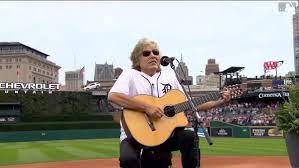 His version was also included on The Tenth Inning, Ken Burns' 2010 sequel to his 1994 miniseries Baseball. Listen and judge for yourself. (As I have pointed out before, NBC no longer has color videotape of most of the World Series prior to 1975.)
Since Colin Kaepernick, then the quarterback for the San Francisco 49ers, began kneeling during the playing of the National Anthem during 2016 games, controversy has raged. Further gestures have been made. Right-wingers have foamed at the mouth over such things, led by Donald Trump -- as Trump's fellow Queens native, and Feliciano's fellow 1968 hitmaker, Paul Simon would say, "the neon god they made."
There is an obvious solution to the problem: Don't play the National Anthem before games at all.
Because the right-wingers are lying: Kaepernick's original protest didn't have a damned thing to do with the flag. Or the troops, present and veteran. It's about white policemen exercising their choice to murder unarmed black people, including children, because they know they will get away with it. And they do.
"Mr. Ernie" had introduced Feliciano to his wife, Susan, who grew up in Detroit. In 2010, Harwell died, and a memorial service was held at Detroit’s Comerica Park. Feliciano was invited to sing the Anthem at this service, and was wildly cheered afterward.
Since Colin Kaepernick, then the quarterback for the San Francisco 49ers, began kneeling during the playing of the National Anthem during 2016 games, controversy has raged. Further gestures have been made. Right-wingers have foamed at the mouth over such things, led by Donald Trump -- as Trump's fellow Queens native, and Feliciano's fellow 1968 hitmaker, Paul Simon would say, "the neon god they made."
There is an obvious solution to the problem: Don't play the National Anthem before games at all.
Because the right-wingers are lying: Kaepernick's original protest didn't have a damned thing to do with the flag. Or the troops, present and veteran. It's about white policemen exercising their choice to murder unarmed black people, including children, because they know they will get away with it. And they do.
O, say, can you see that?
*
October 7, 1968 was a Monday. This was the only baseball game played that day. There would not be Monday Night Football for another 2 years. The NHL season began on October 11; the NBA season, on October 15; and the ABA season, on October 18. So there were no other scores on this historic day.
There was one other note from music: Thom Yorke, the lead singer and main songwriter of the English rock band Radiohead, was born.


