Showing posts with label stanford cardinal. Show all posts

Friday, December 30, 2022

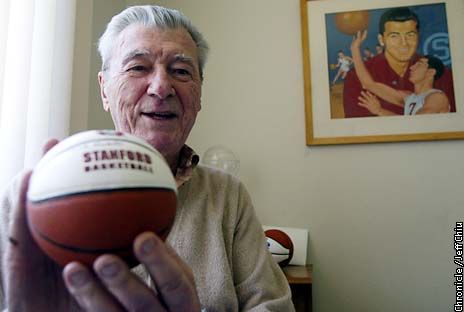
December 30, 1936: Hank Luisetti Revolutionizes Basketball

December 30, 1936: Hank Luisetti changes the game of basketball forever.

A forward, he took his Stanford University team, defending Champions of the Pacific Coast Conference, into the old Madison Square Garden in New York, to play the Number 1- ranked team in the country, Brooklyn-based Long Island University.

New Yorkers, who, even then, thought they knew everything about basketball, and that their teams had practically invented it (this while Dr. James Naismith was still alive), had heard that Luisetti had taken shots with just one hand. This was blasphemy: You had to use both hands, to steady your shot and make it more accurate. One-handed shots were took risky, unless you wanted to use a hook shot.

But Luisetti not only used one hand, he used jump shots. Combining the two? This was madness. Well, on this night, it was a glorious madness. He scored 15 points, but that was a big total in those days. Stanford beat LIU, 45-31, not merely ending the Blackbirds' 43-game winning streak, the longest in college basketball history to that point, but blowing them out.

"I'd get the ball, take a dribble or two and jump and shoot on the way up," Luisetti explained. "I didn't jump and shoot at the height of my jump, the way they do now. I'd let the ball go right near my face. I'd push and shoot, off my fingertips."

"Hank could take over a game like Michael Jordan if he had to," said former Stanford teammate Don Williams. "He was an absolute artist on the basketball court." Certainly, Ned Irish, head of basketball operations at Madison Square Garden and eventually the founding owner of the New York Knicks, thought so: Thinking that Luisetti was the only player who could singlehandedly sell out an arena the size of The Garden, he invited Stanford back for a Holiday Festival in 1937, and they won again. Two nights later, on January 1, 1938, in Cleveland, they played Pittsburgh school Duquesne, and won 92-27. In that game, Luisetti became the 1st player in NCAA history to score 50 points in a game.

Luisetti led the Stanford Indians -- they became the Cardinal in 1972 -- to 3 straight Conference Championships. This was before there was an NCAA Tournament, but they were voted National Champions in 1937.

He arrived on the scene too late to make the 1936 Olympics. He kept his amateur status by playing for Amateur Athletic Union (AAU) teams, including the Olympic Club of his hometown of San Francisco, but the 1940 and 1944 Olympics were canceled due to World War II. He served as a Navy officer, but developed spinal meningitis, ending his basketball career, ruining Irish's hopes of making him the Knicks' 1st star.

In 1950, when he was only 34 years old and should still have been playing, the Associated Press voted him 2nd behind the still-active George Mikan on their list of the top basketball players of the 1st half of the 20th Century. He was a charter inductee into the Basketball Hall of Fame. He ran a travel services company, and died in 2002, at the age of 86.

*

December 30, 1936 was a Wednesday. Baseball and football seasons were over. The NBA hadn't been founded yet. And no NHL games were scheduled. So there were no other scores on this historic day.

Sunday, December 25, 2022

December 25, 1991: Mikhail Gorbachev Resigns, the End of the Soviet Union

December 25, 1991: Mikhail Gorbachev resigns as President of the Soviet Union. The next day, the Supreme Soviet dissolved, its last act being to dissolve the Soviet Union itself after 74 years.
Gorbachev had been named President in 1985, after the death of Konstantin Chernenko, the last of the old-line Communists. Born in 1931, Gorbachev was the 1st Soviet leader who did not remember the Bolshevik Revolution of 1917. So he was uniquely poised to lead reforms, which he called "perestroika" (reconstruction) for domestic change, and "glasnost" (openness) for foreign relations.
That gave the West a chance to make peaceful overtures to a changing adversary. Britain's Prime Minister, Margaret Thatcher, said in an interview, "I like Mr. Gorbachev. We can do business together." The equally conservative American President, Ronald Reagan, met with him in 5 summits: In Geneva, Switzerland in 1985; in Reykjavik, Iceland in 1986; in Washington in 1987, signing the Intermediate-Range Nuclear Forces (INF) Treaty; in Moscow in the Summer of 1988; and in New York toward the end of the year, including President-elect George H.W. Bush.
In 1987, Time magazine named Gorbachev its Man of the Year, recognizing him as the person who had most affected the news during the calendar year. (Remember: It's not an "award" that a person "wins.") In 1989, suggesting that he deserved it again, and then som, Time named him Man of the Decade. In 1990, he was awarded the Nobel Peace Prize.
But the hardline Communists of Gorbachev's generation didn't like the changes he was making to what those of their forefathers had done. In August 1991, he was overthrown in a coup. But Boris Yeltsin, already President of the substate the Russian Federation, rallied the country, getting the Red Army on his side. With several of the Soviet "republics" having already declared their independence, the plotters could not expect help from elsewhere, and the coup collapsed. After 4 days, Gorbachev was back in power.
But he had very little support. The country had still rallied around Yeltsin, who was seen as even more of a reformer. Gorbachev become the opposite of "a man without a country": He was, in effect, a one-man country. On Christmas Day, he bowed to the inevitable, and resigned his office.
Gorbachev continued to advocate for social-democratic reform, was a critic of current Russian President Vladimir Putin, and died on August 30, 2022, at the age of 91.
The sad part is, the end of the Soviet Union was not the end of tyranny in its former lands. Putin ruled the Russian Federation with an iron fist from 2000 until 2008, when the country's Constitution term-limited him out. So his Prime Minister, Dmitry Medvedev, became President, while Putin became Prime Minister. Before Medvedev's term ran out in 2012, the Constitution was amended to allow Putin to return in 2012, and to have no limits.
Meanwhile, some of the other former Soviet "republics" had their own dictators: Saparmurat Niyazov, Turkmenistan, 1990-2006; Islam Karimov, Uzbekistan, 1991-2016; Nursultan Nazarbayev, Kazakhstan, 1991-2019; Alexander Lukashenko, Belarus, since 1994; Emomali Rahmon, Tajikistan, since 1994; and Ilham Aliyev, Azerbaijan, since 2003.
It's as if these countries decided, "We don't want to be a part of the Soviet Union, but we do like what the Soviets do, we just want to do it ourselves."

Following viewer demands for a battle with a Russian, a 2013 episode of the YouTube series Epic Rap Battles of History, featured a five-man "battle royale": "Nice" Peter Shukoff played Rasputin, Vladimir Lenin and Vladimir Putin; while "Epic" Lloyd Ahlquist played Joseph Stalin and Mikhail Gorbachev.

*
December 25, 1991 was a Wednesday. Baseball was in midseason. There was 1 college football game: Georgia Tech beat Stanford, 18-17, in the Aloha Bowl at Aloha Stadium in Honolulu, Hawaii.
The NHL, as usual, did not play on Christmas Day. The NBA usually does, and there were 2 games. The Chicago Bulls beat the Boston Celtics, 121-99 at the Chicago Stadium. Michael Jordan scored 14 points; on his own team, he was outscored by Scottie Pippen (27), B.J. Armstrong (18) and Horace Grant (17). But the Celtics were crumbling, and this would be the last season for Larry Bird.
And the Los Angeles Lakers went back to their 1st home in L.A., the Los Angeles Memorial Sports Arena, and beat the Los Angeles Clippers, 85-75.

December 25, 1894: The 1st Intersectional College Football Game

Walter Camp

December 25, 1894: In a manner of speaking, the 1st holiday-season college bowl game is played on this day. Certainly, it was the 1st college football game, ever, between teams from 2 different parts of the country. And it was the 2 men most responsible for the development of American football who set it up and opposed each other in it.

Walter Camp had been one of the 1st great college football players, at Yale University in the late 1870s. In 1888, he became Yale's head coach, and one of his players on that great team was Amos Alonzo Stagg. Between them, they invented pretty much every feature that turned American football from a game resembling soccer and rugby to the game that became so popular in the 20th Century.
Amos Alonzo Stagg

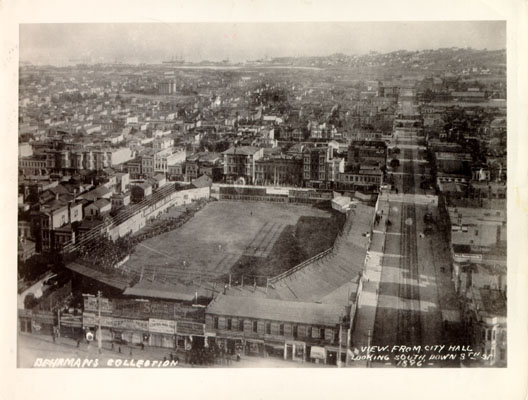
Both men went West to start college football programs, Stagg at the University of Chicago, Camp at the newly-founded Stanford University in the San Francisco Bay Area. They played at the Haight Street Grounds in San Francisco. Chicago beat Stanford 24-4.
The Haight Street Grounds stood from 1887 to 1895. It was actually not at Haight Street, but at the southeastern corner of Stanyan and Waller Streets, in the Haight-Ashbury district that would become the seat of the Hippie movement in the 1960s, at the southeastern corner of Golden Gate Park, about a block from where Kezar Stadium would later be built.

*

December 25, 1894 was a Tuesday. Baseball was out of season, hockey was all-amateur, basketball was a recent invention, and this was before college football was playing bowl games, let alone on Christmas Day.

But in England, soccer, or "football" as they call it, had a tradition: To keep traveling to a minimum, and thus families together, 2 nearby teams would play at one's home ground on Christmas Day, and at the other's on the next day, December 26, Boxing Day. This tradition began to die out in the 1950s, but Boxing Day games are still played.

On December 25, 1894, the London-based team which I would eventually support, then known as Woolwich Arsenal, played, but not against a nearby team: They hosted Burslem Port Vale, at the Manor Ground in Plumstead, Kent, later to be a part of Southeast London, and won, 7-0. Patrick O'Brien scored 3 goals -- not yet known as a "hat trick" in either ice hockey or association football.

Friday, December 2, 2022

December 2, 1915: What Became the Pac-12 Conference Is Founded

December 2, 1915: The Pacific Coast Conference is founded. It will evolve into the league known as the Pac-12.

The 4 original members were the University of California, at Berkeley, usually called "Cal" for sports purposes, and "Berkeley" for everything else; the University of Oregon, at Eugene; Oregon Agricultural College, which became Oregon State University in 1961, located in Corvallis; and the University of Washington, in Seattle.

Washington State College, in Pullman, was admitted in 1917, and was renamed Washington State University in 1959. Stanford University, in Palo Alto, California, between San Francisco and San Jose, was admitted in 1918.

The University of Southern California, a.k.a. USC, in Los Angeles, was admitted in 1922. So was the University of Idaho, in Moscow, just a few miles across a State Line from Washington State. The University of Montana, in Missoula, was admitted in 1924, but left in 1950. And the University of California at Los Angeles, a.k.a. UCLA, a campus which didn't even exist until 1919, was admitted in 1928.

Scandals broke out at several schools in the 1950s, leading to the PCC's disbanding in 1959. Cal, Stanford, UCLA, USC and Washington formed the Athletic Association of Western Universities (AAWU). Washington State joined in 1962, and Oregon and Oregon State joined in 1964. Idaho decided not to join.

In 1968, the league renamed itself the Pacific-8 Conference, Pac-8. In 1978, 2 members of the Western Athletic Conference (WAC), the University of Arizona and Arizona State University, joined, making the league the Pacific-10, or Pac-10. In 2011, Colorado left the Big 12, and Utah left the Mountain West Conference, both joining the Pac-10, which became the Pac-12: "Pacific" was no longer part of the league's official name.
From its inception in 1902 until 2001, the Rose Bowl in the Los Angeles suburb of Pasadena, California usually invited the top team on the West Coast to participate. This included the champions of the PCC (1916-59), the AAWU (1960-68), the Pac-8 (1969-78) and the Pac-10 (1979-2001). With the coming of the Bowl Championship Series (BCS) and then the National Championship Playoff (NCP), the Rose Bowl has not always featured a Pac-12 team, but it does seem to prefer one.

USC have been the league's representative in the Rose Bowl 34 times, Stanford 15, Washington 14, UCLA 12, Cal and Oregon 8 each, Washington State 4, Oregon State 3, Arizona State 2 and Utah 1. Arizona and Colorado have never played in the Rose Bowl. The Rose Bowls of 2002, 2005, 2011, 2018 and 2021 did not feature a Pac-12 team. (UPDATE: In 2023, Utah reached a 2nd Rose Bowl. In 2024, there was no Pac-12 team in the game.)

The Pac-12 has won more NCAA Championships across the sports spectrum than any other league. USC became the dominant school in football. In men's basketball, it was UCLA, but Arizona have done better in recent times. USC and Arizona State have been dominant in baseball, UCLA and Oregon in track, Stanford in women's basketball and soccer. 

The rivalries are intense: USC and UCLA; Cal and Stanford, "The Big Game"; Oregon and Oregon State, "The Civil War"; Washington and Washington State, "The Apple Cup"; and Arizona and Arizona State, "The Duel in the Desert."

On June 30, 2022, UCLA and USC announced plans to leave the Pac-12 for the Big Ten Conference, starting in 2024. For old-time Pac-8/10/12 fans, this must have seemed like what New England baseball fans felt when they saw Red Sox heroes Wade Boggs, Roger Clemens and Johnny Damon go to the New York Yankees. It is feared that this move will break the Pac-12.

UPDATE: In 2023, Colorado announced it would leave the Pac-12, and rejoin the Big 12. This was, almost immediately, followed by Arizona, Arizona State and Utah also heading for the Big 12, and Oregon and Washington bolting for the Big Ten. And, in what is, at least in terms of names, the most absurd move, Cal and Stanford announced they were joining the Atlantic Coast Conference (ACC).

As of December 2, 2023, the Pac-12 appears to be going into the 2024-25 schoolyear with just 2 members: Oregon State and Washington State. The NCAA has announced that it has given the Pac-12 until 2026 to have enough members to meet its bylaws. A merger with the WAC or the Mountain West is possible.

*

December 2, 1915 was a Thursday. Baseball was out of season. Football was in midweek. Professional basketball barely existed. And the hockey season was about to start. So there were no scores on this historic day.

Sunday, November 20, 2022

November 20, 1982: Cal Beats Stanford with "The Play"

November 20, 1982: The University of California and Stanford University play their annual rivalry, known simply as "The Big Game." It becomes the most talked-about game in the history of what's now known as the Pacific-Twelve Conference.

The schools are on opposite sides of San Francisco Bay. The school known as "Cal" for sports purposes and "Berkeley" for just about everything else, is the centerpiece of a great State university system, and is located in "The East Bay" part of "The Bay Area," north of Oakland. Stanford, or "The Farm" to insiders, is in Palo Alto, on The Peninsula between San Francisco and San Jose.

The rivalry between Cal and Stanford is the original version of the downstate rivalry between the University of California at Los Angeles (UCLA) and the University of Southern California (USC): A state school theoretically open to anyone against a stuffy prep school that is nonetheless more successful in football.

"The Big Game" was first played in 1892, and was played in San Francisco every year until 1903. It wasn't played during either World War, but has been played every year since 1946, in Palo Alto in odd-numbered years and in Berkeley in even-numbered years.

There is a trophy for the winner: The Stanford Axe. This trophy originated on April 13, 1899, during what we would now call a pep rally prior to the Stanford-Cal baseball game that was to be played 2 days later. At the time, study of the classics, including ancient Greece, was considered a must in college, and the "yell leaders" would have known Aristophanes' play The Frogs, which has a chorus of, in the original Greek, "Brekekekex, koax, koax." So they made up a literal straw man, dressed in blue and gold ribbons for Cal's colors, and chanted:

Give 'em the axe, the axe, the axe!
Give 'em the axe, where?
Right in the neck, the neck, the neck!
Right in the neck, there!

And you thought this was the Age of Innocence. The axe was taken to the baseball game, in San Francisco, but Cal won it, and a group of their students took the axe and ran off with it, and got chased by Stanford students. At some point, the handle broke off, and only the blade and the top of the handle remained. But the Cal students safely boarded the ferry back to Alameda with it.

Cal had the axe blade kept in a Berkeley bank vault, and only brought it out, via armored car, for football and baseball pep rallies. It took until April 3, 1930 for Stanford students to steal it back, thanks to a smoke bomb lobbed at a baseball pep rally at the Greek Theatre in Berkeley. Three separate cars took off, so the Cal fans wouldn't know which car had the axe. They got back to Palo Alto with it, and those students became known as the Immortal 21 -- or, in the East Bay, the Immoral 21.

After keeping it in a bank vault of their own in Palo Alto, in 1933 Stanford reached an agreement with Cal to make The Stanford Axe the trophy awarded after The Big Game. With 2 minutes left in regulation, the committee for the school holding it takes it to the 50-yard line of their sideline, and the holding committee for the other school goes to their 50, and this is known as The Stare Down. They wait for the final gun, and the the winning team runs to the 50 and the sideline, and takes it.

When people talk about "The Big Game," one edition always stands out: The 1982 edition, at Memorial Stadium in Berkeley. Cal came in at 6-4, and was headed to a bowl game. Despite John Elway being a senior quarterback, Stanford was just 5-5, and needed to win to go to a bowl. Each team was coached by an alumnus: Stanford by Paul Wiggin (who would be replaced by Elway's father Jack), Cal by former quarterback Joe Kapp.

With time running out, Stanford's Mark Harmon -- not the actor, although he did play college football, as a quarterback at UCLA, and was the son of Michigan Heisman Trophy winner Tommy Harmon -- kicked a field goal to make it 20-19 Stanford. There were 4 seconds on the clock, just time for 1 play. All Stanford had to do was stop Cal from scoring a touchdown on the ensuing kickoff -- or, in the event of a touchback, prevent an 80-yard bomb -- and they would win.

But Kapp, between playing for Cal and leading the Minnesota Vikings to the 1969 NFL Championship and into Super Bowl IV, had played in the Canadian Football League. He's the only man to quarterback in the Rose Bowl, the Grey Cup, and the Super Bowl. The CFL, even now, but especially back in the 1960s when Kapp played, still had elements of rugby to it. The forward pass is illegal in rugby, so there's a lot of laterals: Backward and sideways passes.

Figuring a squib kick would get the Stanford players to the Cal return man sooner, Harmon made a short kick. The ball got to the Cal 45-yard line, where Kevin Moen picked it up. He lateraled to Richard Rodgers (no relation to later Cal star Aaron), who gained just 1 yard. He lateraled to Dwight Garner, who gained 5 yards. He lateraled back to Rodgers.

To this day, Stanford fans claim that Garner's knee touched the ground, thus ending the game. Certainly, the Stanford band thought so, and, 144 members strong, they came onto the field -- which they shouldn't have done, since it wasn't a home game for them.

But, as in any sport where there's a clock, you have to play to the whistle. Stanford didn't, and Cal did. Rodgers got to the Stanford 45 before he faced any more Stanford players. He lateraled to Mariet Ford. By this point, the Stanford Band was 20 yards deep on the south side of the field. He got to the Stanford 27, and 3 defenders caught up with him. All he could do was throw the ball over his shoulder, a risky if legal maneuver. Moen, who started it all, caught it, and he outran 2 players, and got into the end zone. He spiked the ball, landing on Stanford trombone player Gary Tyrrell.

Stanford fans not only argue that Garner was down, but that at least one of the laterals was actually a forward pass, which should have negated the touchdown and clinched the win for Stanford.

Even if either one of these statements had been true, the Stanford Band being on the field was interference, and neither half can end on a defensive penalty. At the least, Cal would have been given another chance to try and score. At the most, the referee could have awarded Cal the touchdown anyway, as happened with the Tommy Lewis/Dickie Moegle incident at the 1954 Cotton Bowl.

At any rate, the touchdown was awarded. Final score: California 25, Stanford 20. No bowl for Stanford. No Heisman for Elway. (It went to Herschel Walker of Georgia instead.) "The Play" became instant legend.

But Stanford students, already known for their practical jokes, had one last card to play. The Stanford Daily, the student newspaper, printed up 7,000 bogus copies of the opposition's student newspaper,
The Daily Californian, and distributed them 3 days after the game, with a lead article claiming that the NCAA had overruled the touchdown and awarded Stanford the victory. Today, with social media, the headline would have been quickly exposed as bogus. At the time, though, it upset a lot of people in Berkeley, until the NCAA released a statement saying the result would stand.
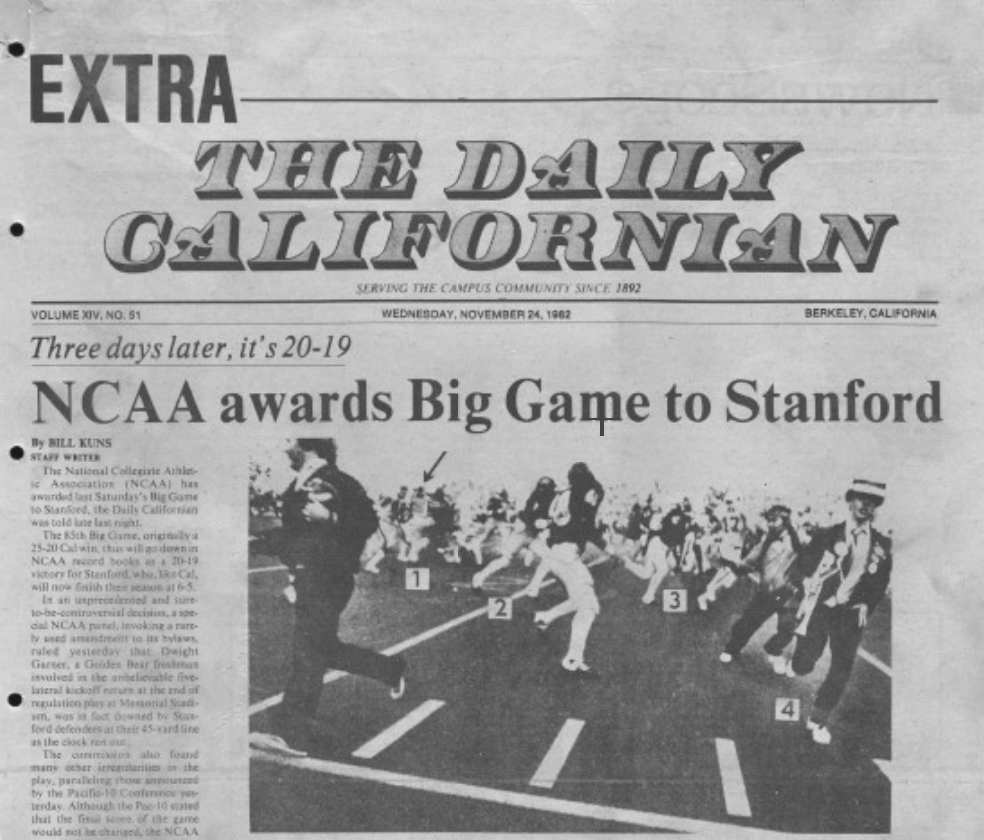
"Fake News"

Officially, Stanford leads the rivalry 65-47-11, having won 10 of the last 11 games. Since the institution of the Axe as a trophy, Stanford leads 48-34-3. I say, "Officially," because whenever Stanford holds the trophy, they replace the plaque containing the 1982 result so that it reads "California 19, Stanford 20." But the agreed-upon rules state that, before the game, it must be changed back to "California 25, Stanford 20" no matter what.
*

November 20, 1982 was a Saturday. And lots of big college football rivalries were played that day, and it included a few upsets:

* Not every team played that week. Number 1 Georgia were off. They won the Southeastern Conference title.

* Number 3 Penn State were also off. They rose to Number 2, and beat Georgia in the Sugar Bowl to win their 1st National Championship.

* Number 4 Nebraska were off. They won the Big Eight Conference, and beat Louisiana State in the Orange Bowl.

* Nor did every team that played that week play an arch-rival. Number 2 Southern Methodist University were held to a tie by Number 9 Arkansas, 17-17 at Texas Stadium in the Dallas suburb of Irving, Texas. Although SMU won the Southwest Conference title and the Cotton Bowl, that one blot on their record cost them the National Championship. Of course, they were breaking rules left and right, and, 4 years later, became the 1st school to get the NCAA's "Death Penalty."

* Number 5 Washington were upset by Washington State, 24-20 at Martin Stadium in Pullman, Washington.

* Number 6 Pittsburgh beat Rutgers, 52-6 at Pitt Stadium in Pittsburgh.

* Number 8 Arizona State were upset by Arizona, 28-18 at Arizona Stadium in Tucson.

* Number 10 Clemson beat South Carolina, 24-6 at Memorial Stadium in Clemson, South Carolina. Clemson won the Atlantic Coast Conference title.

* Number 11 UCLA beat Number 15 USC, 20-19 at the Rose Bowl in the Los Angeles suburb of Pasadena, California. UCLA won the Pac-Ten title, and beat Michigan in the Rose Bowl.

* Number 13 Michigan were upset by Ohio State, 24-14 at Ohio Stadium in Columbus. Michigan won the Big Ten title, anyway.

* Number 18 Notre Dame beat the Air Force Academy, 30-17 at Falcon Stadium in Colorado Springs, Colorado. 

* Number 19 Maryland beat Virginia, 45-14 at Scott Stadium in Charlottesville, Virginia.

Among other major rivalries: Harvard beat Yale, 45-7 in Boston; Boston College beat Holy Cross, 35-10 in Chestnut Hill; Duke beat North Carolina, 23-17 in Durham; Tennessee beat Kentucky, 28-7 in Knoxville; Mississippi State beat Mississippi in Jackson; Indiana beat Purdue, 13-7 in West Lafayette; Wisconsin beat Minnesota, 24-0 at Madison; and Missouri beat Kansas, 16-10 in Columbia.

I mentioned Rutgers lost to Pitt. The other New Jersey team, Princeton, lost to Dartmouth, 43-20 at Palmer Stadium in Princeton.

There were 6 games played in the NBA that day:

* The New York Knicks lost to the Boston Celtics, 97-83 at Madison Square Garden.

* The Chicago Bulls beat the Detroit Pistons, 131-128 at the Chicago Stadium.

* The Kansas City Kings beat the Dallas Mavericks, 127-120 at the Reunion Arena in Dallas.

* The San Antonio Spurs beat the Golden State Warriors, 134-112 at the HemisFair Arena in San Antonio.

* The Phoenix Suns beat the Atlanta Hawks, 91-80 at the Arizona Veterans Memorial Coliseum in Phoenix.

* And the Washington Bullets beat the San Diego Clippers, 95-87 at the San Diego Sports Arena. (It's now named the Pechanga Arena.)

There were 9 games played in the NHL that day. This was the 1st season in which there were 3 NHL teams in the New York Tri-State Area, and all of them were in action:

* The New Jersey Devils lost to the Minnesota North Stars, 5-1 at the Metropolitan Sports Center in Bloomington, Minnesota. Rick Meagher scored the only goal for the Devils, who had been the Denver-based Colorado Rockies the preceding 6 seasons, and the Kansas City Scouts the 2 before that.

* The New York Rangers beat the Toronto Maple Leafs, 6-3 at Maple Leaf Gardens in Toronto.

* The New York Islanders beat the Chicago Black Hawks, 5-4 at the Nassau Coliseum.

* In the opener of the CBC's Saturday doubleheader broadcast of Hockey Night In Canada, the Montreal Canadiens beat the Philadelphia Flyers, 6-4 at the Montreal Forum.

* The Hartford Whalers and the Calgary Flames played to a tie, 4-4 at the Hartford Civic Center. (It's now named the PeoplesBank Arena.)

* The Pittsburgh Penguins beat the Boston Bruins, 4-3 at the Civic Arena in Pittsburgh.

* The Detroit Red Wings and the St. Louis Blues played to a tie, 2-2 at the St. Louis Arena.

* The Buffalo Sabres beat the Los Angeles Kings, 5-2 at The Forum outside Los Angeles in Inglewood, California.

* In the nightcap of HNIC, the Vancouver Canucks and the Edmonton Oilers played to a tie, 3-3 at the Northlands Coliseum in Edmonton.

Also, the football team at what would become my high school, East Brunswick in Middlesex County, New Jersey, did not play, as this was the day for the Semifinals of the State Playoffs, and we did not qualify.

The English soccer team I would one day support, Arsenal of North London, beat Swansea City, 2-1 at the Vetch Field in Swansea, Wales. 

Saturday, October 1, 2022

October 1, 1949: The Death of Buddy Clark

October 1, 1949: A small plane crashes on Beverly Boulevard in West Los Angeles. The pilot, Jim Hayter, and 4 of his passengers survived. One did not: Singer Buddy Clark.

He was born Samuel Goldberg on July 26, 1912, in the Dorchester section of Boston. He first joined a "big band" in 1932, and in 1934 began singing with Benny Goodman on the NBC radio show Let's Dance. From 1936 to 1938, he sang on NBC's Your Hit Parade.

But he didn't have hit records, and serving in World War II delayed his appearance on the music charts. His 1st hit came in 1946, with "Linda," written by Jack Lawrence, in honor of the daughter of his lawyer, Lee Eastman. That girl, Linda Eastman, became better known by her married name: Linda McCartney.

Clark had several hits in 1947, including the Number 1 hit "Peg O' My Heart," and topped the chart again the next year with "Love Somebody," a duet with Doris Day.

On October 1, 1949, he got together with some friends: Sam Hayes, a noted radio announcer; Sally Hayes, Sam's wife; and a pair of NBC executives, Jennings Pierce and Frank Behrend. Together, they boarded a small plane, and flew from Los Angeles to Palo Alto, California, to watch a football game.

The University of Michigan, then ranked Number 1 in the country, and coming off back-to-back National Championships, played Stanford at Stanford Stadium. Although Stanford ended up going 7-3-1, the game was no contest: Michigan won, 27-7. Clark and his friends were part of a crowd of 87,123 to watch Michigan extend its winning streak to 25 games. (They lost the next week, home to Army.)

On the way back, the plane ran out of fuel, lost altitude, and crashed on Beverly Boulevard at its intersection with Rampart Boulevard, not far from its intended landing. A coroner's jury ruled that pilot James Hayter acted "with a lack of care and caution."

Hayter later enlisted in the U.S. Air Force, but was involved in another accident, in 1956. He survived that, retired with the rank of Lieutenant Colonel, and lived until 2012. By that point, Buddy Clark had been long forgotten, a star of the Hit Parade era, buried by the legacy of rock and roll.

*

October 1, 1949 was a Saturday. This was the day of the Communist takeover of China. I have a separate entry for that event.

There would be National Football League and All-America Football Conference games the next day. The National Basketball Association and the National Hockey League were preparing to start new seasons in the coming weeks.

And the Major League Baseball season was reaching its climax: The next day would be the last day of the regular season, and it would turn out to be the only time in the single-division era, 1901 to 1968, that both League's Pennants remained unclinched at the final day began.

* The New York Yankees beat the Boston Red Sox, 5-4 at the original Yankee Stadium. It was Joe DiMaggio Day, since the Red Sox included Joe's brother Dom, and the rest of their family could participate as well.

Joe told the crowd of 69,551, "I'd like to thank the Good Lord for making me a Yankee." The Good Lord only knows what George Weiss, then the Yankees' general manager and the farm director who had approved Joe's signing in 1934, thought about that.

The Yankees trailed the Red Sox by 1 game going into these last 2 games, and had to win both of them in order to win the American League Pennant. Allie Reynolds did not have his best stuff, and the Sox took a 4-0 lead in the 3rd inning. Joe Page, one of the earliest great relief pitchers, had to pitch more than 6 innings. The Yankees came back, knocking Mel Parnell out in the 5th inning, and tied it up. In the bottom of the 8th, left fielder Johnny Lindell hit a home run off Joe Dobson, and the Yankees won. 

The next day, Vic Raschi held the Sox off long enough to gain a 5-3 win and the Pennant, the 1st under manager Casey Stengel.

* The Brooklyn Dodgers lost to the Philadelphia Phillies, 6-4 at Shibe Park in Philadelphia. Del Ennis, Andy Seminick and Willie "Puddin' Head" Jones hit home runs for the Fightin' Phils, 

* The Chicago Cubs beat the St. Louis Cardinals, 3-1 at Wrigley Field in Chicago. What that meant was, on the last day, a Dodger win or a Cardinal loss would give the Dodgers the National League Pennant. The next day, the Dodgers won, 9-7, on 10th inning RBI singles by Duke Snider and Luis Olmo -- bookending an intentional walk to Jackie Robinson -- so it didn't matter that the Cardinals also won their finale, 13-5.

* The New York Giants lost to the Boston Braves, 3-0 at Braves Field in Boston. Vern Bickford -- one of the pitchers the Braves relied on when they couldn't start Warren Spahn or Johnny Sain and knew it would do no good to pray for rain -- allowed 8 hits 6 walks, but still pitched a shutout.

* The Philadelphia Athletics beat the Washington Senators, 7-4 at Griffith Stadium in Washington.

* The Cleveland Indians beat the Detroit Tigers, 4-0 at Briggs (later Tiger) Stadium in Detroit. Mike Garcia allowed 7 hits and 4 walks, but still pitched a shutout.

* And the St. Louis Browns beat the Chicago White Sox, 8-6 at Sportsman's Park in St. Louis.

As I said, it was a Saturday. In addition to the game that Buddy Clark and his friends watched, notable college football games played that day included Notre Dame defeating Washington, 27-7; and Oklahoma beating Texas A&M 33-13.

As for New Jersey's teams, Rutgers lost to Temple, 14-7 at Temple Stadium in Philadelphia; and Princeton lost to Navy, 28-7 at Municipal Stadium in Baltimore, which was later converted into Memorial Stadium, home of the Orioles and Colts.

New York City still had something of a college football following. NYU went to Lewisburg, Pennsylvania and lost 14-0 to Bucknell. City College played at home at Lewisohn Stadium, and lost 20-14 to Colby College of Maine. (CCNY only played 1 more season before dropping its football program.) And Fordham didn't open its season for another week.

This was also the day that the George R. White Memorial Stadium opened in Boston. White Stadium would be the longtime home of high school football in the city. It opened with these games:

* Boston Technical High School beat Boston College High School, 12-6.
* Dorchester High School beat Boston Trade High School for Boys, 18-0.
* The English High School beat Roxbury Memorial High School, 12-6.
* And the Boston Latin School beat Boston High School of Commerce, 33-6.

The Boston Latin School is America's oldest high school, having opened in 1635, and while the term "magnet school" wasn't coined until 1968, it has always been one. Commerce closed in 1960. Roxbury Memorial closed the same year. Boston Tech moved into its building, and in 1994 was renamed The John D. O'Bryant School of Mathematics and Science, for a longtime black educator in the city who had recently died. Boston Trade, also in Roxbury, closed in 1970. BC High is actually across the city from the BC campus, on the Boston campus of the University of Massachusetts, across from the John F. Kennedy Presidential Library and Museum. Dorchester High closed in 2003.

And, in English soccer, Arsenal beat East Midlands team Derby County, 2-1, at the Arsenal Stadium, a.k.a. Highbury, in North London.

Saturday, January 1, 2022

January 1, 1934: Columbia Win the Rose Bowl

January 1, 1934: The football team of Columbia University wins the Rose Bowl.

Stop laughing. It happened.

When the Ivy League was founded as an official college football league in 1954, its teams agreed not to participate in postseason play. That choice still stands. But before that, the teams were permitted to do so. This included the Rose Bowl. Brown played in it in 1916, and lost to Washington State. The University of Pennsylvania lost to Oregon in 1917. Harvard beat Oregon in 1920.

But then, it didn't happen again until the 1933 season. Coached by Lou Little, Columbia were 7-1, having beaten Lehigh, Virginia, Penn State, Navy, Lafayette and Syracuse at home at Baker Field in Upper Manhattan; and Cornell away. Their only loss had been 20-0, away to undefeated Princeton, coached by Fritz Crisler, who did not accept a bowl bid. (Crisler gave Princeton a "winged" design on their helmets, and took it with him to Michigan, who are now the first team fans think of when they think of the design.) The Rose Bowl not yet being automatic between the Champions of the league known today as the Pac-12 and the Champions of the Big 10, they were invited to play in it, and they accepted.

Stanford's teams were called the Indians until 1972, then the Cardinals until 1981, and finally just the Cardinal, after the shade of red they wore, rather than the bird known for the color. In 1933, they were 8-1-1: They beat San Jose State, UCLA, Santa Clara, the University of San Francisco, the Olympic Club of San Francisco, Montana and arch-rivals the University of California at home at Stanford Stadium in the San Francisco suburb of Palo Alto; and USC at the Los Angeles Coliseum. They lost away to the University of Washington, and tied Northwestern away. Among their players was David Packard, co-founder of Hewlett-Packard.

It had rained for 3 days before the New Year, and the field at the Rose Bowl stadium in the Los Angeles suburb of Pasadena, California was described by a Columbia historian as a lake. Attendance was 35,000, the lowest at the game since 1920.

Stanford were heavily favored, having allowed just 5 touchdowns all season. And it rained again, so the field was even worse. The 1st quarter ended scoreless. Early in the 2nd quarter, Columbia quarterback Cliff Montgomery called a trick play: He handed off to Al Barabas, and faked a handoff to Ed Brominski, and he and Barabas ran in opposite directions. The Indians were fooled, going after Brominski, while Barabas ran 83 yards for a touchdown.

That was the game, right there: The muddy field prevented Stanford from getting anything going, and the 7-0 lead held. Columbia had pulled off one of the greatest upsets in college football history, and became the last Ivy League team, and the last college football team from New York City, to win a bowl game.

Whether this remains the greatest win in Columbia history is debatable: On October 25, 1947, they dealt Army their 1st loss in 4 years, in a game known as the Miracle of Morningside Heights.

*

January 1, 1934 was a Monday. It would take until the next year for the Orange Bowl and the Sugar Bowl to be first played, and 2 more years for the Cotton Bowl. The NFL season had ended on December 17, with the Chicago Bears beating the New York Giants in the Championship Game. Baseball was in the off-season. And the NBA wouldn't be founded until 1946.

But there was 1 NHL game played that day: The Toronto Maple Leafs beat the Chicago Black Hawks, 2-1 at the Chicago Stadium.

This was also the date that the Franklin Institute opened its current building in Philadelphia. I have a separate entry for that event.

And it was the date on which Alan Berg, the Denver radio show host who was the subject of Eric Bogosian's play and movie Talk Radio, murdered in 1984 for his political views, was born in Chicago.

January 1, 1929: The Wrong-Way Run of Roy Riegels

Roy Riegels, running the wrong way

January 1, 1929: The Rose Bowl game is played, at the stadium of the same name, in the Los Angeles suburb of Pasadena, California.

The host team was the University of California, the Golden Bears. They were 6-1-2, having blown the Pacific Coast Conference title by only playing the University of Southern California to a 0-0 tie, and USC played more games. But USC declined the invitation to the Rose Bowl, so Cal were invited in their place, and they accepted.

Their opponents were the Georgia Institute of Technology. At the time, Georgia Tech's teams were most commonly called the Golden Tornado. They were also, already, called the Ramblin' Wreck. But they have most commonly been called the Yellow Jackets.

Led by center and captain Peter Pund, They were 9-0, and their signature win was 13-0 over Notre Dame on October 20. Notre Dame coach Knute Rockne said, "I sat at Grant Field, and saw a magnificent Notre Dame team suddenly recoil before the furious pounding of one man: Peter Pund."

Rockne wasn't kidding about his team. Three weeks later, they beat Army at Yankee Stadium, after his "Win one for the Gipper" speech, and they won the National Championship in each of the next 2 seasons. But he wasn't kidding about Pund and Tech, either: They also beat Virginia Military Institute, Oglethorpe, Vanderbilt, Alabama, Auburn (51-0) and arch-rival Georgia at home; Tulane in New Orleans; and North Carolina at Chapel Hill.

So, despite the difficulties in traveling across the country in 1928, George Tech went into the Rose Bowl on New Year's Day 1929 as the favorite over Cal.

Midway through the 2nd quarter, with the game still scoreless, Tech running back John "Stumpy" Thomason fumbled on the Tech 30-yard line. Roy Riegels, both the offensive and defensive center for Cal in those single-platoon days, picked the fumble up, and, started running the wrong way.

He later explained: "I was running toward the sidelines when I picked up the ball. I started to turn to my left toward Tech's goal. Somebody shoved me, and I bounded right off into a tackler. In pivoting to get away from him, I completely lost my bearings."

Riegels was tackled by a teammate -- Benny Lom, his own roommate -- at the Cal 1-yard line. Cal coach Clarence "Nibs" Price decided to punt, but Tech tackle Vance Maree blocked it, sending it back through the end zone, for a safety. Georgia Tech led 2-0.
Vance Maree

Riegels was distraught. But Price reminded him that the game was only half-over. Inspired, Riegles blocked a Tech punt. In the 3rd quarter, Thomason scored a touchdown, and it was 8-0 Tech. The Golden Bears almost got out of it, with their captain, Irvine Phillips, scoring a touchdown. But 8-7 was as close as Cal got, and from New Year's Day 1929 onward, Roy was known as "Wrong Way Riegels."

Georgia Tech were awarded the National Championship, and got it on the basis of a safety. This game, and the 1905 "Game of the Century" in which the University of Chicago beat Michigan, 2-0, may well be the only times in the history of sports where the words "Defense wins championships" actually came true.

Price told the press, "It was an accident that might have happened to anyone." Pund said of Riegels, "He is the best center I have played against all year. He's a battler, and he never quit." Sure enough, Riegels was named Cal's captain the next season, helping them to a 7-1-1 record.

He graduated from Cal in 1931, with a degree in agriculture. He became a public school teacher, and coached football in high school, in junior college, and at Cal. He served in the U.S. Army Air Corps in World War II, and founded a successful chemical company. He died in 1993, at the age of 84. Vance Maree, performer of the most important blocked kick in the history of American football, was also a member of Georgia Tech's basketball and boxing teams. He lived until 1976.

*

January 1, 1929 was a Tuesday. There were no other bowl games until 1933, when the Orange Bowl began. The NBA wasn't founded until 1946. And baseball and pro football were in the off-season. But there were 5 games played in the NHL that day:

* The New York Rangers beat the Toronto Maple Leafs, 3-2 at the Mutual Street Arena in Toronto. Bill Cooke scored in the 2nd period. His brother Frederick "Bun" Cook scored in the 3rd. Art Smith closed the Leafs to 2-1. Bill Cook made it 3-1 with just 3 minutes left in regulation. Andy Blair made it 3-2 with 1:05 left, but the Leafs couldn't find the equalizer.

* The New York Americans and the Montreal Canadiens played to a tie, 1-1 at the old Madison Square Garden.

* The Boston Bruins beat the Ottawa Senators, 3-0 at the recently-opened Boston Garden.

* The Montreal Maroons beat the Pittsburgh Pirates, 4-2 at the Duquesne Gardens in Pittsburgh. The Pirates, named for the baseball team of the same name, became the Philadelphia Quakers in 1930, and went out of business a year later. The Maroons hung on until 1938.

* And the Detroit Cougars beat the Chicago Black Hawks, 2-1 at the Chicago Coliseum. The Cougars became the Detroit Falcons in 1930, and the Detroit Red Wings in 1932. The Black Hawks moved into the new Chicago Stadium 2 months later.

Friday, December 31, 2021

January 1, 1902: The 1st College Football Bowl Game

January 1, 1902: The Tournament of Roses Association, operator of the Tournament of Roses Parade in Pasadena, California, outside Los Angeles, every New Year's Day since 1890, hosts a college football game. Although not immediately, it becomes an annual tradition.

By the dawn of the 20th Century, football had become a big business at a few American colleges, especially in the East. The schools that would eventually form the Ivy League led the way: Harvard, Yale, Princeton, the University of Pennsylvania, Columbia, Cornell, Dartmouth and Brown. A few other Northeastern schools were already playing, including Rutgers and Penn State.

In the South, schools such as the Universities of Virginia, North Carolina, Georgia and Alabama, and Auburn University, had already begun play. And in the Midwest, some of the schools that would eventually form the Big Ten Conference had done so, including the University of Michigan, Ohio State University, and the University of Chicago -- a school that would be a national power into the 1930s, but end its program in 1940, over the accusation that it was taking up too much of the school's attention.

On the West Coast, every one of the schools that are now part of what is currently named Pacific-12 Conference had begun playing, except for the University of California at Los Angeles: UCLA wasn't founded until 1919.

At the time, the best football program on the West Coast was one of the newest schools: Stanford. In full, the Leland Stanford Junior University had only been founded in 1885, and had only admitted its first students in 1891. Among these was a future President of the United States, Herbert Hoover, who served as student manager of its sports teams, including its 1st football team.

In his memoirs, Hoover told a story that is confirmed by the staff at the home of President Benjamin Harrison in Indianapolis: The school's founder, Senator Leland Stanford Sr. of California, had invited Harrison, by this point out of office, to give lectures on government at the school. Hoover attended. Harrison also attended one of the University's baseball games, but had apparently not paid. Hoover was asked to ask Harrison for the 25 cents' admission. The former President paid the future President.

In 1900, Stanford's football team went 7-2-1 under head coach Fielding Yost, a native of West Virginia. He had played at West Virginia University and Lehigh University, and had been head coach at Ohio Wesleyan in the 1897 season, Nebraska in 1898, and Kansas in 1899. In 1901, Michigan hired him, making it 5 schools in 5 years. At the time, this was not considered unusual.
Fielding Yost

What was unusual is that, at the school that liked to call itself "The Harvard of the West" -- and, on occasion, has called Harvard "The Michigan of the East" -- Yost stayed for 26 years, and built what arguably remains the finest college football program in what is now generally called the Midwest. During his tenure, the school's fight song would be written: "Hail to the Victors," with its line, "Hail, hail to Michigan, the Champions of the West."

In that 1st season, 1901, Yost built what became known as "The Point-a-Minute Team." With halfback Willie Heston and fullback Neil Snow, they didn't quite average 60 points per game. They did top 60 points in a game twice. But they did put out an offensive explosion unlike any football had ever seen.

They beat Albion College of Albion, Michigan, 50-0. They beat the Case School of Applied Science, of Cleveland, 57-0. That school became Case Western Reserve University. They beat Indiana University 33-0. They beat Northwestern University 29-0.

Then they played the University of Buffalo, and beat them 128-0. That is not a typographical error: One hundred twenty-eight to nothing. Over two points a minute. It was more points than they had scored in the entire previous season.

They played the Carlisle Indian School, and, with Jim Thorpe still being a few years away from being able to help them, the Wolverines beat them, 22-0, before 8,000 fans at the Detroit Tigers' Bennett Park.

They beat Ohio State, 21-0. Next up was the University of Chicago, coached by Amos Alonzo Stagg, who had beaten Michigan in their last 3 meetings. "I knew long before I came to Michigan of the great rivalry existing between this University and the University of Chicago," Yost wrote in his memoir. "It was my desire to win this game above all others." Final score: Michigan Wolverines 22, Chicago Maroons 0.

They walloped Beloit College of Wisconsin, 89-0. And, on Thanksgiving Day, they beat the University of Iowa, 50-0, before 10,000 fans at the Chicago Cubs' West Side Park. A reporter covering the game for The New York Times wrote, "Michigan scored almost at will," as they "outclassed" an Iowa team he called "sturdy, plucky."

Carlisle went out of business during World War I. Chicago, as I said, stopped playing football in 1940. Albion, Case and Beloit all now compete in NCAA Division III. But Ohio State, Iowa, Indiana and Northwestern are all now fellow Big Ten teams.

In their 10 games, the Wolverines scored 501 points, and allowed none. So, that's 50 points a game -- or, a point every 1 minute and 12 seconds.

They thought the season was over. They were wrong: The Tournament of Roses Association invited them to play Stanford in a game in Pasadena. The Association's president, James Wagner, wanted to increase attendance at the Parade, and also to bring tourists to the area in general. Bringing them in from the San Francisco Bay Area and from Michigan would certainly do it. He guaranteed each school $3,500 to cover their expenses.

Admission was 50 cents -- about $16.20 in today's money. A crowd of 8,000 paid it. An additional $1.00 was charged to admit a horse and buggy to Tournament Park, at California Street and Wilson Avenue. Temporary stands were built. There were 5 officials, all but one a Stanford graduate. Would that help Stanford? As it turned out, no.

Kickoff for "The Tournament East-West Football Game" was at 2:30 PM Pacific Time -- 5:30 Eastern, including in Ann Arbor, Michigan. Under the rules of the time, the game was divided into 2 30-minute halves (it was further divided into 4 15-minute quarters in 1910), a touchdown was 5 points (it was changed to 6 in 1912), so was a field goal (it was changed to 3 in 1909), and a conversion after a touchdown one point. The field was 110 yards long, a team had to make 5 yards in 3 downs to gain a 1st down (it became 10 yards in 4 downs in 1912), and forward passes were not allowed.

It wouldn't have helped Stanford if they were allowed. Michigan took a 17-0 lead by halftime, and ran away with it from there. Snow scored 4 touchdowns. With 8 minutes left on the clock, and Michigan leading 49-0 -- it would have been 52-0 under the current scoring system -- Stanford Captain Ralph Fisher walked up to Michigan Captain Hugh White, and said they'd had enough. Game over. Michigan could now, beyond any doubt, say they were "the Champions of the West."

From September 28, 1901 to November 25, 1905, Yost's Michigan Wolverines went 55-0-1, outscoring their opponents 2,821 to 40 -- an average of 50-1. The only blemish in that stretch was a 6-6 tie with Minnesota in 1903, which started the Little Brown Jug tradition. On Thanksgiving Day, November 30, 1905, they finally lost a game coached by Yost for the 1st time, 2-0 at Marshall Field in Chicago (named for department store founder Marshall Field).

But after the 1902 Tournament East-West Football Game, the Tournament Association decided not to risk another blowout. They tried several accompanying events, from chariot races to ostrich races. Finally, in 1915, they gave in, and went back to football: They invited Washington State University and Brown University of Providence, Rhode Island to play the Tournament of Roses Football Game. On January 1, 1916, at Tournament Park, Washington State won, 14-0.

In 1922, a new Rose Bowl stadium opened. On January 1, 1923, it hosted the Rose Bowl game for the 1st time, and USC beat Penn State, 14-3. Stanford next appeared in 1925, led by Ernie Nevers, but lost 27-10 to Notre Dame, coached by Knute Rockne and led by "The Four Horsemen." Michigan didn't accept another bowl bid until the 1948 Rose Bowl, and walloped USC -- again, by a score of 49-0.

Cities in what we would now call the Sun Belt used parades and college football games to generate tourism, following Pasadena's tradition. In 1933, Miami started the Orange Bowl. In 1935, New Orleans started the Sugar Bowl. In 1937, Dallas started the Cotton Bowl. And so on.

But, as ABC Sports' Keith Jackson named it, the Rose Bowl was, and remains, "The Granddaddy of Them All." It has been played in Pasadena every year since 1916, with 2 exceptions: 1942, moved to Durham, North Carolina (because Duke University was one of the participants) due to concerns over the Pacific Coast being attacked following the attack on Pearl Harbor; and 2021, moved to the Dallas suburb of Arlington, Texas due to COVID restrictions.

USC have played in it the most times, 34, going 25-9. The next-most-frequent team, and the leading Big 10 team, is Michigan: 20, 8-12.

*

January 1, 1902 was a Wednesday. Due to the facts that this was the original bowl game, that baseball was out of season, and that basketball was not yet played on a professional level, there were no other scores on this historic day. On January 23, the Winnipeg Victorias won the Stanley Cup, defeating the Toronto Wellingtons in two games of what was meant to be a best-two-out-of-three series.

December 31, 1999 & January 1, 2000: The Millennium

December 31, 1999:  The Millennium arrives. The people of planet Earth survived. At a terrible cost. But we hadn't destroyed ourselves. ...