Showing posts with label auschwitz. Show all posts

Sunday, October 23, 2022

October 23, 1943: The Last Dance of Franceska Mann

October 23, 1943: Franceska Mann is executed at the Auschwitz concentration camp in Poland. She was 26 years old. A Pole, a Jew, and a famous ballerina in her time, she served as the distraction for an escape attempt, doing a striptease. Down to just one shoe, she held the other shoe in her hand, and used its sharpened heel to stab a guard. She was shot, but the guard died, too.

Born on February 4, 1917 in Warsaw as Franceska Manheimer, she was considered one of the most beautiful and promising dancers of her generation in Poland, both in the classical and modern repertoire.

At the beginning of the Second World War, she was a performer at the Melody Palace nightclub in Warsaw. But she became a prisoner, first in the Warsaw Ghetto, then at Auschwitz.

According to some versions of the story, the new arrivals were not registered, but were told that they had to be disinfected before crossing the border into Switzerland. They were taken into the undressing room next to the gas chamber and ordered to undress. Other versions of the story mention the events that follow taking place at either the selection ramp or a labor area of the camp.

Regardless of location, what is confirmed is that she fatally wounded the roll call, officer, Oberscharführer Josef Schillinger, using a pistol (many accounts say his own), and fired two shots, wounding him in the stomach. Then she fired a third shot, which wounded another SS Sergeant named Emmerich.

Many Resistance heroes of World War II, including women, have had their stories told in films. As of October 23, 2022, Franceska Mann has not been one of them. (UPDATE: In 2024, she was the subject of a documentary, titled Francesca, directed by Lena Chaplin -- no relation to Charlie Chaplin.)

*

October 23, 1943 was a Saturday. Baseball season had ended 12 days earlier, when the New York Yankees beat the St. Louis Cardinals in the World Series. The NBA hadn't been founded yet. And the NHL season started a week later.

Among the college football games played that day were these:

* Number 1 Notre Dame beat Illinois, 47-0 at Notre Dame Stadium in South Bend, Indiana.

* Number 2 Army beat Yale, 39-7 at the Yale Bowl in New Haven, Connecticut.

* Number 3 Navy beat Georgia Tech, 28-14 at Thompson Stadium in Annapolis, Maryland.

* Number 4 Purdue beat Iowa, 28-7 at Ross-Ade Stadium in West Lafayette, Indiana.

* Number 5 University of Pennsylvania beat Columbia, 33-0 at Franklin Field in Philadelphia.

* Number 6 College of the Pacific were defeated by Number 7 University of Southern California, 6-0 at the Los Angeles Memorial Coliseum.

* Rivalry, the Little Brown Jug: Number 10 Michigan beat Number 11 Minnesota, 49-6 at Michigan Stadium in Ann Arbor.

* Number 13 Texas A&M were held to a 0-0 tie by the University of Texas at Arlington (not the main campus in Austin), at Kyle Field in College Stadium.

* Number 14 March Field, the team fielded by what was then designated the U.S. Army Air Forces' 4th Air Force at Riverside, California, were upset by the University of Washington, 27-7 at Husky Stadium in Seattle.

* Rivalry: Number 18 Colorado College beat the University of Colorado, 16-6 at Colorado Stadium (now Folsom Field) in Boulder, Colorado.

* Among New Jersey's teams, Princeton had the week off, and, due to the wartime manpower drain, Rutgers only scheduled 5 games, and didn't start until the next week.

Sunday, October 16, 2022

October 16, 1943: The Raid of the Ghetto of Rome

October 16, 1943: Nazi Germany's Gestapo round up over 1,000 Jews in Rome, and deport them to the Auschwitz concentration camp in Poland. Only 16 of them survive World War II. The public silence of Pope Pius XII, the Bishop of Rome, on this raid casts a shadow over his legacy.

Born on March 2, 1876 in Rome, Eugenio Maria Giuseppe Giovanni Pacelli rose through the ranks of the Vatican before being elected Pope on March 2, 1939 (his 63rd birthday), taking the name Pius XII, as his much-admired immediate predecessor had been Pius XI. Adolf Hitler's Nazi Germany was already in Austria and Czechoslovakia, and before the year was out, he had invaded Poland and started World War II.
With Vatican City surrounded by the Metropolitan City of Rome, and thus by Italy, and thus by Benito Mussolini's Fascist government, allied with Hitler, there wasn't much that the Pope could do. The same was true of Communism: Joseph Stalin, the Premier of the Soviet Union, was told by British Prime Minister Winston Churchill, at the Tehran Conference, earlier in 1943, that the Pope might be able to help the Allied cause, and responded, "The Pope? How many divisions has he?" As in, army divisions.

Pius maintained the Vatican's neutrality, and refused to denounce the Nazis' persecution of the Jews, before the extent of the horrors of the concentration camps were known to the outside world. As Holocaust survivor, author and Nobel Peace Prize laureate Elie Wiesel put it, "We must always take sides. Neutrality helps the oppressor, never the victim. Silence encourages the tormentor, never the tormented." For that reason, some of have called Pius "Hitler's Pope."

This is grossly unfair. He organized relief efforts from Rome, and, through intermediaries in the Church, all over the world, helped get thousands of refugees, Jewish and otherwise, out of Nazi-controlled territories. He continued to lead the Church until his death on October 9, 1958.

The term "ghetto" originated in the limited area into which medieval Rome put Jews, and even in America, the word was used to describe poor Jewish neighborhoods before it was used for poor black ones -- many of which had once been poor Jewish ones. Ruby Goldstein, before becoming one of boxing's best referees, was a lightweight contender from the Lower East Side of Manhattan, nicknamed "The Jewel of the Ghetto."

*

October 16, 1943 was a Saturday. Scottish soccer star Tommy Gemmell, once of Celtic Football Club's 1967 "Lisbon Lions," was born on this day. So was Paul Rose, one of the Front de Libération du Québec (FLQ) terrorists who kidnapped Pierre Laporte, Minister of Labour for the Province of Quebec, as part of what became known as the October Crisis. Unlike his brother Jacques, Paul was not with the others when Laporte tried to escape, and the others killed him in the attempt.

Although England had suspended Football League and FA Cup play for the duration of The War, there was competition. The North London team I would one day support, Arsenal, played West London team Brentford to a 3-3 draw. The game was played at White Hart Lane, home of Arsenal's rivals Tottenham Hotspur, because the British government had appropriated the Arsenal Stadium, a.k.a. Highbury, for the war effort.

The baseball season had ended 5 days earlier, with the New York Yankees winning the World Series over the St. Louis Cardinals in 5 games. The NBA hadn't been founded yet. The NHL season started 2 weeks later.

There was football. But with the manpower drain of World War II, many military bases had football teams, and were scheduled against college teams. This also enabled the teams at the service academies to be better than usual. Indeed, Army won the National Championship in 1944 and 1945, almost did so in 1943 and 1946; and Navy finished the season ranked Number 4 in 1943 and '44, and Number 3 in '45.

On October 16, 1943, Army were ranked Number 2, and beat Columbia, 52-0 at Baker Field in Upper Manhattan; while Navy were ranked Number 3, and beat Penn State, 14-6 at Thompson Stadium in Annapolis, Maryland. Among the other games:

* Number 1 Notre Dame beat Wisconsin, 50-0 at Camp Randall Stadium, which had been built on an Army base in Madison, Wisconsin.

* Number 4 University of Pennsylvania beat Lakehurst Naval Air Station, the site of the Hindenburg disaster, 74-6 at Franklin Field in Philadelphia.

* Number 5 Purdue beat Ohio State, 30-7 at Ohio Stadium in Columbus, Ohio.

* Number 6 Duke beat their arch-rivals, North Carolina, 14-7 at Duke Stadium, later renamed Wallace Wade Stadium, in Durham, North Carolina.

* During the war, the University of Iowa was represented by a U.S. Navy Pre-Flight School, and "Iowa Pre-Flight" were ranked Number 7 on this day. They beat Missouri, 21-6 at Memorial Stadium (later Faurot Field) in Columbia, Missouri.

* Number 8 University of Southern California beat the University of San Francisco, 34-0 at Kezar Stadium in San Francisco.

* In New York City, in addition to Columbia's loss, City College of New York (CCNY) beat Brooklyn College, 22-6 at Kingsmen Field in Brooklyn; New York University (NYU) suspended their program for the 1942 and '43 seasons; and Fordham suspended their program for the 1943, '44 and '45 seasons.

* And among New Jersey's teams, Rutgers had trouble scheduling opponents, and did not play their 1st game until October 30; while Princeton lost to Brown, 28-20 at Palmer Stadium in Princeton.

Tuesday, August 9, 2022

August 9, 1942: The Execution of Edith Stein

August 9, 1942: The Nazis execute Edith Stein, a Jewish woman who had become a Catholic nun, is executed at the Auschwitz concentration camp in Poland. She was 50 years old.

A native of what was then Breslau, Germany -- now Wrocław, Poland -- she read about Teresa of Ávila, the Spanish nun who founded the Carmelite order, converted, and joined the order, taking the name Teresa Benedicta of the Cross. In 1934, living in the Carmelite monastery in Echt, the Netherlands, she published Finite and Eternal Being – An Ascent to the Meaning of Being. This book proposed a phenomenological doctrine of being (Seinslehre), which knows itself to be Christian, i.e. as taking Christian Revelation to contribute towards the view of the world in which it looks for and finds the meaning of being in being's unfolding.  

When the Nazis took over the Netherlands in 1940, she began to believe that, because she was born a Jew, she would be arrested and taken to a concentration camp. On July 20, 1942, the Dutch Bishops' Conference had a public statement read in all churches across the nation on 20 July 1942, condemning the Nazis' racism. Six days later, the arrest of all Jewish converts in the Netherlands was ordered. Teresa Benedicta and her sister Rosa -- a biological sister, not a fellow nun with the title of "Sister" -- was arrested by the SS on August 2, and they were executed a week later.

She was officially declared a martyr of the Catholic Church, and is 1 of the 6 "Patron Saints of Europe." The others all long precede the modern era: Benedict of Nursia, in the 6th Century AD; Cyril and Methodius, Byzantines who ministered to the Slavic peoples of the 9th Century; Bridget of Sweden and Catherine of Siena, in the 14th Century.

*

August 9, 1942 was a Sunday. Comedian, actor and TV director David Steinberg was born on this day. This was also the day the Nazis played a soccer game against Dynamo Kyiv that became known as "The Death Match." I have a separate entry for that event.

These baseball games were played:

* The New York Giants swept a doubleheader from the Philadelphia Phillies at Shibe Park in Philadelphia, 3-2 and 2-0. Mel Ott went 1-for-8 with an RBI over the 2 games, and won the 1st game with a suicide squeeze bunt, belying his status as the National League's all-time home run leader (until surpassed by Willie Mays in 1966). Bill McGee pitched a 5-hit shutout in the 2nd game.

* The St. Louis Cardinals swept the Pittsburgh Pirates, 4-3 and 2-1 at Forbes Field in Pittsburgh. Rookie Stan Musial went 4-for-6 with 2 RBIs. The 2nd game was shortened to 8 innings, because of Pennsylvania's curfew for Sunday sports (long since repealed). 

* A doubleheader was split at Crosley Field in Cincinnati. The Chicago Cubs beat the Cincinnati Reds in the opener, 10-8 -- in 18 innings. Stan Hack went 5-for-5 with and an RBI for the Cubs in this game, Phil Cavarretta went 2-for-5 with 2 RBIs, and both of them drew 4 walks. For the Reds, Eddie Joost went 4-for-9 with 4 RBIs, and Bert Haas went 5-for-9 (but no RBIs). The Cubs led 4-0 going to the bottom of the 9th, and blew it. Both teams scored 2 runs in the 12th inning. Dom Dallessandro doubled home the winning run for the Cubs in the top of the 18th. The nightcap was shortened to 5 innings by a Sunday curfew. At that point, the Reds led, 2-1.

* The Chicago White Sox swept a doubleheader from the Cleveland Indians at Comiskey Park in Chicago, 11-1 and 3-2.

* The Detroit Tigers swept a doubleheader from the St. Louis Browns at Sportsman's Park in St. Louis, 9-3 and 3-1.

* The New York Yankees were supposed to play the Philadelphia Athletics at Yankee Stadium, but got rained out. It was made up as part of a doubleheader the next day. The A's won the 1st game, 4-1. The Yankees won the 2nd game, 3-2. Joe DiMaggio went 1-for-4 in each game.

* The Boston Red Sox were supposed to play the Washington Senators at Griffith Stadium in Washington, but got rained out. It was made up on September 8, and the Senators won, 15-11. Jake Early had 5 RBIs for the Senators, Jimmy Pofahl 4, and Bobby Estallela 3. Ted Williams went 1-for-4 with an RBI.

* The Brooklyn Dodgers were supposed to play the Boston Braves at Braves Field, but got rained out. The game was rescheduled for September 24, and the Dodgers won, 5-3. 

Thursday, January 27, 2022

January 27, 1945: The End of Auschwitz

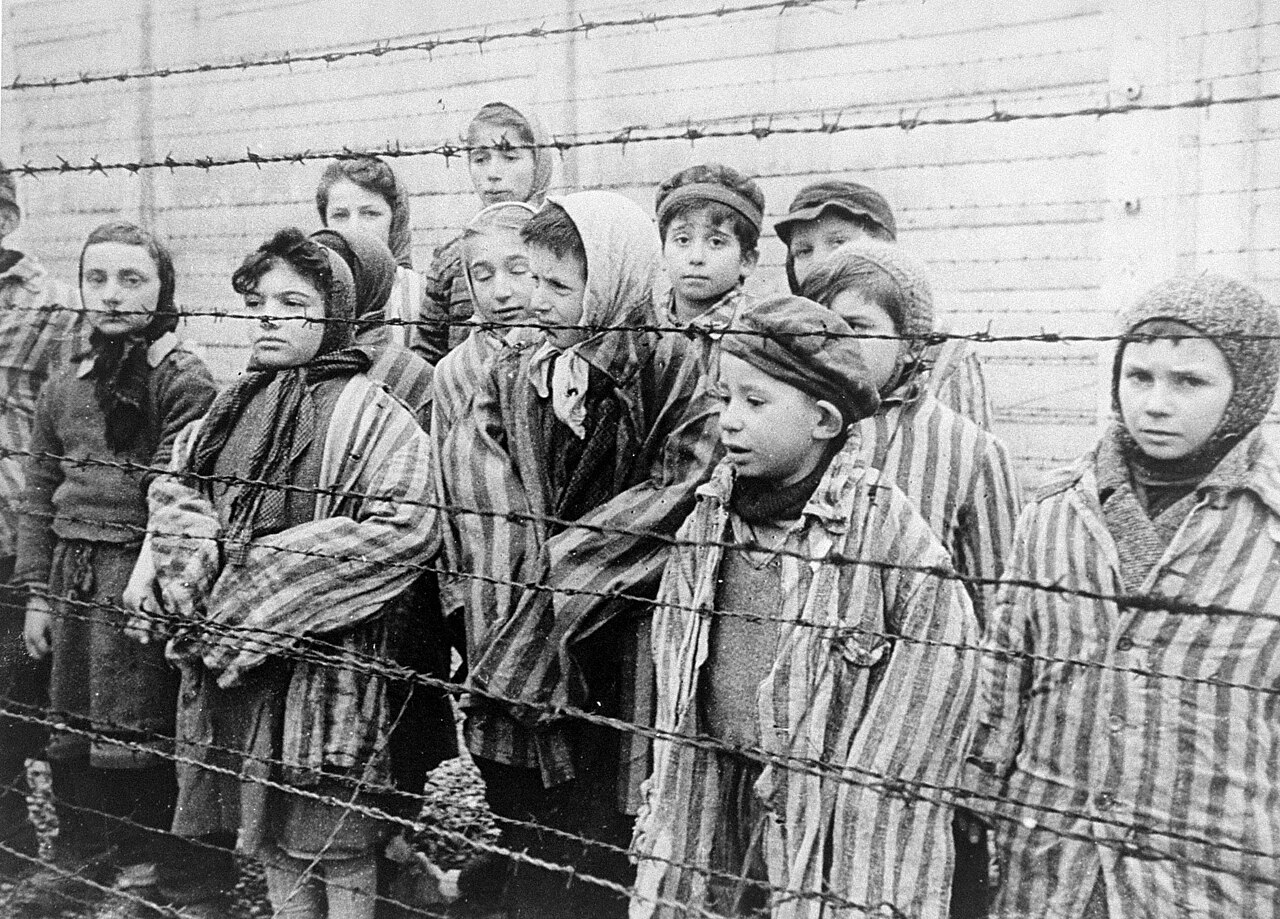
January 27, 1945: The Soviet Union's Red Army discovers the Auschwitz concentration camp, saving the lives of the 8,100 prisoners still alive there. As Auschwitz was the camp with the most deaths in the Holocaust, January 27 has been commemorated as Holocaust Remembrance Day ever since.

I have titled this entry "The End of Auschwitz," not "The Liberation of Auschwitz," because the Soviet Union never "liberated" anything. Most of the survivors returned to a Poland that would be under Communist rule until 1989.

The camp opened in May 1940. Prisoners were beaten, tortured, and executed for the most trivial of reasons. The first gassings took place in August 1941. The freight trains kept on coming in, under the gate with the lettering ARBEIT MACHT FREI -- "Work Makes Free." As far as the outside world knew, such places were slave labor camps, which was true, and was bad enough.
But few outside the Third Reich knew about the genocide. Over 1.3 million people were sent there, and 1.1 million were murdered, 960,000 of those being Jews, and 865,000 of those gassed on arrival. Those not gassed were murdered via starvation, exhaustion, willful ignorance of disease, individual executions, beatings, or during medical experiments that the SS carried out with sadistic glee. There were 802 prisoners known to have tried to escape, 144 successfully. An uprising was launched on October 7, 1944, but it was doomed to failure.

The trains kept coming. Generals begged Chancellor Adolf Hitler to make trains available to send soldiers to the fronts, to stop the Soviets to the East, and the Americans, British, Canadians and French to the West. He told them, "No! I need the trains to kill the Jews!" He seemed to have accepted that the war was lost, but, always determined to exterminate Europe's Jews, he also seemed to have adopted a policy of, "If I'm going down, I'm taking as many of the enemy as I can with me."

As the Red Army approached Auschwitz in January 1945, the SS sent most of the camp's population west on a death march to camps inside Germany and Austria. Those 8,100 remaining prisoners were essentially left to fend for themselves.

Georgii Elisavetskii, a Soviet soldier who entered one of the barracks, said in 1980 that he could hear other soldiers telling the inmates: "You are free, comrades!" But they did not respond, so he tried in Russian, Polish, German, Ukrainian. Then he used some Yiddish: "They think that I am provoking them. They begin to hide. And only when I said to them: 'Do not be afraid. I am a Colonel of Soviet Army, and a Jew. We have come to liberate you.'... Finally, as if the barrier collapsed... they rushed toward us, shouting, fell on their knees, kissed the flaps of our overcoats, and threw their arms around our legs."

The Soviets had first encountered a Nazi concentration camp on August 16, 1944, in Treblinka, Poland. A folk song would later commemorate Treblinka as "the biggest grave in the world."

In Germany itself, on April 11, 1945, American troops under the command of General George S. Patton liberated the Buchenwald camp in Weimar, Thuringia. On April 15, British troops liberated the Bergen-Belsen camp in Bergen, Lower Saxony. On April 22, the Red Army reached the Sachsenhausen camp in Oranienburg, outside Berlin.

On April 29, American troops under the command of General Dwight D. Eisenhower liberated the camp at Dachau, outside Munich. When Eisenhower saw the emaciated prisoners, many of them within days of death if they didn't receive medical treatment, he ordered photographers and film crews to come in and document it, because he knew that if no one did, then, one day, people would deny that the Nazis ever did such things. People have denied it, but "Ike" and the other Allied commanders got the proof.

Over 11 million people died in the Holocaust -- about as many as died from combat in all of World War I. Of those 11 million, over 6 million had been imprisoned for the reason that they were Jewish. Others were killed because they were of Slavic descent, and therefore of "an inferior race" to the German "Aryans"; or because they were Communists; or because they belonged to labor unions; or because, despite not fitting any of those other categories, they resisted the Nazis.

Martin Niemöller, a Lutheran pastor from Lippstadt, Westphalia, had supported the Nazis at first. But when the Nazis began enforcing their ideology on Protestant churches, he led a resistance movement, and was imprisoned in 1938, first at Sachsenhausen, then at Dachau.

On January 6, 1946, in a speech in Frankfurt, he gave a speech whose exact wording has varied over the years, possibly losing something in translation. The most common version is this: "First, they came for the socialists, and I did not speak out, because I was not a socialist. Then, they came for the trade unionists, and I did not speak out, because I was not a trade unionist. Then, they came for the Jews, and I did not speak out, because I was not a Jew. Then, they came for me, and there was no one left to speak for me." He became an antiwar activist, and lived until 1984.

Auschwitz -- with the changing of national borders after The War, now in Oświęcim, in southern Poland -- is maintained as a museum and a UNESCO World Heritage Site.

UPDATE: On the 80th Anniversary, January 27, 2025, the Auschwitz-Birkenau State Museum released a statement:

Auschwitz was at the end of a long process. It did not start from gas chambers. This hatred was gradually developed by humans. From ideas, words, stereotypes & prejudice through legal exclusion, dehumanization & escalating violence... to systematic and industrial murder. Auschwitz took time.

This is true. It also took thought. Careful consideration that should have resulted in the idea of, "There is a group of people that is not doing as well as us, so we should help them, and raise them to our level." Instead, it resulted in the idea of, "There is a group of people that is less than us, and, for that reason, they must be eliminated."

And that kind of evil can never be tolerated.

*

January 27, 1945 was a Saturday. That same day, at another German camp, at Ziegeghain, in Germany's Rhineland, U.S. Army Master Sergeant Robbie Edmunds stood up for the Jewish soldiers under his command. I have a separate entry for that event.

Baseball and football were out of season. The NBA hadn't been founded yet. All of the NHL's "Original Six" teams were in action:

* The New York Rangers lost to the Toronto Maple Leafs, 3-0 at Maple Leaf Gardens in Toronto.

* The Montreal Canadiens beat the Boston Bruins, 11-3 at the Montreal Forum. Maurice "The Rocket" Richard, on his way to the NHL's 1st 50-goal season, scored his 34th, and had 2 assists. Dutch Hiller had 2 goals and an assist. Ray Getliffe had 2 goals. Elmer Lach had a goal and 4 assists.

* And the Detroit Red Wings beat the Chicago Black Hawks, 5-1 at the Olympia Stadium in Detroit.

And while England's Football Association had shut Football League and FA Cup competition down for the duration of the war, there was Football League South play. Arsenal beat Fulham, 8-3 at White Hart Lane in Middlesex. Stan Mortensen, on loan to Arsenal during the war, scored 4 goals.

Yes, The Arsenal used the ground of their arch-rivals, Tottenham Hotspur, because their home, Arsenal Stadium, a.k.a. Highbury, in North London was appropriated by the government for defense purposes. The London Government Act 1963 redrew the boundaries of the city of London (not to be confused with "The City of London") so that White Hart Lane was inside the city for the first time.

December 31, 1999 & January 1, 2000: The Millennium

December 31, 1999:  The Millennium arrives. The people of planet Earth survived. At a terrible cost. But we hadn't destroyed ourselves. ...