Showing posts with label rutgers university. Show all posts

Wednesday, December 28, 2022

December 28, 2006: Rutgers Wins a Bowl Game for the 1st Time

Ray Rice, holding the cowboy hat that served
as the game's MVP trophy

December 28, 2006: For the 1st time, the football team at Rutgers, The State University of New Jersey, wins a postseason "bowl game." And they didn't even have to make it up themselves.

In 1978, frustrated over not having been selected for bowl games despite some fine seasons -- 8-1 in 1958, 8-1 in 1960, 9-0 in 1961, 8-2 in 1968, 7-4 in 1972, 7-3 in 1974, 9-2 in 1975, 11-0 in 1976, 8-3 in 1977 and finally 9-3 -- mainly due to a weak schedule, Rutgers started its own bowl, the Garden State Bowl, at Giants Stadium at the Meadowlands Sports Complex in East Rutherford, Bergen County, New Jersey.

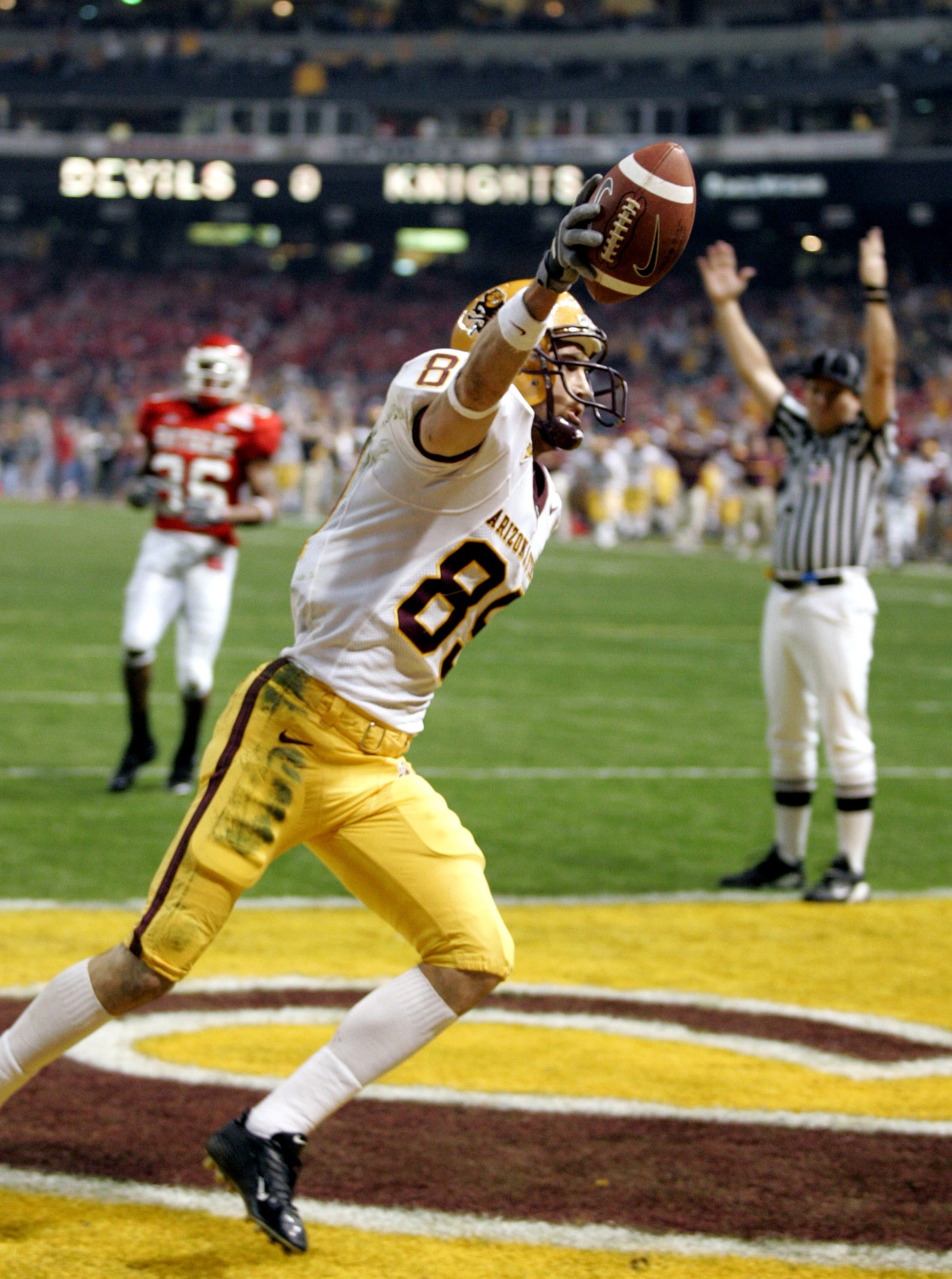
The Scarlet Knights invited Arizona State, which had faced a similar level of disrespect, because they had dominated the weak Western Athletic Conference, and had just joined the Pacific-8, making it the Pac-10. Maybe they should've invited a weaker team than Frank Kush's Sun Devils: They lost, 34-18.

That was a badge of dishonor: The Scarlet Knights couldn't even win a bowl on their secondary home field. So, again, they weren't invited to bowls, despite going 8-3 in 1979, 7-4 in 1980, 7-3 in 1984, 6-4 in 1986, and 7-4 in 1992. In '92, a loss to Boston College really stung, not just because their quarterback, future New York Jet Glenn Foley, had been a Jersey Boy, from Cherry Hill, but because he told the postgame media, "The only bowl Rutgers is going to is the one I just got off of."

The new Rutgers Stadium (now SHI Stadium) opened in 1994, but, having joined the Big East Conference, RU was not putting up bowl-worthy seasons. Greg Schiano was hired in 2001, and it took him until 2005 to put up a winning season, 7-4.

Finally, a bowl came calling. It wasn't a major bowl. It was the Insight Bowl, named for an Internet company. As fate would have it, Rutgers again played Arizona State, so it was like the tables were turned: Their opponent was the home team. Rutgers led 33-31 in the 4th quarter, but lost 45-40.

In 2006, Rutgers went 10-2, finishing 2nd in the Big East Conference. They were invited to the Texas Bowl, at what's now NRG Stadium in Houston. It wasn't the biggest bowl in the State -- that was still the Cotton Bowl in Dallas -- but at least it was the biggest bowl in its own metropolitan area, replacing the former Bluebonnet Bowl at the Astrodome.

The opponent was Kansas State University, who were 7-5, and finished 3rd in the Big 12 Conference North Division. Oddly for a college football game, it was broadcast on the NFL Network. Bad news for me, since my cable system didn't carry it at the time. I had to do what I had done for 90 percent of the Rutgers games of my lifetime to that point: Listen to it on the radio, on "WCTC, AM 1450, New Brunswick, Central Jersey's information leader."

But it was mostly good news thereafter. Mike Teel threw 2 touchdown passes to Tim Brown (not the Notre Dame and Raiders Hall-of-Famer) in the 1st quarter. Kansas State came back with a field goal and a touchdown, but a Jeremy Ito field goal in the last minute of the 1st half sent the Scarlet Knights into the locker room with a 17-10 lead.

Josh Freeman had a decent pro career, and had been an All-American for Kansas State. But on the 1st play from scrimmage in the 2nd quarter, Rutgers linebacker Quintero Frierson intercepted his pass, and returned it 27 yards for a touchdown. The Wildcats never threatened again. Ray Rice scored on a 46-yard touchdown run. Ito kicked 2 field goals in the 4th quarter, and the game ended 37-10 to Rutgers.

Rice rushed for 170 yards, and was named the game's Most Valuable Player. In 6 seasons with the Baltimore Ravens, he rushed for 6,180 yards, before a moment of madness led to the end of his playing career.

This was the 1st of 4 straight seasons in which Rutgers won a bowl game. In the 2007 season, they won the International Bowl in Toronto; in 2008, the PapaJohns.com Bowl in Birmingham; in 2009, the St. Petersburg Bowl. After a sub-.500 season in 2010, they got to the 2011 Pinstripe Bowl at Yankee Stadium. They lost the 2012 Russell Athletic Bowl in Orlando and the 2013 Pinstripe Bowl, before winning the 2014 Quick Lane Bowl in Detroit. That remains Rutgers' most recent bowl game appearance.

*

December 28, 2006 was a Thursday. There were 2 other bowl games played that day. Oklahoma State beat Alabama, 34-31 at the Independence Bowl, at Independence Stadium in Shreveport, Louisiana. And the University of California beat Texas A&M, 45-10 at the Holiday Bowl, at Qualcomm Stadium in San Diego.

There were 3 games played in the NBA that night:

* The Dallas Mavericks beat the Phoenix Suns, 101-99 at the American Airlines Center in Dallas.

* The San Antonio Spurs beat the Utah Jazz, 106-83 at the AT&T Center in San Antonio. (It's now named the Frost Bank Center.)

* And the Denver Nuggets beat the Seattle SuperSonics, 112-98 at the Pepsi Center in Denver. (It's now named the Ball Arena.) Allen Iverson scored 44 points for the Nugs.

There were 5 games played in the NHL. None of them involved any of the New York Tri-State Area teams:

* The Buffalo Sabres beat the Carolina Hurricanes, 4-1 at the HSBC Arena in Buffalo. (It's now named the KeyBank Center.)

* The Detroit Red Wings beat the Columbus Blue Jackets, 7-4 at the Nationwide Arena in Columbus.

* The Philadelphia Flyers beat the Tampa Bay Lightning, 4-3 at the St. Pete Times Forum in Tampa. (It's now named the Benchmark International Arena.)

* The Los Angeles Kings beat the Edmonton Oilers, 7-4 at the Northlands Coliseum in Edmonton. (That was its first, last, and best-known name. In 2006, it was named Rexall Place.)

* And the Phoenix Coyotes beat the San Jose Sharks, 3-2 at the HP Pavilion in San Jose. (It's now named the SAP Center.)

Tuesday, December 27, 2022

December 27, 2005: Rutgers Plays Its 1st Real Bowl Game

December 27, 2005: For the 1st time, the football team at Rutgers, The State University of New Jersey, plays in a real postseason "bowl game."

It wasn't actually the first one. In 1978, frustrated over not having been selected for bowl games despite some fine seasons -- 8-1 in 1958, 8-1 in 1960, 9-0 in 1961, 8-2 in 1968, 7-4 in 1972, 7-3 in 1974, 9-2 in 1975, 11-0 in 1976, 8-3 in 1977 and finally 9-3 -- mainly due to a weak schedule, Rutgers started its own bowl, the Garden State Bowl.

It would be held at their secondary home field, the 77,000-seat Giants Stadium, in the Meadowlands Sports Complex in East Rutherford, Bergen County, New Jersey, 36 miles from their 23,000-seat Rutgers Stadium in Piscataway, and 35 miles from their Student Center in New Brunswick, both in Middlesex County.

The Scarlet Knights invited Arizona State, which had faced a similar level of disrespect, because they had dominated the weak Western Athletic Conference, and had just joined the Pacific-8, making it the Pac-10. Maybe they should've invited a weaker team than Frank Kush's Sun Devils, who beat them, 34-18.

That was a badge of dishonor: The Scarlet Knights couldn't even win a bowl on their secondary home field. So, again, they weren't invited to bowls, despite going 8-3 in 1979, 7-4 in 1980, 7-3 in 1984, 6-4 in 1986, and 7-4 in 1992. In '92, a loss to Boston College really stung, not just because BC's quarterback, future New York Jet Glenn Foley, had been a Jersey Boy, from Cherry Hill, but because he told the postgame media, "The only bowl Rutgers is going to is the one I just got off of." Meaning the toilet.

The new Rutgers Stadium (now SHI Stadium) opened in 1994, but, having joined the Big East Conference, RU was not putting up bowl-worthy seasons. Greg Schiano was hired in 2001, and it took him until 2005 to put up a winning season, 7-4.

Finally, a bowl came calling. It wasn't a major bowl. It was the Insight Bowl, named for an Internet company. It had gone through several names: The Copper Bowl from its 1989 establishment until 1996, the Insight.com Bowl starting in 1997, just the Insight Bowl starting in 2002, the Buffalo Wild Wings Bowl in 2012, the Cactus Bowl starting in 2015, the Cheez-It Bowl in 2018 and 2019, and the Guaranteed Rate Bowl starting in 2020. (UPDATE: In 2024, it was rebranded as the Rate Bowl.)

It was held at the University of Arizona's Arizona Stadium in Tucson from 1989 to 1999; then the Arizona Diamondbacks' Bank One Ballpark/Chase Field in Phoenix from 2000 to 2005; Arizona State University's Sun Devil Stadium (now Mountain America Stadium), in the Phoenix suburb of Tempe, from 2006 to 2015; and Chase Field again ever since.

It is the Phoenix area's secondary bowl game, behind the Fiesta Bowl, which was played at Sun Devil Stadium from 1971 to 2006, and has been played at the Arizona Cardinals' home, now named State Farm Stadium, in the Phoenix suburb of Glendale, since 2007.

So being invited to the Insight Bowl was not much respect. But it was more than Rutgers were used to, and it was a chance to spend Christmas week someplace considerably warmer than New Jersey, so they accepted the bid. As fate would have it, the opponent was the same as in the 1978 Garden State Bowl: Arizona State. The Sun Devils would be traveling 11 miles, so this would be more or less a home game for them. The Scarlet Knights would be traveling 2,386 miles.

At first, the long roadtrip didn't seem to faze Rutgers: Ryan Hart threw a touchdown pass to Clark Harris to give them a 7-0 lead. Arizona State answered with their own touchdown pass, but Hart threw another to Brian Leonard. Just before the 1st quarter ran out, Jeremy Ito kicked a 25-yard field goal. RU were up 17-7. Things were looking good.

The Sun Devils kicked a field goal to make it 17-10. Leonard ran for a touchdown to make it 24-10 Rutgers. But the Sun Devils scored to close to within 24-17 at the half.

In the 3rd quarter, Arizona State scored a tying touchdown, but Ito kicked another field goal to put RU back up, 27-24. Arizona State scored a touchdown to take their 1st lead, 31-27. Just before the end of the quarter, Ito kicked another field goal to make it 31-30 Sun Devils. Early in the 4th quarter, he kicked another to make it 33-31 Scarlet Knights.

Rutgers had a 4th quarter lead in a bowl game, in what was essentially a home game for the other team. This wasn't quite living the dream, but it sure looked like a building block toward reaching the dream.

But you can almost set your watch by the Rutgers defense collapsing. The Sun Devils scored a touchdown and a 2-point conversion, then another touchdown and a failed 2-point conversion. It was 45-33 Arizona State.

With 2 minutes left, Hart threw a 29-yard touchdown pass to Tres Moses, closing RU to within 45-40. But they failed to recover the onside kick, and Arizona State ran out the clock to seal the win.

It was yet another failure for Rutgers, one of the most underachieving programs in college football. On the other hand, they had been invited to a bowl, and scored 40 points against a hometown team. That was something to take with them into the next year.

In 2006, Rutgers went 10-2, finishing 2nd in the Big East. They were invited to the Texas Bowl. It wasn't the biggest bowl in Texas -- that remains the Cotton Bowl in Dallas -- but at least, unlike the Insight Bowl, it was the biggest bowl in its own metropolitan area, Houston. Rutgers won this game rather easily, 37-10, for their 1st-ever bowl win.

It began a streak of 4 straight seasons with bowl wins, and 5 in 6 years. Rutgers has since won (these dates are for the season, not necessarily the calendar year) the International Bowl in Toronto in 2007, The PapaJohns.com Bowl in Birmingham in 2008, the St. Petersburg Bowl in 2009, the Pinstripe Bowl at Yankee Stadium in 2011, and the Quick Lane Bowl in Detroit in 2014. But the biggest bowl game they've ever been to, and it's still only a secondary bowl, is the Gator Bowl in Jacksonville, in the 2021 season, losing to Wake Forest, 38-10.

UPDATE: Rutgers won the Pinstripe Bowl again in 2023.

*

December 27, 2005 was a Tuesday. One other bowl game was played that day, the Champs Sports Bowl. This was also a secondary bowl, the 2nd-biggest at the Florida Citrus Bowl in Orlando, behind the eponymous Citrus Bowl. Clemson beat Colorado, 19-10.

There were 8 games played in the NBA that night:

* The New Jersey Nets beat the Cleveland Cavaliers, 96-91 at the Continental Airlines Arena at the Meadowlands. LeBron James scored 31 points, but it wasn't enough for the Cavs.

* The Charlotte Bobcats (now the new Charlotte Hornets) beat the Atlanta Hawks, 93-90 at the Philips Arena (now the State Farm Arena) in Atlanta.

* The Miami Heat beat the Milwaukee Bucks, 109-98 at the American Airlines Arena (now the Kaseya Center) in Miami. Dwyane Wade scored 35.

* The Utah Jazz beat the Houston Rockets, 82-74 at the Toyota Center in Houston.

* The San Antonio Spurs beat the Indiana Pacers, 99-86 at the SBC Center (now the Frost Bank Center) in San Antonio.

* The Detroit Pistons beat the Toronto Raptors, 113-106 at the Palace in the Detroit suburb of Auburn Hills, Michigan. Chris Bosh scored 37 in defeat.

* The Philadelphia 76ers beat the Denver Nuggets, 108-106 at the Pepsi Center (now the Ball Arena) in Denver. Carmelo Anthony scored 45 to lead all scorers on the night, but the Nugs still lost.

* The Sacramento Kings beat the Los Angeles Clippers, 110-93 at the Staples Center (now the Crypto.com Arena) in Los Angeles. Mike Bibby scored 38 for the Kings.

There were 4 games played in the NHL that night. None involved any of the New York Tri-State Area teams:

* The Boston Bruins beat the Washington Capitals, 4-3 at the MCI Center (now the Capital One Arena) in Washington. Brad Stuart scored the winning goal, 2:04 into overtime.

* The Toronto Maple Leafs beat the Pittsburgh Penguins, 3-2 at the Mellon Arena (usually named the Civic Arena) in Pittsburgh. Tomas Kaberle scored the winning goal, 2:26 into overtime.

* The Detroit Red Wings beat the Dallas Stars, 4-1 at the American Airlines Center in Dallas.

* And the Nashville Predators beat the Calgary Flames, 4-3 at the Saddledome in Calgary.

Monday, December 5, 2022

December 5, 2004: East Brunswick Wins the State Football Championship

Photo of the postgame celebration, taken by yours truly

December 5, 2004: The Night of Nights for the football program at East Brunswick High School in East Brunswick, Middlesex County, New Jersey.

EBHS had opened in 1958, and had begun playing varsity football in 1961. The Bears had won Conference Championships in 1966, 1967, 1968, 1969, 1970, 1972, 1984, 1986, 1987, 1990 and 1994.

They had won the Central Jersey Group IV Championship in 1966, and again in 1972, under the old system of who had the best record in the section. Both times, E.B. went 7-1-1. Both times, the 1 loss came against neighboring South River, to whom the Township of East Brunswick had sent its high school students from 1891 to 1958.

The New Jersey State Interscholastic Athletic Association instituted State Playoffs for the 1974 season. At first, only the top 4 teams in each section qualified. Starting in 1998, it became the top 8 teams. Had that been the case from 1974 to 1997, East Brunswick would have qualified in 1977, 1978, 1981, 1986, 1992 and 1996. But it wasn't.

East Brunswick first qualified in 1980, losing in the Semifinal. In 1984, when I arrived at EBHS as a sophomore, they reached the Final, going into it as undefeated Conference Champions. But an undefeated State Championship season vanished on a missed two-point conversion, losing 27-26 to J.P. Stevens of Edison Township.

This was a shocking loss, the kind that used to happen to teams like the Boston Red Sox, the Chicago Cubs, the Philadelphia Phillies and Eagles, and the New York Rangers; and still happens to the New York Mets, the Cleveland Indians (now Guardians), the Buffalo Bills and the Philadelphia Flyers.

In 1985, the Bears reached the Final again. But, again, they lost to Stevens. They made the Playoffs again in 1987, but were wiped out in a frigid Semifinal against arch-rival Madison Central, the school now known as Old Bridge. The same thing happened in 1988, but in weather that was considerably less cold. They reached the Semifinal in 1990, losing to Trenton Central; the Semifinal again, losing to Piscataway; and the Quarterfinal in 1998, losing to Manalapan.

Then came a down period. Way down. They went 4-6 in 1999, 1-9 in 2000, and 0-10 in 2001. From November 25, 1999 to September 13, 2002, EB went an atrocious 2-21. They rebounded to 6-4 in 2002, but fell back to 4-6 in 2003. And, for Marcus Borden, who had been head coach since 1983, and had come so close in 1984, and nearly as close a few times since, there seemed to be no indication that 2004 would be any better.

We (yes, I have switched from "they" to "we," I admit it) opened the season with home wins over Perth Amboy and Edison. Then we lost away to Piscataway, and we figured a downward spiral into a typically weak season had begun.

But a funny thing happened on the way to mediocrity: We started winning again. We beat North Brunswick at home. Then we went to Sayreville, a tough trip since the early 1990s, and won. That was a good sign.

Before the next game, the Red Sox completed their improbable American League Championship Series comeback against the Yankees -- steroid-aided, as it turned out, but we didn't know that yet. We then beat Stevens at home. In the middle of the next week, the Red Sox beat the St. Louis Cardinals, to win their 1st World Series in 86 years. If the Red Sox could overcome a long drought that included several shocking defeats, why couldn't E.B. football?

We needed overtime to beat South Brunswick away, but not to then beat Woodbridge at home. We had qualified for the Playoffs. On November 13, at Jay Doyle Field -- named for the man who was our 1st athletic director, football coach and wrestling coach -- we beat Brick Township of Ocean County, 13-12. It was a difficult game, as we expected it would be, but we won it, advancing to the Semifinal for the 1st time in 10 years. On November 20, we won that, beating Hillsborough of Somerset County, 28-21 in overtime. We were now in the Final for the 1st time in 19 years.

Fortunately, the NJSIAA rejiggered its sectional boundaries for this season. Good thing, too, as it moved Piscataway from Central Jersey into North Jersey Section II, meaning that if we both made the Playoffs, we wouldn't have to face each other. Instead, we would have to face Jackson Memorial, of Ocean County. They hadn't lost a game in 2 years, and were going for back-to-back State Championships. But we were confident we could give them a game.

And then we went to Old Bridge for our annual Thanksgiving Day game against the arch-rivals, and laid an absolute egg. We lost 20-0, and we never even looked like scoring. What happened to the team that quarterback Matt Mariano had been leading to victory all year long? We hadn't beaten Old Bridge since 1994, and now, with our best team since then -- maybe our best team since 1984 -- we couldn't do it.

No matter: We had to get our confidence back up, because we still had a title to win. But it would be at Rutgers Stadium (now SHI Stadium), on the Busch Campus in Piscataway. It was the 1st time we'd ever played on artificial turf (most area high schools would soon get it, including us), and against the defending Champions. There were 12,000 people on hand, possibly the biggest crowd in EB history (and bigger than a lot of crowds were for Rutgers games at the old, 1938-92 version of Rutgers Stadium).

Somehow, Mariano kept us in the game. It was tight. But we never trailed. We led 7-0, were tied 7-7, led 10-7, led 17-7, and it was 17-14 us in the final seconds. I kept waiting for the other shoe to drop. After all, this was East Brunswick football we were talking about. Something bad always happens, and we always lose the big ones. We were like the Red Sox until 2004, the Chicago Cubs until 2016, the New York Rangers until 1994, the Toronto Maple Leafs since 1967, the New York Mets since 1986, the Cleveland Indians/Guardians, the Buffalo Bills and Sabres, the Vancouver Canucks.

With time for 1 more play, Jackson tried a field goal. I don't remember the exact distance, but it was around 40 yards. It was cold, but there wasn't much wind, and it was on turf. A good high school kicker could have made it.

And, having been through so much with E.B. over the last 20 years -- momentary screwups, all-game-long brain cramps, bogus calls by officials, rotten weather, you name it -- I was sure that the field goal would be good, and that we would lose in overtime.

When the field goal by Jackson was tried, it seemed to hang in the air forever. It didn't, and the other shoe did. The attempt fell a few yards short, and, on December 5, 2004, East Brunswick was the State Champion. Well, the Central Jersey Group IV Champion, anyway.

I'd waited 20 years for that moment, and some EB fans had waited 32 years. The wait was over. Marcus Borden's Green-White Army had conquered. They had beaten the greatest opponent of all: Fear. Deep in my heart, I had ceased to believe that we would overcome one day. But that day finally came. We had overcome.

UPDATE: In 2006, due to rising enrollment at Jackson Memorial, the Township of Jackson opened a 2nd high school, naming it Jackson Liberty. In 2025, due to declining enrollment at both schools, the Township reconsolidated, putting all students at Jackson Liberty, which was renamed Jackson Township High School, and repurposing Jackson Memorial as a middle school.

So, while Jackson had one high school in the 2004-05 schoolyear, and would again in 2025-26, in a manner of speaking, the school that E.B. beat for that 1st Central Jersey Group IV Championship in the Playoff era no longer exists.

*

December 5, 2004 was a Sunday. These NFL games were played that day:

* The New York Giants lost to the Washington Redskins, 31-7 at FedEx Field (now Northwest Stadium) in the Washington suburb of Landover, Maryland.

* The New York Jets beat the Houston Texans, 29-7 at Giants Stadium at the Meadowlands.

* The Philadelphia Eagles beat the Green Bay Packers, 47-17 at Lincoln Financial Field in Philadelphia.

* The Cincinnati Bengals beat the Baltimore Ravens, 27-26 at M&T Bank Stadium in Baltimore.

* The Pittsburgh Steelers beat the Jacksonville Jaguars, at Alltel Stadium (now EverBank Stadium) in Jacksonville, Florida.

* The Tampa Bay Buccaneers beat the Atlanta Falcons, 27-0 at Raymond James Stadium in Tampa.

* The Buffalo Bills beat the Miami Dolphins, 42-32 at Pro Player Stadium (now Hard Rock Stadium) in the Miami suburb of Miami Gardens, Florida.

* The Carolina Panthers beat the New Orleans Saints, 32-21 at the Superdome in New Orleans.

* The New England Patriots beat the Cleveland Browns, 42-15 at Cleveland Browns Stadium (now Huntington Bank Field).

* The Detroit Lions beat the Arizona Cardinals, 26-12 at Ford Field in Detroit.

* The Indianapolis Colts beat the Tennessee Titans, 51-24 at Lucas Oil Stadium in Indianapolis.

* The Chicago Bears beat the Minnesota Vikings, 24-14 at the new Soldier Field in Chicago.

* The St. Louis Rams beat the San Francisco 49ers, 16-6 at the Edward Jones Dome (now The Dome at America's Center) in St. Louis.

* The San Diego Chargers beat the Denver Broncos, 20-17 at Qualcomm Stadium (formerly San Diego Stadium and Jack Murphy Stadium).

* The Kansas City Chiefs beat the Oakland Raiders, 35-27 at the Network Associates Coliseum (as the Oakland Coliseum was then known).

* And the next day, on ABC Monday Night Football, the Dallas Cowboys beat the Seattle Seahawks, 43-39 at Qwest Field (now Lumen Field) in Seattle.

There were no NHL games scheduled for that day, but 2 NBA games were played:

* The Phoenix Suns beat the Portland Trail Blazers, 121-99 at the Moda Center in Portland. Quentin Richardson scored 37 points for the Suns.

* And the Sacramento Kings beat the Boston Celtics, 119-105 at the ARCO Arena in Sacramento. 

Tuesday, November 29, 2022

November 29, 2012: Rutgers' Football Team Blows Their Biggest Chance

November 29, 2012: To paraphrase Boromir in J.R.R. Tolkien's Lord of the Rings: One does not simply blow an 11-point 2nd-half lead at home and lose, on national television, and still call oneself Conference Co-Champions. It is folly. With fifty thousand men, you could not do this.

Rutgers University had played the 1st college football game in 1869, and won it -- and they hadn't done a damn thing since. That was an exaggeration, but not much of one. They had undefeated seasons in 1961 and 1976, but both came as independents, not as members of a conference.

And, in so doing, they played what was, before such a classification became official, a schedule full of NCAA Division I-AA (now Football Championship Subdivision, or FCS) teams. It was only in the wake of not getting a bowl big despite going undefeated in 1976 that they decided on what was then called "bigger-time football," scheduling whatever Division I-A (now Football Bowl Subdivision, of FBS) team was willing to take them.

They joined the Big East Conference in 1991, and never came close to winning it until 2006: They beat the University of Louisville, then ranked Number 3 in the country, at home at Rutgers Stadium. They should have won the Conference Championship. But late-season losses to the University of Cincinnati and West Virginia University cost them the title.

In 2012, with their home now renamed High Point Solutions Stadium (since 2019, it's been SHI Stadium), Rutgers began the season 7-0. They won away to Tulane and home to Howard; away to South Florida, a Big East game; away to Arkansas; then home to Connecticut and Syracuse and away to Temple, all Big East games. They were ranked Number 18 in the country.

Then, embarrassingly, they lost at home to FCS team Kent State. Fortunately, it wasn't a Big East game. Nor was their next game, a home win over Army. On November 17, they traveled to Cincinnati, and beat the Bearcats, 10-3. The Scarlet Knights had clinched no worse than a tie for the Big East title.

All they had to do to win the title outright, and possibly gain a berth in a New Year's Day bowl game, was beat either the University of Pittsburgh away or Louisville at home. But they lost to Pitt, 27-6. And so, in a Thursday night game televised nationally on ESPN, they had to defend their home "On the Banks of the Old Raritan" to take the title.

Rutgers wore all-black uniforms for this game, including silver helmets instead of their usual scarlet red, but looked from a distance like they were black. They scored first, when Gary Nova threw an 85-yard touchdown pass to Brandon Coleman. Louisville kicked a field goal to make it 7-3. Early in the 2nd quarter, Mark Harrison caught a pass from Nova, and broke a tackle to make it a 68-yard touchdown reception. 14-3 Rutgers. That lead held into the 3rd quarter.

But in the last minute of the 3rd quarter, Louisville scored a touchdown to make it 14-10. And then, in true RU fashion, the ensuing kickoff was fumbled, and Louisville recovered, leading to 2 touchdowns in 15 seconds of game-clock time. 17-14 Cardinals.

With less than 8 minutes left in regulation, the Knights tied it with a field goal. And, with 4 minutes left, Rutgers were driving for the go-ahead score. But Nova threw an interception, and, with 1:41 to go, John Wallace kicked a 29-yard field goal to give Louisville back the lead. With 1:06 to go, Nova threw one last interception, and Louisville had it won, 20-17.

The season ended with Rutgers, Louisville, Cincinnati and Syracuse all 5-2 in Big East play. The title was shared. Louisville emerged as the highest-ranked team, so they got the Big East's major bowl bid, and upset Number 4 Florida in the Sugar Bowl, 33-23.

Rutgers were invited to the Russell Athletic Bowl in Orlando -- formerly known as the Tangerine Bowl and the Florida Citrus Bowl -- on December 28, against former Big East team Virginia Tech, now in the Atlantic Coast Conference, and lost in overtime, 13-10. After starting the season 7-0, they ended it 9-4. 

That was RU's last season in the Big East, which was breaking up. Most of its teams ended up in the Atlantic Coast Conference. Rutgers didn't: They spent a stopgap year in The American Conference, and then, in 2014, joined the Big Ten Conference, which made no sense, either geographically (it's a Midwest-based league) or competitively (going into this weekend, their record in Big 10 games is 12-56).

Either way, they are now in a league with national powers Penn State (their arch-rivals), Ohio State, Michigan and Nebraska; and perennial contenders Michigan State, Wisconsin and Iowa. They are not winning the Big Ten title anytime soon.

A few years ago, Greg Schiano said, "It's time." But as Keith Sargent wrote in the local newspaper, the Home News Tribune, after a similarly missed opportunity in 2011, "For Rutgers, the future never seems to come."

That 2012 game against Louisville was supposed to be the night that Rutgers won a Conference Championship outright, without sharing it with another team (and they'd never even done that), and get invited to one of the traditional New Year's Day bowl games. This was supposed to be Rutgers' "We have overcome" night.

Instead, it was their Bill Buckner Game. The one that will have those of us who are Scarlet Knights fans muttering in our beds late at night for the rest of our lives.

Why does Rutgers always have to do this? Why can't they come through and be a true champion? To paraphrase Tevye in the Broadway musical Fiddler On the Roof: Would it spoil some vast eternal plan?

*

November 29, 2012 was a Thursday. This was the only college football game played that night. There was 1 NFL game: The Atlanta Falcons beat their arch-rivals, the New Orleans, Saints, 23-13 at the Georgia Dome in Atlanta.

Baseball was out of season. And the NHL team owners had locked the players out, so the season didn't begin until January 19, 2013. But there were 2 NBA games played. The Miami Heat beat the San Antonio Spurs, 105-100 at the American Airlines Arena (now the Kaseya Center) in Miami. And the Golden State Warriors beat the Denver Nuggets, 106-105 at the Oracle Arena in Oakland.

Friday, November 25, 2022

November 25, 1976: Rutgers Completes Its 2nd Undefeated Football Season

November 25, 1976, Thanksgiving Day: Rutgers University, which played and won the 1st college football game in 1869, completes an undefeated football season. This followed, earlier in the year, the school's basketball team nearly doing the same, going 31-0 and reaching the NCAA Final Four, before losing. Rutgers had previously gone 9-0 in 1961.

By no means were they a "big-time" college football team in those days. Rutgers Stadium, built in 1938 in Piscataway, Middlesex County, New Jersey, across the Raritan River from the school's main campus in New Brunswick, seated only 23,000 people, with grassy berms on either side of the north stand that could fill up with people and raise capacity to about 30,000. And they were playing other small Northeastern schools as well.

Here's the slate: 

* 1-0: September 11, beat the U.S. Naval Academy, 13-3 at Navy-Marine Corps Memorial Stadium in Annapolis, Maryland.

* 2-0: September 18, beat Bucknell University, 19-7 at Memorial Stadium in Lewisburg, Pennsylvania. That stadium would later be renamed for Bucknell's most famous graduate, Christy Mathewson, 1 of the 1st 5 members of the Baseball Hall of Fame.

* 3-0: September 25, beat Princeton University, 17-0 at Palmer Stadium in Princeton, Mercer County, New Jersey. Not only were Princeton their arch-rivals, but they were also their opponents in the 1st college game in 1869. (Rutgers won that, 6 goals to 4.)

* 4-0: October 2, beat Cornell University, 21-14 at Rutgers Stadium.
* 5-0: October 9, beat the University of Connecticut, a.k.a. "UConn," 38-9 at Rutgers Stadium.

* 6-0: October 16, beat Lehigh University, 28-21 at Taylor Stadium in Bethlehem, Pennsylvania.

* 7-0: October 23, beat Columbia University at Giants Stadium in the Meadowlands Sports Complex in East Rutherford, Bergen County, New Jersey. This was the 1st college game played at the Meadowlands, which is closer to Columbia's campus than to Rutgers'.

* 8-0: October 30, beat the University of Massachusetts, a.k.a. "UMass," 24-7 at Rutgers Stadium.

* 9-0: November 6, beat the University of Louisville, 34-0 at Rutgers Stadium.

* 10-0: November 13, beat Tulane University, 29-20 at the Louisiana Superdome in New Orleans. This was the 1st game Rutgers had ever played indoors.

* 11-0: November 25, beat Colgate University, 17-9 at Giants Stadium.
Like Rutgers, Navy was not what it once was, but did join NCAA Division I-A, now known as the Football Bowl Subdivision (FBS). So did Louisville and Tulane.

The Ivy League, including '76 Rutgers opponents Princeton, Cornell and Columbia, joined Division I-AA, now known as the Football Championship Subdivision (FCS). So did '76 Rutgers opponents Bucknell, Lehigh, UMass and Colgate. So did UConn, although they eventually moved up to D I-A/FBS.

This schedule was so lightly regarded that only after Week 10 was Rutgers ranked by the Associated Press' poll, Number 19. And they only got up to Number 17, because they turned down an invite to the Independence Bowl in Shreveport, Louisiana, thinking they would get an invite to a bigger bowl, but that invite never game. And so, 11-0 they remained.

And let's be honest: If there had been a Big East Conference, as Rutgers eventually joined in 1991, RU would have been slaughtered by the University of Pittsburgh, who went 12-0 and won the National Championship, led by Heisman Trophy winner and eventual Dallas Cowboys Hall-of-Famer Tony Dorsett.

Bret Kosup passed for 1,098 yards, Glen Kehler rushed for 764, and Mark Twitty had 514 receiving yards. The head coach was Frank Burns. No, not the incompetent right-wing surgeon then being played by Larry Linville on the TV show M*A*S*H. 
This Frank Burns was a native of Roselle Park, Union County, New Jersey. He had been a quarterback for Rutgers from 1945 to 1948, was an assistant coach "On the Banks of the Old Raritan" in 1949 and '50, served as head coach at Johns Hopkins University in Baltimore in 1951 and '52, coached at Rutgers again in 1955 and '56, spent 4 years as head coach at Chatham High School in Morris County, New Jersey, returned to Rutgers as an assistant in 1961, was named head coach in 1973, and remained through 1983, the early years of Rutgers' attempts to become "bigger time" in football. His career record was 84-52-2, 78-43-1 at Rutgers. He died in 2012, at age 84.

*

As I said, November 25, 1976 was Thanksgiving Day, therefore a Thursday. There was 1 other significant college football game played that day, instead of on the Friday or Saturday of Thanksgiving Weekend: Before 75,000 at Memorial Stadium in Austin, Texas, and millions more watching in prime time on ABC, Number 11 Texas A&M beat arch-rival Texas 27-3. Texas would rebound the next year, led by Heisman Trophy winner Earl Campbell, and win the Southwest Conference, and nearly the National Championship.

And there was a relatively minor college game, not a rivalry game, in the Mid-American Conference: Kent State beat Northern Illinois, 42-0 at Dix Stadium in the Cleveland suburb of Kent, Ohio.

There were 2 NFL games played that day:

* The Detroit Lions beat the Buffalo Bills, 27-14 at the Silverdome in the Detroit suburb of Pontiac, Michigan. In a losing effort for the Bills, O.J. Simpson rushed for 273 yards, a new single-game NFL record. I have a separate entry for this event.

Walter Payton would break that record the next season. O.J., of course, would go on to have a very different kind of "record."

* And the Dallas Cowboys beat the St. Louis Cardinals, 19-14 at Texas Stadium in the Dallas suburb of Irving, Texas.

And Kent State beat Northern Illinois, 42-0 at Dix Stadium in the Cleveland suburb of Kent, Ohio.

One more note from football on this day: Philadelphia Eagles quarterback Donovan McNabb was born.

Major League Baseball was in its off-season. In recent times, the NBA and the NHL have avoided playing on Thanksgiving, so as not to compete for TV ratings with the NFL. But, this time, there were 3 NBA games:

* The Cleveland Cavaliers, beat the Detroit Pistons, 111-105 at The Coliseum in the Cleveland suburb of Richfield, Ohio.

* The Houston Rockets beat the New Orleans Jazz, 105-99 at the Superdome in New Orleans. In defeat, "Pistol" Pete Maravich scored 35 points.

* And the Phoenix Suns beat the Washington Bullets, 104-98 at the Arizona Veterans Memorial Coliseum.

And there were 2 NHL games. The New York Islanders lost to the Detroit Red Wings, 3-1 at the Nassau Coliseum. And the Boston Bruins beat the Vancouver Canucks, 4-2 at the Boston Garden.

And there were 2 games in the World Hockey Association. The New England Whalers beat the Birmingham Bulls, 5-3 at the Jefferson County Civic Center in Birmingham. And the Quebec Nordiques beat the Indianapolis Racers, 5-0 at the Market Square Arena in Indianapolis.

This was also the day of the last concert by The Band, filmed for the documentary The Last Waltz. I have a separate entry for that event.

November 25, 1961: Rutgers Completes Its 1st Undefeated Season

Alex Kroll (left) and John Bateman

November 25, 1961: Rutgers University beat Columbia University, 32-19 at Rutgers Stadium in Piscataway, Middlesex County, New Jersey, across the Raritan River from Rutgers' main campus in New Brunswick. This completes a 9-0 season for Rutgers, the 1st undefeated season of more than a few games for them.

Rutgers and nearby Princeton had played the 1st college football game in 1869, with Rutgers winning, 6-4. Rutgers had mostly struggled since, although the building of Rutgers Stadium in 1938 led to a bit more success for them.

In 1958, under head coach John Stiegman -- ironically, born and raised in Princeton, and for a time a member of their coaching staff -- Rutgers went 8-1, losing only to the Quantico Marines, a Virginia-based team that served as the closest thing that the U.S. Marine Corps had to a team to match the service academies (Army, Navy and Air Force). They dropped their football program in 1972.

In 1959, Rutgers went 6-3. Stiegman then left to become the head coach at the University of Pennsylvania. (In a retroactive irony, since Rutgers and Princeton stopped playing each other in 1980, Penn have replaced RU as Princeton's arch-rival.) John Bateman was hired as head coach, and he led them to an 8-1 record in 1960, their only loss by 2 points at home to Villanova.

Rutgers began the 1961 season away to Princeton, and won, 16-13. They beat Connecticut at home, 35-12; Bucknell away, 21-6 Lehigh at home, 32-15; Stiegman's Penn away, 20-6; Lafayette away,3 7-6; Delaware at home, 27-19; and Colgate away, 26-6.

Beating Columbia on the Saturday after Thanksgiving made Rutgers undefeated. In yet another irony, Bateman was a Columbia graduate, and had played there. RU finished the season ranked Number 15 in the country. However, there were fewer bowl games in that era, and in none of these seasons were they invited to one.

Rutgers' best player was center Alex Kroll, named to the All-American team. A native of Leechburg, Pennsylvania, a small town north of Pittsburgh, he was elected to the College Football Hall of Fame. But his only professional season would be 1962, with the nearby New York Titans of the American Football League. The next season, without Kroll, they became the New York Jets. Kroll went into the advertising industry, and ended up as the CEO of firm Young & Rubicam. As of November 25, 2022, he is still alive.

Bateman remained Rutgers' head coach through the 1972 season. He had seasons of 8-2 in 1968, 7-4 in 1972, and 6-3 in 1964 and 1969. He was succeeded by Frank Burns, who guided RU to an undefeated season in 1976. Bateman died in 1998.

UPDATE: Kroll died in 2024.

*

November 25, 1961 was a Saturday. Before I get to what I consider to be the other notable college football games that were played that day, let me address that this was Thanksgiving Weekend:

* On November 23, Thanksgiving Day, Number 5 Texas beat their arch-rivals, Texas A&M, 25-0 at Kyle Field in College Station, Texas; Colgate beat Brown, 30-6 at Brown Stadium in Providence, Rhode Island; the University of Richmond beat arch-rival William & Mary, 36-18 at City Stadium in Richmond, Virginia; and Memphis State (now the University of Memphis) beat Chattanooga (now the University of Tennessee at Chattanooga), 41-13 at Chamberlain Field in Chattanooga.

* On the day after Thanksgiving, November 24, the University of Miami beat Northwestern, 10-6 at the Orange Bowl in Miami.

Now, for the November 25 games:

* Number 1 Alabama were idle that week. Army and Navy were also idle, preparing for their game against each other the next week, which Navy won, 13-7 at Municipal Stadium (later John F. Kennedy Stadium) in Philadelphia.

* Rivalry: Number 2 Ohio State beat Michigan, 50-20 at Michigan Stadium in Ann Arbor.

* Rivalry: Number 3 Minnesota were upset by Wisconsin, 23-21 at Memorial Stadium in Minneapolis.

* Rivalry: Number 4 Louisiana State (LSU) beat Tulane, 62-0 at Tiger Stadium in Baton Rouge, Louisiana.

* Number 7 Colorado beat Iowa State, 34-0 at Folsom Field in the Denver suburb of Boulder, Colorado.

* Number 8 Michigan State beat Illinois, 34-7 at Spartan Stadium in East Lansing, Michigan.

* Number 9 Arkansas beat Texas Tech, 28-0 at War Memorial Stadium in Little Rock, Arkansas.

* Rivalry: Number 10 Kansas lost to Missouri, 10-7 at Memorial Stadium in Lawrence, Kansas.

* Rivalry: Harvard beat Yale, 27-0 at the Yale Bowl in New Haven, Connecticut.

* Rivalry: Arizona beat Arizona State, 22-13 at Sun Devil Stadium in the Phoenix suburb of Tempe, Arizona.

* Notre Dame lost to Iowa, 42-21 at Iowa Stadium (now Kinnick Stadium) in Iowa City.

* And Rutgers' rival, Princeton, lost to Dartmouth, 24-6 at Palmer Stadium in Princeton.

* Rivalry: Penn State beat the University of Pittsburgh, 47-26 at Pitt Stadium.

* Rivalry: Virginia beat Maryland, 28-16 at Scott Stadium in Charlottesville, Virginia.

* Rivalry: Tennessee beat Kentucky, 26-16 at McLean Stadium in Lexington, Kentucky.

* Rivalry: Purdue beat Indiana, 34-12 at Seventeenth Street Stadium (now Memorial Stadium) in Bloomington, Indiana.

* Rivalry: Oklahoma beat Nebraska, 21-14 at Memorial Stadium in Lincoln, Nebraska.

* Rivalry: The University of California at Los Angeles (UCLA) beat the University of Southern California (USC), 10-7 at the Los Angeles Memorial Coliseum.

* Rivalry: Oregon State beat Oregon, 6-2 at Hayward Field in Eugene, Oregon.

* Rivalry: Washington beat Washington State, 21-17 at Husky Stadium in Seattle.

And in English soccer, North London team Arsenal travel to the Birmingham area, and beat Wolverhampton Wanderers, 3-2 at Molineux Stadium in Wolverhampton.

Baseball was out of season. There were 4 games played in the NBA:

* The New York Knicks lost to the Boston Celtics, 116-96 at the Boston Garden.

* The Philadelphia Warriors beat the Chicago Packers, 134-102 at the Philadelphia Civic Center. Wilt Chamberlain had 39 points and 38 rebounds. In one game.

Yes, the Chicago Packers. It was their 1st season. Most Chicagoans didn't want to root for a team with the same name as the football team they hated so much. So, for 1962-63, they became the Chicago Zephyrs. It didn't help. So, for 1963-64, they became the Baltimore Bullets. They moved to Washington in 1973, and became the Washington Wizards in 1997.

* The Detroit Pistons beat the Los Angeles Lakers, 104-103 at Cobo Hall (now Huntington Place) in Detroit.

* And the St. Louis Hawks beat the Syracuse Nationals, 141-108 at the Kiel Auditorium in St. Louis.

There were 2 games in the NHL that day. The New York Rangers lost to the Toronto Maple Leafs, 6-0 at Maple Leaf Gardens in Toronto. And the Montreal Canadiens beat the Boston Bruins, 5-0 at the Montreal Forum. The Detroit Red Wings and the Chicago Blackhawks were not scheduled.

And in English soccer, North London team Arsenal went to the Birmingham area, and beat Wolverhampton Wanderers, 3-2 at Molineux Stadium in Wolverhampton.

Friday, November 11, 2022

November 11, 1916: Rutgers Stands By Paul Robeson

November 11, 1916: The football team at Rutgers College stands up for their best player -- a month after cowardly refusing to do so.

On October 14, Rutgers were hosting Washington & Lee University at Neilson Field in New Brunswick, New Jersey. Washington & Lee is in Lexington, Virginia, and is named for George Washington and Robert E. Lee. Lee was the leading General of the Confederate States of America. Virginia was still a Southern State. And it had only been 51 years since the end of the American Civil War.
Neilson Field

And Paul Robeson was a sophomore offensive lineman, tackle and guard, for Rutgers. And he was really good. And he was black. And the Washington & Lee players refused to play against him, because of his race.

So Rutgers head coach George Sanford benched Robeson. A friend of him called it "a wound that never healed." The game ended in a 13-13 tie.

A month later, West Virginia University sent its team to play Rutgers. West Virginia had seceded from Virginia and rejoined the Union in 1863. And their campus is further north than one-quarter of Rutgers' home State of New Jersey. Nevertheless, the Mountaineer players also insisted that Robeson not play.

This time, Sanford stood up for Robeson, saying that if the Mountaineers didn't want to play against a black man, they could go home. They didn't want to forfeit either the game, or the money their school would make by playing, so they played, and Robeson made a game-saving tackle near the goal line to preserve a 0-0 tie. Afterward, the WVU players lined up to shake his hand.

In 1917 and 1918, Robeson was considered by many observers to be the best player in the country. In 1920, making his all-time All-American team, Walter Camp, the legendary Yale player and coach who invented the "All-American team" concept, named Robeson the best defensive end he'd ever seen.
Robeson's pro career was brief, but he did play for the 1st champions of the league that became the NFL, the Akron Pros, led by black coach and back Fritz Pollard. Robeson went on to bigger things in the law, music, acting and social activism.
Rutgers' original name, in use from 1766 to 1825, was Queens College. Their administration building, opening in 1825, it still known as Old Queens. And so, when they began intercollegiate sports, their teams became known as the Queensmen.
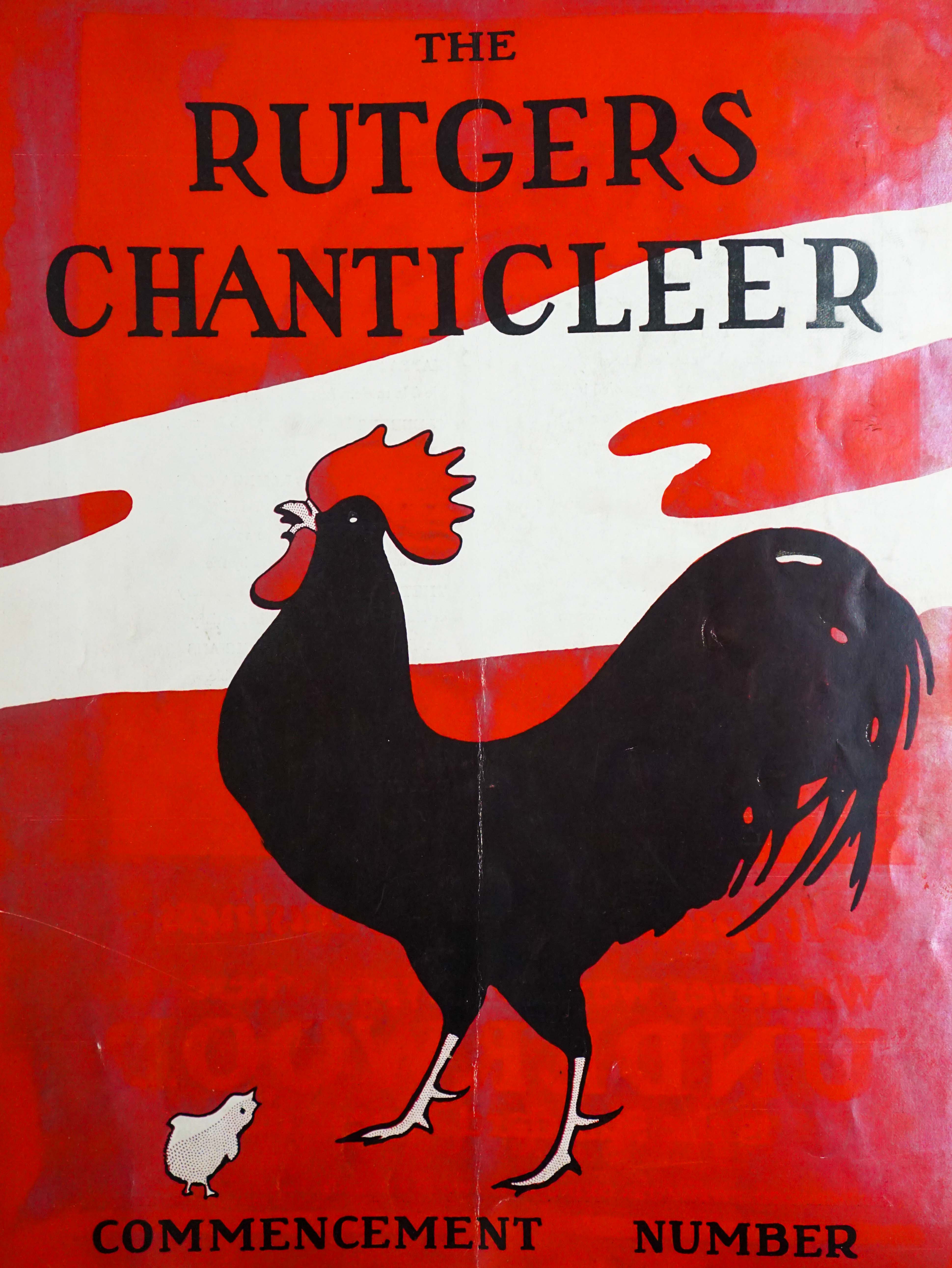
In 1925, the name was changed to the Chanticleers. A chanticleer is a rooster, a fighting cock. There was precedent: The University of South Carolina calls their teams the Gamecocks -- although calling them the Cocks for short is a bit problematic. New Brunswick's radio station, and the carrier for Rutgers' football games, at 1450 on the AM dial, named their call letters after the ChanTiCleers: WCTC.
But too many people associated "Chanticleer" with "chicken," and thus with cowardice. So, in 1955, a student vote was held, and the name chosen the most was "Scarlet Knights." And so they have been ever since.
*
November 11, 1916 was a Saturday. These other noteworthy college football games were played that day:
* Harvard beat Princeton, 3-0 at Harvard Stadium in Boston.
* Army beat Maine, 17-3 on The Plain in West Point, New York.
* Cornell beat Michigan, 23-20 at Schoellkopf Field in Ithaca, New York.
* Dartmouth and Pennsylvania played to a 7-7 tie at the original Franklin Field in Philadelphia.
* Navy beat North Carolina State, 50-0 at Worden Field in Annapolis, Maryland.
* Georgia Tech, 5 weeks after beating Cumberland College 222-0, took it relatively easy on Alabama, beating them 16-0 at Grant Field in Atlanta. Tech went 8-0-1, and were retroactively named National Champions by the Billingsley Report in 1996.
* Rivalry: Tennessee beat Vanderbilt, 10-6 at Waite Field in Knoxville, Tennessee.
* The University of Pittsburgh made Washington & Jefferson continue to pay for their racism, beating them, 37-0 at Forbes Field in Pittsburgh. Pitt went 8-0, and were retroactively named National Champions by most sources other than Billingsley.
* Notre Dame beat South Dakota, 21-0 in Sioux Falls, South Dakota.

Wednesday, November 9, 2022

November 9, 2006: Rutgers Football Grows Up

November 9, 2006: The football team at Rutgers University has what is -- after 1869, anyway -- its signature moment.

Under head coach Greg Schiano, and his aggressive recruiting of New Jersey, New York State, Connecticut, Eastern Pennsylvania, and even Florida, where he'd been an assistant at the University of Miami, collectively calling all of those places "The State of Rutgers," the Scarlet Knights were having their best season since 1976, when they went undefeated against a considerably lesser schedule.

They began the season by beating North Carolina in Chapel Hill, 21-16. They hosted Illinois at Rutgers Stadium -- the 41,500-seat horseshoe in Piscataway, Middlesex County, New Jersey has since been expanded into a 52,454-seat bowl -- and won, 33-0. They hosted Ohio University (not Ohio State), and won, 24-7.

That got them into the Top 25, with a ranking of Number 23. Their next game wasn't going to help them: It was a home game against Howard University, a historically black FCS school, and RU won, 56-7. The next game should have helped them: It was away to South Florida in Tampa, and they won, 22-20. Still, they dropped to Number 24.

After a week off, they went to Annapolis, Maryland, and beat Navy, 34-0. Now, they had risen to Number 19. They played away to the University of Pittsburgh. They never beat Pitt away. This time, they did, 20-10. They rose to Number 16. They hosted Connecticut, and won, 24-13.

Now, the Scarlet Knights were 8-0 -- but still so little respected that they were only ranked Number 15 in the country. On a Thursday night, November 9, they would have a nationally-telecast (ESPN) prime-time game against Number 3 Louisville. The winner of this game would have the inside track to winning the Big East Conference.

A crowd of 44,111 fans crammed into the Piscataway horseshoe. (It's now a 52,000-seat bowl.) At that point, only 7 times had a Rutgers "home game" had more fans, all of them at Giants Stadium at the Meadowlands: Against Florida in 1986; and against Penn State in 1977, 1983, 1985, 1989, 1992 and 1995. (The October 3, 1992 game against Penn State remains a record crowd for a Rutgers home game: 72,203. Rutgers lost, 38-24.)

Louisville scored first. At the end of the 1st quarter, Rutgers scored a touchdown to tie it, but Louisville returned the ensuing kickoff for a touchdown. And they scored a 2-point conversion. It was Cardinals 15, Scarlet Knights 7.

In the 2nd quarter, Louisville added a touchdown and a field goal, to make it 25-7. But Ray Rice, later to be a figure of terrible controversy, scored a touchdown to make it 25-14 at the half. He scored another touchdown in the 3rd quarter, to get RU within 25-20. But placekicker Jeremy Ito missed the extra point.

With 10:13 left in regulation, Ito kicked a 46-yard field goal, to tie the game at 25. RU's defense held until the final minute. Quarterback Mike Teel drove them down the field, and with 13 seconds to go, Ito attempted a 28-yard field goal. It was perfect. Rutgers led 28-25.

Fans stormed the field. And, as a Rutgers fan for nearly 30 years at that point, used to seeing them blowing it, I was worried that they wouldn't be able to clear the field, thus rendering the field unplayable, and forfeiting the game. But they did clear the field, and Louisville were unable to do anything on their last 2 plays.

Rutgers had beaten the Number 3 team in the country, and the entire country -- or, at least, all of that part of the country that cared about college football -- saw it. The Scarlet Knights had grown up. It was a truly magical moment for the country's 1st college football program.
Just 9 days later, they blew it. Now ranked Number 7, they went to Cincinnati, and lost to the University of Cincinnati, 30-11. They came home and beat Syracuse on Thanksgiving Saturday, 38-7. But the following week, they went to Morgantown and lost to West Virginia, 41-39 in overtime. Despite having been beaten by Rutgers, Louisville won the Big East Championship anyway.

Rutgers closed its season in Houston, beating Kansas State in the Texas Bowl, 37-10. They finished at 11-2, ranked Number 12 in the country.

Teel was drafted by the Seattle Seahawks in 2009, and was on the roster for that entire season, but never entered a regular-season game, and was released. In the 2010 preseason, he was signed and released, first by the New England Patriots, then by the Chicago Bears. He has since gone into coaching.

Ito was signed and released by the New Orleans Saints in 2008. In 2009, he played for the Hamilton Tiger-Cats of the Canadian Football League, and was released. 

*

November 9, 2006 was a Thursday. So there were no other college football games played. There were no NFL games played. The baseball season was over. There were 3 games played in the NBA that night:

* The Cleveland Cavaliers beat the Chicago Bulls, 113-94 at the Quicken Loans Arena in Cleveland. (It's now named the Rocket Arena.)

* The Dallas Mavericks beat the Phoenix Suns, 119-112 at the US Airways Center in Phoenix. (It's now named the Mortgage Matchup Center.) Dirk Nowitzki scored 35.

* And the Golden State Warriors beat the New Orleans/Oklahoma City Hornets, 121-116 at the Oakland Coliseum Arena (then named the Oracle Arena). Baron Davis scored 36 points.

There were 8 games played in the NHL:

* The New Jersey Devils beat the Chicago Blackhawks, 2-1 in a shootout at the Brendan Byrne Arena at the Meadowlands. (Okay, it was officially named the Continental Airlines Arena at that point.) Yes, the Devils won in a shootout. Back then, it wasn't that big a deal. Today, it would be.

* The New York Islanders beat the Philadelphia Flyers, 3-1 at the Wachovia Center (now the Xfinity Mobile Arena) in Philadelphia.

* In an "Original Six" matchup, the Toronto Maple Leafs beat the Boston Bruins, 6-4 at the TD Garden in Boston.

* The Carolina Hurricanes beat the Washington Capitals, 5-0 at the RBC Center in Raleigh. (It's now the Lenovo Center.)

* The Columbus Blue Jackets beat the St. Louis Blues, 4-2 at the Scottrade Center in St. Louis. (It's now the Enterprise Center.)

* The Dallas Stars beat the Phoenix Coyotes, 1-0 at the Jobing.com Arena in the Phoenix suburb of Glendale, Arizona. (It's now the Desert Diamond Arena.)

* The San Jose Sharks beat the Los Angeles Kings, 7-3 at the Staples Center in Los Angeles.

* And the Anaheim Ducks beat the Vancouver Canucks, 6-0 at General Motors Place in Vancouver. (It's now named the Rogers Arena.) 

Monday, November 7, 2022

November 7, 1925: The Rutgers Chanticleer

November 7, 1925: Rutgers College, the New Brunswick, New Jersey-based "colonial college," whose teams had previously been called the Queensmen, after their school's original 1766-1825 name, Queen's College, takes on a new name: The Chanticleers. A chanticleer is a fighting rooster, roughly equivalent to the University of South Carolina's Gamecocks. Another school in South Carolina, Coastal Carolina University, a former junior college founded in 1954, uses "Chanticleers."

The change didn't work: They traveled to March Field in Easton, Pennsylvania, where Lafayette College was also introducing a new mascot, the Leopards, and Lafayette won, 34-0.

In 1946, a New Brunswick radio station was founded, at 1450 on the AM dial, and committed to broadcasting Rutgers games. It took its call letters from "Chanticleer": WCTC.

In 1955, the mascot was changed to the Scarlet Knights, after a campus-wide election. Head football coach Harvey Harman supported the change, saying, "You can call it the Chanticleer, you can call it a fighting cock, you can call it any damn thing you want. But everybody knows it's a chicken."

In Middlesex, north of London, fans of the soccer team Tottenham Hotspur Football Club, whose symbol was a cockerel, were unaware of the change, and had no comment.

In 2021, WCTC was bought by Fox, and is now "Fox Sports New Jersey," but it kept the call letters, a vestige of the Chanticleer name.

*

November 7, 1925 was a Saturday. Among the other noteworthy college football games that day were these:

* Army beat Davis & Elkins, 14-6 at Michie Stadium in West Point, New York.

* Fordham beat Holy Cross, 17-0 at the Polo Grounds.

* Columbia and New York University (NYU) played to a tie, 6-6 at Columbia's Baker Field in Upper Manhattan.

* City College of New York beat Manhattan College, 13-10 at CCNY's Lewisohn Stadium in Upper Manhattan.

* Princeton beat Harvard, 36-0 at Palmer Stadium in Princeton, New Jersey.

* Navy beat Western Maryland, 27-0 at Farragut Field in Annapolis, Maryland.

* Alabama beat Kentucky, 31-0 at Rickwood Field in Birmingham, Alabama. 'Bama won the Southern Conference, a precursor to the Southeastern Conference, and finished the season undefeated.

* Texas Christian University beat Texas A&M, 3-0 at Clark Field in Fort Worth, Texas. TCU won the Southwest Conference.

* Notre Dame and Penn State played to a tie, 0-0 at New Beaver Field in State College, Pennsylvania.

* Northwestern upset Michigan, 3-2 at Municipal Grant Park Stadium in Chicago, the building that would soon be renamed Soldier Field. This was the only game Michigan lost all season, and they still won the Big Ten Conference title, and were recognized by one of the determining bodies as the National Champions.

* In what then amounted to a rivalry game, the University of Illinois beat the University of Chicago, 13-6 at Memorial Stadium in Champaign, Illinois.

* Missouri beat Washington University, 14-0 at Francis Field in St. Louis. Mizzou won the Missouri Valley Conference, a precursor to the league eventually known as the Big Eight Conference.

* The University of Washington beat Stanford, 13-0 at University of Washington Stadium, later renamed Husky Stadium, in Seattle. Washington won the Pacific Coast Conference, a precursor to the league eventually known as the Pacific-12 Conference. They were invited to the Rose Bowl, where they were beaten by Alabama, which led to most organizations that chose the National Champion to recognize 'Bama as such.

One game was played in the NFL, due to Pennsylvania's ban on playing professional sports on Sundays, which remained in effect until 1933: The Frankford Yellow Jackets beat the Akron Pros, 17-7 at Frankford Stadium in Northeast Philadelphia.

Saturday, November 5, 2022

November 6, 1869: The 1st American Football Game

The First Game, painted in 1968 by Arnold Friberg,
commissioned for the 1969 College Football Centennial

November 6, 1869: What is generally recognized as the 1st college football game -- and the 1st game of what is usually, outside the United States, called "American football" -- is played. Rutgers College plays the College of New Jersey, on Rutgers' campus in New Brunswick.

Legend has it that the impetus for the game was Rutgers wanting to redeem its honor after losing the 1st-ever baseball game between the schools, on May 2, 1866, 42-0 on CNJ's campus in Princeton, 18 miles down the road that would become the Lincoln Highway and then New Jersey Route 27 -- known as Albany Street, French Street and Somerset Street in New Brunswick, and Nassau Street in Princeton.

The game is essentially a very large soccer game, with a round leather ball, and 25 men on a side. As agreed upon before the game, by Captains William Leggett of Rutgers and William Gummere of CNJ, there was no clock, and the 1st team to 6 goals would win.

The Rutgers men, finding the color inexpensive to obtain, wrap scarlet red cloth around their heads like turbans, so that they can tell each other apart on the field. Thus did they invent school colors and, in a way, the football helmet.

The men of Old Queens must have had less trouble telling team from team than did the men of Old Nassau, as Rutgers won, 6-4 -- that's 6 goals to 4, or 42-28 under today's scoring system.

The next week, the CNJ men returned the favor in Princeton. As before, the home team set the rules, with 8 goals to win. They also wanted "fair catches," which Rutgers had denied them the week before. This played to the Nassau men's strength, and they won, 8-0. There was supposed to be a 3rd game, but the colleges' presidents got together,  and decided that too much emphasis was being placed on athletics, and forbade it.

The field where "the first football game" was played is now the parking lot for Rutgers' College Avenue Gym. Rutgers played at College Field until 1891, then opened Neilson Field across the street, playing there until 1938, when Rutgers Stadium opened across the River in Piscataway. The Alexander Library, the school's main library, was built on the site of Neilson Field in 1953. Rutgers Stadium was replaced on the same site by what's now named SHI Stadium in 1994, while they played their 1993 home games, and many others from 1976 to 2009, at Giants Stadium.
The site of College Field today. In the background,
College Avenue Gym (left) and the Rutgers Student Center.

George Large of Rutgers was the last surviving player from this game, living until August 15, 1939, age 88. The native of Readington, Hunterdon County played on the Rutgers side, and in 1888 served as President of the State Senate, making him the Acting Governor on a few occasions.
Plaque inside the Gym

In 1874, Harvard University would accept a challenge from McGill University in Montreal, and discover on the McGill men's arrival that by "football," McGill meant "rugby," not "soccer." Adjustments were made, Harvard liked the results, and convinced the other "football"-playing schools to join them in this adaptation of "football." In 1906, the forward pass was legalized and hashmarks prevented dangerous scrimmages close to the sideline. "Football" as America knows it now was on its way.

In 1896, the College of New Jersey changed its name to Princeton University, while a nearby school would later be founded as Trenton State College, and change its name to The College of New Jersey. Rutgers College would become, and remains, the centerpiece of the larger system of Rutgers, The State University of New Jersey.

Princeton's nickname, the Tigers, would inspire 2 professional team names: Baseball's Detroit Tigers and the Canadian Rugby Union's Hamilton Tigers, now the Canadian Football League's Hamilton Tiger-Cats.

Rutgers was known as "The Queensmen" until 1925, when they became the Chanticleers, after a fighting rooster. The school's literary magazine was already called The Chanticleer. But this carried the connotation of "chicken" -- and, as the University of South Carolina has found out with their similarly-named Gamecocks, they can be called "Cocks." In 1955, head coach Harvey Harman recommended the change to the Scarlet Knights, and such they have been ever since.
The West Stand of what's now named SHI Stadium

Rutgers continues to bill itself as "The Birthplace of College Football," or simply "The Birthplace." You know the joke: Rutgers invented football in 1869, and they haven't done a damn thing since. It's not completely true -- they had undefeated seasons in 1961 and 1976, won 6 bowl games between 2006 and 2014, and shared the Big East Conference Championship in 2012 -- but it sure feels like it at times.
Statue outside the stadium's North End

After that 1st game, Rutgers did not beat Princeton again until the dedication game for the original Rutgers Stadium in Piscataway, in 1938, going 0-33 in between. But, starting in 1958, Rutgers won 4 straight, before Princeton then won 6 straight.

Rutgers began to dominate the rivalry in 1968. They wanted "bigger-time football" in the 1970s, and started recruiting better, to the point where Princeton, wanting to stay in the Ivy League, couldn't keep up. Rutgers won the last 5 games before Princeton decided to stop playing them, including the finale, on September 27, 1980, a 44-13 win in Piscataway. Nevertheless, Princeton still leads the all-time rivalry, 53-17-1, despite Rutgers going 9-3-1 from 1968 onward.

The rivalry remains intense in other sports, including basketball.

*

November 6, 1869 was a Saturday. You might think that there were no other scores on this historic day. But you'd be wrong. The 1st openly professional baseball team wrapped up its season that day: The Cincinnati Red Stockings beat the Mutual Base Ball Club of New York, 17-8 at the Union Grounds in the Williamsburg section of Brooklyn.   

Tuesday, November 1, 2022

November 2, 1880: James Garfield Wins the Closest Presidential Election

November 2, 1880: James Abram Garfield is elected the 20th President of the United States, in one of the narrowest races ever. In fact, in terms of total popular vote, it remains the closest ever.

The Republican nominee, Garfield, 46, had been elected to Congress from Ohio in 1862, was commissioned a General in the Union Army for the American Civil War without losing his seat. In 1880, the Ohio legislature elected him to a seat in the U.S. Senate. But he never took it, because the Republican Convention nominated him for President.

The Democratic nominee was Winfield Scott Hancock, a 56-year-old native of a small town outside Philadelphia, named for the losing Whig Party candidate of 1852, who had already been a war hero since the War of 1812, 40 years before that. Known as Hancock the Superb, and as The Thunderbolt of the Army of the Potomac for his heroism at the Battle of Gettysburg in 1863, had never previously held political office.
Winfield Scott Hancock

Hancock received 4,444,260 votes, losing by a margin of 1,898 votes, to Garfield's 4,446,158. But it's Electoral Votes that matter, although that was also close: Garfield won 214 to Hancock's 155. Each man won 19 States. Whether the Republicans stole the votes of any State, as they had for Rutherford B. Hayes 4 years earlier, has never been seriously suggested, or proven.

No one State would have helped Hancock. Garfield won the 21 Electoral Votes of New York, then the largest State, by 21,033 votes. Had Hancock won the State, that would still have left the Electoral Vote at a 193-176 Garfield victory.

Garfield was inaugurated on March 4, 1881. On July 2, he was shot. He could have survived, but his doctors' incompetence led to an inability to find the bullet, and a subsequent infection that killed him on September 19. Only William Henry Harrison died earlier upon his Inauguration than Garfield's 200 days.

Hancock didn't fare a whole lot better. He developed diabetes, chose not to run again in 1884, and died in 1886.

Chester Arthur, Garfield's Vice President and successor, also got sick, with kidney disease, did not run for a term of his own in 1884, and died in 1886. Samuel Tilden, cheated out of the Presidency in 1876, did not run in 1880 or 1884, and he, too, died in 1886. None of them lived to see what would have been the end of the Garfield-Arthur ticket's 2nd term -- or, had they won, that of Hancock and his running mate, former Congressman William H. English of Indiana. He lived until 1896.

*

November 2, 1880 was a Tuesday. This was before Saturday was standardized as the day for college football. On this day, the College of New Jersey defeated their arch-rivals, Rutgers, 8-0 in Princeton, New Jersey. The College would rename itself for its town in 1896: Princeton University.

Also on the day, Stevens Institute of Technology beat City College of New York, 6-0 at Stevens' field in Hoboken, New Jersey. CCNY would drop football entirely, while Stevens Tech became an NCAA Division III school.

And Harvard, having hosted Montreal's McGill University in 1875, in a game that changed the course of football in North America, traveled to Montreal, and, on this date, played the Montreal Football Club to a 0-0 tie.

December 31, 1999 & January 1, 2000: The Millennium

December 31, 1999:  The Millennium arrives. The people of planet Earth survived. At a terrible cost. But we hadn't destroyed ourselves. ...