Showing posts with label red ruffing. Show all posts

Friday, May 6, 2022

May 6, 1930: The Red Ruffing Trade

May 6, 1930: The New York Yankees trade outfielder Cedric Durst and $50,000 to the Boston Red Sox for pitcher Charles "Red" Ruffing. This was one of the most lopsided trades in baseball history -- and Sox fans can't blame Harry Frazee for this one, since he had died the year before, and had sold the Sox 6 years before that.

Durst was a reserve on the Yankees' "Murderers' Row" team that won the World Series in 1927 and 1928, but did little for the Sox, and was back int he Pacific Coast League the next season. Ruffing was 39-96 for his career when the Yankees acquired him, but that was for some lousy Boston teams.

Now, he was on the Yankees, with Babe Ruth, Lou Gehrig, Tony Lazzeri and Bill Dickey. He would later have Joe DiMaggio, Joe Gordon, Tommy Henrich and Phil Rizzuto as teammates. And he won 231 games for the Yankees, still the most of any righthanded pitcher. (Only Whitey Ford has more among lefthanders, with 236.)

He and Vernon "Lefty" Gomez were one of the strongest righthander-lefthander pitching combinations in baseball history. They helped the Yankees win the 1932, '36, '37, '38, '39 and '41 World Series. Ruffing would have won the Cy Young Award in 1938 and '39, had there been one at the time. He was elected to the Baseball Hall of Fame, and has a Plaque in Monument Park. (His Number 15 is retired, although for another player, Thurman Munson.)

*

May 6, 1930 was a Tuesday. These baseball games were played:

* The New York Yankees lost to the Cleveland Indians, 7-6 at Yankee Stadium. With Ruffing as yet unavailable, an aging George Pipgras got roughed up, and was outpitched by Wes Ferrell. Earle Combs hit a home run, Babe Ruth went 2-for-5, and Lou Gehrig went 1-for-2 with 3 walks.

* The New York Giants beat the Pittsburgh Pirates, 11-9 at Forbes Field in Pittsburgh. Bill Terry went 2-for-5 with a home run and 2 RBIs. Mel Ott went 2-for-4 with a walk and an RBI.

* The Brooklyn Robins (as the Dodgers were known under Wilbert Robinson's management from 1914 to 1931) lost to the Chicago Cubs, 3-1 at Wrigley Field in Chicago. Already nicknamed "Dem Bums" and "the Daffiness Boys," Brooklyn's only run came on a home run by Babe Herman, as John "Sheriff" Blake outpitched future Hall-of-Famer Arthur "Dazzy" Vance.

* The Chicago White Sox beat the Boston Red Sox, 4-3 at Fenway Park in Boston.

* The Philadelphia Athletics beat the St. Louis Browns, 4-1 at Shibe Park in Philadelphia. Jimmie Foxx hit a home run.

* The Washington Senators beat the Detroit Tigers, 5-4 at Griffith Stadium in Washington.

* The Boston Braves beat the Cincinnati Reds, 4-3 at Redland Field (later Crosley Field) in Cincinnati.

* And the Philadelphia Phillies and the St. Louis Cardinals were rained out at Sportsman's Park in St. Louis. The game was made up as part of a doubleheader on June 22. The Cards swept, 12-3 and 9-3.

Wednesday, April 20, 2022

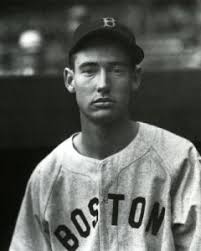
April 20, 1939: Ted Williams' 1st Major League Game

April 20, 1939: It is Opening Day at Yankee Stadium, and the New York Yankees are hosting the Boston Red Sox.

A pair of Hall-of-Fame pitchers start against each other: Charles Herbert "Red" Ruffing for the Yankees, and Robert Moses "Lefty" Grove for the Red Sox, formerly the ace of the Philadelphia Athletics. Between them, these 2 men appeared on 10 of the 14 American League Pennant-winners from 1929 to 1942. Grove won 300 games, Ruffing 273 -- 231 of them with the Yankees, still the most of any Yankee righthanded pitcher.

In fact, this game was loaded with Hall-of-Famers. The Yankees had center fielder Joe DiMaggio, catcher Bill Dickey, and 2nd baseman Joe Gordon. while another pitcher, who did not get into the game, was Vernon "Lefty" Gomez.

The Red Sox had 1st baseman Jimmie Foxx, who would eventually reach 534 career home runs, making him, at the time, 2nd on the all-time list behind Babe Ruth. They also had 2nd baseman Bobby Doerr, and their shortstop, also their manager at the time, Joe Cronin.

But the game would be more notable for 2 other future members of the Hall of Fame. And while one was fading, another debuted.

Lou Gehrig had a difficult Spring Training, and opened the season by going 0-for-4. He was noticeably slower with swinging the bat and playing 1st base. He would end up playing only 8 games that season, going 4-for-33, a batting average of .143. On May 2, he told manager Joe McCarthy that he wanted to be taken out of the lineup, ending his consecutive games played streak at 2,130. Until the 1990s, nobody even thought that record was approachable.

Gehrig soon went to the Mayo Clinic, and found out he had amyotrophic lateral sclerosis, a nerve-and-muscle disease that now bears his name. He died 2 years later.

But in this April 20, 1939 game, a 20-year-old left fielder from San Diego made his major league debut: Theodore Samuel Williams. He played right field, not the left field by which he would be remembered, and wore Number 9, which he would wear throughout his career. He struck out against Ruffing in the 2nd inning. But in the 4th, he hit a double to right-center field. He struck out again in the 6th, and popped up to 2nd in the 9th.

Dickey led off the bottom of the 2nd with a home run off Grove. With 1 out in the 5th, Rolfe reached 1st on an error by Foxx, and was driven in on a triple by Jake Powell. In spite of Williams' debut, the Yankees win, 2-0, and go on to win the World Series.

From 1938 to 1949, the Red Sox would finish 2nd to the Yankees 6 times, and would finish 3rd an additional 3 times in the 1950s. But only twice did they finish ahead of the Yankees in any season from 1919 to 1965: In 1946 and 1948.

There was no Rookie of the Year award in 1939. If there had been, Ted would have won it easily, batting .327, hitting 31 home runs, and leading the American League with 344 total bases and 145 runs batted in -- the 1st rookie ever to lead the AL in RBIs.

He soon developed nicknames. He seemed really young, so they called him "The Kid." He was thin, but could hit, so they called him "The Splendid Splinter." He hit hard, so they called him "The Thumper." And, at some point in his career, he became so much the symbol of baseball in New England, that he was known as "Teddy Ballgame."

Sometimes, he would call himself "Ol' TSW" for his initials. Sometimes, he called himself "Ted Fucking Williams." Or "Teddy Ballgame of the MFL." Asked to explain, he said, "That's the Major Fucking Leagues."

*

April 20, 1939 was a Thursday. This was also the day on which Billie Holiday recorded the anti-lynching song "Strange Fruit." I have a separate entry for that event.

Football was out of season. The NBA hadn't been founded yet. The NHL season ended 4 days earlier, when the Boston Bruins won the Stanley Cup, defeating the Toronto Maple Leafs in 5 games.

There were 4 other games played in baseball that day:

* The Brooklyn Dodgers beat their arch-rivals, the New York Giants, 5-3 at Ebbets Field. Mel Ott hit a home run in defeat for the Giants.

* The Boston Bees beat the Philadelphia Phillies, 2-0 at National League Park in Boston. Lou Fette pitched a 3-hit shutout. This was the 4th of 5 seasons in which the Boston team of the NL used "Bees" instead of "Braves," and had Braves Field renamed. In 1941, they switched back.

* The Philadelphia Athletics beat the Washington Senators, 2-0 at Shibe Park in Philadelphia. George Caster pitched a 4-hit shutout.

* And the Detroit Tigers beat the Chicago White Sox, 8-7 at Briggs Stadium in Detroit. (It was renamed Tiger Stadium in 1961.) Dixie Walker and Hank Greenberg hit home runs for the Tigers, Greenberg's being what would now be called a walkoff in the bottom of the 14th.

December 31, 1999 & January 1, 2000: The Millennium

December 31, 1999:  The Millennium arrives. The people of planet Earth survived. At a terrible cost. But we hadn't destroyed ourselves. ...