Showing posts with label knute rockne. Show all posts

Wednesday, December 7, 2022

December 14, 1930: The New York Giants Beat the Notre Dame All-Stars

December 14, 1930: A football game was played at the Polo Grounds in Upper Manhattan. The home team was not the one cheered by most of the fans. Most of them left stunned at the result.

America was a year into the Great Depression, and Jimmy Walker, the flamboyant, corrupt Mayor of New York City, had a private unemployment relief fund. He contacted his friend, Charles Stoneham, owner of the New York Giants baseball team and its home, the Polo Grounds; and another friend, Tim Mara, owner of the New York Giants football team, which leased the Polo Grounds from Stoneham. He asked if Stoneham would host, and Mara would play, a benefit game for the relief fund. Both agreed.

But who would be the opponent? There was a football team called the Brooklyn Dodgers, and another called the Staten Island Stapletons, but neither had a following that would fill the Polo Grounds' 56,000 seats. Nor did the Giants: Only once all season did they have a home crowd over 25,000, and that was on November 23, when 37,000 saw them beat the Green Bay Packers, 13-6. That would be the Packers' only loss of the season, as they won the Championship by 1 game over the Giants.

The most popular football team among New Yorkers was a college team, 700 miles west: The University of Notre Dame, in South Bend, Indiana. Although there is a school in Washington, D.C. named "The Catholic University of America," the high profile of Notre Dame's football team had made their school America's most familiar Catholic school.

This was due to the success of their head coach, the charismatic Norwegian immigrant Knute Rockne. Coaching players like the ill-fated George Gipp on his National Championship teams of 1919 and 1920, and the four-man backfield known as "The Four Horsemen" on his National Championship team of 1924, Rockne had made himself and his school legend. Catholics in cities like New York, Philadelphia, Boston and Chicago, who couldn't afford to go to college, or even to finish high school, read of Notre Dame's exploits in the newspapers, and became fans, known as "Subway Alumni."

The game in which the great Southern, but nationally-syndicated, sportswriter Grantland Rice had named quarterback Harry Stuhldreher, halfback Don Miller and Jim Crowley, and Elmer Layden "The Four Horsemen," after the Apocalypse figures in the Bible's book of Revelation, had been at the Polo Grounds, a win over the U.S. Military Academy, a.k.a. "Army." The 1928 game in which Rockne had told his players of the dying wish of Gipp, suffering from an infection in those pre-antibiotic days, to "win just one for the Gipper," had also been against Army, at Yankee Stadium.

And Notre Dame had won the National Championship again in 1929 and 1930. In the current season alone, they had gone 10-0, and brought 66,000 fans to Pitt Stadium for their win over the University of Pittsburgh, 75,000 to Franklin Field in Philadelphia for their win over the University of Pennsylvania, 110,000 to Soldier Field in Chicago for their win over Army, and 74,000 to the Los Angeles Memorial Coliseum for their win over the University of Southern California.

So they were the ideal opponent. And it's not as though teams in the NFL's early days hadn't played college teams before. So the Giants asked Rockne if he would bring his "Fighting Irish" east to play the Giants.

He wouldn't do it. Not because he objected to playing professionals -- or because the game would be on a Sunday. (The State of New York had only legalized professional sports on Sundays in 1919.) It was because the game had been set for December 14, only 8 days after their win over USC, and, having needed 3 days to get back to South Bend by train, and needing another day to get to New York by train, Rockne thought his players would be too tired to play.

So a team of "Notre Dame All-Stars" was set up: A few of the current players, who felt they could do it, came east. And the Four Horsemen, none of whom had made the trip to Los Angeles, were reunited.

But Stuhldreher was now the head coach at Villanova University in Philadelphia, Crowley the head coach at Michigan State, Layden the head coach at the University of Pittsburgh, and Miller the backfield coach at Ohio State. None of them had played beyond the 1926 season, and they were now 29 (Stuhldreher), 28 (Miller and Crowley) and 27 (Layden) years old -- not old if they had still been playing all along, but old enough to not be able to fully resume their playing careers if they had wanted.

Nevertheless, the American media had put into the heads of the American football-watching public that college football was superior to professional football, that pro football was a way for boys who hadn't grown up to make money playing the game they loved, on top of, or maybe instead of, getting a "real job." The consensus was that the Giants would be no match for the 24 men who assembled to represent the great Notre Dame.

But the Giants had quarterback Benny Friedman, who has been called the NFL's 1st great passer. They had end Red Badgro. They had tackle Steve Owen, who was also their head coach. All 3 would one day make the Pro Football Hall of Fame. They had backs Dale Burnett and Chris Caple. There were reasons why the Giants nearly won the NFL Championship.

Instead, the Giants sacked Stuhldreher in the end zone for a safety just 2 minutes into the game, and led 2-0. The Giants' big linemen overwhelmed the Notre Dame line, including some of the "Seven Mules" who had blocked for the Four Horsemen. It did no good: The Irish gained only 34 yards -- the entire game. Their passing attack was 0-for-9, with 2 interceptions.

In the New York Daily News, Marshall Hunt wrote of the crowd that came to see Notre Dame and ended up seeing the Giants, "More than 50,000 cheered every futile thrust of Knute Rockne's improvised squadron of former Notre Dame football players against the super line of Tim Mara's team."

In the 2nd quarter, Friedman drove the Giants down the field, and scored on a 4-yard touchdown run. Close to halftime, the Giants' line opened a hole for him, and he ran in from 22 yards. Giants 15, Fighting Irish 0.
Rockne lost the plot, as would be said in English soccer. This was not something he did often. He found Giants team president Harry March, and tore into him for allowing the Giants to embarrass his squad in a purported charity game. He told March to call off the dogs in the second half.

March must have gotten the message to Owen, because he sent in the reserves. And still, in the 3rd quarter, Francis "Hap" Moran threw a touchdown pass to Glenn Campbell (no relation to Glen Campbell the later singer). The Giants won, 22-0.

As sports historian Clayton Trutor wrote for Notre Dame Magazine in 2021:

The 22-0 final score headlined all newspapers in the city, earning the hometown team a grudging respect from writers who had previously discounted the professional game. Nevertheless, they were treated like sparring partners by many of the New York papers, who instead focused their coverage on the plucky performance of a Notre Dame alumni team that had assembled just a few days earlier.

It wasn't the catalyst for the NFL to take over from the pros in the minds of the public, but it was part of a gradual process that began, also with the Giants at the Polo Grounds, when Red Grange and the Chicago Bears beat them in front of 75,000.

Rockne died in a plane crash the next year, and many of the other great old football coaches, some of whom had spoken ill of the professional game -- passed from the scene, either through death or retirement.

In 1933, Jim Crowley became the head coach at Fordham University in The Bronx, and coached a line known as "The Seven Blocks of Granite," including future Packer coach Vince Lombardi. That team played their bigger games at the Polo Grounds, and had a famous 0-0 tie with Pittsburgh there, with both teams going in undefeated.

*

December 14, 1930 was a Sunday. There was 1 regular-season game in the NFL that day: The Green Bay Packers, their Championship already assured, played the Portsmouth Spartans to a tie, 6-6 at Universal Stadium (now Spartan Memorial Stadium) in Portsmouth, Ohio.

Baseball was out of season. The NBA hadn't been founded yet. There were 2 games in the NHL. The New York Rangers beat the Detroit Falcons, 3-0 at the old (but then-new) Madison Square Garden. And the Montreal Maroons beat the Chicago Black Hawks, 2-0 at the Chicago Stadium. The Falcons became the Red Wings in 1932, and the Maroons folded in 1938.

Wednesday, November 9, 2022

November 10, 1928: Notre Dame Wins One for the Gipper

November 10, 1928: The football teams of the University of Notre Dame and the U.S. Military Academy, a.k.a. "Army," play at Yankee Stadium. A crowd of 78,188 see the Cadets lead the Fighting Irish 6-0 at halftime. It wasn't that surprising: Army was undefeated, 6-0, while Notre Dame was only 4-2.

In his halftime pep talk, instead of discussing strategy, Notre Dame coach Knute Rockne tells his players, who would have been in junior high school in 1920, about George Gipp. A back on both offense and defense, and a also a great kicker, Gipp had led Notre Dame to the National Championship that season.
But he had gotten sick -- how it happened depends on who's telling the story -- and, in those pre-antibiotic days, he was doomed to die at the age of 25. As Rockne told it, he went to see Gipp on his deathbed on December 14, 1920, and Gipp told him: 

I've got to go, Rock. It's all right. I'm not afraid. Some time, Rock, when the team is up against it, when things are wrong, and the breaks are beating the boys, ask them to go in there with all they've got, and win just one for the Gipper. I don't know where I'll be then, Rock. But I'll know about it, and I'll be happy.

Having told the 1928 players that story, Rockne concludes by saying, "Gentlemen, this is that game." And the players leave the locker room in tears, and come from behind, with Jack Chevigny and Johnny O'Brien scoring touchdowns, and beat Army 12-6.

That's the story. But it makes no sense. First of all, why choose this game? Because it was in New York? Because it was against Army? Certainly, Rockne didn't need to be afraid of losing his job: He was already an icon in South Bend, Indiana.

Second of all, they were only down by 6 points. Maybe if they needed a much bigger effort, to overcome a 2-touchdown deficit, such a speech might be warranted.

Third of all, like I said, those players were just kids when Gipp died. They never saw him play. It's not like there was television back then. The newsreels probably never showed Gipp. For all they knew, Rockne could have been lying, and Gipp could have walked into the room at that moment, and they wouldn't have recognized him. (Another coach, Edward "Slip" Madigan of St. Mary's in the San Francisco Bay Area, allegedly once tearfully told his players about his sick son, and said to win the game for him, when the son walked in, just fine.) Gipp's legend shouldn't have had any effect on the 1928 Fighting Irish.

And fourth of all, if the locker room speech did happen, Rockne probably made it up. As one sportswriter put it, decades later, If Gipp said anything to Rockne as he was dying, it was probably more along the lines of, "Put a hundred bucks on the 4 horse in tomorrow's 7th race at Arlington for me."

Rockne was killed in a plane crash near Bazaar, Kansas on March 31, 1931. On October 4, 1940, the film Knute Rockne, All-American premiered. Pat O'Brien played the coach. Ronald Reagan, who had played guard at Eureka College in Illinois, now an NCAA Division III school, played Gipp, and played the speech scene straight.

As Reagan went into politics in the 1960s, and was elected President in 1980, he often played up his connection to Notre Dame. His fans joyfully called him "the Gipper." At the 1988 Republican Convention, at the Superdome in New Orleans, knowing he couldn't run for a 3rd term, he told the new nominee, his Vice President, George H.W. Bush (who played baseball at Yale), "Go out there, and win one for the Gipper!" Meaning himself. Bush did win the election.

As Reagan fell victim to Alzheimer's disease, and could no longer make public appearances, campaign signs reading, "WIN ONE FOR THE GIPPER" appeared at rallies for Bob Dole in 1996 and George W. Bush in 2000. Reagan died in 2004, and during Bush's re-election campaign, there were more "Gipper" signs than ever before. They came up again for John McCain in 2008 and Mitt Romney in 2012. They were not used for Donald Trump in 2016 and 2020: Far be it from him to allow someone other than himself to be idolized.

Reagan's political career was built on many, many lies. The "Win one for the Gipper" story was the first. If the truth about Gipp had been widely known in 1966, when Reagan was making his 1st run for public office, for Governor of California, he might never have won an election. After all, the other movie people tended to remember him for was Bedtime for Bonzo, where he worked with a chimpanzee.

George Gipp was a real person, and he really was a great football player. But the thing everybody remembers about him almost certainly isn't true. But, like Reagan's campaign promises, Rockne's Gipper speech was a fraud -- or, as the actual Irish would say, it was blarney -- that worked very well.

*

November 10, 1928 was, like most college football days, a Saturday. There were no baseball games. The NHL season wouldn't start for another 5 days. The NBA wouldn't be founded for another 18 years. But there were NFL games played that day. Because Pennsylvania banned professional sports on Sunday until 1933, the Frankford Yellow Jackets played the Pottsville Maroons on this Saturday, and the Jackets won, 19-0 at Frankford Stadium in Northeast Philadelphia.

And there were other college football games played that day:

* Georgia Tech, 5-0, played Vanderbilt, 6-0, at Grant Field in Atlanta. Tech won, 19-7.

* The championship of the Big Six Conference, the league that would eventually become the Big Eight and 2/3rds of the Big XII, was decided when Nebraska renewed its rivalry with Oklahoma, and won 44-6 at Memorial Stadium in Norman, Oklahoma.

* New York University defeated Alfred University of Alfred, in Western New York State, at Ohio Field in The Bronx.

* Fordham did not play on that day. Instead, they had an Armistice Day (Veterans Day) matinee 2 days later, against Boston College at Fenway Park. BC won, 19-7.

* Rutgers lost to Lafayette, 17-0 at Neilson Field in New Brunswick.

* And Princeton beat Washington & Lee University, 25-12 at Palmer Stadium in Princeton.

Also, Arsenal beat Sheffield United, 2-0 at Highbury in North London.

Also on this day, Italian composer Ennio Morricone was born. He is best known for his collaborations with director Sergio Leone on his "Spaghetti Westerns." His theme for the 1966 Clint Eastwood epic The Good, the Bad, and the Ugly is considered one of the greatest in movie history.

Tuesday, November 1, 2022

November 1, 1913: The Birth of the Notre Dame Legend

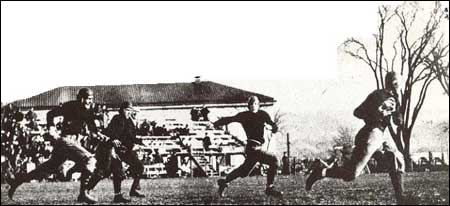
Knute Rockne carrying the ball on The Plain, November 1, 1913

November 1, 1913: The University of Notre Dame says hello.

Had this not happened, the South Bend, Indiana school might now be just another "mid-major" Catholic school in the Midwest, often with a good basketball team, but not a football school -- like Canisius in Buffalo, Duquesne in Pittsburgh, Xavier in Cincinnati, the University of Detroit Mercy, DePaul and Loyola in Chicago, Marquette in Milwaukee, and Saint Louis University.

But it did happen, and the Fighting Irish became, at least for Catholic Americans, the college football program.

From the start of the 1906 season to October 25, 1913, Notre Dame went 47-3-5, but most of that was against what were then called "small colleges." They had, however, beaten the University of Pittsburgh, 3-0 at Forbes Field on November 2, 1912, having played them to a 0-0 tie there in 1911. So it's not as though they hadn't played and beaten a big team before.

As a safety measure, the forward pass was legalized in American football in 1906. But it hadn't been used much by 1913. But Notre Dame quarterback Charles "Gus" Dorais and end Knute Rockne, an immigrant from Norway, had Summer jobs as lifeguards at a Lake Erie beach in Ohio. While there, they practiced passing the football of the time, rounder and less pointy than the one that would be developed in the 1930s.

So that when Notre Dame, 3-0, under new head coach Jesse Harper, took the field at The Plain on November 1, they were ready. Army, still stung by their shocking loss there the year before, to Jim Thorpe and the Carlisle Indian School, were 4-0, were not expecting another upset.

They got it. Dorais threw 17 passes, completing 14, for 243 yards. Rockne was the main receiver. Notre Dame won 35-13. For the 2nd year in a row, Army were beaten by a school that no one expected to beat them.

What's that? You didn't know that Knute Rockne had ever played? Well, there wasn't a National Football League for him to play in just yet. In 1915, Dorais-to-Rockne became the passing combination that led the Massillon Tigers to the Championship of the Ohio League. They played together until 1917, and then enlisted in World War I.

When "The War to End All Wars" ended, Rockne took his pharmacy degree back to South Bend, taught chemistry, and coached football. He coached Notre Dame to the National Championship in 1919, 1920, 1924, 1929 and 1930, before being killed in a plane crash in 1931.

Dorais coached at Dubuque College in Iowa; Gonzaga University in Spokane, Washington; and Detroit Mercy, before taking the reins of the Detroit Lions from 1943 to 1947. But by that point, the forward pass had been refined enough that Sid Luckman had quarterbacked the Chicago Bears to 4 NFL Championships in 7 years. The game had passed Dorais by. And he couldn't go back to Notre Dame, where Frank Leahy had taken over for Rockne, and kept the winning going. Dorais also died young, in 1954, after a few years of health difficulties.

*

November 1, 1913 was a Saturday. Baseball was over for the year, and the NFL, the NBA and the NHL hadn't been founded yet. But there were other college football games played:

* Harvard beat Cornell, 23-6 at Harvard Stadium in Boston.

* Colgate upset Yale, 16-6 at Yale Field in New Haven, Connecticut. The Yale Bowl opened the next year.

* Penn beat Penn State, 17-0 at the original Franklin Field in Philadelphia. The present Franklin Field opened in 1922.

* Princeton beat Holy Cross, 54-0 at University Field in Princeton, New Jersey. Palmer Stadium opened the next year.

* Rutgers lost to Wesleyan University, 20-9 at Neilson Field in New Brunswick, New Jersey.

Also, in their last season using that name, because it was their 1st season away from the locality in it, Woolwich Arsenal beat Nottingham Forest, 3-2 at the Arsenal Stadium in Highbury, North London. 

Tuesday, October 4, 2022

October 4, 1940: "Knute Rockne: All-American" Premieres

October 4, 1940: Knute Rockne: All-American premieres in South Bend, Indiana, just off the campus of the University of Notre Dame, where most of the film takes place.

At age 40, Pat O'Brien was way too old to play Rockne as a student at Notre Dame in 1913. However, because anybody alive today only knows him through black & white film, it's easy to forget that he was only 43 when he was killed in a plane crash in 1931.

At any rate, the film re-creates the 1913 upset of Army, in which Gus Dorais becomes the sport's 1st great passer, and Rockne its 1st great receiver; and the 1924 game against Army at the Polo Grounds, where the Fighting Irish backfield, known as the Four Horsemen, carry them to victory.

In this film, Dorais is played by Owen Davis Jr. As for the Horsemen: Harry Stuhldreher, who also served as a technical advisor on the film, was played by Nick Lukats; Jim Crowley by William Byrne; Don Miller by William Marshall; and Elmer Layden by Kane Richmond. University of Chicago coach Amos Alonzo Stagg, Stanford coach Glenn "Pop" Warner and USC coach Howard Jones all play themselves.

Of course, the film glamorizes Notre Dame back George Gipp, omits his bad behavior, and shows the story of Gipp's death in 1920 as Rockne told it to his players at halftime of the 1928 Army game at Yankee Stadium, with Gipp telling Rockne to tell the boys to go out and "win just one for the Gipper." And, of course, regardless of whether the story was true, Notre Dame won the game.

Gipp was played by Ronald Reagan, who had played guard at Eureka College, at what would now be called the Division III level. He became the Republican Party's ultimate icon, as Abraham Lincoln reminded too many of them of civil rights. Since Reagan left the Presidency in 1989, and even after his death in 2004, his legend has been invoked as Republicans have told other Republicans, "Win it for the Gipper." Had the truth about Gipp been known at the time, it might have tainted Reagan, and he might never have gotten elected to public office.

Knute Rockne: All-American remains the most ridiculous film ever made about Notre Dame football. And Rudy was released in 1993, so that's saying something.

*

October 4, 1940 was a Friday. New York Rangers hockey legend Vic Hadfield was born on this day.

With some appropriateness, there were college football games played that night, 8 of them:

* George Washington University beat Manhattan College, 21-18 at the Polo Grounds. Manhattan dropped football after the 1942 season, and GWU did the same after 1966.

* Georgetown beat Temple, 14-0 at Temple Stadium in Philadelphia. Georgetown dropped football after the 1950 season, restarted as NCAA Division III in 1970, and have been Division I-AA/Football Championship Subdivision (FCS) since 1993.

* Miami beat Stetson University, 19-0 at Burdine Stadium in Miami. Burdine Stadium was renamed the Orange Bowl in 1959. Stetson, in DeLand, Florida, dropped football after the 1956 season, and returned at the FCS level in 2013.

* The University of Detroit -- coached by Rockne's former quarterback Gus Dorais, which means he probably was at this game, not at the premiere -- beat Catholic University, 13-0 at University of Detroit Stadium.

The University of Detroit dropped its football program after the 1964 season, and merged with the all-female Mercy College to become the University of Detroit Mercy in 1990. The Catholic University of America -- in Washington, D.C., and definitely not to be confused with Notre Dame, which thinks of itself as the Catholic university of America -- suspended its football program in 1942, due to World War II, and didn't restart it until 1977, at the NCAA Division III level.

* Saint Louis University and Missouri College of Mines played to a 0-0 tie at Walsh Stadium in St. Louis. Saint Louis (always written as spelled out, never abbreviated to "St. Louis") dropped its football program after the 1949 season. Missouri Mines became the University of Missouri at Rolla in 1964, and Missouri University of Science and Technology, a.k.a. Missouri S&T (never "Missouri Tech"), in 2008. For most of their history, they have competed in NCAA Division II.

* Emporia College beat Washburn University, 38-7 in Emporia, Kansas. Emporia College became Emporia State University in 1977. They now compete in NCAA Division II. So do Washburn, their arch-rivals, of Topeka, Kansas.

* New Mexico beat New Mexico Teachers College, 28-0 at Hilltop Stadium in Albuquerque. In 1949, New Mexico Teachers College, in Silver City, became New Mexico Western College. In 1963, it became Western New Mexico University. For most of their history, they have competed in NCAA Division II.

* And Santa Clara beat UCLA, 9-6 at the Los Angeles Memorial Coliseum.

This was also the day that Game 3 of the 1940 World Series was played. The Detroit Tigers beat the Cincinnati Reds, 7-4 at Briggs Stadium in Detroit. Rudy York and Pinky Higgins hit home runs for the Tigers. But the Reds would win the Series in 7 games. In 1961, Briggs Stadium was renamed Tiger Stadium.

October 4, 1930: Notre Dame Stadium Opens

October 4, 1930: Notre Dame Stadium, the house that Knute Rockne built, opens on the school's campus in South Bend, Indiana, 95 miles east of Chicago, 142 miles north of Indianapolis, and 206 miles west of Detroit. The 1st game is against Southern Methodist University of Dallas. Final score: Catholics 20, Protestants 14.
Notre Dame went undefeated that season, 10-0, and aside from SMU, only Army seriously challenged them, losing 7-6 in front of 110,000 at Soldier Field in Chicago. Years later, Notre Dame was retroactively recognized as National Champions for the 1930 season.
The season finale, a 27-0 win over USC at the Los Angeles Coliseum on December 6, would turn out to be the last game Rockne ever coached, as he was killed in a plane crash in Kansas on March 31, 1931.
Having previously played at Cartier Field since 1900, Notre Dame Stadium originally seated 59,075, which was big for the time. In 1996, that was still its capacity, making it one of the smaller stadiums among the powers of college football. After that season, it was expanded to its current 80,795, and it also received its first permanent lighting.
The expansion raised the height of the stadium, and partially (but not entirely) blocked the view of the Hesburgh Library, built as Memorial Library in 1963, and named for Father Theodore Hesburgh, president of the University from 1952 to 1987. The side facing the stadium is covered with a mural by Millard Sheets, titled Word of Life. It depicts Jesus surrounded by several saints. Since Jesus has his hands raised, and faces the stadium, the figure is known as "Touchdown Jesus."
Since opening Notre Dame Stadium, the Fighting Irish have won 9 National Championships: In 1930, under Rockne; in 1943, 1946, 1947 and 1949, under Frank Leahy; in 1966 and 1973, under Ara Parseghian; in 1977, under Dan Devine; and in 1988, under Lou Holtz.

The field has always been natural grass, and the end zones have never been decorated with anything but thin chalk slashes. The Stadium has hosted 2 games with the unofficial "Game of the Century" distinctions: Notre Dame's tie with Michigan State in 1966, and their win over Florida State in 1993.

They've had 7 Heisman Trophy winners: Quarterback Angelo Bertelli in 1943, quarterback Johnny Lujack in 1947, end Leon Hart in 1949, running back Johnny Lattner in 1953, quarterback Paul Hornung in 1956, quarterback John Huarte in 1964, and receiver Tim Brown in 1987. And 10 of their 1930-onward players have been elected to the Pro Football Hall of Fame: Hornung, Brown, end Wayne Millner, end George Connor, defensive end Alan Page, linebacker Nick Buoniconti, tight end Dave Casper, quarterback Joe Montana, defensive tackle Bryant Young and running back Jerome Bettis.

The stadium never hosted a concert until 2018, with Garth Brooks as the headliner. In January 2019, it hosted 2 outdoor hockey games: The NHL Winter Classic, with the Chicago Blackhawks, as the home team, losing 4-2 to the Boston Bruins; and then, 4 days later, Notre Dame's hockey team losing by the same score to one of their traditional rivals, the University of Michigan, the school that pioneered outdoor hockey.

*

October 4, 1930 was a Saturday. These other notable college football games were played on this day:

* Army beat Furman, 54-0 at Michie Stadium in West Point, New York.

* Navy beat William & Mary, 19-6 at Thompson Stadium in Annapolis, Maryland.

* New York University (NYU) beat West Virginia Wesleyan at Yankee Stadium.

* Columbia beat Union College, 25-0 at Baker Field (now Wien Stadium) in Upper Manhattan.

* Rutgers beat George Washington University, 20-6 at Neilson Field in New Brunswick, New Jersey.

* Princeton beat Amherst, 23-0 at Palmer Stadium in Princeton, New Jersey.

* In a rivalry later known as the Backyard Brawl, the University of Pittsburgh beat West Virginia, 16-0 at the old Mountaineer Field in Morgantown, West Virginia.

* Alabama beat Mississippi, 64-0 at Denny Stadium (later Bryant-Denny Stadium) in Tuscaloosa, Alabama.

* And Michigan and Michigan State played to a tie, 0-0 at Michigan Stadium in Ann Arbor.

Game 3 of the World Series was played. The St. Louis Cardinals beat the Philadelphia Athletics, 5-0 at Sportsman's Park in St. Louis. Bill Hallahan pitched a 7-hit shutout, and Taylor Douthit hit a home run. But the A's went on to win the World Series in 6 days.

Also on this day, Bill Wade, quarterback of the 1963 NFL Champion Chicago Bears, was born. So was Roz Wyman, whose vote on the Los Angeles Board of Supervisors made the difference in giving the land at Chavez Ravine to Walter O'Malley, owner of the Brooklyn Dodgers, so he could build a stadium there, moving the Dodgers to the Los Angeles Memorial Coliseum in the interim.

Thursday, March 31, 2022

March 31, 1931: Knute Rockne Is Killed

March 31, 1931: Knute Rockne is killed in a plane crash. At that point, he was probably the most famous American ever to suffer that fate.

It happened to aviator Wiley Post and entertainer Will Rogers in 1935, on the same flight, in America's northernmost city, Barrow, Alaska. It probably happened to pioneering aviatrix Amelia Earhart and her navigator, Fred Noonan, in the Pacific Ocean in 1937.

It happened to early rock and roll stars Buddy Holly, J.P. "The Big Bopper" Richardson and Ritchie Valens in Iowa in 1959; to soul singer Otis Redding in Wisconsin in 1967; to rock singer Jim Croce in Louisiana in 1973; to country-rock band Lynyrd Skynyrd in Mississippi in 1977; to early rock singer Ricky Nelson in Texas in 1985; pop singer John Denver off California in 1997; pop singer Aaliyah in the Bahamas in 2001; and banda singer Jenni Rivera in Mexico in 2012.

It happened to labor leader Walter Reuther in Michigan in 1970; to Congressmen Hale Boggs and Nick Begich in Alaska in 1972; to Senator John Heinz outside Philadelphia and former Senator John Tower in Georgia, on back-to-back days in 1991; to John F. Kennedy Jr., his wife Carolyn, and her sister Lauren Bessett off Massachusetts in 1999; to Governor Mel Carnahan in Missouri in 2000; and to Senator Paul Wellstone in Minnesota in 2002.

It happened to the Cal Poly football team in Ohio in 1960, and to the U.S. figure skating team in Belgium in 1961. It happened to 2 college football teams within a few weeks in 1970: Wichita State, not in their native Kansas but in Colorado; and Marshall University, near their base of Huntington, West Virginia. It happened to the University of Evansville basketball team near their home base in Indiana in 1977, and to the U.S. boxing team in Poland in 1980.

It happened to baseball players Ken Hubbs in Utah in 1964, Roberto Clemente in Puerto Rico in 1972, Thurman Munson in Ohio in 1979, Cory Lidle in New York in 2006, and Roy Halladay in Florida in 2017; 1920 Olympic sprint champion Charley Paddock in Alaska in 1943; former Heavyweight Champion Rocky Marciano in Iowa in 1969; basketball star Wendell Ladner at Kennedy Airport in New York in 1975. Kobe Bryant's death in Los Angeles in 2020 was in the crash of an aircraft, but it was a helicopter, not an airplane.

Knute Rockne, an immigrant from Norway, grew up on the Northwest Side of Chicago. He had been a star player at the University of Notre Dame in South Bend, Indiana, served in World War I, and then as head football coach at Notre Dame starting in 1918. He led them to National Championships in 1919, 1920 (with George Gipp), 1924 (with a backfield known as "The Four Horsemen of Notre Dame"), 1929 and 1930. He was already being hailed as the greatest coach football had ever known.

On March 31, 1931, Rockne, only 43 years old, and still Notre Dame's head coach, boarded a Fokker F-10 (and that's pronounced "FOH-ker") belonging to Transcontinental and Western Air, at Kansas City Municipal Airport. (It's now named Charles B. Wheeler Downtown Airport.) Having visited his sons Bill and Knute Jr. at their boarding school in Kansas City, he was on his way to Los Angeles to assist in the production of the film The Spirit of Notre Dame.

The plane crashed in Bazaar Township, Kansas, 142 miles to the southwest of its takeoff point. Rockne, the other 5 passengers, and both crewmen were killed. Rockne left behind a wife, 4 children, and the admiration of an entire nation. President Herbert Hoover called it "a national loss," and King Haakon VII of his birthplace of Norway posthumously knighted him.

The Spirit of Notre Dame premiered on October 13, 1931. Lew Ayres starred as a player, Sally Blane as his love interest, and several former Notre Dame players had cameos, including all of the Four Horsemen: Harry Stuhldreher, Jim Crowley, Don Miller and Elmer Layden.

In 1940, the film Knute Rockne, All American was released, though it took some liberties with his story. He was played by Pat O'Brien.

*

March 31, 1931 was a Tuesday. Baseball was in Spring Training. Football was in the off-season. The NBA hadn't yet been founded. And only 1 game was played in the NHL.

It was a Stanley Cup Playoff game. The Chicago Black Hawks beat the New York Rangers, 1-0 at the old (but then, relatively new) Madison Square Garden. Tom Cook scored the only goal of the game. It was a two-games, total-goals series, and it was the 2nd game of the series, and the Rangers were out. The Hawks advanced to the Stanley Cup Finals, where they lost to the Montreal Canadiens.

December 31, 1999 & January 1, 2000: The Millennium

December 31, 1999:  The Millennium arrives. The people of planet Earth survived. At a terrible cost. But we hadn't destroyed ourselves. ...