Showing posts with label new york highlanders. Show all posts

Sunday, October 9, 2022

October 10, 1904: The Jack Chesbro Game

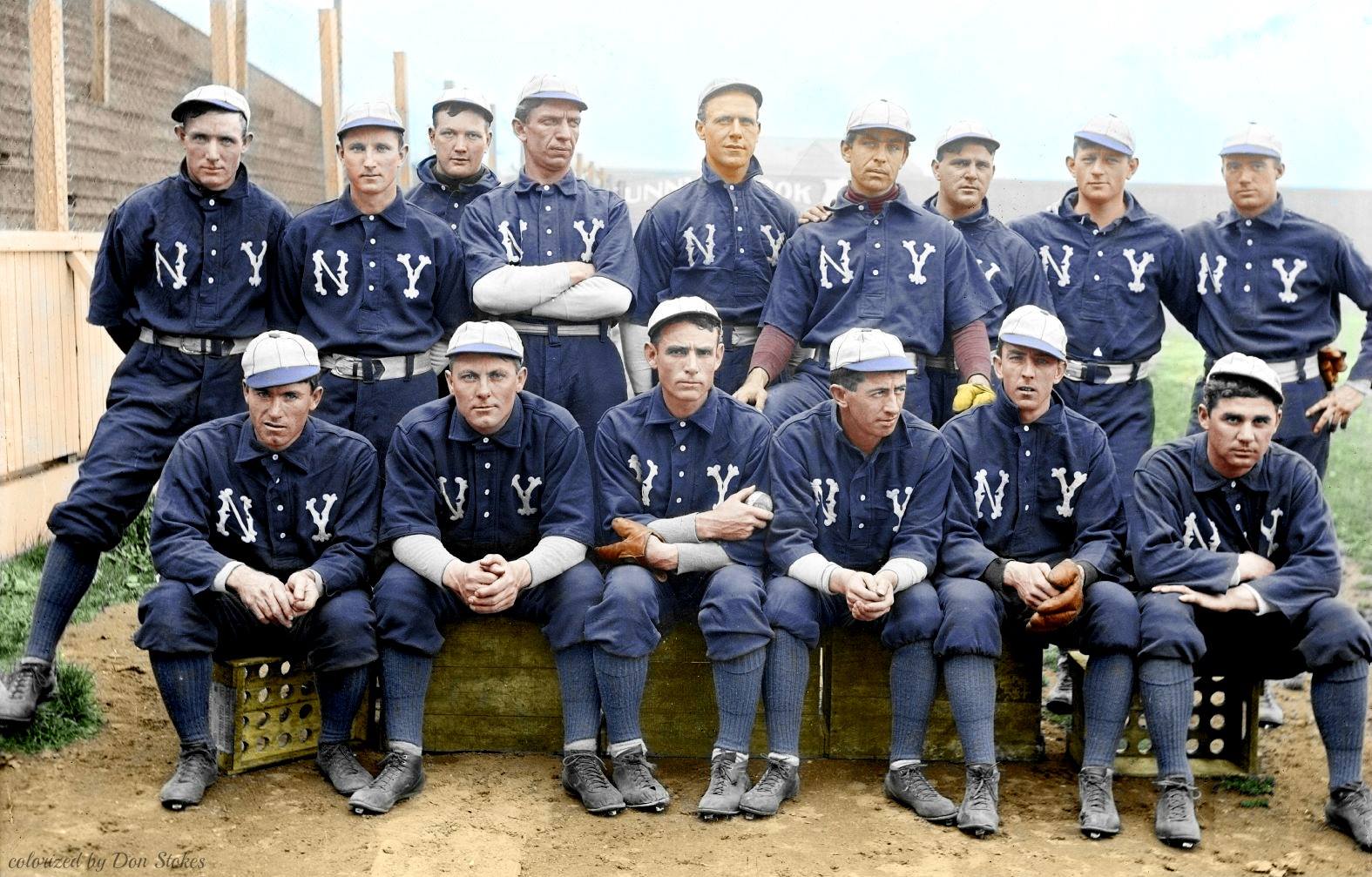
Photo colorized, but otherwise real.

October 10, 1904: For the first time, and not for the last, an American League Pennant comes down to New York and Boston. The last day of the season features a doubleheader at Hilltop Park, at 165th Street & Broadway in Manhattan's Washington Heights.

The New York Highlanders, forerunners of the Yankees, need to sweep the Boston Americans, forerunners of the Red Sox, in order to win. Otherwise, Boston will win it. Hilltop Park seats about 16,000, but there's perhaps 30,000 jammed into the confines, including thousands of standees roped off in the massive outfield area.
Pitching the 1st game for the Highlanders is Jack Chesbro, who has already won 41 games, which remains the single-season record for pitching from 60 feet, 6 inches away. And that's pronounced CHEESE-bro, not CHEZ-bro.

With the score 2-2 in the top of the 9th and Lou Criger on 3rd base, Chesbro throws a spitball – then a legal pitch – but it's a wild pitch, going over the head of his catcher, Jim "Deacon" McGuire, and Criger scores the Pennant-winning run. The Yankees win the nightcap, 1-0, but it's meaningless, as the Red Sox-to-be win the Pennant.

But, faced with the prospect of losing a postseason series not just to the champions of what they view as "an inferior league," but to the other New York team, the National League Champion New York Giants refuse to participate in the World Series. Manager John McGraw, on this day, issues a statement that it was his decision, not that of owner John T. Brush, to refuse to play the AL Champions, regardless of who they turned out to be. The 1904 World Series is called off, and it will be 90 years before such a thing happens again – over a very different kind of stupidity, and a more egregious one at that.

Brush and McGraw were so shamed in the press for chickening out that they agreed that they would participate in any future World Series – and they participated in 14 before moving to San Francisco, their total now 20.

Today, over a century later, the Red Sox organization does not claim a forfeit win and call themselves the 1904 World Champions, which would give them 9 World Championships, rather than 8. But they might as well -- after all, who can stop them, and how? Certainly, they have a more legitimate claim to the title of 1904 than they do to those of 2004, 2007, 2013 and 2018.

And yet, the plaque at Polo Grounds Towers lists the Giants as World Champions for 1904, as well as for 1905, 1921, 1922, 1933 and 1954 -- but not for 1888 and 1889, possibly because those titles were not won at that location, but rather at a different location with a facility called the Polo Grounds.

After 1904, the Americans/Red Sox would win 4 more Pennants in the next 14 seasons. The Highlanders/Yankees would have to wait another 17 years before winning their 1st, but then, they would pretty much keep winning them for the next 43 years.

John Dwight Chesbro, a.k.a. Happy Jack, won 41 games that season, and 198 in his Hall of Fame career for the Pirates and the Yankees (and, for the very last game of his career, the North Adams, Massachusetts native came home and pitched and lost one for the Red Sox). Sadly, he is mainly remembered not for all the games he won, but for one he lost, basically for one bad pitch that he threw. He lived in Conway, Massachusetts, and died there in 1931, of a heart attack, at the age of 57.

A shocking percentage of the 1904 Americans died young, what with that being the pre-antibiotic era, although the man named Denton True Young, a.k.a. Cy Young, lived to be 87. The last survivor of the 1904 Americans, and the 1903 team that won the 1st World Series, was shortstop Freddy Parent, a New England native, from Biddeford, Maine, who lived on until 1972, at the age of 96. The last surviving 1904 Highlander was 2nd baseman Jimmy Williams (no relation to later Red Sox manager Jimy Williams), who died in 1965.

*

October 10, 1904 was a Monday. This was before what became North America's other major sports, football, basketball and hockey, really went professional. There were only 2 other games that day in what would later be called Major League Baseball, and they were a doubleheader.

It was played at Boundary Field in Washington, D.C. The host Washington Senators lost the opener to the Philadelphia Athletics, 7-6. Then they were leading the nightcap, 4-3, when the game was called after 5 innings, due to darkness, as no ballparks had lights in those days.

Boundary Field burned down early in the 1911 season, as did the Polo Grounds in New York. Both were quickly rebuilt. The new Washington ballpark was named National Park, until 1922, when Clark Griffith -- the 1st manager of the Highlanders/Yankees and also a pitcher for them -- bought the Senators, and renamed it Griffith Stadium. Baseball continued to be played there until 1961. It was demolished in 1965, and Howard University Hospital was built on the site.

The Highlanders became the Yankees in 1913. That same year, they moved into the Polo Grounds, invited to do so as a return courtesy for the Yankees letting the New York Giants use Hilltop Park while the Polo Grounds was rebuilt after their fire. They moved into the original Yankee Stadium in 1923.

Hilltop Park was torn down in 1914. For a while, Billy Sunday, a former major league pitcher turned nationally-known evangelist, had a church on the site. In 1928, the site of Hilltop Park, like that of Griffith Stadium, had a hospital built on it, Columbia-Presbyterian Medical Center. At each hospital, the location of home plate is marked with a plaque.

And the home of the Americans/Red Sox? The Huntington Avenue Grounds didn't last much beyond the team moving to Fenway Park in 1912. Northeastern University built athletic facilities on the site. A statue of Cy Young now stands where the pitcher's mound once stood. 

Tuesday, October 4, 2022

October 5, 1910: The 1st Father to Manage His Own Son In Major League Baseball

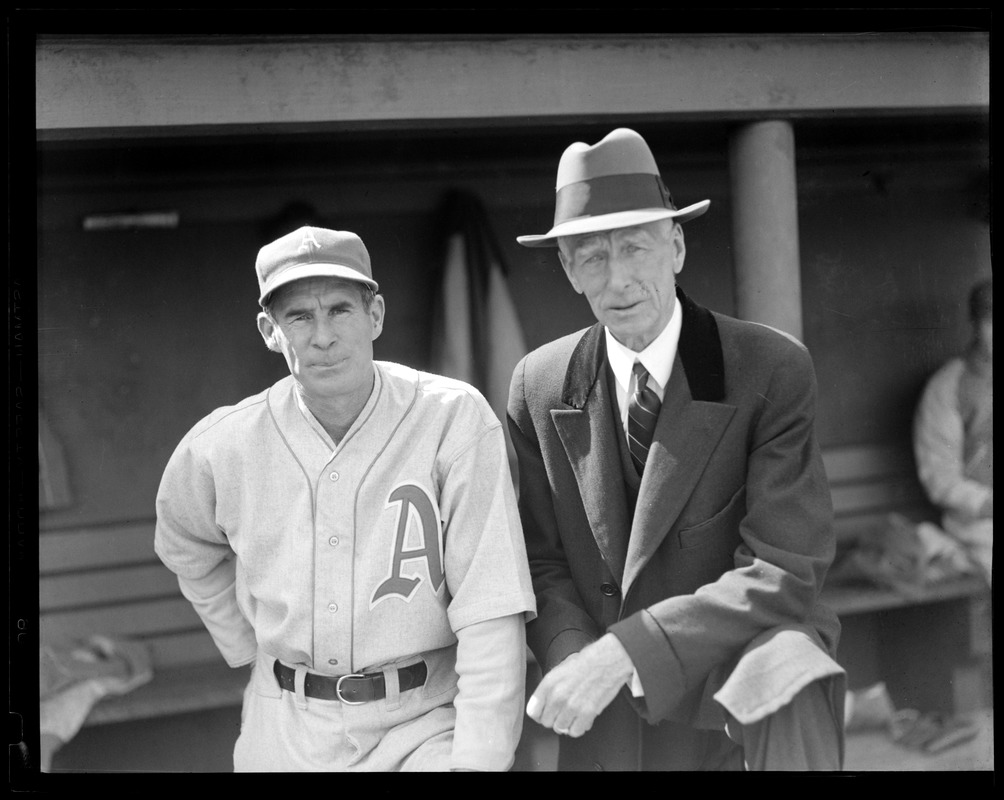
Earle and Connie -- well after 1910.

October 5, 1910: Philadelphia Athletics manager/co-owner Connie Mack inserts his son Earle Mack behind the plate in a game against the New York Highlanders (forerunners of the Yankees) at Shibe Park in Philadelphia. This is the 1st time that a manager has put his son in a game as a player.

Earle‚ who hit .135 in 26 minor league games this year‚ belies that stat with a single and triple while catching Eddie Plank and Jack Coombs. The Highlanders beat the A's 7-4, but it was hardly Earle's fault.

Earle mopped up in late-season games the next year, and again in 1914‚ and served for 25 years as his father's coach, before moving into the front office. While Connie always wore a suit, and thus was limited to the dugout, Earle wore a uniform, usually Number 27, and could handle mound conferences.
The plan may have been for Connie to hand the managing duties over to Earle someday, and concentrate on running the team's finances and personnel as owner and general manager. Earle and his brother Roy, sons from Connie's 1st marriage, to Margaret Hogan, who died in 1892, seemed to be under the impression. Once the other owners, the Shibe brothers, died in the mid-1930s, that seemed like the reasonable thing to believe. And, when Connie had to step aside due to illness for a few days in 1937, and again in 1939, Earle stood in as manager.
But Connie Mack Jr., his son from his 2nd marriage, in 1910 to Catherine Holahan, thought he would be the heir. Catherine herself thought she would be the operating owner, while Connie Jr. managed.
But Connie Sr. wouldn't stop managing. He was the owner, so he had the ultimate job security. He would call out for pinch-hitters and relief pitchers he had long ago traded or sold. Finally, in 1950, at age 87, the team had a horrible season. The sons, who agreed on little else, decided it was time to gang up on "The Grand Old Man of Baseball," and bought out the Shibes' heirs -- bankrupting themselves in the process -- and had the votes to force Connie Sr. out. Catherine was furious, but there was nothing she could do.
Taking out a loan they couldn't hope to pay back in the near future, Earle and Roy bought Connie Jr. out, and finally sold the team in 1954, to Arnold Johnson, who moved them to Kansas City.
After 1914, no manager would again put his son into a game until 1985, when Yogi Berra played his son Dale with the Yankees. Cal Ripken Sr. would also manage Cal Jr. on the Baltimore Orioles, and Felipe Alou would manage Moisés on the Montreal Expos.
*

October 5, 1910 was a Wednesday. This was also the day that a revolution toppled the monarchy of Portugal, never to return. I have a separate entry for that event.

There were 3 other major league games that day:

* The Boston Red Sox led the Washington Senators, 5-1 going into the bottom of the 9th at American League Park in Washington. The Senators tied the game. But they couldn't find the winning run, and the umpires called the game due to darkness.

* And a doubleheader was played at Bennett Park in Detroit. The Detroit Tigers lost the opener to the Cleveland Naps, 8-3, allowing 5 runs in the top of the 10th inning. The nightcap was called due to darkness after 5 innings, with the Tigers leading, 4-2. The Naps were named for their manager, 2nd baseman and best hitter, Napoleon "Nap" Lajoie. They would be renamed the Indians in 1915 and the Guardians in 2022.

This was the last week of the regular season, and Lajoie and the Tigers' Ty Cobb were in a feverish race for the American League battle title, with the Chalmers Auto Company offering a new car to the winner. Over the 2 games, Cobb went 3-for-6 with a walk, 3 stolen bases and 2 RBIs, while Lajoie went 3-for-6 with an RBI. "Shoeless" Joe Jackson went 3-for-7. Cobb ended up winning the batting title, but there were shenanigans (not his doing), and so Chalmers gave both men cars. (Cobb didn't mind: He got what he wanted.)

Bennett Park was torn down in 1911, and a new park opened on the site the next year, known as Navin Field from 1912 to 1937, Briggs Stadium from 1938 to 1960, and Tiger Stadium from 1961 to 1999.

Despite it being a Monday, there were 5 college football games played that day:

* Yale beat Tufts, 17-0 at Yale Field in New Haven, Connecticut.

* The University of Pennsylvania beat Franklin & Marshall University, 17-0 at the original Franklin Field in Philadelphia.

* The Carlisle Indian School, with a sophomore two-way back named Jim Thorpe, beat Dickinson College, 24-0 at Biddle Field in Carlisle, Pennsylvania.

* VPI -- the Virginia Polytechnic Institute, usually known as "Virginia Tech" now -- beat Davidson University, 16-0 at Miles Field in Blacksburg, Virginia.

* And the University of Mississippi, a.k.a. Ole Miss, beat Tennessee Medical College, now the University of Memphis, 2-0 in Oxford, Mississippi.

Friday, September 23, 2022

September 23, 1910: Stallings vs. Chase, the Most Shameful Moment in Yankee History

Hal Chase

September 23, 1910: George Stallings, the manager of the New York Highlanders, tells team owners Frank Farrell and Bill Devery that Hal Chase, a good hitter, and considered the best-fielding 1st baseman the game has ever seen, has been throwing games. It becomes a situation of, "Either he goes, or I go."

Naturally, desperate to bring in as many fans as possible, what with the team (which is already being called the Yankees, and the name will officially be changed to that in 1913) being the 3rd-most-popular team in New York, behind the mighty Giants just a few blocks away and the (thus far) perennial contender Dodgers in Brooklyn, Farrell and Devery tell Stallings, "Here's your hat, George, what's your hurry?"
George Stallings. Like Connie Mack,
he only wore suits as a manager, not a uniform,
and thus wasn't allowed on the field.

Siding with the game-fixing pretty-boy star over the manager? If that had been it, that would have been bad enough. But who did they hire as the new manager? Chase himself. He was just 27 years old, with no managerial or even coaching experience, in any sport, at any level, and was already suspected by many as a game-fixer. And they made him the manager of the team for which he was playing.

This, not any single game or series loss, is the most shameful moment in the history of the New York Yankees franchise.

The Highlanders were in 2nd place in September 1910, not a bad finish at all for a team that hadn't yet won their 1st Pennant, although well behind the eventual World Champion Philadelphia Athletics. But Stallings couldn't take it anymore.

How did Chase do in his 1st full season, in 1911? Not well: 76-76, 6th place. It was clear that, whatever his virtues and flaws, Chase was not (or, at least, not yet) managerial material. So he was relieved of those duties, and Harry Wolverton was appointed. He managed the team to what remains its worst season ever, 50-102.

In 1913, Farrell and Devery hired Frank Chance as manager. Chance was known as "The Peerless Leader," for leading the Chicago Cubs to 4 Pennants and 2 World Series wins in a span of 5 years. But those successes were with Chance himself (a pretty good player) at 1st base, not with Chase at the position.

After 2 years of getting frustrated over Chase continuing to throw games, and the team going nowhere in part because of that, Chance quit, went home to California, and managed the Los Angeles Angels to a Pacific Coast League Pennant. Chase was soon gone from New York as well, with new owners Jacob Ruppert and Til Huston not wanting his maledictory influence around any longer.

Oh yeah, what about Stallings, the man the old regime threw away so foolishly? Did he ever go on to anything of note? Yes, he went to the Boston Braves, and led them to win the 1914 World Series. It would be another 9 years before the Yankees won one.

There's no way to know for sure, but probably no player ever "threw" more games, or did so over a longer period, than "Prince Hal," who played from 1905 to 1919. He even used his reputation as baseball's best-fielding 1st baseman of the time as "cover" for making errors, and thus casting doubt not on his own honesty, but on the fielding ability of the infielders throwing to him.

Eventually, he confessed it all. He was unofficially banned from baseball in 1920, during the Black Sox Scandal. While it's not clear that he was involved in that, he might have been, and the other suspicions about him were enough to get him released by his current team, the Giants, and have no other team re-sign him. It wasn't so much like the 8 Chicago White Sox players associated with the scandal, who were formally banned. It was more like Barry Bonds in 2007: His contract ran out, and nobody lifted a finger to sign him.

Chase played in "outlaw leagues" in the Western U.S. for a few more years. In spite of his reputation, Chase did receive some votes for the Baseball Hall of Fame. The rule making players banned from baseball ineligible was a long way off. He died in 1947, at the age of 64.

*

September 23, 1910 was a Wednesday. These games were played that day:

* The Highlanders lost to the Cleveland Naps, 7-2 at League Park in Cleveland. Napoleon "Nap" Lajoie, the slugging 2nd baseman and manager for whom the eventual Indians and Guardians were then named, went 3-for-4. Shoeless Joe Jackson (later of the Black Sox Scandal) and Ted Easterly each went 4-for-4, and Easterly had 3 RBIs. Chase went 3-for-4 with an RBI, but the rest of the Highlanders combined only got 4 hits.

* The New York Giants beat the Chicago Cubs, 6-4 at the Polo Grounds.

* The St. Louis Cardinals beat the Brooklyn Dodgers, 6-2 in a game that was called due to darkness after 7 innings.

* The Cincinnati Reds beat the Boston Braves, 8-2 at the South End Grounds in Boston.

* And the Philadelphia Phillies beat the Pittsburgh Pirates, 2-1 at Baker Bowl in Philadelphia. Honus Wagner got the day off.

* The Philadelphia Athletics and the Chicago White Sox got rained out at Comiskey Park in Chicago. The game was made up as part of a doubleheader the next day, despite the A's having already clinched the American League Pennant. The White Sox swept, 8-4, and 3-2 in 11 innings.

* The Washington Senators and the St. Louis Browns were rained out at Sportsman's Park in St. Louis. The game was made up as part of a doubleheader 2 days later. The Browns won the 1st game, 2-1. The Senators won the 2nd game, 3-0, as Walter Johnson allowed just 1 baserunner, a single by Frank Truesdale.

* The Boston Red Sox and the Detroit Tigers were rained out at Bennett Park in Detroit. That game was never made up.

Wednesday, September 7, 2022

September 7, 1908: Walter Johnson's 3rd Shutout In 4 Days

September 7, 1908: "The Big Train" arrives. Walter Johnson completes what remains one of the greatest pitching performances of all time.

He had debuted the season before, and had quickly established himself as a great pitcher, with maybe the best fastball of his generation. But this was truly outstanding:

September 4, 1908: The Washington Senators beat the New York Highlanders, 4-0 on a Friday afternoon at Hilltop Park in Upper Manhattan. Johnson, only 20 years old, allows 6 hits and 1 walk, striking out 4. He outpitched Jack Chesbro, and even went 1-for-3 as a hitter.

Four years earlier, Chesbro had been, along with Rube Waddell  of the Philadelphia Athletics, 1 of the top 2 pitchers in the American League. Since then, though, he had been unquestionably surpassed by Waddell, Ed Walsh of the Chicago White Sox, Addie Joss of the Cleveland Naps, and now Johnson.

By itself, it wasn't an exception performance, in spite of the prestige that came from beating Chesbro. But there was more, the next day:

September 5, 1908: The Senators beat the Highlanders, 6-0 on a Saturday afternoon. Johnson went the distance for the 2nd straight day, allowing 4 hits and no walks, striking out 3. In contrast, Highlander starter Rube Manning didn't get out of the 1st inning. Joe Lake took over and went the rest of the way, but he wasn't a lot better.

Oh, yes: Johnson got another hit, going 1-for-4.

September 6, 1908: It was a Sunday, and playing professional sports was still illegal in the State of New York. So Johnson didn't pitch for a 3rd straight day, let alone pitch a shutout.

But the next day:

September 7, 1908: It was a Monday, Labor Day, and the Senators swept a doubleheader from the Highlanders. In the opener, the Senators won, 4-0. On just one day's rest, Johnson went the distance, allowing 2 hits and no walks, striking out 5. Again, he outpitched Chesbro. And, again, he got a hit, going 1-for-2 with an RBI. They won the nightcap, 9-3. Tom Hughes went the distance for the Senators.

So: 4 days, 1 pitcher, 3 wins, 27 innings, no runs, 14 hits, 1 walk, 12 strikeouts, and 3-for-9 with an RBI. A pretty good 4-day holiday weekend. And he was still 2 months short of his 21st birthday.

To be totally fair, the New York Highlanders were a terrible team in 1908. They went 51-103, and those 103 losses remain the most in franchise history. They finished 8th and last in the American League, 39 1/2 games behind the Pennant-winning Detroit Tigers. In 1913, the Highlanders officially took up the name many people were already calling them: The New York Yankees.

On the other hand, the Senators weren't a whole lot better. They finished 7th, 67-85, 22 1/2 games out of 1st. On Friday, they only got 5 hits, 1 fewer than the Highlanders. They did considerably better over the last 3 games.

In his career, Johnson would 417 games, the most in American League history, and 2nd all-time behind the 511 of Cy Young. Of those 417 wins, 113, an all-time record, were by shutout.

Brian Cashman would not have known what to do with Walter Johnson -- any more than American League hitters did for 20 years. He was 1 of the 1st 5 players, and 1 of the 1st 2 pitchers, elected to the Baseball Hall of Fame.

*

September 7, 1908 was a Monday. These other games, all doubleheaders, were played that Labor Day:

* There was a split at the Polo Grounds. The New York Giants won the 1st game, 5-0. George "Hooks" Wiltse allowed 9 hits, but kept the shutout, beating Bill Foxen. The Philadelphia Phillies won the 2nd game, 5-1. Frank Corriden beat Doc Crandall.

* The Brooklyn Superbas got swept by the Boston Doves, 1-0 in both games, at Washington Park in Brooklyn. In the 1st game, Jim Pastorius allowed just 1 hit, but fell to 3-17 on the season, losing to Bill Chappelle, who pitched a 4-hit shutout. In the 2nd game, Vive Lindaman pitched a 6-hit shutout, to beat Harry McIntire. The Superbas became the Brooklyn Dodgers in 1911, and the Doves became the Boston Braves in 1912.

* The Boston Red Sox swept the Philadelphia Athletics, 6-1 and 3-2 at the Huntington Avenue Grounds in Boston. Fred Burchell beat Eddie Plank, and Frank Arellanes beat Chief Bender.

* The Pittsburgh Pirates swept the St. Louis Cardinals, 9-7 and 7-1 at Exposition Park in Pittsburgh. Sam Leever beat Arthur "Bugs" Raymond, and Vic Willis beat Fred Beebe. Honus Wagner went 6-for-9 with a home run, a stolen base, and 5 RBIs.

* The Cleveland Naps beat the Chicago White Sox, 6-0 ant 5-2 at League Park in Cleveland. In the 1st game, Addie Joss pitched a 2-hit shutout to beat Ed Walsh. In the 2nd game, Charlie Chech beat Frank Smith. The Cleveland team was named for its manager, 2nd baseman and best hitter, Napoleon "Nap" Lajoie, who, over the 2 games, went 3-for-8 with 4 RBIs. The team became the Cleveland Indians in 1915, and the Cleveland Guardians in 2022.

* The Detroit Tigers beat the St. Louis Browns, 4-3 and 9-3 at Bennett Park in Detroit. George Winter beat Jack Powell, and George Mullin beat Harry Howell. Over the 2 games, Ty Cobb went 4-for-8 with a stolen base and 2 RBIs.

* And there was a split at the West Side Grounds in Chicago. The Cincinnati Reds won the 1st game, 6-0. Jean Dubuc pitched a 2-hit shutout, beating Charles "Chick Fraser." The Chicago Cubs won the 2nd game, 4-0. Andy Coakley pitched a 4-hit shutout, beating Bob Spade.

Saturday, September 3, 2022

September 3, 1906: A Wild Doubleheader In Washington Heights

Silk O'Loughlin

September 3, 1906: Before they were the New York Yankees, the New York Highlanders had a few moments of glory. Not many, but a few.

Coming into this day, they were 2 games behind the Chicago White Sox in the American League, with 34 games to play. The Philadelphia Athletics, who had won the Pennant the year before under young manager Connie Mack (the former catcher was 43), were 5 behind the South Side ballclub. The Cleveland Naps, led by manager, 2nd baseman and slugger Napoleon "Nap" Lajoie, were 7 back. There was a chance.

That was more than could be said in the National League, where the Chicago Cubs were running away with the Pennant. Frank Chance's West Siders were 13 games ahead of Honus Wagner and the Pittsburgh Pirates.

It was Labor Day, and, after "blue laws" prohibited Sunday baseball in some States, ballclubs were anticipating big holiday doubleheader paydays. The White Sox were to play the Naps at League Park in Cleveland, while the Highlanders were hosting the A's at Hilltop Park, in Washington Heights at 165th and Broadway, the highest elevation on Manhattan Island, which game them team its name, although with its nickname, the Hilltoppers. The name "Yankees" was also being informally used.

The New York shortstop was Norman Elberfeld, usually known as "Kid," short for "The Tabasco Kid," because he was such a hothead. A's 2nd baseman Danny Murphy stole 3rd base in the opener, and Elberfeld was sure that Murphy was out. Umpire Frank "Silk" O'Loughlin said otherwise, and the Kid lost it, and tried to kick him. He was so unsportsmanlike that even the 20,000 or so home fans, who normally loved him, turned on him. He chased O'Loughlin around the field, trying to hit him, and the police had to come onto the field and arrest Elberfeld.

"Slow" Joe Doyle started for New York, and he couldn't quite go the distance. Manager Clark Griffith, himself a former pitcher for the Cubs, brought ace Jack Chesbro in to get the last out in the top of the 9th. Jimmy Dygert started for Philadelphia, and he took a 3-3 tie into the bottom of the 9th, when Frank Delahanty, younger brother of the late star Ed Delahanty, singled Jimmy Williams home, and the Highlanders won, 4-3.

Chesbro started the 2nd game, against the man then recognized as the best pitcher in the AL, Rube Waddell. It was 3-1 A's in the bottom of the 9th, when the Highlanders tied it. A's 1st baseman Harry Davis alleged that the Yankees' best hitter, "Wee" Willie Keeler, had interfered with him on the infield single that led to the tying run.

O'Loughlin, the lone umpire in the games, generally regarded as one of the better ones -- and doomed to die in the 1918 Spanish Flu epidemic -- ruled that there was no interference. Mack pulled his team off the field in protest, and O'Loughlin awarded the game to the Highlanders as a forfeit, with the official score of 9-0.

Meanwhile, 500 miles away, in Cleveland, the Naps swept the ChiSox, 10-3 and 4-3. Over the 2 games, Lajoie went 7-for-8 with an RBI. When the day was done, the Highlanders and White Sox were tied for 1st, but having played fewer games meant that the Highlanders led by 1 game in the loss column; while the A's trailed by 5 games, and the Naps by 5 1/2.

The St. Louis Browns swept the Detroit Tigers, 5-2 and 5-0 at Bennett Park in Detroit, and were now 8 1/2 back. Maybe this wasn't just a 4-team race, but a 5-team race. Far back, the Boston Americans won the 1st game of a doubleheader at the Huntington Avenue Grounds in Boston, 3-1, with Cy Young as the winning pitcher; while the Washington Senators won the 2nd game, 6-3.

In the National League:

* The New York Giants swept the Boston Beaneaters at the Polo Grounds. They won the 1st game, 4-0, on a shutout by Christy Mathewson; and the 2nd game, 3-2 in 11 innings.

* The Brooklyn Superbas had about as good a day as you could imagine, sweeping the Philadelphia Phillies, 8-0 and 10-0, at National League Park, later known as Baker Bowl, in Philadelphia, behind shutouts by Don Scanlan and Harry McIntire.

* The Pittsburgh Pirates swept the St. Louis Cardinals, 7-1 and 2-1 at Exposition Park in Pittsburgh.

* And the Chicago Cubs beat the Cincinnati Reds, 7-0 at The Palace of the Fans in Cincinnati, with Ed Reulbach pitching a shutout; then were leading the 2nd game, 5-2 after 7 innings, when the game was called due to darkness.

The Americans became the Boston Red Sox in 1908. The Superbas became the Brooklyn Dodgers in 1911. The Beaneaters became the Boston Braves in 1912. The Highlanders became the New York Yankees in 1913. The Naps became the Cleveland Indians in 1915.

Tuesday, June 14, 2022

June 15, 1904, The General Slocum Fire

June 15, 1904: The PS General Slocum catches fire in the East River, in New York City, killing 1,021 of the 1,342 people on board.

The "PS" stood for "Passenger Ship." It was named for Henry Warner Slocum (1827-1895), who commanded the 27th New York Infantry during the American Civil War, including at the pivotal Battle of Gettysburg, July 1 to 3, 1863, and during General William Tecumseh Sherman's "March to the Sea" in Georgia the following year. He later served in Congress.

The ship was a paddlewheel steamer, launched in 1891 with a legal capacity of 2,500 passengers. The Knickerbocker Steamboat Company operated her, and, like the Circle Line established in 1945, offered rides around Manhattan Island, and to other nearby places, including Staten Island, Coney Island in Brooklyn, the Rockaways in Queens.

But she was plagued by problems. She around aground off Rockaway only 4 months after being launched. In 1894, she hit a sandbar. Later that year, she ran aground off Coney Island. Again that year, she collided with a tug in the East River, and needed serious repairs. In 1898, she collided with another boat near Battery Park. And in 1902, she ran aground once more.

The St. Mark's Evangelical Lutheran Church, based in what was then known as Little Germany -- now the East Village and the Lower East Side -- chartered the General Slocum for their annual picnic at Locust Grove, in Eatons Neck in what's now Huntington, Suffolk County, Long Island. The majority of the passengers -- 745, as opposed to 613 adults -- were children, born to German immigrants, or the grandchildren of such. (It's hard to imagine in the wake of the 2 World Wars that would be fought in the ensuing 40 years, but, even 75 years after that, Germans are the largest ethnic group in America.)

The ship was launched from its pier at 3rd Street at 9:30 AM. It sailed up the East River, between Manhattan and Blackwell Island (later renamed for the man then President of the United States, Theodore Roosevelt). Passing 90th Street, a fire was started in the forward cabin, generally believed to be caused by a discarded cigarette or match. The room had straw, lamp oil and oily rags, and this fed the fire.

By 10:00, as the ship was at Hell Gate, at Randall's Island, the passengers became aware of the fire. The Captain, William H. Van Schaick, ordered that the ship be beached on North Brother Island, which, like the smaller South Brother Island, is between the Hunts Point section of The Bronx and Rikers Island. When this was done, at 10:10, Van Schaick... abandoned ship like a coward, jumping into the water and swimming to the Island. 

The crew had never practiced a fire drill. The lifeboats were tied up, useless. The life preservers were old, and tore apart, equally useless. Most of the people on board didn't know how to swim, and most were wearing wool clothing that weighed them down once they hit the water. It wasn't fire, but water that caused most of the deaths. Two tugboats arrived, and managed to save over 200 people.

Many of the victims were buried at the Lutheran All Faiths Cemetery in Middle Village, Queens, and so the official General Slocum Memorial was erected there.

A federal grand jury indicted 8 people, but only one was convicted: Van Schaick, on the charge of criminal negligence. He was acquitted of manslaughter. He was sentenced to 10 years in prison, and served 3 1/2 at Sing Sing Prison in Ossining before being paroled. He died in 1927, more forgotten than disgraced.

The losses, especially of the children, essentially put an end to Little Germany. Demographics also had something to do with it: The 1890s and the 1900-09 decade brought in immigrants that changed New York dramatically. Italians poured into Greenwich Village, and Eastern Europeans, both Catholic and Jewish, turned Little Germany into the East Village and the Lower East Side that now occupies the public memory. In 1940, St. Mark's was converted into a synagogue.

Catherine Uhlmyer was 11 years old when she survived the fire. She died in 2002, the last person who could remember being on board. The youngest survivor was Adele Liebenow, just 7 months old. She lost 2 sisters, 2 aunts and 2 cousins in the fire. In 1906, just 2 1/2, she pulled the string that unveiled the monument in the Queens cemetery. She grew up in Watchung, Somerset County, New Jersey, became a public schoolteacher under her married name Adella Wotherspoon, and became the last survivor of the fire, dying on January 26, 2004, 2 months after her 100th birthday, and 5 months prior to the fire's Centennial.

The General Slocum fire would remain New York City's deadliest fire until September 11, 2001.

*

June 15, 1904 was a Wednesday. Professional basketball and professional hockey did not exist, at least not openly. Professional football barely did. But a full slate of games was played in what would later be called Major League Baseball: 

* The New York Highlanders lost to the St. Louis Browns, 6-1 at Sportsman's Park in St. Louis. Barney Pelty outpitched Long Tom Hughes. The Highlanders were limited to 5 hits, including 1 by Wee Willie Keeler.

In 1913, the Highlanders officially changed their name to what people began calling them in 1904, the Yankees. In 1909, Sportsman's Park was torn down and replaced with a new ballpark with that name, on the same site. It would remain the home of the Browns until 1953, after which they moved, becoming the Baltimore Orioles. The St. Louis Cardinals began playing there in 1920. After Gussie Busch bought the team in 1953, he also bought the ballpark, and renamed it Busch Stadium, and built its replacement in 1966. That stadium, and the one that replaced it in 2006, have also been named Busch Stadium.

* The New York Giants lost to the St. Louis Cardinals, 5-2 at the Polo Grounds, about 4 miles west of the site of the fire. But the Giants would win the National League Pennant.

* The Brooklyn Superbas swept a doubleheader with the Cincinnati Reds at Washington Park, in what's now the Park Slope section of Brooklyn. They won the opener 4-0, as Ned Garvin pitched a 5-hit shutout. They won the nightcap 10-5. In 1911, they became the Brooklyn Dodgers.

* The Boston Beaneaters beat the Chicago Cubs, 4-3 at the South End Grounds in Boston. The Beaneaters would go through a few name changes before becoming the Braves in 1912, moving to Milwaukee in 1953 and Atlanta in 1966.

* The Pittsburgh Pirates beat the Philadelphia Phillies, 9-3 at Baker Bowl in Philadelphia.

* The Chicago White Sox beat the Boston Americans, 3-0 at South Side Park in Chicago. Nick Altrock, later to become known as one of the Clown Princes of Baseball, pitched a 5-hit shutout, defeating Cy Young. But the Americans, who changed their name to the Red Sox in 1908, would edge the Highlanders for the American League Pennant.

When the Giants refused to play the AL Champions in a World Series -- afraid of losing, especially to the AL's New York team -- the Series was canceled. The Red Sox could claim the 1904 World Championship on a forfeit, but don't. It would be a fairer claim than those they make for 2004, 2007, 2013 and 2018.

* The Cleveland Naps beat the Washington Senators, 8-0 at League Park in Cleveland. Red Donahue allowed 9 hits, but kept the shutout. The Cleveland team was named for Napoleon "Nap" Lajoie, their manager, 2nd baseman, and star hitter. When he left after the 1914 season, the team was renamed the Cleveland Indians.

* The Detroit Tigers beat the Philadelphia Athletics, 1-0 at Bennett Park in Detroit. Wild Bill Donovan pitched a 2-hit shutout, and Sam Crawford's RBI single in the bottom of the 9th won it. Ty Cobb's debut, with the Tigers, was more than a year away. 

Friday, April 22, 2022

April 22, 1903: The New York Highlanders (Yankees) Debut

The original Yankees. Colorized, but otherwise real.
No pinstripes here.

April 22, 1903: A new baseball season begins. Among the games played this day is one at American League Park in Washington, D.C. The Washington Senators host the New York Highlanders.

The Highlanders had entered the American League, taking the place of the dissolved Baltimore Orioles. Their name came from 2 sources. Their home field, Hilltop Park, was at the highest elevation on Manhattan Island, on Broadway between 165th and 168th Streets.

And the owners, 37-year-old gambling impresario Frank J. Farrell and 49-year-old former Chief of Police William S. "Big Bill" Devery -- having controversial team owners was nothing new in New York sports, not even then -- had hired a team president named Joseph Gordon (no relation to the later Hall of Fame 2nd baseman for the team), and brought to mind the Gordon Highlanders, a Scottish military unit that had distinguished itself in British military actions over the preceding 20 years, including the recent Boer War.

Many early sports-page cartoons showed team figures, often the manager, in Scottish garb, including a tam o' shanter cap, a kilt, and argyle socks. Had the Highlanders name survived until 1986, when the film Highlander premiered, it might have changed the image of the team.

At any rate, the team's first game was on the road, against the Senators. Here was the starting lineup:

LF Alphonso "Lefty" Davis
RF Willie Keeler
CF Dave Fultz
2B Jimmy Williams
1B John Ganzel
3B William "Wid" Conroy
SS Herman Long
C Jack O'Connor
P Jack Chesbro

The team's manager was Clark Griffith, and behind Chesbro the team's best pitcher. He had starred with 2 different teams named the Chicago White Stockings: As a pitcher for the National League team that had become the Cubs, and as ace pitcher and manager of the team that won the 1st American League Pennant in 1901, eventually known as the White Sox.

With some irony, Griffith is now best known for being the longtime owner of the day's opponents, the Washington Senators. When American League Park burned down in 1911, a replacement on the site, named National Park. Griffith became the team's manager in 1912, and bought the team in 1920, renaming the park Griffith Stadium for himself.

He, former Pittsburgh Pirates pitcher Chesbro, and former Orioles (NL version) and Brooklyn Superbas (Dodgers) hitter Keeler would all go to the Baseball Hall of Fame, although only Griffith would live to see its establishment, let alone his own induction.

The Senators team they played on this day was nothing special. The most interesting players on it were William "Boileryard" Clarke, a teammate of Keeler's on the 1894, '95 and '96 Pennant winners of the National League's version of the Orioles; and their starting pitcher that day, Al Orth, who would later pitch for the Highlanders, well enough, but with only a fastball, to be known as "The Curveless Wonder."

The attendance on this Wednesday afternoon was listed at 11,050, a sellout. Not among the crowd was the District of Columbia's most famous temporary resident, and New York City's most famous permanent resident, the President of the United States, Theodore Roosevelt. Although he loved all kinds of competition, TR was not a baseball fan. His successor, William Howard Taft, had played baseball at Yale University, and, in 1910, would begin the tradition of the President going to the Senators' home opener and throwing out the ceremonial first ball.

Aside from it being the Highlanders' debut, the game itself is only noteworthy to modern eyes for one reason. Early AL rules allowed the home team to choose whether to bat first or, as usual, last. This time, the Senators chose to bat first.

So the Highlanders batted in the bottom half of each inning. They scored a run in the bottom of the 1st, but that would be it for them. The Senators tied the game in the top of the 4th, and scored 2 more in the top of the 5th, and held on for a 3-1 win. Not an auspicious beginning for the New York club of the American League.

The next day, April 23, with Harry Howell pitching (no relation to the later Rangers Hockey Hall-of-Famer of the same name), the Highlanders won for the 1st time, 7-2. On April 30, after going 3-4 in away games in Washington and Philadelphia, they played their 1st home game at Hilltop Park, also against the Senators, and beat them 6-2, with Chesbro winning.

Like most of the other AL teams, they were often called "the Americans" in the newspapers. In addition to identifying their league, it was a way of getting around the fact that, at 11 letters, "Highlanders" is a long name to put into a headline.

In late 1904, shortly after the Highlanders ended their 2nd season by losing a close Pennant race to the Boston Americans, George M. Cohan's musical Little Johnny Jones opened on Broadway, including the song "Yankee Doodle Dandy."

It was still running as the 1905 baseball season began, and, making the connection between "Yankee" and "American," some papers began calling the Highlanders "the Yankees." It's a 7-letter word that fits more easily into a headline. It can be shortened further, to the 5-letter "Yanks." (This was also one of the reasons why "Mets" was chosen for the later National League team: Brevity for headlines.)

By 1912, pretty much everybody was calling the Highlanders the Yankees. So for 1913, the team made it official. It still hadn't done well, competitively speaking: They'd finished 2nd in 1904, 1906 and 1910, but only in 1904 did they come close to the Pennant.

That would change in 1915, when Farrell and Devery, fed up with each other and with running the team, sold it to brewery boss Jacob Ruppert and engineer Tillinghast L'Hommedieu Huston. Ruppert began throwing money around, eventually bought Babe Ruth, and the rest is history.

Today, the name "Highlanders" is mostly forgotten, although there's a Mets' fan blog that calls the Yankees that, to remind them of the days when they were unsuccessful. As opposed to the Mets, who are nearly always unsuccessful.

*

April 22, 1903, unofficially the date of birth for the most successful franchise in the history of North American sports, was a Wednesday. And the Highlanders'/Yankees' debut was 1 of 7 games played that day:

* The New York Giants beat the Brooklyn Superbas, 7-2 at Washington Park in Brooklyn. The Superbas had been managed by Ned Hanlon, bringing to mind a famous circus troupe, Hanlon's Superbas. They became the Dodgers in 1911, short for "Trolley Dodgers." In 1914, they hired Wilbert Robinson, an 1890s Orioles teammate of Keeler, Clarke, and Giants manager John McGraw, and became the Brooklyn Robins. He led them to Pennants in 1916 and 1920, and nearly in 1924, but was fired after the 1931 season, and they became the Dodgers again.

* The Boston Beaneaters beat the Philadelphia Phillies, 2-1 in 12 innings at the South End Grounds in Boston. They became the Braves in 1912.

* The Philadelphia Athletics beat the Boston Americans, 6-1 at Columbia Park in North Philadelphia. The Americans took the Beanaters' former name of Red Stockings, and became the Boston Red Sox in 1908.

* The Detroit Tigers beat the Cleveland Naps, 4-2 at Bennett Park in Detroit. After the 1911 season, Bennett Park was torn down, and what would eventually be named Tiger Stadium was built in the site. The Cleveland team was named for its manager and 2nd baseman, Napoleon "Nap" Lajoie. They became the Cleveland Indians in 1915.

* The Cincinnati Reds beat the Chicago Cubs, 5-3 at West Side Park in Chicago.

* And the Chicago White Sox beat the St. Louis Browns, 14-4 at Sportsman's Park in St. Louis. That park would be torn down after the 1908 season, and a new part with the same name was built on the site.

December 31, 1999 & January 1, 2000: The Millennium

December 31, 1999:  The Millennium arrives. The people of planet Earth survived. At a terrible cost. But we hadn't destroyed ourselves. ...