Showing posts with label nebraska. Show all posts

Saturday, December 31, 2022

December 31, 1993: The Murder of Brandon Teena

December 31, 1993: Brandon Teena is murdered by bigots in Humboldt, Nebraska. He was 21 years old, and unwittingly becomes perhaps the first famous pre-surgery transgender person – not post-surgery, what was then called a "transsexual."

The subject of this essay was born on December 12, 1972, in Lincoln, Nebraska, with female characteristics, and the name Teena Brandon. The child's father died before the birth, and was raised, along with an older sister, by a single mother. Both children were abused by an uncle.

Teena was described by others as a "tomboy," and, in adolescence, began identifying as male. He was kicked out of a Catholic high school for dressing like a boy, and rejected by the U.S. Army by listing "male" on his enlistment form.

In 1993, Teena began dating a woman named Lana Tisdel, who was 2 years younger. Teena was arrested for forging checks, and it was only upon going to bail him out and seeing "her" in the female section of the jail that Tisdel learned that Teena was transgender. He assured her that he was seeking what would then have been called a sex change operation (today, it would be called "gender reassignment surgery"), and she stuck with him.

Five days later, on Christmas Eve, Teena was beaten and raped by 2 male ex-convicts. They told him that if he went to the police, they would kill him. He went to the police. They refused to file charges. Seven days later, on New Year's Eve, the rapists kept their word, shooting Teena in the stomach. Both men were convicted, and, as of December 31, 2022, are still in prison.

In 1999, Hilary Swank played Brandon Teena in the film Boys Don't Cry, and won an Academy Award for Best Actress, as a woman playing, as would have been said at the time, "a man trapped in a woman's body."

*

December 31, 1993 was a Friday. Baseball was out of season. No NBA games were scheduled. There were 4 college football bowl games played:

* Number 12 North Carolina were beaten by Number 18 Alabama, 24-12 in the Gator Bowl, at the stadium of the same name in Jacksonville, Florida.

* Number 21 Indiana were beaten by Number 22 Virginia Tech, 45-20 in the Independence Bowl, at Independence Stadium in Shreveport, North Carolina.

* Number 24 Clemson beat Kentucky, 14-13 in the Peach Bowl, at the Georgia Dome in Atlanta.

* And California beat Iowa, 37-3 in the Alamo Bowl, at the Alamodome in San Antonio.

In the fictional world of the ABC sitcom Coach, the next day, January 1, 1994, the Pioneer Bowl was held at the Alamodome, to decide the National Championship. Minnesota State, coached by the titular Hayden Fox, played by Craig T. Nelson, beat West Texas, 24-20. Footage of a Minnesota-Wisconsin game, at the Metrodome in Minneapolis, was used.

At the time, there was no real school named Minnesota State University. In 1998, Mankato State University was renamed Minnesota State University, Mankato. In 2000, Moorhead State University was renamed Minnesota State University Moorhead. Unlike the Mankato campus, there is no comma in the title.

There were no NBA games scheduled. There were 7 games in the NHL:

* The New York Rangers lost to the Buffalo Sabres, 4-1 at the Buffalo Memorial Auditorium.

* The Quebec Nordiques beat the Pittsburgh Penguins, 5-4 at the Civic Arena in Pittsburgh.

* The Detroit Red Wings and the Los Angeles Kings played to a tie, 4-4 at the Joe Louis Arena in Detroit.

* The Dallas Stars beat the Chicago Blakchawks, 5-2 at the Chicago Stadium.

* The Philadelphia Flyers beat the Boston Bruins, 4-3. This was part of the NHL's experiment in the 1992-93 and 1993-94 seasons, with neutral-site games, in a search for future expansion sites. This one was at the Target Center in Minneapolis, 8 months after the Minnesota North Stars moved to Dallas. Minnesota did get a new team for the 2000-01 season, the Minnesota Wild, playing at the new Xcel Energy Center in St. Paul, built on the site of the St. Paul Civic Center, which had been home to the World Hockey Association's Minnesota Fighting Saints.

* The Montreal Canadiens beat the Calgary Flames, 5-2 at the Saddledome in Calgary.

* And the San Jose Sharks beat the Vancouver Canucks, 3-2 at the Pacific Coliseum in Vancouver.

Monday, December 12, 2022

December 12, 1917: Boys Town Is Founded

December 12, 1917: Boys Town is founded in Omaha, Nebraska by Father Edward J. Flanagan, as a home for wayward boys.

Edward Joseph Flanagan was born on July 13, 1886 in Leabeg, County Roscommon, Ireland. He came to America in 1904, and was ordained as a priest in the Roman Catholic Church in 1912. He first visited Omaha when he contracted pneumonia, and had to temporary leave the seminary to stay with his brother there. In 1916, he established a homeless shelter there, and became a U.S. citizen in 1919.

Boys Town grew out of his shelter, at a camp 10 miles west of downtown Omaha. He did not believe in the reform school model, which he thought too punitive. Following the long-established Catholic model of following the wisdom of ancient Greek philosopher Aristotle, "Give me a child until he is 7, and I will show you the foundations of the man," he stated, "There's no such thing as a bad boy."

Under Flanagan's direction, Boys Town grew to be a large community with its own boy-mayor, schools, chapel, post office, cottages, gymnasium, and other facilities. Boys between the ages of 10 and 16 could receive an education there and learn a trade.

Flanagan's work became widely known, especially after the 1938 release of an MGM film, Boys Town, starring Spencer Tracy as Flanagan and Mickey Rooney as one of the boys. Flanagan was allowed to review the script before filming, some of which took place at the complex. Tracy won an Academy Award for Best Actor for his performance.

General Douglas MacArthur, who was leading the Allied occupation of Japan, invited Flanagan to Japan and Korea in 1947 to advise on child welfare. He also invited him to review conditions the next year in occupied territory in Austria and Germany, where Flanagan traveled in 1948. While in Germany, Flanagan died of a heart attack on May 15. He was 61 years old. He is interred at Dowd Memorial Chapel of the Immaculate Conception Parish in Boys Town.

Monsignor Robert P. Hupp had experience working with troubled girls. He had served from 1946 to 1950 as chaplain, teacher, and athletic coach for a girls' home. He was appointed to run Boys Town in 1973. In 1978, he accepted five girls into the Boys Town residential program in what was to be a small, short-term test. By 1985, 26 girls were citizens of Boys Town.

In 1943, Boys Town adopted as its image and logo a picture of a boy carrying a younger boy on his back, captioned, "He ain't heavy, Father, he's my brother," a phrase originating with the United Free Church of Scotland. They felt it epitomized the importance of their residents caring for each other and having someone care about them.

In 1969, songwriters Bobby Scott and Bob Russell collaborated on a song based on the idea, "He Ain't Heavy, He's My Brother." Scott loved the idea, and admitted, "I just got rid of the idea of the priest." In 1970, the song was a hit for both The Hollies and Neil Diamond, and has been recorded by many singers since.

In 2022, the original Village of Boys Town in Nebraska houses about 400 children, and is 1 of 9 such locations run by the organization across America.

*

December 12, 1917 was a Wednesday. This was also the day of the Saint-Michel-de-Maurienne troop train derailment in France. I have a separate entry for that event.

Baseball was out of season. Football season was pretty much over. Professional basketball barely existed. And the 1st NHL season was a week away from starting. So there were no scores on this historic day.

Sunday, December 4, 2022

December 4, 1982: The Nebraska Cornhuskers Go to Hawaii

Aloha Stadium

December 4, 1982: The University of Nebraska plays a football game. The weather was perfect. Some 16,000 people from Nebraska attended.

Doesn't sound like much, does it? Especially by Nebraska standards.

The game was in Hawaii.

And the recession that the nation was in had hit farm communities especially hard. But 16,000 Nebraskans were among the 46,876 fans inside Aloha Stadium in Halawa, a suburb of Honolulu, that day. Nebraska, ranked Number 3 in the country, beat the University of Hawaii, 37-16.

The Cornhuskers had already won the Big Eight Conference title. On New Year's Day, they beat Louisiana State University (LSU) in the Orange Bowl. But a loss to Penn State earlier in the season decided the National Championship: Had Nebraska won that game, they, rather than Penn State, would have been awarded it.

In 1982 and 1983 combined, Nebraska went 24-2, losing 2 games by a total of 4 points, but didn't win a National Championship between 1971 and 1994.

Built in 1975, the 50,000-seat Aloha Stadium hosted UH's Rainbow Warriors from then until 2020; "The Hawaiians" of the World Football League in 1975; the Aloha Bowl, usually on Christmas Day, from 1982 to 2000; the Oahu Bowl from 1998 to 2000; the Hawai'i Bowl from 2002 to 2019; the Hula Bowl, a postseason East-West All-Star game, from 1976 to 2020; and the Pro Bowl, the NFL's postseason All-Star game, from 1980 to 2009, again from 2011 to 2014, and once more in 2016.

It also hosted Team Hawaii in the North American Soccer League in 1977. And from 1976 to 1987, it hosted the Hawaii Islanders of baseball's Pacific Coast League. The stands rotated to set up something resembling a baseball configuration. In 1997, the St. Louis Cardinals and the San Diego Padres played 3 regular-season games there.
Rutgers had gone to Hawaii in 1974, losing to the Rainbow Warriors at Honolulu Stadium. Built as a baseball park in 1926, by the 1960s, it was in such bad shape that it was nicknamed the Termite Palace. Aloha Stadium replaced it, and, inspired by Nebraska's trip, other schools wanted to play there for their last regular-season game, to avoid cold weather, and have the equivalent of a bowl game, even if they were already expecting to go to one. Oklahoma attracted 45,143 in 1983, Iowa a sellout of 50,000 in 1984, Michigan 50,000 in 1986, Arkansas 42,712 in 1987, Notre Dame 50,000 in 1991, the University of Pittsburgh 46,281 in 1992, Tulane 36,576 in 1993, Missouri 33,979 in 1994, Wisconsin 34,727 in 1996, Notre Dame again with 41,509 in 1997, Michigan again with 34,193 in 1998, Wisconsin again with 41,313 in 2000, Miami University of Ohio with 33,148 in 2001, the University of Cincinnati (Miami's arch-rivals) with 36,851 in 2002, Army with 41,668 and Alabama with 43,477 in 2003, Northwestern with 33,846 and Michigan State with 41,654 in 2004, Wisconsin again with 34,031 in 2005, Purdue with 47,825 and Oregon State with 50,000 in 2006, Cincinnati again with 40,549 in 2008, Navy with 40,643 and Wisconsin again with 40,069 in 2009.

The stadium was not built with Hawaii's climate in mind, and deteriorated much sooner than expected. By 2011, sections had to be closed off, and crowds topped out at 37,000. The University moved out after the 2019 season, to a much smaller on-campus stadium. As of 2022, the plan is to demolish the old stadium in 2024, and build the new one, seating 35,000, on the site.

UPDATE: Demolition began in 2025, and the new stadium is expected to open in time for the 2029 season.

*

December 4, 1982 was a Saturday. These other college football games were played that day:

* Number 12 Texas beat Number 6 Arkansas, 33-7 at Memorial Stadium in Austin, Texas, to clinch the Southwest Conference title.

* Florida upset Number 15 Florida State, 13-10 at Doak Campbell Stadium in Tallahassee, Florida.

* And Navy beat Army, 24-7 at Veterans Stadium in Philadelphia.

Baseball was out of season. There were 7 games played in the NBA:

* The New York Knicks beat the Atlanta Hawks, 80-79 at Madison Square Garden.

* The Cleveland Cavaliers beat the Indiana Pacers, 109-89 at The Coliseum in the Cleveland suburb of Richfield, Ohio.

* The Boston Celtics beat the Detroit Pistons, 119-112 at the Silverdome in the Detroit suburb of Pontiac, Michigan.

* The Washington Bullets beat the Dallas Mavericks, 115-105 at the Reunion Arena in Dallas.

* The Houston Rockets beat the San Antonio Spurs, 94-93 at The Summit in Houston. (The arena has since been converted into the Central Campus of the Lakewood Church, Dr. Joel Osteen's "megachurch.")

* The Utah Jazz beat the Chicago Bulls, 131-124 at the Salt Palace in Salt Lake City. Adrian Dantley scored 57 points.

* And the San Diego Clippers beat the Phoenix Suns, 113-103 at the Arizona Veterans Memorial Coliseum in Phoenix.

And there were 10 games in the NHL:

* The New York Rangers lost to the Hartford Whalers, 5-2 at the Hartford Civic Center (now the PeoplesBank Arena).

* The New York Islanders lost to the Toronto Maple Leafs, 4-1 at Maple Leaf Gardens in Toronto.

* The New Jersey Devils lost to the Detroit Red Wings, 6-2 at the Joe Louis Arena in Detroit.

* The Quebec Nordiques beat the Buffalo Sabres, 3-2 at Le Colisée de Québec.

* In an "Original Six" matchup, the Boston Bruins beat the Montreal Canadiens, 6-4 at the Montreal Forum.

* The Washington Capitals beat the Chicago Black Hawks, 4-2 at the Capital Centre in the Washington suburb of Landover, Maryland.

* The Philadelphia Flyers and the Pittsburgh Penguins, arch-rivals, played to a 0-0 tie at the Civic Arena in Pittsburgh.

* The Minnesota North Stars beat the Winnipeg Jets, 4-1 at the Metropolitan Sports Center in the Minneapolis suburb of Bloomington, Minnesota.

* The Edmonton Oilers beat their arch-rivals, the Calgary Flames, 7-5 at the Northlands, Coliseum.

* The Los Angeles Kings beat the St. Louis Blues, 6-3 at The Forum outside Los Angeles in Inglewood, California.

* And the Vancouver Canucks were the only team not scheduled to play.

Friday, November 25, 2022

November 25, 1971: Nebraska vs. Oklahoma, "The Game of the Century"

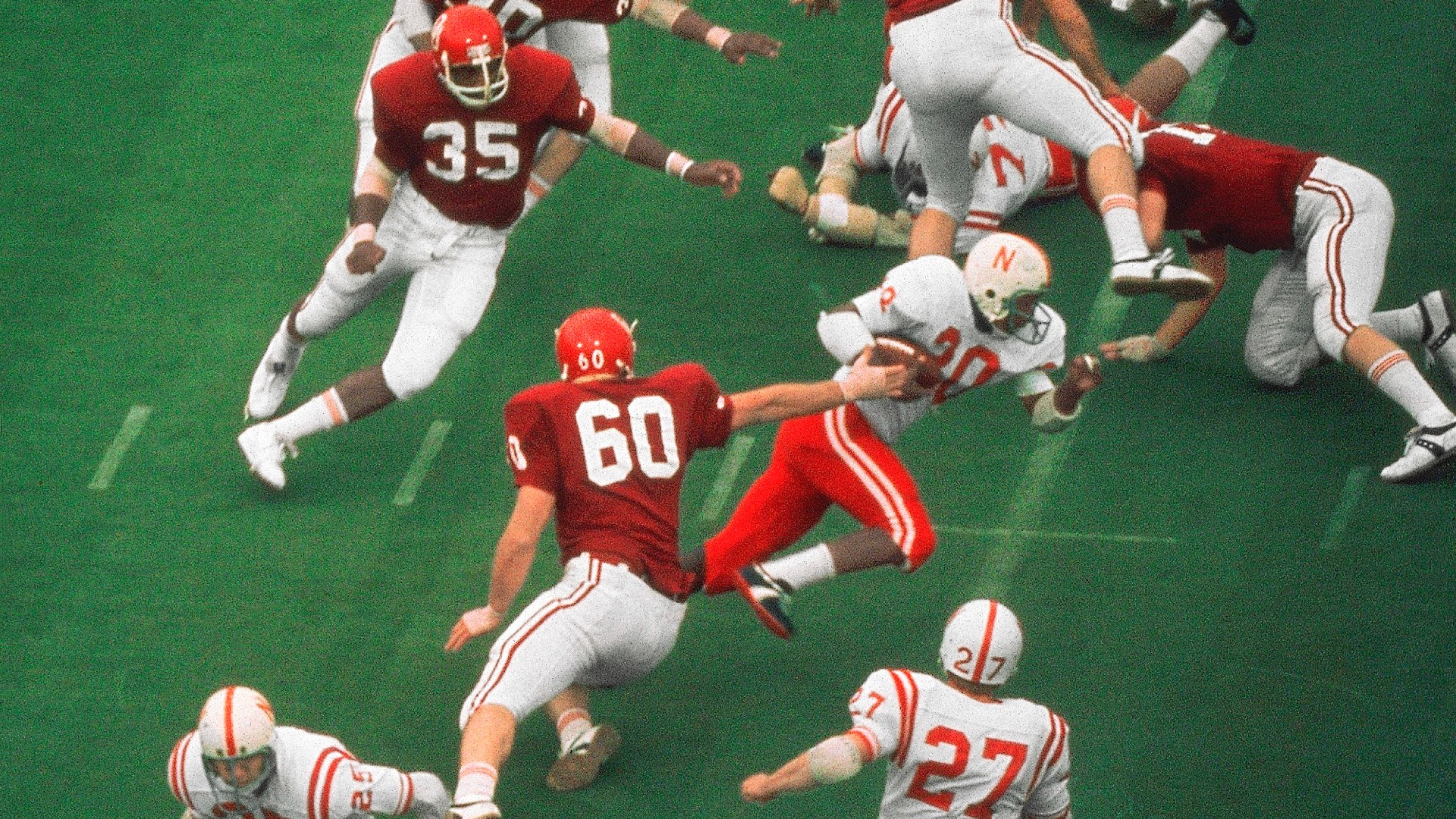
Number 20: Johnny Rodgers

November 25, 1971: One of college football's occasional "Games of the Century" is played.

They seemed to be coming every year. 1966 saw Michigan State vs. Notre Dame, in the Big Ten region if not a Big Ten game in its own right. 1967 saw USC vs. UCLA, in the league now known as the Pac-12. 1969 saw Texas vs. Arkansas, in the now-defunct Southwest Conference. In 1971, it was the turn of the league then known as the Big 8, now the Big 12.

For many years, the University of Nebraska's big rival was the University of Oklahoma. The rivalry was usually played on Thanksgiving weekend. In 1959, Nebraska beat Oklahoma, ending the Sooners' 74-game conference winning streak. In 1963, Nebraska won a game that the Big 8 refused to postpone, despite President Kennedy's assassination the day before.

On November 25, 1971, the Nebraska Cornhuskers and the Oklahoma Sooners met at Oklahoma Memorial Stadium, a.k.a. Owen Field, in Norman. The 'Huskers had won the National Championship the season before, were riding a 28-game unbeaten streak (27-0-1, without losing since October 11, 1969), and were ranked Number 1 in the country. The Sooners ranked Number 2. The entire country was watching that Thanksgiving Day.

Each team had a superstar running back. Nebraska, coached by Bob Devaney, had Johnny Rodgers, also a great receiver, from Omaha, running as the last back in the "I formation." He was known as "Johnny the Jet" and "Johnny R Superstar." The nickname clearly came from the theme song to the Broadway musical Jesus Christ Superstar, although it's not known if Nebraska fans made up a song for it, the way fans of London soccer team Arsenal made one up for "Charlie George, superstar."

Oklahoma had Greg Pruitt, a Houston native, running out of the wishbone offense, installed by coach Chuck Fairbanks, after he was impressed at how the Sooners' other big rivals, the University of Texas, ran it under coach Darrell Royal. (Ironically, Royal had played quarterback at Oklahoma.)

Chris Schenkel and Bud Wilkinson, who had established the Oklahoma dynasty before retiring (there were 2 other head coaches between him and Fairbanks), called the game for ABC, and the largest college football audience ever to that point, 55 million people, watched. It kicked off at 2:00 PM Central Time (3:00 Eastern, the ABC broadcast beginning 10 minutes before).

Nebraska stopped Oklahoma's 1st possession, and the Sooners had to punt. Rodgers returned the punt 72 yards for a touchdown. Twice in the 1st half, the Sooners fumbled the ball away. Rich Glover, the 'Huskers' middle guard, toyed with the Oklahoma offensive line.

The Sooners kicked a field goal, then teach team scored a touchdown in the 2nd quarter. But quarterback Jack Mildren led the Sooner offense on a long drive at the end of the 1st half, and Oklahoma had a 17-14 lead. It was the 1st time Nebraska had been behind all season long.

But a 3rd Sooner fumble led to the 'Huskers retaking the lead, and they expanded it to 28-17 late in the 3rd quarter, on Jeff Kinney's 3rd touchdown of the day. But near the end of the 3rd quarter, Mildren led the Sooners on another drive, and it was 28-24 'Huskers. He did it again, and with 7:10 left in regulation, Oklahoma led, 31-28.

The 'Huskers made the most of the time they had left. They got to the Sooner 48, and Husker quarterback Jerry Tagge through to Rodgers, who made a 2nd "signature play" in 1 game, breaking tackles and getting to the 15. Kinney scored his 4th touchdown of the game with 1:38 left. Oklahoma got the ball back, but the 'Huskers sacked Mildren on 3rd and 4th down to put it away. Final score: Nebraska 35, Oklahoma 31.

Nebraska thus clinched the Big 8 title, kept the Number 1 ranking, and set themselves up for the National Championship. They did have 1 more regular-season game, traveling to Hawaii, and they won, 45-3. They closed with another Number 1 vs. Number 2 matchup, beating Alabama in the Orange Bowl in Miami, 38-6.

Oklahoma only dropped to Number 3, and also had 1 more regular-season game, against in-State rival Oklahoma State. They traveled to Stillwater, and beat the Cowboys, 58-14. The aforementioned Alabama beat their big rivals, Auburn, in "the Iron Bowl" in Birmingham, 2 days after Thanksgiving, and Auburn, holding their Number 5 ranking, played Oklahoma in the Sugar Bowl in New Orleans. Oklahoma won, 40-22. Nevertheless, they finished the season with only the Sugar Bowl trophy, while Nebraska were the National Champions and the Big Eight Conference Champions.

Nebraska's 31-game unbeaten streak (30-0-1) ended with the opening game of the 1972 season, 20-17 against UCLA at the Los Angeles Coliseum. Then they went 9-0-1, with only a tie against Iowa State further marring their record. They had gone 40-1-2 over 3 years, a staggering total, for a .942 winning percentage. Then they hosted Oklahoma at Memorial Stadium in Lincoln on Thanksgiving, and the Sooners got some revenge, 17-14. 

After beating Notre Dame in the 1973 Orange Bowl, Devaney retired as Nebraska head coach, becoming athletic director, and elevating his offensive coordinator Tom Osborne to the head job. Osborne had a great deal of success, winning 13 Conference Championships, and 12 bowl games including 9 of those traditionally contested on New Year's Day; but also some staggering near-misses for the National Championship, before winning it in the 1994, 1995 and (in a split poll) 1997 seasons.

Nebraska's Johnny Rodgers was awarded the Heisman Trophy for the 1972 season. The San Diego Chargers took him with their 1st round pick in the 1973 NFL Draft. Instead, he signed with the Montreal Alouettes of the Canadian Football League. He won a Rookie of the Year award, 2 Most Valuable Player awards, and the 1974 Grey Cup (CFL Championship.)

In 1977, with the Chargers still holding his NFL rights, he signed with them. But he was plagued with injuries, and retired after the 1978 season, having played only 17 NFL games.

Oklahoma's Greg Pruitt had a much better pro career. He made 5 Pro Bowls, 4 with the Cleveland Browns and 1 with the Los Angeles Raiders, and was a member of the Raiders' Super Bowl XVIII winners in 1984. Both Rodgers and Pruitt were elected to the College Football Hall of Fame, but neither made it to the Pro Football Hall of Fame.

In 1978, Nebraska won the regular-season game, as Number 4 beating Number 1 Oklahoma, but a rematch was set up in the Orange Bowl (which then took the Big 8 winner), and Oklahoma won it. In 1987, Oklahoma were Number 2 when they beat Number 1 Nebraska.

The Big 8's 1996 conversion into the Big 12 put the teams in separate divisions, as Oklahoma and Oklahoma State were put in with the 4 teams brought in from Texas to form the South Division, to balance the divisions out, ending Huskers-Sooners as an annual rivalry.

Nebraska's 2011 move to the Big Ten made the matchup even rarer: They stopped playing each other after Oklahoma beat them in the 2010 Big 12 Championship Game. They finally met again on September 18, 2021, in Norman, to celebrate the 50th Anniversary of that Game of the Century. Oklahoma won, 23-16.

Overall, Oklahoma leads the rivalry 46-38-3, but it's 43-23 Oklahoma since 1943, 11-8 Nebraska since 1988, and 7-2 Oklahoma since 2000.

*

November 25, 1971 was Thanksgiving Day, so it was a Thursday. 'Huskers-Sooners was 1 of 4 college football games played that day. Number 7 Georgia beat Georgia Tech, 28-24 at Grant Field in Atlanta. Number 12 Texas beat Texas A&M, 34-14 at Kyle Field in College Station, Texas. And Number 18 Mississippi, a.k.a. Ole Miss, beat Mississippi State, 48-0 at Hemingway Stadium in Oxford, Mississippi. (It's now named Vaught-Hemingway Stadium.)

In the NFL doubleheader, NBC telecast the opener, and the Detroit Lions beat the Kansas City Chiefs, 32-21 at Tiger Stadium in Detroit. (Remember: This was 50 years ago.) CBS aired the nightcap, and the Dallas Cowboys beat the Los Angeles Rams, 28-21 at Texas Stadium in the Dallas suburb of Irving Texas.

There were 3 games played in the NBA. The Phoenix Suns beat the Detroit Pistons, 122-103 at the Arizona Veterans Memorial Coliseum in Phoenix. The Philadelphia 76ers beat the Golden State Warriors, 112-111 at the Oakland Coliseum Arena. And the Los Angeles Lakers beat the Seattle SuperSonics, 139-115 at the Seattle Center Coliseum.

There were 2 games played in the American Basketball Association. The New York Nets lost to the Kentucky Colonels, 133-117 at Freedom Hall in Louisville. And the Virginia Squires beat the Pittsburgh Condors, 131-118 at the Civic Arena in Pittsburgh.

And 1 game was played in the NHL: The Boston Bruins beat the Philadelphia Flyers, 4-2 at the Boston Garden.

Also, actress Christina Applegate was born.

Thursday, November 3, 2022

November 3, 1962: The Birth of Nebraska's Red Sea

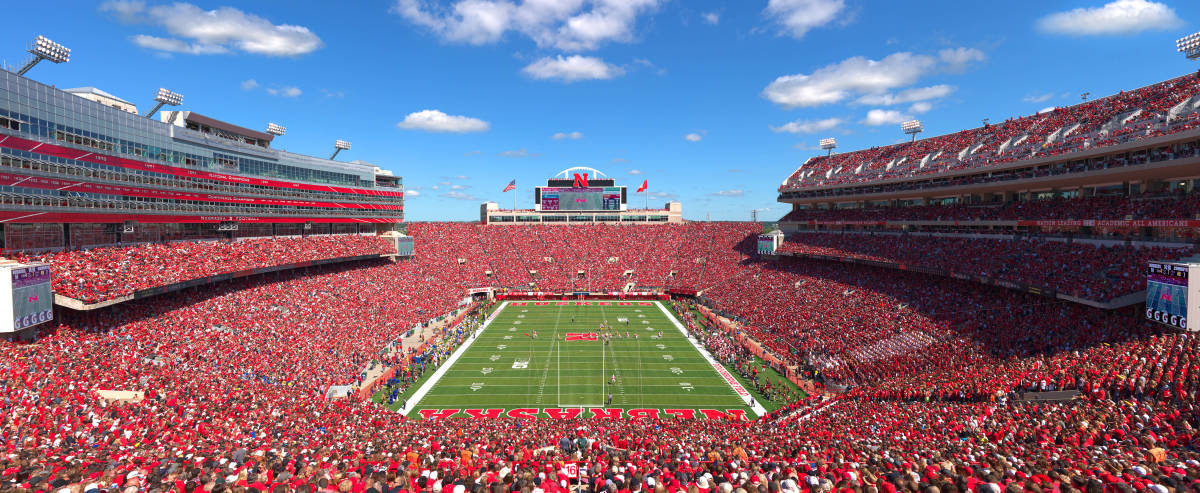
November 3, 1962: The University of Nebraska loses its Homecoming game, to Missouri, 16-7, at Memorial Stadium in Lincoln. The attendance is 36,501, a sellout. Despite Memorial Stadium now officially seating 85,458, the Cornhuskers sold out every home game for the next 57 years.
The Nebraska home crowd is known as the Red Sea. With no major league teams in the State -- the highest-ranking professional team is the Omaha Storm Chasers of Class AAA baseball -- Cornhusker football is it in the Cornhusker State. This is true for many States were there is no major league team, including Alabama, Arkansas and West Virginia.
The Nebraska fan base is devoted. How devoted is it? On December 4, 1982, 16,000 Nebraska fans showed up for a game against the University of Hawaii -- in Honolulu, a game they couldn't drive to. Nebraska won, 37-16, against a Hawaii team that were 6-4 going in, so it's not like they were a bad team.
Due to COVID-19 restrictions preventing fans from attending games in the 2020 season, Nebraska hosted 3 games there, with a combined attendance of exactly zero. The NCAA has chosen to exempt those games from the streak.
In 2021, despite a 3-9 season, one of the worst in Nebraska's modern history, the Cornhuskers played 6 home games, each with an attendance of at least 85,663. As of October 29, 2022, Nebraska's home sellout streak is officially 387 straight games. Since any other school with a sellout streak would also have seen it snapped in 2020, for the same reason, if you consider the 372 straight games from 1962 to 2019 to be the record and now over, that record is unlikely ever to be broken -- at least, not until the 2078 season.
*
November 3, 1962 was a Saturday. Among the other college football games played that day were these:
* Number 1 Northwestern beat Indiana, 26-21 at Seventeenth Street Stadium (now Memorial Stadium) in Bloomington, Indiana. Yes, Northwestern were ranked Number 1 in November. But they lost their next 2 games, to Wisconsin and Michigan State. They did go to the Orange Bowl stadium, but that was for a scheduled game with the University of Miami, which they won.
* Number 2 Alabama beat Mississippi State, 20-0 at Scott Field (now Davis Wade Stadium) in Starkville, Mississippi. Alabama blew its chances at the Southeastern Conference and National Championships by losing to Georgia Tech 2 weeks later. They were still invited to the Orange Bowl.
* Number 3 Southern California beat Number 9 Washington, 14-0 at the Los Angeles Memorial Coliseum. USC won the title of the Athletic Association of Western Universities (AAWU, a precursor to the Pacific-Twelve Conference).
* Number 4 Louisiana State were beaten by Number 6 Mississippi, 15-7 at Tiger Stadium in Baton Rouge, Louisiana. This was LSU's only loss of the season, although they had also been tied by Rice University. "Ole Miss" won the SEC Championship.
* Number 5 Texas beat Southern Methodist (SMU), 6-0 at Memorial Stadium in Austin, Texas. Texas won the Southwest Conference title, but lost the Cotton Bowl to LSU.
* Number 7 Michigan State were upset by Minnesota, 28-7 at Spartan Stadium in East Lansing, Michigan.
* Number 8 Arkansas beat Texas A&M, 17-7 at Kyle Field in College Station, Texas. Arkansas had already lost their shot at the SWC title by losing to Texas, but were invited to the Sugar Bowl, where they lost to Ole Miss.
* Number 10 Auburn were upset by Florida, 22-3 at Florida Field in Gainesville.
* Wisconsin, then unranked, beat Michigan, 34-12 at Michigan Stadium in Ann Arbor. Wisconsin won the Big Ten Conference title, but lost the Rose Bowl to USC, making USC the National Champions.
* Oklahoma, then unranked, beat Colorado, 62-0 at Folsom Field in the Denver suburb of Boulder, Colorado. Oklahoma won the Big Eight Conference title, then beat Alabama in the Orange Bowl.
* Among the service academies, Army beat Boston University, 26-0 at Nickerson Field in Boston; Navy lost to Notre Dame, 20-12 at Municipal Stadium (later John F. Kennedy Stadium) in Philadelphia; and Air Force beat Wyoming, 35-14 at Falcon Stadium in Colorado Springs.
* And among New Jersey teams, Rutgers beat Lafayette, 40-0 at the old Rutgers Stadium in Piscataway; and Princeton beat Brown, 28-12 at Palmer Stadium in Princeton.
There were 4 games played in the NBA that day:
* The Boston Celtics beat the Detroit Pistons, 125-11 at the Boston Garden.
* The Syracuse Nationals beat the Cincinnati Royals, 130-111 at the Onondaga County War Memorial (now the Upstate Medical University Arena) in Syracuse, New York. This would be the last season for the Nationals: The next season, 1963-64, they moved, becoming the Philadelphia 76ers.
* The St. Louis Hawks beat the Chicago Zephyrs, 114-109 at the Kiel Auditorium in St. Louis. The next season, the Zephyrs moved, becoming the Baltimore Bullets. They moved to Washington in 1973, and became the Washington Wizards in 1997.
* And the Los Angeles Lakers beat the San Francisco Warriors, 127-115, despite Wilt Chamberlain scoring 72 points -- yes, seventy-two -- for the Warriors, in their 1st season in the San Francisco Bay Area, having previously been the Philadelphia Warriors.
And there were 2 games played in the NHL. The New York Rangers and the Montreal Canadiens played to a tie, 3-3 at the Montreal Forum. And the Detroit Red Wings beat the Toronto Maple Leafs, 7-3 at Maple Leaf Gardens in Toronto. The Boston Bruins and the Chicago Black Hawks were not scheduled.

Wednesday, October 5, 2022

October 5, 1988: Dan Quayle Proves He Is No Jack Kennedy

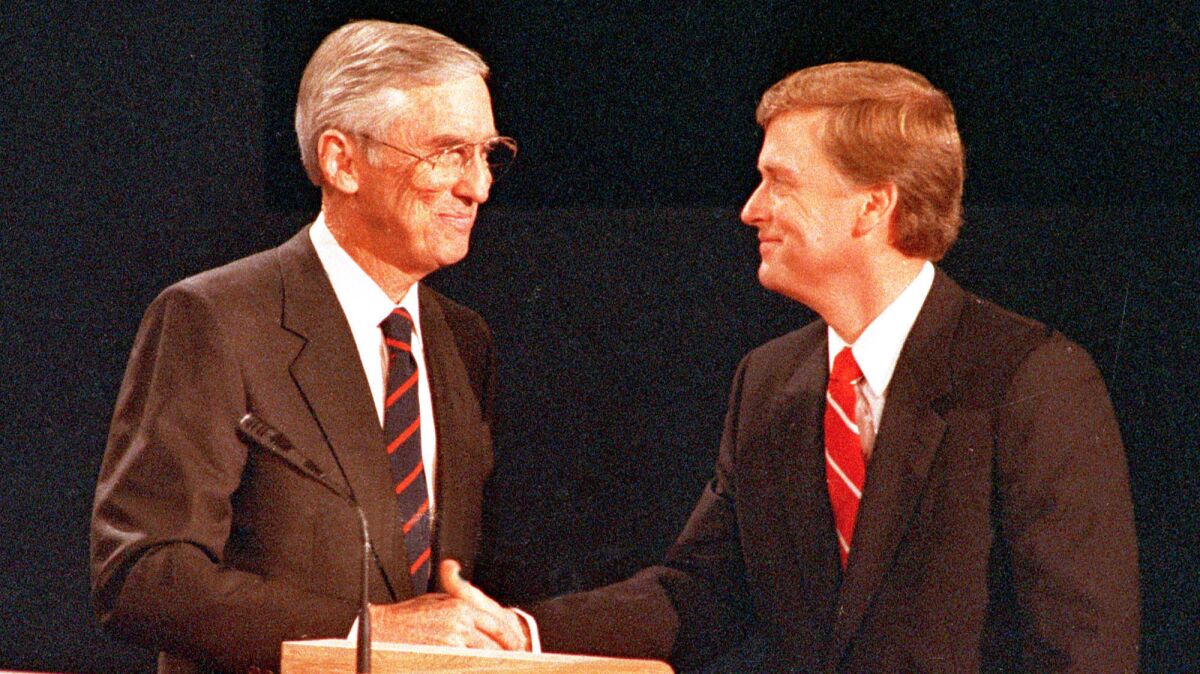
October 5, 1988: The Omaha Civic Auditorium is home to the Vice Presidential Debate. The Republican Party's nominee, Dan Quayle, is just 41, but has been in the Senate for 8 years, and represented an Indiana district in the House of Representatives for 4 years before that. That's 12 years in the Congress, compared to the 14 years that John F. Kennedy had when he was elected President in 1960.
So when he's asked about his qualifications for the Presidency, in the event his running mate, the incumbent Vice President, George H.W. Bush, should win but die in office, or resign, or be impeached and removed, Quayle says, "I have far more experience than many others that sought the office of Vice President of this country. I have as much experience in the Congress as Jack Kennedy did when he sought the Presidency."
The Democratic Party's nominee, Senator Lloyd Bentsen of Texas, was 67 years old, was first elected to Congress in 1948 and to the Senate in 1970. He had run for President in 1976, but hadn't done well. He had been told by those preparing for this debate to expect this comparison.
He points out the flaw in Quayle's reasoning: "Senator, I served with Jack Kennedy. I knew Jack Kennedy. Jack Kennedy was a friend of mine. Senator, you're no Jack Kennedy."
It had been just 25 years since JFK was assassinated, and his time in office was still fresh in many people's memories. Quayle's comparison had left many of them offended, and they cheered Bentsen's rejoinder.
Instead of saying, "I didn't say I was, Senator. I was comparing our experiences," as an intelligent man might have, Quayle got hissy and, incorrectly, said, "That was really uncalled for, Senator." Bentsen replied, "You are the one that was making the comparison, Senator. And I'm one who knew him well. And, frankly, I think you are so far apart in the objectives you choose for your country that I did not think the comparison was well-taken."
Before this debate, Quayle looked like, as Saturday Night Live would say, a "Not Ready for Prime Time Player." After it, he looked like a naive idiot. Ron Brown, chairman of Jesse Jackson's Presidential campaign and soon to be elected Chairman of the Democratic National Committee, used an old expression, saying that Quayle "looked like a deer caught in the headlights." Had these been the Presidential nominees, Bentsen would have won in a landslide.
But this debate turned out to be little more than an entertaining footnote in the campaign. Bush won in a landslide, defeating Governor Michael Dukakis of Massachusetts, winning 40 States for 411 Electoral Votes. No nominee of either party has come close to those totals since.
Quayle proved to be so bad at the job of Vice President, he's never been seriously considered for the Republican nomination for President, despite being younger than the Party's nominees in 1996, 2000, 2004, 2008 and 2016, and mere days older than their 2012 nominee.
Once, he was talking about how important role models are. Turns out, he was a role model -- for the stupidity, ignorance and extremism that the Republican Party has since embraced wholesale.
The Omaha Civic Auditorium opened in 1954, and was demolished in 2016. It was also famous for being the site of Elvis Presley's concert on June 19, 1977, taped for a CBS special, intended for the Christmas season. But the performance was so bad that CBS was going to shelve it permanently -- until he died, and then they showed it on October 3 of that year.


*

October 5, 1988 was a Wednesday. Football was in midweek. The NHL season began the next day; the NBA season, not until November 4.

Game 2 of the National League Championship Series was played at Dodger Stadium in Los Angeles. The New York Daily News had hired New York Mets pitcher David Cone to write a postseason diary. After the Mets' win last night in Game 1, he unfavorably compared Los Angeles Dodgers closer Jay Howell with Met closer Randy Myers: "We saw Howell throwing curveball after curveball and we were thinking: This is the Dodgers' idea of a stopper? Our idea is Randy, a guy who can blow you away with his heat. Seeing Howell and his curveball reminded us of a high school pitcher."

That got the Dodgers mad, and they take it out on the Mets' Game 2 starter -- who happens to be Cone. They Dodgers score a run in the 1st and 4 in the 2nd, and win, 6-3. The series is tied.

Big mistake, Coney. It's worth mentioning that he was not yet with the Mets when they won the 1986 World Series. It's also worth mentioning that, from this day forward, the Mets have never won another World Series. Cone would go on to win 5 World Series, including 4 with the Yankees.

Game 1 of the American League Championship Series was also played, at Fenway Park in Boston. Rick Honeycutt outpitched Bruce Hurst, and was backed by a home run from José Canseco, and the Oakland Athletics beat the Boston Red Sox, 1-0. The A's went on to sweep this series, and were heavily favored to beat the Dodgers in the World Series. But the Dodgers won the Series in 5 game.

Sunday, September 4, 2022

September 5, 1877: The Execution of Crazy Horse

Crazy Horse was never photographed, due to
a Native superstition that photography captured the subject's soul.
A Mormon missionary made this sketch after interviewing
Crazy Horse's sister, and she claimed the depiction was accurate.

September 5, 1877: The Lakota warrior Crazy Horse is executed -- martyred -- at Fort Robinson, Nebraska.

It's not clear how old he was, but, based on the sources available at the time, the likeliest year of his birth was 1840, making him 36 or 37 at the time of his death. He was born to the Lakota branch of the Sioux tribe of Native Americans, near Rapid Creek, in what is now South Dakota. He was born with the name Čháŋ Óhaŋ, meaning ''Among the Trees," indicating that he was "one with nature." Eventually, he was given the same name as his father: Tȟašúŋke Witkó, meaning ''His Horse Is Crazy.'' 

A cousin, Black Elk, described him in the 1932 book Black Elk Speaks: Being the Life Story of a Holy Man of the Oglala Sioux:

He was a queer man and would go about the village without noticing people or saying anything. In his own teepee he would joke, and when he was on the warpath with a small party, he would joke to make his warriors feel good. But around the village, he hardly ever noticed anybody, except little children. All the Lakotas like to dance and sing, but he never joined a dance, and they say nobody ever heard him sing. But everybody liked him, and they would do anything he wanted or go anywhere he said.

(In this case, "queer" meant "strange," not "homosexual." Crazy Horse is known to have married at least once, and fathered at least one child, a daughter. And a story dating to before his marriage reports that a tribesman once caught Crazy Horse with his wife.)

In 1864, after the Third Colorado Cavalry decimated Cheyenne and Arapaho tribesmen in the Sand Creek Massacre, Oglala and Minneconjou bands allied with them against the U.S. military. Crazy Horse was present at the Battle of Platte Bridge (near present-day Casper, Wyoming) and the Battle of Red Buttes (on the North Platte River in Nebraska) in July 1865. Both were Native victories.

On December 21, 1866, he led a group of 10 men who killed 81 men at Fort Phil Kearny, Wyoming, in what became known as the Fetterman Massacre. His reputation grew from there, peaking on June 25, 1876, when his troops crushed the U.S. Army's 7th Cavalry, killing 268 of them, including their commanding officer, Lieutenant Colonel George Custer, at the Battle of the Little Bighorn in Montana.

The U.S. government's reaction was to put an end to the threat by any means necessary. They cut off supply lines, separating the Lakota from the buffalo, their main sources of food and clothing, for the Winter. The idea was to starve and freeze them into surrendering. It worked: Crazy Horse took his men to the Red Cloud Agency, located near Fort Robinson, Nebraska, on May 5, 1877.

On September 5, the Agency received orders that Crazy Horse was to be arrested and taken under the cover of darkness to Division Headquarters. Once there, Crazy Horse struggled with the guard, made up entirely of Natives. He was stabbed with a bayonet by one of the members of the guard. He died that night. His remains were turned over to his elderly parents. His final resting place is not known to the white man.

Historian Ian Frazier wrote of him:

Even the most basic outline of his life shows how great he was, because he remained himself from the moment of his birth to the moment he died; because [though] he may have surrendered... he was never defeated in battle; because, although he was killed, even the Army admitted he was never captured. His dislike of the oncoming civilization was prophetic. Unlike many people all over the world, when he met white men he was not diminished by the encounter.

In response to the carving of Mount Rushmore, near Rapid City, South Dakota, which Natives consider a desecration of one of their holy lands, Korczak Ziolkowski, who had worked on it, designed the Crazy Horse Memorial. He died in 1982, early in the moument's construction. When the head was completed in 1998, it was 87 feet high, compared to the 60-foot-high faces on Rushmore, 17 miles away. 
The Memorial in 2020

When finished, if it ever is, the Memorial will show Crazy Horse on a horse, pointing with his left arm. At last check, the hand, arm, shoulder, hairline, and top of the horse's head were anticipated to be finished by 2037.

*

September 5, 1877 was a  Wednesday. At the time, the only professional sports league in North America was baseball's National League. And no games were played that day.

Tuesday, June 28, 2022

June 28, 1947: The 1st College World Series

The 1947 Cal Golden Bears, National Champions

June 28, 1947: The 1st NCAA Baseball Tournament Final, the 1st College World Series, is played at Hyames Field, on the campus of Western Michigan University, in Kalamazoo, Michigan. It is an East vs. West matchup, as the University of California, having already won the day before, 17-4, defeat Yale University again, 8-7.

The Cal team featured Jackie Jensen, who would also play for them in the 1949 Rose Bowl. He went on to win the World Series with the New York Yankees in 1952, 1953 and 1956; win the American League Most Valuable Player award with the Boston Red Sox in 1958; make 3 All-Star Games; appear on the TV series Home Run Derby at the start of the 1960 season; and retire due to a fear of flying, after just 199 career home runs.

He remains the only player ever to play in the World Series, the College World Series, and the Rose Bowl. Chuck Essegian is the only other player to play in both the major-league World Series (in his case, with the 1959 Los Angeles Dodgers) and the Rose Bowl (1952, with Stanford).

Yale returned to the CWS in 1948, losing to another West Coast team, the University of Southern California (USC). Both times, Yale's 1st baseman was George H.W. Bush, who didn't play in Major League Baseball, but went into politics, eventually being elected the 41st President of the United States in 1988.

After its 1st 2 seasons, in Kalamazoo, the tournament was moved to Lawrence Stadium in Wichita, Kansas for 1949. Since 1950, it has been held in Omaha, Nebraska, first at what became known as Johnny Rosenblatt Stadium, and then, from 2011 onward, at Charles Schwab Field Omaha.

In 2008, with the rise of women's college softball, the names of the tournaments have been the Men's College World Series and the Women's College World Series. Both tournaments start with 64 teams, in 8 regions, and the 8 regional winners play in the CWS, in 2 4-team double-elimination tournaments, with the winners of each bracket playing a best-2-out-of-3 championship series.

Given the regional ability to play more games in better weather, it is not surprising that the most successful teams have been in the Sun Belt. USC have won 12 National Championships, Louisiana State University (LSU) 6, the University of Texas 6, Arizona State 5; and 4 each have been won by Arizona, the University of Miami, and California State University at Fullerton. Among Winter States, the University of Minnesota and Oregon State University have done the best, winning 3 each.

The Women's College World Series, though not yet under that name, was 1st played in 1969. As with the men, the Sun Belt dominates: The University of California at Los Angeles (UCLA) have won 12 titles, while Arizona have won 8, Oklahoma 6, and no other school has won more than 2.

(UPDATE: In 2023, the LSU men and the Oklahoma women each won a 7th title. The Oklahoma women won an 8th in 2024.)

*

June 28, 1947 was a Saturday. These baseball games were played that day:

* The New York Yankees beat the Philadelphia Athletics, 5-2 at Shibe Park in Philadelphia. Randy Gumpert went the distance for the win. George McQuinn and Tommy Henrich hit home runs. Joe DiMaggio went 1-for-2 with 2 walks. Rookie Yogi Berra went 2-for-4.

* The New York Giants beat the Philadelphia Phillies, 14-6 at the Polo Grounds.

* The Brooklyn Dodgers lost to the Boston Braves, 5-4 at Braves Field in Boston. Earl Torgeson doubled Tommy Holmes home with the winning run in the bottom of the 9th inning. For the Dodgers, Johnny "Spider" Jorgenson and Fred "Dixie" Walker hit home runs. They were among the players phased out after this Pennant-winning season, because they couldn't get along with Jackie Robinson, who went 1-for-3 with 2 walks.

* The Boston Red Sox beat the Washington Senators, 8-0 at Griffith Stadium in Washington. Denny Galehouse pitched a 4-hit shutout. Ted Williams went 2-for-3 with 2 walks and an RBI.

* The Cleveland Indians beat the Chicago White Sox, 3-2 at Cleveland Municipal Stadium.

* The Detroit Tigers beat the St. Louis Browns, 6-3 at Briggs Stadium (later Tiger Stadium) in Detroit.

* The Chicago Cubs swept a doubleheader from the Pittsburgh Pirates, 6-2 and 6-5 at Wrigley Field in Chicago.

* And the St. Louis Cardinals beat the Cincinnati Reds, 8-7 at Sportsman's Park in St. Louis. Stan Musial went 2-for-4 with a walk and 2 RBIs.

June 28, 1928: The Tragedy of Harry Kersenbrock

Left to right: Phog Allen, Harry Kersenbrock, James Naismith

June 28, 1928: Harry Kersenbrock dies from drowning in Crete, Nebraska. He was only 22 years old.

He was born on December 4, 1905, also in Crete, Nebraska. The last of 8 children, his father died when he was a toddler, and his mother had to raise all 8 alone. "High Harry" grew to a height of 7 feet, one-half inch. In the Final of the 1925 Saline County Basketball Tournament, he played for Crete High against DeWitt, and scored all of his team's points in a 45-9 win. This was when there was still a center jump after every basket, so 45 was a lot of points for a single player, at any level.

He played basketball at Doane College (renamed Doane University in 2016) in Crete, before transferring to the University of Kansas, coached by Dr. Forest "Phog" Allen, with his mentor, the inventor of basketball, Dr. James Naismith, still teaching on campus. (Both men were certified medical doctors.)

Like a later, even taller, basketball star at that school, Wilt Chamberlain, he was also an expert high jumper by the standards of his time. Unlike Wilt, he also played football, at least at Doane, using his height to stop any runner and bat down any pass.

On June 28, 1928, he and a former Crete High and Doane football teammate, Byron Horn, were canoeing on the Blue River, near Crete. As they approached the boathouse, the canoe tipped, throwing them both into the water. Kersenbrock took Horn down with him once before both gained a hold on the canoe.

Horn could swim slightly, and Kersenbrock not at all, friends said. Horn told him to hang on, as he tried to swim ashore pulling the canoe. But the hold slipped, and the football player went down, not rising again.

He has been forgotten. But, even had he lived, there might not have been much of a post-college platform for him. This was before the advent of college basketball doubleheaders at Madison Square Garden in New York, the NCAA Tournament, the NIT, or any professional basketball league that could be called "major."

Harry Kersenbrock never got to become a Kansas Jayhawk basketball legend like his predecessors Paul Endacott, Charlie T. Black or Tusten Ackerman; or his successors Charles B. Black (no relation to Charlie T.), Ray Evans, Clyde Lovellette, B.H. Born, Wilt Chamberlain, Walt Wesley, Jo Jo White, Dave Robisch, Darnell Valentine, Danny Manning, Jacques Vaughn, Raef LaFrentz, Paul Pierce, Drew Gooden, Kirk Hinrich, Nick Collison, Thomas Robinson or Frank Mason III.

*

June 28, 1928 was a Thursday. Patrick Hemingway, writer and wildlife manager, was born on this day, to writer and adventurer Ernest Hemingway and 2nd wife, Pauline Pfeiffer. This was also the day that Governor Al Smith of New York was nominated for President by the Democratic Party, making him the 1st Catholic major-party nominee for the office. I have a separate entry for that event.

These baseball games were played:

* The New York Yankees beat the Philadelphia Athletics, 10-4 at Shibe Park in Philadelphia. George Pipgras went the distance for the win, while Rube Walberg only pitched 2 innings. Babe Ruth went 3-for-5 with 2 home runs, a walk and 3 RBIs. Bob Meusel went 2-for-4 with a home run, a walk, and 2 RBIs. Lou Gehrig went 2-for-4 with a walk and an RBI.

Playing out the string with the A's, Ty Cobb went 1-for-5 with an RBI, Eddie Collins struck out as a pinch-hitter, and Tris Speaker did not get into the game. Jimmy Dykes went 3-for-4 with a home run, a walk and 3 RBIs. Al Simmons went 1-for-4. Jimmie Foxx went 0-for-3 with a walk. He was catching, and Mickey Cochrane did not get into the game.

* The New York Giants beat the Philadelphia Phillies, 2-1 at the Polo Grounds. Bill Terry and Mel Ott each went 0-for-2 with a walk.

* A doubleheader was split at Fenway Park in Boston. The Washington Senators won the opener, 4-3. The Boston Red Sox won the nightcap, 8-7.

* The St. Louis Browns beat the Detroit Tigers, 5-2 at Navin Field (later Briggs Stadium and Tiger Stadium) in Detroit.

* The Chicago White Sox beat the Cleveland Indians, 3-2 at Comiskey Park in Chicago.

* The St. Louis Cardinals beat the Pittsburgh Pirates, 4-3 at Sportsman's Park in St. Louis. Frankie Frisch and Chick Hafey hit home runs. For the Pirates, Paul Waner went 1-for-3 with a walk and an RBI, and Pie Traynor and Lloyd Waner each went 0-for-4.

* The Chicago Cubs and the Cincinnati Reds were rained out at Redland Field (later renamed Crosley Field) in Cincinnati. The game was made up on July 2. The Cubs won, 8-2. Hack Wilson went 3-for-5 with 4 RBIs. Kiki Cuyler also went 3-for-5, but had no RBIs.

* And the Brooklyn Dodgers and the Boston Braves were not scheduled. 

Monday, February 7, 2022

February 8, 1896: What Became the Big Ten Conference Is Founded

February 8, 1896: The Intercollegiate Conference of Faculty Representatives is founded in Chicago. It eventually became known as the Big Ten Conference, or the Big 10. It is the oldest college sports league in America.

To deal with mounting criticism of college football, James Henry Smart, then the President of Purdue University in West Lafayette, Indiana invited the presidents of some other Midwestern schools to a meeting in Chicago. The original 7 members were Purdue; the University of Chicago; the University of Illinois, in Champaign, Illinois; the University of Michigan, in Ann Arbor; the University of Minnesota, in Minneapolis; Northwestern University, in Evanston, Illinois; and the University of Wisconsin, in Madison.

"The Intercollegiate Conference of Faculty Representatives" was an unwieldy name. So they called themselves "The Western Conference." This would appear to make little sense, but the western part of the U.S., in spite of the transcontinental railroad having been in place since 1869, still didn't really feel like part of the country to the east. And so, what is now called "the Midwest" was still "the West" for a lot of people.

Indicative of this is the fact that a school just north of Chicago is called "Northwestern University"; and also the fact that, in 1899, the University of Michigan published a fight song, "Hail to the Victors," that calls themselves "Michigan, the Champions of the West." Schools that would later oppose them in the Rose Bowl would sometimes get a laugh at that.

In 1899, Indiana University, in Bloomington, and the University of Iowa, in Iowa City, joined. This led to the league being nicknamed the Big Nine. In 1900, the University of Nebraska, in Lincoln, petitioned to join, but were turned down. They were turned down again in 1911.

In 1907, Michigan were voted out of the league. In 1912, the Ohio State University, in Columbus, were voted in. In 1916, Michigan were voted back in, and the league began to be called the Big Ten for the first time. In 1939, the University of Chicago de-emphasized their sports program, and dropped out, making the league a Big Nine again. In 1949, Michigan State University, in East Lansing, were admitted, and it was a Big Ten Conference again, although that name wasn't made official until 1987.
Logo, 1949-1990

From 1947 until 2001, the Rose Bowl in the Los Angeles suburb of Pasadena, California usually invited the Big 10 football champion to play against the champion of the league that would eventually be known as the Pac-8, the Pac-10 and the Pac-12.

Of those 55 appearances: Michigan made 16, Ohio State 12, Wisconsin 6, Iowa 5, Illinois 4, Michigan State 4, Minnesota 2, Northwestern 2, Purdue 2, Indiana 1... and Penn State 1. More on that in a moment. It should be noted that, until 1975, the Big 10 had a rule: No school could represent them in the Rose Bowl 2 years in a row. So, if a team won back-to-back titles, in the 2nd season, the 2nd-place team would go to the Rose Bowl instead.

In 1990, Pennsylvania State University, or "Penn State" for short, based in State College and an independent until then, were admitted as the league's 11th member, to begin play in the 1993-94 schoolyear. A vote was taken to keep the Big Ten name, but a new logo was designed, with the number 11 worked in. Leaving the Big 12, Nebraska were finally admitted, effective 2011, and the current "B1G" logo was unveiled.
Logo, 1990-2011

But at least a school in Nebraska was Midwestern, and it was odd, but not outrageous, to give a school in Central Pennsylvania the "Midwestern" label. But in 2013, effective the next year, the Big 10 admitted Rutgers University, in New Brunswick, New Jersey, from the Big East; and the University of Maryland, in the Washington suburb of College Park, from the Atlantic Coast Conference.

All geographical sense was blown out of the water in 2022, when the 2 major schools in Los Angeles -- UCLA, the University of California at Los Angeles, and USC, the University of Southern California -- were admitted, effective with the 2024-25 schoolyear. The Pac-12 was disintegrating. The following year, the University of Oregon, in Eugene, and the University of Washington, in Seattle, joined the Big 10, also effective in 2024. That made the Big 10 an 18-team league.

The University of Notre Dame, in South Bend, Indiana, had long had rivalries with Michigan, Michigan State, Purdue and Northwestern, and had occasionally had big games with Ohio State. But, being an independent, they didn't want to split bowl game and other-sports tournament revenue. Finally, other expenses prevailed: They joined the Big 10, but only for hockey purposes, in 2016, and the ACC for other sports.

A person knowing only geography, and not the history of college football, would think that Michigan and Michigan State would be a big rivalry. And it is. Certainly, Michigan State fans think of Michigan as their biggest rivals. But Michigan fans see MSU as merely "the little brother." To them, the true arch-enemy is Ohio State. The schools were so dominant in football for so long, and are again, that the league was often referred to as "The Big Two, Little Eight." UM-MSU is, however, a big rivalry in basketball and hockey.

In football, Michigan and Michigan State play each other for the Paul Bunyan Trophy. Michigan and Minnesota play for the Little Brown Jug. Minnesota and Wisconsin play for the Paul Bunyan Axe. And Minnesota and Iowa play for a bronze statue of a pig, named Floyd of Rosedale, after a live pig that was a trophy designed to actually calm down the rivalry during a nasty stage in 1935.

Minnesota vs. Wisconsin is easily the biggest college hockey rivalry in the country, the way many people (ignoring Alabama vs. Auburn and Texas vs. Texas A&M) think of Michigan vs. Ohio State. The biggest basketball rivalry is the intrastate one between Indiana and Purdue. In football, Indiana and Purdue play for the Old Oaken Bucket. Illinois vs. Northwestern is also a big rivalry.

Ohio State vs. Penn State would seem to be a big rivalry, but PSU's recency in the league keeps a damper on it. Penn State's main rivals are the University of Pittsburgh, now in the ACC. Same with Iowa vs. Nebraska: Both schools have a bigger rivalry with Iowa State, Iowa because it's intrastate, Nebraska because they were in the Big 8 and then the Big 12 with Iowa State. Neither Rutgers nor Maryland have a rivalry with any of the other Big 10 schools, although it wouldn't be surprising to see them develop one with each other.

*

February 8, 1896 was a Saturday. Baseball and football were out of season. Hockey was all-amateur. And basketball barely existed. The only scores on this day were in English soccer, and some of the teams involved no longer exist. And most of the teams that do don't even use the same names anymore.

Saturday, January 29, 2022

January 29, 1958: Charles Starkweather Is Arrested

January 29, 1958: Charles Starkweather is arrested in Douglas, Wyoming, after killing 11 people, 10 of them in a span of 8 days. He becomes one of the best-known "spree killers" in human history.

Charles Raymond Starkweather was born on November 24, 1938 in Lincoln, Nebraska. He had birth defects that manifested themselves in misshapen legs and a speech impediment. He was teased about these things, and, as he got older and bigger, began to strike back against the kids, the bullied becoming the bully.

He began to see anyone he didn't like as a target of his rage. Bob von Busch, a high school friend, said:
He could be the kindest person you've ever seen. He'd do anything for you if he liked you. He was a hell of a lot of fun to be around, too. Everything was just one big joke to him. But he had this other side. He could be mean as hell, cruel. If he saw some poor guy on the street who was bigger than he was, better looking, or better dressed, he'd try to take the poor bastard down to his size.
He dropped out of high school in his senior year, at age 18, got a job at a newspaper warehouse, and met Caril Ann Fugate, a 14-year-old girl who went to school near the warehouse. On November 30, 1957, he tried to buy her a stuffed animal at a service station in Lincoln -- on credit. The attendant, Robert Colvert, wouldn't do it. Starkweather returned later, with a shotgun, and forced Colvert to give him $100 from the station's till. That done, Starkweather shot Colvert, committing his first murder.

On January 21, 1958, Starkweather went to the Fugate home, but Caril's mother and stepfather, Velda and Marion Bartlett, told him to stay away. He shot them, and clubbed their 2-year-old daughter Betty Jean to death. He later told the police that Caril approved of all of it. She later told the police otherwise, but that she stuck with him, fearing for her own life.

Starkweather stole the Bartlett's car, took Caril with him, and drove to nearby Bennet, Nebraska, where he killed August Meyer, a farmer and a friend of the Bartletts, and his dog. The stolen car eventually got stuck in mud, and when a pair of local teenagers, Robert Jensen and Carol King (not the singer-songwriter Carole), offered them a ride, Starkweather told them to drive him and Caril to an abandoned storm cellar. Starkweather killed them as well, and stole Jensen's car.

He drove to a wealthy section of Lincoln, and broke into the home of industrialist C. Lauer Ward. He stabbed maid Ludmila Fenci, broke the neck of the family dog, stabbed Ward's wife Clara when she got home, and shot Ward when he got home. Then he stole some jewelry and Ward's 1956 Packard, and he and Caril fled.

These last 3 killings, because they took place in a wealthy home, caused more of an uproar than the preceding 7. Governor Victor Anderson even called out the Nebraska National Guard. It was too late: Starkweather had already gotten all the way across and out of the State. In Douglas, Wyoming, he saw a Buick pulled over. Traveling salesman Merle Collison was sleeping in the car. Needing another change of ride, because the Nebraska authorities had broadcast the description of the Packard, Starkweather shot Collison.

But, much as the Son of Sam would in New York nearly 20 years later, Starkweather caught an unlucky break. Unlike the Son of Sam, he knew it immediately. The Buick had something he'd never seen before: An emergency brake, or a parking brake. Not knowing it had to be released, he tried to drive off, and the car stalled.

Just then, another driver came by, a geologist named Joe Sprinkle. He offered to help, but Starkweather pointed the rifle at him. Instead of shooting Sprinkle, he just argued with him. And a Natrona County Sheriff's Deputy, William Romer, drove up. As he got out of the car, Caril ran out, yelling, "It's Starkweather! He's going to kill me!"
Caril Ann Fugate, 1958

Starkweather figured out the emergency brake, and drove off. Romer took Caril into the car, took off, and radioed for backup. It arrived, and Earl Heflin, the Sheriff of Converse County, shot out the Buick's windshield, causing the flying glass to cut Starkweather. He pulled over, and was arrested. Heflin told the press, "He thought he was bleeding to death. That's why he stopped. That's the kind of yellow son of a bitch he is."

Starkweather made a big mistake: Offered the choice of which State in which he could be tried, he chose Nebraska, unaware that Governor Milward Simpson of Wyoming (later a Senator, and the father of later Senator Alan Simpson) was opposed to the death penalty, and probably would have commuted his sentence to life. 

Starkweather tried to blame Caril for 3 of the killings, calling her "the most trigger-happy person I've ever met." She denied responsibility for any of the killings. He was tried only for the murder of Robert Jensen, and was convicted. He was electrocuted at the State Penitentiary in Lincoln on June 25, 1959, at the age of 20.

Caril was tried as an adult, though she was only 15 at the time. With a judge having told a jury that Fugate had many chances to escape, suggesting that her story of being an unwilling hostage didn't hold water, she was convicted as an accomplice, and sentenced to life in prison on November 21, 1958. In 1973, her sentence was commuted to 30 to 50 years, making her eligible for parole. On June 20, 1976, just before her 33rd birthday, and considered a model prisoner, she was paroled.

She settled in Hillsdale, Michigan, and worked as a janitorial assistant. In 2007, at the age of 64, she married for the 1st time, to machinist Frederick Clair. On August 5, 2013, a car crash seriously injured her, and killed her husband. Now going by her married name of Caril Ann Clair, she continues to maintain her innocence, and has applied for a pardon, with the support of some of the victims' relatives. Thus far, it has been denied.

The Starkweather case inspired episodes of the TV shows Naked City in 1962 and The Name of the Game in 1968; and the films Badlands (1973, starring Martin Sheen and Sissy Spacek), Stark Raving Mad (1983, Russell Fast and Marcie Severson, a dramatization of the true story), Kalifornia (1993, Brad Pitt and Juliette Lewis), Natural Born Killers (1994, Woody Harrelson and, again, Juliette Lewis), and Starkweather (2004, with Brent Taylor and Shannon Lucio playing the actual figures instead of a cinematic interpretation of them).

It also inspired Bruce Springsteen's 1982 song "Nebraska," and stuck in Billy Joel's memory enough for him to include the line "Starkweather homicide" in his 1989 Number 1 hit "We Didn't Start the Fire."

*

January 29, 1958 was a Wednesday. Baseball and football were out of season. There was 1 game in the NBA: The Boston Celtics beat the St. Louis Hawks, 111-101 at the Boston Garden. Bob Cousy had 39 points, Tommy Heinsohn 29 points and 15 rebounds, and Bill Russell 10 points and 24 rebounds. For the Hawks, Bob Pettit had 22 points and 18 rebounds. This was both a rematch of the previous season's NBA Finals, won by the Celtics; and a preview of this season's Finals, won by the Hawks.

In the NHL, the New York Rangers and the Boston Bruins played to a 1-1 tie at the old Madison Square Garden, and the Chicago Black Hawks beat the Toronto Maple Leafs, 4-1 at Maple Leaf Gardens in Toronto. The Montreal Canadiens and the Detroit Red Wings were not scheduled.

December 31, 1999 & January 1, 2000: The Millennium

December 31, 1999:  The Millennium arrives. The people of planet Earth survived. At a terrible cost. But we hadn't destroyed ourselves. ...