
January 29, 1958: Charles Starkweather is arrested in Douglas, Wyoming, after killing 11 people, 10 of them in a span of 8 days. He becomes one of the best-known "spree killers" in human history.
Charles Raymond Starkweather was born on November 24, 1938 in Lincoln, Nebraska. He had birth defects that manifested themselves in misshapen legs and a speech impediment. He was teased about these things, and, as he got older and bigger, began to strike back against the kids, the bullied becoming the bully.
He began to see anyone he didn't like as a target of his rage. Bob von Busch, a high school friend, said:
He dropped out of high school in his senior year, at age 18, got a job at a newspaper warehouse, and met Caril Ann Fugate, a 14-year-old girl who went to school near the warehouse. On November 30, 1957, he tried to buy her a stuffed animal at a service station in Lincoln -- on credit. The attendant, Robert Colvert, wouldn't do it. Starkweather returned later, with a shotgun, and forced Colvert to give him $100 from the station's till. That done, Starkweather shot Colvert, committing his first murder.
On January 21, 1958, Starkweather went to the Fugate home, but Caril's mother and stepfather, Velda and Marion Bartlett, told him to stay away. He shot them, and clubbed their 2-year-old daughter Betty Jean to death. He later told the police that Caril approved of all of it. She later told the police otherwise, but that she stuck with him, fearing for her own life.
Starkweather stole the Bartlett's car, took Caril with him, and drove to nearby Bennet, Nebraska, where he killed August Meyer, a farmer and a friend of the Bartletts, and his dog. The stolen car eventually got stuck in mud, and when a pair of local teenagers, Robert Jensen and Carol King (not the singer-songwriter Carole), offered them a ride, Starkweather told them to drive him and Caril to an abandoned storm cellar. Starkweather killed them as well, and stole Jensen's car.
He drove to a wealthy section of Lincoln, and broke into the home of industrialist C. Lauer Ward. He stabbed maid Ludmila Fenci, broke the neck of the family dog, stabbed Ward's wife Clara when she got home, and shot Ward when he got home. Then he stole some jewelry and Ward's 1956 Packard, and he and Caril fled.
These last 3 killings, because they took place in a wealthy home, caused more of an uproar than the preceding 7. Governor Victor Anderson even called out the Nebraska National Guard. It was too late: Starkweather had already gotten all the way across and out of the State. In Douglas, Wyoming, he saw a Buick pulled over. Traveling salesman Merle Collison was sleeping in the car. Needing another change of ride, because the Nebraska authorities had broadcast the description of the Packard, Starkweather shot Collison.
But, much as the Son of Sam would in New York nearly 20 years later, Starkweather caught an unlucky break. Unlike the Son of Sam, he knew it immediately. The Buick had something he'd never seen before: An emergency brake, or a parking brake. Not knowing it had to be released, he tried to drive off, and the car stalled.
Just then, another driver came by, a geologist named Joe Sprinkle. He offered to help, but Starkweather pointed the rifle at him. Instead of shooting Sprinkle, he just argued with him. And a Natrona County Sheriff's Deputy, William Romer, drove up. As he got out of the car, Caril ran out, yelling, "It's Starkweather! He's going to kill me!"
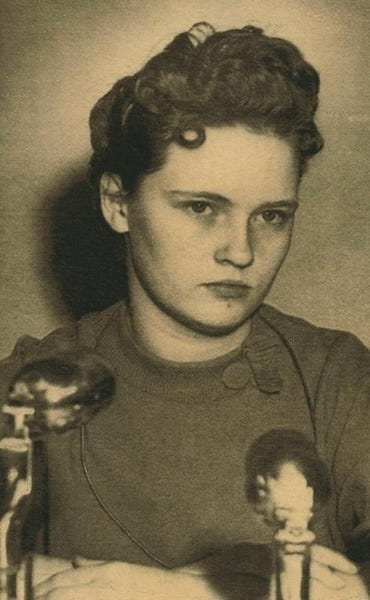
Caril Ann Fugate, 1958
Starkweather figured out the emergency brake, and drove off. Romer took Caril into the car, took off, and radioed for backup. It arrived, and Earl Heflin, the Sheriff of Converse County, shot out the Buick's windshield, causing the flying glass to cut Starkweather. He pulled over, and was arrested. Heflin told the press, "He thought he was bleeding to death. That's why he stopped. That's the kind of yellow son of a bitch he is."
Starkweather made a big mistake: Offered the choice of which State in which he could be tried, he chose Nebraska, unaware that Governor Milward Simpson of Wyoming (later a Senator, and the father of later Senator Alan Simpson) was opposed to the death penalty, and probably would have commuted his sentence to life.
Starkweather tried to blame Caril for 3 of the killings, calling her "the most trigger-happy person I've ever met." She denied responsibility for any of the killings. He was tried only for the murder of Robert Jensen, and was convicted. He was electrocuted at the State Penitentiary in Lincoln on June 25, 1959, at the age of 20.
Caril was tried as an adult, though she was only 15 at the time. With a judge having told a jury that Fugate had many chances to escape, suggesting that her story of being an unwilling hostage didn't hold water, she was convicted as an accomplice, and sentenced to life in prison on November 21, 1958. In 1973, her sentence was commuted to 30 to 50 years, making her eligible for parole. On June 20, 1976, just before her 33rd birthday, and considered a model prisoner, she was paroled.
She settled in Hillsdale, Michigan, and worked as a janitorial assistant. In 2007, at the age of 64, she married for the 1st time, to machinist Frederick Clair. On August 5, 2013, a car crash seriously injured her, and killed her husband. Now going by her married name of Caril Ann Clair, she continues to maintain her innocence, and has applied for a pardon, with the support of some of the victims' relatives. Thus far, it has been denied.
The Starkweather case inspired episodes of the TV shows Naked City in 1962 and The Name of the Game in 1968; and the films Badlands (1973, starring Martin Sheen and Sissy Spacek), Stark Raving Mad (1983, Russell Fast and Marcie Severson, a dramatization of the true story), Kalifornia (1993, Brad Pitt and Juliette Lewis), Natural Born Killers (1994, Woody Harrelson and, again, Juliette Lewis), and Starkweather (2004, with Brent Taylor and Shannon Lucio playing the actual figures instead of a cinematic interpretation of them).
It also inspired Bruce Springsteen's 1982 song "Nebraska," and stuck in Billy Joel's memory enough for him to include the line "Starkweather homicide" in his 1989 Number 1 hit "We Didn't Start the Fire."
*
January 29, 1958 was a Wednesday. Baseball and football were out of season. There was 1 game in the NBA: The Boston Celtics beat the St. Louis Hawks, 111-101 at the Boston Garden. Bob Cousy had 39 points, Tommy Heinsohn 29 points and 15 rebounds, and Bill Russell 10 points and 24 rebounds. For the Hawks, Bob Pettit had 22 points and 18 rebounds. This was both a rematch of the previous season's NBA Finals, won by the Celtics; and a preview of this season's Finals, won by the Hawks.
In the NHL, the New York Rangers and the Boston Bruins played to a 1-1 tie at the old Madison Square Garden, and the Chicago Black Hawks beat the Toronto Maple Leafs, 4-1 at Maple Leaf Gardens in Toronto. The Montreal Canadiens and the Detroit Red Wings were not scheduled.


No comments:
Post a Comment