Showing posts with label james cagney. Show all posts

Saturday, November 26, 2022

November 26, 1938: "Angels With Dirty Faces" Premieres

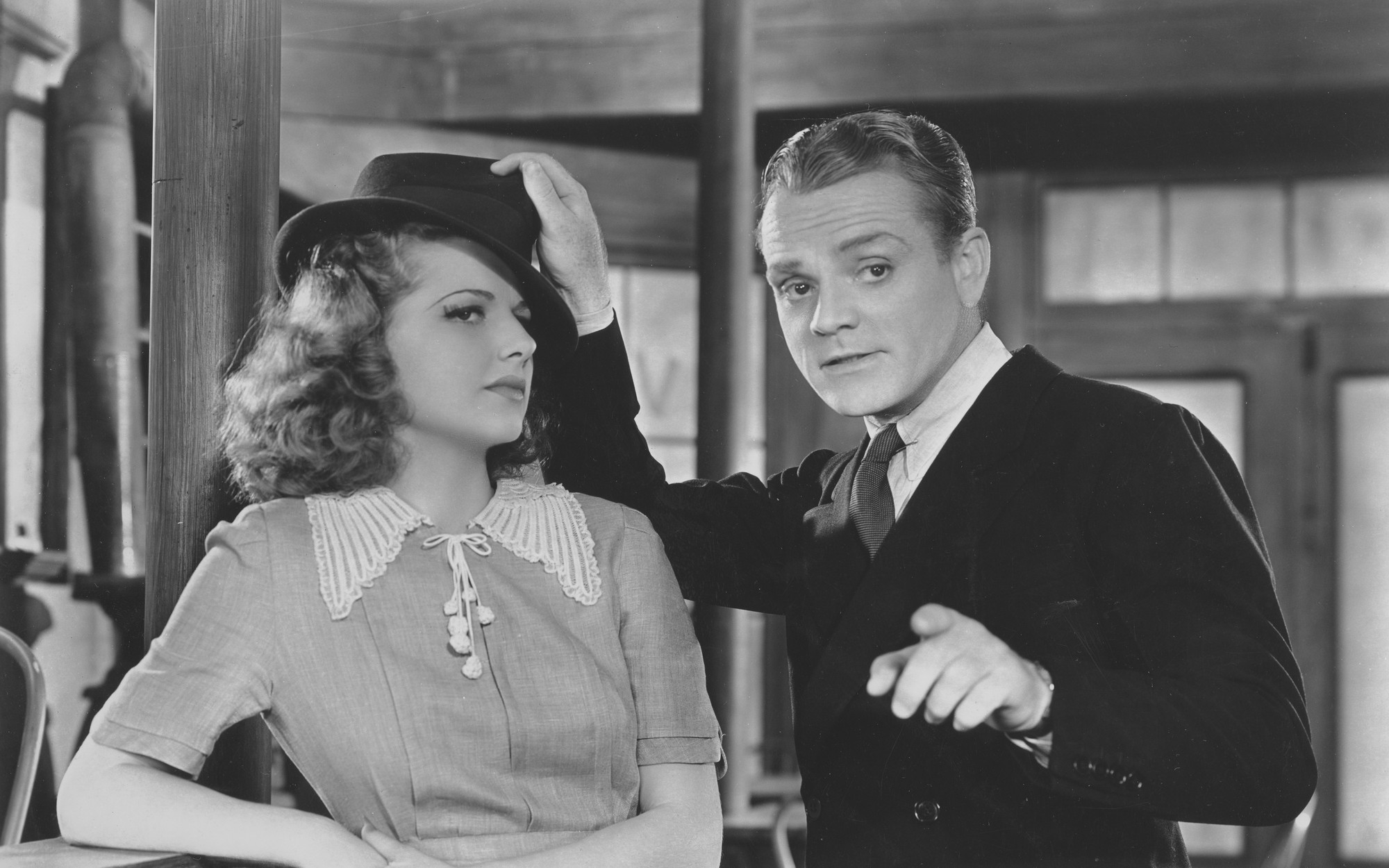
Ann Sheridan and James Cagney

November 26, 1938: Angels with Dirty Faces premieres. To paraphrase a much more recent saying, Everybody thinks they're a gangster until they face James Cagney.

In 1920, William "Rocky" Sullivan and Jerry Connolly are New York boys who commit a petty robbery. Jerry gets away, but Rocky is caught by the police, and goes to reform school. He doesn't reform, and grows up to be a criminal played by Cagney. Jerry is "scared straight" by the experience, and grows up to become a priest played by Pat O'Brien.

In 1935, Rocky is arrested for armed robbery. His lawyer and co-conspirator, Jim Frazier (Humphrey Bogart), asks him to take the blame for the robbery. In exchange, he will keep Rocky's share of the robbery, $100,000 (about $2.1 million in 2022 money), safe until he is released. Rocky agrees, and is sentenced to 3 years in prison.

After serving his sentence, Rocky returns to his old neighborhood, and rents a room in a boardinghouse run by Laury Martin (Ann Sheridan). He goes to Frazier's casino. Frazier promises to have the $100,000 ready by the end of the week, and he gives Rocky $500 spending money.

Rocky has his pocket picked by a gang of teenagers. In various films, these actors, always together, would be known under various names: The East Side Kids, the Bowery Boys, or, as they are here, the Dead End Kids. Rocky tracks them down to his old childhood hideout, and gives them what-for. They admit to an admiration of Rocky's reputation and criminal lifestyle. After retrieving his wallet and all the money therein, Rocky invites them to dinner.

While they are eating, Jerry arrives, and asks the gang why they have not been playing basketball. Laury expresses her concern over the potential negative influence Rocky may be having on the gang, which is echoed by Jerry.
Cagney as Rocky, O'Brien as Father Jerry

Frazier's goons try to kill Rocky, but he escapes. He finds Frazier, raiding his house at gunpoint and stealing $2,000 and a ledger. Rocky then brazenly approaches Frazier's business partner, Mac Keefer (George Bancroft), and requests $100,000 in trade for Frazier's release. With no other option, Mac agrees and pays Rocky, but as Rocky leaves, Mac informs on him to the police. Rocky is arrested, and sets about mocking the police for their lack of evidence, even goading them to ring his lawyer (Frazier).

Frazier approaches Mac and learns of Rocky's arrest. He informs Mac that Rocky is in possession of the ledger. This forces Frazier to tell the police it was all a "misunderstanding" -- Bogart was not yet big enough of a star to play actual tough guys -- and Rocky is released.

Jerry buys time on a radio station to expose corruption in New York. Rocky tries unsuccessfully to stop Jerry, as he knows the other mobsters won't take kindly to what his friend the priest is trying to do. Rocky isn't trying to protect himself, he's trying to protect Jerry. To this end,  Rocky kills Frazier and Keefer. After escaping the casino, he makes his way to an abandoned warehouse, where he is forced to kill a police officer. A standoff ensues with the police.

Jerry tells the police that he can get Rocky to surrender peacefully. Instead, Rocky takes Jerry hostage, but is shot in the leg by the police as he tries to escape. He is convicted of murder, and sentenced to death in the electric chair.

Right before his scheduled execution, Rocky tells Jerry he's not afraid to die. Jerry tells him to at least pretend to be scared, but he refuses, because his reputation is all he has left. In the end, though, he begs for mercy. His execution is shown only in shadow: The Hays Code meant that Rocky had to pay for all he'd done, but the public shouldn't actually see it happen.

The gang read in the newspaper of how Rocky "turned yellow." Soapy (Bill Halop), the gang's leader, asks Jerry if it's true. Jerry tells them it is, and says, "Come on, boys: Let's go say a prayer for a boy who couldn't run as fast as I could." He knows the cliché: "There but for the grace of God go I."

The film was nominated for 3 Academy Awards: Best Actor for Cagney, Best Director for Michael Curtiz, and Best Original Story by Rowland Brown. However, none won. It's hard to argue they were robbed, though. Spencer Tracy won for playing a different priest, the real-life Father Edward Flanagan (who was still alive), in Boys Town. Frank Capra won for directing You Can't Take It With You. And Boys Town also won for Best Original Story, by Eleanore Griffin and Dore Schary.

Cagney and O'Brien remained close friends until the end. In 1983, Cagney had a stroke, and was confined to a wheelchair. Still, CBS offered him the role of an elderly ex-boxer in the TV-movie Terrible Joe Moran. He wasn't sure he could do it, so he called O'Brien, who yelled, "Do it, Cagney! It's medicine!" and slammed the phone down.

O'Brien died a few days later, but Cagney took the role, and the film aired on March 27, 1984, with scenes from his 1932 boxing movie Winner Take All used to portray the younger Moran. Two years later, Cagney was dead. He did not die a coward.

Sadly, Ann Sheridan, known for her foxiness as "The Oomph Girl," died of cancer in 1967, only 52 years old.

*

November 26, 1938 was a Saturday. Impressionist Rich Little and Florida Congressman Porter Goss were born.

These college football games were played:

* Rivalry: Number 2 Texas Christian University (TCU), with Heisman Trophy-winning quarterback Davey O'Brien, beat Southern Methodist University (SMU), 20-7 at Ownby Stadium in Dallas.

* Number 3 Duke beat Number 4 Pittsburgh, 7-0 at Duke Stadium (now Wallace Wade Stadium) in Durham, North Carolina.

* Rivalry: Number 6 Oklahoma beat Oklahoma A&M (now Oklahoma State), 19-0 at Lewis Field (now Boone Pickens Stadium) in Stillwater, Oklahoma.

* Number 7 Carnegie Tech (now Carnegie-Mellon University) beat North Carolina State, 14-0 at Riddick Stadium in Raleigh, North Carolina.

* Rivalry: Number 11 Holy Cross beat Boston College, 29-7 at Fenway Park in Boston.

* Number 13 Dartmouth were upset by Stanford, 23-13 at Stanford Stadium in the San Francisco suburb of Palo Alto, California.

* Number 17 Texas Tech beat Marquette, 21-2 at Tech Field (now Jones Stadium) in Lubbock, Texas.

* Rivalry: Fordham beat New York University (NYU), 25-0, in front of 50,000 at Yankee Stadium.

* Rivalry: Army beat Navy, 14-7 at Municipal Stadium (later John F. Kennedy Stadium) in Philadelphia.

* Florida beat Alabama A&M (now Auburn), 9-7 at Fairfield Stadium in Jacksonville, Florida.

* Rivalry: The University of Mississippi (Ole Miss) beat Mississippi State, 19-6 at Scott Field (now Davis-Wade Stadium) in Starkville, Mississippi.

* Rivalry: Tulane beat Louisiana State (LSU), 14-0 at Tiger Stadium in Baton Rouge, Louisiana.

* Baylor beat Rice, 21-6 at Rice Field in Houston.

* Montana beat Arizona, 7-0 at Arizona Stadium in Tucson.

* Rivalry: Oregon State beat Oregon, 14-0 at Multnomah Stadium (now Providence Park) in Portland.

* Rivalry: Washington beat Washington State, 26-0 at Husky Stadium in Seattle.

* Idle this week: Number 1 Notre Dame, Number 7 USC, Number 9 California, Number 14 Southern California (USC); and, having completed their schedules, the entire Big Ten Conference, including Number 8 Minnesota, these schools in the New York Tri-State Area: City College of New York (CCNY), Rutgers and Princeton.

Two days before, on Thanksgiving, Number 5 Tennessee beat Kentucky, 46-0 at Shields-Watkins Field (now Neyland Stadium) in Knoxville, Tennessee. Also that day, Number 10 Cornell and the University of Pennsylvania played to a tie, 0-0 at Franklin Field in Philadelphia.

Among New York area schools playing on Thanksgiving: Manhattan College lost to Villanova, 20-0 at the Polo Grounds; and Columbia lost to Brown, 36-27 at Brown Stadium in Providence, Rhode Island.

USC and Cal tied for the Pacific Coast Conference title, but USC beat Cal for the tiebreaker. The following week, USC beat Notre Dame. USC went on to beat Duke in the Rose Bowl. St. Mary's, of the San Francisco Bay Area, beat Texas Tech in the Cotton Bowl. Minnesota won the Big Ten Conference title, but did not go to a bowl game.

Tennessee won the Southeastern Conference title. Oklahoma won the Big Six Conference title. Tennessee beat Oklahoma in the Orange Bowl. TCU won the Southwest Conference title, and beat Carnegie Tech in the Sugar Bowl. TCU and Tennessee split the polls for the National Championship.

Baseball was out of season. The NBA hadn't been founded yet. There were 2 games in the NHL. The New York Americans beat the Chicago Black Hawks, 6-4 at the old Madison Square Garden. And the Toronto Maple Leafs beat the Detroit Red Wings, 5-0 at Maple Leaf Gardens in Toronto.

And in English soccer, North London team Arsenal went to Yorkshire, and played Middlesbrough to a draw, 1-1 at Ayresome Park.

Monday, November 7, 2022

November 7, 1904: "Little Johnny Jones" Opens On Broadway

November 7, 1904: Little Johnny Jones opens at the Liberty Theatre at 236 West 42nd Street in New York. It is the 1st play staged there. George M. Cohan is the writer, director and star, playing an American jockey who goes to London to race in the famed Epsom Derby, loses, is accused of throwing the race, and must clear his name.
The show contains 2 of Cohan's legendary songs: "Yankee Doodle Dandy" and "Give My Regards to Broadway." The former not only becomes the title of the 1942 film biography of Cohan, starring James Cagney, but also helps to popularize "Yankees" as an alternative name for the New York Highlanders of baseball's American League.
Ironically, because New York Giants manager John McGraw cultivated Broadway performers as friends, Cohan became a Giants fan, despite being from Providence, Rhode Island. Cagney, however, was a Yankee Fan, and even threw out the ceremonial first ball at a 1981 World Series game. It was one of his last public appearances.
Cohan is best remembered for his patriotic songs, like "Grand Old Flag" and what became known as the theme song of the American Expeditionary Force in World War I, "Over There." Of all the stars that Broadway has ever had, he's the only one with a statue on the street, at the northern end of Times Square.
But, contrary to what the song "Yankee Doodle Dandy" says, he was not born on the 4th of July. He was born on July 3, 1878, in Providence. Close enough, he probably thought. He died of cancer on November 5, 1942, at 64, 5 months after the premiere of Yankee Doodle Dandy the film. (Film biographies of classical composers, and of writers of more recent popular songs, were big in the 1930s and '40s.)
The Liberty Theatre still stands, but has been converted into retail space, including a Ripley's Believe It Or Not Museum and a Famous Dave's restaurant. With some appropriateness, a Yankees Clubhouse Store is almost right across the street, at 236 West 42nd.
*
November 7, 1904 was a Monday. Baseball was out of season. Saturday had been standardized as the day for football. And the NBA and the NHL hadn't been founded yet. So there were no scores on this historic day.

Sunday, May 29, 2022

May 29, 1942: “Yankee Doodle Dandy” Premieres

May 29, 1942: Yankee Doodle Dandy premieres, starring James Cagney as George M. Cohan. Biographies of composers were a trend in the 1940s, both during and after World War II. Cohan lived long enough to see this film, but died 5 months later.

As "The Man Who Owned Broadway" -- he is the only actor to have a statue in the Theater District -- Cohan developed friendships with other New York celebrities in the late 19th and early 20th Centuries, including New York Giants manager John McGraw.

But it was another team that, sort of, was named for his work. When the American League put a team in New York in 1903, it was named the Highlanders. Too long a name to fit into a headline, so they looked for something shorter. In 1904, Cohan's musical Little Johnny Jones included the songs "Yankee Doodle Dandy" and "Give My Regards to Broadway." The word "Yankee" stuck in New Yorkers' minds, and, since all teams in the AL were unofficially nicknamed "the Americans," it fit, and it fit headlines, too: "Yankees" or "Yanks." The ballclub finally made it official in 1903.

Cohan was a Giants fan, but Cagney was a Yankee Fan, and, in one of his last public appearances, threw out the ceremonial first ball at Yankee Stadium before a 1981 World Series game.

*

May 29, 1942 was a Friday. This was also the day that actor John Barrymore died. I have a separate entry for that event. And hockey player Pierre Bourque and actor Kevin Conway were born.

These baseball games were played:

* The New York Yankees beat the Washington Senators, 16-1 at Yankee Stadium. Lefty Gomez went the distance for the win. Joe DiMaggio, Joe Gordon and Buddy Hassett hit home runs.

* The New York Giants beat their arch-rivals, the Brooklyn Dodgers, 3-1 at Ebbets Field. Babe Young batted in the top of the 10th inning, hitting a ground ball to shortstop Pee Wee Reese, who makes a bad throw, allowing 2 runs to score.

* The Philadelphia Phillies beat the Boston Braves, 2-1 at Braves Field in Boston.

* The Boston Red Sox beat the Philadelphia Athletics, 14-2 at Shibe Park in Philadelphia. Ted Williams went 3-for-4 with 2 home runs, a walk, and 7 RBIs.

* The Detroit Tigers beat the Cleveland Indians, 14-3 at Briggs Stadium (later renamed Tiger Stadium) in Detroit.

* The Chicago Cubs beat the Cincinnati Reds, 6-5 at Wrigley Field in Chicago. Joe Beggs walked Dom Dallesandro with the bases loaded in the bottom of the 10th inning.

* The Chicago White Sox beat the St. Louis Browns, 12-8 at Sportsman's Park in St. Louis.

* And the Pittsburgh Pirates and the St. Louis Cardinals were not scheduled.


Saturday, April 23, 2022

April 23, 1931: "The Public Enemy" Premieres

April 23, 1931: The Public Enemy premieres, based on Beer and Blood, a novel by John Bright and Kubec Glasmon. It is directed by William Wellman, and starring James Cagney. It wasn't the 1st great gangster movie -- Little Caesar, starring Edward G. Robinson, had premiered 3 months earlier -- but it made Cagney the defining gangster portrayer.

The term "public enemy" dates back to ancient Rome: "Hostis publicus" in the Latin of the time. The French Revolution used the term "ennemi du peuple," or "enemy of the people." In 1930, Frank Loesch, Chairman of the Chicago Crime Commission, used the term to describe the city's leading gangster Al Capone. This led to the use of the phrase in the title of the film.

Later, the phrase was used by FBI Director J. Edgar Hoover, to describe not just outlaws, but fugitives, men on the run from the law, whereas Capone, until his arrest for tax evasion, could sit tight and not really worry. Hoover had the FBI officially label bank robber John Dillinger "Public Enemy Number 1." After Dillinger was killed the title was given to others, eventually evolving into the FBI Ten Most Wanted Fugitives list. In 1985, rapper Carlton Ridenhour, a.k.a. Chuck D, named his group "Public Enemy," due to their distaste with law enforcement and its frequent racist actions.

James Francis Cagney Jr. was born on July 17, 1899 at 391 East 8th Street, between Avenues C and D, on Manhattan's Lower East Side. Sidney Zion, a columnist for the New York Daily News, listed him as one of "The Century Seven," 7 people born in 1899, the last year of the 19th Century, whose work guided American popular culture through much of the 20th Century. They were: Duke Ellington, born on April 29; Fred Astaire, May 10; James Cagney, July 17; Alfred Hitchcock, August 13; Hoagy Carmichael, November 22; Noël Coward, December 16; and Humphrey Bogart, December 25.

If Jimmy Cagney had his druthers, he wouldn't have become known for gangster movies. Like Fred Astaire, and like George Raft, who not only played gangsters but worked for some before becoming a star, he started out as a dancer.

And he was good enough to play the great Broadway showman George M. Cohan in the 1942 film Yankee Doodle Dandy, winning the Academy Award for Best Actor. It was this combination of playing showmen and tough guys that led actor Michael J. Fox to later say, "In acting school, everybody else wanted to be James Dean. I wanted to be James Cagney."

But his roles in gangster movies most him an icon. In The Public Enemy, he played Tom Powers, a Chicago street tough rising through the ranks of gangsters in the early 20th Century, boosted by Prohibition. Mae Questel played Kitty, his first girlfriend. Early in the film, they argue during breakfast, and he pushes half a grapefruit into her face. The scene is rough, but the still photos, including the one shown above, made it look even meaner.

He dumps Kitty for Gwen, played by the top "blonde bombshell" of the time, Jean Harlow. He doesn't get to enjoy her for long, though, as he meets a typical gangster's fate of getting gunned down in the gang war that his actions launched.

Cagney went on to play a lot of tough guys: Boxers, military men, and, yes, lawmen. Playing a con artist in the 1931 film Blonde Crazy, he called somebody, "That dirty, double-crossin' rat!" Playing a cabdriver in the 1932 film Taxi!, he pulled a gun, and told an enemy, "Come out and take it, you dirty, yellow-bellied rat, or I'll give it to you through the door!" From that point onward, anybody doing an impression of Cagney would say, "You dirty rat!" But the quote was never quite accurate.

But it would be gangsters that people would think of: Patsy Gargan in The Mayor of Hell in 1933, Flicker Hays in He Was Her Man and Jimmy Corrigan in Jimmy the Gent in 1934, Rocky Sullivan in Angels With Dirty Faces in 1938, Eddie Bartlett in The Roaring Twenties in 1939, and, one more time in perhaps his greatest role, Cody Jarrett in White Heat in 1949: "Made it, Ma: Top o' the world!"

After that, he was too old to play heroes anymore, and began playing not-so-likeable authority figures, like Lieutenant Commander Morton in Mister Roberts in 1955. That same year, he played Cohan again to Bob Hope's Eddie Foy in The Seven Little Foys, and played Lon Chaney Sr. in The Man of a Thousand Faces in 1957.

In 1961, he played C.R. McNamara, a Coca-Cola executive who made a mistake and was exiled to the company's West Berlin office, and was angling to get to run their main European office in London, in the comedy One, Two, Three. The film included an homage to The Public Enemy's grapefruit scene. He turned 62 during the making of the film, and was tired, and quit acting.

In 1974, he received the American Film Institute's Lifetime Achievement Award, in a ceremony recorded for television. He told the audience, "Just for the record, I never said, 'You dirty rat!' What I said was, 'Judy, Judy, Judy!'" That was also a misquote of a man who had given up acting, Cary Grant, who was in the audience, and laughed along with everyone else.

Cagney didn't act again until 1981, when he accepted the role of Rhinelander Waldo, New York City's Fire Commissioner and Police Commissioner in the 1910s, a man he remembered well, in the film version of E.L. Doctorow's novel Ragtime. That year, the man who starred in Yankee Doodle Dandy threw out the ceremonial first ball before Game 1 of the World Series at Yankee Stadium, between the New York Yankees and the Los Angeles, formerly Brooklyn, Dodgers. (Ironically, George M. Cohan had been a fan of the New York Giants, before their move to San Francisco.)

In 1983, he'd had a stroke, and was confined to a wheelchair. Still, CBS offered him the role of an elderly ex-boxer in the TV-movie Terrible Joe Moran. He wasn't sure he could do it, so he called his old friend Pat O'Brien, who co-starred with him in Angels With Dirty Faces. O'Brien yelled, "Do it, Cagney! It's medicine!" and slammed the phone down. O'Brien died a few days later, without speaking to Cagney again. Cagney took the role, and the film aired on March 27, 1984, with scenes from his 1932 boxing movie Winner Take All used to portray the younger Moran.

James Cagney died on March 30, 1986, in Stanford, Dutchess County, New York, about 90 miles north of Midtown Manhattan.

*

April 23, 1931 was a Thursday. Football was out of season. The NBA hadn't been founded yet. The Stanley Cup had been awarded 9 days earlier, when the Montreal Canadiens defeated the Chicago Black Hawks.

There were 2 games played in baseball. The Detroit Tigers beat the St. Louis Browns, 1-0 at Navin Field in Detroit. That ballpark was renamed Briggs Stadium in 1938 and Tiger Stadium in 1961. Tommy Bridges pitched a 4-hit shutout, with 3 of those hits gained by Browns 3rd baseman Red Kress, the other by future Tiger star Goose Goslin. The only run came in the 4th inning, when Dale Alexander singled home Charlie Gehringer.

And the Cleveland Indians beat the Chicago White Sox, 8-2 at Comiskey Park in Chicago. Lew Fonseca and Johnny Hodapp each got 3 hits, and Wes Ferrell went the distance for the win.

December 31, 1999 & January 1, 2000: The Millennium

December 31, 1999:  The Millennium arrives. The people of planet Earth survived. At a terrible cost. But we hadn't destroyed ourselves. ...