Manager Franz Beckenbauer, Lothar Matthäus and Andreas Brehme
July 8, 1990: What has often been called the best World Cup ever staged reaches its Final. But that Final turns out to be -- for everybody but fans of the winning team -- a tremendous letdown.
Most of the major stadiums in Italy either received major renovations, or were torn down and completely replaced, in preparation for this World Cup. Two years later, Camden Yards opened in Baltimore, changing stadium and arena architecture forever. Instantly, Italian soccer had 12 major stadiums that went from great to obsolete almost overnight. Today, those stadiums range from merely outdated to in serious need of repair. One of them, a Semifinal host, didn't even last 20 years.
The U.S. team, in the World Cup for the 1st time in 40 years, did not make the Final. They didn't even come close to reaching the knockout stage. In their 1st game, on June 10, they lost, 5-1 to Czechoslovakia, at the Stadio Comunale in Florence. The only U.S. goal was scored by Paul Caliguiri, then playing his club soccer in Germany's lower divisions. (Czech captain Ivan Hašek was not related to later hockey goaltending legend Dominik.)
It could have been much worse. It was already 3-0 to the Czechs when Eric Wynalda, now one of the worst soccer pundits on Earth, was rightly sent off in the 52nd minute. Tony Meola, creator of the Kearny Mullet, was lucky not to be lit up for 10. The U.S. team was like a dog that chased cars, until one day he caught one... and then the car started, and backed up.
After that, the last thing the U.S. team needed in their 2nd World Cup match was to play the host country at their national stadium. Nevertheless, Italy at the Stadio Olimpico in Rome on June 14 it was. Italy fielded some serious legends: Franco Baresi, Giuseppe Bergomi, Paolo Maldini, Roberto Donadoni, Gianluca Vialli and Salvatore Schillaci. (Roberto Baggio was an unused substitute.) And we were going to face them, with our best players being the Kearny Army -- Tony Meola, John Harkes and Tab Ramos? Plus Rutgers University's Peter Vermes of Delran?

Left to right: Tab Ramos, John Harkes, Tony Meola
Giuseppe Giannini scored in the 11th minute, and the worst fears of U.S. fans seemed to be realized. But the U.S. defense held on long enough to give their attack a chance to tie it up. But it just wasn't going to happen. Now, even with a win in their last Group Stage game against Austria, it was unlikely the U.S. would advance to the knockout stage.
On June 19, the campaign ended not with a bang, but with a whimper. Back in Florence, we lost 2-1 to Austria. Bruce Murray, a D.C.-area native who later played in England for London club Millwall and retired as the U.S. team's all-time leading scorer, scored in the 85th minute to make a game of it. But that was it, despite Austria being down to 10 men for 2/3 of the match. (Both their goals came after Peter Artner was sent off with a straight red card.)
The U.S. would qualify for the 1994 World Cup -- as hosts. At least we made more out of that opportunity than with the one we actually earned for 1990.
*
Cameroon was a story, led by Roger Milla. Like baseball pitcher Leroy "Satchel" Paige and boxing champion Archie Moore, Milla seemed more myth than man, partly because he'd been operating for so long on a level that white people hadn't seen, and partly because there was great speculation as to how old he was. Officially, the forward had just turned 38, but some people thought he was older than that.
He had led Léopards Douala to his country's top league's title in 1972, '73 and '74. He had led Tonnerre Yaoundé, in his country's capital city, to the 1975 African Cup Winners' Cup. He went to France's top league, and won the Coupe de France with AS Monaco in 1980 and Corsican team SC Bastia in 1981. And he had led Cameroon to the African Cup of Nations in 1984 and '88.
In the Group Stage, he captained Cameroon to an opening victory over defending Champions Argentina at the San Siro in Milan, and a win over Romania in Bari, guaranteeing advancement, before a bad but meaningless loss to the Soviet Union in Bari.

Roger Milla
The Republic of Ireland was a story: While Northern Ireland had made the World Cup twice before, this was the 1st time the Republic had made it. And their 1st game was to be against arch-rivals England, on June 11, at Stadio Sant'Elia in Cagliari on the island of Sardinia. Gary Lineker of Tottenham Hotspur scored for England in the 9th minute, but Kevin Sheedy of Everton equalized in the 73rd, and the Boys In Green escaped with a 1-1 draw.

They went to Palermo, on the island of Sicily, and got a 0-0 draw with Egypt. Their last Group Stage game was against the Netherlands, the winners of Euro 88. They needed at least a draw to advance. They followed the same script as against England: They gave up an early goal, to Ruud Gullit in the 11th, and got a late equalizer, from Arsenal's Niall Quinn in the 71st. It ended 1-1, and they moved on.
Then came the knockout stage. Cameroon were put up against Colombia, at Stadio San Paolo in Naples. It was 0-0 after regulation. On to extra time, and Milla scored in the 106th and the 108th minute. They let in a goal in the 115th, but hung on for a 2-1 win.
It was the 1st time any African nation had qualified for the Quarterfinals. Algeria had qualified in 1934, but no African team was admitted again until FIFA began allowing a single qualifier in 1970, which turned out to be Morocco. Zaire was the only team in 1974, making them the 1st team from sub-Saharan Africa to qualify. Tunisia was the 1978 qualifier. They got 2 qualifiers for 1982, '86 and '90; and would get 3 in 1994, expanding to 5 for 1998. South Africa hosting in 2010 meant a 6th qualifier. (UPDATE: In 2022, Morocco became the 1st African team to reach the Semifinals. The expansion of the tournament to 48 teams for 2026 meant 10 African nations qualified.)
As for Ireland, the consensus was, "Okay, lads: You've had your fun, now it's time for some serious football. You're about to be eliminated by a real football nation, Romania." The Boys In Green either didn't get the message, or rejected it: At the Stadio Luigi Ferraris in Genoa, home to Genoa and Sampdoria, they held Romania scoreless through normal time and extra time, and went to penalties. And while Glasgow Celtic goalkeeper Patrick "Packie" Bonner came through on Romania's last spot-kick, Arsenal's ageless defender David O'Leary made Ireland's last, and they were through to the Quarterfinals.
They gave it all they had against Italy in Rome. But Salvatore Schillaci of Juventus scored in the 38th, and Italy won, 1-0. Cameroon had a little more to give, leading England 2-1 after 65 minutes in Naples. But England were awarded 2 penalties, an equalizer in the 83rd, and in extra time, in the 105th. Lineker converted both, and England won, 3-2.
*
Both Semifinals became legendary, much more so than the Final. On July 3, one Semifinal was held in Naples. Hosts Italy played defending champions Argentina, featuring Diego Maradona, the hero (and villain) of the 1986 World Cup. He had just led the venue's main tenant, SSC Napoli, to their 2nd national title in 4 seasons.
Diego Maradona
Maradona had asked the people of Naples to root for Argentina, against Italy. No chance: During the game, a banner was hung, reading, "Maradona, we love you, but Italy is our home." The game was 1-1 after normal time, it went to penalties, and Argentina won. They would play the winner of the next day's Semifinal.
That game was played on July 4, but there was nothing American about it. It was played in the rain at Stadio Delle Alpi in Turin, home to Juventus FC and Torino FC from 1990 until 2009. It was another showdown between England and (West) Germany.
England were managed by Bobby Robson, who had been a forward on their World Cup teams of 1958 and 1962, and was famed for leading Ipswich Town to the 1978 FA Cup and the 1981 UEFA Cup. West Germany were managed by Franz Beckenbauer, who captained their 1974 World Cup winners while starring for Bayern Munich.
Andreas Brehme, familiar with the stadium because he played his "club football" for Internazionale Milano, opened the scoring at the hour mark. Gary Lineker of North London team Tottenham Hotspur tied it up in the 80th minute, and the game went to extra time.
Lineker's Tottenham teammate, Paul Gascoigne, had been one of the heroes of the tournament. This Newcastle-area native with the great skills, but also the great self-destructive streak, had thrilled TV audiences, and "Gazzamania" was born. For the first generation of English people not old enough to remember their country's win in 1966, the 1990 edition remains their favorite World Cup.
But in extra time, in the 99th minute, Gazza fouled Thomas Berthold, another German player in the Italian league, playing for A.S. Roma. Gazza could remain in this game, but, due to yellow card accumulation, he would be suspended for the Final if England won this game. The sight of Gazza wiping both tears and rain out of his eyes became an iconic image, and summed up what happened to England in this tournament:
Lineker told Robson to substitute Gazza off, because his head was no longer in the game: Using a classic English expression, Lineker told Robson, "He's lost the plot!" Robson left him Gazza, but he was useless for the game's last 20 minutes. So much passion, so much promise, but, in the end...
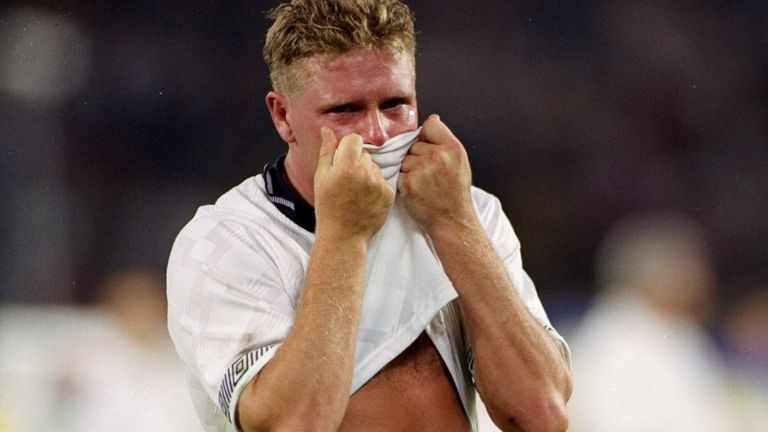
Paul Gascoigne
In the end, Bodo Illgner, goalkeeper for F.C. Köln of Cologne, held off the penalty of Stuart Pearce, and Chris Waddle -- a former teammate of Gazza at Newcastle, and of both Gazza and Lineker at Spurs, now with French club Olympique de Marseille -- blasted his shot over the bar, and the Germans advanced to the Final. They'd lost the last 2 Finals, to Italy in 1982 and to Argentina in 1986. Now, they would play Argentina again.
But after 2 great Semifinals, the Final, on July 8 at the Stadio Olimpico, was an anticlimax. TNT, Turner Network Television, broadcast it live in the U.S. The Germans had a few chances in the 1st half, but could not capitalize on them. Argentina played its usual dirty game, and were getting away with it. Twice, the Germans appealed for penalties, on a handball in the box by Oscar Ruggeri in the 13th minute, and a dirty tackle in the box by Simón on Rudi Völler in the 18th. Referee Edgardo Codesal, born in Uruguay but a citizen of Mexico, refused to grant either. Argentina had just one chance in the half, late, but Maradona sent a kick over the crossbar.

In the 58th minute, Argentine goalkeeper Sergio Goycochea took Klaus Augenthaler down inside the penalty area. Again, Codesal refused to award a penalty. Finally, in the 65th minute, Pedro Monzón of Independiente became the 1st player ever sent off in a World Cup Final, with Codesal showing him a straight red card for a reckless studs-up challenge on Jürgen Klinsmann. Still, despite Argentina being down to 10 men, West Germany couldn't score.
Finally, in the 83rd minute, Roberto Sensini brought Völler down in the box, and Codesal awarded a penalty. Brehme took it, and it was 1-0 to West Germany.
Gustavo Dezotti had already been cautioned in the 5th minute. In the 87th, he received a straight red card when he hauled Jürgen Kohler down with what The New York Times described as a "neck tackle right out of professional wrestling." After dismissing Dezotti, Codesal was surrounded and jostled by the rest of the Argentinian team, with Maradona receiving a yellow card for dissent.
Argentina were down to 9 men, and they were lucky to end the game with that many. West Germany hung on for the 1-0 win, as their opponents now had over half of their intended squad unavailable due to injury or suspension.
Beckenbauer joined Brazil's Mário Zagallo as only the 2nd man to both play on and manage a World Cup winner. He has been followed by France's Didier Deschamps.
UPDATE: An article for ESPN.com, published after the 2026 World Cup, ranking all 23 tournaments, rated this one 16th, citing the amount of dull games seeming to cancel out the large amount of star power.
*
July 8, 1990 was a Sunday. These Major League Baseball games were played:
* The New York Yankees lost to the Minnesota Twins, 6-3 at Yankee Stadium. David West outpitched Tim Leary. Mike Blowers hit a home run, but it was a rotten season for the Yankees, who finished last for only the 4th time in their history -- and, through the 2021 season, the last.
* The New York Mets beat the Atlanta Braves, 2-1 at Atlanta-Fulton County Stadium. Frank Viola was the winning pitcher.
* The Houston Astros beat the Montreal Expos, 5-3 at the Olympic Stadium in Montreal.
* The Philadelphia Phillies beat the Cincinnati Reds, 4-3 at Veterans Stadium in Philadelphia.
* The Seattle Mariners beat the Toronto Blue Jays, 6-3 at the SkyDome (now the Rogers Centre) in Toronto. Ken Griffey Jr. went 2-for-4 with a walk.
* The Oakland Athletics beat the Cleveland Indians, 8-3 at Cleveland Municipal Stadium. Rickey Henderson went 1-for-3 with 2 walks, a stolen base and an RBI.
* The Detroit Tigers beat the Kansas City Royals, 10-4 at Tiger Stadium in Detroit. George Brett went 1-for-3 with 2 walks and an RBI.
* The Baltimore Orioles beat the Chicago White Sox, 8-6 at Comiskey Park in Chicago. Mike Devereaux doubled home 2 runs in the top of the 11th inning. Cal Ripken went 1-for-5.
* The Milwaukee Brewers beat the California Angels, 20-7 at Milwaukee County Stadium. The Brewers scored 6 runs in the 4th inning, and 13 in the 5th inning.
* The Texas Rangers beat the Boston Red Sox, 4-3 at Arlington Stadium in the Dallas suburb of Arlington, Virginia. Gary Pettis hit a ground ball that Boston shortstop Luis Rivera bobbled, allowing Jack Daugherty to score the winning run in the bottom of the 11th.
* The St. Louis Cardinals beat the San Diego Padres, 4-1 at Jack Murphy Stadium in San Diego. Tony Gwynn did not play.
* The Pittsburgh Pirates beat the Los Angeles Dodgers, 7-2 at Dodger Stadium in Los Angeles. Barry Bonds went 2-for-4 with a walk and 3 RBIs.
* And the San Francisco Giants swept a doubleheader from the Chicago Cubs, 5-3 and 10-4 at Candlestick Park in San Francisco.