Showing posts with label french resistance. Show all posts

Monday, October 10, 2022

October 10, 1963: Édith Piaf Dies

October 10, 1963: Édith Piaf dies in Paris at age 47, after years of alcoholism and prescription drug abuse stemming from a car accident years earlier.

She was born as Édith Giovanna Gassion in Paris, on December 19, 1915, a week after Frank Sinatra. She began touring with her father at age 14. She had an affair, and at age 17, gave birth to a daughter, Marcelle, who died from meningitis 2 years later. Marcelle would be her only child.

In 1935, she was hired by nightclub owner Louis Leplée, who gave her her stage name, La Môme Piaf. There is a dispute as to the translation: Either "The Bonnet Kid" or "The Sparrow Kid." He also gave Édith her signature look, a black dress. He was murdered by gangsters in 1936, and since she knew them, she was questioned as an accomplice by the police, but cleared.

Her image was in tatters, but her next boyfriend, songwriter Raymond Asso, built her back up. He changed her name to Édith Piaf, kept the undesirables away, and, in addition to the songs he wrote for her, brought Marguerite Monnot in to write songs for her, many of them reflecting her life as a poor kid in Paris.

In 1940, she starred in Le Bel Indifférent, a play by Jean Cocteau, then one of France's greatest living writers, and a lifelong friend thereafter. Despite the Nazi occupation, her fame grew, and she became a symbol of French Resistance. She performed at Paris' legendary Moulin Rouge nightclub, and began an affair with actor Yves Montand.

By 1947, 2 songs that she wrote had become famous all over the world: Her own recording of "La Vie en Rose" (The Life In Pink), and "What Can I Do?" recorded by Montand, Montand became as popular as she was, and she couldn't take it, and she broke up with him. She soon began an affair with Marcel Cerdan, who had been Middleweight Champion of the World. That affair ended when Cerdan died in a plane crash in 1949.

"France's national chanteuse" became popular in America. She appeared on The Ed Sullivan Show 8 times, including live in 1950 and 1956 during her tours, the other times with clips filmed in Paris.

In 1952, Piaf married her 1st husband, singer Jacques Pills. They divorced 5 years later. In 1960, in a successful effort to save the Paris Olympia music hall from bankruptcy, she recorded Charles Dumont's song "Non, je ne regrette rien" ("No, I do not regret anything"), and performed several concerts at the Olympia. In 1962, she married Théo Sarapo, a Parisian-born singer of Greek descent who was 20 years younger. 

But she was in a bad car crash in 1951, and, on top of her alcoholism, she became addicted to the painkiller morphine. She was in 2 more car crashes, and her drug dependency deepened. Her liver was hopelessly damaged, she developed cancer in it, and died on October 10, 1963, at her country home in Plascassier. Sarapo drove her body back to Paris, so her fans would believe she died there.

Her death was announced the next day. Cocteau gave a tearful public statement about it, and died later that day. But he already, literally, had a broken heart: He had suffered a heart attack the previous April. And he was not young, 74.

Sarapo also died young, in 1970, at 34, in a car crash, in Limoges, France.

In the film Bull Durham, Annie Savoy (Susan Sarandon) played a record of her singing "Non, je ne regrette rien" as a prelude to romance.

Marion Cotillard played Piaf in the 2007 film La Vie en Rose, winning the Academy Award for Best Actress, the 1st time an Oscar had ever been given for a French-language role. Although the facial resemblance was undeniable, Piaf was 5 feet even and Cotillard is 5-foot-10, and so some special effects were necessary.

*

October 10, 1963 was a Thursday. The baseball season ended 4 days earlier, when the Los Angeles Dodgers completed a 4-game sweep of the New York Yankees. Football was in midweek. The NBA season started 6 days later.

There was 1 score on this historic day, and it was in the NHL: The Detroit Red Wings beat the Chicago Black Hawks, 5-3 at the Olympia Stadium in Detroit. Gordie Howe scored 2 goals for the Wings. The Hawks got a goal from Bobby Hull and another from Stan Mikita, but it wasn't enough.

Sunday, October 2, 2022

October 2, 1927: Josephine Baker: Siren of Paris

October 2, 1927: The silent film Siren of the Tropics premieres in Paris. It will take 2 more years for it to be released in America, despite the fact that its star is an American.

You don't need to know about the film's plot. You only need to know about its star, the 1st black woman to star in a major motion picture, anywhere in the world: Josephine Baker.

She was born as Freda Josephine McDonald on June 3, 1906 in St. Louis. She grew up in what would once have been quaintly called "a broken home," and by the age of 13, she was homeless, making money by dancing on street corners. By 15, she had been married and divorced. At 15, she married William Baker, and began using the stage name Josephine Baker. In 1925, she got a job with a New York vaudeville troupe, and divorced William.

Like a few black American entertainers before her, and many after her -- some specifically because of her example -- she went to France to take the stage in Paris. She became a feature of a famed nightclub, the Folies Bergère. Her performance in its 1927 revue Un vent de folie (A Wind of Madness) caused a sensation in the city: Her costume consisted only of a short skirt of artificial bananas and a beaded necklace. She became known as the Black Venus, the Bronze Venus, the Black Pearl and the Creole Goddess. Film of her doing the decade's defining dance, the Charleston, has made her an icon of "The Roaring Twenties."

She renounced her U.S. citizenship and became a French national after her marriage to French industrialist Jean Lion in 1937. Following the example of dancer Isadora Duncan, and presaging the later actress (of French descent) Angelina Jolie, she adopted 12 children of various nationalities, which she referred to as the Rainbow Tribe, and raised them in France.

During World War II, Baker aided the French Resistance, and worked with the U.S. Secret Service and the British Secret Intelligence Service. After the war, President Charles de Gaulle named her a Chevalier of the Legion of Honor, and the French Army awarded her its highest honor, the Croix de Guerre (Cross of War).
She did occasionally return to America, but refused to perform for segregated audiences in the United States. In 1951, Grace Kelly walked out of New York's famed Stork Club, hand-in-hand with Baker, vowing never to return, since it would let her perform there, but not dine there. (She broke the vow only once, because her eventual husband, Prince Rainier III of Monaco, wanted to visit.) In 1963, she was one of the speakers at the Lincoln Memorial during the March On Washington for Jobs and Freedom.

When, despite being an international star in the 1920s, a heroine of the French Resistance in the 1940s, and a major figure in the Civil Rights Movement in the 1960s, she lost her French castle due to unpaid debts. Rainier and Grace took her in.
On April 8, 1975, she had a triumphal concert in Monte Carlo, attended by Rainier and Grace, Jacqueline Kennedy Onassis, Sophia Loren, Mick Jagger, Shirley Bassey, Diana Ross, and Liza Minnelli. Four days later, at the age of 68, she died of a cerebral hemorrhage in Paris. She was 68. The Monaco royals paid for her funeral and burial in Monte Carlo.

Ross often emulated her onstage, and wanted to make a movie about her life, but couldn't get the funding. Eventually, in 1991, The Josephine Baker Story aired on HBO, starring Lynn Whitfield. The film closes with her finale in Monte Carlo, with Whitfield singing Bob Dylan's "The Times, They Are a-Changin'."

A country not interested in honoring her during her lifetime did so afterward. Her hometown inducted her into its St. Louis Walk of Fame, and the U.S. Postal Service issued a stamp with her image. Despite having married and divorced 4 men, and being known to have had an affair with the fame Swiss architect Le Corbusier, she has also been rumored to have had affairs with women, including French writer Colette and Mexican painter Frida Kahlo, and gay-rights displays in Chicago and San Francisco have honored her.

*

October 2, 1927 was a Sunday. Baseball was between the regular season and the World Series. The NBA hadn't been founded yet. The NHL started its season a few weeks later. But these games were played in the NFL:

* The New York Giants and the Cleveland Bulldogs played to a tie, 0-0 at Luna Park in Cleveland.

* There was a team named the New York Yankees playing in the NFL, and, on this day, 2 days after the baseball Yankees' Babe Ruth hit his 60th home run of the season, the football Yankees beat the Dayton Triangles, 6-3 at Triangle Park in Dayton, Ohio.

* The Chicago Cardinals beat the Pottsville Maroons, 19-7 at Normal Park on the South Side of Chicago. The "Roaring Twenties" were the football version of baseball's "Dead Ball Era," and the Cards scored 36 percent of the points in the League that day, all by themselves.

* The Providence Steam Roller (no S on the end) beat the Buffalo Bisons, 5-0 at the Cycledrome in Providence, Rhode Island.

* And the Chicago Bears beat the Green Bay Packers, 7-6 at City Stadium in Green Bay, Wisconsin. With the Cardinals still being in Chicago, it would take many years before the Bears and their fans began to consider the Packers their arch-rivals.

Friday, July 8, 2022

July 8, 1943: The Death of Jean Moulin

July 8, 1943: Jean Moulin is executed by the Nazis. He was the leading figure in the French Resistance.

Jean Pierre Moulin was born on June 20, 1899 in Béziers, in Occitain on the Mediterranean coast. He became a lawyer, and served in World War I. He rose through the French national government, and, during the Spanish Civil War, used his position in the Air Ministry to send planes to the Spanish Republic, a move that didn't help the Republic, much, but boosted his credibility in France's political left.

The Nazis invaded Paris on June 14, 1940. Three days later, the arrested Moulin because he refused to sign a false declaration that three Senegalese tirailleurs had committed atrocities, killing civilians in La Taye. In fact, those civilians had been killed by German bombings. Beaten and imprisoned because he refused to comply, Moulin attempted suicide by cutting his own throat with a piece of broken glass. This act left him with a scar he would often hide with a scarf, giving us the image of Jean Moulin by which he often is remembered today. The suicide attempt did not succeed because he was discovered by a guard and taken to a hospital for treatment.

Moulin joined the Resistance sub-organization Free France, and traveled to London, where he met the exiled General Charles de Gaulle, whom he briefed on the state of the Resistance. de Gaulle put Moulin in charge of coordinating and unifying the Resistance. 

Moulin united them under the name Moucements Unis de la Résistance (MUR), eventually becoming the Conseil National de la Résistance (CNR). His work convinced Communist groups to join, having previously refused due to de Gaulle's conservatism. de Gaulle considered this unity a step toward forming a Fourth Republic, to take the place of the Third Republic that had fallen to the Nazis.

On June 21, 1943, Gestapo agents raided a Resistance leaders' meeting. in Caluire-et-Cuire, outside Lyon. Moulin was among them. It came to be believed that one of the other leaders betrayed Moulin for a more lenient sentence. They were sent to Montluc Prison in Lyon, and Moulin was tortured by local Gestapo head Klaus Barbie. He fell into a coma, and was being transported to Germany for trial when he was discovered to be dead as the train sat in the station at Metz. He was 44 years old.

Barbie, known to the French as "The Butcher of Lyon," almost got away with it. U.S. intelligence services appreciated his anti-Communist efforts, and aided his escape to the South American nation of Bolivia, where he advised the fascist dictatorship on the proper use of torture, and became one of the most sought-after surviving Nazi war criminals.

In 1983, with the election of a leftist party, Barbie was arrested and extradited to France, where he was convicted of crimes against humanity. The American TV show Saturday Night Live had a field day with his surname, showing black-and-white photos of a Barbie doll in a Nazi uniform. Klaus Barbie died in prison in 1991.

In the late 20th and early 21st Centuries, American conservatives took to suggesting that the French are cowards, who easily surrender. Nothing could be further from the truth. In World War I, they fought for 4 years to keep Imperial Germany from taking over, until American troops could arrive to turn the tide. In World War II, they were technologically overwhelmed, and did the only thing they could do: Surrender, and then resist from within, fighting the Nazis on their own terms until, again, America could send troops in to liberate them. They never really surrendered.

And Jean Moulin was a big reason why. Even after his first meeting with Moulin, Charles de Gaulle wrote of him, "A great man. Great in every way." That opinion never changed for as long as de Gaulle lived, until 1970.

*

July 8, 1943 was a Thursday. These baseball games were played that day:

* The New York Yankees lost to the Chicago White Sox, 1-0 at Comiskey Park in Chicago. Hank Borowy allowed only 4 hits, and the game's only run scored on a groundout by Luke Appling in the bottom of the 1st inning.

Orval Grove (no relation to Lefty) came within 1 out of a no-hitter, but Joe Gordon doubled in the 9th inning, so, despite his superb effort, the result of the game was still in doubt at the end. Grove also walked 3 batters, and the White Sox also made an error. Grove pitched from 1940 to 1949, all with the White Sox, going 63-73 for his career, and was named to the 1944 All-Star Game.

* The Brooklyn Dodgers lost to the Pittsburgh Pirates, 8-2 at Ebbets Field.

* A doubleheader was split at Shibe Park in Philadelphia. The Cincinnati Reds won the opener, 7-5. The Philadlephia Phillies won the nightcap, 1-0. Merrill May singled Coaker Triplett home in the bottom of the 14th inning. Dick Barrett allowed 9 hits over 14 innings to win. Ray Starr allowed 3 hits over 10 innings to keep the Reds in it, before Joe Beggs pitched the last 4 and lost it.

* The Cleveland Indians beat the Washington Senators, 5-2 at League Park in Cleveland.

* The Detroit Tigers beat the Philadelphia Athletics, 3-1 at Briggs Stadium in Detroit. (It was renamed Tiger Stadium in 1961.)

* The St. Louis Browns beat the Boston Red Sox, 5-2 at Sportsman's Park in St. Louis.

* The Boston Braves and the St. Louis Cardinals were rained out at Braves Field in Boston. The game was made up as part of a doubleheader on August 22. The Cards swept, 6-1 and 5-1. Stan Musial 4-for-9 with a walk and an RBI over the 2 games.

* And the New York Giants and the Chicago Cubs were not scheduled.

Tuesday, June 14, 2022

June 14, 1940: The Fall of Paris

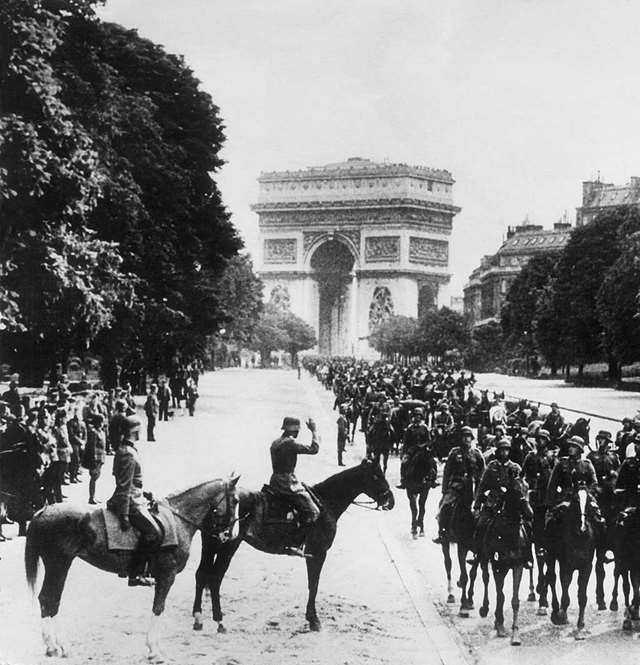
June 14, 1940: The government of France flees the capital of Paris, for Bordeaux, just ahead of the advancing Heer, the army of Nazi Germany. The City of Light has fallen to the forces of darkness. The Third Republic is dead.

France, along with its ally Britain, had been at war with the Nazis since September 3, 1939, when the Nazis invaded Poland. For a while, it was called a sitzkrieg, a "sit-down war" or a "phony war," because nothing seemed to be happening.

But on May 10, 1940, the blitzkrieg, or "lightning war," began. German forces invaded the Low Countries: Tiny Luxembourg was conquered by the end of the 1st day, the Netherlands fell on May 17, and Belgium was conquered on May 28.

With those events, the British policy of appeasement saw its failure completed. Neville Chamberlain resigned as Prime Minister, and Winston Churchill was given the job. On May 13, he gave his first speech to Parliament, saying, "I have nothing to offer but blood, toil, tears and sweat."

On that same day, the Germans faced the supposedly unbreachable Maginot Line at Sedan, the site of their greatest victory in the Franco-Prussian War of 1870, and simply went around it, over ground the French thought couldn't be gone over. The Maginot Line proved to be the most overrated thing since the "unsinkable" cruiseliner RMS Titanic, 28 years earlier.

On May 20, the Nazis opened their largest concentration camp, near Oświęcim, Poland. In German, the town's name becomes "Auschwitz." Their "Final Solution" was still a year and a half away from beginning. On May 26, the 300,000-man British Expeditionary Force began evacuating from France at the port of Dunkirk.

On June 3, The Nazi Air Force, the Luftwaffe, bombed Paris for the 1st time. On June 4, the Dunkirk evacuation was completed. Churchill told Parliament that it didn't matter when, or how, the Nazis came for Britain: 

Even though large tracts of Europe and many old and famous States have fallen, or may fall, into the grip of the Gestapo and all the odious apparatus of Nazi rule, we shall not flag or fail.

We shall go on to the end. We shall fight in France, we shall fight on the seas and oceans, we shall fight with growing confidence and growing strength in the air, we shall defend our island, whatever the cost may be.

We shall fight on the beaches, we shall fight on the landing grounds, we shall fight in the fields and in the streets, we shall fight in the hills. We shall never surrender. And if, which I do not for a moment believe, this island or a large part of it were subjugated and starving, then our Empire beyond the seas, armed and guarded by the British Fleet, would carry on the struggle, until, in God's good time, the New World, with all its power and might, steps forth to the rescue and the liberation of the old.

The Nazi advance continued. On June 7, the royal family of Norway evacuated their country. And on June 13, knowing that the Nazis were now close, the French government declared Paris to be an open city. They fled the next day.

The bad news continued. Also on June 14, on the Eastern Front, the Soviet Union annexed the Baltic states of Estonia, Latvia and Lithuania. While decrying the "imperialism" of the West. They would hold on to those "republics" for half a century.

It was a great day for Adolf Hitler. It was a great day for Joseph Stalin. It was a great day for the concept of dictatorship in general. It was a horrible day for civilization. It might have been the worst day in human history.

France's humiliation continued. On June 15, the fortress of Verdun, which had famously refused to surrender in World War I, surrendered. On June 16, Philippe Pétain, known as the Lion of Verdun for his refusal to surrender at that place and at that time (declaring, "They shall not pass!"), accepted the post of France's head of state, and began negotiating with the Nazis.

On June 18, General Charles de Gaulle began a series of radio broadcasts from exile in London, calling on French people, wherever they were in the world, to join him in resistance. He said, "France has lost a battle. But France has not lost the war."

Also on June 18, Churchill spoke to the world from Parliament:

The Battle of France is over. The Battle of Britain is about to begin. Upon this battle depends the survival of Christian civilization. Upon it depends our own British life, and the long continuity of our institutions and our Empire. The whole fury and might of the enemy must very soon be turned on us. Hitler knows that he will have to break us in this island or lose the war. If we can stand up to him, all Europe may be freed and the life of the world may move forward into broad, sunlit uplands.

But if we fail, then the whole world, including the United States, including all that we have known and cared for, will sink into the abyss of a new dark age made more sinister, and perhaps more protracted, by the lights of perverted science. Let us therefore brace ourselves to our duties, and so bear ourselves, that if the British Empire and its Commonwealth last for a thousand years, men will still say, "This was their finest hour."

On June 23, Nazi Chancellor Adolf Hitler visited Paris, copying the visit of Kaiser Wilhelm I in 1871, and achieving what Kaiser Wilhelm II could not do from 1914 to 1918.

The Battle of Britain began on July 10. No hour in the war seemed to remain the darkest for long.

The film Casablanca dramatized the events of the fall of Paris in a flashback sequence. And there was this sequence in the film's "present," in December 1941, right before the U.S. entered the war, in the title city, in the French colony of Morocco:

Major Heinrich Strasser (played by Conrad Veidt): Are you one of those people who cannot imagine the Germans in their beloved Paris?

Rick Blaine (Humphrey Bogart): It's not exactly MY beloved Paris.

Colonel Heinze (Richard Ryen): Can you imagine us in London?

Rick, knowing they haven't gotten there yet: When you get there, ask me!

Captain Louis Renault (Claude Rains): Hm! Diplomats!

Strasser, feeling full of himself: How about New York?

Rick: Well, there are certain sections of New York, Major, that I wouldn't advise you to invade.

On August 25, 1944, after 4 years, 2 months and 15 days of the city under Nazi control, the Allies liberated Paris. On April 30, 1945, Hitler killed himself. On May 8, the Nazis surrendered.

*

June 14, 1940 was a Friday. It was the off-season for the NFL and the NHL, and the NBA had not yet been founded. But there was a full slate of Major League Baseball games that day:

* The New York Yankees beat the St. Louis Browns, 12-3 at Sportsman's Park in St. Louis. Charlie Keller hit 2 home runs in support of Monte Pearson.

* The Brooklyn Dodgers beat the Cincinnati Reds, 2-0 at Ebbets Field. Luke Hamlin pitched a 2-hit shutout.

* The New York Giants beat the Pittsburgh Pirates, 8-6 at the Polo Grounds.

* The Boston Bees beat the Chicago Cubs, 4-2 at Braves Field in Boston. This would be the last of the Boston National League team's 5 seasons under the Bees name, as it just didn't catch on, and they once again became the Braves for 1941.

* The St. Louis Cardinals beat the Philadelphia Phillies, 6-2 at Shibe Park in Philadelphia.

* The Cleveland Indians beat the Philadelphia Athletics, 8-0 at League Park in Cleveland. Johnny Allen pitched a 2-hit shutout.

* The Detroit Tigers beat the Washington Senators, 10-1 at Briggs Stadium (later Tiger Stadium) in Detroit.

* And the Boston Red Sox beat the Chicago White Sox, 5-1 at Comiskey Park in Chicago.

December 31, 1999 & January 1, 2000: The Millennium

December 31, 1999:  The Millennium arrives. The people of planet Earth survived. At a terrible cost. But we hadn't destroyed ourselves. ...