Showing posts with label allie reynolds. Show all posts

Tuesday, October 11, 2022

October 11, 1946: The Reynolds-Gordon Trade

Allie Reynolds

October 11, 1946: A trade is made in baseball, and it is a rarity: One that works out very well for both teams.

The New York Yankees trade 2nd baseman Joe Gordon to the Cleveland Indians for pitcher Allie Reynolds. Gordon, the 1942 American League Most Valuable Player, was nicknamed "Flash," not because of his flashy defense, but because he reminded people of science-fiction film hero Flash Gordon, played by Buster Crabbe, who also played another sci-fi hero, Buck Rogers.

Joe Gordon secured his (posthumously-elected) Hall of Fame status by helping the Indians win the 1948 World Series, on October 11, 2 years to the day after the trade. This was his 5th title, having won 4 with the Yankees. But the Yankees had gotten George "Snuffy" Stirnweiss in a separate trade, and then had Jerry Coleman, Billy Martin and Bobby Richardson at the keystone sack for the next 15 years.
Joe Gordon

The Indians needed a veteran infield presence like Gordon, and their owner, Bill Veeck, was willing to trade any pitcher except the future Hall-of-Famer Bob Feller. Yankee general manager Larry MacPhail asked his best player, Joe DiMaggio, which one he should take. The Yankee Clipper said, "Take Reynolds. I'm a fastball hitter, but he can buzz his hard one by me any time he has a mind to." In other words, "He's really good, so even if he does nothing for us, at least he won't be doing anything to us."

That fastball, and his Cherokee heritage, got Reynolds a nickname that applied to Native Americans and a famous train of the time: The "Superchief." Still, he was only 51-47, with a 3.31 ERA, for his career when the Yankees acquired him. There was no indication that he would become a great pitcher.

But he did. In a rotation that already included Vic Raschi, the "Springfield Rifle," the Yankees won the 1947 World Series. In 1948, the Yankees obtained Eddie Lopat, a lefthander specializing in off-speed pitches, known as "the Junkman."

And with new manager Charles "Casey" Stengel coming in for the 1949 season, and pitching the speedy righthander Reynolds followed by the junkballing lefty Lopat, followed by the speeding righthander Raschi, the Yankees had a very tough combination that won the next 5 World Series: 1949, '50, '51, '52 and '53 -- each time with a different 4th starter. So this trade helped the Yankees get 6 titles.

Reynolds only won 20 games once, in 1952, but that was partly because Stengel also frequently used him as a reliever. Had he come along 30 years later, he might have been a big blazing righthanded closer in the mold of Goose Gossage, Rob Dibble or Rod Beck. He hurt his back in 1954, but still managed to go 13-4 at age 37. He then retired: Having invested in oil wells in Oklahoma, he could afford to play for the love of the game, and then walk away.

The Yankees honored him with a Plaque for Monument Park in Yankee Stadium in 1989, although they have never retired his Number 22. He died in 1994.

*

October 11, 1946 was a Friday. There was baseball action on this day, Game 5 of the World Series at Fenway Park in Boston. The Boston Red Sox beat the St. Louis Cardinals, 6-3. Ted Williams singled in a run in the bottom of the 1st inning, and Cardinal manager Eddie Dyer panicked, taking out starter Howie Pollet. While Al Brazle got out of the jam, he gave up a home run to Leon Culberson in the 6th inning, and fell apart in the 7th. In contrast, Joe Dobson went the distance for the Sox, holding Stan Musial to a 1-for-3 day.

The Sox thus took a 3-games-to-2 lead in the Series. All they had to do was win 1 of 2 games at Sportsman's Park in St. Louis. They just had to win 1 more World Series game, and they would have their 1st World Championship since 1918. It took them another 58 years to get that title.

There was also a game played in the All-America Football Conference: The football version of the Brooklyn Dodgers and the Chicago Rockets played to a tie, 21-21 at Ebbets Field.

And there were 7 college football games:

* Number 8 Georgia beat Number 19 Kentucky, 28-13 at Sanford Stadium in Athens, Georgia.

* Georgetown beat Fordham, 8-7 at Griffith Stadium in Washington. Georgetown dropped their football program after the 1950 season, re-established it at NCAA Division III in 1973, and moved up to Division I-AA/Football Championship Subdivision in 1993. Fordham dropped their program after 1954, restored it to Division III in 1973, and to I-AA/FCS in 1989.

* South Carolina beat Furman University, 14-7 at Furman's Sirrine Stadium in Greenville, South Carolina.

* George Washington University beat Rollins College, 13-0 at Orlando Stadium (now Camping World Stadium). Orlando-based Rollins dropped their football program after the 1949 season, and D.C.-based GWU dropped theirs after 1946.

* The University of Miami beat Texas Christian University, 20-12 at Burdine Stadium (later renamed the Orange Bowl) in Miami.

* Wichita State University beat Drake University, 12-6 at Drake Stadium in Des Moines, Iowa. Drake downgraded their program to Division I-AA/FCS in 1971, and Wichita State dropped theirs after 1985.

* And Southern Methodist University beat Oklahoma A&M, 15-6 at the Cotton Bowl in Dallas. A&M became Oklahoma State in 1958.

Wednesday, October 5, 2022

October 5, 1953: Five Straight World Series Wins

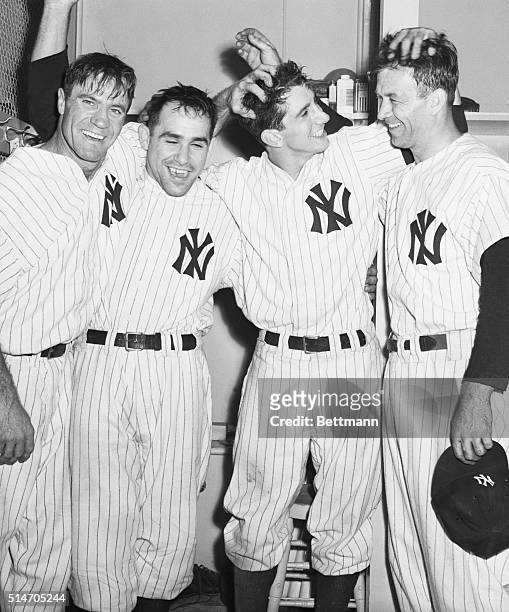
Left to right: Hank Bauer, Yogi Berra,
Billy Martin and Joe Collins

October 5, 1953: The New York Yankees beat the Brooklyn Dodgers, 4-3 at Yankee Stadium, to win Game 6 of the World Series, clinching it, 4 games to 2. This was the 5th straight World Championship for the Yankees. No other baseball team has ever done that.

The Yankees hired Charles Dillon "Casey" Stengel as their manager for the 1949 season, and he led them to the American League Pennant in each of the next 5 years. In 1949, they beat the Dodgers in the World Series in 5 games. In 1950, they swept the Philadelphia Phillies in 4 straight. In 1951, they beat the New York Giants in 6 games. That was Joe DiMaggio's last season, and Mickey Mantle's 1st season.

In 1952, it took them 7 games to finish the Dodgers off. That gave them 4 straight World Series wins, matching the Joe McCarthy-managed Yankees of 1936 to 1939.

In 1953, they faced the Dodgers again. It's important to note that, due to his U.S. Army commitments -- the Korean War was over by this point, but not everybody serving in it had been discharged yet -- the Dodgers did not have their best pitcher, Don Newcombe, for either the 1952 or the '53 Series. However, the Yankees had lost Whitey Ford to the war for the Series in '51 and '52. And the Giants had lost their best player, Willie Mays, for the '52 and '53 seasons, so if he was available, maybe they would have won those Pennants instead of the Dodgers.

The Dodgers were loaded. They won 105 games, which would remain a franchise record for 64 years. They finished 13 games ahead of the newly-moved Milwaukee Braves in the National League. They had 6 .300+ hitters, led by NL batting champion Carl Furillo at .344, and center fielder Edwin "Duke" Snider right behind at .336.

All 8 starting position players had at least 18 doubles, with Snider and Furillo each hitting 38. 2nd baseman Jim Gilliam led the NL with 17 triples. Snider hit 42 home runs, catcher Roy Campanella hit 41, and 1st baseman Gil Hodges hit 31. They had 5 players with at least 95 RBIs, with Campy leading the NL with 142, the Duke having 126, and Hodges 121. Campy was named NL Most Valuable Player.

They were superb defensively as well: Furillo also had the best right field arm in the game at the time, Snider was at least the equal with the glove in center as the Yankees' Mickey Mantle (if not of Mays), Hodges was the best-fielding 1st baseman in baseball, Billy Cox was the best-fielding 3rd baseman, Harold "Pee Wee" Reese was still the best shortstop in the NL; and Jackie Robinson, rotated between 2nd base, 3rd base and left field, played all of those positions well.

Their pitching was also strong, even without Newcombe available. Carl Erskine had the best curveball in the NL, going 20-6, leading the League with a .769 winning percentage. Russ Meyer, "The Mad Monk," was 15-5. Billy Loes was 14-8. Elwin "Preacher" Roe was 11-3. Rookie Johnny Podres was 9-4. Clem Labine, Joe Black and Jim Hughes made for a good bullpen.

But the Yankees were still the Yankees. They still had the best catcher in all of baseball, Lawrence "Yogi" Berra. Mantle, not yet 22 years old, had come into his own, launching some of the longest home runs anyone had ever seen: That season alone, he may have hit the longest ones ever seen at Griffith Stadium in Washington, Shibe Park/Connie Mack Stadium in Philadelphia, and Sportsman's Park/Busch Stadium in St. Louis. Left fielder Gene Woodling and right fielder Hank Bauer both batted over .300. Phil Rizzuto was still Reese's equal as a shortstop. Gil McDougald had become an excellent 3rd baseman.

And Ford returned to a starting rotation that still had "The Big Three": Allie Reynolds, Eddie Lopat and Vic Raschi. Stengel's alternation from the speedy Reynolds to the junkballing Lopat, then to the speedy Raschi, then to the mix-it-up master Ford kept American League batters on their toes, and made it hard for them to get into a day-to-day rhythm. The Yankees won 99 games, finishing 8 1/2 ahead of the Cleveland Indians, whose 3rd baseman, Al Rosen, narrowly lost the batting title to cost himself the Triple Crown. He was named the AL's MVP.

Despite the Dodgers' firepower, the Yankees' experience, especially against the Dodgers, made them slight betting favorites. Dwight D. Eisenhower, a former West Point baseball and football player in his 1st year as President, admitted before Game 1 that, "It would be nice if someone besides the Yankees won for a change."

With 85-year-old Cy Young throwing out the ceremonial first ball to Berra to open the World Series -- Yogi said, "It was like watching a statue come to life" -- the Yankees won Game 1, 9-5 at Yankee Stadium in The Bronx. Yogi hit a home run, and Eisenhower, having watched the television broadcast of the game on NBC, said, "I received a terrific kick out of Yogi Berra's home run. That fellow really slammed it out of the park."

The Yankees won Game 2 at home, 4-2. The Series moved to Ebbets Field in Brooklyn, and the Dodgers won Game 3, 3-2, and Game 4, 7-3. In Game 4, Erskine struck out 14 batters, setting a new Series record that would last for 10 years. But in Game 5, Mantle hit a grand slam to give the Yankees an 11-7 win, and a 3-2 lead in the Series.

Game 6 was played at Yankee Stadium, in front of 62,730 fans, about the twice the seating capacity of Ebbets Field. Ford started for the Yankees, Erskine for the Dodgers. With one of the best curveballs in the game at the time, "Oisk," as the Dodger fans called him in their Brooklyn accent, gave the Flatbush Faithful -- also known as the Flastbush Flock -- hope that "Dem Bums" could push the Series to a Game 7.

But the Yankees struck quickly. Woodling led off with a walk. 1st baseman Joe Collins struck out, but Bauer singled, and Berra hit a ground-rule double to get Woodling home. Mantle was walked intentionally. 2nd baseman Billy Martin grounded to 2nd, and Gilliam bobbled the ball, allowing Bauer to score. For whatever reason, Dodger manager Charlie Dressen had put his usual 2nd baseman, Jackie Robinson, in left field.

The Yankees scored again in the 2nd, on a sacrifice fly by Woodling. The game remained 3-0 until the top of the 6th. With 1 out, Robinson doubled to left, and stole 3rd base. Campanella got him home on a groundout, to make it 3-1.

Stengel brought Reynolds in for the 8th inning, thinking he had the right mentality to close the game out. Perhaps the best starting pitcher on his 5 Pennant winners, Reynolds had a blazing fastball, and was willing to throw inside. He hit 57 batters during his career, but claimed he only hit 6 on purpose. The Dodgers accused him of targeting black players, but he seemed to brush white players back with the same frequency. He once plunked a batter on a 3-0 count, telling a reporter after the game, "If I'm going to put you on, I might as well hurt you." Partly because of his Cherokee heritage, and partly because his fastball seemed to bring up memories of a speeding train of that name, he was known as the Superchief.

Reynolds got through the 8th, giving up only a single to Robinson. But with 1 out in the 9th, he walked Snider, and then gave up a home run to Furillo. The game tied, Reynolds then struck out Cox and the opposing pitcher, Labine.

This was the last game played by Hall-of-Famer Johnny Mize: "The Big Cat," a 1st baseman, pinch-hit for Collins in the 8th, and grounded out to 1st. He was 40 years old and fat, so, despite also being a 1st baseman, he did not take the position in the 9th, Stengel instead sending Don Bollweg in to do so.

Cliché Alert: Walks can kill you, especially the leadoff variety. Labine walked Bauer to start the bottom of the 9th. He got Berra to fly to right. But Mantle beat out a single to 3rd. The batter was Martin. An ordinary player from April through September, he always seemed to turn it on for the World Series, turning a regular-season batting average of .257 to a World Series average of .333. In 28 World Series games, he hit 5 home runs and had 19 RBIs. Stretch that to a full 154-game season, as was standard at the time, and it would have been 28 homers and 105 RBIs. And a catch he made in Game 7 in 1952 may have saved the Series for the Yankees. Whatever else can be said about Billy -- as a player, as a manager, and as a person -- he was a clutch performer as a player.

At this point, 4 players had collected 12 hits in a single World Series: Charles "Buck" Herzog of the 1912 New York Giants, Shoeless Joe Jackson of the 1919 Chicago White Sox (in spite of the accusation that he helped "throw" the Series), Sam Rice of the 1925 Washington Senators, and Johnny "Pepper" Martin of the 1931 St. Louis Cardinals. Oddly, all but Pepper Martin -- no relation to Billy -- were on the losing side.

Billy Martin singled up the middle, for his 12th hit of the Series, and Bauer came around 3rd to score the winning run: Yankees 4, Dodgers 3. The Yankees had won their 5th straight World Series.

There were 11 players who played on all 5 of those Yankee World Champions: Phil Rizzuto, Yogi Berra, Johnny Mize, Gene Woodling, Hank Bauer, Jerry Coleman, Joe Collins, Allie Reynolds, Vic Raschi, Eddie Lopat, and, though he played just 156 games in those 5 seasons, and just 1 ever in the World Series, backup catcher Charlie Silvera. Coleman, however, was serving in the Korean War for most of the '52 and '53 seasons, and, though he returned for the end of the '53 season, was not placed on the Series roster. Collins was a rookie in '49, and was not on the Series roster.

Since then, 3 in a row has been done, but not 4, and certainly not 5. The Montréal Canadiens would soon start a streak of 5 straight Stanley Cups, but they were unable to make it 6. The Boston Celtics would later win 8 straight NBA Titles, but basketball didn't exactly get the best athletes then.

This was the last World Series, and the last Pennant in either League, won by an all-white team. The next season, the Yanks lost the American League Pennant to the well-integrated Cleveland Indians, and the argument of, "Why integrate? We're winning with what we've got" was no longer valid. Elston Howard became the 1st black man to play for the Yankees the following April, and the team went on to win 9 Pennants and 4 World Series in the next 10 years.

Art Schallock is the last surviving member of the 1953 World Champion New York Yankees. He is also the last surviving former teammate of Joe DiMaggio, although he was not on the World Series roster in either 1951 or 1952. As of October 5, 2022, he is the oldest living former player, age 98. (UPDATE: He lived to be 100, but died in 2025, shortly before he would have turned 101.)

There have now been 3 players with 13 hits in a single World Series: Bobby Richardson of the 1964 Yankees, Lou Brock of the 1968 Cardinals, and Marty Barrett of the 1986 Boston Red Sox -- and all 3 ended up on the losing side.

In 1972-74, the Oakland Athletics won 3 straight World Series. They remain the only team other than the Yankees ever to win more than 2 straight. The Yankees won 3 straight in 1996-98.

*

October 5, 1953 was a Monday. This was before Monday Night Football, so there were no football games. It was too early to start the new NBA and NHL seasons. So there were no other scores on this historic day.

But this was also the day that President Dwight D. Eisenhower appointed Earl Warren to be Chief Justice of the Supreme Court of the United States. I have a separate entry for that event.

October 5, 1949: Tommy Henrich Is "Old Reliable" Again

Tommy Henrich (left) and Allie Reynolds

October 5, 1949: Game 1 of the World Series is played at Yankee Stadium. Allie Reynolds of the New York Yankees and Don Newcombe of the Brooklyn Dodgers pitch a scoreless game, taking it to the bottom of the 9th.

Tommy Henrich leads off that inning for the Yankees, and shows why Yankee broadcaster Mel Allen nicknamed him "Old Reliable." Or maybe he just liked hitting against the Dodgers. Or maybe he liked October 5 -- it was, after all, the 8th anniversary of his benefit of Mickey Owen's Muff. Henrich hits a home run into the right-field stands, and the Yankees win, 1-0.

That was pretty much the Series: Despite putting together one of the best teams in franchise history, the Dodgers couldn't beat the Yankees, winning only Game 2 on a shutout by Elwin "Preacher" Roe. Henrich's shot is the 1st game-ending home run in the history of postseason baseball, the 1st October "walkoff."

With Newcombe's death in 2019, all the players who appeared in this game have died. Yogi Berra was the last surviving Yankee, living until 2015.

*

October 5, 1949 was a Wednesday. This was the only baseball game on the day. Football was in midweek. And it was too early for the NBA or the NHL season. So there were no other scores on this historic day. 

Wednesday, September 28, 2022

September 28, 1951: A No-Hitter and a Clincher for the Yankees

September 28, 1951: A sweep of a doubleheader with the Boston Red Sox at Yankee Stadium means that the New York Yankees will clinch the American League Pennant.

They win the 1st game 8-0, as Allie Reynolds pitches his 2nd no-hitter of his career -- and his 2nd of the season, having blanked the Cleveland Indians on July 12. He is backed by home runs by Joe Collins and Gene Woodling.

The part-Cherokee fireballer known as the Superchief was the 1st AL pitcher to throw 2 no-hitters in a season. The only other major league pitchers to do it, through 2021: Johnny Vander Meer of the 1938 Cincinnati Reds (the only back-to-back no-hitters in MLB history), Virgil Trucks of the 1952 Detroit Tigers (one of them against the Yankees), Roy Halladay of the 2010 Philadelphia Phillies (one a perfect game, the other in the Playoffs), and Max Scherzer of the 2015 Washington Nationals.

The last out Allie needed for the 2nd no-hitter was Ted Williams, often called "the greatest hitter who ever lived." Allie got the Splendid Splinter to pop up in foul territory, but catcher Yogi Berra dropped it. Yogi goes to the mound to apologize, but Allie says, "Don't worry, Yogi, we'll get him again." He was right: He induced another pop-up, but Yogi caught this one.

The nightcap was not as spectacular, but no less effective: A Pennant-clinching 11-3 win. Vic Raschi was the winning pitcher, backed by a home run by Joe DiMaggio, the 361st of his career -- and, as it turned out, his last in regular-season play. He would hit 1 more in the upcoming World Series, and then retire.

Other Major League Baseball games played on this Friday:

* The Philadelphia Phillies beat the Brooklyn Dodgers, 4-3 at Shibe Park in Philadelphia. With the New York Giants not scheduled, this drops the Dodgers, who had been 13 1/2 games ahead of the Giants on August 11, into a tie for 1st place in the National League. The season will end with them tied, forcing a Playoff. And if you don't know how that turned out, you're too young to know baseball history, and/or you're too ignorant to be reading this blog.

* The Cincinnati Reds beat the Pittsburgh Pirates, 4-3 at Forbes Field in Pittsburgh.

* And the Chicago White Sox swept a doubleheader from the St. Louis Browns at Sportsman's Park in St. Louis. The Pale Hose won the opener, 6-2; and the nightcap, 4-3 in 10 innings.

There was also an NFL game played on this day. The Los Angeles Rams beat the football team named the New York Yanks, 54-14 at the Los Angeles Memorial Coliseum. Rams quarterback Norm Van Brocklin passed for 554 yards. To this day, it is an NFL record. And the achievement is worthy of its own entry, which I have written.

September 28, 1951: Norm Van Brocklin Passes for 554 Yards

September 28, 1951: The Los Angeles Rams beat the football team named the New York Yanks, 54-14 at the Los Angeles Memorial Coliseum. Rams quarterback Norm Van Brocklin passed for 554 yards. To this day, it is an NFL record.

A 25-year-old native of Walnut Creek, California, in the San Francisco Bay Area, he excelled at the University of Oregon. From 1949 to 1952, he alternated with Bob Waterfield as the Rams' starting quarterback. But, despite having led the Rams, then in Cleveland, to the 1945 NFL Championship, and becoming one of the NFL's earliest "golden boy" players, Waterfield never had a day like this.

Van Brocklin, nicknamed "Van" and "the Dutch Master," threw 41 passes, completing 27 of them. He threw for 2 interceptions, but also 5 touchdowns. Four of them, ranging from 1 to 47 yards, were to Elroy Hirsch, the receiver known as "Crazy Legs" for his speed. The other was to Verda Thomas Smith, known as V.T. or "Vitamin" Smith. Van Brocklin also ran 1 yard for a touchdown.

Although end Tom Fears, who with Waterfield was one of the NFL's earliest great passing combinations, did not catch any touchdown passes in the game, he caught 7 passes for a game-leading 162 yards, and his longest, 54 yards, was longer than any of Hirsch's. Fears also kicked 6 extra points.

The Rams had lost the NFL Championship Game to the Philadelphia Eagles in 1949, and lost it to the Cleveland Browns in 1950. In 1951, they went on to beat the Browns in the Championship Game. Van Brocklin, Waterfield, Hirsch and Fears would all be elected to the Pro Football Hall of Fame. So would defensive end Andy Robustelli, although that was mainly for his later play for the New York Giants. So would head coach Joe Stydahar, although that was for his performance as a two-way tackle for the 1940s Chicago Bears.

Not in the Hall of Fame, but should be, were the Rams' top 2 rushers, both among the NFL's earliest black stars: Paul "Tank" Younger and "Deacon" Dan Towler. Another running back on the '51 Rams, in the College Football Hall but not the Pro Football Hall, since his Army service and a knee injury meant that he only played 2 NFL seasons, was 1946 Heisman Trophy winner Glenn Davis.

Van Brocklin would become the Rams' sole starter in 1953, after Waterfield's retirement. In 1958, he was traded to the Eagles. In 1960, in his last game before retiring, he led them to victory in the NFL Championship Game. Until Super Bowl 50 in 2016, Van Brocklin was the only quarterback ever to coach 2 different franchises to the NFL Championship. Peyton Manning and Tom Brady * have since joined him in that distinction.

In 1961, Van Brocklin was named the 1st head coach of the expansion Minnesota Vikings. In 1968, he became the 2nd head coach of the Atlanta Falcons. Like many great players, he was not nearly as good as a coach. He died in 1983, after years of battling brain cancer. At one point, he addressed surgery he'd had: "It was a brain transplant. They gave me a sportswriter's brain, to make sure I got one that hadn't been used."

The previous record for passing yards in a game was 468 yards, by Johnny Lujack of the Chicago Bears, against the crosstown Chicago Cardinals on December 11, 1949. The fact that these marks of 468 and 554 yards were set in the early days of the NFL, when the only superstar quarterbacks yet seen were Sammy Baugh of the Washington Redskins and Sid Luckman, Lujack's predecessor with the Bears, is less surprising than the fact that, 71 years later, Van Brocklin's 554 still stands.

Through September 28, 2022, there have been 25 occurrences of a quarterback passing for 500 or more yards in a regular-season NFL game. The 2nd time didn't happen until October 28, 1962, when Y.A. Tittle passed for 505 yards for the Giants against the Washington Redskins. It's been done by 22 different players, including 3 times by Ben Roethlisberger and twice by Drew Brees.

The 2nd-best performance has been 527 yards, and it's been done twice: By Warren Moon, for the Houston Oilers against the Kansas City Chiefs, on December 16, 1990; and by Matt Schaub, for the Houston Texans against the Jacksonville Jaguars, on November 18, 2012.

But nobody else has done 554, or even 528. Not Tittle, Otto Graham, Bobby Layne, Johnny Unitas, or Van Brocklin himself, or any other star quarterback of the 1950s. Not Unitas, Bart Starr, Sonny Jurgensen, Joe Namath or any of the other "mad bombers" in the freewheeling, pass-happy American Football League, or any other quarterback in the 1960s. Not Fran Tarkenton, Roger Staubach, Bob Griese, Terry Bradshaw, Ken Stabler, or any other 1970s quarterback.

Not Joe Montana, Joe Theismann, Dan Marino, John Elway, Phil Simms, or any other 1980s passer. Not Elway, Troy Aikman, Brett Favre, or any other 1990s quarterback. Not any 21st Century quarterback, whether they used Spygates, deflated footballs, the name Manning, or anything else.

Van Brocklin's 554 passing yards in one game isn't like old-time baseball records, such as Cy Young's 511 career wins or Walter Johnson's 113 career shutouts, where changes in rules and styles have made it harder to pursue the record. If anything, the rules and styles should have made it easier to break this record.

After all, Van Brocklin finished with 23,611 career passing yards. At the time, that was a record. As of this writing, the record is 85,193, held by Brady. That's 3.6 times the record that Van Brocklin set. Until Namath in 1967, no pro quarterback had passed for 4,000 yards in a season. That record is now 5,477, by Peyton Manning in 2013.

But most passing yards in a game? Logic would dictate that a record set in the Truman Administration, a time when pro football trailed not only baseball and college football, but boxing and horse racing as America's most popular sport, would have been far surpassed by now. And yet, no one has come within 23 yards of it.

*

September 28, 1951 was a Friday. This was the only NFL game played on the day. But these Major League Baseball games were played:

* The New York Yankees swept a doubleheader from the Boston Red Sox at Yankee Stadium. In the opener, Allie Reynolds pitched a no-hitter, as the Yankees won, 8-0. It was his 2nd no-hitter of the season. This is an achievement worthy of its own entry, and I've made one.

The nightcap was not as spectacular, but no less effective: A Pennant-clinching 11-3 win. Vic Raschi was the winning pitcher, backed by a home run by Joe DiMaggio, the 361st of his career -- and, as it turned out, his last in regular-season play. He would hit 1 more in the upcoming World Series, and then retire.

* The Philadelphia Phillies beat the Brooklyn Dodgers, 4-3 at Shibe Park in Philadelphia. With the New York Giants not scheduled, this drops the Dodgers, who had been 13 1/2 games ahead of the Giants on August 11, into a tie for 1st place in the National League. The season will end with them tied, forcing a Playoff. And if you don't know how that turned out, you're too young to know baseball history, and/or you're too ignorant to be reading this blog.

* The Cincinnati Reds beat the Pittsburgh Pirates, 4-3 at Forbes Field in Pittsburgh.

* And the Chicago White Sox swept a doubleheader from the St. Louis Browns at Sportsman's Park in St. Louis. The Pale Hose won the opener, 6-2; and the nightcap, 4-3 in 10 innings. 

December 31, 1999 & January 1, 2000: The Millennium

December 31, 1999:  The Millennium arrives. The people of planet Earth survived. At a terrible cost. But we hadn't destroyed ourselves. ...