The man was redeemed. His hairstylist was not.
June 30, 2002: The World Cup Final is held at the International Stadium in Yokohama, Japan, about 50 miles south of the national capital of Tokyo. As with the rest of the tournament, with help from ESPN for some games, ABC broadcasts the Final in the U.S.
Brazil, having lost the last Final in 1998, were going for redemption, and a record 5th title. Germany were going for a 4th – or a 1st, if you only count since the country was reunified. There was little doubt that these were the 2 best teams in the world.
But there was some doubt as to how they got to the Final.
For the 1st time, the World Cup's hosting duties were split between 2 countries: Japan and neighboring South Korea. Korea would host Groups A, with Denmark, France, Senegal and Uruguay; B, with Paraguay, Slovenia, South Africa and Spain; C, with Brazil, China, Costa Rica and Turkey; and D, with Poland, Portugal, co-hosts South Korea, and the United States. Japan would host Groups E, with Cameroon, Germany, Ireland and Saudi Arabia; F, with Argentina, England, Nigeria and Sweden; G, with Croatia, Ecuador, Italy and Mexico; and H, with Belgium, co-hosts Japan, Russia and Tunisia. (In each case, the countries are listed alphabetically.)
Denmark won Group A, mainly because Zinedine Zidane, who had led France to victory in the previous tournament, had been injured in qualifying, and could only play in the last Group Stage game, leaving the defending Champions with just a draw with Uruguay and losses to Denmark and to their own former African colony, Senegal.
Brazil easily won Group C, beating Turkey in Ulsan, China in Seogwipo, and Costa Rica in Suwon. Germany won Group E, walloping Saudi Arabia 8-0 in Sapporo, being held to a draw by Ireland in Ibaraki, and beating Cameroon in Shizuoka. Ireland finished 2nd to Germany, despite team Captain Roy Keane, a Manchester United star, leaving their camp before the 1st game, following a dispute with team manager Mick McCarthy. Teammate Niall Quinn, a star for Sunderland, said, "He punished himself more than any of us by not coming back."
Despite neither country having the color in their national flags, both Italy and Japan wear blue shirts in soccer/football. Blue is the color of the House of Savoy, the royal house of Italy at the time of Unification in 1871, and they've kept it despite abolishing the monarchy in 1946. Japan wear blue because of superstition: Their 1st tournament was the 1930 Far Eastern Championship, they wore blue, and won it, and have worn it when receiving first choice of uniform ever since.
In Group F, England drew with Sweden in Saitama; then resumed their rivalry with Argentina by beating them 1-0 in Sapporo, thanks to a rightly-awarded penalty in the 44th minute, taken by David Beckham of Manchester United; and then, having guaranteed advancement, played a meaningless finale against former colony Nigeria in Osaka, and played to a turgid 0-0 draw. (The word "turgid" seems like it was designed to describe a dull 0-0 soccer game.)
Group D provided problems for me. Most fans usually want the host nation to do well, as long as they don't beat the fan's own national side. And most fans usually want their ancestral homeland to do well, as long as they don't beat the country where the fan was born, or at least raised.
But the U.S. had to play both co-host South Korea and my ancestors' home of Poland, as well as Portugal. Had I known then that Portuguese fans from Newark would feed my fandom at the next World Cup, it would have been even more problematic for me. I would have wanted all 4 nations to do well, and that's just not possible. And, after an awful performance in France in 1998, the U.S. needed all the points it could get.
South Korea beat Poland, 2-0 in Busan. The U.S. beat Portugal, 3-2 at Suwon, going 3-0 up in the 36th minute, and almost blowing it. The U.S. drew with South Korea, 1-1 at Daegu, blowing a 1-0 lead in the 78th, but guaranteeing them no worse than 2nd place, and thus advancement. Portugal wiped Poland out, 4-0 at Jeonju, preventing them from advancing. South Korea beat Portugal, 1-0 at Incheon, clinching the Group lead. And, in a meaningless finale, Poland beat the U.S., 3-1 at Daejeon.
*
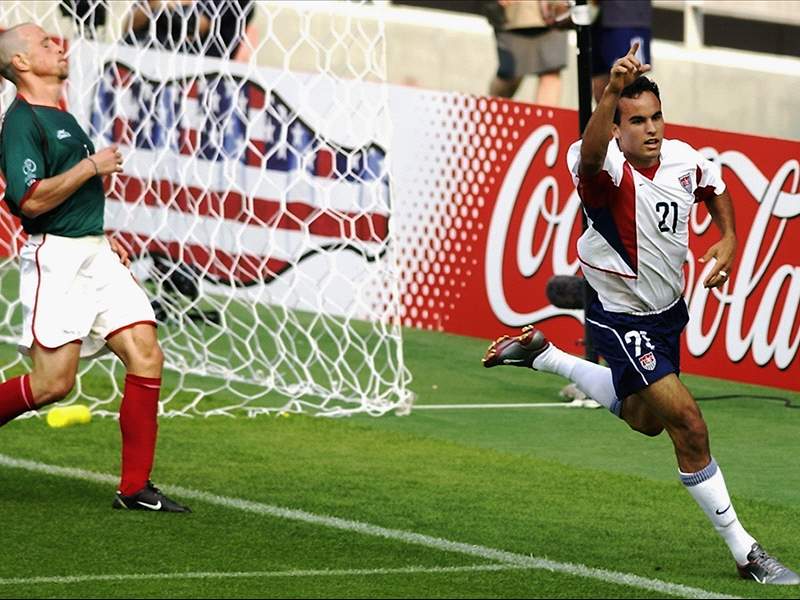
The Round of 16 saw the U.S. beat arch-rival Mexico, 2-0 an Jeonju, in the famous "Dos a Cero" game; England beat Denmark, 3-0 at Niigata; Ireland fell to Spain, 3-2 on penalties after a 1-1 draw in Suwon; Germany beat Paraguay, 1-0 at Seogwipo; Senegal beat Sweden, 2-1 at Ōita, on a "golden goal" in the 104th minute by Henri Camara; Brazil beat Belgium, 2-0 at Kobe; and Turkey eliminated co-hosts Japan, 1-0 at Rifu.
But the other host nation, South Korea, beat Italy, 2-1 in extra time, to clinch advancement to the Quarterfinals and knock the Azzurri out. The Koreans trailed 1-0 for most of the game, but in the 88th minute, Seol Ki-Hyeon scored. In the 117th minute, Ahn Jung-Hwan scored. It is the greatest victory in the history of South Korean soccer. (Although the North will argue that the greatest victory in the history of Korean soccer is their 1966 win that knocked out… Italy.)
The Italians have argued ever since that the officials were trying to fix the game for the home team. I guess they'd seen too many games fixed in favor of Juventus to think that they could be beaten honestly.
The Quarterfinals saw the U.S. knocked out by Germany, 1-0 at Ulsan, on a 39th minute goal by Bayer Leverkusen (and later Bayern Munich and Chelsea) star Michael Ballack, ending the best American performance at a World Cup since the 1st one in 1930; Turkey beat Senegal, 1-0 in extra time in Osaka, on a golden goal in the 94th minute by İlhan Mansız; and South Korea further feeding Italians' conspiracy theories by playing Spain to a 0-0 drawin Guangju, and then beating them 5-3 on penalties.
At Fukuroi, England took a 1-0 lead over Brazil by a 23rd minute goal by Michael Owen of Liverpool. But Rivaldo scored on the stroke of halftime. And Ronaldinho scored a spectacular lob shot in the 50th minute, beating England and Arsenal goalkeeper David Seaman. A joke developed: A man called his penis "Ronaldinho, because it can lob Seaman from 40 yards."
The Semifinals both ended 1-0: Germany curtailed the conspiracy theories, beating South Korea at Seoul, with Ballack scoring in the 75th minute; and Brazil beat Turkey, 1-0 at Saitama, when Ronaldo scored in the 49th. For both South Korea and Turkey, this remains their best performance.
*
The Final was held in Yokohama, before a crowd of 69,029. It was 70 degrees, with 88 percent humidity, but there was no rain. Each team wore its usual first-choice kit: Brazil were in yellow shirts with blue shorts, Germany in white with black shorts. The referee was Pierluigi Collina, perhaps the best in the world, named world referee of the year 6 times, the one ref in Italy considered un-bribe-able.
This was the 1st time the tournament was ever held in Asia, after 8 times being held in Europe, 4 in South America, and 3 in North America.
Because of the Far East location of the tournament, starting times for the games were difficult for much of the world. For the Final, kickoff was at 8:00 PM Japan time, 12:00 Noon in Germany and most of Europe, 11:00 AM in Britain, 7:00 AM in Brazil, and 6:00 AM U.S. Eastern. "Breakfast at the World Cup."
(UPDATE: Through 2026, it's been 10 in Europe, 5 in South America, 3 in North America, 2 in Asia, 1 in Africa, and, unlike the World Cups of Cricket and Rugby, never yet in Oceania. By Hemisphere: 13 in the Eastern, 8 in the Western; 15 in the Northern, 6 in the Southern.)
From 1950 onward, every World Cup Final except 1978 had included either Brazil or Germany, but they had never previously played each other in any round of a World Cup. Oddly, the streak would end in the next World Cup, in 2006, hosted by Germany.
It was the ultimate clash of styles: The dour, defense-minded Die Mannschaft, with Captain and Bayern goalkeeper Oliver "King" Kahn," Liverpool midfielder Dietmar Hamman, and Kaiserslautern (later Bayern) forward Miroslav Klose; against the attacking Selecão, with Palmeiras goalie Marcos, Captain and AS Roma (and later AC Milan) right back Cafu, São Paulo FC (and later FC Barcelona) centerback Edmílson, Real Madrid left back Roberto Carlos, Arsenal "Double"-winning midfielder Gilberto Silva, Barcelona midfielder Rivaldo, Paris Saint-Germain forward Ronaldo de Assis Moreira (who had to be known as Ronaldinho, because they already had a "Ronaldo"), and, of course, Ronaldo.
Ballack was suspended for the Final, due to yellow card accumulation. Ronaldinho had been suspended for the Semifinal for the same reason, but was eligible to return for the Final. The big question was whether Ronaldo would come through, the way he hadn't in the 1998 Final, for reasons on which people still speculate.
Ronaldo Luís Nazário de Lima, then 25, and a native of Itaguaí, outside Rio de Janeiro but no suburb, was then the biggest star in the game. He had starred for Cruzeiro in Belo Horizonte, Brazil; PSV Eindhoven in the Netherlands; Barcelona in Spain; and Internazionale Milano.
Italy's Serie A, with its tradition of defense-first thinking, symbolized by the catenaccio of both Milan teams of the 1960s, was considered the most difficult European league in which to score, but Ronaldo had utterly conquered it. It was there that he received the nickname that would stick with him: Il Fenomeno (The Phenomenon, or, in his native Portuguese, O Fenômeno). AC Milan and Italy defender Paolo Maldini ranked him with Argentina's Diego Maradona as the 2 best attackers he had ever faced. Ronaldo had become beloved.
But while he'd gotten a winner's medal for the 1994 World Cup in the U.S., he hadn't played; and while he'd starred in 1998, his role in the Final was partly blamed for Brazil's defeat to host France.
He was injured early in the 1999-2000 season, and made it worse in his 1st game back toward the end of the season. Inter physiotherapist Nilton Petrone said, "His knee-cap actually exploded," and called it "the worst football injury I've ever seen." Ronaldo sat out the entire 2000-01 season. It was thought that the career of a genius of the sport might be prematurely over.
After 2 surgeries, he had still missed Brazil's entire World Cup qualifying campaign, which was beset with problems. He was selected for the final team, anyway. Tim Vickery, who covered South American soccer for BBC Sport, said, "Without Ronaldo, Brazil were a shambles, fortunate even to get to the tournament. With him, it was a different story." So every football fan and football journalist on the planet was focused on him.

Yokohama International Stadium
He had a one-on-one with Kahn in the 18th minute, but missed. Kahn saved a shot from him at the half-hour. Ronaldo missed another shot in 1st half stoppage time. By the 67th minute, Kahn had gotten through 6 and 3/4 games allowing just 1 goal.
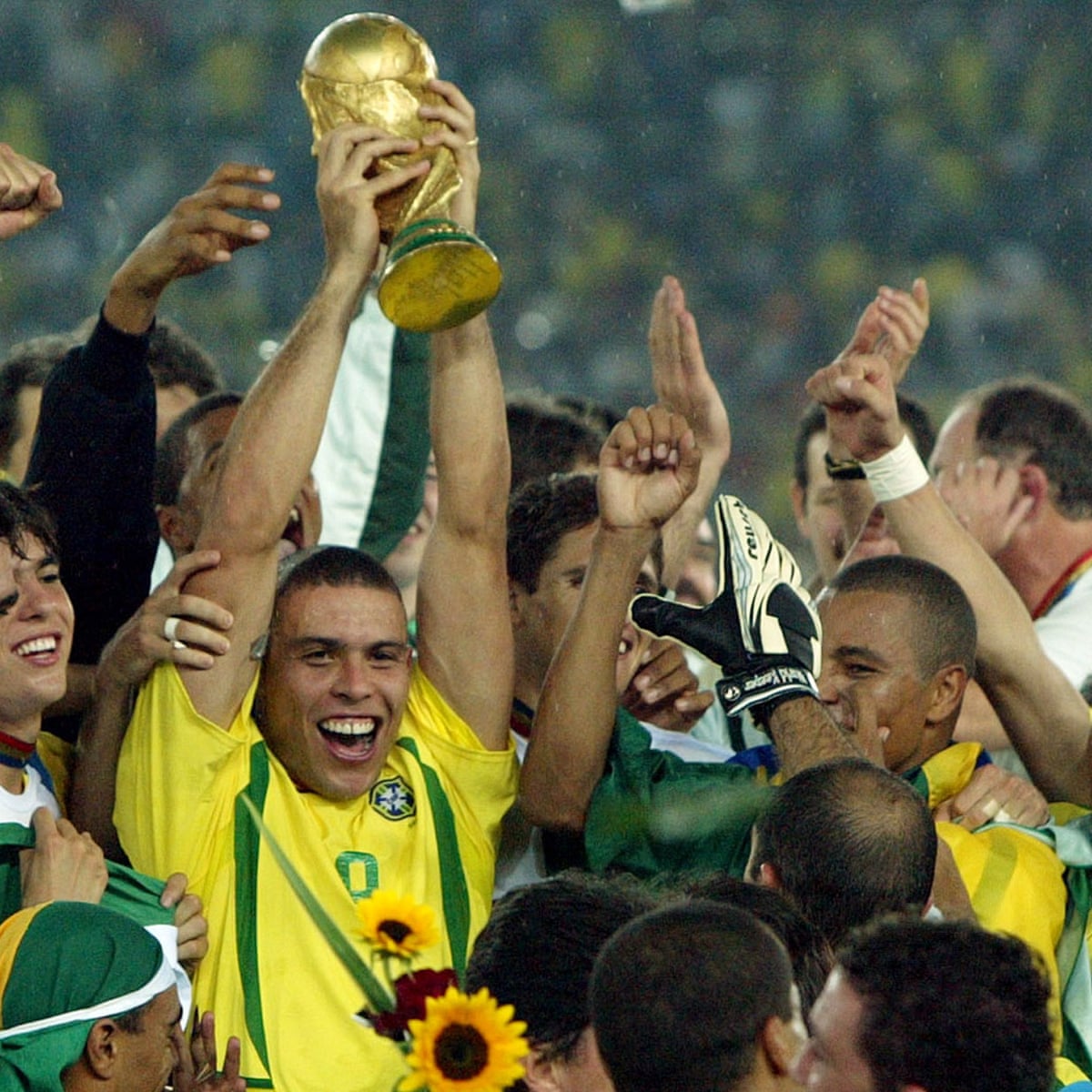
But in that 67th minute, Ronaldo won the ball from Hamann in the German half of the pitch. He passed to Rivaldo, who struck a low shot towards goal. Kahn attempted to catch the shot, but he was unable to take it cleanly, and it rebounded into play. Ronaldo, who had followed Rivaldo's shot, put the rebound in the net, ending Khan's clean sheet streak at 427 minutes.
Ronaldo scored again in the 79th, his 8th goal of the tournament, winning him the Golden Boot as its leading scorer. Oliver Bierhoff of AS Monaco and Christian Ziege of Tottenham Hotspur had come on as substitutes for Germany. Bierhoff had a shot in the 83rd minute, and Ziege one in the 93rd, but Marcos saved both, and Brazil were 2-0 winners.
For both Brazil as a team and Ronaldo in particular, the game was a sweet redemption. For Germany, it turned out to be their best performance in a World Cup between 1990 and 2014, but not good enough.
Real Madrid soon signed Ronaldo to join his Brazil teammate Roberto Carlos, and such stars as Zinedine Zidane, Luis Figo, Iker Casillas, Raúl, Guti, Fernando Hierro, Fernando Morientes, Míchel Salgado and Claude Makélélé, and later English stars David Beckham and Steve McManaman, as part of their "Galácticos."
After 5 years with them, which included a disappointing performance by the entire Brazil team at the 2006 World Cup, he played the 2007-08 season with AC Milan. He had played for both Milan teams, and both "Spanish giants," Barcelona and Real Madrid. Somehow, despite having switched sides in 2 of the biggest rivalries in sports on planet Earth, he remains beloved by fans of all 4 teams. He returned to Brazil in 2009, spending 2 seasons with São Paulo team Corinthians, before admitting that his increasing weight had slowed him down too much, and retiring in 2011.
With the arrival of Portuguese star Cristiano Ronaldo, the Brazilian, whose hair has ranged from weirdly styled to completely shaved and several styles in between, became known as "Bald Ronaldo," "Fat Ronaldo," or simply, due to his usual uniform number, "R9," along with "O Fenômeno." He is a reminder to people calling Cristiano "The GOAT," meaning "The Greatest Of All Time," that he is not even the greatest Ronaldo to have played for Real Madrid in the 21st Century.
The 2002 World Cup would be the only one won by Ronaldo or Ronaldinho. Ronaldo won 5 league titles and 3 national cups, but never a continental title. Ronaldinho, never his club teammate (he arrived as AC Milan as Ronaldo left), won 6 league titles, a national cup, and the continental titles of both Europe (the Champions League with Barcelona in 2006) and South America (the Copa Lbertadores with Atlético Mineiro in 2013).
Brazil and Germany would face each other in the 2014 World Cup Semifinal, in Brazil. In one of the most shocking games in the sport's history, Germany won, 7-1. As basketball coach Rick Pitino would have said, Ronaldo wasn't walking through that door. Ronaldinho wasn't walking through that door. Pelé wasn't walking through that door. And if they had, it would have been as slow old men. (Ronaldinho was still playing, but he was 34 and far from his best.)
UPDATE:
An article
for ESPN.com, published after the 2026 World Cup, ranking all 23
tournaments, rated this one 13th.
*
June 30, 2002 was a Sunday. These Major League Baseball games were played, most of them Interleague:
* The New York Yankees beat the New York Mets, 8-0 at Yankee Stadium. I cared more about this game that I did about the World Cup Final. John Vander Wal and Alfonso Soriano hit home runs, while Derek Jeter went 2-for-4 with a walk. For the Mets, Mo Vaughn and Roberto Alomar, 2 of the franchise's many regrettable too-late acquisitions, both singled, and Vaughn added a double, but those would be the only 3 hits in an Andy Pettitte shutout, while Steve Trachsel didn't get out of the 4th inning.
* The Atlanta Braves, a former Boston team, beat the Boston Red Sox, 7-3 at Fenway Park in Boston. Boston's bullpen and defense completely collapsed in the top of the 10th inning, with 5 hits, an error and a passed ball.
* The Philadelphia Phillies beat the Baltimore Orioles, 8-5 at Camden Yards in Baltimore.
* The Tampa Bay Devil Rays beat Florida's original team, the Florida Marlins, 6-5 at Tropicana Field in St. Petersburg, Florida. The game went to extra innings, and each team scored a run in the 11th. Brent Abernathy singled Steve Cox home with the winning run in the bottom of the 12th.
* The Toronto Blue Jays beat Canada's original team, the Montreal Expos, 7-5 at the SkyDome (now the Rogers Centre) in Toronto.
* The Arizona Diamondbacks beat the Cleveland Indians, 5-2 at Jacobs Field (now Progressive Field) in Cleveland.
* The Pittsburgh Pirates beat the Detroit Tigers, 6-2 at Comerica Park (now Fifth Third Park) in Detroit.
* The Chicago Cubs beat the Chicago White Sox, 9-2 at the new Comiskey Park (now Rate Field) in Chicago.
* In what had been an American League matchup from 1970 to 1997, the Minnesota Twins beat the Milwaukee Brewers, 4-3 at the Metrodome in Minneapolis.
* In the one intraleague game, the Cincinnati Reds beat the St. Louis Cardinals, 12-8 at Busch Stadium in St. Louis. Ken Griffey Jr. was injured, and did not play. Albert Pujols went 1-for-4 with 2 RBIs. Former Yankee Tino Martinez hit a home run for the Cards.
* The Kansas City Royals beat the San Diego Padres, 13-1 at Kauffman Stadium in Kansas City.
* The Anaheim Angels beat their neighbors, the Los Angeles Dodgers, 5-1 at Edison International Field of Anaheim (now Angel Stadium of Anaheim).
* The Oakland Athletics beat their cross-Bay rivals, the San Francisco Giants, 7-0 at the Network Associates Coliseum (as the Oakland Coliseum was then known). Tim Hudson pitched a 5-hit shutout. The A's hit no home runs, but Scott Hatteberg went 3-for-5 with 3 RBIs. Barry Bonds went 0-for-2 with 2 intentional walks.
* The Colorado Rockies beat the Seattle Mariners, 4-3 at Safeco Field (now T-Mobile Park) in Seattle. Larry Walker went 4-for-5. Ichiro Suzuki went 1-for-3 with 2 walks and a stolen base.
* And the Texas Rangers and their cross-State rivals, the Houston Astros, were rained out at The Ballpark in the Dallas suburb of Arlington, Texas. Labor Day, September 2, was an off-day for both teams, so that's when the game was made up. The Rangers won, 7-2.