Showing posts with label joe frazier. Show all posts

Saturday, October 1, 2022

October 1, 1975: The Thrilla In Manila

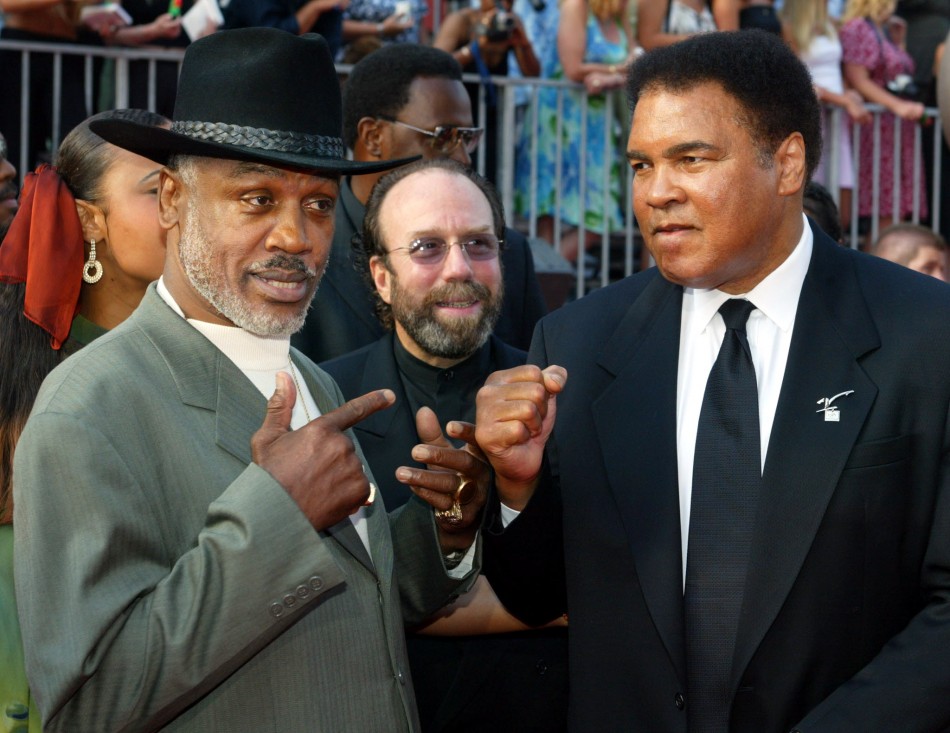
October 1, 1975: Heavyweight Champion Muhammad Ali fights former Heavyweight Champion Joe Frazier for the 3rd time, at the Araneta Coliseum in Quezon City, the capital of the Philippines. Quezon City is the national capital, and the arena is located about 5 miles east of the country's largest city, Manila.

Ali, under his birth name Cassius Clay, was an Olympic Gold Medalist in boxing, in 1960 in Rome. Frazier was as well, in 1964 in Tokyo. A man they would both memorably fight, George Foreman, followed them, in 1968 in Mexico City.

Ali first won the title in 1964 by knocking out Sonny Liston. He held it until he was stripped of it in 1967, for refusing to accept the U.S. military draft. Foreman won what was essentially a tournament for the title, ending in 1970 with a win over top contender Jimmy Ellis.

Ali got his conviction overturned by the Supreme Court, and his boxing license restored -- but not his title. That, he would have to win back. When he and Frazier met for "The Fight of the Century" at Madison Square Garden in 1971, it was the 1st time 2 undefeated Heavyweight Champions had ever met in the ring. It was a hard, even fight until the 15th and final round, when a classic Philly left hook floored the Louisvillian, and Ali received his first-ever knockdown, from which he got up to finish the fight, and his first-ever professional loss.

Ali got revenge in 1974, also at The Garden, although neither man was champion at the time. Frazier had lost the title in 1973 to Foreman, whom Ali subsequently beat to regain the title in Kinshasa, Zaire (now the Democratic Republic of the Congo), the fight known as "The Rumble In the Jungle."

Ali mocked Frazier for his fighting ability and his looks, saying, "It'll be a thrilla and a chilla and a killa, when I get the Gorilla in Manila!"

But it was intensely hot inside the Coliseum when "The Thrilla In Manila" was fought. Still, like the other 2 Ali-Frazier fights, it lived up to the hype. Ali led in the early rounds, but in the 5th round, Frazier began to turn the tide. At the end of the 6th, Ali, who'd been trash-talking (as we would say today) all the way, yelled, "They told me Joe Frazier was washed up!" Frazier yelled back, "They lied!"

Ali won the 8th round, but Frazier clobbered him in the 9th, leading him to go back to his corner and tell his trainer, Angelo Dundee, "Man, this is the closest I've ever been to dying." But Ali had landed so many punches that Frazier's face was swelling, and he was having trouble seeing.

Early in the 13th round, Ali hit Frazier in the jaw with a thunderous right hook, sending Frazier's mouthpiece flying out of his mouth and out of the ring. Ali dominated the 14th as well, because Frazier was too tired and having too much difficulty seeing. Ali was hitting Frazier with the same kind of punches that knocked out Foreman a year earlier. Except, when Ali knocked Foreman out, it took just a few seconds. He had been throwing these things at Frazier for the last 2 rounds, and Frazier simply would not go down.

Frazier had more courage and endurance than sense, and refused to go down, and refused to quit. As the 15th and final round approached, Frazier wanted to continue. His trainer, Eddie Futch, told him that he was going to stop the fight. Frazier said no: "I want him, boss." He was unable to talk Futch out of it: "The fight's over, Joe. No one will forget what you did here today." And he told the referee, Carlos Padilla, to stop the fight. Padilla did so.

Ali retained the crown, the belt, the title, whatever you want to call it. He got up off his stool, raised his right arm in victory... and collapsed. He had nothing left to give. If Futch had let Frazier fight the 15th round, he would have knocked Ali out.

It's been called the greatest prizefight in history. Today, most people know the name Manila for 3 things: The brown office folders that bear its name, its role in the Pacific Theater of World War II, and Ali-Frazier III.

Howard Cosell, who covered the fight for ABC Wide World of Sports, later said, "A big piece of Ali remained in that ring." Indeed, at age 33, with nothing left to prove, Ali probably should have retired right there. Instead, he kept fighting for 6 more years. So did Frazier. Both men would have their moments, but neither was ever so good again.
"The Greatest of All Time" developed Parkinson's disease as a result of his taking so many blows to the head. The big mouth that got him the early nickname "The Louisville Lip" was rendered mostly silent by the turn of the 21st Century. He died on June 3, 2016, at age 74.

"Smokin' Joe" would continue to alternately feud with Ali and reconcile with him, restart the feud, and reconcile again. Joe died of liver cancer on November 7, 2011, at age 67, after 30 years of training fighters at his gym in North Philadelphia.

One of the fighters he trained was his son Marvis, who, like Ali on that awful night in 1980, would get slaughtered by Larry Holmes in Las Vegas. His daughter Jackie Frazier-Lyde also fought professionally, as has Ali's daughter Laila Ali. (She went 24-0 with 21 knockouts, and won a majority decision against Frazier-Lyde in Verona, New York in 2001.) Another daughter of Ali's, Maryum, is a rapper using the name May May.

Opened in 1960, the Araneta Coliseum is still used for sporting events and concerts. A shopping center 2 blocks away is named Ali Mall.

*

October 1, 1975 was a Wednesday. Baseball was between the regular season and the Playoffs. The 1975-76 basketball and hockey seasons hadn't started yet. And the NFL was in midweek. But there was one score on this historic day, in the Canadian Football League: The Ottawa Rough Riders beat the Hamilton Tiger-Cats, 16-11 at Ivor Wynne Stadium in Hamilton, Ontario.


Friday, September 30, 2022

September 30, 1967: The Spectrum Opens

September 30, 1967: The Spectrum, a new sports arena, opens in South Philadelphia, just to the north of John F. Kennedy Stadium. The new baseball and football facility, Veterans Stadium, had recently begun construction, just to the north. The first event at the arena was the Quaker City Jazz Festival.

Lou Scheinfeld, former President of the Spectrum, explained that the name "Spectrum" was selected to evoke the broad range of events to be held there:

* SP: "SPorts" and "South Philadelphia"
* E: "Entertainment"
* C: "Circuses"
* T: "Theatricals"
* R: "Recreation"
* UM: "Um, what a nice building!"

That last one was a bit of a stretch. Scheinfeld also said that a seat in the city's first superbox initially cost $1,000 a year: "For every Flyers game, Sixers game, circus, you name it, you got 250 events for $1,000."

The first sporting event at the arena was a fight card on October 17, headlined by hometown hero Joe Frazier defeating Tony Doyle. The next day, the defending NBA Champion 76ers, previously playing at the Convention Hall of the Philadelphia Civic Center, made their Spectrum debut, beating the Los Angeles Lakers, 103-87. Elgin Baylor of the Lakers led all scorers with 24 points. Wilt Chamberlain scored only 11, but had 30 rebounds. The day after that, the Flyers made their home debut, beating their fellow Pennsylvania expansion team, the Pittsburgh Penguins, 1-0. Bill Sutherland scored the 1st goal.

On March 1, 1968, wind blew part of the covering off The Spectrum's roof during a performance of the Ice Capades, forcing the building to close for a month while Mayor James Tate fought with Philadelphia County District Attorney Arlen Specter (later a U.S. Senator) over responsibility for the construction of the roof, and the damage was repaired.

The 76ers moved their home games to Convention Hall and to the Palestra, but neither of those arenas had ice rinks at the time, and there were no other NHL-quality sites in the Philadelphia area. Thus the Flyers hurriedly moved their next home game, against the Oakland Seals, to Madison Square Garden in New York, followed by a meeting with the Boston Gardens at Maple Leaf Gardens in Toronto, before establishing a base at Le Colisée de Québec in Quebec City, home of their top farm team, the Quebec Aces. The roof was repaired in time for them to play their home Playoff games there.

In 1976, the nation's Bicentennial led to several events being held in Philadelphia, where the Declaration of Independence was written, debated and signed. Veterans Stadium hosted MLB's All-Star Game, while The Spectrum hosted the NBA and NHL All-Star Games, and the NCAA Final Four, won by Indiana University.

In fiction, each of the fights between Rocky Balboa and Apollo Creed were held at The Spectrum in 1976: The 1st, in the original Rocky, on New Year's Day, January 1; the 2nd, in Rocky II, on Thanksgiving Day, November 25.

The Spectrum also hosted the All-Star Game for the NBA in 1970, and for the NHL in 1992. A 2nd Final Four was held there in 1981, again won by Indiana. The Spectrum hosted the NBA Finals in 1977, 1980, 1982 and 1983, with the Sixers winning only the last of these; and the Stanley Cup Finals in 1974, 1975, 1976, 1980, 1985 and 1987, with the Flyers winning the 1st 2 of these.

The arena became home to statues of 76ers star Julius "Dr. J" Erving, a prominent goal scored by the Flyers' Gary Dornhoefer, the fictional Rocky Balboa (later moved to its site in the movies, the Philadelphia Museum of Art), and Kate Smith, the Flyers' "good luck charm" during their 1974 Stanley Cup run.

Elvis Presley sang there 4 times: November 8, 1971; June 23, 1974; June 28, 1976; and May 28, 1977. The Beatles did not perform there together, but all of them except John Lennon would give solo concerts there. The Grateful Dead played there more than any other act, 53 times. Other notable Spectrum concerts included Jimi Hendrix and Led Zeppelin in 1969, The Doors in 1970, The Who in 1973, Bob Marley in 1975 and 1978, Queen in 1980, Bruce Springsteen paying tribute to John Lennon the day after his murder in 1980, Guns N'Roses opening for Aerosmith in 1988, N.W.A. and Metallica in 1989 (not on the same bill), and Philadelphia-area natives Pink and Taylor Swift in 2009 (not on the same bill).

Unlike most arenas, The Spectrum was not replaced due to it being technologically outdated, or in poor condition, or being in a bad neighborhood (it was an island in a sea of parking, therefore it was in no neighborhood). It was because Spectator, the company owned by the Snider family to operate the arena and the Flyers, was booking more events than it could handle.

So in 1992, JFK Stadium was torn down, and what was originally named Spectrum II was built on the site. The idea was that the new arena would host the headline events -- the 76ers, the Flyers, and the major concerts -- while the original Spectrum would host smaller events.

The 76ers' last game at The Spectrum was on April 19, 1996. They lost to the Orlando Magic, 112-92. The Flyers' last game there was in the Stanley Cup Playoffs, on May 12. They were eliminated from the Eastern Conference Semifinals by the Florida Panthers, 2-1. Mike Hough scored the winning, and last, goal at 8:05 of the 2nd overtime.

The Spectrum continued to hold public events until a series of Pearl Jam concerts from October 27 to 31, 2009. The building was torn down the following year. Xfinity Live! Philadelphia, a dining and entertainment complex, opened on the site in 2012.

In 2005, the NBA's Charlotte Bobcats opened a new arena, named the Charlotte Bobcats Arena. Neither the team nor the arena kept their original names. In 2008, the arena became the Time Warner Cable Arena. In 2014, the Bobcats were permitted to take the name of the city's previous NBA team, the Charlotte Hornets. In 2016, following Time Warner's breakup, its cable-TV operations were bought out by Charter Communications, and the arena became the Spectrum Center. Charter Communications and their Spectrum division have no connection to Spectacor or the Snider family, which sold Spectacor in 2011.

*

September 30, 1967 was a Saturday. Actress Andrea Roth was born. And, in college football, Nate Northington of the University of Kentucky became the Southeastern Conference's 1st black football player. I have a separate entry for this event. Kentucky lost to the University of Mississippi, 26-13 at McLean Stadium in Lexington, Kentucky.

Among the other college football games played that day were these:

* Number 1 Notre Dame were upset by Number 10 Purdue, 28-21 at Ross-Ade Stadium in West Lafayette, Indiana.

* Number 2 Southern California (USC) beat Michigan State, 21-17 at Spartan Stadium in East Lansing, Michigan.

* The night before, Number 3 University of Houston beat Wake Forest, 50-6 at the Astrodome in Houston.

* Number 4 UCLA beat Washington State, 51-23 at the Los Angeles Memorial Coliseum.

* Number 5 Georgia beat Clemson, 24-17 at Memorial Stadium in Clemson, South Carolina.

* Number 7 Nebraska beat Minnesota, 7-0 at Memorial Stadium in Lincoln, Nebraska.

* Number 8 Texas lost to Texas Tech, 19-13 at Memorial Stadium in Austin, Texas.

* Number 9 Alabama beat Southern Mississippi, 25-3 at Ladd Stadium in Mobile, Alabama.

* Among the service academies, Army beat Boston College, 21-10 at Alumni Stadium, just outside Boston in Chestnut Hill, Massachusetts; Navy lost to Rice, 21-7 at Rice Stadium in Houston; and Air Force lost to the University of Washington, 30-7 at Falcon Stadium in Colorado Springs, Colorado.

* In New Jersey, Princeton beat Rutgers, 22-21 at Palmer Stadium in Princeton.

And in New Jersey high school football, East Brunswick, the school that would one day be my Alma Mater, beat Woodbridge, 14-0 at home, at the stadium that would one day be named Jay Doyle Field.

And these games were played in Major League Baseball:

* The Boston Red Sox beat the Minnesota Twins, 6-4 at Fenway Park in Boston. This was the next-to-last day of the regular season, and the Red Sox and Twins were battling the Detroit Tigers and the Chicago White Sox for the American League Pennant. Carl Yastrzemski of the Red Sox and Harmon Killebrew of the Twins each hit his 44th home run of the season. Neither of them homered the next day, so they finished in a tie for the AL home run lead.

With Yaz also leading the AL in batting average and runs batted in, that means that, despite only being tied for the home run lead, he was awarded the Triple Crown. There would not be another Triple Crown winner for 45 years.

At the time, the Red Sox' games were broadcast on WHDH-Channel 5. With the Sox involved in a Pennant race for the 1st time in a generation, the station went against protocol, which was to save money on videotape by taping over old games, and saved several games from that season. These clips were edited down into a highlight reel, except for the last 2 games, this one and the next day's. As a result, this Boston victory over Minnesota is, as far as is publicly known, the oldest surviving full color video broadcast of an MLB game.

* A doubleheader was split at Tiger Stadium in Detroit. The Detroit Tigers won the opener, 5-0. Mickey Lolich pitched a 3-hit shutout. The California Angels won the nightcap, 8-6. Over the 2 games, Al Kaline went 1-for-8 with a walk.

With this doubleheader, the AL standings now featured the Red Sox and the Twins tied for 1st place, with the Tigers only half a game back. The Red Sox and Twins played each other again the next day, with the winner assured of no worse than a Playoff for the Pennant the next day. The Tigers had another doubleheader, and if they swept it, they would have a Playoff with the Red Sox-Twins winner. As it turned out, the Red Sox beat the Twins, and the Tigers only split their doubleheader, so the Sox won the Pennant.

* The Washington Senators beat the Chicago White Sox, 4-0 at Comiskey Park in Chicago. The White Sox had been eliminated from the race when the Senators beat them the night before, so this game was meaningless -- except, perhaps, to Senators pitcher Frank Bertaina, who pitched a 5-hit shutout.

* The New York Yankees beat the Kansas City Athletics, 5-4 at Yankee Stadium. Mickey Mantle drove in the Yankees' 1st run with a groundout, and then left the game due to injury. Rookie Reggie Jackson did not play for the A's in this game. The next day, the Yankees won, 4-3. This was the last game for the A's representing Kansas City. The next season, they moved to Oakland.

* The New York Mets beat the Los Angeles Dodgers, 5-0 at Dodger Stadium in Los Angeles. Les Rohr pitched 8 shutout innings, and Ron Taylor completed a 7-hit shutout, to outpitch Don Drysdale. Ken Boswell hit a home run.

* The St. Louis Cardinals beat the Atlanta Braves, 3-1 at Atlanta Stadium (later Atlanta-Fulton County Stadium). In contrast to the AL, the Cardinals had the National League Pennant wrapped up several days earlier. Lou Brock went 3-for-4. Roger Maris went 1-for-4 with an RBI. Joe Torre went 1-for-3 with an RBI. Hank Aaron only appeared as a pinch-hitter, and struck out.

* The Houston Astros beat the Pittsburgh Pirates, 4-3 at Forbes Field in Pittsburgh. Roberto Clemente went 1-for-3 with a walk. Willie Stargell went 1-for-4 with an RBI.

* The Baltimore Orioles beat the Cleveland Indians, 5-2 at Cleveland Municipal Stadium. Frank Robinson went 0-for-4, and Brooks Robinson did not play.

* The Chicago Cubs beat the Cincinnati Reds, 9-4 at Crosley Field in Cincinnati. Ernie Banks went 4-for-5 with an RBI. Pete Rose went 1-for-5 with 2 RBIs. Rookie Johnny Bench did not play for the Reds in this game.

* And the San Francisco Giants swept a doubleheader with the Philadelphia Phillies, 3-2 and 1-0 at Candlestick Park in San Francisco. Willie McCovey hit a home run in the 1st game. Willie Mays went 0-for-4, and then did not play in the 2nd game. Three Giant pitchers -- Bill Henry (3 innings), Nestor Chavez (4, winning pitcher) and Lindy McDaniel (2, save) combined on a 4-hit shutout. 

Tuesday, March 8, 2022

March 8, 1971: The Super Fight

March 8, 1971: For the 1st time -- and, so far, for the last time -- 2 men who were undefeated and, at least officially, undisputed Heavyweight Champions had faced each other in the ring. Of course, it had to be at Madison Square Garden. It was March 8, 1971. Like many others, it was billed as The Fight of the Century. It was also called The Super Fight. It was also called simply The Fight.

Muhammad Ali had won a Gold Medal for America in the 1960 Olympics in Rome, and had won the Heavyweight Title on February 25, 1964, beating Sonny Liston in Miami Beach. Shortly thereafter, he converted to Islam and changed his name, which had been Cassius Clay. He won a rematch with Liston, and defeated anyone and anyone challenging him, including former Heavyweight Champion Floyd Patterson.

But on April 29, 1967, he was drafted into the U.S. Army. He reported for induction, and refused to accept it. He was immediately indicted for draft evasion. His boxing license was subsequently suspended, and he was stripped of the title. He would be convicted, but appealed the decision. It went all the way to the Supreme Court of the United States, where it was overturned in a unanimous vote. However, that wouldn't happen until nearly 4 months after The Super Fight.

In the meantime, Joe Frazier, who had won a Gold Medal at the 1964 Olympics in Tokyo, had won a piece of the title on March 4, 1968, having beaten the other major contender, Buster Mathis, at the new Madison Square Garden. (The replacement for "the old Garden" really was new, having opened on February 11.) On February 16, 1970, Frazier unified the title by beating the holder of its other pieces, Jimmy Ellis.

Ali received a new boxing license, and on October 26, 1970, in Atlanta, knocked out Jerry Quarry in his 1st fight back. On December 7, he knocked out Oscar Bonavena at The Garden. In hindsight, the Louisville Lip should have had at least one more tuneup fight before taking on Smokin' Joe.

Neither man had ever lost a professional fight: Ali went into the fight 31-0; Frazier, 26-0. Of course, it had to be held at The Garden: Like its predecessor arena, it was billed as "The Mecca of Boxing." (I don't know what Ali, a Muslim, thought about that nickname.)

How big was this fight? How tough a ticket was it? Frank Sinatra, the biggest living name in entertainment, and a great fan of sports, especially boxing, couldn't get a ticket. So he made arrangements to be Life magazine's official photographer for the fight.

But there were music legends on hand, including Count Basie, Miles Davis, Motown's Diana Ross and Marvin Gaye, Bob Dylan and Isaac Hayes. So was TV host Ed Sullivan, a big sports and especially boxing fan, who knew a "really big show" and a "great stage" when he saw one. So was actor-director Woody Allen, who had been there 10 months earlier when the Knicks finally won their 1st NBA title, and his muse/then-girlfriend, Diane Keaton.

So was Playboy boss Hugh Hefner. So was "gonzo journalist" Dr. Hunter S. Thompson. So was author Norman Mailer, who fancied himself a good boxer. (He wasn't.) Former Champions Jack Dempsey and Joe Louis were there.

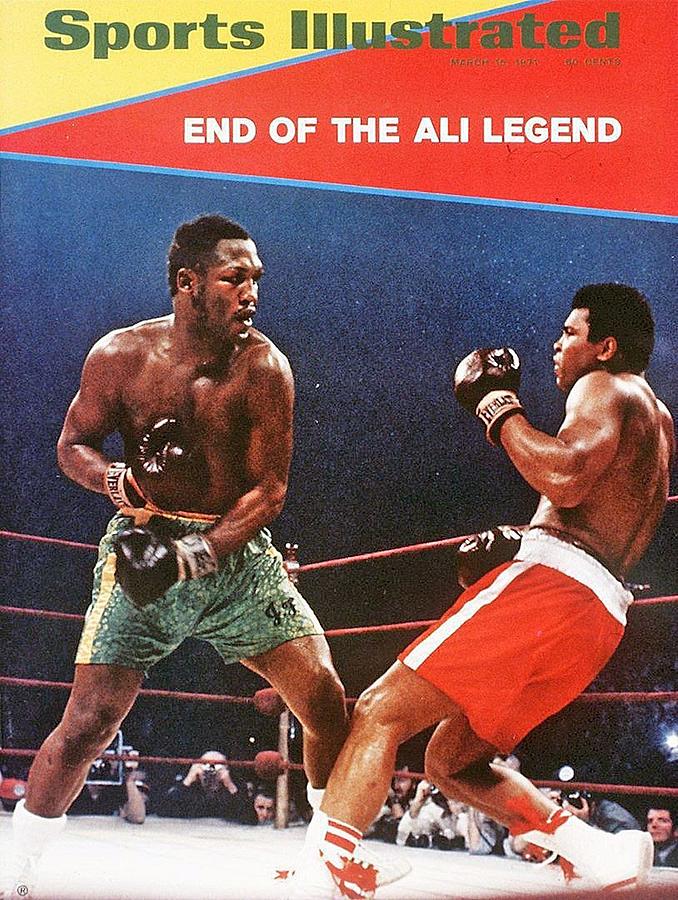
Most of the fight was even. But as it went on, Ali's rustiness began to show. In the 15th and final scheduled round, Frazier's famed left hook knocked Ali down, the 1st time he'd been knocked down since Henry Cooper did it at Wembley 8 years earlier. He got right back up, but it was too late: The knockdown was enough to give Frazier a unanimous decision, and the undisputed title.

Sports Illustrated would put the knockdown on their cover, and used the headline "END OF THE ALI LEGEND."

Well, that time, "The Dreaded SI Cover Jinx" fell on SI itself. Ali stayed in the ring on a regular basis, winning 10 straight fights, until fighting Ken Norton in San Diego in 1973. Norton broke Ali's jaw -- "Perhaps poetic justice," as his frenemy Howard Cosell would say -- and won a split decision. Undeterred, Ali fought Norton again, 6 months later at the Forum outside Los Angeles. Again, it was a split decision. This time, it went in Ali's favor.

And then he fought Frazier a 2nd time, also at the Garden. After 12 rounds, he won a unanimous decision. Except Frazier was no longer the Champion: On January 22, 1973, in Kingston, Jamaica, he had been knocked out by George Foreman, who had won the Gold Medal at the 1968 Olympics in Mexico City. Foreman then knocked out Norton, the only other man to have beaten Ali.

A fight between Ali and Foreman was set up, and some people thought Foreman was going to kill Ali. Not just beat him, but possibly end his life. On October 30, 1974, in Kinshasa, the capital of the African nation of Zaire (now the Democratic Republic of the Congo), in a fight known as "The Rumble in the Jungle," Ali fooled everybody, and knocked Foreman out.

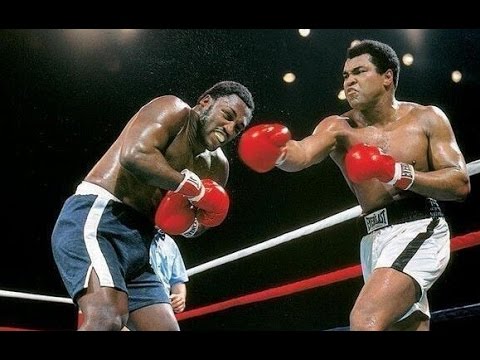
On October 1, 1975, he fought Frazier for a 3rd time, in the Philippines, in a fight known as "The Thrilla in Manila." Frazier hit Ali so hard, Ali told his trainer Angelo Dundee that the 9th round was the closest he had ever come to death. But Ali rallied, knocking Frazier's mouthpiece out in the 13th, and absolutely pummeling him in the 13th and 14th rounds.

Frazier's trainer Eddie Futch was afraid his man would get badly hurt if he fought a 15th round, so he stopped it. Ali stood to receive the cheers of the crowd, and collapsed. Both men should have retired for good after that fight. Neither did.

In 1988, Michael Spinks was 31-0, and held the IBF version of the Heavyweight Title. Mike Tyson was 34-0, and held the WBA and WBC versions. Both were undefeated, but the title was split, so it wasn't undisputed. This is the closest a fight has since come to the 1971 Super Fight. The fight was held at Boardwalk Hall in Atlantic City, and Tyson knocked Spinks out midway through the 1st round. Spinks never fought again.

*

March 8, 1971 was a Monday. It was during the NFL's off-season, and baseball was in Spring Training, so there were no games scheduled for either sport. The NHL regular season was approaching its climax, but that League didn't schedule any games for that day, either.

There were, however, 2 games in the NBA that night, and 1 in the American Basketball Association:

* The Milwaukee Bucks beat the Seattle SuperSonics, 104-99 at the Milwaukee Arena. In 1974, it was renamed the Milwaukee Exposition, Convention Center and Arena, or "The MECCA." Since 2014, it has been named the UW-Panther Arena.

* In a battle of 1st-year expansion franchises, the Buffalo Braves beat the Portland Trail Blazers, 114-98 at the Portland Memorial Coliseum.

* And in the ABA, the Indiana Pacers beat the Carolina Cougars, 118-105 at the Indiana State Fair Coliseum (now the Corteva Coliseum) in Indianapolis.

Saturday, January 22, 2022

January 22, 1973: Roe v. Wade, LBJ Dies, Down Goes Frazier

The Justices of the U.S. Supreme Court, 1973. Top row, left to right:
Lewis Powell, Thurgood Marshall, Harry Blackmun, William Rehnquist.
Bottom row, left to right: Potter Stewart, William O. Douglas,
Chief Justice Warren Burger, William J. Brennan, Byron White.

January 22, 1973: The U.S. Supreme Court announces its decision in the case of Jane Roe, et al. v. Henry Wade, District Attorney of Dallas County -- heretoafter referred as Roe v. Wade for short.

It is the most controversial decision the Court has made since Dred Scott v. Sanford in 1857. And it is a story so big that it overshadows 2 other events on the same day: The death of a former President of the United States, and the Heavyweight Championship of the World changing hands on a spectacular knockout.

In 1968, Norma McCorvey, a 21-year-old Dallas resident, became pregnant for the 3rd time. She had given up her 2nd child for adoption willingly, and was tricked into doing the same for her 1st. She was divorced from the father of her 1st child, and had no means to raise a child.
She sought an abortion, but the law of the State of Texas prohibited in nearly all cases. The only exception was if giving birth would endanger the mother's life. She was referred to attorneys Sarah Weddington and Linda Coffee, who filed a lawsuit in U.S. federal court in March 1970, alleging that Texas' abortion laws were unconstitutional.

To keep her identity a secret, McCorvey was listed in court records with the placeholder name Jane Roe. (Legal placeholder names include John Doe, Jane Doe, Richard Roe, and, in this case, Jane Roe.) The defendant was the District Attorney for Dallas County, Henry Wade, previously best known for having successfully prosecuted Jack Ruby, who had murdered Lee Harvey Oswald before Oswald could be tried for the assassination of President John F. Kennedy.
Three months after filing the suit, on June 2, 1970, Norma McCorvey gave birth to her 3rd child, a girl, and put her up for adoption. A few months later, a 3-judge panel of the U.S. District Court for the Northern District of Texas heard the case, and ruled in her favor. Crawford Martin, the Attorney General of the State of Texas, appealed directly to the U.S. Supreme Court.

It took until January 22, 1973 for the High Court to issue a ruling. It was 7-2 in McCorvey's favor. The reasoning was that the Due Process Clause of the 14th Amendment to the Constitution of the United States provides a "right to privacy" that protects a pregnant woman's right to choose whether to have an abortion.

However, it also ruled that this right is not absolute, and tied the degree of any State's regulation to the trimester of pregnancy which is to be aborted. In other words, the Court provided a loophole which gave anti-abortion activists hope that, one day, the Roe v. Wade decision might be overturned.

The decision was written by Justice Harry Blackmun, who became, to anti-abortion activists, the most hated Justice in the Court's history. He was joined by Chief Justice Warren Burger, and Justices William O. Douglas, William J. Brennan, Potter Stewart, Thurgood Marshall and Lewis Powell.

Dissenting were Justices Byron White and William Rehnquist. Both were Catholic -- but so was Brennan, who supported the aforementioned citation of a right to privacy.

Appointed by Democratic Presidents: Douglas by Franklin D. Roosevelt in 1939, White by John F. Kennedy in 1962, and Marshall by Lyndon Johnson in 1967. The Democrats, ever since, have been the Party favoring abortion rights, but White did not vote that way.

Appointed by Republican Presidents: Dwight D. Eisenhower had appointed Brennan in 1956, and Stewart 1958; while the current President, Richard Nixon, had appointed Burger in 1969, Blackmun in 1970, and Powell and Rehnquist in 1972.

However, Brennan was a Democrat, whom Eisenhower had appointed as a gesture of bipartisanship. Of the other 5, only Rehnquist ruled against the right to an abortion. In 1986, when Burger retired as Chief Justice, President Ronald Reagan rewarded Rehnquist by promoting him to the Chief's chair.

Control of the Supreme Court has been seen as the anti-abortion movement's way of getting Roe overturned. Which is why, in 2016, when hard-core anti-abortion Justice Antonin Scalia died, Senate Majority Leader Mitch McConnell prevented President Barack Obama's appointee to the seat, Merrick Garland, from even getting a hearing in the Senate.

It was also why evangelical "Christian" Republicans, so often hypocritical, were willing to accept Donald Trump, a pathological liar, a man married 3 times and divorced twice, a serial adulterer, a confessor to serial sexual assault, and a man whose words and actions compare very poorly with those of Jesus of Nazareth, as the Republican nominee for President, because they knew he would appoint Justices to the Court that would be acceptable to McConnell, and thus acceptable to them. This allowed the Scalia seat to remain vacant until Trump took office, enabling him to appoint Neil Gorsuch to the seat.

Justice Anthony Kennedy, often the "swing vote" on cases, including the biggest challenge to Roe to that point, Planned Parenthood v. Casey in 1992, surprisingly retired in 2018, and Trump appointed Brett Kavanaugh as his replacement, an alcoholic with, like Trump himself, a record of sexual assault and hatred of women.

And when Justice Ruth Bader Ginsburg died in office in 2020, before Senate Minority Leader Chuck Schumer could do anything about it, McConnell rushed the confirmation of Trump's appointee, Amy Comey Barrett, through the Senate, giving the Court a 6-3 conservative majority that, Court-watchers believe, will overturn Roe when they reach a decision in Dobbs v. Jackson Women's Health Organization, likely coming at the end of the Court's term in June 2022, 7 months short of the 50th Anniversary of Roe. (UPDATE: That decision came on June 24, and it did overturn Roe.)

After Roe v. Wade, Henry Wade did not see his reputation take a hit. Liberals didn't blame him for a law in place well before he ever took office, and conservatives did not hold it against him that he lost the case. He retired as District Attorney in 1987, after 36 years, and died in 2001.

Despite having slept around with men, Norma McCorvey more often identified as a lesbian, having spent most of her adult life with a single life-partner, Connie Gonzales, but constantly cheating on her. In 1989, she came forward as Jane Roe, and participated in abortion-rights rallies.

Then, in 1995, she switched sides, becoming an evangelical Catholic -- at least, officially -- and attending anti-abortion rallies. She wrote 2 books, 1 while on each side of the debate, and both of which were exposed for containing lies. She was never really an asset to either side. Apparently, the only thing she truly believed in was publicity.

In 2017, I wrote, "Whoever that baby turned out to be, he or she is now 47 – my age -- and we have no way of knowing whether he or she knows of the status as the most famous unwanted child of all time, a famous person whose name no one knows." At the time, that was still true.

In 2021, the baby that "Jane Roe" didn't want came forward for an article in the Atlantic Monthly magazine, and a subsequent book by Joshua Prager, The Family Roe. (Prager had gained the cooperation of McCorvey's 1st 2 children and her ex-partner.) 

Shelley Lynn Thornton grew up in the Dallas suburb of Mesquite, Texas, and later in the Seattle suburb of Kent, Washington, knowing that she was adopted and that she had 2 half-sisters living elsewhere -- but, at the time, no more than that. Shortly before her 19th birthday, she was told -- by a "reporter" for the National Enquirer -- who her birth mother was.

She freaked out. Not because she now knew that her birth mother wanted to end her life. But because, even at her age, she knew that both the Enquirer and the right-to-life movement would want to use her. In one of the few decent things the Enquirer has ever done, it kept Shelley's name out of the printed story.

In 1991, Shelley herself became pregnant. Understandably, she was opposed to abortion, but, to her, the term "pro-life" meant the fanatics who terrorized women seeking a choice, and blew up clinics, killing people and making themselves hypocrites, and she wanted nothing to do with that label. She didn't want the "Right to Life" movement to use her in any way.

Unlike her mother, she had a supportive boyfriend, and they got married before their son was born. They moved to Tucson, Arizona, and added 2 daughters. She met both of her half-sisters, and got along well with them. But, despite 2 difficult phone calls, years apart, Shelley Thornton never met Norma McCorvey face-to-face.

McCorvey died on February 18, 2017, in the Houston suburb of Katy, Texas, of heart failure, at age 69. In what turned out to be a final interview, what abortion rights activists have called a "deathbed confession," she said she was paid to switch to the anti-abortion side: "I was the big fish. I think it was a mutual thing. I took their money, and they'd put me out in front of the cameras and tell me what to say. That's what I'd say."

However unreliable a narrator she may have been, I'll let her have the last word: "If a young woman wants to have an abortion, that's no skin off my ass. That's why they call it 'choice.'"

Of the 9 Justices on the Court for Roe v. Wade, Rehnquist was the last one on the Court, dying in office in 2005. The last one who voted for reproductive rights was Harry Blackmun, who retired in 1994.

*

January 22, 1973 was a Monday. And Norma McCorvey was not the only Texas resident in the news that day. Former President Lyndon B. Johnson suffered a heart attack at his LBJ Ranch outside Johnson City. (The city was named for his grandfather, and the closest big city is Austin.) He had a private plane on the Ranch, and Secret Service agents loaded him onto it. He was flown to Brooke Army Medical Center at Fort Sam Houston, outside San Antonio, but he was pronounced dead on arrival.
The last known photo

He was 64, and had spent the last 4 years watching Nixon pick apart at his legacy. Actually, while Nixon did dismantle some "Great Society" programs, he kept some, and strengthened others.

That night, at the National Stadium (now named Independence Park) in Kingston, Jamaica, Joe Frazier defended the Heavyweight Championship of the World. His opponent was George Foreman, from Houston. Both men were Olympic Gold Medalists: Frazier in Tokyo in 1964, Foreman in Mexico City in 1968. Both men were undefeated as professionals: Frazier was 29-0, and Foreman, despite being 5 years younger, was 37-0.

In what was known as the Sunshine Showdown (despite taking place at night), Foreman dominated from the opening bell. The rule mandating the fight be ended in the event of 3 knockdowns in 1 round was waived for this fight. Angelo Dundee, Muhammad Ali's trainer, who had also worked with Foreman, was seated at ringside, and, halfway through the 1st round, could be heard on ABC Sports' broadcast yelling, "Frazier's hurt!"

Sitting next to Dundee, Howard Cosell tried to tell the ABC audience what Dundee had said, but couldn't finish it, because Foreman delivered a knockdown blow: "Angie Dundee, Ali's trainer, right next to me, is saying it. You may hear it... Down goes Frazier! Down goes Frazier! Down goes Frazier! The Heavyweight Champion is taking the mandatory 8-count, and Foreman is as poised as can be in a neutral corner!"
Frazier got up at the count of 2, but took the 8-count, and resumed. With 16 seconds left in the 1st round, Foreman knocked Frazier down again. He got up. Just before the bell rang to end the round, Foreman knocked Frazier down for a 3rd time. There was no "saving by the bell": Had Frazier not gotten up, it would have been over then.

It should have been over then. Instead, referee Arthur Mercante, who had refereed the 1st Ali-Frazier fight in 1971, let the 2nd round begin. Frazier was knocked down a 4th time. Mercante didn't stop it. Frazier was knocked down a 5th time. Mercante didn't stop it. Frazier was knocked down a 6th time. Only then did Mercante stop it. Foreman was the Champion.

In his next fight, on September 1 at Budokan in Tokyo, Japan, Foreman knocked Puerto Rican fighter José "King" Roman out in the 1st round. Next up, on March 26, 1974 in Caracas, Venezuela, Foreman knocked Ken Norton out in the 2nd round.

Roman had never fought Ali. But, now, Foreman had destroyed the only 2 men to defeat Ali as professionals. Yet Ali wanted to fight him to regain the title. People were afraid that Foreman would badly hurt Ali, maybe even kill him. Instead, Ali knocked Foreman out in the 8th round, and proved that he was, indeed, what he had been saying he was: "The Greatest of All Tiiiiiiiime!"

Foreman retired in 1977, became a minister, and, in 1987, returned to boxing to raise money for his church. Discovering that he still had some punching power, he kept at it. He fought Evander Holyfield for the title in 1991, and while he didn't come close to winning, he went the distance and didn't get hurt.

Lots of people, myself included, thought he had proven his point, and that he should stop before he did get hurt. He didn't. In 1994, with the title now in the hands of Michael Moorer, Foreman knocked Moorer out, and, at 45, became the oldest Heavyweight Champion of the World ever.

*

The Foreman-Frazier fight was, by far, the biggest sporting event on January 22, 1973. Baseball and football were out of season. And there were no games scheduled in the NBA, the ABA, or the NHL that day.

Two games were played in the World Hockey Association. The New York Raiders lost to the Minnesota Fighting Saints, 3-2 at Madison Square Garden. And the Alberta Oilers beat the Chicago Cougars, 6-1 at the Edmonton Gardens.

The following year, the Oilers would drop "Alberta" from their name and become the Edmonton Oilers. And the Raiders would change their name to the New York Golden Blades, and, in midseason, move to the Philadelphia suburb of Cherry Hill, and change their name to the Jersey Knights. They folded at the end of the season.

December 31, 1999 & January 1, 2000: The Millennium

December 31, 1999:  The Millennium arrives. The people of planet Earth survived. At a terrible cost. But we hadn't destroyed ourselves. ...