Showing posts with label villanova wildcats. Show all posts

Thursday, November 10, 2022

November 10, 1944: The USS Mount Hood Explosion

November 10, 1944: The ammunition ship USS Mount Hood (AE-11) disintegrates from the accidental detonation of 3,800 tons of cargo in the Seeadler Harbor fleet anchorage at Manus Island, Papua New Guinea.

Named for Mount Hood, the highest point in the State of Oregon, the ship had been launched on November 28, 1943, from the Norfolk Navy Yard in Virginia. Befitting her name, she was sent to the Pacific Theater of Operations in World War II.

On November 10, 1944, the ship was docked at Seeadler Harbor -- yes, I know, it looks weird, but that's how it's spelled -- in Papua New Guinea, then controlled by Australia. At 8:30 AM, a party consisting of 17 men left the ship and headed for shore, to collect the ship's mail. At 08:55, while this party was walking on the beach, the explosion occurred.

Even at a distance of 4,600 yards (about 2.6 miles) from the ship, the force of the explosion knocked the men from their feet. Scrambling back into their boat, they headed back to the ship, only to turn around again shortly thereafter as, according to one sailor's account, "There was nothing but debris all around..."

In addition to the Mount Hood, 22 small boats were destroyed, 36 nearby ships were damaged, 432 men were killed, and 371 more were injured.

Papua New Guinea was granted independence by Australia in 1949. It remains a parliamentary democracy, part of the British Commonwealth.

In 1971, a new ammunition ship was launched by the U.S. Navy, with the name USS Mount Hood, serving until 1999.

*

November 10, 1944 was a Friday. Songwriter Tim Rice was born.

Baseball season was over. The NBA hadn't been founded yet. And while the NHL season was underway, no games were scheduled for this day.

There were 2 college football games played. North Carolina State beat the University of Miami, 28-7 at Burdine Stadium, later renamed the Orange Bowl, in Miami.

And, with The War -- as my grandmother, who lived through it, always said, "Capital T, Capital W" -- was in progress, many college football teams played teams from military bases. The team from Naval Air Station Atlantic City beat Villanova University, 25-6 at Shibe Park in Philadelphia. NAS Atlantic City, in Egg Harbor Township across Brigantine Bay from the island on which Atlantic City sits, was handed over to the New Jersey Air National Guard in 1958, and was converted into Atlantic City International Airport in 1983.


Friday, September 30, 2022

September 30, 1967: The Spectrum Opens

September 30, 1967: The Spectrum, a new sports arena, opens in South Philadelphia, just to the north of John F. Kennedy Stadium. The new baseball and football facility, Veterans Stadium, had recently begun construction, just to the north. The first event at the arena was the Quaker City Jazz Festival.

Lou Scheinfeld, former President of the Spectrum, explained that the name "Spectrum" was selected to evoke the broad range of events to be held there:

* SP: "SPorts" and "South Philadelphia"
* E: "Entertainment"
* C: "Circuses"
* T: "Theatricals"
* R: "Recreation"
* UM: "Um, what a nice building!"

That last one was a bit of a stretch. Scheinfeld also said that a seat in the city's first superbox initially cost $1,000 a year: "For every Flyers game, Sixers game, circus, you name it, you got 250 events for $1,000."

The first sporting event at the arena was a fight card on October 17, headlined by hometown hero Joe Frazier defeating Tony Doyle. The next day, the defending NBA Champion 76ers, previously playing at the Convention Hall of the Philadelphia Civic Center, made their Spectrum debut, beating the Los Angeles Lakers, 103-87. Elgin Baylor of the Lakers led all scorers with 24 points. Wilt Chamberlain scored only 11, but had 30 rebounds. The day after that, the Flyers made their home debut, beating their fellow Pennsylvania expansion team, the Pittsburgh Penguins, 1-0. Bill Sutherland scored the 1st goal.

On March 1, 1968, wind blew part of the covering off The Spectrum's roof during a performance of the Ice Capades, forcing the building to close for a month while Mayor James Tate fought with Philadelphia County District Attorney Arlen Specter (later a U.S. Senator) over responsibility for the construction of the roof, and the damage was repaired.

The 76ers moved their home games to Convention Hall and to the Palestra, but neither of those arenas had ice rinks at the time, and there were no other NHL-quality sites in the Philadelphia area. Thus the Flyers hurriedly moved their next home game, against the Oakland Seals, to Madison Square Garden in New York, followed by a meeting with the Boston Gardens at Maple Leaf Gardens in Toronto, before establishing a base at Le Colisée de Québec in Quebec City, home of their top farm team, the Quebec Aces. The roof was repaired in time for them to play their home Playoff games there.

In 1976, the nation's Bicentennial led to several events being held in Philadelphia, where the Declaration of Independence was written, debated and signed. Veterans Stadium hosted MLB's All-Star Game, while The Spectrum hosted the NBA and NHL All-Star Games, and the NCAA Final Four, won by Indiana University.

In fiction, each of the fights between Rocky Balboa and Apollo Creed were held at The Spectrum in 1976: The 1st, in the original Rocky, on New Year's Day, January 1; the 2nd, in Rocky II, on Thanksgiving Day, November 25.

The Spectrum also hosted the All-Star Game for the NBA in 1970, and for the NHL in 1992. A 2nd Final Four was held there in 1981, again won by Indiana. The Spectrum hosted the NBA Finals in 1977, 1980, 1982 and 1983, with the Sixers winning only the last of these; and the Stanley Cup Finals in 1974, 1975, 1976, 1980, 1985 and 1987, with the Flyers winning the 1st 2 of these.

The arena became home to statues of 76ers star Julius "Dr. J" Erving, a prominent goal scored by the Flyers' Gary Dornhoefer, the fictional Rocky Balboa (later moved to its site in the movies, the Philadelphia Museum of Art), and Kate Smith, the Flyers' "good luck charm" during their 1974 Stanley Cup run.

Elvis Presley sang there 4 times: November 8, 1971; June 23, 1974; June 28, 1976; and May 28, 1977. The Beatles did not perform there together, but all of them except John Lennon would give solo concerts there. The Grateful Dead played there more than any other act, 53 times. Other notable Spectrum concerts included Jimi Hendrix and Led Zeppelin in 1969, The Doors in 1970, The Who in 1973, Bob Marley in 1975 and 1978, Queen in 1980, Bruce Springsteen paying tribute to John Lennon the day after his murder in 1980, Guns N'Roses opening for Aerosmith in 1988, N.W.A. and Metallica in 1989 (not on the same bill), and Philadelphia-area natives Pink and Taylor Swift in 2009 (not on the same bill).

Unlike most arenas, The Spectrum was not replaced due to it being technologically outdated, or in poor condition, or being in a bad neighborhood (it was an island in a sea of parking, therefore it was in no neighborhood). It was because Spectator, the company owned by the Snider family to operate the arena and the Flyers, was booking more events than it could handle.

So in 1992, JFK Stadium was torn down, and what was originally named Spectrum II was built on the site. The idea was that the new arena would host the headline events -- the 76ers, the Flyers, and the major concerts -- while the original Spectrum would host smaller events.

The 76ers' last game at The Spectrum was on April 19, 1996. They lost to the Orlando Magic, 112-92. The Flyers' last game there was in the Stanley Cup Playoffs, on May 12. They were eliminated from the Eastern Conference Semifinals by the Florida Panthers, 2-1. Mike Hough scored the winning, and last, goal at 8:05 of the 2nd overtime.

The Spectrum continued to hold public events until a series of Pearl Jam concerts from October 27 to 31, 2009. The building was torn down the following year. Xfinity Live! Philadelphia, a dining and entertainment complex, opened on the site in 2012.

In 2005, the NBA's Charlotte Bobcats opened a new arena, named the Charlotte Bobcats Arena. Neither the team nor the arena kept their original names. In 2008, the arena became the Time Warner Cable Arena. In 2014, the Bobcats were permitted to take the name of the city's previous NBA team, the Charlotte Hornets. In 2016, following Time Warner's breakup, its cable-TV operations were bought out by Charter Communications, and the arena became the Spectrum Center. Charter Communications and their Spectrum division have no connection to Spectacor or the Snider family, which sold Spectacor in 2011.

*

September 30, 1967 was a Saturday. Actress Andrea Roth was born. And, in college football, Nate Northington of the University of Kentucky became the Southeastern Conference's 1st black football player. I have a separate entry for this event. Kentucky lost to the University of Mississippi, 26-13 at McLean Stadium in Lexington, Kentucky.

Among the other college football games played that day were these:

* Number 1 Notre Dame were upset by Number 10 Purdue, 28-21 at Ross-Ade Stadium in West Lafayette, Indiana.

* Number 2 Southern California (USC) beat Michigan State, 21-17 at Spartan Stadium in East Lansing, Michigan.

* The night before, Number 3 University of Houston beat Wake Forest, 50-6 at the Astrodome in Houston.

* Number 4 UCLA beat Washington State, 51-23 at the Los Angeles Memorial Coliseum.

* Number 5 Georgia beat Clemson, 24-17 at Memorial Stadium in Clemson, South Carolina.

* Number 7 Nebraska beat Minnesota, 7-0 at Memorial Stadium in Lincoln, Nebraska.

* Number 8 Texas lost to Texas Tech, 19-13 at Memorial Stadium in Austin, Texas.

* Number 9 Alabama beat Southern Mississippi, 25-3 at Ladd Stadium in Mobile, Alabama.

* Among the service academies, Army beat Boston College, 21-10 at Alumni Stadium, just outside Boston in Chestnut Hill, Massachusetts; Navy lost to Rice, 21-7 at Rice Stadium in Houston; and Air Force lost to the University of Washington, 30-7 at Falcon Stadium in Colorado Springs, Colorado.

* In New Jersey, Princeton beat Rutgers, 22-21 at Palmer Stadium in Princeton.

And in New Jersey high school football, East Brunswick, the school that would one day be my Alma Mater, beat Woodbridge, 14-0 at home, at the stadium that would one day be named Jay Doyle Field.

And these games were played in Major League Baseball:

* The Boston Red Sox beat the Minnesota Twins, 6-4 at Fenway Park in Boston. This was the next-to-last day of the regular season, and the Red Sox and Twins were battling the Detroit Tigers and the Chicago White Sox for the American League Pennant. Carl Yastrzemski of the Red Sox and Harmon Killebrew of the Twins each hit his 44th home run of the season. Neither of them homered the next day, so they finished in a tie for the AL home run lead.

With Yaz also leading the AL in batting average and runs batted in, that means that, despite only being tied for the home run lead, he was awarded the Triple Crown. There would not be another Triple Crown winner for 45 years.

At the time, the Red Sox' games were broadcast on WHDH-Channel 5. With the Sox involved in a Pennant race for the 1st time in a generation, the station went against protocol, which was to save money on videotape by taping over old games, and saved several games from that season. These clips were edited down into a highlight reel, except for the last 2 games, this one and the next day's. As a result, this Boston victory over Minnesota is, as far as is publicly known, the oldest surviving full color video broadcast of an MLB game.

* A doubleheader was split at Tiger Stadium in Detroit. The Detroit Tigers won the opener, 5-0. Mickey Lolich pitched a 3-hit shutout. The California Angels won the nightcap, 8-6. Over the 2 games, Al Kaline went 1-for-8 with a walk.

With this doubleheader, the AL standings now featured the Red Sox and the Twins tied for 1st place, with the Tigers only half a game back. The Red Sox and Twins played each other again the next day, with the winner assured of no worse than a Playoff for the Pennant the next day. The Tigers had another doubleheader, and if they swept it, they would have a Playoff with the Red Sox-Twins winner. As it turned out, the Red Sox beat the Twins, and the Tigers only split their doubleheader, so the Sox won the Pennant.

* The Washington Senators beat the Chicago White Sox, 4-0 at Comiskey Park in Chicago. The White Sox had been eliminated from the race when the Senators beat them the night before, so this game was meaningless -- except, perhaps, to Senators pitcher Frank Bertaina, who pitched a 5-hit shutout.

* The New York Yankees beat the Kansas City Athletics, 5-4 at Yankee Stadium. Mickey Mantle drove in the Yankees' 1st run with a groundout, and then left the game due to injury. Rookie Reggie Jackson did not play for the A's in this game. The next day, the Yankees won, 4-3. This was the last game for the A's representing Kansas City. The next season, they moved to Oakland.

* The New York Mets beat the Los Angeles Dodgers, 5-0 at Dodger Stadium in Los Angeles. Les Rohr pitched 8 shutout innings, and Ron Taylor completed a 7-hit shutout, to outpitch Don Drysdale. Ken Boswell hit a home run.

* The St. Louis Cardinals beat the Atlanta Braves, 3-1 at Atlanta Stadium (later Atlanta-Fulton County Stadium). In contrast to the AL, the Cardinals had the National League Pennant wrapped up several days earlier. Lou Brock went 3-for-4. Roger Maris went 1-for-4 with an RBI. Joe Torre went 1-for-3 with an RBI. Hank Aaron only appeared as a pinch-hitter, and struck out.

* The Houston Astros beat the Pittsburgh Pirates, 4-3 at Forbes Field in Pittsburgh. Roberto Clemente went 1-for-3 with a walk. Willie Stargell went 1-for-4 with an RBI.

* The Baltimore Orioles beat the Cleveland Indians, 5-2 at Cleveland Municipal Stadium. Frank Robinson went 0-for-4, and Brooks Robinson did not play.

* The Chicago Cubs beat the Cincinnati Reds, 9-4 at Crosley Field in Cincinnati. Ernie Banks went 4-for-5 with an RBI. Pete Rose went 1-for-5 with 2 RBIs. Rookie Johnny Bench did not play for the Reds in this game.

* And the San Francisco Giants swept a doubleheader with the Philadelphia Phillies, 3-2 and 1-0 at Candlestick Park in San Francisco. Willie McCovey hit a home run in the 1st game. Willie Mays went 0-for-4, and then did not play in the 2nd game. Three Giant pitchers -- Bill Henry (3 innings), Nestor Chavez (4, winning pitcher) and Lindy McDaniel (2, save) combined on a 4-hit shutout. 

Friday, April 1, 2022

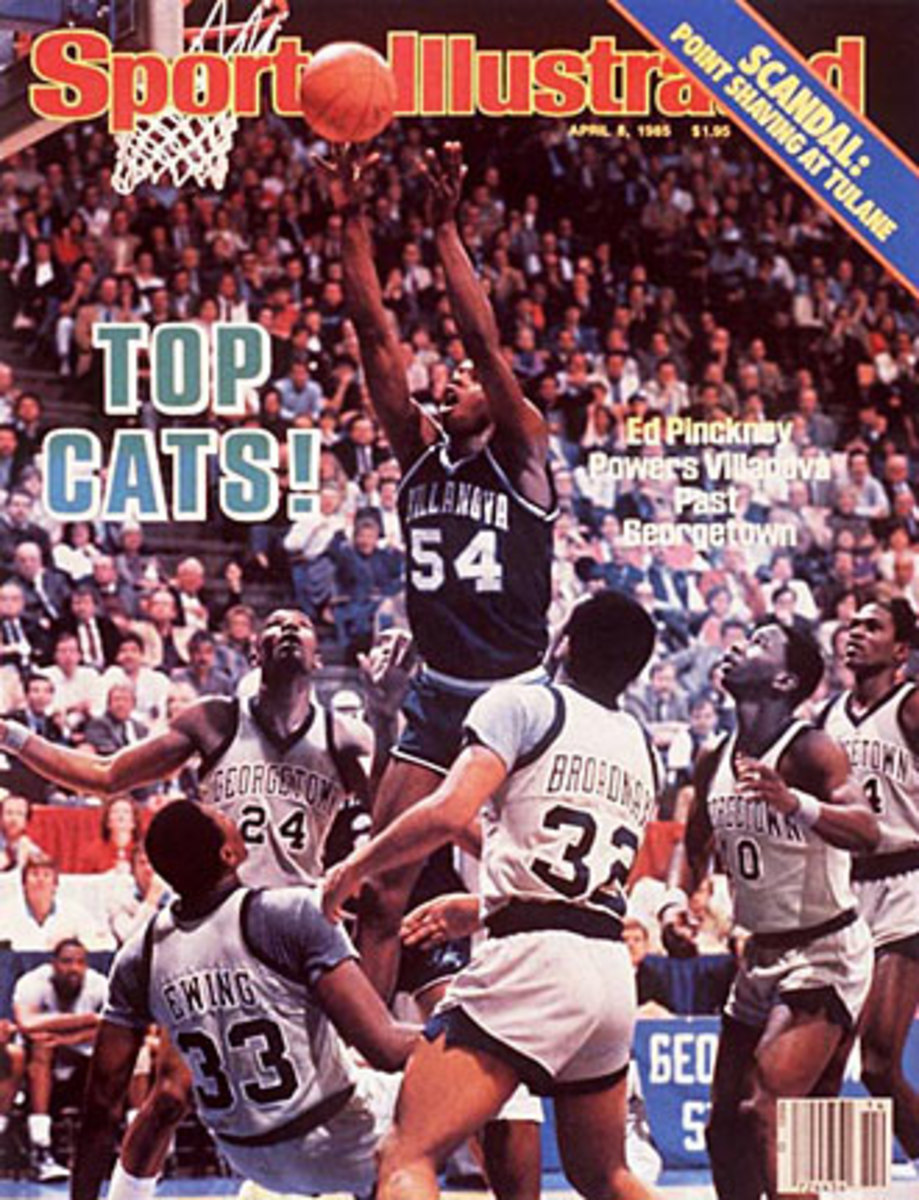
April 1, 1985: Villanova's Perfect Game

April 1, 1985: Someone who had been following the college basketball season, but had been unable to watch the game, might have seen the final score, and thought it was an April Fool's joke. After all, this was mere days after Sports Illustrated's article "The Curious Case of Sidd Finch." But it was real, and it remains the biggest upset in the history of the NCAA's men's basketball tournament.

In Philadelphia college basketball, the "Big Five," an unofficial group, are the University of Pennsylvania, Temple University, La Salle University, St. Joseph's University, and Villanova University. Temple is secular. Penn is Ivy League. La Salle and St. Joe's are Catholic. Villanova is Catholic, likes to pretend that it is Ivy.

While St. Joe's straddles the City Line and the western "Main Line" suburbs, Villanova, is 11 miles to the northwest, well into the Main Line. While the other 4 schools, especially Temple, are more racially diverse (yes, even Penn), the Wildcats are mocked as "Vanilla-nova," and with claims that half the black people on campus are on the basketball team.

One season, as the seconds ticked down in a win over St. Joe's, allowing them to clinch the best overall record in the Big 5, their fans chanted, "We own Philly!" The St. Joe's fans chanted back, "You ain't Philly!" They do seem, of the 5 student bodies, the least likely to eat a cheesesteak and then work it off by running up the steps of the Philadelphia Art Museum -- but then, their track and field program has been among the nation's best for decades.

In 1972, Chuck Daly, later to coach the Detroit Pistons to back-to-back NBA Championships, hired Rollie Massimino as an assistant coach. In 1973, trying to move on from the scandal that got their 1971 Final Four berth stricken from the record, Villanova needed a young man of integrity. The fact that the 38-year-old Rollie was Catholic, and had the endorsement of the admired Daly, helped a lot.

Burdened by NCAA sanctions that the previous regime had brought on, his 1st 2 seasons were bad. But in 1976, he went 16-11. In 1977, he got them into the NIT. In 1978, he got them into the NCAA Tournament.

In 1982, he won the Big East Conference, and got 'Nova to the Elite Eight. In 1983, he did that again, tying Georgetown for the title. In 1984, he finished 2nd in the Big East, to Georgetown.

The Wildcat players were believing in the man they called Daddy Mass, and they were giving him something to believe in. In other words, what happened in the 1984-85 season, while worthy of expressions of surprise, should not have been considered an outright shock.

The big rivalry in the Big East was between 2 big-city Catholic schools: St. John's in New York, and Georgetown in Washington, D.C. Almost nobody was paying attention to the one in between, where Rollie had made the Wildcats big enough that the 1,500-seat Villanova Field House (shortly thereafter, renamed the Jake Nevin Field House) was woefully inadequate, and even the 6,500-seat Pavilion that was then under construction wasn't enough: 'Nova played nearly every game at the 18,000-seat Spectrum, the South Philly home of the 76ers and Flyers, 14 miles from campus.

Villanova went just 9-7 in Big East play, and were 19-10 going into the NCAA Tournament. They were seed 8th in their region, and their game against 9th seed Dayton was, uncharacteristically, on Dayton's home court. The Wildcats won anyway. Then they best 1st seed Michigan, 4th seed Maryland (with Len Bias), and 2nd seed North Carolina.

The Big East had 3 of the Final Four berths: Lou Carnsecca's St. John's, John Thompson's Georgetown, and Rollie Massimino's Villanova. Dana Kirk's Memphis State had the other one.

The Final Four was set for Rupp Arena in Lexington, Kentucky. On spite of being named the Wildcats and wearing blue, like the venue's home team, most observers didn't give Villanova a chance. Even if they beat Memphis in the Final, the other Semifinal, between defending National Champion Georgetown and St. John's, who had split their regular-season meetings, was being considered "the real final."
Rupp Arena

But Villanova did beat Memphis, and when Georgetown beat St. John's rather easily, it seemed to set Monday, April 1, 1985 up as a coronation for the defending National Champion Hoyas.

Instead, Villanova pulled off one of the biggest upsets of all time. They shot 22-for-28 from the field, 78 percent, the highest in Final Four history. Georgetown hardly folded, but Villanova won, 66-64. It was April Fool's Day, but there was no joke in Rupp Arena.

It was the 1st NCAA men's basketball National Championship won by a Philadelphia-area team since La Salle in 1954. And, with the 9th seed in their region, the 1985 Villanova team remains the lowest seed ever to win the Tournament.

"I still never saw the Championship Game replay in its entirety," Massimino said in 2015, at a 30th Anniversary reunion. "I still think we might lose."

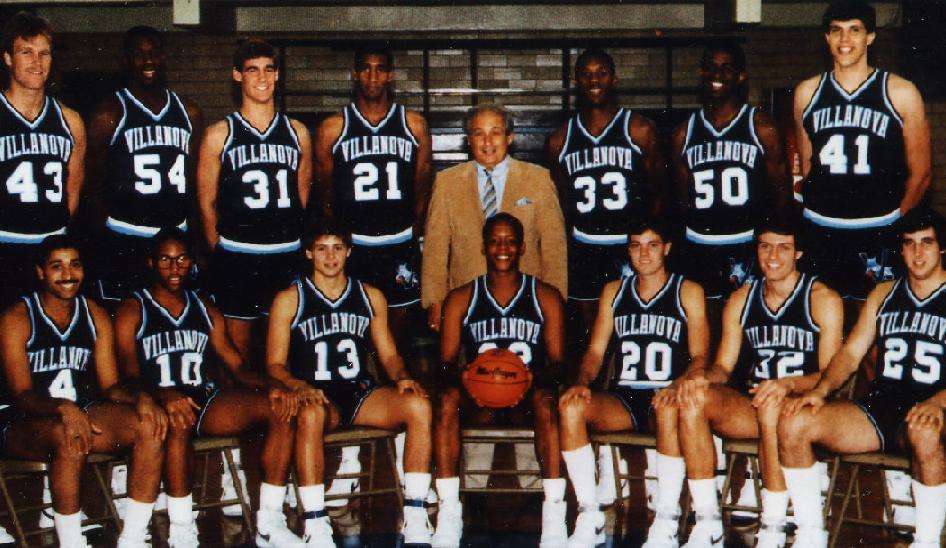
But they won. Hail the Champions:
Top row, left to right: Center Wyatt Maker; forward Ed Pinckney,
forward Mark Plansky, forward Howard Pressley,
head coach Rollie Massimino, forward Dwayne McClain,
forward Connally Brown, center Chuck Everson.
Bottom row: Guard Dwight Wilbur, guard DeAlvin Phillips,
guard R.C. Massimino, guard Gary McLain,
guard Brian Harrington, guard Harold Jensen, forward Steve Pinone.

Pretty much all of them went on to do good things. Ed Pinckney played 12 seasons in the NBA, mostly for the Phoenix Suns. He went back to Villanova, on Jay Wright's staff, and has been an assistant coach for 3 NBA teams. Dwayne McClain played 12 seasons of pro ball, mostly in Europe, but did have 1 season with the Indiana Pacers. He went into coaching, and now runs a financial firm in Florida.

Harold Pressley played for the Sacramento Kings, and is now a TV announcer in Sacramento. Connally Brown became an FBI Agent. And R.C. Massimino, 1 of 5 kids Rollie had with his wife, now runs a construction management company in the Philadelphia suburbs.

Rollie stayed at Villanova until 1992, when he got an offer that spoke to his integrity, and mirrored his arrival at Villanova. The University of Nevada at Las Vegas, reeling from NCAA sanctions after their failure to defend their 1990 National Championship, a 1991 Semifinal loss to Duke nearly as shocking as Georgetown's 1985 loss to Villanova (a win by Duke could still be considered a big upset then), had fired crooked head coach Jerry Tarkanian.

But maybe, just maybe, Vegas corrupts everyone eventually. Just 2 years later, Rollie's own integrity was impeached. It was revealed that he and UNLV President Robert Maxson cut a deal to lift Rollie's salary above the figure that was reported to the State of Nevada, violating ethics rules. He had to go.

He resurfaced in 1996, at Cleveland State University. He did not do well there, and he couldn't control his players, who were involved in substance abuse, other crimes, and academic fraud. He left in 2003.

He moved to Florida, intending to be retired. But in 2005, Northwood University, an NAIA school in West Palm Beach, started a basketball program, and the athletic director asked Rollie to be their 1st coach. He led them to 4 conference titles, getting to the NAIA Semifinal in 2011 and the Final in 2012. In 2014, Northwood was bought by a private corporation, and renamed Keiser University.

He began battling cancer, but in 2016, Villanova got back to the NCAA Final, and coach Jay Wright asked Rollie to come to the Final at NRG Stadium in Houston. He did, and met with the team. Villanova won a thriller against North Carolina, to take their 2nd National Championship. He died the following year.

Villanova won another National Championship in 2018. The Big 5's count currently stands as follows: Villanova 3, Penn 2 (if you count retroactive titles from the pre-NCAA Tournament era), La Salle 1, Temple 1 (if you count NIT titles from the era before the NCAA Tournament became the big one), St. Joseph's none.

*

April 1, 1985 was a Monday. Baseball was still in Spring Training. Football was out of season. And no games were scheduled in the NHL.

There were 2 games in the NBA that night. The Atlanta Hawks beat the Detroit Tigers, 114-100 at the Silverdome in the Detroit suburb of Pontiac, Michigan. And the Houston Rockets beat the Seattle SuperSonics, 127-116 at the Seattle Center Coliseum.

And Daniel Murphy, a 3-time All-Star 2nd baseman, was born on this day.

Saturday, January 1, 2022

January 1, 1927: The Palestra Opens

January 1, 1927: The Palestra opens on the campus of the University of Pennsylvania, next-door to the school's football stadium, Franklin Field. It become known as "The Cathedral of College Basketball."

William N. Bates, a Penn professor, named the building after the ancient Greek term palaestra, meaning a rectangular enclosure attached to a gymnasium where athletes would compete in various sports in front of an audience. 

There is one level of seats, 8,725 of them. The seats do not have backs. Also, if you're in the back row, you could end up sitting next to a hot radiator. But it really does resemble a cathedral: There are stained-glass windows. And there are no luxury boxes: Ivy League bankers and lawyers have to sit next to kids from the street. This is what Philadelphia, the birthplace of the country, the Declaration of Independence and the Constitution, is all about.
Starting in 1955, the "Big Five" has been Penn, Temple University, La Salle University, St. Joseph's University and Villanova University. The Palestra became nationally famous for its Big 5 doubleheaders, with 4 out of the 5 teams playing. Temple used it as its home court from 1955 until the 1969 opening of McGonigle Hall, and St. Joe's used it in the 2008-09 season, while Alumni Fieldhouse/Hagan Arena was renovated.

*

January 1, 1927 was a Saturday. In the Rose Bowl, in the stadium of the same name in the Los Angeles suburb of Pasadena, California, Stanford University and the University of Alabama played to a 7-7 tie. The schools were retroactively recognized as sharing the National Championship. It was the 1st sporting event broadcast on nationwide radio, on NBC.

It was a big day in the history of football for another reason, although that wouldn't be known for another 20 years: Doak Walker was born on this day.

There were 4 games played in the NHL:

* The New York Rangers beat the Chicago Black Hawks, 4-0 at the Chicago Coliseum.

* The Ottawa Senators beat the Montreal Canadiens, 2-1 at the Ottawa Auditorium.

* The Montreal Maroons beat the Toronto Maple Leafs, 3-0 at the Mutual Street Arena in Toronto.

* And the Pittsburgh Pirates beat the Detroit Cougars, 3-2 at the Border Cities Arena (now the Windsor Arena) in Windsor, Ontario.

And in English soccer, Arsenal lost to Welsh team Cardiff City, 3-2 at the Arsenal Stadium, nicknamed Highbury for its North London neighborhood. It was no fluke: Cardiff City would also defeat Arsenal in that season's FA Cup Final.

December 31, 1999 & January 1, 2000: The Millennium

December 31, 1999:  The Millennium arrives. The people of planet Earth survived. At a terrible cost. But we hadn't destroyed ourselves. ...