Showing posts with label jersey shore. Show all posts

Wednesday, December 28, 2022

December 28, 1929: The 1st NHL Game In New Jersey

Boardwalk Hall

When was the 1st National Hockey League game in New Jersey? It was the Devils' opener in 1982, right? Actually, it goes back a lot further than you might think.

December 28, 1929: It was at the end of the Roaring Twenties, just 2 months after the stock market's Crash of 1929. No one had yet realized that the Great Depression had begun. The Shore resort of Atlantic City had just opened a new Convention Hall, a 17,000-seat amphitheater, with the round end of the horseshoe pointing to the beach and a stage at the inland end.

The New York Rangers had begun play in the 1926-27 season. In 1927-28, they won the Stanley Cup. In 1928-29, they reached the Stanley Cup Finals, but lost to the Boston Bruins. For reasons lost to time, they decided to play a "home game" of the 1929-30 season 120 miles away, at Convention Hall.

The Rangers were loaded, with a forward line of Frank Boucher centering the brothers Bill and Frederick "Bun" Cook. Their defense was led by Ivan Johnson, known as "Ching" because, in that much less politically correct era, some people, who clearly needed glasses, thought he looked Chinese. Their goalkeeper for this game, and for every game from 1928 to 1933, was John Ross Roach, picked up following a goalkeeping emergency that nearly cost them the '28 Cup.

The Ottawa Senators had won the Cup in 1920, '21, '23 and '27, but were now in decline. They were still led by forwards Frank Nighbor, Frank Finnigan, and the brothers Hector and Wally Kilrea. Their defense still had Frank "King" Clancy and Alex Smith, with Alex Connell in goal.

Boucher opened the scoring at 14:30 of the 1st period. Clancy tied the game at 5:11 of the 2nd. At 9:00, Paul Thompson, later to help the Chicago Black Hawks win the 1934 and '38 Stanley Cups, gave the Rangers the lead. With 2:24 left in regulation, Leroy Goldsworthy (no relation to 1970s hockey star Bill Goldsworthy) gave the Broadway Blueshirts an insurance goal. The Rangers won, 3-1.
Frank Boucher

Two more games would be played at Convention Hall that season. On January 25, 1930, the Chicago Black Hawks beat the Pittsburgh Pirates, 5-2. And on March 15, the Senators returned, and beat the New York Americans, 8-7. The next season, the hockey version of the Pirates became the Philadelphia Quakers, but went out of business after that one season. They played at the Philadelphia Arena, and did not play any games in Atlantic City.

The Rangers reached the Finals again in 1932, and won the Cup in 1933, before rebuilding, and reaching the Finals in 1937 and winning the Cup in 1940. World War II wrecked the franchise, and they have only won the Cup once since, in 1994. They're still better off than the Senators, who went out of business in 1934. A new Ottawa Senators franchise began in 1992, but has only reached the Finals once, in 2007.

Despite the World Hockey Association moving the New York Golden Blades (formerly the New York Raiders) to the Cherry Hill Arena in the Philadelphia suburbs, and renaming them the Jersey Knights, in the middle of the 1973-74 season, after which they folded, there would be no more NHL games in New Jersey for 52 years, until October 5, 1982, when the New Jersey Devils made their regular-season debut, tying the Pittsburgh Penguins, 3-3.

Convention Hall, renamed Boardwalk Hall in 2001, still stands. From 1940 to 1997, and again from 2013 to 2019, it hosted the Miss America Pageant. Within days in August 1964, it hosted both the Democratic National Convention and a concert by The Beatles. It hosted the Liberty Bowl football game in 1964, despite not quite being long enough for a standard football field. It's hosted many concerts, and some big prizefights, the most famous of them being Mike Tyson's 91-second knockout of Michael Spinks in 1988.

*

December 28, 1929 was a Saturday. One other NHL game was played that day: The Boston Bruins beat the Montreal Canadiens, 3-2 at the Montreal Forum. The Bruins had won the Stanley Cup the season before, but the Canadiens would win it this season.

Baseball was out of season. Football season had just ended. The NBA hadn't been founded yet.

One other sports note from this day: The English soccer team I have come to support, Arsenal F.C., went to Yorkshire, and lost to Leeds United, 2-0 at Elland Road. They went on to win their 1st major trophy that season, anyway, the 1930 FA Cup.

Saturday, October 29, 2022

October 29, 2012: Hurricane Sandy

The Seaside Heights roller coaster, ruined

October 29, 2012: Hurricane Sandy strikes the New York Tri-State Area, the most destructive storm ever to hit the region. It kills 233 people, including 53 people in New York and 37 people in New Jersey. The damage is especially devastating on the Jersey Shore and Staten Island. In my hometown of East Brunswick, New Jersey, power was out for a full 7 days.

The day before, on Facebook, I posted:

New Jersey Transit buses and trains will suspend service at 4:00 this afternoon, in anticipation of the effects of Hurricane Sandy.

New York subways and buses will do so at 7:00 tonight.

PATH (Port Authority Trans-Hudson) trains will wait until midnight. I guess Jersey City think they're tougher than everyone else.

A few minutes later, the last sporting event in the New York Tri-State Area before the hurricane hit was completed. The New York Jets were hosting Miami, the city best known for facing hurricanes, at the Meadowlands. I wrote, "Well, it's official. Disaster conditions in New Jersey. Dolphins 30, Jets 9."

The New York Giants beat the Dallas Cowboys on the road, 29-24, and I wrote, "I wonder if the Giants were able to fly back home. I certainly wouldn't want to be stuck in a crummy city like Dallas." (They were able to fly home.)

On October 29, we were hit by hard rain and heavy wind all day, but the power stayed on through daylight. My Facebook postings went like this:

* So far, here, it's no worse than an ordinary, if windy, autumn storm. A mess with the fallen leaves, but that's it. As long as we have power and food, we're okay.

A friend who was a Yankee Fan, remembering how the Yankees had gotten embarrassed by in the recent American League Championship Series, with the Detroit Tigers going on to get swept in the World Series by the San Francisco Giants, wrote, "Imagine if the Yankees had won the ALCS, and the prospects of World Series Games in the Bronx last night and tonight with this weather." To which I replied, "The Candlestick-era Giants would've felt like they had the home-field advantage!"

* This hurricane is hitting Central Jersey like we're Jeff Weaver. (A reference to the Yankee pitcher who threw away the 2003 World Series.)

* Accuweather.com is saying which hours over the next few days have such-and-such percent chance of rain. But not what kind - drizzle, shower, thunderstorm, cats-n-dogs - nor what speed of wind we can expect.

It's like a menu saying, "We have meat, vegetables and drinks, and it will cost you some money." And that's it.

* Based on what I'm reading off Channel 6 Action News out of Philly, Sandy should start crawling up the Jersey coast at around 8:00 tonight. The worst of it will hit my area at around midnight. Hopefully, by that point I'll be ready to fall asleep, so losing power won't be as big a problem - if it happens. By the morning, the wind should be significantly reduced, but there's going to be rain for much of the day.

Then it's just a matter of when NJ Transit will resume normal service.

* (A reference to the Obama vs. Romney election, 8 days later) At times like this, a CEO is useless. What's he going to do, fire the hurricane? Transfer it to another city? Outsource it to another country? Offer it stock options if it'll do something helpful? Offer it a "golden parachute" if it'll go away?

A CEO can't help us now. A community organizer is exactly what we need - before, during, and after the storm.

* (At 5:30 PM) Just heard on WCBS 880: Sandy has made landfall, in Cape May. 134 miles away.

So far, a lot of noise, but no damage, and the power remains on. I haven't even heard the sump-pump - which is a good thing, it means that there's no sump to pump.

I was beginning to think we were going to get away with it. But at 7:00 PM on the dot, already dark, the lights went out. We had flashlights, candles, and fully-charged phones, and the phone charger in the car still worked. And, while we were one block from a river, we were on relatively high ground, so flooding wasn't an issue. I typed:

Well, that's it. The power is out. Just as I was sitting down to dinner, too.
Since my phone's battery drains rather easily, I'm going to have to be very judicious with its use. This may be the last time you hear from me until the morning when I get to work - if, that is, bus service is restored by then.
Good luck, everyone.

* (A little later) 11 hours to sunrise. At least then, I can see well enough to prepare cereal (I have one serving of milk left) and read.

* WCBS 880 reports "dozens of trees across Route 18" in East Brunswick. Route 9 closed in Old Bridge and Sayreville.
I have about 60% power left on this phone. 10 hours and change until sunrise.

* Nine hours to sunrise. I tried to use my flashlight to do a little reading, but after a while it hurt my eyes too much.

* Lincoln Tunnel now the only way off Manhattan Island. Brooklyn-Battery Tunnel and at least one subway tunnel under East River flooded.

Although my home base is still without power, 5 days later, I did get through Hurricane Sandy all right.

New posts will have to wait until I can use a computer other than my smartphone for more than a few minutes at a time.


But I did make it through. I didn't want anyone to worry...

Until I can type for longer, I hope you all made it through as well, and that we'll all have power again soon.

Power returned on November 5, after 7 days. We were lucky. A lot of people weren't. On March 24, 2013, 5 months later, the family took my 5-year-old nieces to Point Pleasant Beach for the annual Palm Sunday Easter Egg Hunt. The town had replaced the parts of the Boardwalk that had been wrecked.

Point Pleasant Beach is at the top of a sandbar, separated from the mainland by Barnegat Bay, which includes the famous (or infamous) Seaside Heights, and also South Seaside Park, where my father's parents had a bungalow where they spent Summer weekends, and where my parents watched the 1st Moon landing on TV in 1969.

For old times' sake, we went down the sandbar on New Jersey Route 35, where everything was hit by wind coming off both the Atlantic Ocean and Barnegat Bay. There was so much devastation. Houses shattered. Some seeming intact, but cockeyed and leaning off their foundations. Much of the Seaside Heights boardwalk was still being repaired. The bungalow was still there, apparently unharmed.

But, 10 years later, there are still communities on Staten Island and Long Island working to rebuild.

*

What was meant to be the 1st regular-season game for the Brooklyn Nets, three nights later against the crosstown New York Knicks, was postponed. They first played 2 days after that, on November 3, at the Barclays Center in downtown Brooklyn, beating the Toronto Raptors 107-100. The New York City Marathon was canceled outright, since the City was in no condition to host such a wide-ranging event.

Most of the country was not affected. Nevertheless, the NBA season hadn't yet begun, and no games were played that night. Nor were any NHL games played, as the season was delayed by the owners once again being greedy enough to lock the players out. The season did not start until January 19, 2013.

Nor was there any baseball. The season ended the night before, as the San Francisco Giants beat the Detroit Tigers, 4-3 in 10 innings, to take Game 4 and sweep the World Series. The winning run scored on a single by Marco Scutaro.

But there was NFL action, on Monday Night Football: The San Francisco 49ers beat the Arizona Cardinals, 24-3 at University of Phoenix Stadium (now named State Farm Stadium) in the Phoenix suburb of Glendale, Arizona. Alex Smith threw 3 touchdown passes, 2 to Michael Crabtree and 1 to Randy Moss. 

Tuesday, October 4, 2022

October 4, 1918: The Morgan Explosion

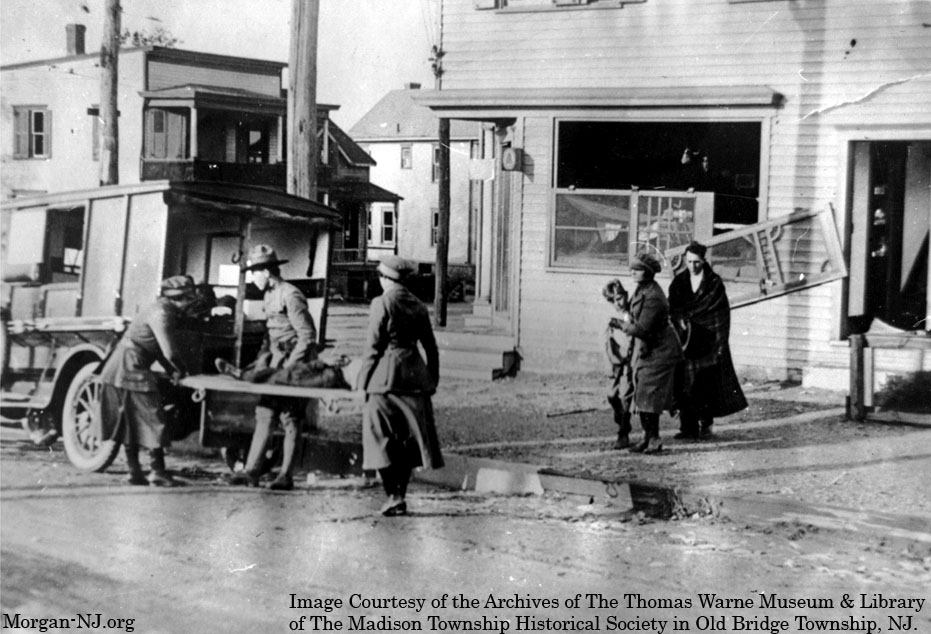
October 4, 1918: At 7:36 PM, the T.A. Gillespie Company Shell Loading Plant, making munitions for the U.S. effort in World War I, explodes on Cheesequake Creek in the Morgan section of Sayreville, Middlesex County, New Jersey.

One explosion led to another, and they went on all night. The fires started by the explosions could be seen for miles, including across the Arthur Kill in Staten Island, New York. Over 300 buildings were destroyed, including the one containing the company's records. For this reason, it's not known for sure how many people died, but the number is believed to be over 100.
I've lived my whole life in Middlesex County, and this is the greatest tragedy ever to befall Central Jersey. Today, the Morgan Marina and a housing development called the Highland House Apartments are on the site. It's a gated community, so it might be difficult to visit. As you might guess, it was pounded again by Hurricane Sandy on October 29, 2012.
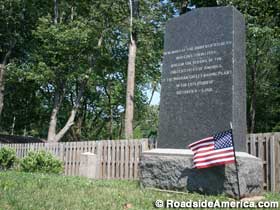
A cemetery, where some of the victims -- just pieces, so they don't even know how many, but they think it's between 14 and 18 -- are buried under a large monument, is on Ernston Road, on the municipal border between Sayreville and Old Bridge. I used to pass it on the way to a job at a building on Ernston, next to U.S. Route 9.
"IN MEMORY OF THE UNIDENTIFIED SOULS
WHO GAVE THEIR LIVES
WHILE IN THE SERVICE OF THE
UNITED STATES OF AMERICA
AT THE MORGAN SHELL LOADING PLANT
IN THE EXPLOSION OF
OCTOBER 4 -5 1918."

It was particularly poignant on April 15, 2009, the 20th Anniversary of the Hillsborough Disaster in England, at an FA Cup Semifinal at Hillsborough Stadium in Sheffield, Yorkshire, at which a similar number of people died, 96. Having to walk up Ernston from my bus stop in order to be on time for work at 10:30 AM, I passed the cemetery at 10:06 -- 3:06 PM British time, the time the match between Liverpool and Nottingham Forest was stopped due to the referee realizing what was happening in the stands.

UPDATE: A 97th victim later died from Hillsborough-induced injuries.

*

October 4, 1918 was a Friday. The baseball season was over, cut short by government demands due to World War I. Professional basketball barely existed. Professional football did, but neither it nor college football played games on Fridays then. And the NHL season wouldn't begin for another 2 months. So there were no scores on this historic day. 

Sunday, September 18, 2022

September 19, 1881: President James Garfield Dies

September 19, 1881: President James A. Garfield dies at Francklyn Cottage, on the beach at Long Branch, Monmouth County, New Jersey, 79 days after being shot. He was 49 years old.

James Abram Garfield was elected President in 1880, after being nominated by the Republican Party. A Representative from Ohio since the 1862 election, he was a compromise candidate, after the the Convention couldn't come to agreement.

The "Stalwarts" wanted former President Ulysses S. Grant -- more than Grant wanted it himself. The "Half-Breeds" wanted James G. Blaine, Senator from Maine and former Speaker of the House. Each group rejected the other's choice, due to corruption. Garfield, as far as anyone knew at the time, was clean. The Stalwarts managed to get one of their own into the Vice Presidential nomination: Chester Alan Arthur, Collector of the Port of New York. 

Garfield won a very close election, over the Democratic nominee, Winfield Scott Hancock, a hero General of the Union Army in the Civil War. With 185 Electoral Votes being necessary, Garfield won 214, to Hancock's 155; and got 48.32 percent of the popular vote, to Hancock's 48.21 percent. Not that the popular vote mattered, but Garfield won it by 10,364 votes, and by 0.11 percent, in each case the closest ever.

He was inaugurated as the 20th President of the United States on March 4, 1881, and one of his pet projects was civil service reform. That upset the Stalwarts, who, thinking they were responsible for Garfield's election, wanted the "spoils system" maintained.
And one of the Stalwarts who expected to be rewarded for his role in getting Garfield elected was Charles Julius Guiteau. He actually had nothing to do with it, but he thought he was instrumental in it. This was because he was insane. His family had committed him to a psychiatric asylum in 1875, but he escaped.
Does this look like a sane man to you?
It sure doesn't look like a sane man to me.

He kept visiting the White House, hoping to see Garfield, or at least Blaine, who, as a bone thrown to the Half-Breeds, was appointed Secretary of State. As a bone thrown to them, he was given the leading job in the Cabinet. Guiteau wanted to be named Consul to Vienna, but was willing to "settle" for Paris. He got banned from the White House, but managed to confront Blaine, who told him, "Never again speak to me on the Paris consulship, as long as you live."

So Guiteau bought a .442 Webley British Bulldog revolver, with an ivory handle. He chose it because he thought that, after the assassination, he would be hailed as a hero for getting rid of the corrupt Garfield, and that that particular gun would look great in a museum. Did I mention that he was nuts?

Guiteau gave Garfield one last chance: He wrote a letter saying Garfield should fire Blaine, or "you and the Republican Party will come to grief." Like everything else he sent to the White House, this letter was thrown away without being opened.

And, unintentionally, Guiteau gave Garfield one more "last chance": Knowing that Garfield liked to vacation in Long Branch, Monmouth County, New Jersey, one of America's earliest shore resorts, he followed Garfield to the Baltimore and Potomac Railroad Station, on the southwest corner of 6th Street and B Street Northwest, intending to shoot him there.
But the First Lady, Lucretia Garfield, was with him, and Guiteau didn't want her to see her husband shot dead in broad daylight. Perhaps he remembered how Abraham Lincoln had been shot in the presence of his wife (albeit indoors and at night). John Wilkes Booth didn't care. Nor did Lee Harvey Oswald, decades later, care that Jacqueline Kennedy was with her husband. (That is, if you believe that Oswald did it. Ida McKinley was a few miles away from her husband William when he was shot.)

Washington can get very hot in the Summer. On July 2, the newspapers reported that Garfield was heading off to Long Branch again -- and, this time, Lucretia would not be with him as he left: She had contracted malaria, and had been sent to Long Branch without him to recover.

Who was with him at the Station? His sons, James Rudolph Garfield and Harry Augustus Garfield. And Blaine. Also there, but not going with him like the others, his Secretary of War -- Robert Todd Lincoln, son of the only President who had been assassinated to that point. There was no bodyguard or security detail, and, up to that point in Presidential history, that was not unusual.

At 9:20 AM, Guiteau saw Garfield and Blaine walk in. He waited until they were about 6 feet in front of him, and fired. The shot only grazed Garfield's shoulder. A General in the Union Army, he knew gunfire when he heard it, and called out, "My God, what is that?" No one saw the shot, giving Guiteau the chance to fire again. This bullet lodged in Garfield's back, and he went down.
Artist's depiction of the shooting.
Blaine is the bearded man in the top hat.

Guiteau, unusually for him, was calm throughout the event. He turned to walk out and head for the hansom cab that was waiting for him. But he bumped into a policeman, Patrick Kearney, who had gone into the station after hearing the first shot. As he was carried off to jail, Guiteau yelled out, "I am a Stalwart, and now, Arthur is President!"

Garfield did not die quickly. He would have been better off if he had. The doctors who treated him couldn't find the bullet -- no X-ray machines available at the time -- and subjected him to treatments that led to an infection. In other words, for all of Guiteau's planning, it could be argued that he didn't kill Garfield: Garfield's doctors did.

Mrs. Garfield received a telegram about the shooting in Long Branch, and, with some irony, she got on a train to see him, weak but determined. The President lingered on for weeks -- and, until the 25th Amendment to the Constitution was ratified in 1967, there was no mechanism for replacing a President who was alive but incapacitated -- and the First Lady decided to get him out of the hot capital, and put him on a train for Long Branch, with a specially cushioned bed to protect him from the bumpy ride.
Lucretia Garfield

On September 6, he arrived at Francklyn Cottage, in the Elberon section of Long Branch, at the city's southern end. It didn't work: On September 19, 1881, at 10:35 PM, he reached up for a pain in his chest, and called out for his Chief of Staff, David Swaim: "Oh, Swaim, this terrible pain. Press your hand on it." When he did, Garfield's hands went up, and he yelled, "Oh, Swaim? Can't you stop this? Oh, oh, Swaim!" And he died.

He was only 49 years old, 2 months short of turning 50. To this day, only 1 President has had a shorter lifespan: John F. Kennedy was 46 when he was assassinated. (The shortest-lived President who died of natural causes? James Polk was 53.)

It was after midnight by the time Vice President Arthur received the telegram about Garfield's death at his townhouse, at 123 Lexington Avenue, in the Gramercy Park neighborhood of Manhattan. John R. Brady, a Judge of the Supreme Court of the State of New York, came, and administered the Oath of Office to Arthur as the 21st President of the United States, by candlelight, at 2:15 AM on September 20, 1881.
Arthur took a train to Long Branch to pay his respects to the Garfields, and accompanied them on the funeral train to Washington. On September 22, just to make everything official, he was sworn in again at the Capitol Building, by the Chief Justice of the Supreme Court of the United States, Morrison Waite.

In the 19th Century, Congress usually adjourned upon the completion of its term on March 3, and then didn't reconvene, except for special occasions, until December 3. This was partly due to the long distances required to travel by horse, or horse-drawn vehicle, or boat during the pre-railroad era; and partly due to the nasty Summers of Washington. It would often be until December that a new leaders of the House and Senate were chosen.

This led to the potential for a huge problem. With Arthur having become President, there was, until the passage of the 25th Amendment to the Constitution in 1967, no legal mechanism for filling the vacancy in the office of Vice President.

According to the Presidential Succession Act of 1792, the next man in line was the President Pro Tempore of the Senate. "Pro Tempore" is Latin for "For the time being." In other words, the man who sits in for the Vice President when the Vice President is unavailable. In other words, the Vice Vice President. The next man in line was the Speaker of the House. But on September 19, 1881, both of those offices were, officially, vacant. In other words, had something happened to Arthur, there would have been no President!

On October 10, 1881, Congress met, and Senator Thomas F. Bayard of Delaware was appointed President Pro Tempore of the Senate. Now, there was a "next President" in place, in case of emergency. It would take until December 5 for the House to convene, and elect J. Warren Kiefer of Ohio as Speaker.

But then, on October 13, the Senate held a new election for President Pro Tempore. David Davis of Illinois, a former Justice of the Supreme Court. Before that, he was Abraham Lincoln's campaign manager in 1860. He did not run for re-election to the Senate in 1882, so he was next in line until March 3, 1883. When the Senate met the next day, they chose George F. Edmunds of Vermont, and he was next in line for the remainder of the Garfield-Arthur term.

As a result of not wanting to face this potential problem again, Congress acted, and the Presidential Succession Act of 1886 took the leaders of Congress out of the line of succession, and put the members of the Cabinet, in descending order of their department's establishment, in it. Therefore, had the 1886 Act been in place when Arthur was sworn in, Secretary of State Blaine would have been next in line for the Presidency.

In spite of his lack of experience, Arthur is generally regarded to have run a good Administration. He, too, pursued civil service reform, getting the Pendleton Act passed in 1883. And he appears to have completely avoided any action that could have been described as "corrupt." In other words, he governed very little like a Stalwart.

Had Garfield lived, and done as well as Arthur, he would have had less affection than he got from being martyred, but he might have had more respect from history. But Garfield was beloved for his courage in the face of impending death. And Arthur was admired for not running a Stalwart-style corrupt Administration. And, of course, had Garfield had smarter doctors, he might have recovered. In other words, by shooting Garfield, Guiteau accomplished nothing.

Guiteau was formally indicted for murder on October 14, 1881. A psychiatrist testified that Guiteau was a "morbid egotist" with "a tendency to misinterpret the real affairs of life." The District Attorney for the District of Columbia argued, "There's nothing of the mad about Guiteau: He's a cool, calculating blackguard, a polished ruffian."

(Although Garfield was the elected head of the federal government, and was shot in a place of interstate travel and commerce, his assassin's prosecution was handled by the court system of the District of Columbia, not the U.S. Department of Justice. The fact that the DOJ was then headed by Blaine may have had something to do with it: He was a witness, and a potential victim, therefore a walking conflict of interest.)

Guiteau was convicted and sentenced to death on January 25, 1882; and hanged on June 30. He was 40 years old. All through the trial, and up until the moment the black hood was placed over his head for his execution, he lashed out and remained proud of what he had done, believing it to be the will of God. Indeed, his last words were a poem he had written for the occasion: "I am Going to the Lordy."

The gun that Guiteau thought would look so good in a museum? It's not on display in one. In fact, no one knows where it is, or what happened to it. The Smithsonian Institution did have it on display for a while, but it has since been lost.

The pistol that John Wilkes Booth used to assassinate Lincoln -- an event for which it is a little too far back in history to do a "Scores On This Historic Day" entry -- is on display in the basement of Ford's Theatre in Washington, where the assassination happened.

The pistol that Leon Czolgosz used to kill McKinley is in the Buffalo History Museum. And the rifle that Oswald -- as the official story goes -- used to kill Kennedy is in a National Archives Building in College Park, Maryland, just outside D.C., and is not available for public viewing. The one on display in the Sixth Floor Museum in Dallas is a replica.

Arthur did not run for a term of his own in 1884: He had Bright's disease, a kidney disorder that is still not curable, but is treatable now, but not then. (That same year, it killed Alice Roosevelt, first wife of future President Theodore Roosevelt. In 1912, it killed Vice President James Sherman. In 1914, it killed Ellen Wilson, the first wife of President Woodrow Wilson. She remains the last First Lady to die "in office.") Arthur died in 1886.

Robert Todd Lincoln had been tired from his Civil War service, and declined to accompany his parents to Ford's Theatre on April 14, 1865, but he was in Washington and the time of his father's assassination. He had been with Garfield when he was shot. And he was a guest at the Pan-American Exposition in Buffalo on September 6, 1901, standing just outside the Temple of Music when William McKinley was shot. He didn't see the shooting, but he heard it.

When the Lincoln Memorial was to be dedicated in 1922, the current President, Warren G. Harding, was one of the listed speakers. Also in attendance was the Chief Justice of the United States, former President William Howard Taft. As the only surviving child of Honest Abe, Robert was invited. He refused to come. He was afraid Harding would be assassinated, too. (If he was concerned for Taft's safety, he didn't say so.)

Finally, he was talked into attending the ceremony. Harding was not assassinated, but he was already in poor health (not that the public knew this at the time), and he died in office the next year. Robert was more sure than ever that he was a jinx. He died in 1926, without ever meeting another President.

The Baltimore and Potomac Station was demolished after the opening of Union Station in 1907. In 1931, B Street was renamed Constitution Avenue, and was made part of U.S. Route 50, which it remains today. In 1941, the National Gallery of Art opened on the site of the station. It took until 2019 for the National Park Service to erect interpretive plaques about the assassination on the site.
Francklyn Cottage has long since been demolished. However, in the middle of Long Branch's boardwalk, Seven Presidents Park pays tribute to the 7 Presidents who vacationed there, and there is a statue of Garfield.
Like fellow Presidents George Washington, Thomas Jefferson, Andrew Jackson, Abraham Lincoln, Theodore Roosevelt, Woodrow Wilson, Franklin Roosevelt and Dwight D. Eisenhower, James Abram Garfield has an official memorial in Washington, D.C. -- but not at the site of the assassination. The James A. Garfield Monument, dedicated on May 12, 1887, is in front of the U.S. Capitol Building, in a traffic circle at First Street and Maryland Avenue Southwest.
There are 11 cities in America named for Garfield, in Bergen County, New Jersey. There are Counties named for him in Colorado, Montana, Nebraska, Oklahoma, Utah and Washington. There are 2 high schools named for him in Ohio, 1 in Los Angeles, and 1 in Seattle.

Arthur was the 1st President born in Vermont, but represented New York in politics. He has a statue in New York's Madison Square, not far from his Lexington Avenue apartment, but no towns named for him, and no memorial in the nation's capital.
Arthur Statue, Madison Square Park, Manhattan

Garfield was played by Francis Sayles in The Night Riders in 1939, and Van Johnson in The Price of Power in 1969. Arthur was played by Emmett Corrigan in Silver Dollar in 1932, and Larry Gates in Cattle King in 1963. There have been 2 ships named the SS President Garfield: A hospital ship in service from 1921 to 1948, and an attack transport from 1940 to 1955. There was a transport ship named SS President Arthur from 1922 to 1927.

In a great irony, despite being the sons of the 1st 2 assassinated Presidents, Robert Todd Lincoln turned out to be the last surviving member of the Cabinets of both Garfield and Arthur, living until 1926; and James R. Garfield would be the last surviving member of the Cabinet of Theodore Roosevelt, serving as Secretary of the Interior, and living until 1950 -- 84 years old, and 69 years after his father's death.

Garfield was President for only 200 days -- and he had a bullet in him for 80 of them. His Presidency is the 2nd-shortest, ahead of only William Henry Harrison, who was inaugurated on March 4, 1841, and died on April 4, after 31 days.

*

September 19, 1881 was a Monday. There was only one score on this historic day: The Troy Trojans beat the Buffalo Bisons, 7-5 at Haymakers' Grounds in Troy, New York, named for the Troy Haymakers, the Trojans' predecessors.

The Trojans, who played across the Hudson River from Albany, New York, folded after the 1882 season. In 1883, their place in the NL was taken by the New York Gothams, who became the Giants in 1886, and the San Francisco Giants in 1958. The Bisons went out of business after the 1885 season.

Thursday, September 8, 2022

September 8, 1934: The Morro Castle Fire

September 8, 1934: The cruiseliner SS Morro Castle burns and sinks, killing 135 people, off the coast of Asbury Park, Monmouth County, New Jersey.

Launched in 1930, the ship was run by Agwi Navigation Lines, and regularly sailed between New York City and Havana. Before 1959 and the revolution of Fidel Castro, Cuba, especially its capital city of Havana, was considered a resort for America's rich. And in the days before air travel was considered safe, cruise ships were the way to go to islands that couldn't be reached by train or automobile. The ship was named for a castle built in Havana by their former colonial overlords, the Spanish Empire.

On September 5, the Morro Castle set out from Havana to New York. On September 7, a storm began brewing, and when the rain started, many crewmembers retired early to their berths. Among them was the Captain, Robert Rennison Willmott. He had his dinner delivered to his quarters, rather than dining with his officers.

Shortly thereafter, he complained of stomach pain. Shortly after that, he died. Chief Officer William Warms was forced to assume command. As Midnight and September 8 came, the winds increased past 30 miles per hour.

At around 2:50 AM, the ship was 8 nautical miles -- the limit of a country's jurisdiction being 3 miles, until a 1982 United Nations agreement made it 12 miles -- off the coast of New Jersey's Long Beach Island. That's when a fire was detected in a storage locker on B Deck. Within 20 minutes, the fire had burned through the ship's main cables. This ended all electrical power, including the radio. The hydraulic lines were also severed by the fire, costing everyone the ability to steer the ship.

Of the ship's 12 lifeboats, only 6 could be launched. The sea was still rough, but the passengers pretty much had the choice to jump or burn. Some people tossed deck chairs and life rings overboard, to act as makeshift flotation devices. Several boats came to the rescue, but the rough sea made that difficult. Out of 549 people on board, 135 died.

There is a theory that the ship had been used to smuggle things between New York and Havana and back, and that the fire was purposely set to disguise this, and that the Captain was killed to silence him. Of course, Prohibition had ended 9 months earlier, so if they were transporting liquor, that wouldn't have been very profitable. And, of course, this was long before the embargo on Cuban products such as cigars. So this theory might not be accurate.

Less than 3 years later, less than 30 miles to the southwest, at Lakehurst Naval Air Station in Ocean County, the zeppelin LZ 129 Hindenburg caught fire and crashed, killing 36 people.

*

September 8, 1934 was a Saturday. The NFL and NHL seasons hadn't started yet, most college football teams hadn't started their seasons, yet, and the NBA hadn't been founded yet.

In baseball, the entire American League played that day, but the entire National League did not:

* The New York Yankees beat the Chicago White Sox, 7-1 at Comiskey Park in Chicago. Lou Gehrig, George Selkirk and Tony Lazzeri hit home runs in support of Johnny Broaca.

* The Cleveland Indians swept a doubleheader from the Boston Red Sox at League Park in Cleveland. The Tribe won the opener 5-1, and the nightcap 3-2.

* A doubleheader was split at Navin Field in Detroit. The Philadelphia Athletics won the 1st game, 4-3. The Detroit Tigers won the 2nd game, 2-1. The ballpark was expanded into its familiar configuration in 1938, and renamed Briggs Stadium. It was renamed Tiger Stadium in 1961.

* The Washington Senators beat the St. Louis Browns, 5-1 at Sportsman's Park in St. Louis.

So what was up with the National League? The storm that hit the Northeast postponed some games. The Brooklyn Dodgers were supposed to host the St. Louis Cardinals at Ebbets Field. The game was moved to September 21, as part of a doubleheader.

The Cards won the opener, 13-0. Jay "Dizzy" Dean pitched a 3-hit shutout. The nightcap was a 3-0 Cardinal win, and Dizzy's brother, Paul "Daffy" Dean pitched a no-hitter. (Diz liked his nickname. Daff hated his.) Although Dizzy made the Hall of Fame, and had plenty of accomplishments to brag about, and did brag about them, a no-hitter was one that eluded him. He said afterward, "Gee, Paul, if I'd a-known you was gonna throw a no-hitter, I'd a-thrown one, too."

On September 7, the New York Giants wrapped up a series against the Chicago Cubs at the Polo Grounds. On September 9, they started a home series against the Pittsburgh Pirates. And the Giants played only 153 games that season, instead of the standard 154.

Since it would have been very odd not to play on a Saturday, when most people weren't working and thus a high attendance could be expected, and there is no notation in the remainder of the Giants', Cubs' or Pirates' schedules, it is reasonable to conclude that there was a game set for September 8, but it got rained out, and it wasn't necessary to reschedule it.

Likewise, the Philadelphia Phillies played only 149 games that season, but none between a September 5 win over the Cincinnati Reds and a September 9 loss to the Cardinals. It seems likely that the storm that helped end the cruising life of the Morro Castle also canceled the game they had scheduled for September 8. The Boston Braves are also not listed as playing that day, so the storm may have rained them out, too.

Also, Arsenal drew with Leeds United, 1-1 at Elland Road in Leeds, Yorkshire. 

September 8, 1921: The 1st Miss America Pageant

September 8, 1921: The 1st Miss America Pageant is held at Atlantic City, New Jersey. The winner is Margaret Gorman, a 16-year-old native of Washington, D.C. She is still the only Miss America winner who did not come from an actual State.

Gorman was a junior at Western High School in Washington when her photo was entered into a popularity contest at the Washington Herald. She was chosen as Miss District of Columbia on account of her athletic ability, past accomplishments, and outgoing personality.

As a result of that victory, she was invited to join the Second Annual Atlantic City Pageant held on September 8, 1921, as an honored guest. There she was invited to join a new event: the "Inter-City Beauty" Contest. She won the titles "Inter-City Beauty, Amateur" and "The Most Beautiful Bathing Girl in America" after competing in the Bather's Revue. She won the grand prize, the Golden Mermaid trophy. She was expected to defend her positions the next year, but someone else had attained the title of "Miss Washington, D.C.," so she was instead crowned as "Miss America."

A tradition was born. The Pageant would later be limited to unmarried women between the ages of 18 and 28. The contest is now judged on these competition segments with the following scoring percentages:

Private Interview (30 percent), a 10-minute press conference-style interview with a panel of judges.
* On Stage Question (10 percent), answering of a judge's question while onstage.
* Talent or HER Story (20 percent), a performance talent or 90 second speech.
* Health and Fitness (20 percent), in which contestants demonstrate physical fitness onstage while dressed in athletic wear. And:
Evening Gown (20 percent), in which contestants model evening-wear onstage.

In 1950, the "year" of Miss America was moved to the following year, since the Pageant was usually held during Labor Day weekend, with the majority of the year having already passed. So there was no Miss America 1950. The COVID-19 pandemic canceled the Pageant, so there was no Miss America 2021.

Among the more prominent winners have been Bess Myerson, 1945, the 1st Jewish winner and later a well-known consumer advocate; Lee Meriwether, 1955, later a prominent actress; Mary Ann Mobley, 1959, also an actress; Phyllis George, 1971, later part of CBS' studio team on The NFL Today, and in 1989 and 1990 the 1st female host of the Pageant; Kaye Lanie Rae Rafko, 1988, the 1st Asian winner; and Heather Whitestone, 1995, the 1st winner with a disability (she was deaf). There has never been an openly gay Miss America, and not until Erin O'Flaherty in 2016 was there even an openly gay contestant.

In 1984, Vanessa Williams became the 1st black winner. But she also had to become the 1st winner to resign her crown, due to a scandal that no longer matters. Oddly, the runner-up who took her place was also black: Suzette Charles, from Mays Landing, New Jersey, just a few miles from Atlantic City. Williams would go on to become a big singing and acting star, and most people have forgotten that she was ever Miss America, let alone why she had to stop. In 2015, all seemed to be forgiven, when Williams was invited to be the Pageant's head judge.

New York has had the most winners, 7. Right behind, with 6, are California, Ohio and Oklahoma. There is often seen to be a bias against candidates from New England: Connecticut has had only 1 winner, and the remaining New England States -- Maine, New Hampshire, Vermont, Massachusetts and Rhode Island -- have none between them. Other States with none: Delaware, Idaho, Iowa, Louisiana, Maryland, Montana, Nevada, New Mexico, South Dakota, Washington West Virginia and Wyoming.

The Pageant was first televised in 1954, on NBC, and that network has usually broadcast it ever since. Bert Parks hosted the Pageant every year from 1955 to 1979, until he was infamously fired. After the crowning of the new winner, he would sing, "There she is, Miss America! There she is, your ideal!" Other notable hosts included Bob Russell (1940-54), Gary Collins (1982-90, and married to Mobley), Regis Philbin and Kathie Lee Gifford (1991-95), Donny and Marie Osmond (1999 and 2000), Tony Danza (2001), and Wayne Brady (2002).

On a 1978 episode of Match Game, there was a question about a man's girlfriend: "From the back, she looks like Miss America. From the front, she looks like (blank)." Panelist Richard Dawson said, "Bert Parks." Meriwether and Mobley both served as semi-regular panelists on Match Game.

The Pageant was subjected to a feminist protest in 1968, as women through various things connected with traditional womanhood into a trash can on the Atlantic City Boardwalk. The objects were not, however, set on fire. Somewhere down the line, this action and the burning of men's draft cards during the Vietnam War became conflated as "women burning their bras."

From 2005 to 2013, the Pageant was held in Las Vegas, which had preceded Atlantic City as a legal gambling center. It then moved back to Atlantic City.

Margaret Gorman later said: "I never cared to be Miss America. It wasn't my idea. I am so bored by it all. I really want to forget the whole thing." In 1925, she married Victor Cahill, and was married until he died in 1957. She lived all her life in Washington, became a socialite and enjoyed traveling. She died on October 1, 1995, aged 90.

*

September 8, 1921 was a Thursday. These baseball games were played:

* The New York Yankees lost to the Philadelphia Athletics, 6-5 at Shibe Park in Philadelphia. Babe Ruth hit his 53rd home run of the season. He would finish with 59. But pitcher Tom Rogers melted down in the bottom of the 9th, allowing 2 runs.

* A doubleheader was split at Braves Field in Boston. The Philadelphia Phillies won the opener, 8-6. The Boston Braves won the nightcap, 13-2.

* The Detroit Tigers beat the Cleveland Indians, 15-1 at League Park in Cleveland. Tiger player-manager Ty Cobb went 3-for-6 with 3 RBIs. Indian player-manager Tris Speaker went 1-for-4.

* The Chicago Cubs beat the Cincinnati Reds, 6-2 at Cubs Park (later renamed Wrigley Field) in Chicago.

* The St. Louis Browns beat the Chicago White Sox, 4-3 at Sportsman's Park in St. Louis. George Sisler went 2-for-3 with a walk and an RBI. Eddie Collins went 0-for-2 with a walk.

 And the New York Giants, the Brooklyn Dodgers, the Pittsburgh Pirates, the St. Louis Cardinals, the Boston Red Sox and the Washington Senators were not scheduled.

Tuesday, September 6, 2022

September 6, 1968: The Miss America Protest

September 6, 1968: Feminists protest the Miss America Pageant on the Boardwalk in Atlantic City, New Jersey. Some people consider this the beginning of the modern feminist movement in America, a.k.a. Second Wave Feminism.

To counter the song Bert Parks, host of the Pageant's broadcast, sang after each Miss America was crowned – "There she is, Miss America! There she is, your ideal!" – they threw items they considered "instruments of oppression" into a trash can.

This included bras. Somehow, in the public mind, this got conflated with men burning their draft cards, and it became the beginning of "bra burning." In fact, nothing was burned at this protest. Maybe some people got sunburn, but there was never a public bra burning in the name of feminism, not on this occasion, or on any other.

The next day, Judith Anne Ford, Miss Illinois, won the Pageant.

*

September 6, 1968 was a Friday. These baseball games were played:

* The New York Mets lost to the Pittsburgh Pirates, 2-1 at Forbes Field in Pittsburgh. Steve Blass outpitched Jim McAndrew. Roberto Clemente hit a home run. The Mets' only run came on a home run by Jerry Grote.

* The Chicago White Sox beat the Baltimore Orioles, 3-2 at Memorial Stadium in Baltimore. Buddy Bradford won the game with a home run leading off the top of the 11th inning. Brooks Robinson went 2-for-5 with an RBI. Frank Robinson went 1-for-6.

* The Atlanta Braves beat the Houston Astros, 7-1 at Atlanta Stadium (later renamed Atlanta-Fulton County Stadium). Hank Aaron went 1-for-3 with a walk.

* The Los Angeles Dodgers swept a doubleheader from the Cincinnati Reds, 6-4 and 8-6 at Crosley Field in Cincinnati. Over the 2 games, Pete Rose went 3-for-10, and Johnny Bench, about to be named National League Rookie of the Year, went 3-for-6 with a walk.

* The Detroit Tigers beat the Minnesota Twins, 8-3 at Tiger Stadium in Detroit. Al Kaline went 1-for-3 with a walk and an RBI. Harmon Killebrew struck out as a pinch-hitter, and Rod Carew did not play. The Twins did get a sign of the future, as Graig Nettles hit a home run, but he wouldn't give most of that future to them.

* The Philadelphia Phillies beat the Chicago Cubs, 5-2 at Wrigley Field in Chicago. Ernie Banks went 1-for-4 with an RBI.

* The San Francisco Giants swept the St. Louis Cardinals, 3-2 and 8-7 at Busch Memorial Stadium in St. Louis. Willie Mays only appeared as a defensive replacement in the 1st game, in which Bobby Bolin outpitched Bob Gibson, who fell to 20-7, with an ERA of 1.03. Juan Marichal outpitched Steve Carlton in the 2nd game, in which Mays went 3-for-4 with a home run and 3 RBIs.

* The California Angels beat the Boston Red Sox, 4-0 at Anaheim Stadium (now Angel Stadium of Anaheim). Andy Messersmith pitched a 2-hit shutout. Carl Yastrzemski went 0-for-1 with 3 walks.

* The Oakland Athletics beat the Cleveland Indians, 7-0 at the Oakland Coliseum. John "Blue Moon" Odom pitched a 6-hit shutout. Rookie Reggie Jackson went 0-for-2 with 2 walks.

* And the New York Yankees and the Washington Senators were rained out at Yankee Stadium. The game was made up as part of a doubleheader the next day. The Yankees swept, 16-2 and 10-0. Mel Stottlemyre won the 1st game, and went 2-for-4 to help his own cause. The Yankees got home runs from Jake Gibbs, Joe Pepitone and Roy White. Mickey Mantle, in what turned out to be his last month as an active player, went 2-for-3 with a walk and an RBI in the 1st game, and got the 2nd game off.

Fritz Peterson won the 2nd game, and the Yankees got home runs from Frank Fernández and, newly acquired and in his last month as an active player, Bronx native and former Cleveland and Detroit slugger Rocky Colavito. 

Over the 2 games, White went 4-for-8 with 2 walks and 2 RBIs, Gibbs went 1-for-6 with 2 RBIs, Pepitone went 2-for-5 with a walk and 2 RBIs, Horace Clarke went 4-for-11 with 3 RBIs, and Tom Tresh went 3-for-9 with 2 RBIs.

Wednesday, July 6, 2022

July 6, 1988:"Hypodermics On the Shore"

July 6, 1988: The first reported medical waste on beaches in the Greater New York area, including hypodermic needles and syringes possibly infected with the AIDS virus, washes ashore on Long Island.

Subsequent medical waste discoveries on beaches in Coney Island, Brooklyn and in Monmouth County, New Jersey forced the closure of numerous area beaches in the middle of one of the hottest summers on record in the American Northeast. New England was also hit hard by this phenomenon.

Dumping dirty needles into the ocean was typical of how people treated the seas before the environmental movement, discouraged into dormancy by the Presidency of Ronald Reagan, got going again after the old bastard left office.

It got so bad, Long Islander Billy Joel worked it into his song "We Didn't Start the Fire": "Hypodermics on the shore." In an interview with Rolling Stone magazine in 1990, following the successful revolutions in Eastern Europe and the failed one in China, he said, "I almost added, 'Poison apples in the store,' because that whole 'Alar' thing was happening. Then Tienanmen Square happened, and it became 'China's under martial law.' Think what I'd have to write about Eastern Europe now."

*

July 6, 1988 was a Wednesday. These Major League Baseball games were played:

* The New York Yankees lost to the Texas Rangers, 4-2 at Arlington Stadium in the Dallas suburb of Arlington, Texas. Jeff Russell outpitched Ron Guidry, who was nearing the end of the line. Pete Incaviglia hit a home run for the Rangers. For the Yankees, Dave Winfield went 2-for-4 with a walk. Don Mattingly went 3-for-5. Rickey Henderson went 0-for-3 with 2 walks.

* The New York Mets beat the Cincinnati Reds, 5-4 at Shea Stadium. Ron Darling was the winning pitcher. Darryl Strawberry hit a home run.

* The Atlanta Braves beat the Philadelphia Phillies, 3-2 at Atlanta-Fulton County Stadium. Mike Schmidt appeared as a pinch-hitter, and did not reach base.

* The California Angels beat the Toronto Blue Jays, 5-4 at Exhibition Stadium in Toronto. Chili Davis hit a home run in the top of the 10th inning.

* The Cleveland Indians beat the Oakland Athletics, 8-6 at Cleveland Municipal Stadium.

* The Detroit Tigers beat the Seattle Mariners, 7-6 at Tiger Stadium in Detroit.

* The Chicago White Sox beat the Baltimore Orioles, 4-1 at Comiskey Park in Chicago. Eddie Murray went 0-for-4. Cal Ripken went 2-for-4.

* The Minnesota Twins beat the Boston Red Sox, 8-1 at the Metrodome in Minneapolis.

* The Milwaukee Brewers beat the Kansas City Royals, 4-2 at Royals Stadium (now Kauffman Stadium) in Kansas City. Robin Yount went 3-for-4 with an RBI. Paul Molitor went 1-for-4 with a walk. George Brett went 1-for-4.

* The Montreal Expos beat the Houston Astros, 4-2 at the Astrodome in Houston.

* The Los Angeles Dodgers beat the St. Louis Cardinals, 7-3 at Dodger Stadium in Los Angeles.

* The San Francisco Giants beat the Chicago Cubs, 2-0 at Candlestick Park in San Francisco. Former Cub Rick Reuschel pitched 8 innings of 6-hit shutout ball, but needed Craig Lefferts and Scott Garrelts to finish the 7-hit shutout.

It was the 176th out of the 218 wins Reuschel would have in his career, that began in 1972. The losing pitcher was Jamie Moyer, who then had 24 of the 269 wins he would have in his career, that ended in 2012, 50 years after Reuschel's began.

* And, despite playing each other at Jack Murphy Stadium in San Diego both the day before and the day after, the Pittsburgh Pirates and the San Diego Padres did not play. Baseball-Reference.com gives no explanation, nor suggests that a game was postponed and made up later in the year.

Friday, July 1, 2022

July 2, 1881: President James Garfield Is Assassinated

July 2, 1881: President James Garfield is shot at the Baltimore & Potomac Railroad Station in Washington, while waiting for the train that would take him to a vacation on the Jersey Shore.

James Abram Garfield was elected President in 1880, after being nominated by the Republican Party. A Representative from Ohio since the 1862 election, he was a compromise candidate, after the the Convention couldn't come to agreement. The "Stalwarts" wanted former President Ulysses S. Grant -- more than Grant wanted it himself. The "Half-Breeds" wanted James G. Blaine, Senator from Maine and former Speaker of the House.

Each group rejected the other's choice, due to corruption. In Blaine's case, it was personal: He had been involved in Crédit Mobilier, a scandal over a railroad contract. In Grant's case, it wasn't personal: He was considered completely honest, but a lot of his friends were not, involved in one scandal or another, including the far-ranging Crédit Mobilier.

Garfield, as far as anyone knew at the time, was clean. Indeed, when the Crédit Mobilier scandal unfolded in 1872, Garfield testified before his Congressional colleagues that he had been offered a bribe in connection with it, but he refused it. As far as journalists then and historians since have been able to determine, he was not otherwise involved.

The Stalwarts managed to get one of their own into the Vice Presidential nomination: Chester Alan Arthur, Collector of the Port of New York. This was a position where it was easy to make a lot of dirty money, so some people presumed Arthur had. But he hadn't, and it was widely known that he hadn't, and that was part of his appeal.

Garfield won a very close election, over the Democratic nominee, Winfield Scott Hancock, a hero General of the Union Army in the Civil War. He was named for Winfield Scott, another great General who had been nominated for President, but lost, to Franklin Pierce in 1852. If Garfield hadn't been from Ohio, he might have lost that State, and lost the national popular vote, although he still would have won the Electoral Vote. But he won it, getting 51.7 percent of the vote there.

On the other hand, New York was also very close, and Arthur being on the ticket may well have made the difference in the election, even though he was one of the least qualified candidates any major-party national ticket has ever had. Garfield won the State with 50.3 percent.

Overall, with 185 Electoral Votes being necessary, Garfield won 214, to Hancock's 155; and got 48.32 percent of the popular vote, to Hancock's 48.21 percent. Not that the popular vote mattered, but Garfield won it by 10,364 votes, and by 0.11 percent, in each case the closest ever.

He was inaugurated as the 20th President of the United States on March 4, 1881, and one of his pet projects was civil service reform. That upset the Stalwarts, who, thinking they were responsible for Garfield's election, wanted the "spoils system" maintained.

And one of the Stalwarts who expected to be rewarded for his role in getting Garfield elected was Charles Julius Guiteau. He actually had nothing to do with it, but he thought he was instrumental in it. This was because he was insane. His family had committed him to a psychiatric asylum in 1875, but he escaped.
Does this look like a sane man to you?
It sure doesn't look like a sane man to me.

He kept visiting the White House, hoping to see Garfield, or at least Blaine, who, as a bone thrown to the Half-Breeds, had been appointed Secretary of State. Guiteau wanted to be named Consul to Vienna (the Austro-Hungarian Empire), but was willing to "settle" for Paris (the French Third Republic).

On May 13, having bothered the people at the White House too many times, he was banned from the building. The next day, he waited for Blaine to leave his office, and confronted him. Blaine told him, "Never again speak to me on the Paris consulship, as long as you live."

So Guiteau bought a .442 Webley British Bulldog revolver, with an ivory handle. He chose it because he thought that, after the assassination, he would be hailed as a hero for getting rid of the corrupt Garfield, and that that particular gun would look great in a museum. Did I mention that he was nuts?

Guiteau gave Garfield one last chance: He wrote a letter saying Garfield should fire Blaine, or "you and the Republican Party will come to grief." Like everything else he sent to the White House, this letter was thrown away without being opened.

And, unintentionally, Guiteau gave Garfield one more "last chance": Knowing that Garfield liked to vacation in Long Branch, Monmouth County, New Jersey, one of America's earliest shore resorts, he followed Garfield to the Baltimore and Potomac Railroad Station, on the southwest corner of 6th Street and B Street Northwest, intending to shoot him there.
But the First Lady, Lucretia Garfield, was with him, and Guiteau didn't want her to see her husband shot dead in broad daylight. Perhaps he remembered how Abraham Lincoln had been shot in the presence of his wife (albeit indoors and at night). John Wilkes Booth didn't care. Nor did Lee Harvey Oswald, decades later, care that Jacqueline Kennedy was with her husband. (That is, if you believe that Oswald did it. Ida McKinley was a few miles away from her husband William when he was shot.)

Washington can get very hot in the Summer. On July 2, the newspapers reported that Garfield was heading off to Long Branch again -- and, this time, Lucretia would not be with him as he left: She had contracted malaria, and had been sent to Long Branch without him to recover.

Who was with him at the Station? His sons, James Rudolph Garfield and Harry Augustus Garfield. And Blaine. Also there, but not going with him like the others, his Secretary of War -- Robert Todd Lincoln, son of the only President who had been assassinated to that point. There was no bodyguard or security detail, and, up to that point in Presidential history, that was not unusual.

At 9:20 AM, Guiteau saw Garfield and Blaine walk in. He waited until they were about 6 feet in front of him, and fired. The shot only grazed Garfield's shoulder. A General in the Union Army, he knew gunfire when he heard it, and called out, "My God, what is that?" No one saw the shot, giving Guiteau the chance to fire again. This bullet lodged in Garfield's back, and he went down.
Artist's depiction of the shooting.
Blaine is the bearded man in the top hat.

Guiteau, unusually for him, was calm throughout the event. He turned to walk out and head for the hansom cab that was waiting for him. But he bumped into a policeman, Patrick Kearney, who had gone into the station after hearing the first shot. As he was carried off to jail, Guiteau yelled out, "I am a Stalwart, and now, Arthur is President!"

Garfield did not die quickly. He would have been better off if he had. The doctors who treated him couldn't find the bullet -- no X-ray machines available at the time -- and subjected him to treatments that led to an infection. In other words, for all of Guiteau's planning, it could be argued that he didn't kill Garfield: Garfield's doctors did.

Mrs. Garfield received a telegram about the shooting in Long Branch, and, with some irony, she got on a train to see him, weak but determined. The President lingered on for weeks -- and, until the 25th Amendment to the Constitution was ratified in 1967, there was no mechanism for replacing a President who was alive but incapacitated -- and the First Lady decided to get him out of the hot capital, and put him on a train for Long Branch, with a specially cushioned bed to protect him from the bumpy ride.
Lucretia Garfield

On September 6, he arrived at Francklyn Cottage, in the Elberon section of Long Branch, at the city's southern end. It didn't work: On September 19, 1881, at 10:35 PM, he reached up for a pain in his chest, and called out for his Chief of Staff, David Swaim: "Oh, Swaim, this terrible pain. Press your hand on it." When he did, Garfield's hands went up, and he yelled, "Oh, Swaim? Can't you stop this? Oh, oh, Swaim!" And he died.

He was only 49 years old, 2 months short of turning 50. To this day, only 1 President has had a shorter lifespan: John F. Kennedy was 46 when he was assassinated. (The shortest-lived President who died of natural causes? James Polk was 53.)

It was after midnight by the time Vice President Arthur received the telegram about Garfield's death at his townhouse, at 123 Lexington Avenue, in the Gramercy Park neighborhood of Manhattan. John R. Brady, a Judge of the Supreme Court of the State of New York, came, and administered the Oath of Office to Arthur as the 21st President of the United States, by candlelight, at 2:15 AM on September 20, 1881.
Arthur took a train to Long Branch to pay his respects to the Garfields, and accompanied them on the funeral train to Washington. On September 22, just to make everything official, he was sworn in again at the Capitol Building, by the Chief Justice of the Supreme Court of the United States, Morrison Waite.

In spite of his lack of experience, Arthur is generally regarded to have run a good Administration. He, too, pursued civil service reform, getting the Pendleton Act passed in 1883. In other words, he governed very little like a Stalwart.

Had Garfield lived, and done as well, he would have had less affection than he got from being martyred, but he might have had more respect from history. But Garfield was beloved for his courage in the face of impending death. And Arthur was admired for not running a Stalwart-style corrupt Administration. And, of course, had Garfield had smarter doctors, he might have recovered. In other words, by shooting Garfield, Guiteau accomplished nothing.

Guiteau was formally indicted for murder on October 14, 1881. A psychiatrist testified that Guiteau was a "morbid egotist" with "a tendency to misinterpret the real affairs of life." The District Attorney for the District of Columbia argued, "There's nothing of the mad about Guiteau: He's a cool, calculating blackguard, a polished ruffian."

He was convicted and sentenced to death on January 25, 1882; and hanged on June 30. He was 40 years old. All through the trial, and up until the moment the black hood was placed over his head for his execution, he lashed out and remained proud of what he had done, believing it to be the will of God, his last words a poem he had written for the occasion: "I am Going to the Lordy."

The gun that Guiteau thought would look so good in a museum? It's not on display in one. In fact, no one knows where it is, or what happened to it. The Smithsonian Institution did have it on display for a while, but it has since been lost.

The pistol that John Wilkes Booth used to assassinate Lincoln -- an event for which it is a little too far back in history to do a "Scores On This Historic Day" entry -- is on display in the basement of Ford's Theatre in Washington, where the assassination happened.

The pistol that Leon Czolgosz used to kill McKinley is in the Buffalo History Museum. And the rifle that Oswald -- as the official story goes -- used to kill Kennedy is in a National Archives Building in College Park, Maryland, just outside D.C., and is not available for public viewing. The one on display in the Sixth Floor Museum in Dallas is a replica.

Arthur did not run for a term of his own in 1884: He had Bright's disease, a kidney disorder that is still not curable, but is treatable now, but not then. (That same year, it killed Alice Roosevelt, first wife of future President Theodore Roosevelt. In 1914, it killed Ellen Wilson, the first wife of President Woodrow Wilson. She remains the last First Lady to die "in office.") Arthur died in 1886.

Robert Todd Lincoln had been tired from his Civil War service, and declined to accompany his parents to Ford's Theatre on April 14, 1865, but he was in Washington and the time of his father's assassination. He had been with Garfield when he was shot. And he was a guest at the Pan-American Exposition in Buffalo on September 6, 1901, standing just outside the Temple of Music when William McKinley was shot. He didn't see the shooting, but he heard it.

When the Lincoln Memorial was to be dedicated in 1922, the current President, Warren G. Harding, was one of the listed speakers. Also in attendance was the Chief Justice of the United States, former President William Howard Taft. As the only surviving child of Honest Abe, Robert was invited. He refused to come. He was afraid Harding would be assassinated, too. (If he was concerned for Taft's safety, he didn't say so.)

Finally, he was talked into attending the ceremony. Harding was not assassinated, but he was already in poor health (not that the public knew this at the time), and he died in office the next year. Robert was more sure than ever that he was a jinx. He died in 1926, without ever meeting another President.

The Baltimore and Potomac Station was demolished after the opening of Union Station in 1907. In 1931, B Street was renamed Constitution Avenue, and was made part of U.S. Route 50, which it remains today. In 1941, the National Gallery of Art opened on the site of the station. It took until 2019 for the National Park Service to erect interpretive plaques about the assassination on the site.
Francklyn Cottage has long since been demolished. However, in the middle of Long Branch's boardwalk, Seven Presidents Park pays tribute to the 7 Presidents who vacationed there, and there is a statue of Garfield.
Like fellow Presidents George Washington, Thomas Jefferson, Andrew Jackson, Abraham Lincoln, Theodore Roosevelt, Woodrow Wilson, Franklin Roosevelt and Dwight D. Eisenhower, James Abram Garfield has an official memorial in Washington, D.C. -- but not at the site of the assassination. The James A. Garfield Monument, dedicated on May 12, 1887, is in front of the U.S. Capitol Building, in a traffic circle at First Street and Maryland Avenue Southwest.
*

July 2, 1881 was a Saturday. Baseball was the only sport then that was openly professional, and the National League was the only league. These 4 games were played in it that day:

* The Buffalo Bisons beat the Boston Red Stockings, 7-4 at Riverside Park in Buffalo. The Bisons went out of business after the 1885 season. The Red Stockings were the forerunners of the Atlanta Braves, and bear no relation besides name to the American League's Boston Red Sox.

* The Cleveland Blues beat the Worcester Ruby Legs, 4-0 at Kennard Street Park in Cleveland. The Blues went out of business after the 1884 season. The Ruby Legs went out of business after the 1882 season. In 1883, their place in the NL was taken by the Philadelphia Phillies. (They are not, as I believed before doing research for this post, a continuous franchise.)

* The Providence Grays beat the Detroit Wolverines, 7-5 at Recreation Park in Detroit. In spite of the Grays winning a Pennant in 1884, and the Wolverines doing so in 1887, each would end up lasting just 1 more season.

* And the Chicago White Stockings beat the Troy Trojans, 10-5 at Lakefront Park in Chicago. The White Stockings were the forerunners of the Chicago Cubs, and bear no relation besides name to the American League's Chicago White Sox.

The Trojans, who played across the Hudson River from Albany, New York, folded after the 1882 season. In 1883, their place in the NL was taken by the New York Gothams, who became the Giants in 1886, and the San Francisco Giants in 1958. (As with Worcester and the Phillies, the Trojans and the Giants are not, as I previously believed, a continuous franchise. Unlike Worcester and the Phillies, however, there were players who went from the Trojans to the Giants, 4 of them.)

December 31, 1999 & January 1, 2000: The Millennium

December 31, 1999:  The Millennium arrives. The people of planet Earth survived. At a terrible cost. But we hadn't destroyed ourselves. ...