Showing posts with label u.s. open. Show all posts

Monday, October 3, 2022

October 4, 1895: The 1st Golf U.S. Open

The Open Championship Cup trophy

October 4, 1895: The 1st U.S. Open golf tournament is held, at the Newport Country Club in Rhode Island. Horace Rawlins, a 21-year-old Englishman, won it, with a score of 173 -- in 3 rounds.
NOTE: For a long time, with this project, I resisted putting in references to golf, because of the kind of people who tend to play it. I finally caved in, although I haven't included as many references as I would if it were a real sport, which it is not.
Rawlins, from the Isle of Wight off the south coast of England, never entered another major golf tournament, and died in 1935, at the age of 60.
The U.S. Open, held at different sites, was traditionally, chronologically, the 2nd of professional golf's 4 "majors," until 2019, when the PGA Championship, formerly the 4th, was moved to between the Masters and the U.S. Open. It is often considered the hardest to win, due to the difficulty of some of its courses. Famously, Sam Snead was unable to win it: From 1942 to 1954, he won 3 Masters, 3 PGA Championships, and 1 British Open, but could only finish 2nd at the U.S. Open, which he did 4 times.
As to those locations: It has been played 9 times at Oakmont Country Club in the Pittsburgh suburb of Oakmont, Pennsylvania; 7 times at Baltusrol Golf Club, outside New York City in Springfield, New Jersey; 6 times at Winged Foot Golf Course, outside New York City in Mamaroneck, New York; 6 times at Oakland Hills Country Club, in the Detroit suburb of Bloomfield Hills, Michigan; 5 times at Merion Golf Club, in the Philadelphia suburb of Ardmore, Pennsylvania; 5 times at the Olympic Club, in San Francisco; 5 times at Shinnecock Hills Golf Club, in Shinnecock Hills, Long Island, New York; 4 times at the Myopia Hunt Club, in the Boston suburb of South Hamilton, Massachusetts; 4 times at The Country Club, in the Boston suburb of Brookline, Massachusetts; 4 times at the Inverness Club, in Toledo, Ohio; and 4 times at Pebble Beach Golf Links in Pebble Beach, outside Carmel, California.
(UPDATE: Pinehurst Resort, in the Charlotte suburb of Pinehurst, North Carolina, hosted for a 4th time in 2024. Oakmont hosted for a 10th time in 2025.)
Willie Anderson, Bobby Jones, Ben Hogan and Jack Nicklaus hold the record for the most U.S. Open victories, with 4 each. Hale Irwin is the oldest winner, at 45 in 1990. The youngest winner is John McDermott, in 1911: He would still be a teenager for a few more weeks.
As golf was so dominated by men from the British Isles early on, McDermott was also the 1st American-born winner. Gary Player of South Africa, in 1965, was the 1st winner from neither the U.S. nor the British Isles. Not until 2007 would the winner come from outside the U.S. or the British Commonwealth: Ángel Cabrera of Argentina.
The record low score is 268, set by Rory McIlroy of Northern Ireland in 2011. His 16 under par was also a record, since tied by American Brooks Koepka in 2017.
*
October 4, 1895 was a Friday. The great silent film comedian Buster Keaton was born. The only major professional sport in America at this point was baseball, and the season had already ended, with the Baltimore Orioles (not the current team with the name) having won the National League Pennant, and thus, unofficially, the World Championship. So there were no other scores on this historic day.

Saturday, October 1, 2022

October 1, 1988: Steffi Graf Wins the Golden Slam

October 1, 1988: Steffi Graf, as I mentioned earlier, had already won the Grand Slam. She goes one better: In the first Olympics in which tennis was a medal sport, she wins the Gold Medal -- making what remains, for either men or women, the only "Golden Slam."

Going into 1988, the native of Mannheim, Germany was 18, and had one major to her name, the 1987 French Open. She won the Australian Open on January 23, beating veteran Chris Evert, 6-1, 7-6. On June 4, she repeated as French Open champion, not losing a game in the Final, against Soviet player Natalia Zvereva.

Wimbledon would be a harder nut to crack. She got to the Final, and was up against the best woman Wimbledon had yet seen, Martina Navratilova. Martina took the 1st set, 7-5. But Steffi came back strong, winning the next 2 sets, 6-2 and 6-1.

On September 10, she went into Flushing Meadow, and took the court for the Final of the U.S. Open, against Argentine star Gabriela Sabatini. Graf won the 1st set, 6-3. Sabatini won the 2nd set, 6-3. Suddenly, the Steffi Slam was in doubt. But she removed all down, beating Gabby, 6-1, and finishing the Slam. She matched Maureen Connolly in 1953 and Margaret Court in 1970.

But neither Connolly nor Court had a chance to achieve a "Golden Slam." Off to the Olympic Games in Seoul, Korea, where tennis was a competitive sport for the 1st time since 1924. As with the U.S. and Australian Opens, it was on a hard court, as opposed to the grass of Wimbledon and the clay of the French Open. Miloslav Mečíř of Czechoslovakia won the Gold Medal in men's singles, defeating American Tim Mayotte. Graf played Sabatini in the Final again, and won, 6-3, 6-3. The 1st Golden Slam was done.

Graf won 3 out of 4 majors 4 more times, missing in the French in 1989 and 1993, and the Australian in 1995 and 1996. When her career was over, she had won 22 majors: Wimbledon 7 times, the French Open 6 times, the U.S. Open 5 times, and the Australian Open 4 times.

She topped the Golden Slam in 1999, by joining with President Jed Bartlet to win a mixed doubles match against White House Communications Director Toby Ziegler and Press Secretary C.J. Cregg. Sadly, this match took place prior to the pilot episode of The West Wing, and was only alluded to early in the first season, so we never got to see it.

In 2001, she married Andre Agassi, winner of 4 Australian Opens, 2 U.S. Opens, Wimbledon in 1992, the French Open in 1999, and a 1996 Olympic Gold Medal, for a career Golden Slam. They have a son and a daughter, and live in the suburbs of Agassi's hometown of Las Vegas.

*

October 1, 1988 was a Saturday. I'm originally from Bloomfield, New Jersey, but the family moved before I could go to Bloomfield High School. That day, BHS broke a 40-game football winless streak, 39 losses and a tie going back 1983, beating Paramus Catholic, 7-0. I was there, my 1st game at Bloomfield's Foley Field. The night before, I saw my actual Alma Mater, East Brunswick High School, beat Edison, 29-18.

Among the major college football games played that day were these:

* Number 1 Miami beat Missouri, 55-0 at the Orange Bowl in Miami.

* Number 2 University of California at Los Angeles (UCLA) beat Number 16 University of Washington, 24-17 at Husky Stadium in Seattle.

* Number 3 University of Southern California beat Arizona, 38-15 at Arizona Stadium in Tucson, Arizona. USC won the Pacific-Ten Conference title.

* Number 4 Auburn beat North Carolina, 47-21 at Jordan-Hare Stadium in Auburn, Alabama. Auburn won the Southeastern Conference title.

* Number 5 Notre Dame beat Stanford, 42-14 at Notre Dame Stadium in South Bend, Indiana. Notre Dame went on to beat Miami in this season's "Game of the Century."

* Number 6 Florida State beat Tulane, 48-28 at the Superdome in New Orleans. Florida State were invited to the Sugar Bowl, and beat Auburn.

* Number 7 West Virginia beat Virginia Tech, 22-10 at Lane Stadium in Blacksburg, Virginia. There was no Big East Conference for football at this point, but West Virginia would have won it. They were invited to the Fiesta Bowl, to play what amounted to a National Championship decider against Notre Dame, but lost.

* Number 8 South Carolina beat Appalachian State, 35-9 at Williams-Brice Stadium in Columbia, South Carolina.

* Number 9 Nebraska beat the University of Nevada at Las Vegas (UNLV), 48-6 at Memorial Stadium in Lincoln, Nebraska. Nebraska won the Big Eight Conference title, but lost the Orange Bowl to Miami, for whom the Orange Bowl stadium was their home field. This was not the first time this happened to Nebraska.

* Number 10 Oklahoma beat Iowa State, 35-7 at Owen Field in Norman, Oklahoma.

* Number 17 Florida upset Number 14 Louisiana State University (LSU), 19-6 at Ben Hill Griffin Stadium in Gainesville, Florida.

* Number 19 Michigan beat Wisconsin, 62-14 at Camp Randall Stadium in Madison, Wisconsin. Michigan won the Big Ten Conference title, but lost the Rose Bowl to USC.

* Arkansas, not ranked at the time, beat Texas Christian University (TCU), 53-10 at Razorback Stadium in Fayetteville, Arkansas. Arkansas won the Southwest Conference title, but lost to UCLA in the Cotton Bowl.

* Among the service academies, Army beat Bucknell, 58-10 at Michie Stadium in West Point, New York; Navy beat Yale, 41-7 at Navy-Marine Corps Memorial Stadium in Annapolis, Maryland; and Air Force beat New Mexico, 63-14 at Falcon Stadium in Colorado Springs, Colorado.

* And Rutgers beat the University of Cincinnati, 38-9 at the original Rutgers Stadium in Piscataway, New Jersey.

The regular season of Major League Baseball was winding up. These games were played on the next-to-last day:

* The New York Yankees lost to the Detroit Tigers, 6-5 at Tiger Stadium in Detroit. Old warhorses Tommy John and Doyle Alexander started, neither of them making it through 6 innings. The Yankees got home runs from Claudell Washington, Randy Velarde and, yes, Ken Phelps. Don Mattingly went 1-for-5. Rickey Henderson went 3-for-5. Dave Winfield was injured. Chet Lemon's home run off Neil Allen in the bottom of the 8th made the difference.

* The New York Mets beat the St. Louis Cardinals, 6-3 at Shea Stadium. Lenny Dykstra hit a home run, in support of Sid Fernandez. The Mets had won the National League Eastern Division title, and were probably the most talented team in baseball. But they blew it in the NL Championship Series against the Los Angeles Dodgers.

* The Philadelphia Phillies beat the Montreal Expos, 5-4 at the Olympic Stadium in Montreal. Mike Schmidt, in what turned out to be his last full season, did not play.

* The Cleveland Indians beat the Boston Red Sox, 1-0 at Cleveland Municipal Stadium. John Farrell pitched 8 innings of 3-hit shutout ball, and Doug Jones pitched a perfect 9th. Sox starter Jeff Sellers allowed only 1 hit in 7 1/3rd innings, but it was a home run by Luis Medina in the bottom of the 8th.

The 1988 American League Eastern Division race was a wild ride. The Red Sox won the Division with a record of 89-73, the Detroit Tigers were 1 game back, the Milwaukee Brewers and the Toronto Blue Jays 2 each, and the Yankees 3 1/2. Five teams within three and a half games. Injuries and needing 1 more quality starting pitcher did the Yankees in. The Indians were 11 back, and the Baltimore Orioles, who got off to the worst start in MLB history, 21 straight losses to open the season, were 34 1/2 back, 54-107.

And yet, the Red Sox lost the AL Championship Series to the Oakland Athletics, getting swept in 4 straight.

* The Toronto Blue Jays beat the Baltimore Orioles, 7-3 at Exhibition Stadium. Cal Ripken went 1-for-3 with a walk.

* The Atlanta Braves beat the Cincinnati Reds, 4-2 at Riverfront Stadium in Cincinnati.

* The Chicago Cubs beat the Pittsburgh Pirates, 9-7 at Wrigley Field in Chicago. Barry Bonds did not play.

* The Minnesota Twins beat the California Angels, 10-5 at the Metrodome in Minneapolis.

* The Chicago White Sox beat the Kansas City Royals, 3-0 at Royals Stadium (now Kauffman Stadium) in Kansas City. Mélido Turpen Gross Pérez pitched a 2-hit shutout, no walks, 10 strikeouts, outpitching Mark Gubicza, who had won 20 games. Steve Lyons and Mike Diaz each got 3 hits. George Brett went 0-for-4.

* The San Diego Padres beat the Houston Astros, 6-3 at the Astrodome in Houston. Tony Gwynn went 2-for-3.

* The Los Angeles Dodgers beat their arch-rivals, the San Francisco Giants, 2-1 at Dodger Stadium in Los Angeles. The Dodgers went on to upset the Mets in the NLCS, and upset the Oakland Athletics in the World Series.

* The Milwaukee Brewers beat the Oakland Athletics, 8-3 at the Oakland Coliseum.

* And the Seattle Mariners beat the Texas Rangers, 4-3 at the Kingdome in Seattle. The M's blew a 3-0 lead after 7 innings, but won the game in the 11th, on a home run by Scott Bradley.

And in English soccer, Arsenal crossed from North London to East London, and beat West Ham United, 4-1 at Upton Park. Arsenal went on to win the Football League title the following May.

Saturday, September 24, 2022

September 24, 1938: Don Budge Wins the Grand Slam

September 24, 1938: Don Budge wins the men's singles title at tennis' U.S. Open, at the Forest Hills Stadium in Queens. This completes the sport's 1st-ever grand slam.

John Donald Budge was born on June 13, 1915 in Oakland, California. His father, John "Jack" Budge, was from Scotland, and played for the reserve team at Glasgow club Rangers before coming to America. Don didn't begin playing tennis until he was 13, urged to take it up by his brother Lloyd, who was on the team at the University of California in nearby Berkeley. Don would also play tennis at "Cal" (the school is usually called that for sports purposes, and "Berkeley" for everything else), but dropped out to play full-time. In 1937, he won both Wimbledon and the U.S. Open. In fact, at Wimbledon, he won tennis' version of the Triple Crown: His gender's singles and doubles, and mixed doubles.

At the time, the long distance between Australia and the other 3 "majors," and the lack of safe and fast air travel, meant that, for players from outside Australia and New Zealand who wanted to play in the Australian Open, they would have to take a long cruise ship ride. So many of them didn't try; likewise, many of the better Australian players didn't play in Wimbledon or the U.S. or French Opens.

But Budge went for what was the Australian Open, and won the men's singles title in Adelaide on January 31, 1938, defeating Australian player John Bromwich, 6-4, 6-2, 6-1. On June 11, he defeated Roderich Menzel of Czechoslovakia, 6-3, 6-2 and 6-4 to win the French Open. On July 2, in the "gentlemen's singles" Final at Wimbledon, he beat Englishman Henry "Bunny" Austin, 6-1, 6-0, 6-3. He won the Triple Crown at that meet, too.

Coming home, the American press began to compare the feat-in-the-making to the sweep of golf titles by Bobby Jones in 1930, winning the U.S. and British Opens, and the U.S. and British Amateurs, all in the same year: If Budge could win the U.S. Open, that would be considered the "Grand Slam."

In the Quarterfinal, he beat Australian Harry Hopman, 6-3, 6-1, 6-3. In the Semifinal, he beat American Sidney Wood, 6-3, 6-3, 6-3. Bromwich fell in the other Semifinal, to American Gene Mako. In the Final, on September 24, Mako did what no other player did in any of the majors: He made Budge lose a set. After Budge won the 1st set, 6-3, Mako won the 2nd set, 8-6. It may only have made Budge more determined, because he dominated the rest of the way, winning the 3rd set, 6-2; and the 4th set, 6-1. He also won another Triple Crown, to go with his Grand Slam.

After this achievement, he turned professional, making him ineligible for the traditional majors: They wouldn't permit professionals to compete until 1968. However, in 1939, he won the French Pro and the Wembley Pro. In 1940 and 1942, he won the U.S. Pro.

Sidney Wood, an American who won Wimbledon in 1931, claimed to have competed, in one format or another, "against virtually every top player in the world." He said ranking Budge as the greatest tennis player he ever saw was a "no-brainer," and that he was "recognized by his peers as the one player to have commanded not only every shot in the book for every surface, but also to have been blessed with the single most destructive tennis weapon ever -- a bludgeon backhand struck with a sixteen ounce 'Paul Bunyan' bat."

Budge retired from competition in 1961. In 1997, when the new Arthur Ashe Stadium opened as the centerpiece of the Billie Jean King National Tennis Center at Flushing Meadow-Corona Park in Queens, Budge was the earliest of the tennis champions invited to attend. He died on January 26, 2000, at the age of 84.

*

September 24, 1938 was a Saturday. In English soccer, North London team Arsenal hosted Birmingham team Aston Villa at the Arsenal Stadium, a.k.a. Highbury, and they played to a 0-0 draw.

These baseball games were played that day:

* The New York Yankees lost to the Boston Red Sox, 7-6 at Yankee Stadium. Red Ruffing ran out of gas in the 9th inning, and gave up a home run to Jimmie Foxx, the 48th of 50 he would hit that season. For the Yankees, Bill Dickey hit a home run, Lou Gehrig went 1-for-4 with an RBI, and Joe DiMaggio also went 1-for-4. The Yankees had already clinched the American League Pennant 2 days earlier.

* The New York Giants swept a doubleheader from the Boston Bees, 9-8 and 2-1 at National League Park in Boston. Those are the names the Boston team of the National League used from 1936 to 1940, but the change never caught on with the fans, and they went back to being the Boston Braves, playing at Braves Field. Over the 2 games, Mel Ott went 3-for-8 with 2 walks and 3 RBIs.

* The Brooklyn Dodgers beat the Philadelphia Phillies, 8-1 at Ebbets Field in Brooklyn.

* The Washington Senators beat the Philadelphia Athletics, 7-3 at Shibe Park in Philadelphia. Taffy Wright hit a 2-run triple, part of a 4-run top of the 10th inning.

* The Pittsburgh Pirates beat the Cincinnati Reds, 4-1 at Forbes Field in Pittsburgh. Paul Waner went 1-for-4, Lloyd Waner went 2-for-4, and each also drew a walk.

* The Detroit Tigers beat the Cleveland Indians, 7-6 at Briggs Stadium (later Tiger Stadium) in Detroit. The Tigers scored 6 runs in the bottom of the 7th to win it. Charlie Gehringer hit a home run. Hank Greenberg went 0-for-2 with 2 walks, feeding the myth that pitchers were walking him semi-intentionally because they didn't want to see a Jewish player break Babe Ruth's record of 60 home runs in a season. He had hit 2 the day before, to give him 56, but over the last 9 games of the season, had only 2 more homers, and 9 walks.

* The Chicago Cubs beat their arch-rivals, the St. Louis Cardinals, 9-3 at Wrigley Field in Chicago. The Cubs went on to win the National League Pennant, but were swept by the Yankees in the World Series.

* And a doubleheader was split at Sportsman's Park in St. Louis. The St. Louis Browns won the 1st game, 8-7. The Chicago White Sox won the 2nd game, 3-2.

Among the college football games played that day were these:

* Alabama beat the University of Southern California, 19-7 at the Los Angeles Memorial Coliseum. Early-season intersectional matchups like this would become common, but were not at this point. USC went on to win the Pacific Coast Conference.

* In another notable intersectional matchup, Minnesota beat the University of Washington, 15-0 at Memorial Stadium in Minneapolis. UW went 3-5-1. In contrast, Minnesota went 6-2, and won the Big Ten Conference title, but they didn't go to a bowl game, either: Not until the 1946 season would the Rose Bowl become a matchup between the Champions of the Big Ten and the league eventually known as the Pac-12.

* Duke beat Virginia Tech, 18-0 at World War Memorial Stadium in Greensboro, North Carolina. Duke went undefeated and won the Southern Conference title, before losing the Rose Bowl to USC.

* Tennessee beat Sewanee, 26-3 at Shields-Watkins Field (later renamed Neyland Stadium) in Knoxville, Tennessee. Tennessee, which won the Southeastern Conference title, and Oklahoma, who opened their season the following week, and won the Big Six Conference title both went undefeated, and faced each other in the Rose Bowl, where Tennessee won, and put in a claim for the National Championship.

* Texas Christian University beat Centenary College of Louisiana, 13-0 at TCU Stadium (later Amon G. Carter Stadium) in Fort Worth, Texas. This was nothing to sneeze at: Centenary went 7-3 the rest of the way. But TCU, with lefthanded quarterback Davey O'Brien winning the Heisman Trophy, went undefeated, and won the Southwest Conference title. They beat Carnegie Tech in the Sugar Bowl, to also lay a claim for the National Championship. Most sources chose TCU Number 1, and Tennessee Number 2. (Carnegie Tech, now Carnegie-Mellon University, opened their season the week after this date.)

* Army beat Wichita State, 32-0 at Michie Stadium in West Point, New York.

* Navy beat William & Mary, 26-0 at Thompson Stadium in Annapolis, Maryland.

* In a rivalry that would one day be known as the "Backyard Brawl," the University of Pittsburgh beat West Virginia, 19-0 at Pitt Stadium in Pittsburgh.

* The University of California beat fellow East Bay team Saint Mary's, 12-7 at Memorial Stadium, in Berkeley, California. Cal would lose only 1 game that season, but it was to USC, blowing their chance at league and national honors. St. Mary's were invited to the Cotton Bowl.

* Texas Tech beat Wyoming, 39-0 at Tech Field (now Jones AT&T Stadium -- not named for Jerry Jones) in Lubbock, Texas. Tech won the Border Conference and went undefeated, until losing the Cotton Bowl to St. Mary's.

* Notre Dame opened its season the next week, and went undefeated until losing their regular-season finale to USC.

* Columbia, Fordham, NYU, CCNY and Brooklyn College all opened their seasons the next week. The only New York City team playing that week was Manhattan College, and they lost to St. Bonaventure, 7-6 at Ebbets Field. So a school named for Manhattan, but located in The Bronx, played a "home game" in Brooklyn. That season, they also played 2 games at the Polo Grounds, and 3 games at Yankee Stadium.

* And Rutgers beat Marietta, 20-0 at Neilson Field in New Brunswick, New Jersey. New Jersey's other major school, Princeton, opened the next week. Rutgers opened the original Rutgers Stadium later in the year, beating Princeton. 

Monday, September 19, 2022

September 20, 1913: American Golf Comes of Age

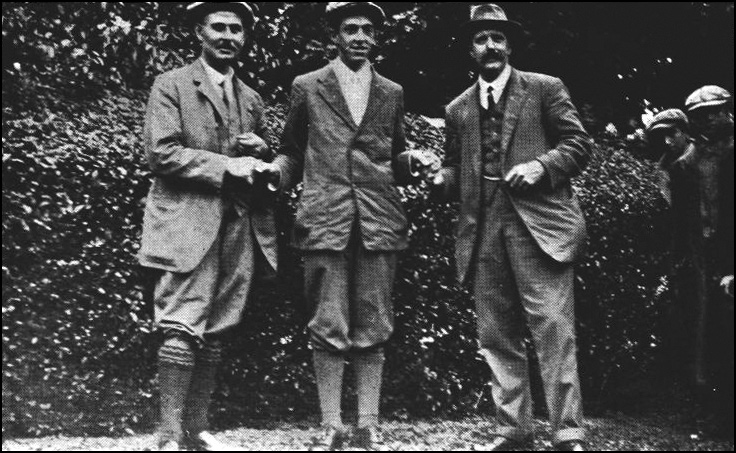
Left to right: Harry Vardon, Francis Ouimet, Ted Ray

September 20, 1913: Francis Ouimet wins the U.S. Open golf tournament, held at The Country Club in his hometown of Brookline, Massachusetts, outside Boston.

NOTE: For a long time, with this project, I resisted putting in references to golf, because of the kind of people who tend to play it. I finally caved in, although I haven't included as many references as I would if it were a real sport, which it is not.

This was the 19th time that the Open was conducted. It wasn't the 1st time an American had won it -- that was John McDermott, who had won the previous 2, ending the English and Scottish monopoly on America's top golf tournament -- but it was a watershed moment, because he had to defeat the 2 leading golfers in the world to do it, both from the Channel Island of Jersey: Harry Vardon and Ted Ray.

Vardon was 43 years old, Ray 36, Ouimet 20. Ouimet was the quintessential New Englander: Father of French-Canadian descent, mother from Ireland. Both ancestries would have inspired him to beat the Englishmen.

After 72 holes of regulation play ended in a 3-way tie, Ouimet, Vardon, and Ray engaged in an 18-hole playoff the next day, in rainy conditions. Ouimet won the playoff at one-under-par for the day, beating Vardon by 5 strokes and Ray by 6.

His victory was widely hailed as a stunning upset over the strongly favored British, who were regarded as the top two golfers in the world. He was the first amateur to win the U.S. Open. The biggest crowds ever seen in American golf followed the playoff, and his achievement was front-page news across the country.

Ouimet's U.S. Open success is credited for bringing golf into the American sporting mainstream. Before his win over Vardon and Ray, golf was dominated by British players. In America, the sport was restricted to players with access to private facilities. There were very few public courses. Ten years after his 1913 victory, the number of American players had tripled and many new courses had been built, including numerous public ones.

In 1951, Francis Ouimet became the first non-Briton elected Captain of the Royal and Ancient Golf Club of St Andrews, where the game was allegedly invented, and still the game's spiritual home. He died in 1967.

*

September 20, 1913 was a Saturday. These baseball games were played that day:

* The New York Yankees beat the Cleveland Naps, 7-2 at the Polo Grounds. Ray Caldwell went the distance for the win. Napoleon "Nap" Lajoie, the Cleveland team's 2nd baseman, best hitter, manager and namesake, did not put himself into the game. "Shoeless" Joe Jackson went 1-for-3 with an RBI.

* The Brooklyn Dodgers swept a doubleheader from the Pittsburgh Pirates at Forbes Field in Pittsburgh. The Pirates won the opener, 1-0. Hank Robinson pitched a 4-hit shutout. The Dodgers won the nightcap, 4-3. Herbie Moran went 4-for-5. Honus Wagner did not play in either game.

* The Philadelphia Athletics beat the Detroit Tigers, 4-2 at Shibe Park in Philadelphia. Ty Cobb went 2-for-4 with an RBI.

* And the Washington Senators beat the St. Louis Browns, 6-3 at National Park (later Griffith Stadium) in Washington. Walter Johnson pitched 3 2/3rds innings of relief to get the win.

There was 1 college football game played, the opening game of the season: The Carlisle Indian School beat Albright College, 36-0 at Indian Field in Carlisle, Pennsylvania, outside Harrisburg. The Carlisle school was shut down in 1917.  Albright, in Reading, Pennsylvania, downgraded their program, and now play in NCAA Division III.

And in English soccer, at their brand-new Arsenal Stadium in the Highbury section of North London, Arsenal played Yorkshire team Hull City to a 0-0 draw.

Friday, September 9, 2022

September 9, 1969: Rod Laver's Grand Slam & The Black Cat Game

September 9, 1969: Two big events in sports happen in Queens, in New York City.

In tennis, the Grand Slam is winning all 4 majors: In chronological order, the Australian Open, the French Open, Wimbledon (the British championship) and the U.S. Open. From 1905, when the Australian Open, the newest of them, was first staged until 1961, it was achieved only once, in 1938, by Don Budge.

One big reason was that, early on, the distance from Australia to, well, pretty much anywhere else in the world meant that a lot of the best players simply didn't go to compete in it. As a result, Australian men and women won it more often than even home-court advantage would suggest they would. Another reason is that, due to the French Open having a clay court, players who are used to that surface have an advantage over those who aren't used to it, and upsets are common there. Another reason is that these tournaments weren't as "open" as their names suggest: Only amateur players were eligible, and some of the best players turned professional early.

One of those best players was Rod Laver. In 1962, at the age of 24, the Rockland, Queensland, Australia won all 4, and it was a big deal. Then, having nothing left to prove as an amateur, he turned professional.

But in 1968, the rules changed, and the majors allowed professionals. So now, truly, the best of the best were playing in the biggest tournaments. On January 27, 1969, at the Milton Courts in Brisbane, Queensland, Laver beat Spanish player Andrés Gimeno, 6–3, 6–4, 7–5, to win the Australian Open. On June 8, at Stade Roland Garros in Paris, he beat fellow Australian Ken Rosewall, 6–4, 6–3, 6–4, to win the French Open. On July 5, at Centre Court in London, he beat another Australian, John Newcombe, 6–4, 5–7, 6–4, 6–4, to win Wimbledon.

When the U.S. Open began at the Forest Hills Stadium in the neighborhood of the same name in Queens, it became the biggest event in tennis history at the time: In only the 2nd year of everybody-eligible, there was a chance at a fully legitimate Grand Slam, which neither Laver in '62 nor Budge in '38 had really won. And the growth of television sports coverage meant that anybody who wanted to see it didn't have to travel to the site and hope that tickets were available. (The Forest Hills Stadium, built in 1923 and still standing, only seats 14,0000 people.) They could turn on the tube and watch.

In the 1st Round, Laver beat Luis-Agusto Garcia of Mexico, 6-2, 6-4, 6-2. In the 2nd Round, he beat Jaime Pinto-Bravo of Chile, 6-4, 7-5, 6-2. In the 3rd Round, he beat another Chilean, Jaime Fillol, 8-6, 6-1, 6-2. He had a serious challenge in the 4th Round, by American player Daniel Ralston. He won the 1st set, 6-4; then dropped the next 2, 6-4, 6-4; but came back to win the last 2, 6-2 and 6-3.

In the Quarterfinals, he was seriously pushed again, by fellow Australian Roy Emerson. Emerson won the 1st set, 6-4. The next 2 sets went to tiebreakers, and Laver won them, 8-6 and 13-11. Laver won the 4th set, 6-4. In the Semifinal, he faced Arthur Ashe. A year earlier, Ashe became the 1st black man to win the U.S. Open. Laver won in straight sets, but 2 of the sets went to tie breakers: 8-6, 6-3 and 14-12.

(Althea Gibson became the 1st black person to win it the U.S. Open, and also the 1st to win Wimbledon, in 1957, and again in 1958. Ashe would go on to become the 1st black man to win Wimbledon, in 1975.)

The Final was against Tony Roche, yet another Australian. This was the golden age of Australian tennis, and they haven't reached those heights since. Roche won the 1st set, 9-7. But Laver took control from there, going 6-1, 6-2, 6-2.

He had won the Grand Slam. It was the 1st ever won against full competition, and there has never been another. Jimmy Connors never did it: He won all but the French in 1974. Nor did Björn Borg: He won 5 straight Wimbledons and 6 French Opens in 8 years, but never won the U.S. or the Australian. Nor did John McEnroe: He never won the French or the Australian. Nor did Ivan Lendl: He never won the French. Nor did Andre Agassi: He won all 4, but never more than 2 in the same year. Nor did Pete Sampras: He never won the French, either. Nor did Roger Federer: He won all but the French in 2004 and again in 2006; and his only French win came in 2009, and he won Wimbledon that year, too, but not the other 2. Nor did Rafael Nadal: He won all but the Australian in 2010.

In 2016, Novak Djokovic, having already won that year's Australian and the previous year's Wimbledon and U.S., won the French, making him the 1st man since Laver to hold all 4 titles at once. But that's not the Grand Slam: He didn't do all 4 in the same calendar year. He did win all but the French in 2011 and 2015. He won the French after winning the Australian in 2016, but didn't win Wimbledon or the U.S. He won the Australian, the French, and Wimbledon in 2021, but lost the U.S. in the Semifinal. That's the closest anyone has come since Laver.

Three women have achieved a single-calendar-year Grand slam: Maureen Connolly in 1953, Margaret Court in 1970, and Steffi Graf in 1988.

In 1988, a new main stadium for the Australian Open opened in Melbourne. It is named the Rod Laver Arena. The Milton Courts were demolished in 2002.

*

The U.S. Open has been held in Queens since 1915. In 1978, it was moved from Forest Hills. the neighborhood whose name had come to mean "the U.S. Open," to Flushing Meadow-Corona Park, site of the 1939-40 and 1964-65 New York World's Fairs, across Roosevelt Avenue from Shea Stadium, home of baseball's New York Mets from 1964 to 2008 and football's New York Jets from 1964 to 1983.

And on September 9, 1969, an iconic moment took place at Shea. But let's take a step back, to set this moment up:

In 1969, the 1st season of Divisional Play, the Chicago Cubs won 11 of their 1st 12 games. They had a 5-game winning streak in May, a 7-game winning streak in June, and another 7-game winning streak in August. On August 16, they beat the San Francisco Giants, 3-0 at Candlestick Park in San Francisco. They led the National League Eastern Division by 9 games, with 42 games to go. The Division title was hardly wrapped up, but they were in great shape.

But they slipped. Not much at first: On September 3, they were still 5 games up with 24 games to go. The problem was, the New York Mets, who had lost an average of 108 games over their 1st 6 seasons before improving to 73-89 in 1968, went on a tear. On September 7, with the Cubs having lost 4 straight, the Mets had closed to within 2 1/2 games of the Cubs, with a 2-game series between the teams set for Shea.

On Monday, September 8, Tommie Agee put the Mets up 2-0 with a home run off Bill Hands in the bottom of the 3rd inning. The Cubs tied the game against Jerry Koosman in the top of the 6th. But Agee led off the bottom of the 6th with a double, and Wayne Garrett singled. Agee tried to score, and the instant replay clearly showed that he was out. But Satch Davidson, the home plate umpire, ruled him safe.

Cub catcher Randy Hundley, whose son Todd would eventually catch for both of these teams, knew Agee was out, and was furious at the blown call, enough to jump higher in the air than any man loaded down with catcher's equipment could be expected to. Leo Durocher, formerly manager in New York with first the Brooklyn Dodgers, then the New York Giants, was now managing the Cubs, and he ran out of the dugout to argue. Davidson held his call, and the Mets' 3-2 lead held up. The Mets were now within a game and a half of the Cubs.

The September 9 game was started by a pair of future Hall-of-Famers: Tom Seaver of New York was 20-7, and Ferguson "Fergie" Jenkins of Chicago was 19-12. The Mets led 4-0 in the top of the 4th, thanks in part to a home run by Donn Clendenon. With 1 out, Glenn Beckert on 2nd base, and Billy Williams at the plate, Ron Santo was in the on-deck circle.

And then, a black cat, often thought of as a symbol of bad luck, ran into the field. It ran in front of Santo. Then it stopped in front of the Cub dugout, and looked right at Durocher.
The men in the Cub dugout overheard Santo saying, "Oh, man, we're fucked now." Durocher, a baseball lifer, superstitious as hell, and one of the great practitioners of baseball profanity, yelled, "Somebody get that fucking cat out of here! Get him away from me!"

The cat then ran away, and disappeared under the stands. To this day, no one knows for sure whether the cat got out there on its own, or if someone had it and released it. (If anyone did know, they have never spoken up.) The most likely explanation was given by the Mets' Ed Kranepool: Like many stadiums, Shea had rats, cats were brought in to eat the rats, and this was probably one of those cats. Unless someone kept a record of those cats, there's no way to tell how long this cat lived.

In this case, the legend far exceeds the truth: The cat had absolutely no effect on either the game or the Pennant race. What became known as the Cubs' "September Swoon" was already well underway. Santo got a hit to drive Beckert home. But that only got the Cubs to within 4-1, and the Mets won, 7-1, to get within half a game.

The next day, the Mets swept a doubleheader from the expansion Montreal Expos at Shea, and the Cubs lost away to the Philadelphia Phillies. For the 1st time in their history, the Mets were in 1st place, and the cat didn't have anything to do with it: It was a convenient symbol, not the cause.

The Cubs' losing streak reached 8 games the day after that. On September 24, despite the Cubs beating the Expos at Wrigley Field, the Mets beat the St. Louis Cardinals at Shea, and clinched the NL East title. It was the first time a National League team from New York had finished 1st since the 1956 Dodgers. The Mets ended up winning the Division by 8 games over the Cubs.

The Mets went on to win the World Series, while the '69 Cubs have had to live with words like "September Swoon," "choke," "black cat" and "curse" ever since. Whie Ernie Banks (who didn't even play in the Black Cat Game) was a member of the 500 Home Run Club, and was elected to the Baseball Hall of Fame in his 1st year of eligibility, it took a long time for their other stars to make it: Jenkins was elected in his 3rd year, Williams was elected in his 6th, and Durocher (whose true Hall credentials came well before he arrived on the North Side of Chicago) and Santo didn't get in until after they died.

Then again, only 2 members of the '69 Mets are in the Hall of Fame: Seaver, and Nolan Ryan, who, despite being a key figure in on the Mets' pitching staff in the postseason, hadn't yet found his control, and so his true Hall credentials came after he was traded away. Manager Gil Hodges has finally been elected to the Hall, but that was for what he did as a player. Agee and Cleon Jones had very good careers, but not at Hall of Fame level.

In 1969, the Chicago Cubs had the better collection of players, but the New York Mets had, if not the better team, then, certainly, the better team performance.

As did the performances of the 1951 Brooklyn Dodgers and the 1964 Philadelphia Phillies before this, and the 1978 Boston Red Sox after this, the 1969 Chicago Cubs left their fans mentally scarred to the point that a later World Championship -- 1955 in Brooklyn, 1980 and 2008 in Philadelphia, 2004 and 3 more since in Boston, and 2016 in Chicago -- couldn't fully ease the pain.

Mike Royko, the great newspaper columnist who was with the Chicago Daily News in 1969, and turned 37 a few days after the Black Cat Game, would one day write, "New York didn't need that 1969 Pennant. It should have been ours. All we wanted was the one lousy Pennant. It would have kept us happy for the rest of the century. But New York took that from us, and I can never forgive them for that."

Royko died in 1997, having lived to see another Cub disaster in 1984. Michael Wilbon, co-host of Pardon the Interruption on ESPN, grew up in Chicago, remains a Cub fan, and says he still hates the Mets. Which is funny, because his co-host is Tony Kornheiser, who grew up on Long Island as a Met fan. (They were colleagues at The Washington Post when ESPN hired them, and remain close friends despite their baseball and geographic divides.)

An interesting side note: The cat got pretty close to the Cubs' batboy, Jim Flood, and he even got into a photograph taken of the incident. He became a lawyer, and, when the Cubs finally won another Pennant in 2016, people told him to stay away from cats and goats, bringing up another piece of Cub lore, "the Curse of the Billy Goat." The Cubs won the World Series, anyway. In a 50th Anniversary interview in 2019, Flood said he had 4 cats, and 1 of them was black. He named that cat Fergie, after Jenkins, an African-Canadian.

UPDATE: The Cubs have a team Hall of Fame. Inducted from their 1969 near-miss team team were shortstop Ernie Banks, left fielder Billy Williams, 3rd baseman Ron Santo, shortstop Don Kessinger, 2nd baseman Glenn Beckert, catcher Randy Hundley; pitchers Ferguson Jenkins and Ken Holtzman; manager Leo Durocher; coach and scout John "Buck" O'Neil, owner Philip K. Wrigley, clubhouse manager Yosh Kawano, public address announcer Pat Pieper; and broadcasters Jack Brickhouse, Lou Boudreau and Vince Lloyd.

From between the 1969 near-miss and the 1984 Playoff berth, they have inducted outfielder José Cardenal, 1st baseman Bill Buckner, and pitchers Rick Reuschel and Bruce Sutter.

*

September 9, 1969 was a Tuesday. These other games were played in Major League Baseball that day:

* The New York Yankees lost to the Detroit Tigers, 2-0 at Tiger Stadium in Detroit. And it wasn't either Denny McLain or Mickey Lolich who pitched the shutout, either: It was Mike Kilkenny, outpitching Fritz Peterson. Roy White and rookie Thurman Munson each had 2 of the Yankees' 8 hits.

* The Montreal Expos beat the Pittsburgh Pirates, 4-2 at Jarry Park in Montreal. Roberto Clemente went 0-for-4, and Willie Stargell went 1-for-4.

* The St. Louis Cardinals beat the Philadelphia Phillies, 6-2 at Connie Mack Stadium in Philadelphia. Lou Brock went 2-for-4 with a walk, a stolen base, and an RBI. Joe Torre went 1-for-2 with 3 walks and an RBI.

* The Baltimore Orioles swept a doubleheader from the Washington Senators at Memorial Stadium in Baltimore, 6-1 and 3-2. Frank Howard homered in the opener, but that was the only run that Mike Cuellar allowed. Tom Phoebus won the nightcap, despite a home run from Mike Epstein, a slugger who apparently didn't mind being called "Superjew." Over the 2 games, Brooks Robinson went 2-for-6 with 2 walks and 4 RBIs, while Frank Robinson went 0-for-3 with a walk in the 1st game and didn't play in the 2nd.

* The Atlanta Braves beat the Los Angeles Dodgers, 2-1 at Atlanta (later Atlanta-Fulton County) Stadium. Hank Aaron went 1-for-3 with a walk. Ralph Garr singled home the winning run in the bottom of the 10th inning. Phil Niekro went all 10 innings for the win.

* The Boston Red Sox beat the Cleveland Indians, 3-1 at Cleveland Municipal Stadium. Carl Yastrzemski went 1-for-5 with an RBI.

* The San Francisco Giants beat the Cincinnati Reds, 7-4 at Crosley Field in Cincinnati. Dick Dietz and Willie McCovey hit home runs for the Giants. (In spite of the Giants finishing 2nd to the Braves in the NL West, and Seaver's Cy Young Award season, it was McCovey who was named the NL's Most Valuable Player that year.) Willie Mays went 2-for-5. For the Reds, Pete Rose went 0-for-1 before leaving the game due to an injury, and Johnny Bench went 1-for-4.

* The Houston Astros beat the expansion San Diego Padres, 9-2 at the Astrodome in Houston. Larry Dierker outpitched Phil Niekro. Jim Bouton, in the process of writing Ball Four and having been traded from the Pilots to the Astros, did not get into the game, since Dierker went the distance.

But it was a noteworthy day in the book. Tommy Davis, the former NL batting champion who had been traded from Seattle to Houston a week after Bouton was, confirmed Bouton's suspicions that most of the Pilot players thought he was "weird," and that manager Joe Schultz, instead of acknowledging that Bouton was, at the least, working hard and always thinking, egged them on by making fun of Bouton in front of the other players.

This was also the night when, after the game, the postgame spread included a big pot of chicken a la king. The players hated it. And they went on a 6-game losing streak. After the 5th loss, Bouton wrote, "Has anybody noticed that we haven't won a game since we ate that chicken a la king?"

* The Minnesota Twins beat the California Angels, 11-7 at Anaheim Stadium (now Angel Stadium of Anaheim). Harmon Killebrew went 2-for-4 with an RBI. Rod Carew went 1-for-5.

* The expansion Kansas City Royals beat the team that had abandoned Kansas City after the 1967 season, the now-Oakland Athletics, 2-1 at the Oakland Coliseum. Reggie Jackson went 0-for-4.

* And the Chicago White Sox and the expansion Seattle Pilots were not scheduled to play.

Also, New Zealand supermodel Rachel Hunter was born on this day.

Tuesday, September 6, 2022

September 6, 1953: Maureen Connolly Wins the Grand Slam

September 6, 1953: The Finals of tennis' U.S. Open are played at the Forest Hills Stadium in Queens. Tony Trabert wins men's singles. Women's singles is won by Maureen Connolly. She becomes the 1st woman ever to win tennis' "Grand Slam."

Maureen Catherine Connolly was born on September 17, 1934 in San Diego. Her parents divorced when she was 3 years old, and she took up tennis because it was easier for her single mother to afford than her original passion, horseback riding. In 1951, she won the U.S. Open, making her the youngest player to win it up to that time.

In 1952, she won Wimbledon and the U.S. Open. Plane travel was making it easier to travel long distances relatively quickly. Prior to this era, due to the distance involved, many Australian tennis stars didn't travel to the other major tennis-playing countries, and many players from those countries found the trip to Australia not worth it. But on January 17, 1953, Connolly beat fellow American Julia Sampson, 6-3, 6-2, to win the Australian Open.

On May 31, she beat fellow American Doris Hart, 6-2, 6-4, to win the French Open. She had now won all 4 majors, and all in a row. But no one considered this to be "the Grand Slam": It had to be all 4 in the same calendar year. On July 3, she beat Hart again, 8-6, 7-5, to win Wimbledon.

She reached the Final at Forest Hills on September 6, and Hart stood in her way again. It was no contest: Connolly won, 6-2, 6-4. She had won the Grand Slam.

Her streak of 6 straight majors ended in the 1954 Australian Open, because she stayed home rather than defend her title, but she won the French and Wimbledon that year, giving her 9 majors. There would be no more. She had intended to turn professional after the 1954 U.S. Open, thus making her, under the rules of the time, ineligible for the majors.

But on July 20, 1954, the choice was taken from her: She was riding her horse when a truck spooked horse, throwing her against the truck, breaking her leg. She would never play tennis again, and was only 19. She sued for loss of professional income, and won $95,000.

In 1955, she married a fellow horse-lover, Norman Brinker, a member of the 1952 U.S. Olympic equestrian team. They had 2 daughters, Cindy and Brenda. Living in Norman's hometown of Dallas, Maureen earned a degree from Southern Methodist University. Norman became a restaurant magnate, running Jack in the Box, and founding Steak and Ale, Bennigan's, and Chili's. But Maureen developed ovarian cancer, and died on June 21, 1969. She was only 34 years old. Shortly after her death, Connolly was elected to the International Tennis Hall of Fame.

In 1957, she published an autobiography titled Forehand Drive. She wrote, "I have always believed greatness on a tennis court was my destiny, a dark destiny, at times, where the court became my secret jungle and I a lonely, fear-stricken hunter. I was a strange little girl armed with hate, fear, and a Golden Racket."

*

September 6, 1953 was a Sunday. These baseball games were played:

* The Brooklyn Dodgers beat their arch-rivals, the New York Giants, 6-3 at the Polo Grounds. Preacher Roe went the distance for the win. Roy Campanella and Jackie Robinson hit home runs for Dem Bums. Alvin Dark and Bobby Thomson hit home runs for the Jints. Not available, due to serving in the Korean War, were Willie Mays of the Giants and Don Newcombe of the Dodgers.

* The Boston Red Sox swept a doubleheader from the Philadelphia Athletics, 8-4 and 4-0 at Connie Mack Stadium in Philadelphia. Ted Williams, having returned from the Korean War, went 2-for-2 with a home run, 2 walks and an RBI in the 1st game, then got the 2nd game off. Mickey McDermott pitched a 6-hit shutout in that 2nd game.

* The Philadelphia Phillies beat the Pittsburgh Pirates, 7-2 at Forbes Field in Pittsburgh.

* The Cleveland Indians beat the Chicago White Sox, 4-2 at Cleveland Municipal Stadium.

* The Chicago Cubs swept a doubleheader from the Cincinnati Reds, 7-6 and 7-2 at Wrigley Field in Chicago. Just 11 days later, Ernie Banks would make his major league debut, as the 1st black player, and maybe the greatest player, in Cub history.

* A doubleheader was played at Milwaukee County Stadium. The Milwaukee Braves won the opener, 3-1. Eddie Mathews hit a home run. Bob Buhl was the winning pitcher, with Warren Spahn notching a save. The nightcap was tied, 3-3 after 8 innings. According to Retrosheet, the game was called due to darkness, but that doesn't make any sense: Already, every ballpark in the major leagues, except for Wrigley Field, had lights. A Sunday curfew, with play having to stop at a specific time, is more likely. Over the 2 games, Stan Musial went 3-for-8 with a solo home run.

* The Detroit Tigers beat the St. Louis Browns, 5-2 at Busch Stadium (formerly Sportsman's Park) in St. Louis.

* And the New York Yankees and the Washington Senators were rained out at Griffith Stadium in Washington. The Yankees were running away with the American League Pennant, and the game was never rescheduled.

Saturday, September 3, 2022

September 3, 1881: The 1st U.S. Open

Richard D. Sears

September 3, 1881: The Singles Final of the 1st U.S. National Championships -- tennis' 1st U.S. Open -- is held at the Newport Casino in Newport, Rhode Island. Richard Sears defeats William E. Glyn, 6-0, 6-3, 6-2. Both players were American: At the time, the tournament was only open to Americans.

Richard Dudley Sears was born on October 26, 1861 in Boston. He won the U.S. Open the 1st 7 times, 1881 to 1887. He also won its doubles tournament from 1882 to 1887, with James Dwight as his partner, except for 1885, when it was Joseph Clark. After that, he retired from tennis. He died in 1943.

In 1903, Laurence Doherty -- interestingly enough, a native of Wimbledon, in South London -- became the 1st non-American to win the U.S. Open. Sears' 7 wins have been matched by fellow Americans William Larned and Bill Tilden, but no player has managed to win an 8th. In fact, the next-most is 5, by Americans Jimmy Connors and Pete Sampras, and Switzerland's Roger Federer.

The 1st women's tournament was held in 1887. It was won by Ellen Hansell, born in Philadelphia in 1869. She reached the Final again in 1888, but lost, and never got that far again. She lived until 1937. Mabel Cahill, from Ireland but competing for Great Britain, was the 1st non-American woman to win, in 1891. In the Final, she defeated Ellen Roosevelt, a 1st cousin of Franklin Delano Roosevelt.
Ellen Hansell

The woman with the most U.S. Open wins is Molla Bjurstedt Mallory, a Norwegian who came to America to live in 1915, and won 8 titles from that year until 1926. Helen Wills Moody won 7, Chris Evert won 6, and Serena Williams has also won 6.

The Newport Casino hosted the U.S. Open until 1914, and is the home of the International Tennis Hall of Fame. From 1915 to 1920, it was held at the West Side Tennis Club in Forest Hills, Queens. From 1921 to 1923, it was played at the Germantown Cricket Club in Philadelphia.
Newport Casino

In 1923, the West Side Tennis Club built a stadium that still stands, and hosted 2 concerts by The Beatles in 1964. That stadium hosted the U.S. Open from 1924 until 1977. In 1978, the Open moved 3 miles to Flushing Meadow-Corona Park, to the Singer Bowl, which was renamed Louis Armstrong Stadium: The jazz master lived nearby, in Corona, and was a big sports fan, including, unusually for a black man at the time, tennis. The complex was named the National Tennis Center by the United States Tennis Association (USTA).
Forest Hills Stadium

In 1997, a new main venue opened at Flushing Meadow, Arthur Ashe Stadium. Louis Armstrong Stadium was kept as a backup, before being torn down and replaced by a new stadium on the same site, with the same name, in 2018. In 2006, the entire complex was renamed the USTA Billie Jean King National Tennis Center.
Arthur Ashe Stadium

*

September 3, 1881 was a Saturday. The only professional sports league in North America at that point was baseball's National League, and these games were played that day:

* The Boston Red Stockings beat the Worcester Ruby Legs, 3-2 at the 1st version of the South End Grounds in Boston. The Red Stockings eventually became the Braves. In 1883, the Ruby Legs moved, becoming the Philadelphia Phillies.

* The Providence Grays beat the Troy Trojans, 11-1 at the Haymakers' Grounds in Troy, New York, across the Hudson River from the State capital in Albany. In 1883, the Trojans moved, becoming the New York Giants. The Grays had won the NL Pennant in 1879, and would do so again in 1884, but went out of business just 1 year later.

* The Buffalo Bisons beat the Detroit Wolverines, 5-3 at Riverside Park in Buffalo. The Bisons went out of business after the 1885 season. The Wolverines won the Pennant in 1887, but went out of business just 1 year later.

* The Chicago White Stockings beat the Cleveland Blues, 4-2 at Kennard Street Park in Cleveland. The Blues went out of business after the 1884 season, while the White Stockings eventually became the Cubs.

Monday, August 29, 2022

August 29, 1977: Renée Richards Competes In Women's Singles

August 29, 1977: The U.S. Open tennis tournament gets underway, at the Forest Hills Stadium in Queens, New York City. It is the last time the venue will host the tournament, as the new National Tennis Center will open the next year, also in Queens, in Flushing-Meadow Corona Park.

Among the players competing in women's singles at this tournament is Renée Richards. A native of Forest Hills, she fought hard for the right to compete in women's singles.

Because she wasn't always Renée Richards. As we now understand things, she was always a she -- but, physically speaking, that was not always the case.

Richard Raskin was born on August 19, 1934 in New York City. At Horace Mann School, one of the country's leading prep schools, he was good enough as a baseball pitcher to be scouted by the New York Yankees. He was a wide receiver on the football team, and was also on the tennis and swim teams.

He went to Yale University, and was Captain of the men's tennis team. He was considered by some to be one of the best college tennis players in the country. He went to medical school, and became an eye doctor. He enlisted in the U.S. Navy, and won service championships in tennis.

But he was harboring a secret: Since college, he had been dressing as a woman. She had heard about what is now called gender-reassignment surgery, but was then called "a sex-change operation." She began receiving the hormone treatments that have become a precursor to such surgery, but chose not to go through with it at that time. In 1970, still Richard Raskind and officially male, he married model Barbara Mole, and fathered a son, Nicholas, in 1972.

But in 1975, they divorced. By that point, the transition process had begun. As Dr. Renée Richards, she set up an ophthalmology practice in the Los Angeles suburb of Newport Beach, California. She applied to play in women's singles at the 1976 U.S. Open, but refused to take the Barr body test for gender verification, and was denied admittance to the big Summer tournaments: Wimbledon, the U.S. Open, and the Italian Open.

She sued the U.S. Tennis Association (USTA) in New York State court, alleging gender discrimination under the New York Human Rights Law. As the case dragged on, she took the Barry body test, and the results were ambiguous. She was told she would have to take it again before being allowed to play, refused -- understandable, since she had given in to the demand to take it once -- and was denied admittance to the Open by the USTA.

On August 16, 1977 -- the day Elvis Presley died -- Judge Alfred M. Ascione found in Richards' favor. He ruled, "This person is now a female," and that requiring Richards to pass the Barr body test was "grossly unfair, discriminatory and inequitable, and a violation of her rights." He further ruled that the USTA practiced an intentional discrimination against Richards, and granted Richards an injunction against the USTA and the USOC, allowing her to play in the 1977 U.S. Open.

On August 29, she played in the 1st round, against British star Virginia Wade, and lost. However, she and her tennis partner, Betty Ann Stuart, reached the women's doubles Final, losing in straight sets to Martina Navratilova and Betty Stöve. She competed in the next 4 U.S. Opens, getting to the 3rd round in 1979. She never competed in any of the other majors. In 1979, competing in mixed doubles -- teams of one man and one woman, having already endured jokes about her having competed in "mixed singles" -- she reached the Semifinals.

After the 1981 U.S. Open, she moved her residence and her practice to New York. She wrote a memoir, Second Serve, which was made into a 1986 CBS TV-movie starring Vanessa Redgrave. In 2017, with "trans" people becoming more visible and vocal than ever, she sat for an interview with Katie Couric for the documentary Gender Revolution. As of August 29, 2022, Dr. Richards is retired from medical practice, and living in Carmel, in New York's Lower Hudson Valley.

*

August 29, 1977 was a Monday. A pair of baseball All-Stars, pitcher Roy Oswalt and outfielder Aaron Rowand, were born.

And these Major League Baseball games were played:

* The New York Yankees beat the Kansas City Royals, 5-3 at Yankee Stadium. Chris Chambliss hit a 3-run home run in the bottom of the 8th, providing the comeback win, and making Sparky Lyle a winning pitcher in relief of Catfish Hunter. Cliff Johnson also hit a home run. Reggie Jackson went 0-for-4. For the Royals, George Brett and Al Cowens hit home runs.

* The Montreal Expos beat the Cincinnati Reds, 7-2 at the Olympic Stadium in Montreal. Tony Pérez hit a home run against his former team, and Gary Carter added one. For the Reds, Johnny Bench hit a home run, but Pete Rose went 0-for-4.

* The Oakland Athletics beat the Boston Red Sox, 8-7 at Fenway Park in Boston. Bill Campbell, the reliever the Sox signed through free agency to compete with the Yankees, collapsed against the cash-stripped A's, allowing the tying run in the 8th and a home run to Mitchell Page to lose it in the 9th, wasting a 3-homer performance by Jim Rice. Carl Yastrzemski went 1-for-5 with an RBI.

* The Philadelphia Phillies beat the Atlanta Braves, 3-2 at Veterans Stadium in Philadelphia. Davey Johnson, later to manage several teams, won the game in the bottom of the 14th inning by drawing a bases-loaded walk against Steve Hargan, forcing Greg Luzinski home. Luzinski had also homered. Mike Schmidt went 1-for-4 with 2 walks.

* The Baltimore Orioles beat the California Angels, 6-1 at Memorial Stadium in Baltimore. Rudy May outpitched Nolan Ryan. Eddie Murray, about to be named American League Rookie of the Year, went 0-for-2, but drew a walk and had an RBI on a sacrifice fly.

* The Cleveland Indians beat the Chicago White Sox, 9-2 at Cleveland Municipal Stadium. Indians 2nd baseman Duane Kuiper hit a home run, the only one he would hit in 3,754 major league plate appearances over 12 seasons.

* The Minnesota Twins swept a doubleheader from the Toronto Blue Jays, 7-6 and 6-5 at Metropolitan Stadium in the Minneapolis suburb of Bloomington, Minnesota. Bob Gorinski won the opener with a sacrifice fly in the bottom of the 10th inning, scoring Larry Hisle.

* The San Diego Padres beat the St. Louis Cardinals, 4-3 at San Diego Stadium (later Jack Murphy Stadium). Mike Ivie hit a home run in the bottom of the 8th to help the Padres come from behind. Dave Winfield went 0-for-3. Lou Brock went 1-for 3 with a walk and a stolen base.

It was the 893rd steal of his career. At the time, this was thought to give him the all-time record, surpassing Ty Cobb. A later check of the records showed that stole 897, not 892; and that 1890s star Billy Hamilton had 914. Brock finished his career with 938, which was definitely a record, and remains so for the National League. However, Rickey Henderson went on to shatter all records, with 1,406.

* The Los Angeles Dodgers beat the Chicago Cubs, 4-1 at Dodger Stadium in Los Angeles.

* And the New York Mets, the Houston Astros, the Pittsburgh Pirates, the San Francisco Giants, the Detroit Tigers, the Milwaukee Brewers, the Seattle Mariners and the Texas Rangers were not scheduled.

December 31, 1999 & January 1, 2000: The Millennium

December 31, 1999:  The Millennium arrives. The people of planet Earth survived. At a terrible cost. But we hadn't destroyed ourselves. ...