Showing posts with label oklahoma. Show all posts

Saturday, December 24, 2022

December 24, 1924: The Babbs Switch Fire

December 24, 1924: A fire kills 36 people in a one-room school house at Babbs Switch, Oklahoma, about 125 miles southwest of Oklahoma City.

The death toll wasn't high due to kids still being in school on Christmas Eve. Rather, the fire started during a Christmas party attended by over 200 people. A Christmas tree decorated with lighted candles stood at the front of the room, and presents were placed on the tree to be distributed to the children in attendance at the end of the program.

The fire began when a teenage student dressed as Santa Claus was removing presents from the tree to give to the children. The flames ignited paper decorations, tinsel, and dry needles and spread quickly to the tree, stage, and the greater structure of the building.

People rushed to the building's single door, which opened inward, and was soon jammed with people. Escape through the windows was blocked because they were covered with secure metal screens to prevent vandals from breaking into the school.

The day after the fire, 25 children from Muskogee, Oklahoma sent a box of their new Christmas toys to the children who survived the fire.

A month later, the National Fire Protection Association (NFPA) released a report, stating, "It is hardly conceivable that conditions could have been worse, even in so rudimentary a structure as this one-story building."

A new school was built on the site in 1925 but closed in 1943 when the Babbs Switch district was annexed into nearby districts. A stone monument, which bears a short description of the fire and a list of the dead, currently stands on the site of the former school.

Eleven years to the day earlier, the Italian Hall Disaster occurred on Michigan's Upper Peninsula. It was rumored that the death toll there was boosted because the exit doors opened inward, but this was not true.

*

December 24, 1924 was a Tuesday. Singer Lee Dorsey was born.

Baseball was out of season. Football season was over, except for some Christmas Day games and the Rose Bowl. The NBA hadn't been founded yet. And no games were scheduled for the NHL. So there were no games on this historic day.

Sunday, November 13, 2022

November 13, 1974: The Death of Karen Silkwood

November 13, 1974: Karen Silkwood is killed in a car crash near Crescent, Oklahoma. She was 28 years old.

A native of Nederland, in southeast Texas, she worked making plutonium pellets at the Cimarron Fuel Fabrication Site, owned by the Kerr-McGee energy company, near Cimarron City, Oklahoma. She became the 1st woman on the negotiating team of the Oil, Chemical & Atomic Workers Union.

The Union said that "the Kerr-McGee plant had manufactured faulty fuel rods, falsified product inspection records, and risked employee safety." On November 5, 1974, after testifying to the Atomic Energy Commission about her concerns, Silkwood was found to have plutonium contamination on her body, about 400 times the legal limit. That contamination was also in her home, as she had unwittingly brought it there.

On November 13, she was driving her Honda Civic to meet with a New York Times reporter and an official of her union's national office. She was founded the next morning, with her car having run off the road and struck a culvert on the east side of State Route 74. The documents she said she was bringing to the meeting were not found in or around the car.

Her family sued Kerr-McGee for the plutonium contamination, and the company settled out of court for $1.38 million, while not admitting liability. No one was ever charged in connection with her crash.

Her story was chronicled in Mike Nichols' 1983 film Silkwood, in which she was played by Meryl Streep.

*

November 13, 1974 was a Wednesday. This was also the day of the "Amityville Horror" murders, and the day of Yassir Arafat's lie-filled speech before the United Nations. I have separate entries for those events.

Baseball was out of season. Football was in midweek. There were 4 games in the NBA:

* The Washington Bullets beat the Kansas City-Omaha Kings, 118-81 at the Capital Centre in the Washington suburb of Landover, Maryland.

* The Detroit Pistons beat the Milwaukee Bucks, 98-91 at Cobo Hall (now Huntington Place) in Detroit. Bob Lanier had 40 points and 24 rebounds.

* The Phoenix Suns beat the Philadelphia 76ers, 105-100 at the Arizona Veterans Memorial Coliseum in Phoenix. Charlie Scott scored 41 for the Suns.

* And the Seattle SuperSonics beat the Los Angeles Lakers, 108-103 at the Seattle Center Coliseum.

There were 4 games played in the American Basketball Association:

* The New York Nets lost to the Kentucky Colonels, 132-129 in double overtime at Freedom Hall in Louisville, Kentucky. Julius "Doctor J" Erving scored 44 points and grabbed 18 rebounds. But it wasn't enough, as Louie Dampier led the Colonels with 32.

* The Spirits of St. Louis beat the Memphis Sounds, 97-92 at the St. Louis Arena. Marvin "Bad News" Barnes scored 31.

* The Utah Stars beat the Indiana Pacers, 114-103 at the Salt Palace in Salt Lake City, Utah.

* And the Denver Nuggets beat the San Diego Conquistadors, 132-108. Travis Grant scored 35 in defeat.

There were 8 games in the NHL:

* The New York Rangers lost to the Philadelphia Flyers, 3-2 at Madison Square Garden.

* The New York Islanders lost to the Pittsburgh Penguins, 8-2 at the Civic Arena in Pittsburgh.

* The Buffalo Sabres beat the Montreal Canadiens, 8-6 at the Montreal Forum. René Robert scored 3 goals and an assist. Guy Lapointe had 3 goals and 2 assists for the Canadiens.

* The Atlanta Flames beat the Washington Capitals, 4-3 at The Omni in Atlanta.

* The Minnesota North Stars beat the Detroit Red Wings, 7-4 at the Metropolitan Sports Center in the Minneapolis suburb of Bloomington, Minnesota.

* The Kansas City Scouts beat the team that was meant to be their arch-rivals, the St. Louis Blues, 5-3 at the Kemper Arena (now the Hy-Vee Arena) in Kansas City. But the Scouts went just 2-8 against the Blues, failed after just 2 seasons, and the Blues' arch-rivals remained the Chicago Black Hawks. The Scouts became the Colorado Rockies in 1976, and the New Jersey Devils in 1982.

* The Los Angeles Kings beat the Toronto Maple Leafs, 4-0 at The Forum outside Los Angeles in Inglewood, California.

* The California Golden Seals beat the Chicago Black Hawks, 2-0 at the Oakland Coliseum Arena.

* And the Boston Bruins and the Vancouver Canucks were not scheduled.

And there were 4 games in the World Hockey Association:

* The Quebec Nordiques beat the Indianapolis Racers, 10-3 at the Colisée de Québec.

* The Houston Aeros beat the Minnesota Fighting Saints, 8-5 at the St. Paul Civic Center in St. Paul, Minnesota.

* The Edmonton Oilers beat the Winnipeg Jets, 5-3 at the Northlands Coliseum in Edmonton. This was only the 2nd game the Oilers played there, following their November 10 opener, a 4-1 win over the Cleveland Crusaders. They had played their 1st 2 seasons, and the start of this, their 3rd, at the Edmonton Gardens.

* And the Toronto Toros beat the Vancouver Blazers, 5-3 at the Pacific Coliseum in Vancouver.

Friday, November 11, 2022

November 11, 1933: The Beginning of the Dust Bowl

November 11, 1933: As if the Great Depression wasn't already bad, and hitting farm country harder than the cities, on came the Dust Bowl. For those of you who are sports fans: No, this was not a college football game.

On this day, a very strong dust storm stripped topsoil from desiccated South Dakota farmlands in one of a series of severe dust storms that year.

Such storms had been periodic since 1931, but this was when the Dust Bowl kicked into high gear. Beginning on May 9, 1934, a strong, two-day dust storm removed massive amounts of Great Plains topsoil. The dust clouds blew all the way to Chicago. Two days later, the same storm reached cities to the east, such as Cleveland, Buffalo, Boston, New York and Washington, Over the Winter of 1934-35, red snow fell on New England.

On April 14, 1935, known as "Black Sunday," 20 of the worst "black blizzards" occurred across the entire sweep of the Great Plains, from Canada south to Texas. The dust storms caused extensive damage and appeared to turn the day to night. Witnesses reported that they could not see 5 feet in front of them at certain points.

Denver-based Associated Press reporter Robert E. Geiger was in Boise City, Oklahoma that day. His story about Black Sunday marked the first appearance of the term "Dust Bowl," coined by Edward Stanley, Kansas City news editor of the AP.

Dust Bowl conditions fomented an exodus of the displaced from the Texas Panhandle, the adjoining Oklahoma Panhandle, and the surrounding Great Plains to adjacent regions. More than 500,000 Americans were left homeless. More than 350 houses had to be torn down after one storm alone. The severe drought and dust storms had left many homeless; others had their mortgages foreclosed by banks, or felt they had no choice but to abandon their farms in search of work.

Many Americans migrated west looking for work. Parents packed up "jalopies" with their families and a few personal belongings, and headed west in search of work. In particular, residents of Oklahoma and Arkansas -- "Okies" and "Arkies" -- headed west on U.S. Route 66, which became known as "The Mother Road," for California, "the land of milk and honey," hearing of jobs available picking fruits and vegetables. These jobs proved to be worse than farming, as they were no longer their own bosses, and the bosses were brutal until the labor unions came in.

The Plains States lost about 3.5 million people in the 1930s. More migrants arrived in California in 1936 than in any other year, including the Gold Rush year of 1849. Many of them brought their Southern mindsets with them, and were every bit as biased against the black and Hispanic people of California as they were against the black people of their home States. Ray Manzarek, keyboard player for rock band The Doors, said that, in the 1960s, a big chunk of the Los Angeles Police Department was the sons of Southerners who had come from the Dust Bowl, and they enjoyed practicing police brutality on minorities and hippies.

What did the federal government do about the Dust Bowl? President Franklin D. Roosevelt quickly set the New Deal to work on the problem. The Soil Conservation Service, forerunner of the Natural Resources Conservation Service, was founded. He also created the Civilian Conservation Corps (CCC), which created the Great Plains Shelterbelt: A line of 200 million trees from Canada to Abilene, Texas, to block the wind and cut the giant dust storms off.

In 1939, John Steinbeck published The Grapes of Wrath, about a family that escaped the Dust Bowl, only to find life in California just as hard as life in Oklahoma. The following year, it was made into a film. That same year, Woody Guthrie recorded one of the earliest "concept albums," Dust Bowl Ballads, making himself a legend of folksinging.

*

November 11, 1933 was a Saturday. Actor James Boyd, who played J. Arthur Crank and Paul the Gorilla on the 1970s PBS kids show The Electric Company, was born on this day.

Among the college football games played that day were these:

* Alabama beat Virginia Tech, 27-0 at Denny Stadium (now Bryant-Denny Stadium) in Tuscaloosa, Alabama. This was the 1st season of the Southeastern Conference, and Alabama won the title.

* Duke beat Maryland, 38-7 at Byrd Stadium in the Washington suburb of College Park, Maryland. Duke won the Championship of the Southern Conference, which, 20 years later, would sort-of evolve into the Atlanta Coast Conference.

* Michigan beat Iowa, 10-6 at Michigan Stadium in Ann Arbor. Michigan won the Big Ten Conference.

* Nebraska beat Kansas, 12-0 at Memorial Stadium in Lincoln, Nebraska. Nebraska won the Big Six Conference, the league that would become the Big Eight, and, later, the Big Twelve.

* Rice beat Arkansas, 7-6 at Rice Field in Houston. Nevertheless, Arkansas went on to win the title in the Southwest Conference.

* Purdue beat Notre Dame, 19-0 at Notre Dame Stadium in South Bend, Indiana.

* Among the service academies, Army beat Harvard, 27-0 at Harvard Stadium in Boston; and Navy lost to Columbia, 14-7 at Baker Field in Manhattan.

* In the other major game played in New York City that day, Fordham beat New York University (NYU), 20-12 at Yankee Stadium.

* And among New Jersey's teams, Princeton beat Dartmouth, 7-0 at Palmer Stadium in Princeton; and Rutgers beat Lafayette, 20-13 at Fisher Field in Easton, Pennsylvania.

* Stanford beat the University of Southern California (USC), 13-7 at the Los Angeles Memorial Coliseum. Stanford won the Pacific Coast Conference, the league that would become the AAWU, the Pac-8, the Pac-10 and the Pac-12.

Baseball was out of season. The NBA hadn't yet been founded. There were 3 games played in the NHL:

* The Montreal Maroons beat the Boston Bruins, 3-2 at the Montreal Forum.

* The Ottawa Senators beat the Montreal Canadiens, 2-0 at the Ottawa Auditorium.

* The Toronto Maple Leafs beat the New York Rangers, 4-3 at Maple Leaf Gardens in Toronto.

* And the New York Americans, the Detroit Red Wings and the Chicago Black Hawks were not scheduled.

And in English soccer, defending Champions Arsenal, of North London, beat Wolverhampton Wanderers, a.k.a. Wolves, 1-0 at Molineux Stadium in Wolverhampton, outside Birmingham.

Thursday, October 27, 2022

October 28, 1913: Christy Mathewson vs. Walter Johnson

Walter Johnson (left) and Christy Mathewson

October 28, 1913: In the only time the 2 greatest pitchers of their time face each other -- baseball would have no All-Star Game until 1933, and no Interleague Play until 1997, and they never faced each other in a World Series -- Walter Johnson and Christy Mathewson square off, at South Main Park in Tulsa‚ Oklahoma.

Normally, Johnson pitched for the Washington Senators. This time, he is backed by the Chicago White Sox‚ with the addition of another superstar, Boston Red Sox center fielder Tris Speaker. Johnson wins the battle‚ as the White Sox beat the New York Giants, 6-0. Johnson went the distance, striking out 8, while Matty exited after 4 innings.

Speaker and White Sox regular Buck Weaver did the hitting for the Pale Hose‚ while Oklahoma native, Sac and Fox Indian, and fan favorite Jim Thorpe got 2 hits for the Giants off Johnson. 

The game had been delayed for nearly 2 hours when the stands collapsed‚ injuring 52 people and killing a soldier. Governor R.L. Williams of Oklahoma narrowly escaped injury in the tragedy.

This was part of a world tour undertaken by the Giants and White Sox from late October 1913, after the Giants lost the World Series to the Philadelphia Athletics, until February 1914, through the Western United States, then to Asia, Australia, Egypt and Europe, although some of their intended games were rained out.

Mathewson won more games in the 1900s (1900 through 1909) than any other pitcher: 236. Johnson was the winningest pitcher of the 1910s: 265. Each would be among the 1st 5 inductees into the Baseball Hall of Fame in 1936, along with Ty Cobb, Babe Ruth and Honus Wagner. Unfortunately, both men would die too soon: Mathewson from tuberculosis in 1925, at the age of 45; Johnson from a brain tumor in 1946, at 59.

*

October 28, 1913 was a Tuesday. Football was in midweek. Professional basketball barely existed. And it was too early for hockey season. So this was the only score on this historic day.

Saturday, October 22, 2022

October 22, 1934: Pretty Boy Floyd Is Killed

"Pretty Boy"?

October 22, 1934: Pretty Boy Floyd is killed by FBI agents led by Melvin Purvis in East Liverpool, Ohio. The Midwest-based bank robber was 30 years old. Like his contemporary Lester Gillis, a.k.a. Baby Face Nelson, he hated his nickname.

Charles Arthur Floyd was born on February 3, 1904 in Adairsville, Georgia, and grew up in Akins, Oklahoma. He first got arrested at age 18, for stealing $3.50 from a post office. In 1925, he was busted for a payroll robbery in St. Louis, and served 3 1/2 years in prison.

He got involved with organized crime in Kansas City, and pulled off numerous robberies. In 1930, he was sentenced to 12 to 15 years for bank robbery in Ohio, but escaped. In 1931, members of his gang killed Patrolman R.H. Castner in Bowling Green, Ohio. Later that year, Floyd himself killed federal Agent Curtis Burke in Kansas City.

In 1933, Floyd was implicated in a shootout at Union Station that left 2 Kansas City detectives, an Oklahoma police chief, a federal agent dead, becoming known as the Kansas City Massacre. However, the available evidence suggests that Floyd wasn't even there.

Following the death of John Dillinger on July 22, 1934, FBI Director J. Edgar Hoover replaced him as "Public Enemy Number 1" with Floyd. By mid-October, Floyd was on the run in Ohio. On October 22, he made his way to East Liverpool, not far from Wheeling, West Virginia, and found refuge at a pool hall owned by a friend. Attempting to leave the pool hall, he was confronted by officers, tried to run, and was shot and killed.

It was a busy time for the nascent FBI, having gunned down some major bad guys in an 8-month span of 1934 and 1935: May 23, Bonnie Parker and Clyde Barrow in Arcadia, Louisiana; July 22, Dillinger in Chicago; October 22, Floyd November 27, Nelson outside Chicago in Wilmette, Illinois; and January 16, Ma Barker in Lake Weir, Florida.

*

October 22, 1934 was a Monday. Canadian football star Gerry James was born on this day.

Although Monday Night Football was still 36 years away, there was only 1 score on this historic day, and it was in the NFL: The new Detroit Lions beat the football version of the Brooklyn Dodgers, 28-0 at the University of Detroit Stadium.

Wednesday, October 19, 2022

October 20, 1923: Oklahoma Memorial Stadium Opens

October 20, 1923: Oklahoma Memorial Stadium opens on the campus of the University of Oklahoma in Norman, 20 miles south of Oklahoma City. The Sooners defeat Washington University of St. Louis 62-7. Just 7 days earlier, Oklahoma had visited Nebraska, which would become their arch-rivals in the Conference alternately known as the Big Six, the Big Seven, the Big Eight and the Big Twelve, for the opening of their Memorial Stadium in Lincoln, and lost.
Originally, the stadium seated 16,000. It was expanded to 32,000 in 1929, 55,000 in 1949, 61,000 in 1957, 71,000 in 1975, 75,000 in 1980, 81,000 in 2003, and 86,000 in 2016, before a seat-widening reduced capacity to 80,126 in 2019.
Since 1905, the Sooners had played at Boyd Field. Bennie Owen, head football coach from 1905 to 1926, basketball coach from 1908 to 1921, baseball coach from 1906 to 1922, and athletic director from 1907 to 1934, directed its replacement's construction. In his honor, the playing surface was named Owen Field. That surface was artificial from 1970 to 1993, but has been natural grass again since then.
In 2002, after a gift from the Gaylord family, publishers of the State's largest newspaper, the Daily Oklahoman, the structure was renamed Gaylord Family Oklahoma Memorial Stadium.
Since moving into "The Palace On the Prairie," the Sooners have claimed 47 Conference Championships: 1938, '43, '44, '46, '47, '48, '49, '50, '51, '52, '53, '54, '55, '56, '57, '58, '59, '62, '67, '68, '72, '73, '74, '75, '76, '77, '78, '79, '80, '84, '85, '86, '87, 2000, '02, '04, '06, '07, '08, '10, '12, '15, '16, '17, '18, '19 and '20. And they claim 7 National Championships: 1950, 1955 and 1956 under head coach Bud Wilkinson; 1974, 1975 and 1985 under Barry Switzer; and 2000 under Bob Stoops.
They have had 7 players win the Heisman Trophy: Running backs Billy Vessels in 1952, Steve Owens in 1969, and Billy Sims in 1978; and quarterbacks Jason White in 2003, Sam Bradford in 2008, Baker Mayfield in 2017 and Kyler Murray in 2018. Their legendary players have also included 1950s receiver Tommy McDonald, 1950s linebacker Jerry Tubbs, 1970s running backs Greg Pruitt and Joe Washington, 1970s defensive end Lee Roy Selmon, 1980s defensive tackle Tony Casillas, 1980s linebacker Brian Bosworth, and 2000 quarterback Josh Heupel.
Unfortunately for Oklahoma, the stadium's most famous game was one they lost: The 1971 "Game of the Century," in which they came in at Number 2 and Nebraska at Number 1, and Nebraska won, to win the Big Eight title, and go on to the National Championship.
*
October 20, 1923 was a Saturday. These other notable college football games were played that day:
* In an unusual North vs. South matchup, Army beat Auburn, 28-6 on The Plain at West Point, New York.
* Navy lost to Penn State, 21-3 at Beaver Field (not to be confused with the later Beaver Stadium) in State College, Pennsylvania.
* Fordham lost to Lehigh, 7-0 at Taylor Stadium in Bethlehem, Pennsylvania.
* Columbia lost to the University of Pennsylvania, 19-7 at Franklin Field in Philadelphia. This was only the 4th game at the new Franklin Field, which had replaced the one that had stood there since 1895.
* Rutgers beat New York University (NYU), 7-3 at Neilson Field in New Brunswick, New Jersey.
* Princeton lost to Notre Dame, 25-2 at Palmer Stadium in Princeton.
* Syracuse beat the University of Pittsburgh, 3-0 at Yankee Stadium. It was the 1st college football game played there.
* Harvard beat Holy Cross, 6-0 at Harvard Stadium in Boston.
* In what would later become an arch-rivalry, Michigan beat Ohio State, 23-0 at Ferry Field in Ann Arbor, Michigan.
* The University of Chicago beat nearby Northwester University, 13-0 at Stagg Field in Chicago.
* The University of Missouri and Saint Louis University played to a 0-0 tie at Sportsman's Park in St. Louis.
This was also the day that Zev, America's leading thoroughbred racehorse, beat Papyrus, Britain's leading thoroughbred, in a match race at Belmont Park. I have a separate entry for that event.
Also on this day, "Beat Generation" writer Philip Whalen was born. 

Sunday, October 9, 2022

October 10, 1900: The 1st Red River Showdown

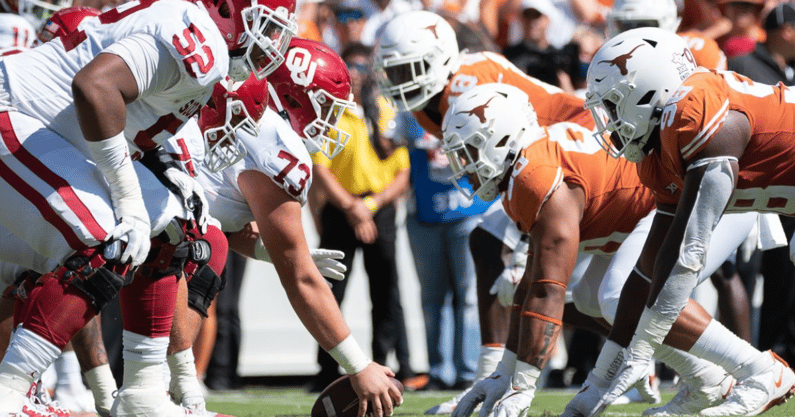
October 10, 1900: The University of Texas and the University of Oklahoma play each other in football for the 1st time, on the Texas campus in Austin. This was 7 years before Oklahoma gained Statehood. Texas wins, 28-2.

The game became an institution, and has several nicknames: The Red River Showdown (the Red River separates the States), the Red River Rivalry, the Red River Classic and the Red River Shootout. It was played in Austin from 1900, 1901, 1902, 1903, 1904, 1907, 1909, 1910, 1911 and 1923; Norman in 1901, 1903 (played twice in those seasons), 1908 and 1922; Oklahoma City in 1905 and 1906; Houston in 1913; and in Dallas every other time, including every season since 1929. A deal has been made to keep the game at the Cotton Bowl through at least 2025.
The fact that it's played in Texas would seem to give the Longhorns an unfair advantage. However, each school gets half the tickets, and it's actually closer to the OU campus in Norman (190 miles) than it is to the UT campus in Austin (197 miles).
As of the 2022 game, Texas' 49-0 win, the biggest blowout in the rivalry's history, Texas leads the rivalry 63-50-5. Oklahoma beat Texas in the 2018 Big 12 Conference Championship Game, which was also played in the Dallas area, but at the Cowboys' new AT&T Stadium in suburban Arlington.
A running joke is that, unlike the Longhorns' rivalries with Texas A&M and Arkansas, and the Sooners' with Oklahoma State and Nebraska, this is a rivalry not for the people but the rich, and that millionaires have bet ranches and oil wells on the outcome, many regretting it.

*

October 10, 1900 was a Wednesday, not a Saturday as is the case for most college football games today. There were other games played that day:

* Columbia and Williams College played to a 0-0 tie at Columbia Field in Manhattan.

* Manhattan College lost to Lafayette College, 11-0 at March Field in Easton, Pennsylvania.

* Princeton beat Penn State, 26-0 at Osborne Field in Princeton, New Jersey.

* Bowdoin College beat Colby College, 68-0 in Brunswick, Maine.

* Harvard beat cross-State Amherst, 18-0 at Soldiers' Field in Boston.

* Yale beat Bates College, 50-0 at Yale Field in New Haven, Connecticut.

* The University of Pennsylvania beat Dickinson College, 35-0 at the original Franklin Field in Philadelphia.

* And Illinois beat Chicago Physicians and Surgeons College, 6-0 at Illinois Field in Champaign, Illinois. CPSC is now part of the University of Illinois system, the University of Illinois College of Medicine.

And there was 1 baseball game played: The Philadelphia Phillies beat the Boston Beaneaters, 5-2 at National League Park in Philadelphia. In 1912, the Boston team of the National League, having gone through several names, settled on "Braves." The following season, the Phillies' ballpark was renamed Baker Bowl.

This was also the birthdate of actress Helen Hayes, known as "The First Lady of the American Theater."

Saturday, September 3, 2022

September 4, 1886: Geronimo Surrenders

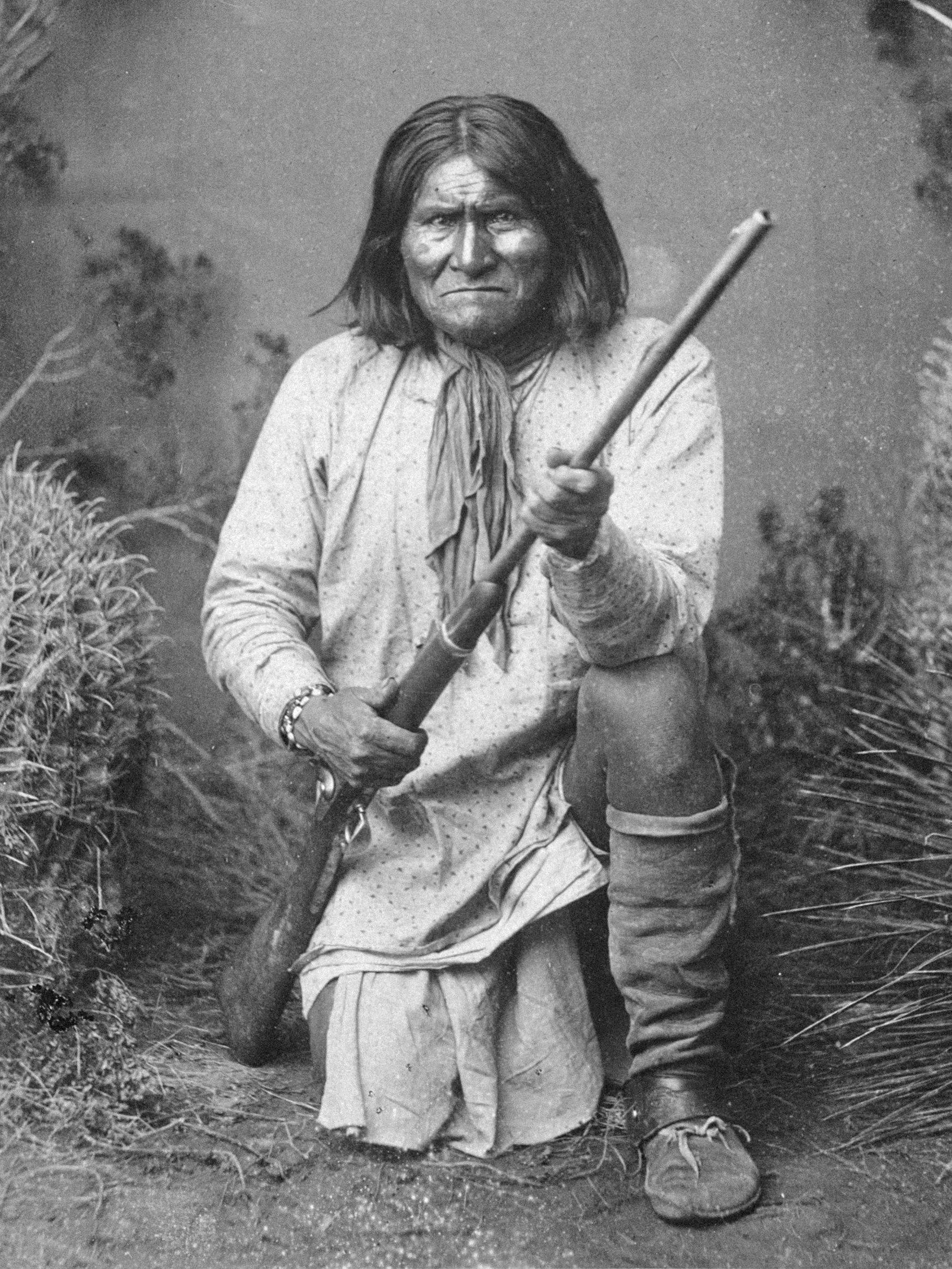
The best-known image of Geronimo, 1887

September 4, 1886: Geronimo surrenders to the U.S. Army. The last great at-large Native American opponent of "the white man" gives up the fight.

He was born to the Apache tribe on June 16, 1829, in No-doyohn Cañon, Arizona, then a part of Mexico, with the name Goyaałé, meaning "The One Who Yawns." No one should be stuck with what he was called as a baby, but he wouldn't have to be.

In 1851, with the Apaches having to move south following the Mexican-American War, they were attacked by the Mexican Army, and another Apache heard a Mexican soldier that Goyaałé was killing yell, ¡Jerónimo!" invoking his patron saint, St. Jerome, for help. The warrior was known as "Geronimo" from then on.

Reservation life was confining to the free-moving Apache people, and they resented restrictions on their customary way of life. Geronimo led breakouts from the reservations, in attempts to return his people to their previous nomadic lifestyle.

While well-known, Geronimo was not a chief of the Bedonkohe band of the Central Apache, but a shaman. However, since he was a superb leader in raiding and warfare, he frequently led large numbers of 30 to 50 Apache men.

In 1886, after an intense pursuit in northern Mexico by American forces that followed his 3rd 1885 reservation breakout, Geronimo surrendered for the last time, at Skeleton Canyon, Arizona, to Lieutenant Charles B. Gatewood. Geronimo and 27 other Apaches were later sent to join the rest of the Chiricahua tribe.

While holding him as a prisoner, the United States capitalized on Geronimo’s fame among non-Indians by displaying him at various fairs and exhibitions. In 1905, the Indian Office provided Geronimo for use in a parade at the Inauguration of President Theodore Roosevelt. He and Geronimo admired each other, as Geronimo admitted in a memoir published later that year.

He died on February 17, 1909, of pneumonia, at the age of 79, at the Army hospital at Fort Sill, Oklahoma, still a prisoner of war, and was buried at the Fort Sill Indian Agency Cemetery, among the graves of relatives and other Apache prisoners of war. He has living descendants today.

In 1939, Victor Daniels, who claimed to be of Cherokee ancestry, acted under the name Chief Thundercloud, and was the 1st actor to play Tonto in a Lone Ranger film, starred in the film Geronimo: The Story of a Great EnemyInspired by the film, U.S. Army paratroopers, testing the practice of parachuting from planes, began a tradition of shouting "Geronimo!" to show they had no fear of jumping out of an airplane.

Geronimo has also been played by John Doucette in the 1958 ABC movie Tombstone Territory, Chuck Connors in the 1962 film Geronimo!, Enrique Lucero in the 1979 CBS miniseries Mr. Horn, and in 2 films in 1993, both with Native American actors in the role: Geronimo, starring Joseph Runningfox; and Geronimo: An American Legend, starring Wes Studi.

*

September 4, 1886 was a Saturday. The only professional team sport in America at the time was baseball. In the National League:

* The New York Giants lost to the Detroit Wolverines, 7-1 at Recreation Park in Detroit.

* The Chicago White Stockings (forerunners of the Cubs) beat the Washington Nationals, 13-6 at West Side Park in Chicago.

* The St. Louis Maroons beat the Boston Beaneaters (forerunners of the Braves), 12-2 at an early version of Sportsman's Park in St. Louis.

* The Philadelphia Quakers (forerunners of the Phillies) beat the Kansas City Cowboys, 3-0 at Association Park in Kansas City.

And in the American Association:

* The New York Metropolitans, nicknamed the Mets, beat the Baltimore Orioles, 6-2 at the Polo Grounds. Neither of these teams has any connection to the teams using those names today.

* The Brooklyn Grays lost to the Philadelphia Athletics, 15-2 at the original Washington Park in Brooklyn.

* The Pittsburgh Alleghenys (forerunners of the Pirates) beat the Cincinnati Red Stockings (forerunners of the Reds, but not connected to the 1869-70 team of the same name), 1-0 at Recreation Park in Pittsburgh.

* The St. Louis Browns (forerunners of the Cardinals) beat the Louisville Colonels, 11-4 at Eclipse Park in Louisville.

Monday, August 8, 2022

August 8, 1952: Bob Neighbors Is Killed In Action


August 8, 1952: Major Robert Neighbors, U.S. Air Force, is shot down over North Korea. He is believed to be the only major league athlete to have been killed in action in the Korean War. He was 34 years old.

Robert Otis Neighbors was born on November 9, 1917 in Talihina, Oklahoma. After playing baseball for a season at Oklahoma Baptist University, he signed with the St. Louis Browns, who had a farm team in the area. He moved up through their system as a power-hitting shortstop, a rarity in those days.

On September 16, 1939, Bob Neighbors made his major league debut. He entered the game as a late-inning defensive replacement, and the Browns lost to the Washington Senators, 4-0 at Griffith Stadium in Washington. (By a twist of fate, his uniform number has been lost to history: Neither Baseball-Reference.com nor Baseball-Almanac.com nor Wikipedia have it recorded, and no surviving photographs reveal it.)

Neighbors played 7 of the Browns' last 17 games, 5 at shortstop and 2 as a pinch-runner. He fielded 12 chances, with 6 assists, 5 putouts, participating in 1 double play, and making only 1 error. He got 2 hits in 11 at-bats, one of them a home run off Denny Galehouse in a 6-2 Browns loss to the Boston Red Sox at Fenway Park. The Browns finished 43-111, the rock-bottom worst finish for the worst franchise in American League history.

(Galehouse would later help the Browns win their only Pennant in 1944, then go back to the Red Sox, and start and lose their 1948 Playoff for the Pennant with the Cleveland Indians. The Browns became the Baltimore Orioles in 1954, and found some success, but their 111 losses as the '39 Browns remained the worst in the franchise's history, until, in 2018, they lost 115. )

Neighbors never played another major league game. He played for the Toledo Mud Hens in the American Association in 1940. In 1941, he married Winifred Wilcox, and played for the San Antonio Missions in the Texas League. That Summer, while the Missions were on the road, "Winnie" was hit by a car and killed.

"It had a bad effect on Bob," his younger brother Morris said later. "Bob was on the road, and Winnie back home in San Antonio when it happened. He felt that if he had been there, if he had a job where he wasn't traveling, it wouldn't have happened." His hitting also seemed to die, as he fell to a .216 batting average. When Pearl Harbor was bombed at the end of the year, he felt he had enough reason to quit baseball, and joined what was then called the U.S. Army Air Corps.

While serving at Maxwell Field in Montgomery, Alabama, he met Katherine "Kitty" Burke, and she became his 2nd wife. He didn't quit baseball entirely, playing for base teams. But when World War II ended, he decided to keep the military as his career, including as player-manager for the Maxwell Field team. In 1947, the Army Air Corps was separated from the Army to become its own branch of the armed forces, the U.S. Air Force. In 1950, Bob became the father of Robert Cameron Neighbors. All seemed well.

Then North Korea invaded South Korea, and President Harry S Truman rallied the United Nations to South Korea's aid. Major Neighbors flew a Douglas Invader with the 13th Bomb Squadron of the 3rd Bomb Group.

On August 8, 1952, he and his crew, also including 1st Lieutenant William Holcom and Staff Sergeant Grady Weeks, flew a night mission over North Korea. They reported being hit by enemy fire, and said they were bailing out. There was no further contact, and they failed to return. They were reported as "Missing In Action" (MIA). After the Truce of Panmunjom ended the war, and all prisoners of war were repatriated, Neighbors, Holcom and Weeks were not among them. It became accepted that they had died in action.

The Browns moved to Baltimore after the 1953 season. The Orioles make no mention of Neighbors in their historical displays at Oriole Park at Camden Yards. Although the St. Louis Cardinals have honored Browns legend George Sisler with a statue outside the new Busch Stadium, and have some Browns memorabilia in their in-park Hall of Fame Museum, they make no mention of Neighbors, either.

By a macabre coincidence, like Neighbors, the only Major League Baseball Player who died in the Korean War, the 2 Major League Baseball players to die in combat in World War II also played very briefly, just in the 1939 season, for teams that no longer exist under the names they used at the time.

Elmer Gedeon, a multi-sport star athlete at the University of Michigan, played 5 games in the outfield for the Washington Senators, and was shot down over France in 1944. Harry O'Neill made 1 appearance as a catcher for the Philadelphia Athletics, and died on Iwo Jima in early 1945.

*

August 8, 1952 was a Friday. These baseball games were played that day:

* The New York Giants lost to the Boston Braves, 2-0 at Braves Field in Boston. Max Surkont pitched a 4-hit shutout, and Bob Thorpe went 3-for-4 with an RBI. Willie Mays was serving in the Korean War, and unavailable to the Giants.

* The Brooklyn Dodgers beat the Philadelphia Phillies, 6-3 at Shibe Park in Philadelphia. Andy Pafko went 2-for-5 with 5 RBIs, including a 3-run home run in the top of the 10th inning, to make a winning pitcher out of Preacher Roe. Jackie Robinson went 1-for-4. Richie Ashburn went 3-for-4 for the Phillies.

* The Pittsburgh Pirates beat the Chicago Cubs, 1-0 at Forbes Field in Pittsburgh. Murry Dickson went the distance and beyond for the Pirates, winning his own game with a single in the bottom of the 10th inning, allowing just 6 hits in his extra-inning shutout.

* The Cincinnati Reds beat the St. Louis Cardinals, 8-5 at Crosley Field in Cincinnati. Stan Musial went 1-for-4.

* The Chicago White Sox swept a doubleheader from the Detroit Tigers, 4-3 and 2-1 at Comiskey Park in Chicago.

* The Cleveland Indians beat the St. Louis Browns, 10-9 at Sportsman's Park in St. Louis. Bob Feller had the worst performance of his Hall of Fame career, getting knocked out of the box in the 1st inning, allowing 6 runs without getting an out. But the Indians came back from an 8-0 2nd inning deficit, as Bill Glynn won it with a home run leading off the top of the 12th inning, to make a winner in relief out of Early Wynn. That's the kind of franchise the Browns were.

* The New York Yankees and the Boston Red Sox were rained out at Yankee Stadium. The game was made up on August 11, and the Yankees won, 7-0. Allie Reynolds pitched a 2-hit shutout. Mickey Mantle hit 2 home runs. Ted Williams was serving in the Korean War, and unavailable to the Red Sox.

* And the Philadelphia Athletics and the Washington Senators were rained out at Griffith Stadium in Washington. The game was made up as part of a doubleheader on September 2, and the Senators swept, 3-2 and 5-0. Jackie Jensen won the opener with a bases-loaded walk in the bottom of the 10th. Mike Fornieles pitched a 1-hit shutout in the nightcap.

Thursday, July 21, 2022

July 21, 1970: Bob Kalsu Is Killed In Action

This photograph was probably taken in preseason.
He wore Number 61 in the regular season,
but I couldn't find a good picture of him with that number.

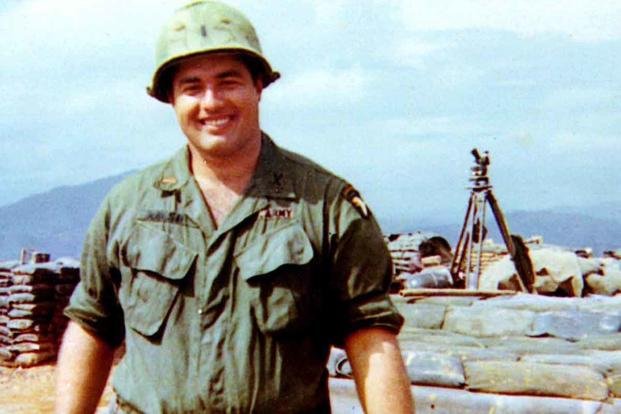
July 21, 1970: Fire Support Base Ripcord, in the A Sầu Valley of South Vietnam, used by the U.S. Army's famed 101st Airborne Division, comes under enemy fire. For his actions, Lieutenant Bob Kalsu was awarded the Bronze Star. But he was killed in the process, at age 25.

Two days later, word reached his wife Jan – mere hours after giving birth to his son, James Robert Kalsu Jr. He also left behind a daughter, Jill.

James Robert Kalsu was born on April 13, 1945, in Oklahoma City. A star guard at the University of Oklahoma, he played for the Buffalo Bills in 1968, 14 games, starting 9 of them, and was named the team's Rookie of the Year. But he enlisted in the U.S. Army to fulfill his collegiate ROTC requirement.
Del City High School, his alma mater in Oklahoma City, named its football stadium for him. Also named for him have been an Army base in Iraq and a replacement company at Fort Campbell in Kentucky, where he had trained. In 2000, on the 50th Anniversary of his death, the Bills inducted him into their team Wall of Fame.

He was the only active athlete, in any American sport, killed in the Vietnam War. In 1998, NFL Films released a feature, interviewing the Kalsu family, and calling him the only NFL player to be killed in service in that war. The company was later informed that this was incorrect: Major Don Steinbrunner, U.S. Air Force, who had played for the Cleveland Browns in 1953, was shot down in 1967.

*

July 21, 1970 was a Thursday. These Major League Baseball games were played that day:

* The New York Yankees beat the Milwaukee Brewers, 4-2 at Yankee Stadium. Stan Bahnsen outpitched Skip Lockwood. The Yankees only got 4 hits, but one was an RBI single by Jerry Kenney. Horace Clarke and Gene Michael each drove in a run with a sacrifice fly, and Thurman Munson did so with a bases-loaded walk. Bahnsen helped himself with a single, and the Yankees also got singles from Danny Cater and Curt Blefary.

* The New York Mets beat the San Diego Padres, 3-0 at San Diego Stadium (later Jack Murphy Stadium and Qualcomm Stadium). Jim McAndrew pitched a 3-hit shutout.

* The California Angels beat the Boston Red Sox, 10-6 at Fenway Park in Boston. Carl Yastrzemski went 3-for-5 with 2 home runs and 4 RBIs, to no avail. Tony Conigliaro went 2-for-4, but, soon, his vision problems would return, ending his valiant comeback.

* The Oakland Athletics beat the Washington Senators, 4-0 at Robert F. Kennedy Memorial Stadium in Washington. Reggie Jackson went 2-for-2 with 2 walks and an RBI.

* The Chicago Cubs beat the Atlanta Braves, 8-2 at Atlanta Stadium (later Atlanta-Fulton County Stadium). Fergie Jenkins went the distance for the win, and helped his own cause with a home run. He was also backed by homers from Ron Santo and Randy Hundley. Hank Aaron went 1-for-3 with an RBI -- but not on a home run.

* The Chicago White Sox beat the Cleveland Indians, 5-3 at Cleveland Municipal Stadium.

* The Baltimore Orioles beat the Kansas City Royals, 2-1 at Kansas City Municipal Stadium. Brooks Robinson went 1-for-4. Frank Robinson did not play.

* The Detroit Tigers beat the Minnesota Twins, 5-2 at Metropolitan Stadium in the Minneapolis suburb of Bloomington, Minnesota. Al Kaline went 1-for-3 with a walk. Harmon Killebrew went 0-for-4. Rod Carew did not play.

* The Cincinnati Reds beat the St. Louis Cardinals, 6-5 at Busch Memorial Stadium in St. Louis. Pete Rose went 0-for-5. Johnny Bench drove in a run as a pinch-hitter, and finished the game, unusually, in left field. Lou Brock went 2-for-4 with a walk and a stolen base. Joe Torre went 3-for-5 with an RBI.

* The Houston Astros beat the Pittsburgh Pirates, 3-1 at the Astrodome in Houston. Roberto Clemente and Willie Stargell both went 1-for-4.

* The Montreal Expos beat the Los Angeles Dodgers, 5-2 at Dodger Stadium in Los Angeles.

* And the Philadelphia Phillies beat the San Francisco Giants, 9-6 at Candlestick Park in San Francisco. Rick Wise outpitched Juan Marichal. Willie Mays only appeared as a pinch-hitter, and drew a walk.

Tuesday, May 31, 2022

May 31, 1921: The Tulsa Race Massacre

May 31, 1921: The Tulsa Race Massacre begins, and continues into the next day. Mobs of White residents, some of them deputized and given weapons by city officials, attacked Black residents and destroyed homes and businesses of the Greenwood District in Tulsa, Oklahoma. The attacks burned and destroyed more than 35 square blocks of the neighborhood – at the time one of the wealthiest Black communities in the United States, known as "Black Wall Street."

More than 800 people were admitted to hospitals, and as many as 6,000 Black residents of Tulsa were interned in large facilities, many of them were interned for several days. The Oklahoma Bureau of Vital Statistics officially recorded 36 dead. The actual death toll may have been as high as 300.

The massacre began when 19-year-old Dick Rowland, a Black shoeshiner, was accused of assaulting Sarah Page, the 17-year-old White elevator operator in the nearby Drexel Building. He was taken into custody. After he was arrested, rumors which stated that he was going to be lynched were spread throughout the city.

Upon hearing reports that a mob of hundreds of White men had gathered around the jail where Rowland was being held, a group of 75 Black men, some of whom were armed, arrived at the jail in order to ensure that Rowland would not be lynched. The sheriff persuaded the group to leave the jail, assuring them that he had the situation under control.

An old white man approached O.B. Mann, a Black man, and demanded that he hand over his pistol. Mann refused, and the old man attempted to disarm him. Mann shot him, and then, according to the sheriff's reports, "all hell broke loose." At the end of the exchange of gunfire, 12 people were dead, 10 White and 2 Black. Subsequently the militants fled back into Greenwood shooting as they went. White rioters invaded Greenwood that night and the next morning, killing men and burning and looting stores and homes. Around noon on June 1, the Oklahoma National Guard imposed martial law, ending the massacre.

About 10,000 Black people were left homeless, and property damage amounted to more than $1.5 million in real estate and $750,000 in personal property, equivalent to $32.7 million today. Many survivors left Tulsa, while Black and White residents who stayed in the city largely kept silent about the terror, violence, and resulting losses for decades.

The massacre was largely omitted from local, state and national histories. Growing up white in a mostly-white suburb in the 1970s and '80s, I didn't learn about it until around 2000 or so. With the growth of the Black Lives Matter movement in the early 21st Century, the event has re-entered the national consciousness, including as a plot point in the 2017 TV miniseries version of Watchmen.

*

May 31, 1921 was a Tuesday. It was the off-season for the NFL and the NHL. The NBA had not yet been founded. But a full slate of Major League Baseball games was played that day:

* The New York Yankees lost to the Washington Senators, 12-5 at Griffith Stadium. Waite Hoyt did not have good stuff, and allowed 7 runs in the 2nd inning. Tom Zachary went the distance for the Senators, despite giving up a home run to Babe Ruth in the 9th. In 1927, Ruth would hit a much more significant home run off Zachary, his 60th of the season.

* The New York Giants lost to the Philadelphia Phillies, 10-5 at the Polo Grounds.

* The Brooklyn Dodgers beat the Boston Braves, 4-2 at Braves Field in Boston.

* The Boston Red Sox swept a doubleheader from the Philadelphia Athletics, at Shibe Park in Philadelphia. The Sox won the opener 5-3, and the nightcap 8-4.

* The Chicago Cubs beat the Pittsburgh Pirates, 7-6 in 12 innings, at Forbes Field in Pittsburgh.

* The Cincinnati Reds beat the St. Louis Cardinals, 6-5 in 10 innings, at Redland Field (later renamed Crosley Field) in Cincinnati.

* The Cleveland Indians beat the Detroit Tigers, 7-4 at Navin Field in Detroit. This ballpark would be renamed Briggs Stadium in 1938 and Tiger Stadium in 1961.

* And the St. Louis Browns beat the Chicago White Sox, 8-7 at Comiskey Park in Chicago. 

Sunday, May 15, 2022

May 15, 1963: The Flight of Gordon Cooper

May 15, 1963: Gordon Cooper is launched into space aboard Faith 7. It is the last mission of Project Mercury.

Leroy Gordon Cooper Jr. was born on March 6, 1927 in Shawnee, Oklahoma. Like his father before him, "Gordo" rose to the rank of Colonel in the U.S. Air Force. He did not see action in either World War II or the Korean War, but he became one of the USAF's top test pilots, enabling him to be chosen as one of the Mercury 7, the 1st 7 American astronauts, in 1959.

On May 15, 1963, he was launched from Cape Canaveral, Florida aboard Mercury 9, the mission also known as Faith 7. He circled the Earth 22 times, and reached a height of 166 miles. This makes him, to this day, the human being who has traveled the furthest from the surface of the Earth alone. (The Apollo missions to the Moon had 3 men each.)

He later flew on Gemini 5, and later helped the Walt Disney Company design the EPCOT Center. He was also one of the few astronauts to have claimed to have seen what he thought was an alien spacecraft. In the 1983 film The Right Stuff, he was played by Dennis Quaid. He died on October 4, 2004, at the age of 77.

*

May 15, 1963 was a Wednesday. These baseball games were played that day:

* The New York Yankees beat the Minnesota Twins, 4-3 at Yankee Stadium. The Yankees scored 2 runs in the bottom of the 8th to come from behind, making Bill Stafford a winning pitcher in relief of Ralph Terry. Mickey Mantle went 2-for-4 with a home run and 2 RBIs. Yogi Berra and Roger Maris did not play. Harmon Killebrew went 1-for-4. Four months later, on September 15, in Minnesota, the Yankees would beat the Twins again, to clinch the American League Pennant.

* The New York Mets beat the Houston Colt .45s, 7-4 at Colt Stadium in Houston. The Colts became the Astros in 1965. Ron Hunt went 3-for-5 with an RBI for the Mets. Al Jackson went the distance for the win.

* The Boston Red Sox swept a doubleheader from the Los Angeles Angels, 9-3 and 7-6 at Fenway Park in Boston. Dick Stuart hit home runs in each game, but the 1st baseman so bad a fielder than he was known as "Dr. Strangeglove" and "Stonefingers" also made an error in each game. Carl Yastrzemski went 1-for-9 with an RBI.

* The Baltimore Orioles beat the Washington Senators, 7-1 at District of Columbia Stadium (later renamed Robert F. Kennedy Stadium) in Washington. Brooks Robinson went 1-for-3.

* The Cleveland Indians beat the Kansas City Athletics, 1-0 at Cleveland Municipal Stadium.

* The Chicago White Sox beat the Detroit Tigers, 7-4 at Comiskey Park in Chicago. Al Kaline went 0-for-4.

* The Cincinnati Reds beat the Chicago Cubs, 10-2 at Wrigley Field in Chicago. Yes, both Chicago teams were at home on the same day. Frank Robinson went 3-for-4 with a walk and 3 RBIsl Rookie Pete Rose went 3-for-5 with a walk and 2 RBIs. Ernie Banks went 0-for-3 with a walk.

* The Milwaukee Braves beat the St. Louis Cardinals, 9-3 at Milwaukee County Stadium. Hank Aaron went 0-for-3 with a walk. Stan Musial, in his final season as a player, did not get into the game.

* The Los Angeles Dodgers beat the Philadelphia Phillies, 3-2 at Dodger Stadium in Los Angeles. Ron Fairly singled Jim Gilliam home with the winning run in the bottom of the 12th inning. Sandy Koufax pitched all 12 innings and got the win.

* And the San Francisco Giants beat the Pittsburgh Pirates, 4-3 at Candlestick Park in San Francisco. Willie Mays went 1-for-4. So did Roberto Clemente, and he also had an RBI.

Tuesday, April 26, 2022

April 26, 1940: Woody Guthrie Records "Dust Bowl Ballads"

April 26, 1940: Woody Guthrie records the album Dust Bowl Ballads at RCA Victor studios, at 155 East 24th Street in Manhattan.

The "Dust Bowl" was a series of wind storms that produced "black blizzards" across the entire sweep of the Great Plains, from Canada south to Texas. The dust storms caused extensive damage, and appeared to turn the day to night. Witnesses reported that they could not see 5 feet in front of them at certain points.

Dust Bowl conditions fomented an exodus of the displaced from the Texas Panhandle, the adjoining Oklahoma Panhandle, and the surrounding Great Plains to adjacent regions. More than 500,000 Americans were left homeless. More than 350 houses had to be torn down after one storm alone. The severe drought and dust storms had left many homeless; others had their mortgages foreclosed by banks, or felt they had no choice but to abandon their farms in search of work.

Many Americans migrated west looking for work. Parents packed up "jalopies" with their families and a few personal belongings, and headed west in search of work. In particular, residents of Oklahoma and Arkansas -- "Okies" and "Arkies" -- headed west on U.S. Route 66, which became known as "The Mother Road," for California, "the land of milk and honey," hearing of jobs available picking fruits and vegetables. These jobs proved to be worse than farming, as they were no longer their own bosses, and the bosses were brutal until the labor unions came in.

The Plains States lost about 3.5 million people in the 1930s. More migrants arrived in California in 1936 than in any other year, including the Gold Rush year of 1849.

Guthrie, a native of Okemah, Oklahoma, then 27 years old, recorded Dust Bowl Ballads, one of the earliest "concept albums." It was 12 songs, 6 songs to a side, and if that wasn't enough symmetry -- not that he was going for it, on purpose -- the total length is 36 minutes and 36 seconds.

Side 1: "Talkin' Dust Bowl Blues," "Blowing Down This Road," "Do Re Mi" (not the traditional "scales" song, or the song that would later appear in the musical The Sound of Music), "Dust Can't Kill Me," "Tom Joad-Part 1" and "Tom Joad-Part 2," tributes to the lead character of John Steinbeck's novel about the Dust Bowl, The Grapes of Wrath, whose film version had been released 3 months earlier.

Side 2: "The Great Dust Storm," "Dusty Old Dust" (a.k.a. "So Long, It's Been Good to Know Yuh"), "Dust Bowl Refugee," "Dust Pneumonia Blues," "I Ain't Got No Home In This World Anymore," and "Vigilante Man."

All songs were written by Guthrie himself, although he got help on "Blowing Down This Road" from Lee Hays of The Weavers.

Recorded for the album, but not included on it until a 1964 reissue, was "Pretty Boy Floyd," which recasts the vicious bank robber Charles Arthur Floyd, gunned down by FBI agents in 1934, as a misunderstood hero of poor people, a Robin Hood type. In that song, Woody wrote:

Yes, as through this world I've wandered
I've seen lots of funny men.
Some will rob you with a six-gun
and some with a fountain pen.

In 1969, Mario Puzo would agree with him, writing in The Godfather, "A lawyer with his briefcase can steal more than a hundred men with guns."

But Woody followed with:

And as through your life you travel
yes, as through your life you roam
you won't never seen an outlaw
drive a family from its home.

In 1981, Bruce Springsteen, heavily influenced by Guthrie, would disagree with him, writing in "Atlantic City":

Well, they blew up the Chicken Man in Philly last night.
And they blew up his house, too. 

*

April 26, 1940 was a Friday. It turned out to be a big day in music for another reason: Giorgio Moroder was born. Unfortunately, he turned his music production talents to a form of music I can't stand, becoming known as "The Father of Disco."

These baseball games were played:

* The New York Yankees lost to the Boston Red Sox, 8-1 at Fenway Park. Emerson Dickman outpitched Monte Pearson. Jimmie Foxx went 1-for-3 with a walk and an RBI. Ted Williams went 0-for-4 with a walk. Joe DiMaggio did not play.

* The New York Giants beat the Boston Bees, 5-3 at the Polo Grounds. Cliff Melton was the winning pitcher, in relief of Carl Hubbell. Mel Ott went 0-for-2 with 2 walks. The next season, the Bees went back to their 1912-1935 name, the Boston Braves.

* The Brooklyn Dodgers beat the Philadelphia Phillies, 6-0 at Shibe Park in Philadelphia. Freddie Fitzsimmons pitched a 7-hit shutout. Harry "Cookie" Lavagetto went 3-for-4 with a home run, a walk, and 4 RBIs.

* The Washington Senators beat the Philadelphia Athletics, 8-6 at Griffith Stadium in Washington.

* The Pittsburgh Pirates beat the St. Louis Cardinals, 10-4 at Forbes Field in Pittsburgh. Paul Waner went 1-for-3 with a walk. Lloyd Waner went 1-for-5.

* The Chicago White Sox beat the Cleveland Indians, 11-1 at League Park in Cleveland.

* The Chicago Cubs beat the Cincinnati Reds, 6-2 at Wrigley Field in Chicago.

* And the Detroit Tigers and the St. Louis Browns were rained out at Sportsman's Park in St. Louis. The game was made up as part of a doubleheader on June 29. The Tigers won the opener, 9-5. The nightcap was called due to darkness after 9 innings, tied 9-9. Over the 2 games, Hank Greenberg went 2-for-7 with a home run, 3 walks, and 5 RBIs.

December 31, 1999 & January 1, 2000: The Millennium

December 31, 1999:  The Millennium arrives. The people of planet Earth survived. At a terrible cost. But we hadn't destroyed ourselves. ...