Showing posts with label venezuela. Show all posts

Thursday, June 2, 2022

June 2, 1943: The Death of Nile Kinnick

June 2, 1943: Ensign Nile Kinnick is killed in a U.S. Navy training flight. He was a month short of his 25th birthday.

Nile Clarke Kinnick Jr. was born on July 9, 1918 in Adel, Iowa, the grandson of George Clarke, a Republican who served as Governor of Iowa from 1913 to 1917. His family were devout Christian Scientists, and, while Nile Jr. was already a sports star at Adel High School, Nile Sr. got a job in Omaha, Nebraska, and the family had to move. At Benson High School, he won a State Championship in baseball, and starred in basketball.

But his best sport was football, and he chose to attend the University of Iowa, supposedly because their program, then in a down period, would represent a better test for him than his other major option, the University of Minnesota, then one of the best programs in the country -- and Iowa's arch-rival.

Iowa still struggled, going just 1-7 in his sophomore year, 1937. (Freshmen were not eligible for varsity sports under NCAA rules until 1972, with occasional exceptions, such as during the upcoming World War II.) They went 1-6-1 in 1938. Head coach Irl Tubbs was fired, and Eddie Anderson was lured away from Holy Cross in Massachusetts.

He turned the team around in just 1 year: Iowa went 6-1-1, beating South Dakota and Indiana at home, losing away to Michigan, then winning away to Wisconsin and Purdue, beating then-Number 3 Notre Dame and then-Number 20 Minnesota at home, rising to Number 9 in the country, before closing the season with a tie away to Northwestern.

The loss to Michigan cost Iowa the Big Ten Conference title, throwing it to Ohio State, whom Iowa did not play. They did not receive an invitation to a bowl game. But the Notre Dame game became their signature win, and it was recognized as Kinnick's signature performance, scoring Iowa's only touchdown and pinning Notre Dame deep in their own end zone with a late punt, to secure a 7-6 win.

Kinnick was awarded the Heisman Trophy. In his acceptance speech, he said:, "I thank God I was warring on the gridirons of the Midwest, and not on the battlefields of Europe. I can speak confidently and positively that the players of this country would much more, much rather struggle and fight to win the Heisman award than the Croix de Guerre." Another writer cited a pair of famed speechmakers from classical times, saying that his remarks "tackled Demosthenes and threw Cicero for a 15-yard loss."

He was elected student body president, maintained a grade-point average of 3.4, and gave the commencement address for his Class of 1940. That Summer, he played for the College All-Stars in the Chicago College All-Star Game at Soldier Field, losing to the defending NFL Champion Chicago Bears, 45-28.

But he never played football again. The NFL version of the Brooklyn Dodgers drafted him, but he turned down a $10,000 salary to go to the University of Iowa College of Law. He also served as an assistant coach at Iowa in the 1940 and '41 seasons, as the team went 4-4 and 3-5, respectively.

He spoke before the Young Republicans, and introduced Wendell Willkie, the 1940 Republican nominee for President, at an Iowa campaign rally. An Iowa newspaper, the Marion Sentinel, endorsed him for the 1956 Presidential election, the 1st in which he would be eligible, having met the minimum age requirement of 35.

He enlisted in the U.S. Naval Reserve, and reported for induction -- 3 days before the Japanese attack on Pearl Harbor. He received leave to visit his family in Omaha in September 1942, and attended Iowa's season opener, at home at Iowa Stadium in Iowa City, a 26-7 win over Washington University of St. Louis.
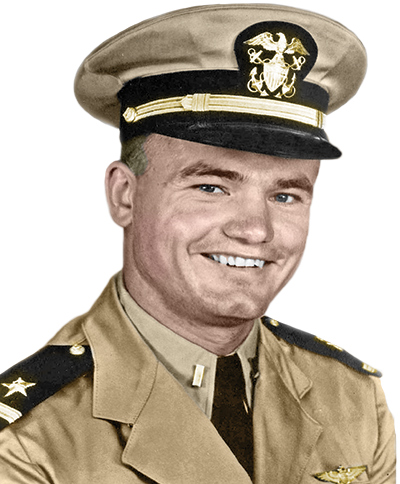
On June 2, 1943, Ensign Nile Kinnick was stationed aboard the aircraft carrier USS Lexington, off the coast of Venezuela. He was on a routine training flight in a Grumman F4F Wildcat, when it developed an oil leak. Radio contact was made, determining that he was 4 miles from the carrier, and was forced to carry out an emergency landing in the water. Rescue boats arrived 8 minutes later, but they found only an oil slick.

His body was never recovered. It took until 1996 for the plane to be found but, given that he might have still been inside, it was decided not to disturb the site.

A legend developed that the deck of the Lexington was covered with planes preparing to take off, and that trying to land on it would have caused an explosion that would have killed many of his crewmates, so Kinnick sacrificed himself to save them. The Navy later determined that it wouldn't have mattered: He couldn't have reached the carrier anyway, so the choice was out of his hands.

With the award's establishment in 1935, he was the 1st winner of the Heisman Trophy to die. There wouldn't be another until 1963, when 1961 winner Ernie Davis of Syracuse died from leukemia.

For nearly 30 years, Nile Kinnick Sr., having outlived his son, refused all requests by the University of Iowa to honor his son, not wanting to single him out over all other students who died in World War II. Finally, in 1972, he consented to the renaming of Iowa Stadium, which opened in 1929, as Kinnick Stadium. It remains the only stadium in American college football named for a Heisman Trophy winner. A statue of Kinnick was placed outside in 2006. His Number 24 was retired. The school plays an excerpt from his Heisman Trophy acceptance speech at every home game, before playing the National Anthem.

The coin flipped at the start of every Big Ten football game bears his image. He was a charter inductee into the Iowa Sports Hall of Fame in 1951. That same year, he was elected to the College Football Hall of Fame. In 1999, Sports Illustrated named him Iowa's 3rd-greatest sports figure, behind only wrestler and wrestling coach Dan Gable, and Cleveland Indians pitcher Bob Feller, who had been on a youth baseball team with Kinnick.

Feller, also a U.S. Navy veteran, went to his grave believing that, had he lived, Kinnick would have been elected Governor of Iowa, and would have beaten John F. Kennedy in the 1960 Presidential election.

*

June 2, 1943 was a Wednesday. These baseball games were played that day:

* The New York Yankees lost to the Chicago White Sox, 2-1 at Yankee Stadium.

* The New York Giants lost to the Cincinnati Reds, 13-6 at Crosley Field in Cincinnati. Mel Ott went 1-for-4.

* The Brooklyn Dodgers beat the St. Louis Cardinals, 3-2 at Sportsman's Park in St. Louis. Stan Musial went 1-for-1 with 3 walks.

* A doubleheader was split at Fenway Park in Boston, and both games went to extra innings, not an easy feat given that Fenway didn't get lights until 1947. The St. Louis Browns won the opener, 7-4. Chet Laabs, Frankie Hayes and George McQuinn all singled home runs in the top of the 12th inning. The Boston Red Sox won the nightcap, 3-2. Jim Tabor tripled home the winning run in the bottom of the 10th.

* The Detroit Tigers beat the Philadelphia Athletics, 7-2 at Shibe Park in Philadelphia.

* The Washington Senators beat the Cleveland Indians, 13-1 at Griffith Stadium in Washington.

* The Pittsburgh Pirates beat the Boston Braves, 3-2 at Forbes Field in Pittsburgh.

* And the Philadelphia Phillies beat the Chicago Cubs, 6-5 at Wrigley Field in Chicago.

Wednesday, May 25, 2022

May 25, 2008: Omar Vizquel Breaks the Record for Games Played at Shortstop

May 25, 2008: The Florida Marlins sweep a doubleheader from the San Francisco Giants, 8-6 and 5-4 at Dolphin Stadium (now Hard Rock Stadium) in Miami Gardens, Florida. It is a bad day for veteran shortstop Omar Vizquel, as he goes 0-for-7 with a walk for the Giants over the 2 games.

But it is still an important day for him, as he plays in his 2,582nd and 2,583rd career games as a shortstop. That ties and then breaks the record for most games played at the position, set by Luis Aparicio.

Both men were from Venezuela. Aparicio starred in the major leagues from 1956 to 1973, mostly for the Chicago White Sox. His slick fielding, contact hitting and quick baserunning were emblematic of the "Go-Go White Sox" won won the American League Pennant in 1959. In 1966, with the Baltimore Orioles, he won the World Series for the only time in his career. He was a 13-time All-Star and a 9-tie Gold Glove winner, collecting 2,677 hits and stealing 506 bases. In 1984, Aparicio became the 1st native of South America elected to the Baseball Hall of Fame.

Vizquel debuted with the Seattle Mariners in 1989, and was best known for his fielding with the Cleveland Indians. He helped them win the AL Pennant in 1995 and 1997. He collected 2,877 hits and stole 404 bases. He last played in 2012, with the Toronto Blue Jays.

He had the misfortune to play the same position, in the same League, at the same time as Cal Ripken Jr., Derek Jeter, Alex Rodriguez and Nomar Garciaparra, before Ripken and "A-Rod" each switched to 3rd base. As a result, he only made 3 All-Star Games, but he won 11 Gold Gloves.

Vizquel became eligible for in the Baseball Hall of Fame in 2018. As of 2022, he has not been elected, due to allegations of domestic violence. He remains the all-time leader in games played at shortstop, with 2,709. Jeter is now 2nd, with 2,674.

*

May 25, 2008 was a Sunday. These other games were played in Major League Baseball:

* The New York Yankees beat the Seattle Mariners, 6-5 at Yankee Stadium. The Yankees scored 4 runs in the bottom of the 8th to come from behind, making a winning pitcher of Edwar Ramírez in relief of Chien-Ming Wang. Derek Jeter went 1-for-3 with a walk and an RBI. Alex Rodriguez went 1-for-2 with 2 walks.

* The New York Mets lost to the Colorado Rockies, 4-1 at Coors Field in Denver. Aaron Cook outpitched John Maine.

* The Washington Nationals beat the Milwaukee Brewers, 7-6 at Nationals Park in Washington.

* The Arizona Diamondbacks beat the Atlanta Braves, 9-3 at Turner Field (now Center Parc Stadium) in Atlanta. Micah Owings outpitched Tom Glavine.

* The Tampa Bay Rays beat he Baltimore Orioles, 5-4 at Tropicana Field in St. Petersburg, Florida.

* The Toronto Blue Jays beat the Kansas City royals, 3-1 at the Rogers Centre in Toronto.

* The Pittsburgh Pirates beat the Chicago Cubs, 6-5 at PNC Park in Pittsburgh. Jason Bay singled Chris Gomez home with the winning run in the bottom of the 11th inning.

* The Texas Rangers beat the Cleveland Indians, 2-1 at Progressive Field in Cleveland. Ramón Vázquez singled Jarrod Saltalamacchia home with the winning run in the top of the 10th inning.

* The Minnesota Twins beat the Detroit Tigers, 6-1 at Comerica Park in Detroit.

* The Chicago White Sox beat the Los Angeles Angels, 3-2 at U.S. Cellular Field (now Rate Field) in Chicago.

* The Philadelphia Phillies beat the Houston Astros 15-6 at Minute Maid Park (now Daikin Park) in Houston. The Phils scored 5 runs in the 6th inning and 6 in the 7th. Geoff Jenkins, Pat Burrell and Chase Utley hit home runs.

* The San Diego Padres beat the Cincinnati Reds, 12-9 at Petco Park in San Diego. Each team scored a run in the 9th. Each team scored 2 in the 11th. Finally, in the bottom of the 18th inning, Adrián González hit a game-winning home run.

* The Los Angeles Dodgers beat the St. Louis Cardinals, 4-3 at Dodger Stadium in Los Angeles. This one needed "only" 10 innings, before Andre Ethier singled Juan Pierre home with the winning run.

* And the Oakland Athletics beat the Boston Red Sox, 6-3 the McAfee Coliseum (as the Oakland Coliseum was then known). David Ortiz cheated his way to a home run.

Football was out of season. The Stanley Cup Finals were between Games 1 and 2. The Detroit Red Wings went on the beat the Pittsburgh Penguins in 6 games. There was 1 game in the NBA Playoffs: The San Antonio Spurs beat the Los Angeles Lakers, 103-84 at the AT&T Center (now the Frost Bank Center) in San Antonio.

Friday, May 13, 2022

May 13, 1958: The Nixons Are Attacked In Caracas

May 13, 1958: A goodwill tour of South America fails to generate goodwill, as a motorcade containing Richard Nixon, then Vice President of the United States, and his wife, Pat Nixon, is attacked by demonstrators in Caracas, the capital of Venezuela.

recent worldwide drop in commodity prices that badly affected South American economies, coupled with increasing Soviet overtures in the Western Hemisphere, led President Dwight D. Eisenhower to decide that a tour by a major U.S. functionary was necessary to demonstrate U.S. commitment to the region. Nixon retrospectively wrote that he didn't want to take the trip; but, as a good soldier for the old General, he did it anyway.

The tour was to see the Nixons visit every independent country in South America except Brazil, which he had visited the year before; and Chile, whose leadership were scheduled to be out of the country during the time period of the visit, making a visit there all but pointless.

The tour began in Uruguay on April 28. Although there were some protestors, for the most part, the visit to that country was a success. In Argentina, the Nixons attended the inauguration of President Arturo Frondizi. And in Lima, the capital of Peru, things started out well. The Vice President shook hands with students at the University of San Marcos. But others started throwing rocks, and one grazed Nixon's neck. As his Secret Service protection got him out, another rock hit him in the face.

When he got to his next stop, in Quito, the capital of Ecuador, he received a diplomatic cable from Eisenhower:
Dear Dick: Your courage, patience and calmness in the demonstration directed against you by radical agitators have brought you new respect and admiration in our country. I am certain that the vast majorities of citizens both in Peru and in the United States deplore the incident caused by a few. I note with satisfaction that the Peruvian Government has already expressed to you its regret. Indeed, I feel that every participant in the mob will finally come to feel a sense of guilt and embarrassment because of his failure to show toward a friendly visitor the ordinary measure of courtesy and hospitality. Give my love to Pat and warm regards to yourself.
Better crowds greeted Nixon in Quito, and in Bogotá, the capital of Colombia, where he laid a wreath at a statue of the country's 1st President, the man regarded as the liberator of South America, Simón Bolívar. So far, the incident in Lima could be written off as an anomaly. And had that been the worst of it, the moment would still have been noted in the American media, but it would have relatively minor.

It was on to Caracas -- ironically, Bolívar's birthplace, and also his burial place. Earlier in the year, Venezuela had overthrown its U.S.-backed right-wing dictator, Marcos Evangelista Pérez Jiménez, and the U.S. gave him safe haven. (Later, he was taken in by the fascist regime of Francisco Franco in Spain, where he lived until his death in 2001.) A leftist Admiral, Wolfgang Enrique Larrazábal, became provisional President, but lost the subsequent election to former President Rómulo Ernesto Betancourt, who had U.S. backing.

Therefore, the people of Venezuela were seriously split on whether they liked America in general, or Nixon in particular. Nixon would campaign for President in 1960 -- and, as it turned out, in 1968 and 1972 -- as a middle-of-the-road politician, conservative in the traditional sense but not as a radical right-winger. But from his 1st campaign for Congress in 1946 through 1958, his image, both at home and abroad, was as a hard-right anti-Communist, opposed to organized labor, although civil rights leaders had reason to consider him sympathetic to their cause.

Still, there was concern going into his visit to Caracas. The Municipal Council passed a resolution effectively declaring him persona non grata. As with President John F. Kennedy's visit to Dallas in 1963, there were people recommending that he skip Venezuela, including the CIA station chief there, the U.S. Ambassador to the country, and embassy staff.

But, as Nixon would later tell the nation, he had never been a quitter. He went forward. There was already a demonstration at the airport when he landed, and the national and local police had a hard time keeping it away from him. People tried to spit on Nixon, including with tobacco.

As the Nixons traveled by motorcade through Caracas, the vehicle carrying them was slowed to a crawl by heavy traffic. A crowd of several hundred people rushed to the car, stoning it, and banging on the windows with their fists. When the mob began rocking the car back and forth in an attempt to overturn it, Secret Service agents, believing the Vice President's life was in jeopardy, drew their firearms, and prepared to begin shooting into the crowd. Nixon ordered Secret Service agent-in-charge Jack Sherwood to hold fire and shoot only on his orders. No shots were fired.

Nixon would later recount that Venezuelan Foreign Minister Óscar García Velutini, who was traveling with him, was "close to hysterics," and kept repeating "This is terrible, this is terrible." According to Nixon, Velutini explained the police inaction was because the Communists "helped us overthrow Pérez Jiménez and we are trying to find a way to work with them."

Nixon's longtime secretary, Rose Mary Woods, who would still be with him at the end in 1974, was injured by flying glass when the windows of the car in which she was riding, following Nixon, were smashed. Vernon Walters, then a mid-ranking U.S. Army officer serving as Nixon's translator, and later to be a Lieutenant General and the U.S. Ambassador to the United Nations, ended up with a "mouthful of glass." Velutini was also hit by shards of the limousine's supposedly "shatter-proof" glass.

Sources differ as to whether a path for the car was cleared by the Caracas police, the Venezuelan Army, or the U.S. press corps' flatbed truck. The Nixons made it to the U.S. Embassy, and the Army and the U.S. Marine Corps (which is traditionally in charge of guarding U.S. Embassies) gave the building a heavier guard than usual. Nixon met with members of the ruling junta, who formally apologized for the disruption.

Eisenhower was furious at the attack on Nixon, and, at one point, told his staff, "I am about ready to go put my uniform on." He sent the aircraft carrier USS Tarawa to the Venezuelan coast, and Nixon's planned laying of a wreath at Bolívar's tomb was canceled. He and his wife left Caracas 7 hours earlier than previously planned, took the same route back to the airport, with the Army having cleared the streets, and safely flew back to Puerto Rico.

Eisenhower, seen by most Americans as being above taking a personal approach to things, did so on this occasion, directing the reception for the Nixon party's return. The Nixons deplaned before a cheering crowd of 10,000 people, including the Congressional leadership, and Ambassadors from most Latin American countries. "Ike" personally greeted Nixon at the airport, and the two then traveled to the White House along a route lined by 100,000 people. Nixon recommended decorations for all 12 of his protection agents, and Ike agreed without hesitation.

Most news sources praised Nixon's courage under fire, and said that, rather than making him look weak, his having gone through the attack unscathed would help him should he choose to run for President in 1960. The usually liberal magazine The New Republic demurred, suggesting the attack was what would now be called a "false flag operation," staged and designed to help him in said election.

Watching what happened to Nixon on television, Kennedy, then running for re-election as U.S. Senator from Massachusetts, and preparing to run for the Democratic Party's nomination for President in 1960, which would put him on a collision course with Nixon, he told his brother and campaign manager, Robert F. Kennedy, "I'd like to think it was just his personality."

But he also knew that the demonstrators had a point: Under the Eisenhower-Nixon Administration, America hadn't exactly observed what Franklin Roosevelt had called a "Good Neighbor Policy." JFK asked his advisors, "If we offer the Third World freedom, and the Communists offer them food, who do you think they're going to side with?" This led to, among other things, the Kennedy campaign's stressing of foreign policy considerably more than domestic policy; and, once in office, the Alliance for Progress, aimed at improving relations with Latin America.

Needing something to do after leaving the Vice Presidency, and not being President, Nixon wrote a memoir about his political experiences to that point. He titled it Six Crises. In addition to the 1958 trip to South America, he included the Alger Hiss case, what became known as the Checkers Speech, his role as "Acting President" after Eisenhower's 1955 heart attack, his "Kitchen Debate" with Nikita Khrushchev in 1959, and his loss to Kennedy in 1960.

*

May 13, 1958 was a Tuesday. These baseball games were played:

* The New York Yankees beat the Baltimore Orioles, 3-0 at Yankee Stadium. Don Larsen pitched a 4-hit shutout, and helped his own cause with a home run. Mickey Mantle went 1-for-4, Yogi Berra went 0-for-4, and Norm Siebern went 3-for-4.

For the Orioles, Brooks Robinson went 1-for-4. Clifford "Connie" Johnson was the losing pitcher. He pitched in the Negro Leagues from 1940 to 1948, the previously all-white minor leagues until 1953, and then in the previously all-white majors until 1958. In 1990, Johnson would be interviewed, alongside his former Kansas City Monarchs teammate Alfred "Slick" Surratt, who did not reach the major leagues, for their Negro League experiences, by documentarian Ken Burns for his miniseries Baseball.

* The Philadelphia Phillies beat the Milwaukee Braves, 5-2 at Connie Mack Stadium in Philadelphia. Robin Roberts went the distance for the win. Hank Aaron hit a home run. There was plenty more where that came from.

* The Boston Red Sox beat the Washington Senators, 9-8 at Griffith Stadium in Washington. Ted Williams went 1-for-1... with 3 walks. 

* The Pittsburgh Pirates beat the Cincinnati Redlegs (as the Reds were known from 1953 to 1959), 6-3 at Forbes Field in Pittsburgh. Roberto Clemente went 0-for-4, but Bill Mazeroski went 3-for-3 with a home run and a walk. Frank Robinson went 2-for-5.

* The Detroit Tigers beat the Cleveland Indians, 11-1 at Briggs Stadium in Detroit. (It was renamed Tiger Stadium in 1961.) Al Kaline went 0-for-4. The lone Cleveland run came on a home run by Roger Maris.

* The St. Louis Cardinals beat their arch-rivals, the Chicago Cubs, 5-3 at Wrigley Field in Chicago. For the Cubs, Ernie Banks went 0-for-3, but had an RBI on a sacrifice fly. For the Cardinals, Stan Musial singled as a pinch-hitter, to collect his 3,000th career hit. It was the 1st major baseball milestone recorded on television.

* The Chicago White Sox beat the Kansas City Athletics, 9-2 at Kansas City Municipal Stadium.

* And the San Francisco Giants beat their arch-rivals, the Los Angeles Dodgers, 16-9 at the Los Angeles Memorial Coliseum. Yes, that was (and remains) a football stadium. No, that's not a football score. Giant starting pitcher Mike McCormack didn't get out of the 1st inning, and neither his reliefer Ramon Monzant nor Dodger starter Don Newcombe got out of the 3rd. Sandy Koufax hadn't yet found his control, and got hit hard, too.

Remember: The Coliseum's left-field fence was just 251 feet away. And so, there seemed to be more projectiles flying there that day than in Caracas. Home runs were hit by: For the Giants, 2 each by Willie Mays and Daryl Spencer, and 1 by Orlando Cepeda; and, for the Dodgers, 2 by Charlie Neal, and 1 each by Carl Furillo and Gil Hodges. Mays was 5-for-5 with 4 RBIs, and Spencer was 4-for-6 with 6 RBIs.

December 31, 1999 & January 1, 2000: The Millennium

December 31, 1999:  The Millennium arrives. The people of planet Earth survived. At a terrible cost. But we hadn't destroyed ourselves. ...