Showing posts with label joe dimaggio. Show all posts

Sunday, November 27, 2022

November 27, 1947: The MVP "Robbery" of Ted Williams

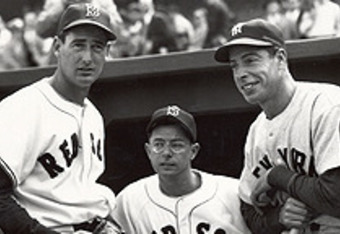
Ted Williams (left) and Joe DiMaggio

November 27, 1947: Despite it being Thanksgiving Day, the vote for the American League’s Most Valuable Player is announced. Joe DiMaggio of the New York Yankees wins for the 3rd time, despite the fact that Ted Williams of the Boston Red Sox won the Triple Crown. Why?

The official reason is that one sportswriter, who didn't like Ted, and whose name has never been revealed, left him off his ballot completely. Had he given Ted even a 10th-place vote, he would have won.

There were previous MVP controversies involving Ted. In 1941, with his 56-game hitting streak, Joe put the Yankees on his back, and carried them to glory. On Game 3 of the streak, on May 17, the Yankees were 7 1/2 games out of 1st place in the American League. The day the streak ended, exactly 2 months later, they were in 1st place by 7 games, a 14 1/2-game swing.

Don't tell me Ted was the most valuable player, capitalized or otherwise, in the AL that season. His .406 batting average didn't help his team come anywhere near a Pennant. The latest in the season that the Boston Red Sox were in 1st place was April 22. After June 25, they were never within 3 games of 1st place. From July 13 onward, they were never within 10. From August 9 onward, they were never within 14. On September 4, they bottomed out at 20 1/2 back. And when the regular season ended on September 28, they were 84-70, not a bad record, and in 2nd place, not a bad finish -- but 17 games behind the Yankees.

Ted batted .406, with an on-base percentage of .553, a slugging percentage of .735, a 235 OPS+, and hit 37 home runs, all of which led both major leagues. He had 120 RBIs. In comparison, Joe's "slash line" for the season was .357/.440/.643, his OPS+ was 185, and he hit 30 homers, but led both Leagues with 125 RBIs.

But with the streak, DiMaggio put the Yankees on his back, and carried them to glory. On Game 3 of the streak, on May 17, the Yankees were 7 1/2 games out of 1st place in the American League. When it was stopped in Game 57, exactly 2 months later, they were in 1st place by 7 games, a 14 1/2-game swing.

The Yankees went 41-13, with a game tied when called due to darkness and another tied when called due to rain, over those 56 games, including winning streaks of 14 and 8. Of those 56, 4 went to extra innings, but Joe got his 1st hit within the 1st 9 each time; and 4 were shortened due to rain, making it even more impressive that Joe got at least 1 hit in each.

For those of you who believe in "WAR," Wins Above Replacement: Ted's was 10.4, Joe's was 9.3. More evidence that WAR is misleading, and should be ignored.

In 1942. Ted batted .356, hit 36 home runs, and had 137 RBIs. Each of these led the League, giving him the Triple Crown. But the Sox finished 2nd to the Yankees, a not-very-close 9 games back, and the MVP went to Joe Gordon, who did bat .302 with 103 RBIs, though only 18 home runs, and played 2nd base superbly. How do you deny a Triple Crown winner the MVP? Again: Most Valuable Player, not Most Outstanding Player.

In 1946, the Red Sox ran away with the Pennant. This time, there was no denying Ted: He batted .342, hit 38 home runs, and had 123 RBIs (oddly, none of these led the AL), and he was an easy choice for MVP.

Then came the World Series. The opposition was the St. Louis Cardinals. Led by the NL's answer to Ted, Stan Musial, the Cards were in their 4th World Series in 6 years, having won in 1942 and 1944, and lost in 1943. But Ted was nursing an elbow injury, and only batted .200, 5-for-25. Stan didn't hit well, either, and neither would end up the big story of the Series. The Cards won in 7 games.

Ted won the Triple Crown again in 1947, as he batted. .343, hit 32 home runs and had 114 RBIs. But, again, the Sox didn't win the Pennant, finishing 3rd, 14 games behind the Yankees (and 2 behind the Tigers). Joe batted .315, hit 20 homers, had 97 RBIs, and led his team to the Pennant, and then to the World Series.

The National League's MVP went to Bob Elliott, the 3rd baseman for the Boston Braves. He batted .317, hit 22 homers, and had 113 RBIs. The Braves finished 3rd, 8 games behind the Pennant-winning Brooklyn Dodgers. Ewell Blackwell of the Cincinnati Reds finished 2nd in the voting, going 22-8, including a 16-game winning streak, the 9th game of which was a no-hitter; and led the major leagues with 193 strikeouts.

Johnny Mize of the New York Giants finished 3rd, batted .302, led the majors with 138 RBIs, and shared the major league lead in home runs with Ralph Kiner of the Pittsburgh Pirates, who finished 6th, with 51. Finishing 4th and 5th were members of the Pennant-winning Dodgers: Catcher Bruce Edwards, and 1st baseman Jackie Robinson, the 1st black player in modern baseball, who received the 1st-ever Rookie of the Year award.

Personally, I think Jackie should have gotten it: He was the biggest reason the Dodgers won. Only twice has a player ever gotten the MVP and the ROY in the same season: Fred Lynn of the 1975 Boston Red Sox, and Ichiro Suzuki of the 2001 Seattle Mariners. Ichiro, who had starred in Japan, and Jackie, who had played in the Negro Leagues and had starred in football at UCLA, were both 28, and only "rookies" by the letter of the law.

In 1949, the Sox and Yanks battled for the Pennant all the way to the final weekend. The Sox led the Yanks by 1 game with 2 to go, against each other, at Yankee Stadium. All the Sox had to do was win 1 of the 2. The Yankees won them both, 5-4 and 5-3. Ted went 1-for-3 with a walk in the Saturday game, and 0-for-2 with 2 walks in the Sunday game.

In spite of the Sox not winning the 1949 Pennant, the Yanks didn't have any single player who stood out above the others -- DiMaggio being hurt much of the year, keeping his power stats down -- so Ted got his 2nd MVP. But he had also begun to get a reputation as coming up small in big games. This ignores the fact that, in those 3 end-of-season games in '48 and '49, he did reach base 5 times. But, in those days, you rarely heard the cliché, "A walk is as good as a hit."

Ted hit 43 home runs and had 159 RBIs. His .343 slightly trailed George Kell of the Tigers for the batting title, costing him a record 3rd Triple Crown by the slimmest of margins. But he got 13 of a possible 16 1st-place votes, and won the MVP.

Among the Yankees, Phil Rizzuto finished 2nd, reliever Joe Page 3rd, and Tommy Henrich 6th. But the Scooter just didn't have big stats, and as for Page, nobody was willing to give the MVP to a relief pitcher to that point. The next year, Jim Konstanty of the Philadelphia Phillies became the 1st, in the NL. No AL reliever would get the award until Rollie Fingers of the Milwaukee Brewers in 1981.

So Ted didn't help his team win the Pennant. Yogi Berra finished 15th in the voting, but, giving the Yankees their 1st good year from a catcher since 1943, he was probably the best choice.

In 1978, Jim Rice got the MVP in a year when Ron Guidry may have been more valuable to the Yankees than any player has ever been to a single team for a single season. So Red Sox fans who say Ted was robbed of one or more MVPs can put a red sock in it.

*

November 27, 1947, like all Thanksgiving Days, was a Thursday. The Chicago Bears beat the Detroit Lions, 34-14 at Briggs Stadium (later Tiger Stadium) in Detroit. In the All-America Football Conference, the Cleveland Browns beat the Los Angeles Dons, 27-17; and the San Francisco 49ers beat the Brooklyn Dodgers, 21-7 at Ebbets Field. Yes, from 1930 to 1948, there were 2 different professional football teams named the Brooklyn Dodgers.

There were 14 college football games played, including some major rivalries:

* Rivalry: Number 7 Texas beat Texas A&M, 32-13 at Kyle Field in College Station.

* Number 8 University of Pennsylvania beat Cornell, 21-0 at Franklin Field in Philadelphia.

* Rivalry: Number 14 William & Mary beat Richmond, 35-0 at City Stadium in Richmond, Virginia.

* Rutgers beat Brown, 27-20 at Brown Stadium in Providence, Rhode Island.

* George Washington University beat the U.S. Merchant Marine Academy, 40-0 at Griffith Stadium in Washington.

* Rivalry: Virginia Military Institute (VMI) beat Virginia Tech, 28-14 at Victory Stadium in Roanoke. It would be several more years before VMI became a "small college team," and the University of Virginia replaced them as Tech's main rival.

* South Carolina beat Wake Forest, 6-0 at American Legion Memorial Stadium in Charlotte, North Carolina.

* Davidson University beat Furman University, 20-6 at Sirrine Stadium in Greenville, South Carolina.

* North Texas beat Chattanooga, 14-7 at Chamberlain Field in Chattanooga, Tennessee.

* Saint Louis University beat Duquesne, 14-13 at Walsh Stadium in St. Louis.

* The Municipal University of Wichita (now Wichita State University) beat Colorado College (not to be confused with the University of Colorado or Colorado State), 62-6 at Veterans Field in Wichita, Kansaas.

* Arkansas beat the University of Tulsa, 27-13 at Skelly Stadium (now Skelly Field at H.A. Chapman Stadium) in Tulsa, Oklahoma.

* Rivalry: The University of Denver beat the University of Colorado, 26-20 at DU Stadium at Denver.

* Rivalry: Utah beat Utah State, 40-14 at Ute Stadium (later Robert Rice Stadium) in Salt Lake City.

These days, the NBA does not play on Thanksgiving. In the 1947-48 season, still using the name of the Basketball Association of America, they did, playing 2 games. The New York Knicks beat the Philadelphia Warriors, 81-59 at the Philadelphia Arena. And the Baltimore Bullets beat the Providence Steam Roller, 76-61 at the Rhode Island Auditorium in Providence.

The NHL also does not play on Thanksgiving in the modern era. But, on this day, they also played 2 games. The Montreal Canadiens beat the Toronto Maple Leafs, 2-0 at the Montreal Forum. And the Detroit Red Wings beat the Boston Bruins, 4-1 at the Olympia Stadium in Detroit. Boston has a tradition of high school football on Thanksgiving Day, which is probably why the Bruins did not play at home. The New York Rangers and the Chicago Black Hawks did not play.

Monday, November 21, 2022

November 21, 1934: Joe DiMaggio Becomes a Yankee

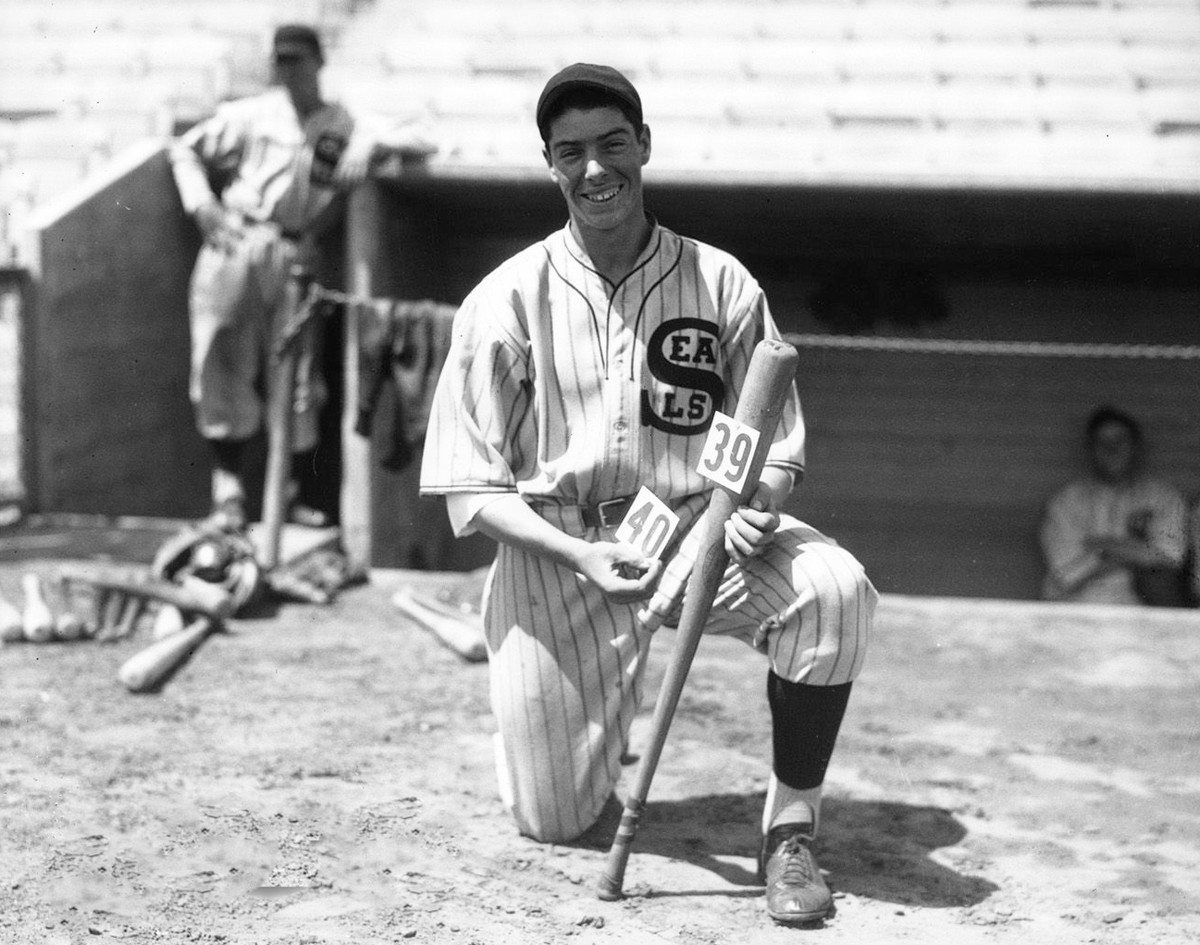
November 21, 1934: The New York Yankees purchase the contract of Joe DiMaggio from the San Francisco Seals of the Pacific Coast League for $50,000, also sending the Seals 5 players.

The Seals played in the PCL from its founding in 1903 until 1957, when the New York Giants moved to San Francisco. They were named for Seal Rock, an island in San Francisco Bay where seals gathered. They won 14 Pennants: 1909, 1915, 1917, 1922, 1923, 1925, 1928, 1931, 1935, 1943, 1944, 1945, 1946, 1957. And they formed a rivalry across the Bay with the Oakland Oaks. From 1931 onward, they played at Seals Stadium, considered one of the best minor-league ballparks. The Giants used it in 1958 and 1959, before Candlestick Park opened.

A minor-league hockey team would also be named the San Francisco Seals. When the NHL expanded to the Bay Area, the team played in Oakland, and was known as the Oakland Seals, and then as the California Golden Seals, before moving.

Giuseppe DiMaggio was an immigrant from Sicily, who immigrated first to Martinez, California, in what's now called the East Bay, and then to San Francisco. He was a professional fisherman, and he expected his sons to fish with him. He forbid his boys to play the American game of baseball.

In 1932, his oldest son, Vince disobeyed him, and signed with the Seals. Giuseppe told him not to come back. A month later, he came back, and slammed a wad of cash down on the kitchen table. Seeing more money at once than he'd ever had in his life, Giuseppe welcomed Vince back, and also let sons Giuseppe Jr. (Joe) and Dominic (Dom) play pro ball.

They also signed with the Seals. In 1933, Joe became a star, putting together a 61-game hitting streak, foreshadowing the 56-game streak he would have with the Yankees in 1941. But a knee injury in 1934 had scared the Eastern major league teams away. The Yankees took a chance on him, wanting him so badly that they let the Seals keep him for one more season in 1935. (In international soccer, it would have been considered a "loan deal.") Joe led the Seals to the Pennant that year.

Joe debuted with the Yankees in 1936, just 21 years old, and was instantly a star. Babe Ruth had retired, but Lou Gehrig was still there, and took Joe under his wing. For 3 years, Gehrig and DiMaggio pounded American League pitching. In 1939, Gehrig fell to the illness that would kill him, but Joe, catcher Bill Dickey, and some great pitching carried the Yankees to a 106-win season and a World Series win. Joe won the AL's batting title, and the 1st of his 3 AL Most Valuable Player awards.

He only played 13 seasons, losing 3 in the middle due to serving in World War II, and more at the end because he retired at age 37 due to a heel injury that had bothered him for his last 4 seasons. In those 13 seasons, he made the All-Star Game every year, helping the Yankees win 10 Pennants and 9 World Series.

The Yankees of Ruth and Gehrig had been "Murderers' Row." It was the DiMaggio era, 1936 to 1951, that made them more than a single-generation great team. It was "The Yankee Clipper," with his stoic greatness and resistance to injury, that made them, as the saying went, "the lordly Yankees."

Vince, who played his best years with the Pittsburgh Pirates, was an All-Star in the 1943 and 1944 seasons. Dom, who played his entire career with the Boston Red Sox, was an All-Star 7 times: 1941, 1942, 1946, 1949, 1950, 1951 and 1952. There are still Red Sox fans who say he was a better center fielder than Joe. They also say he should join Joe in the Baseball Hall of Fame. The 1st claim is ridiculous: The number of men who have played center field on Joe's level is very small. The 2nd claim has some merit.

Vince died in 1986, Joe in 1999, Dom in 2009.

*

November 21, 1934 was a Wednesday. This was also the day that American newspapers broke the story of the "Business Plot," a proposed military coup that would be backed by some of America's richest men to depose President Franklin D. Roosevelt and install a fascist government, a plan torpedoed when their intended commander, Marine General Smedley Butler, blew the whistle on it in a Congressional committee hearing. I have a separate entry for that event.

This was also the day the Cole Porter musical Anything Goes, starring Ethel Merman, debuted on Broadway. I have a separate entry for that event.

Baseball was out of season. Football was in midweek. The NBA hadn't been founded yet. And while the NHL season began on November 8, there were no games scheduled for this day. So there were no scores.

Tuesday, October 11, 2022

October 11, 1946: The Reynolds-Gordon Trade

Allie Reynolds

October 11, 1946: A trade is made in baseball, and it is a rarity: One that works out very well for both teams.

The New York Yankees trade 2nd baseman Joe Gordon to the Cleveland Indians for pitcher Allie Reynolds. Gordon, the 1942 American League Most Valuable Player, was nicknamed "Flash," not because of his flashy defense, but because he reminded people of science-fiction film hero Flash Gordon, played by Buster Crabbe, who also played another sci-fi hero, Buck Rogers.

Joe Gordon secured his (posthumously-elected) Hall of Fame status by helping the Indians win the 1948 World Series, on October 11, 2 years to the day after the trade. This was his 5th title, having won 4 with the Yankees. But the Yankees had gotten George "Snuffy" Stirnweiss in a separate trade, and then had Jerry Coleman, Billy Martin and Bobby Richardson at the keystone sack for the next 15 years.
Joe Gordon

The Indians needed a veteran infield presence like Gordon, and their owner, Bill Veeck, was willing to trade any pitcher except the future Hall-of-Famer Bob Feller. Yankee general manager Larry MacPhail asked his best player, Joe DiMaggio, which one he should take. The Yankee Clipper said, "Take Reynolds. I'm a fastball hitter, but he can buzz his hard one by me any time he has a mind to." In other words, "He's really good, so even if he does nothing for us, at least he won't be doing anything to us."

That fastball, and his Cherokee heritage, got Reynolds a nickname that applied to Native Americans and a famous train of the time: The "Superchief." Still, he was only 51-47, with a 3.31 ERA, for his career when the Yankees acquired him. There was no indication that he would become a great pitcher.

But he did. In a rotation that already included Vic Raschi, the "Springfield Rifle," the Yankees won the 1947 World Series. In 1948, the Yankees obtained Eddie Lopat, a lefthander specializing in off-speed pitches, known as "the Junkman."

And with new manager Charles "Casey" Stengel coming in for the 1949 season, and pitching the speedy righthander Reynolds followed by the junkballing lefty Lopat, followed by the speeding righthander Raschi, the Yankees had a very tough combination that won the next 5 World Series: 1949, '50, '51, '52 and '53 -- each time with a different 4th starter. So this trade helped the Yankees get 6 titles.

Reynolds only won 20 games once, in 1952, but that was partly because Stengel also frequently used him as a reliever. Had he come along 30 years later, he might have been a big blazing righthanded closer in the mold of Goose Gossage, Rob Dibble or Rod Beck. He hurt his back in 1954, but still managed to go 13-4 at age 37. He then retired: Having invested in oil wells in Oklahoma, he could afford to play for the love of the game, and then walk away.

The Yankees honored him with a Plaque for Monument Park in Yankee Stadium in 1989, although they have never retired his Number 22. He died in 1994.

*

October 11, 1946 was a Friday. There was baseball action on this day, Game 5 of the World Series at Fenway Park in Boston. The Boston Red Sox beat the St. Louis Cardinals, 6-3. Ted Williams singled in a run in the bottom of the 1st inning, and Cardinal manager Eddie Dyer panicked, taking out starter Howie Pollet. While Al Brazle got out of the jam, he gave up a home run to Leon Culberson in the 6th inning, and fell apart in the 7th. In contrast, Joe Dobson went the distance for the Sox, holding Stan Musial to a 1-for-3 day.

The Sox thus took a 3-games-to-2 lead in the Series. All they had to do was win 1 of 2 games at Sportsman's Park in St. Louis. They just had to win 1 more World Series game, and they would have their 1st World Championship since 1918. It took them another 58 years to get that title.

There was also a game played in the All-America Football Conference: The football version of the Brooklyn Dodgers and the Chicago Rockets played to a tie, 21-21 at Ebbets Field.

And there were 7 college football games:

* Number 8 Georgia beat Number 19 Kentucky, 28-13 at Sanford Stadium in Athens, Georgia.

* Georgetown beat Fordham, 8-7 at Griffith Stadium in Washington. Georgetown dropped their football program after the 1950 season, re-established it at NCAA Division III in 1973, and moved up to Division I-AA/Football Championship Subdivision in 1993. Fordham dropped their program after 1954, restored it to Division III in 1973, and to I-AA/FCS in 1989.

* South Carolina beat Furman University, 14-7 at Furman's Sirrine Stadium in Greenville, South Carolina.

* George Washington University beat Rollins College, 13-0 at Orlando Stadium (now Camping World Stadium). Orlando-based Rollins dropped their football program after the 1949 season, and D.C.-based GWU dropped theirs after 1946.

* The University of Miami beat Texas Christian University, 20-12 at Burdine Stadium (later renamed the Orange Bowl) in Miami.

* Wichita State University beat Drake University, 12-6 at Drake Stadium in Des Moines, Iowa. Drake downgraded their program to Division I-AA/FCS in 1971, and Wichita State dropped theirs after 1985.

* And Southern Methodist University beat Oklahoma A&M, 15-6 at the Cotton Bowl in Dallas. A&M became Oklahoma State in 1958.

Monday, October 10, 2022

October 10, 1951: Joe DiMaggio's Last Game

October 10, 1951: The Yankees defeat the New York Giants, 4-3 in Game 6 at Yankee Stadium, and win their 3rd straight World Series, their 14th World Championship. The Giants had taken 2 of the 1st 3 games in this Series, but the Yanks took 3 straight to win.
Joe DiMaggio goes 1-for-2 with 2 walks. In the bottom of the 8th, he laces a double to left-center off Larry Jansen. It turns out to be the last at-bat of his career, as he announces his retirement 2 months later.
His intended center field successor, Mickey Mantle, had gotten hurt in right field in Game 2, and missed the rest of the Series, and the knee he injured would never be the same again, the beginning of a cloud over his career that would only grow. The "other" great rookie center fielder, Willie Mays of the Giants, had a poor Series, and would spend most of the next 2 seasons in the Army in the Korean War. But both Mantle and Mays would be back, and would resume building their legends.
This game is significant for another reason: It is the Yankees' 14th World Series win, making them, officially, the greatest franchise in baseball history. While the team known, at this point, as the Boston Braves had won only 1 World Series, in 1914, they had previously won 9 National League Pennants, and, before that, 4 Pennants in the National Association, making them, effectively, the world champions of baseball 13 times. The Yankees had now exceeded that.
On December 12, 1951, DiMaggio announced his retirement at Yankee Stadium: "I have played my last game of ball." He later explained it this way: "You start chasing a ball, and your brain immediately commands your body to 'Run forward, bend, scoop up the ball, peg it to the infield!' Then your body says, 'Who, me?'"
He had reached his 37th birthday between that last game and his retirement announcement. And 37 has been a troublesome age for the Yankees: Mantle would also retire at 37, Lou Gehrig died at that age, Yogi Berra began his last season, Don Mattingly had been retired for 3 years, and Thurman Munson had been dead for 5.
By 1968, a year of turmoil, and the last season for Mantle, DiMaggio was already seen as a relic of an earlier age. In their Number 1 hit song "Mrs. Robinson," Paul Simon and Art Garfunkel sang:
Where have you gone, Joe DiMaggio?
A nation turns its lonely eyes to you.
Woo woo woo.
What’s that you say, Mrs. Robinson?
Joltin’ Joe has left and gone away?
Hey hey hey.
Hey hey hey. 

At one point, DiMaggio and Simon met, and DiMaggio asked him, "What do you mean, where have I gone? I haven't gone anywhere." DiMaggio didn't understand. 

Of course, being just 9 years old when the 1951 transition was made, Simon's hero was Mantle, and Mantle asked why he wasn't mentioned. Simon had to tell him that his name didn't fit the rhythm of the song. In 1988, Simon made it up to Mantle, putting him in a video he made for his 1972 solo hit "Me and Julio Down by the Schoolyard," filming it in a Manhattan schoolyard, even though the song takes place in Corona, one neighborhood over from the Mets' Shea Stadium. 

DiMaggio died in 1999. At a ceremony for the Monument that replaced his plaque in Yankee Stadium's Monument Park, Simon sang "Mrs. Robinson" while standing in DiMaggio's old position of center field.

Bobby Brown was the last surviving member of the 1951 Yankees, living until 2021.
UPDATE: Among the Yankees' many traditions is Monument Park at Yankee Stadium. From the 1949-53 team that won 5 straight World Series, they have honored center fielders Joe DiMaggio and Mickey Mantle with Monuments; and given Plaques to catcher Lawrence "Yogi" Berra, shortstop Phil Rizzuto, pitchers Allie Reynolds and Edward "Whitey" Ford, manager Charles "Casey" Stengel, public address announcer Bob Sheppard, and broadcaster Mel Allen.
Billy Martin played 2nd base in this period, but that's not why he's in Monument Park, or why his uniform Number 1 has been retired. The Yankees have also retired 5 for DiMaggio, 7 for Mantle, 8 for Berra, 10 for Rizzuto, 16 for Ford and 37 for Stengel. Although 1st baseman Johnny Mize and general manager George Weiss are in the Baseball Hall of Fame, they are not honored in Monument Park. Neither are team owners Dan Topping and Del Webb, who are also not in the Hall of Fame.
*
October 10, 1951 was a Wednesday. This was the only baseball game played that day. Football was in midweek. The NHL season started the next day. And the NBA season didn't start until November 1. So there were no other scores on this historic day.

Saturday, October 8, 2022

October 8, 1939: Ernie Lombardi's "Snooze"

October 8, 1939: Game 4 of the World Series is played at Crosley Field in Cincinnati. The New York Yankees already lead the Cincinnati Reds, 3 games to none. The game is scoreless until the top of the 7th inning, when Charlie Keller and Bill Dickey hit home runs for the Yankees. The Reds come right back with 3 runs, started by an error by the normally sure-fielding Red Rolfe.

Mel Allen, then in his 1st season as a Yankee broadcaster, would later call Rolfe his all-time 3rd baseman, ahead of Pie Traynor and Eddie Mathews, the 2 most-named candidates at that point. This was while Brooks Robinson was still active, and before Mike Schmidt and George Brett debuted. So that should give an idea of how good Rolfe was, even though he is not in the Baseball Hall of Fame.

The Reds scored another run in the 8th. But their ace pitcher, Bucky Walters, ran out of gas in the 9th, and the Yankees sent the game to extra innings.

Cliché Alert: Walks can kill you, especially the leadoff variety. Frank Crosetti led off the top of the 10th by drawing a walk off Walters. Rolfe bunted him over. Keller -- nicknamed "King Kong," which he hated, because he was big, strong and hairy -- reached on an error by shortstop Billy Myers And Joe DiMaggio, already the best player in baseball at age 24, singled to right. Crosetti easily scored the go-ahead run.

It got worse for the Reds: Right fielder Ival Goodman bobbled the ball, and Keller tried to score. The throw got to catcher Ernie Lombardi, but there was a collision, and Lombardi dropped the ball. For a moment, he just lay there at home plate, in a daze. DiMaggio noticed this as he approached 3rd base, and tried to score. Lombardi snapped out of it, got the ball, and leaned over to tag DiMaggio, who executed a fantastic slide, thrown his entire body away from the plate, just brushing it with his right foot. It was 7-4 Yankees. That completed the World Series sweep, and manager Joe McCarthy's team became the first club to win 4 consecutive Fall Classics. It was their 8th World Championship overall.

The prudish press of the day said that Lombardi "swooned" or "snoozed" at the plate, but, in reality, Keller had inadvertently kneed him in the groin. His inability to act for a few seconds thereafter was understandable, even if he was wearing a cup.

Lombardi died in 1977, and was posthumously elected to the Hall of Fame in 1986. He batted .306 for his career, won 2 National League batting titles, was the NL Most Valuable Player in 1938, and was selected for 8 All-Star Games. But, because of his large nose, he was nicknamed "Schnozz." And because of that and the aforementioned play, it was said that he was "known for his schnozz and his snooze." This was unfair.

Keller looked like he might be headed for the Hall, but missed the 1944 season due to World War II, hurt his back during his service with the U.S. Merchant Marine, and was never the same player. He played his last game just after his 36th birthday, and still ended up with a .286 batting average, 189 home runs, and a career OPS+ of 152 -- considerably higher than Lombardi's 126. He retired to a farm in his native Maryland, trained racehorses with Yankee-themed names, and lived until 1990.

The last surviving player from the Yankees' 1939 World Champions -- and their 1937, 1938 and 1941 titlists as well -- was right fielder Tommy Henrich, a.k.a. Ol' Reliable, who lived until 2009. The Reds would rebound from this defeat, and win the 1940 World Series, beating the Detroit Tigers in 7 games.

*

October 8, 1939 was a Sunday. This was the only baseball game. The NHL season didn't start until the next month. The NBA hadn't been founded yet. But these NFL games were played:

* The football version of the New York Giants beat the football version of the Pittsburgh Pirates, 14-7 at Forbes Field in Pittsburgh. The football Pirates would change their name to the Pittsburgh Steelers the next season.

* The football version of the Brooklyn Dodgers lost to the Washington Redskins, 41-13 at Griffith Stadium in Washington.

* The Chicago Bears beat the Cleveland Rams, 35-21 at Cleveland Municipal Stadium. The Rams moved to Los Angeles in 1946, to St. Louis in 1995, and back to Los Angeles in 2016.

* And the Green Bay Packers beat the Chicago Cardinals, 27-20 at the Dairy Bowl in the Milwaukee suburb of West Allis, Wisconsin. The Dairy Bowl was a football stadium built in the infield of a speedway, now known as the Milwaukee Mile, at the Wisconsin State Fair Park. The Cardinals moved to St. Louis in 1960, and to Arizona in 1988.

Also, Australian actor Paul Hogan, star of the Crocodile Dundee films, was born on this day. So was "underground" cartoonist Harvey Pekar.

Thursday, October 6, 2022

October 6, 1938: Dizzy Dean's Last Stand

October 6, 1938: The Yankees defeat the Cubs, 6-3 at Wrigley Field, and take a 2-games-to-0 lead in the World Series. Dean, now with the Cubs following an arm injury that will ultimately end his meteoric career at age 31, takes a 3-2 lead into the 8th inning, but Frank Crosetti's homer gives the Yanks a lead they will not relinquish. Joe DiMaggio added a homer in the 8th. It becomes known as Dizzy Dean's Last Stand, although he did pitch another 3 seasons.

The winning pitcher is Gomez, making him 6-0 in World Series play. Although he appears in 3 more Series with the Yankees, this will be his last Series decision. But although Whitey Ford with 10 and Bob Gibson with 7 will win more Series games, Gomez has the best winning percentage in Series history to this day.

Diz was born Jay Hanna Dean, but sometimes told people his name was Jerome Herman Dean. He was born in 1910, but sometimes told people it was 1911, or 1912. He was born in Lucas, Arkansas, but sometimes told people that he was born elsewhere in Arkansas. Or places in Tennessee. Or Mississippi. Or Louisiana. Or Texas. Or Oklahoma. He was one of three, or four, or five, or more siblings. He explained that he wanted every reporter to have an exclusive.

He had a brother who was born in 1912, in Lucas, Arkansas: Paul Dee Dean. Because Jay was called Dizzy, Paul was called Daffy. And Paul really hated that, because, unlike is freewheeling brother, he was a very thoughtful man.

Dizzy was not. He once said, "The Good Lord was good to me. He gave me a strong right arm, a good body and a weak mind." He later went into broadcasting, and took his homespun talk with him. He was a lot like later football star Terry Bradshaw, figuring out that if people think you're an under-educated hick who knows nothing except his sport, but knows that very well, use it to your advantage before they can use it to theirs.

At any rate, Paul was a very good pitcher. Not as good as Dizzy, but capable of winning 19 games in 1934, including a no-hitter in the the 2nd game of a doubleheader, after Dizzy pitched a 3-hit shutout in the 1st game. Dizzy said, "Gee, Paul, if I'd a-known you was gonna throw a no-hitter, I'd a-thrown one, too!"

Another of Dizzy's quotes was, "If you can do it, it ain't braggin'." Before the 1934 season, he said, "Me an' Paul is gonna win 50 games." Not quite: Diz won 30, and Paul won 19, for a total of 49. But by going 30-7, Diz became the last National League pitcher, to this day, to win 30 games in a season. He also said, "Men an' Paul are gonna win this here World Series." This time, he was right: The Cardinals beat the Detroit Tigers, 4 games to 3, and each brother won 2 games, including Diz pitching a shutout in Game 7.

From 1933 to 1937, Diz was, along with Carl Hubbell and the Negro Leagues' Satchel Paige, 1 of the 3 best pitchers on the planet. Then, in the 1937 All-Star Game in Washington, Earl Averill, the Hall of Fame center fielder for the Cleveland Indians, hit a line drive back up the middle, off his foot. The doctor told him his big toe was fractured. And the undereducated country boy said, "Fractured, hell, the damn thing's broken!"

He came back too soon, and, to favor the toe, he altered his pitching motion, and wrecked his elbow. At age 27, he went from one of the best pitchers in baseball to a man who couldn't pitch without pain. The Cardinals traded him to the Cubs before the 1938 season, and he was only able to make 10 starts. But he went 7-1 with a 1.81 ERA, and the Cubs made a big comeback to win the Pennant. Dean pitched well in Game 2, but the Yankees beat him. He didn't run out of gas so much as he fell victim to the Yankees' comeback ability, known in those days of 3:00 PM starts as "Five O'Clock Lightning."

Dizzy Dean retired after the 1941 season, with a record of 150-83. Ordinarily, 150 wins wouldn't be enough to get a player into the Baseball Hall of Fame. But his 5 years of dominance got him there. He became a beloved broadcaster, and died in 1974. Paul went 50-34 in a career lasting from 1934 to 1943, and died in 1981.

*

October 6, 1938 was a Thursday. Football was in midweek. The NBA wasn't founded yet. And the NHL season was a month away. So there were no other scores this day.

Wednesday, October 5, 2022

October 5, 1951: Mantle vs. Drain

October 5, 1951: Game 2 of the World Series, at Yankee Stadium. The New York Yankees, with Eddie Lopat pitching a fine game, evened up the Series against the New York Giants by winning 3-1 over Larry Jansen. Joe Collins hit a home run. But the big story came in the top of the 5th inning.

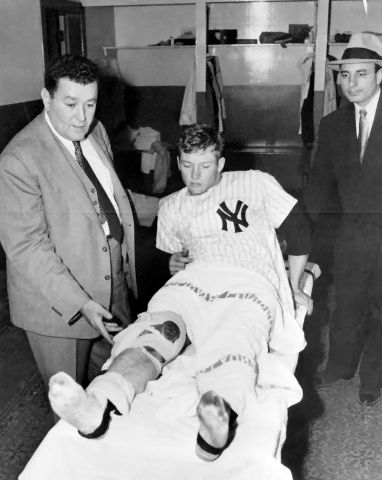
The Yankees' big rookie, Mickey Mantle, already a big story and not yet 20 years old for another 15 days (Mays had turned 20 in May), was playing right field, with the idea that, the next season, he would succeed Joe DiMaggio in center field.
The Giants' big rookie, Willie Mays, hit a fly ball to right-center. Mantle went for it, but heard DiMaggio calling for it, and stopped short. That caused Mantle to step in a drain that had been mistakenly left open, catching his spikes, and tearing the anterior cruciate ligament (ACL) his right knee.
With today's sports medicine, Mickey would have been operated on the next day, and would have been ready for Opening Day the next April. But they didn't know how to treat a torn-up knee in the Truman years, and the surgery he got was hardly good enough, and the knee never really healed right. This is why people say, "We never got to see Mickey Mantle on 2 good legs."
If the Yankees ever found out which groundskeeper left the drain open, they handled it privately, without ever revealing the man's name. Which, given the fanatical devotion of the fans Mantle would eventually have, was for the best.
The story got worse. Mickey's father, Elvin "Mutt" Mantle, who had made his son a special project, teaching him to play, including how to switch-hit, was in attendance. They rode to the hospital together in a taxi. Mickey leaned on his father for support getting out of the cab. But Mutt collapsed, causing Mickey to collapse, too.
All those years of working in the zinc mines of northeastern Oklahoma, inhaling the poisonous dust, had given Mutt Hodgkin's disease. He was not just too weak to support his son at that moment, he was dying. Also with today's medicine, he might have lived. Then again, with today's economy, he might not have had to work in the mines.
Father and son spent the rest of the World Series watching the games from adjoining hospital beds. Mutt died on May 7, 1952, only 40 years old. None of the men in Mickey's family had lived past the age of 45, and Mickey was convinced they family was "cursed," and that he wouldn't make it past 45, either. So he was going to live every day like there was no tomorrow. It didn't occur to him that, not working in the mines, he would be healthier.
Instead, he drank to dull the physical pain of so many injuries, and the psychological pain of losing his father so soon, and of the way he was often treated by the New York fans and the New York media, until he went from being the kid with all the promise to the star who was fulfilling the promise. He ended up playing 18 seasons, hitting 536 home runs, winning 3 American League Most Valuable Player awards, including in 1956 when he won the Triple Crown, and helped the Yankees win 12 Pennants and 7 World Series.
But it never seemed to be enough for him. There was always a hole in his life, and he tried filling it with booze and other indulgences. That never works. Realizing it too late, Mickey began using the old line, "If I'd known I was gonna live this long, I'd have taken a lot better care of myself." He finally quit drinking in 1994 -- but the damage to his liver was done, as he only lived another year and a half.
*
October 5, 1951 was a Friday. Actress Karen Allen and Irish rock singer Bob Geldof were born on this day. And the DuMont network variety show Cavalcade of Stars, hosted by Jackie Gleason, includes a 6-minute sketch that became a recurring one, and eventually its own half-hour sitcom on CBS: The Honeymooners.
There were 5 college football games played that night:
* Number 5 Notre Dame beat the University of Detroit, 40-6 at Briggs Stadium in Detroit. That ballpakr was renamed Tiger Stadium in 1960.
Florida State University, which had only become coeducational in 1947 (after being a women's college), played the University of Miami in football for the 1st time, at Burdine Stadium in Miami -- the stadium that will later be renamed the Orange Bowl. Miami won, 35-13. The Seminoles did not beat the Hurricanes for the 1st time until 1958, and not at home in Tallahassee until 1979. The rivalry would get much bigger over the next few years.
* Alabama Polytechnic Institute beat Wofford, 30-14 at the Cramton Bowl in Montgomery, Alabama. API was renamed Auburn University in 1960.
* The University of Mississippi beat Boston College, 34-7 at Crump Stadium in Memphis.
* And Boston University beat the University of Louisville, 39-7 at duPont Manual Stadium in Louisville, Kentucky.

October 5, 1947: The 1st Televised White House Speech

President Harry S Truman (left) and Charles Luckman,
Chairman of the President's Citizens Food Committee,
under a portrait of President Ulysses S. Grant

October 5, 1947: President Harry S Truman becomes the 1st President to deliver a speech from the White House that is broadcast on television.

With World War II only a little over 2 years in the past, there are still food shortages. The Marshall Plan, devised by his Secretary of State, former General George C. Marshall, is trying to do something about this, but it hasn't yet been approved by Congress. (That will take until the following March.) So Truman asks the American people to voluntarily observe meatless Tuesday and poultryless Thursdays. Most do.

Truman said:

The situation in Europe is grim and forbidding as Winter approaches. Despite the vigorous efforts of the European people, their crops have suffered so badly from droughts, floods, and cold that the tragedy of hunger is a stark reality.

The nations of Western Europe will soon be scraping the bottom of the food barrel. They cannot get through the coming Winter and Spring without help, generous help, from the United States, and from other countries which have food to spare.

I know every American feels in his heart that we must help to prevent starvation and distress among our fellow men in other countries.

But more than this, the food-saving program announced tonight offers an opportunity to each of you to make a contribution to the peace. We have dedicated ourselves to the task of securing a just and a lasting peace. No matter how long and hard the way, we cannot turn aside from that goal.

An essential requirement of lasting peace is the restoration of the countries of Western Europe as free self-supporting democracies. There is reason to believe that those countries will accomplish that task if we aid them through this critical Winter, and help them get back on their feet during the next few years. They must do most of the job themselves. They cannot do it if thousands of their people starve. We believe they can, and will, do the job if we extend to them that measure of friendly aid which marks the difference between success and failure.

Their most urgent need is food. If the peace should be lost because we failed to share our food with hungry people there would be no more tragic example in all history of a peace needlessly lost. 

As a gesture of bipartisanship, Truman asked former President Herbert Hoover to assist. Hoover had become known as the President who presided over the start of the Great Depression and didn't do enough to solve it. But one of the reasons he was elected in the first place is that, during World War I, he led a food drive for the starving nations of Europe. Truman knew that he could do it again, and Hoover was moved by Truman's invitation.

*

October 5, 1947 was a Sunday. Game 6 of the World Series was played at Yankee Stadium. The Brooklyn Dodgers beat the New York Yankees, 8-6, and forced a Game 7, which the Yankees won. I have a separate entry for this event. On this day, Harry Truman giveth, and Al Gionfriddo taketh away.

These games were played in the National Football League:

* The New York Giants lost to the Philadelphia Eagles, 23-0 at the Polo Grounds.

* The Detroit Lions beat the Boston Yanks (yes, baseball fans, a team with that name existed), 21-7 at Fenway Park in Boston.

* The Washington Redskins beat the Pittsburgh Steelers, 27-26 at Griffith Stadium in Washington.

* The Chicago Cardinals beat their crosstown rivals, the Chicago Bears, 31-7 at Comiskey Park.

* The Green Bay Packers beat the Los Angeles Rams, 17-14 at the Dairy Bowl in the Milwaukee suburb of West Allis, Wisconsin. The Dairy Bowl was a football stadium built in the infield of a speedway, now known as the Milwaukee Mile, at the Wisconsin State Fair Park.

And in the All-America Football Conference:

* The New York Yankees lost to the Cleveland Browns, 26-17 at Cleveland Municipal Stadium.

* The Baltimore Colts and the San Francisco 49ers played to a tie, 28-28 at Baltimore Municipal Stadium (later converted into Memorial Stadium).

* The Buffalo Bills beat the Los Angeles Dons, 27-25 at the Los Angeles Memorial Coliseum. In old Spanish California, a "Don" was equivalent to an English "Lord." The title was also in Italy, which is why Mafia boss were called "Dons."

As for the Bills, this is not the team we know today: When the NFL absorbed the Browns, the Colts and the 49ers after the 1949 season, many people expected them to take the Bills as well, but they didn't. It became known as "The Screwing of Buffalo." When the AFL was founded in 1960, a new Bills team was established, and that's the team we know today.

* Two days earlier, the football version of the Brooklyn Dodgers beat the Chicago Rockets, 35-31.

Also on this day, Brian Johnson, who was hired to replace the late Bon Scott as lead singer of rock band AC/DC, was born.

October 5, 1947: The Al Gionfriddo Game


October 5, 1947: Game 6 of the World Series. The New York Yankees trail the Brooklyn Dodgers, 8-5 in the bottom of the 6th inning, but have 2 men on. Joe Hatten pitches to Joe DiMaggio, and the Yankee Clipper rips the ball deep to left-center field.
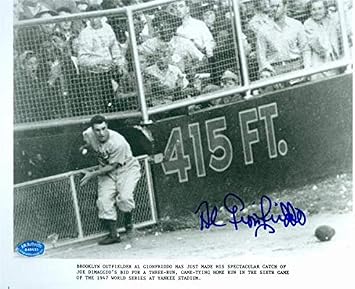
But, in Yankee Stadium, that's "Death Valley." Dodger left fielder Al Gionfriddo makes a leaping catch near the bullpen gate. Red Barber had the call on the Dodgers' radio station, WMGM, AM 1050:
Here's the pitch. Swung on, belted, it's a long one! Back goes Gionfriddo, back, back, back, back, back, back, he makes a one-handed catch against the bullpen! Oh, Doctor!
In a rare show of emotion, DiMaggio kicked the infield dirt, caught by at least 2 newsreel cameras.
The Yankees closed to within 8-6, but that was as close as they would get. Ralph Branca, winner of 21 regular-season games this year at age 21, but to whom baseball history would get considerably less kind, was the winning pitcher. Hugh Casey, to whom baseball history was nasty in 1941 but had already been the winning pitcher in Game 4, got the save in Game 6.
Game 7 was played the next day, and the Yankees won it, 5-2. The Dodgers won the 2 best-remembered games of the Series, but the Yankees won the Series itself. It was similar to 1975, when the Boston Red Sox won the memorable Game 6, but the Cincinnati Reds won Game 7.
Gionfriddo became a hero, but, like Game 4 heroes Bill Bevens and Cookie Lavagetto, he never plays another major league game after the next day's Game 7. He played in the minors until 1953, managed in the minors until 1959, and died in 2003.
This was also the day that the 1st televised speech by a President from the White House was delivered, by Harry Truman. I have a separate entry for this event.
*
October 5, 1947 was a Sunday. This was the only baseball game played that day. And it was too early for the NBA or the NHL to start there seasons. But there were professional football games played. In the NFL:
* The New York Giants lost to the Philadelphia Eagles, 23-0 at Shibe Park in Philadelphia.
* The Detroit Lions beat the Boston Yanks, 21-7 at Fenway Park in Boston. Yes, there was a football team named the Boston Yanks, who existed from 1944 to 1948. Yes, these Yanks played at Fenway. No, they did not wear Pinstripes, choosing instead the kelly green and gold of Notre Dame.
* The Washington Redskins beat the Pittsburgh Steelers, 27-26 at Griffith Stadium in Washington.
* The Chicago Cardinals beat their cross-town rivals, the Chicago Bears, 31-7 at Comiskey Park in Chicago. The Cardinals would win the NFL Championship in 1947. In the three-quarters of a century since, including moves to St. Louis in 1960 and Phoenix in 1988, including 2 Super Bowl defeats as the Arizona Cardinals, they have never won another.
* And the Green Bay Packers beat the Los Angeles Rams, 17-14 at the Dairy Bowl in the Milwaukee suburb of West Allis, Wisconsin. The Dairy Bowl was a football stadium built in the infield of a speedway, now known as the Milwaukee Mile, at the Wisconsin State Fair Park.

In the All-America Football Conference, which challenged the NFL from 1946 to 1949, and produced 3 teams that would join it in 1950:
* The Cleveland Browns beat the New York Yankees, 26-17 at Cleveland Municipal Stadium. These football Yankees played their home games at Yankee Stadium, were owned solely by Yankee half-owner Dan Topping, and had former NFL Giants star Ray Flaherty as head coach. They lost the AAFC Championship Game to the Browns in 1946 and 1947, and were not welcomed into the NFL, as the Browns were.
* The Baltimore Colts and the San Francisco 49ers, the other 2 AAFC teams that would be absorbed into the NFL, played to a 28-28 tie at Baltimore Municipal Stadium. In 1954, this facility was converted into Memorial Stadium.
* And the Buffalo Bills beat the Los Angeles Dons, 27-25 at the Los Angeles Memorial Coliseum. In Spanish-era California, "Don" was a term meaning "Lord," and was given to the landowners. The term was also used in Italy, and the term "Don" for a Mafia boss comes from this.
The Bills reached the 1949 AAFC Championship Game, losing to the Browns, but were not invited into the NFL. This quickly became known as "The Screwing of Buffalo."
In 1959, Ralph Wilson, a former part-owner of the Lions, was offered a team in the American Football League by founder Lamar Hunt. He wanted Miami, but was turned down. When the first choice for a Buffalo team's owner backed out, Wilson told Hunt, "Count me in with Buffalo." And he named the team after the AAFC team, the Buffalo Bills, who were named after Wild West showman William F. "Buffalo Bill" Cody.
Also on this day, Brian Johnson, who was hired to replace the late Bon Scott as lead singer of rock band AC/DC, was born.

Sunday, October 2, 2022

October 2, 1949: Both Leagues' Pennants Decided On the Final Day

Left to right: Ted Williams, Dom DiMaggio, Joe DiMaggio.

October 2, 1949: Yankee Stadium, Bronx, New York. Regular-season finale. Winner takes the American League Pennant.

On the last day of the 1948 regular season, the Boston Red Sox beat the New York Yankees at Fenway Park in Boston, clinching at least a tie for the AL Pennant, and knocking the Yanks out of a chance for it. Ted Williams went 2-for-4 with 2 RBI doubles. Sox center fielder Dom DiMaggio went 3-for-4, including a solo home run. His brother, Yankee center fielder Joe DiMaggio, went went 4-for-5 with 2 doubles and 3 RBIs -- meaning that, between them, the DiMaggios go 7-for-9 with 3 extra-base hits and 4 RBIs. And brother Vince, who also reached the majors, wasn't even in this game! Although he was there, as were their parents.

The next day, also at Fenway, the Sox lost a playoff for the Pennant to the Cleveland Indians, 8-3, as Tribe shortstop-and-manager Lou Boudreau hit 2 home runs. They went on to beat the Boston Braves in the World Series.

In the off-season, the Yankees Bucky Harris, who had managed them to the 1947 World Series, and hired Casey Stengel, who had just won the Pacific Coast League Pennant with the Oakland Oaks, but had failed as manager of the Brooklyn Dodgers and the Boston Braves. The Sox were managed by Joe McCarthy, who had managed the Yankees from 1931 to 1946, winning 8 Pennants and 7 World Series.

Joe DiMaggio, the best player in baseball since he arrived in the major leagues in 1936, missed the 1st 2 months of the season with a heel spur. In late June, the pain vanished. In a 3-game series at Fenway on June 28, 29 and 30, he went 5-for-9, with 4 home runs and 9 RBIs. The Yankees swept, winning 5-4, 9-7 and 6-3. During the 3rd game, a fan flew a plane over Fenway, trailing a banner reading "THE GREAT DIMAGGIO." The joke was that it had to be for Joe, since Dom was only a very good DiMaggio.

The Yankees jumped out to a 12-game lead, but blew it, mainly due to injuries that kept several players out of the lineup for long stretches. They trailed the Sox by 1 game with 2 to play -- and these 2 were against the Sox at The Stadium.

For the 1st time, the Pennant would come down to the Yankees and the Red Sox. Yes, there was 1904, but that was between the New York Highlanders and the Boston Americans. Not only had the teams not yet adopted their familiar names, but the rivalry tailed off, sparked again by the Red Sox' sale of Babe Ruth and practically their entire starting rotation to the Yankees in the early 1920s.

On October 1, the Yanks held Joe DiMaggio Day, since his brother Dom played for the Sox, and thus the whole family could attend. Joe had been ill with pneumonia, but had kept playing, and says, "I'd like to thank the Good Lord for making me a Yankee." (I guess he didn't have an agent back in 1934.) In the game that followed, the Sox, acting like more recent Red Sox teams, blew a 4-0 lead, Johnny Lindell hit an 8th-inning homer, and the race was tied. Yankees 5, Red Sox 4.

In fact, in the 1901 to 1968 era of 2 single-division leagues, 1949 was the only season in which both leagues' races were unresolved as the final day of the regular season dawned. On the last day of the season, the Brooklyn Dodgers needed a win or a St. Louis Cardinals loss to win the National League Pennant. If they'd gotten neither, there would have been a Playoff.

The Dodgers needed 10 innings, but they got their win, 9-7 over the Philadelphia Phillies at Shibe Park (later renamed Connie Mack Stadium) in Philadelphia. Pee Wee Reese led off the inning with a single. Eddie Miksis sacrificed him to 2nd base. Duke Snider singled him home. Jackie Robinson was intentionally walked to set up the inning-ending double play. But Luis Olmo, one of the earliest Puerto Rican players in the major leagues -- and considered "white" enough to make it before Robinson desegregated the game -- singled Snider home. Jack Banta held the Phils off in the bottom of the 10th, and got the win in relief of Don Newcombe.
1949 Dodger photos. Top row, left to right: Ralph Branca,
Jackie Robinson, Gil Hodges, Roy Campanella.
Bottom row, left to right: Pee Wee Reese,
Duke Snider, a 2nd photo of Hodges, Don Newcombe.

October 2, 1949, Yankee Stadium. This was for the Pennant. A crowd of 68,055 was on hand. Phil Rizzuto led off the bottom of the 1st inning with a triple to left field. Tommy Henrich grounded to 2nd, and "The Scooter" scored. It was 1-0 Yankees.

The Yanks still led 1-0 with 1 out in the top of the 8th, when McCarthy sent Tom Wright up to pinch-hit for his starting pitcher, Ellis Kinder. Big mistake. Wright drew a walk, but Dom DiMaggio grounded into a double play.

Henrich led off the bottom of the 8th with a home run off Mel Parnell, ordinarily the Boston ace. McCarthy removed him, and brought in Tex Hughson, the ace of the Sox' 1946 American League Pennant winners. Yogi Berra, who came into his own this season as both a hitter and a catcher, singled to left. Joe DiMaggio grounded into a double play. But Lindell singled to center, with Hank Bauer pinch-running for him. Billy Johnson singled to left. Hughson, unintentionally, walked Cliff Mapes to load the bases. Jerry Coleman sent a drive down the right field line, clearing the bases, although he was out trying to stretch it from a double to a triple. It was 5-0 Yankees.

Yankee starter Vic Raschi had allowed only 2 hits over the 1st 8 innings, and got the 1st out in the 9th. Then he faltered: He walked Williams, threw a wild pitch, and allowed a single to Vern Stephens. Bobby Doerr lifted a drive to center field. Joe DiMaggio, still sick, dropped an easy fly ball, scoring both runners. Normally so good out there, Joe walked off the field, taking himself out of the game for the good of the team. Stengel moved Bauer from left field to right, moved Mapes from right to center, and put Gene Woodling in left.

Raschi got Al Zarilla to fly to center, where the newly-installed Mapes caught it. But Billy Goodman singled to center, scoring Doerr. It was now 5-3, the tying runs were on, and the run that could win the Pennant was at the plate, in the person of Sox catcher George "Birdie" Tebbetts.

Berra went out to talk to Raschi. "The Springfield Rifle" angrily said, "Gimme the goddamned ball, and get the hell out of here!" Yogi did as he was told, and Raschi got the final out, as Tebbetts popped up to 1st base, where Henrich, normally a right fielder, caught it. Final score: Yankees 5, Red Sox 3. The Yankees had won their 16th American League Pennant.

The Yanks beat the Dodgers in the World Series. In the last 2 seasons, the Sox had won 192 games, and didn't even win a Pennant.

"I won one," a jubilant Stengel said in the locker room. Later, in his weird way of talking that became known as "Stengelese," he said, "I couldn't a-done it without my players."

The following season, the Yankees won it again; while the Dodgers and Phillies again needed 10 innings to settle the race, this time against each other, with no scoreboard-watching. Dick Sisler hit a home run to win it.

UPDATE: The Red Sox have a team Hall of Fame. From their 1948 and 1949 near-misses, they have inductedleft fielder Ted Williams, center fielder Dom DiMaggio, 2nd baseman Bobby Doerr, shortstops Johnny Pesky and Vern Stephens, infielder Billy Goodman; pitchers Tex Hughson, Joe Dobson, Boo Ferris, Mel Parnell and Ellis Kinder; team owner Tom Yawkey, general manager Joe Cronin, scout George Digby, executive Edward F. Kenney, and longtime vendor Arthur D'Angelo.

But from between the 1949 near-miss and the 1967 Pennant, only broadcaster Curt Gowdy, 1st baseman Pete Runnels, 3rd baseman Frank Malzone, center fielder Jimmy Piersall, right fielder Jackie Jensen, and pitchers Frank Sullivan, Bill Monbouquette and Dick Radatz. That should show you how bad the Sox were in the 1950s and most of the 1960s.

*

October 2, 1949 was a Sunday. These other baseball games were played that day:

* The 3rd team in New York -- and, since the Dodgers' 1941 Pennant, they were unquestionably 3rd -- the New York Giants, lost to the Boston Braves, 2-1 at Braves Field in Boston.

* The St. Louis Cardinals beat the Chicago Cubs, 13-5 at Wrigley Field in Chicago. Stan Musial went 3-for-5 with 2 home runs, a walk and 4 RBIs. Once again, Stan was "The Man." But the Dodgers also won, so there would be no Playoff for the Pennant between the teams, as there was in 1946, and there would be between the Dodgers and the Giants in 1951.

* The Washington Senators beat the Philadelphia Athletics, 3-0 at Griffith Stadium in Washington. Dick Weik allowed just 1 hit over the 1st 4 innings, then was replaced by Lloyd Hittle. No indication is given as to why. Hittle allowed only 1 hit over the last 5 innings.

* A doubleheader was split at Forbes Field in Pittsburgh. The Pittsburgh Pirates won the opener, 4-2. The Cincinnati Reds won the nightcap, 6-5.

* The Cleveland Indians beat the Detroit Tigers, 8-4 at Briggs Stadium (later Tiger Stadium) in Detroit. The Tigers scored 4 runs in the 6th to take the lead away from Bob Feller, but the Indians scored 4 in the 8th, to make Feller the winning pitcher.

This would be Bill Veeck's last game as Indians owner. Although he had made the acquisitions necessary to win them the 1948 World Series, he went broke, and had to sell them. Before the last home game of this season, he had a "funeral" for the team's 1948 Pennant, burying it in center field. (Presumably, it was eventually dug up and salvaged.) He would recover, buy and sell the St. Louis Browns, and then later buy and sell the Chicago White Sox -- twice.

* And a doubleheader was split at Sportsman's Park in St. Louis. The White Sox won the 1st game, 4-3. The Browns won the 2nd game, 5-3.

Since it was Sunday, there was NFL action, but only 2 games were played. The Chicago Bears beat the Chicago Cardinals, 17-7 at Comiskey Park in Chicago. And the Los Angeles Rams beat the Green Bay Packers, 48-7 at City Stadium in Green Bay, Wisconsin.

Although Monday Night Football didn't arrive until 1970, there were 2 games the next day, October 3. With Briggs Stadium available, the Detroit Lions lost to the Philadelphia Eagles, 22-14. And with Forbes Field available, the Pittsburgh Steelers lost to the Washington Redskins, 27-14.

The preceding Friday, September 30, at the Polo Grounds, the football version of the New York Giants beat the New York Bulldogs, 38-14. The Bulldogs had been the Boston Yanks (yes, there was actually a team with that name) from 1944 to 1948, playing at Fenway Park, of all places. In 1950, they moved to Yankee Stadium, and used the name "New York Yanks" that year and in 1951. In 1952, they became the original Dallas Texans. In 1953, they became the 2nd, and most familiar version, of the Baltimore Colts.

This was the 4th and final season of the All-America Football Conference. On October 2, the Cleveland Browns, the only Champions the AAFC would ever know, beat the Los Angeles Dons, 42-7 at Cleveland Municipal Stadium; and the original version of the Colts beat the original version of the Buffalo Bills, 35-28 at Civic Stadium (later renamed War Memorial Stadium) in Buffalo.

The preceding Friday, the San Francisco 49ers beat the Chicago Hornets, 42-24 at Soldier Field in Chicago. One AAFC team had the week off, and it was named the New York Yankees. After the season, the Browns, the 49ers and the Colts were admitted to the NFL, but the original Colts flopped and folded, allowing for the newer version in 1953.

Saturday, October 1, 2022

October 1, 1949: Red China

October 1, 1949: The People's Republic of China, a Communist state, is declared by Mao Zedong. This brings the 37-year-old Republic of China, and the 22-year-old Chinese Civil War between each side's respective forces, to an end.

As American conservatives said, 600 million people were suddenly hurled into slavery. But then, as with Cuba 9 years later, "Nationalist China," led by Chiang Kai-shek and now limited to the island of Formosa (which was renamed Taiwan), was not a particularly free country. Certainly, it was not a wealthy one.

Those conservatives supported Chiang because of his stand against Communism. In particular, Henry Luce, co-founder and now sole operator of Time magazine, who had been born to American missionaries in China and retained affection for the country, admired Chiang, and his wife, Soong Mei-ling, known throughout the world as "Madame Chiang."

She rallied support for his regime, even as he got more and more corrupt: The leading American General assisting Nationalist China, "Vinegar Joe" Stilwell, called him "Peanut" and "Generalissimo Cash My Check." Luce called the Chiangs Time's "Man and Wife of the Year for 1937." It was the 1st time he'd given the distinction to more than one person.
Still, when American conservatives asked, "Who lost China?" they expected the American people to answer, "The Democrats." Or, perhaps specifically, President Harry S Truman. Or his Secretary of State, Dean Acheson. Or his former Secretary of State, now Secretary of Defense, George C. Marshall. Or General Stilwell. Or Harry Dexter White, a State Department official involved with China, suspected of being a Communist spy, hounded into suicide in 1948.

The truth was this: China was lost by Chiang Kai-shek, even more than it was won by Mao Zedong. Chiang ruled Taiwan until his death in 1975; Mao, the People's Republic, until his death the following year. With his son from his 1st marriage, Chiang Ching-kuo, taking over as dictator of Taiwan, Madame Chiang lost her influence on the island, and moved to New York, living their until her death in 2003, at the age of 105. The younger Chiang ended martial law on Taiwan in 1987, and died the next year.

Today, "Red China" is home to 1.4 billion people, more than any country on Earth, although India may surpass it in the next 20 years. After its "reopening" in the 1970s, it became a sports power, and moved toward becoming an economic power as well. It remains totalitarian in practice, but mostly in official name is it still Communist.

American conservatives still consider China to be a threat. They are not: They know that any overt attack on America would be national suicide, economically as well as militarily. They're not stupid.

*

October 1, 1949 was a Saturday. This was the day of the plane crash that killed singer Buddy Clark. I have a separate entry for that event.

There would be National Football League and All-America Football Conference games the next day. The National Basketball Association and the National Hockey League were preparing to start new seasons in the coming weeks.

And the Major League Baseball season was reaching its climax: The next day would be the last day of the regular season, and it would turn out to be the only time in the single-division era, 1901 to 1968, that both League's Pennants remained unclinched at the final day began.

* The New York Yankees beat the Boston Red Sox, 5-4 at the original Yankee Stadium. It was Joe DiMaggio Day, since the Red Sox included Joe's brother Dom, and the rest of their family could participate as well.

Joe told the crowd of 69,551, "I'd like to thank the Good Lord for making me a Yankee." The Good Lord only knows what George Weiss, then the Yankees' general manager and the farm director who had approved Joe's signing in 1934, thought about that.

The Yankees trailed the Red Sox by 1 game going into these last 2 games, and had to win both of them in order to win the American League Pennant. Allie Reynolds did not have his best stuff, and the Sox took a 4-0 lead in the 3rd inning. Joe Page, one of the earliest great relief pitchers, had to pitch more than 6 innings. The Yankees came back, knocking Mel Parnell out in the 5th inning, and tied it up. In the bottom of the 8th, left fielder Johnny Lindell hit a home run off Joe Dobson, and the Yankees won. 

The next day, Vic Raschi held the Sox off long enough to gain a 5-3 win and the Pennant, the 1st under manager Casey Stengel.

* The Brooklyn Dodgers lost to the Philadelphia Phillies, 6-4 at Shibe Park in Philadelphia. Del Ennis, Andy Seminick and Willie "Puddin' Head" Jones hit home runs for the Fightin' Phils, 

* The Chicago Cubs beat the St. Louis Cardinals, 3-1 at Wrigley Field in Chicago. What that meant was, on the last day, a Dodger win or a Cardinal loss would give the Dodgers the National League Pennant. The next day, the Dodgers won, 9-7, on 10th inning RBI singles by Duke Snider and Luis Olmo -- bookending an intentional walk to Jackie Robinson -- so it didn't matter that the Cardinals also won their finale, 13-5.

* The New York Giants lost to the Boston Braves, 3-0 at Braves Field in Boston. Vern Bickford -- one of the pitchers the Braves relied on when they couldn't start Warren Spahn or Johnny Sain and knew it would do no good to pray for rain -- allowed 8 hits 6 walks, but still pitched a shutout.

* The Philadelphia Athletics beat the Washington Senators, 7-4 at Griffith Stadium in Washington.

* The Cleveland Indians beat the Detroit Tigers, 4-0 at Briggs (later Tiger) Stadium in Detroit. Mike Garcia allowed 7 hits and 4 walks, but still pitched a shutout.

* And the St. Louis Browns beat the Chicago White Sox, 8-6 at Sportsman's Park in St. Louis.

As I said, it was a Saturday. Notable college football games played that day included Number 1 Michigan winning at Stanford 27-7, Notre Dame winning by the same score against Washington, and Oklahoma beating Texas A&M 33-13.

As for New Jersey's teams, Rutgers lost to Temple, 14-7 at Temple Stadium in Philadelphia; and Princeton lost to Navy, 28-7 at Municipal Stadium in Baltimore, which was later converted into Memorial Stadium, home of the Orioles and Colts.

New York City still had something of a college football following. NYU went to Lewisburg, Pennsylvania and lost 14-0 to Bucknell. City College played at home at Lewisohn Stadium, and lost 20-14 to Colby College of Maine. (CCNY only played 1 more season before dropping its football program.) And Fordham didn't open its season for another week.

This was also the day that the George R. White Memorial Stadium opened in Boston. White Stadium would be the longtime home of high school football in the city. It opened with these games:

* Boston Technical High School beat Boston College High School, 12-6.
* Dorchester High School beat Boston Trade High School for Boys, 18-0.
* The English High School beat Roxbury Memorial High School, 12-6.
* And the Boston Latin School beat Boston High School of Commerce, 33-6.

The Boston Latin School is America's oldest high school, having opened in 1635, and while the term "magnet school" wasn't coined until 1968, it has always been one. Commerce closed in 1960. Roxbury Memorial closed the same year. Boston Tech moved into its building, and in 1994 was renamed The John D. O'Bryant School of Mathematics and Science, for a longtime black educator in the city who had recently died. Boston Trade, also in Roxbury, closed in 1970. BC High is actually across the city from the BC campus, on the Boston campus of the University of Massachusetts, across from the John F. Kennedy Presidential Library and Museum. Dorchester High closed in 2003.

And, in English soccer, Arsenal beat East Midlands team Derby County, 2-1, at the Arsenal Stadium, a.k.a. Highbury, in North London. 

December 31, 1999 & January 1, 2000: The Millennium

December 31, 1999:  The Millennium arrives. The people of planet Earth survived. At a terrible cost. But we hadn't destroyed ourselves. ...