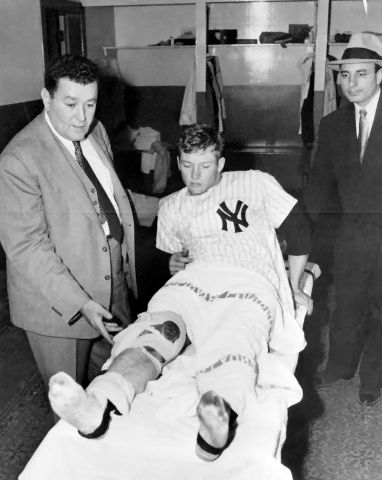
October 5, 1951: Game 2 of the World Series is played at Yankee Stadium. The New York Yankees, with Eddie Lopat pitching a fine game, evened up the Series against the New York Giants by winning 3-1 over Larry Jansen. Joe Collins hit a home run. But the big story came in the top of the 5th inning.
The Yankees' big rookie, Mickey Mantle, already a big story and not yet 20 years old for another 15 days, was playing right field, with the idea that, the next season, he would succeed Joe DiMaggio in center field.
The Giants' big rookie, Willie Mays, who had turned 20 in May, hit a fly ball to right-center. Mantle went for it, but heard DiMaggio calling for it, and stopped short. That caused Mantle to step in a drain that had been mistakenly left open, catching his spikes, and tearing the anterior cruciate ligament (ACL) in his right knee.
With today's sports medicine, Mickey would have been operated on the next day, and would have been ready for Opening Day the next April. But they didn't know how to treat a torn-up knee in the Truman years. The surgery he got was hardly good enough, and the knee never really healed right. This is why people say, "We never got to see Mickey Mantle on 2 good legs."
If the Yankees ever found out which groundskeeper left the drain open, they handled it privately, without ever revealing the man's name. Which, given the fanatical devotion of the fans Mantle would eventually have, was for the best.
The story got worse. Mickey's father, Elvin "Mutt" Mantle, who had made his son a special project, teaching him to play, including how to switch-hit, was in attendance. They rode to Lenox Hill Hospital together in a taxi. Mickey leaned on his father for support getting out of the cab. But Mutt collapsed, causing Mickey to collapse, too.
All those years of working in the zinc mines of northeastern Oklahoma, inhaling the poisonous dust, had given Mutt Hodgkin's disease. He was not just too weak to support his son at that moment, he was dying. Also with today's medicine, he might have lived. Then again, with today's economy, he might not have had to work in the mines.
Father and son spent the rest of the World Series watching the games from adjoining hospital beds. Mutt died on May 7, 1952, only 40 years old. None of the men in Mickey's family had lived past the age of 45, and Mickey was convinced they family was "cursed," and that he wouldn't make it past 45, either. So he was going to live every day like there was no tomorrow. It didn't occur to him that, not working in the mines, he would be healthier.
Instead, he drank to dull the physical pain of so many injuries, and the psychological pain of losing his father so soon, and of the way he was often treated by the New York fans and the New York media, until he went from being the kid with all the promise to the star who was fulfilling the promise. He ended up playing 18 seasons, hitting 536 home runs, winning 3 American League Most Valuable Player awards, including in 1956 when he won the Triple Crown, and helped the Yankees win 12 Pennants and 7 World Series.
But it never seemed to be enough for him. There was always a hole in his life, and he tried filling it with booze and other indulgences. That never works. Realizing it too late, Mickey began using the old line, "If I'd known I was gonna live this long, I'd have taken a lot better care of myself." He finally quit drinking in 1994 -- but the damage to his liver was done, as he only lived another year and a half.
*
October 5, 1951 was a Friday. Actress Karen Allen and Irish rock singer Bob Geldof were born on this day. And the DuMont network variety show Cavalcade of Stars, hosted by Jackie Gleason, includes a 6-minute sketch that became a recurring one, and eventually its own half-hour sitcom on CBS: The Honeymooners.
There were 5 college football games played that night:
* Number 5 Notre Dame beat the University of Detroit, 40-6 at Briggs Stadium in Detroit. That ballpakr was renamed Tiger Stadium in 1960.
* Florida State University, which had only become coeducational in 1947 (after being a women's college since its founding in 1854), played the University of Miami in football for the 1st time, at Burdine Stadium in Miami -- the stadium that will later be renamed the Orange Bowl. Miami won, 35-13. The Seminoles did not beat the Hurricanes for the 1st time until 1958, and not at home in Tallahassee until 1979. The rivalry would get much bigger over the next few years.
* Alabama Polytechnic Institute beat Wofford, 30-14 at the Cramton Bowl in Montgomery, Alabama. API was renamed Auburn University in 1960.
* The University of Mississippi beat Boston College, 34-7 at Crump Stadium in Memphis.
* And Boston University beat the University of Louisville, 39-7 at duPont Manual Stadium in Louisville, Kentucky.


No comments:
Post a Comment