Showing posts with label yankee stadium. Show all posts

Friday, December 30, 2022

December 30, 1962: The Birth of NFL Films

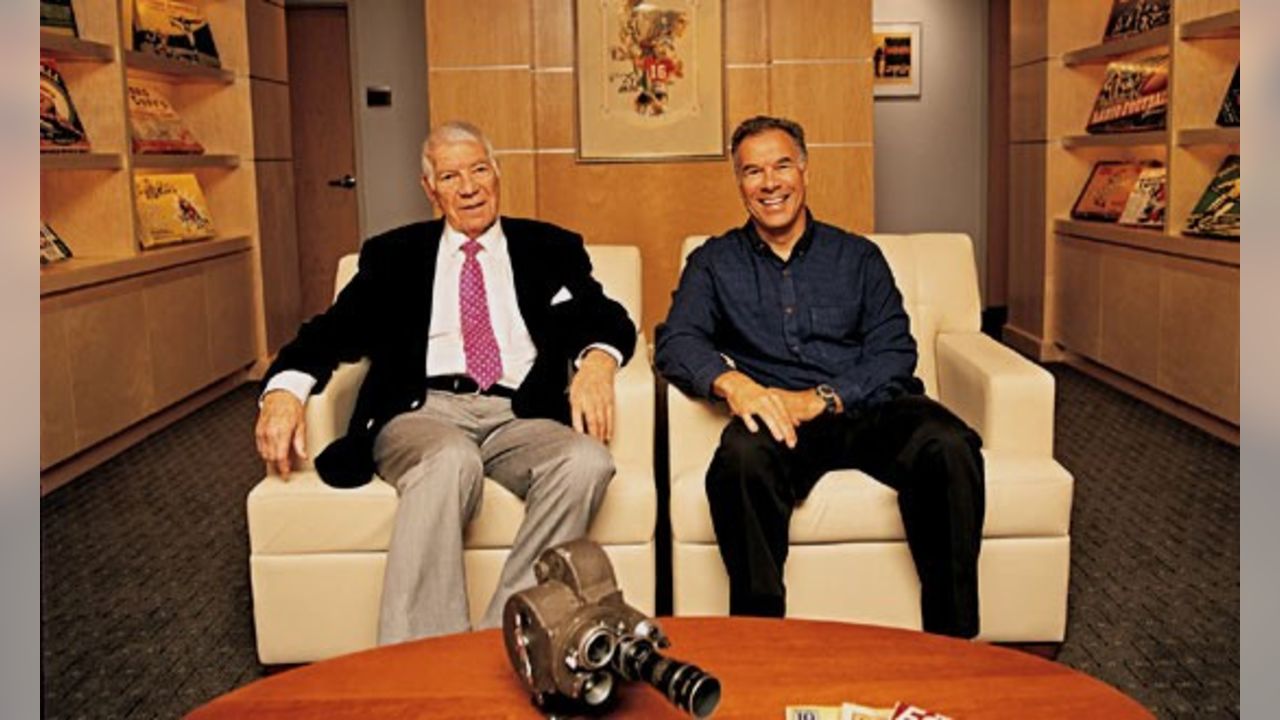
Ed Sabol (left), Steve Sabol,
and the camera that started it all.

December 30, 1962: The Green Bay Packers beat the New York Giants, 16-7 at Yankee Stadium in The Bronx. Aside from being bitterly cold, with New York dealing with the kind of weather that Green Bay was used to, the game itself was not especially remarkable.

But it was filmed by a crew from Blair Motion Pictures of Philadelphia. This was the birth of NFL Films. That company would be nearly as responsible for the League's growth in popularity as Commissioner Pete Rozelle and the various television network executives.

A son of Romanian Jewish immigrants, growing up in Blairstown, Warren County, New Jersey, Ed Sabol served in World War II, then sold topcoats. But he got a home movie camera as a wedding present. He used it to record his son Steve's high school football games. Then he formed a small film company, named for his daughter, Blair. In 1962, he won the rights to film the NFL Championship Game, by bidding $5,000. And even that was double the winning bid of the season before.

Rozelle was impressed by the resulting film, and in 1965, the NFL team owners bought Blair Motion Pictures, renaming it NFL Films. Each of the League's 14 team owners gave Ed $20,000, and the right to shoot all NFL games, and produce an annual highlight film for each team.

In 1967, NFL Films released a half-hour documentary, The Call It Pro Football, including footage of the game that was retroactively renamed Super Bowl I. It began with the narrator, Philadelphia newscaster John Facenda, saying, "It starts with a whistle, and ends with a gun. Sixty minutes of close-in action from kickoff to touchdown. This is pro football: The sport of our time." It was one of the earliest successes for the company.

In 1970, ABC began broadcasting Monday Night Football, and, during halftime, showed NFL Films' footage of the previous day's games. In 1971, the company began producing This Is the NFL, a Saturday show that showed highlights of the previous week's games, on CBS, featuring the network's lead announcing team, former New York Giants tackle and kicker Pat Summerall, and former Philadelphia Eagles cornerback Tom Brookshier. That program did such a great job of raising the NFL's profile, it inspired Major League Baseball to start Major League Baseball Productions, and start the series This Week In Baseball in 1977.

Three things stood out in NFL Films' broadcasts: The marching-band music, the use of slow motion to capture things like the spinning of a passed football in flight, and the narration of Facenda. Let the record show, however, that he never described the field in Green Bay as "the frozen tundra of Lambeau Field." That was later ESPN announcer Chris Berman, imitating him.

ESPN eventually began doing historical programs, featuring footage from NFL Films' vault at their massive headquarters in Mount Laurel, Burlington County, New Jersey, a suburb of Philadelphia; and interviews with surviving figures from those films, conducted by Steve Sabol.

These included Old Leather, from 1976, about stars of the 1920s, with Red Grange, Fritz Pollard, and Johnny "Blood" McNally among those alive and well enough to sit for interviews; and Their Deeds and Dogged Faith, from 1977, about some of the toughest figures in NFL history, including Chicago Bears (and NFL) founder George Halas.

Facenda died in 1984, his last film being the highlights of Super Bowl XVIII. Another Philadelphia broadcast legend, Phillies announcer Harry Kalas, took over until his death in 2009. They have used various announcers since.

Ed Sabol was elected to the Pro Football Hall of Fame as a "Contributor" in 2011. It seemed to be just in time: He was 95 years old and in a wheelchair; and Steve was dealing with brain cancer. Steve died the next year, at age 69. Ed lived until 2015, age 98. Steve was posthumously elected to the Hall in 2020.

*

December 30, 1962 was a Sunday. There were no other football games that day: The NCAA had college football bowl games scheduled for the day before and the day after, but not this day; and the AFL Championship Game was the week before, with the Dallas Texans (soon to be the Kansas City Chiefs) beating the Houston Oilers in double overtime.

There were 2 games played in the NBA. The Los Angeles Lakers beat the Detroit Pistons, 135-130 at Cobo Hall (now Huntington Place) in Detroit. Elgin Baylor scored 38 points. And the St. Louis Hawks beat the Chicago Zephyrs, 107-100 at the Chicago Coliseum. The failing Zephyrs moved the next season, becoming the Baltimore Bullets. They moved to Washington in 1973, and became the Washington Wizards in 1997.

There were 2 games played in the NHL. The New York Rangers and the Montreal Canadiens played to a 4-4 tie at the old Madison Square Garden. And the Chicago Black Hawks beat the Boston Bruins, 4-2 at the Chicago Stadium. The Toronto Maple Leafs and the Detroit Red Wings were not scheduled. 

December 30, 1956: "De-FENSE!"

Sam Huff

December 30, 1956: The NFL Championship Game is played at Yankee Stadium. This was the 1st season in which the football version of the New York Giants played their home games there, after 31 seasons across the Harlem River, at the Polo Grounds, home of the baseball Giants.

The Giants selected linebacker Sam Huff of West Virginia in the 3rd round of the 1956 NFL Draft. He did not get along with head coach Jim Lee Howell, and quit. But before he could get on a plane to go home, the team's offensive coordinator caught him at the airport, and talked him into going back. That coach's name was Vince Lombardi.

The defensive coordinator was Tom Landry, who had been perhaps the 1st player in the two-platoon era to became a great defensive back without also playing on offense. He devised the 4-3 defense, with 2 tackles, 2 ends, and 3 linebackers, and dropped Huff to the position of middle linebacker, which did not previously exist. (Up to then, most teams used a 5-2 defense.)

Huff recalled, "Before, I always had my head down, looking right into the center's helmet. Now, I was standing up, and I could see everything, and I mean everything. I always had outstanding peripheral vision. It's one of the reasons I was so perfectly suited for the position."

The Giants had a good offense, with quarterback Charley Conerly; running backs Frank Gifford, Mel Triplett and Alex Webster; end Kyle Rote; and offensive tackle Roosevelt Brown. But, for the 1st time in NFL history, it was a defense that caught everybody's attention. Before the various Fearsome Foursomes (at least 3 teams had lines nicknamed that), before the No-Name Defense in Miami, before the Steel Curtain in Pittsburgh, before the Doomsday Defense in Dallas, before the Jets' New York Sack Exchange, and before the 46 Defense in Chicago, there was the Big Blue Wrecking Crew.

The tackles were Dick Modzelewski and Rosey Grier. The ends were Jim Katcavage and Andy Robustelli. The linebackers were Sam Huff, flanked by Bill Svoboda and Harland Svare. The cornerbacks were Ed Hughes and Dick Nolan. The safeties were Emlen Tunnell and Jimmy Patton. They were so good, a new chant rang around the rafters of the pre-renovation original Yankee Stadium: "De-FENSE! De-FENSE! De-FENSE!"
The pre-renovation old Yankee Stadium,
in its football configuration

Huff said, "Landry built the 4-3 defense around me. It revolutionized defense, and opened the door for all the variations of zones and man-to-man coverage, which are used in conjunction with it today."

Gifford, the 1st in a long line of great tailbacks at the University of Southern California, was the glamour boy on offense, but Huff became that on defense. And on December 30, 1956, with the field at Yankee Stadium frozen solid, the Giants played the NFL Championship Game against the Chicago Bears. They were a far cry from the "Monsters of the Midway" who had dominated the NFL in the 1940s.

Three weeks earlier, on December 9, the Bears were playing the Chicago Cardinals at Wrigley Field, in a game that would be depicted in an episode of the ABC sitcom Happy Days. Ed Brown, playing quarterback for the Bears, threw an interception. Richie Cunningham, played by Ron Howard, said he wanted the other quarterback put in. His friend Ralph Malph, played by Donny Most, said of that quarterback, "He's washed up. He's old. He's 30. He's got no future." Richie said, "George Blanda has 2 or 3 good years left."

The Bears won the game, 10-3. And, while Brown got the Bears into the Championship Game, Blanda kept on playing and playing and playing, until the 1975 AFC Championship Game, played 16 days before that episode of Happy Days aired.

Record-wise, the Bears were better, 9-2-1, compared to the Giants' 8-3-1. But the game was no contest. Especially since, echoing their 1934 Championship Game win over the Bears, the Giants wore sneakers instead of shoes with cleats, getting better traction on the frozen field. This would finally be outlawed -- too late for the Bears.

Tunnell returned Blanda's opening kickoff 53 yards. Just 3 plays later, Triplett ran 17 yards for a touchdown. On the Bears' 1t play from scrimmage, Brown fumbled a handoff, and the Giants recovered. On their next drive, Brown was intercepted by Jim Patton. Both times, Ben Agajanian kicked a field goal, and the Giants ended the 1st quarter up 13-0.

In the 2nd quarter, Alex Webster scored on a 3-yard touchdown run. Rick Casares ran the ball in from 9 yards to put the Bears on the scoreboard. They would not get on it again. Before the half was out, Webster would score another touchdown, and Henry Moore would block a punt in the end zone, making it 34-7 New York.

As Huff and the dee-fense continued to shut the Bears down (if not quite shutting them out), the Giants carried out the kind of ball-control offense that Bill Parcells would use for them 30 years later. In the 3rd quarter, Conerly threw a 9-yard touchdown pass to Rote, although Agajanian missed the extra point. In the 4th quarter, Conerly threw a 14-yard pass to Gifford. Final score: Giants 47, Bears 7. It wasn't a "miracle on ice," it was a massacre on ice.

This began a run of 8 seasons in which the Giants would win their Division 6 times, but they wouldn't win the NFL Championship Game again. In 1958, the Giants hosted the Baltimore Colts, and lost in overtime, in what has become known as "The Greatest Game Ever Played." In 1959, they had a rematch at Memorial Stadium in Baltimore, and the Colts won again.

By that point, Lombardi was gone, having been named the head coach of the Green Bay Packers. In 1960, Landry was named the 1st head coach of the expansion Dallas Cowboys. That season, the Giants lost the Division title to the Philadelphia Eagles, after a fumble-forcing tackle by Chuck Bednarik knocked Gifford out for the rest of the season.

Gifford sat out the 1961 season, while Allie Sherman was named the Giants' new head coach, and Y.A. Tittle replaced Conerly as quarterback. They won the Division again, but lost the Championship Game to Lombardi's Packers on a snow-strewn Lambeau Field on New Year's Eve. In 1962, with Gifford returning, it was Giants vs. Packers again, this time at Yankee Stadium, again with the field frozen, and the Packers won. In 1963, on yet another frozen field, the Giants went out against the Bears at Wrigley Field, and lost a tough battle.

All the while, Huff became more and more famous. He was named to 5 Pro Bowls. Time magazine had placed college football players on its cover before, but Huff became the 1st NFL player on it, for its issue dated November 30, 1959.

In the 1960 preseason, the CBS news program The Twentieth Century approached Huff, offering to put a microphone on his uniform for practices and an exhibition game, to show TV viewers what a football game really sounded like. Hosted by Walter Cronkite, it was titled "The Violent World of Sam Huff," and it aired, perhaps appropriately, on October 30, Mischief Night.

How successful was the program? The next day, a CBS executive wrote a letter, put it in an envelope, and wrote nothing on the envelope except "Number 70." No actual name, no return address, nothing except "Number 70." Three days later, the letter was delivered to Huff's locker at Yankee Stadium.

The U.S. Postal Service employees knew exactly what, and who, it meant. Even before Lawrence Taylor was born, Huff might have been a better linebacker.

The team seemed to get old all at once in 1964. Huff was traded to the Washington Redskins, Tunnell was already gone, and 1964 would be the last season for Tittle, Gifford and Robustelli. Roosevelt Brown lasted 1 more season. The Yankees, too, seemed to get old overnight between the Autumn of 1964 and the Spring of 1965. Yankee Stadium became a very different place through its closing for renovations in 1973.

In October 1976, the Yankees would be back in the World Series, in a renovated Yankee Stadium; while the new Giants Stadium opened in the New Jersey Meadowlands. It took until 1981 for the Giants to make the Playoffs again, and the 1986 season before they won another title.

*

December 30, 1956 was a Sunday. Actresses Sheryl Lee Ralph and Patricia Kalember were born.

At the time, the NCAA did not permit college football games, even bowl games, to be played on Sundays. Baseball was out of season. There were 4 games played in the NBA:

* The New York Knicks beat the Rochester Royals, 96-88 at the old Madison Square Garden. Kenny Sears scored 33 points for the Knicks. This would be the last season in Rochester, as the Royals moved to Cincinnati for 1957-58.

* The Boston Celtics beat the Syracuse Nationals, 105-92 at the Boston Garden.

* The Fort Wayne Pistons beat the Philadelphia Warriors, 104-99 at the Allen County War Memorial Coliseum in Fort Wayne, Indiana. In spite of the defeat, the Warriors' Paul Arizin scored 35 points. This would be the last season in Fort Wayne, as the Pistons moved to Detroit for 1957-58.

* And the St. Louis Hawks beat the Minneapolis Lakers, 100-93 at the Kiel Auditorium in St. Louis. Bob Pettit scored 41 points and had 18 rebounds for the Hawks.

And there were 2 games in the NHL. The Boston Bruins beat the Detroit Red Wings, 4-2 at the Olympia Stadium in Detroit. And the Chicago Black Hawks beat the Toronto Maple Leafs, 2-0 at the Chicago Stadium. The New York Rangers and the Montreal Canadiens were not scheduled.

Wednesday, December 28, 2022

December 28, 1958: Pro Football's "Greatest Game"

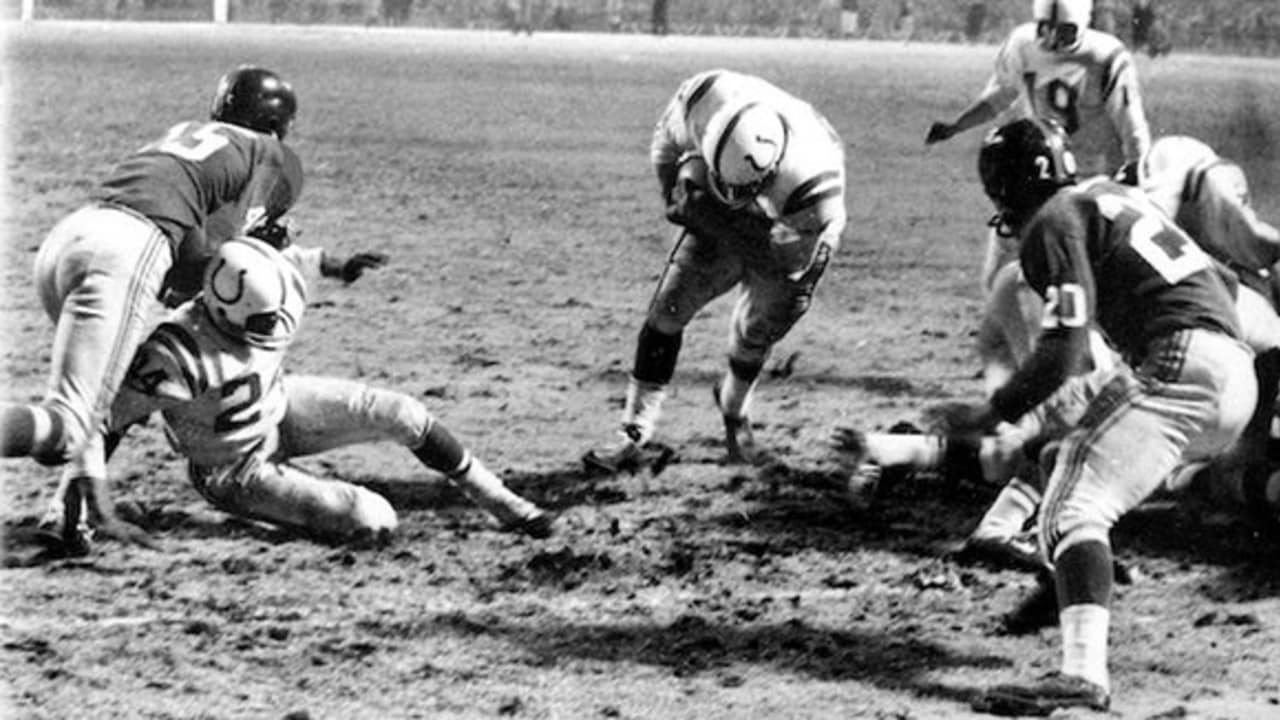
Alan Ameche scores the winning touchdown.
Lenny Moore (24) provides the key block on Emlen Tunnell.
Johnny Unitas (19) watches.

December 28, 1958: The NFL Championship Game is held at Yankee Stadium. The New York Giants, Champions of the NFL Eastern Division, play the Baltimore Colts, Champions of the Western Division. It is the 1st Championship Game for the Colts, the 10th for the Giants, who had previously won it in 1934, 1938 and 1956. (Why Baltimore, a Northeastern city, was placed in the League's Western Division, I don't know.)

The Giants had Charlie Conerly as their quarterback, and the biggest football star of the time, Frank Gifford, at running back. They were the 1st team to really make defense a priority, led by future Hall-of-Famers Sam Huff, Andy Robustelli and Emlen Tunnell. Two years earlier, they had destroyed the Chicago Bears in the Championship Game, 47-7.
The pre-renovation original Yankee Stadium, set up for football

But the Colts were on the rise. Their quarterback was Johnny Unitas. He had Raymond Berry to throw to, Lenny Moore in his backfield, and Jim Parker to block for him. All 4 would make the Hall of Fame. His defense was led by Hall-of-Famers Gino Marchetti and Art Donovan.

The 1st half was a bit sloppy, and didn't live up to the legend. Pat Summerall, future broadcasting legend, began the scoring with a field goal in the 1st quarter, putting the Giants up 3-0. In the 2nd quarter, Alan Ameche, who won the Heisman Trophy at the University of Wisconsin in 1954, scored a touchdown to put the Colts ahead. Unitas threw a touchdown pass to Berry, giving the Colts a 14-13 lead at the half.

In the 3rd quarter, Mel Triplett snuck the ball over the goal line to put the Giants back in it. Early in the 4th quarter, Conerly threw a touchdown pass to Gifford, giving the Giants a 17-14 lead. As the clock wound down, Unitas drove the Colts, but couldn't get them over. So Steve Myhra was sent in to kick a field goal as time expired. With the clock reading 0:00, the scoreboard read 17-17.

No NFL Championship Game had ever ended in a tie. Overtime was needed, for the 1st time in NFL history. (The League didn't institute overtime for the regular season until 1974.) The Giants won the toss, but couldn't score. Unitas led an inspiring drive, toward what would have been left field in The Stadium's baseball setup, which finally ended with Ameche scoring from the 1-yard line -- appropriately where Monument Park would later be in The Stadium's post-renovation period (1976-2008).

Bob Wolff, who had been in the same Stadium 2 years earlier to call Don Larsen's perfect game for the New York Yankees against the Brooklyn Dodgers in the 1956 World Series, was at the microphone for NBC again, and had the call: "Unitas gives to Ameche... The Colts are the World Champions! Ameche scores!" He later said he was glad he didn't "bury the lead" by saying, "Ameche scores!" first.

This game had the largest TV audience in NFL history to that point, 45 million people. The fact that it was in New York, and involved a New York team, helped it loom large in the public consciousness. This was the game that launched the NFL on a path to becoming, at least in perception, more popular than Major League Baseball.

It made legends of the Colts, and Unitas in particular. He would go on to be recognized as the greatest quarterback of all time. It's been 62 years, and some people still think he is. And the Colts, playing in a city that didn't have a big college football team -- Morgan State University is a historically black school, the U.S. Naval Academy is a national school, and the University of Maryland is closer to Washington -- became known as the team of America's working class, an "America's Team" in a way that felt artificial when the Dallas Cowboys later called themselves that.
Johnny Unitas

It also became known as "The Greatest Game Ever Played." It has been noted that it would never have been called that had the Colts beaten, say, the Philadelphia Eagles. But it was the New York team that they beat, in New York City. And so, every so often, polls are taken that show this game as the "greatest." The most recent was in 2019, for the NFL's 100th Anniversary. In 1981, John Thorn left his comfort zone, baseball, and published Pro Football's 10 Greatest Games. He included this game as one of them.

The teams had a rematch in the 1959 NFL Championship Game. In those days, home field was rotated between the Eastern and Western Champions, and the Colts hosted it at Memorial Stadium, beating the Giants again.

It remains the longest game in New York Giants history.

When The Sporting News ranked its 100 Greatest Football Players in 1999, Unitas came in 5th, Marchetti 15th, Parker 24th, Berry 40th, and Moore 71st. When the NFL Network ranked its 100 Greatest Players in 2010, Unitas was 6th, Parker 32nd, Berry 36th, Marchetti 39th and Moore 94th.


*

December 28, 1958, as you may have guessed, was a Sunday. There were no more NFL games to be played. It was the off-season for baseball.

There was only 1 NBA game played that day: The Cincinnati Royals beat the Minneapolis Lakers, 120-116 at the Cincinnati Gardens. Jack Twyman of the Royals scored 32 to lead all players in this game. Bob "Slick" Leonard, later to coach the Indiana Pacers to 3 ABA Championships, led the Lakers with 20 points.

The Lakers moved to Los Angeles in 1960. The Royals moved to Kansas City, becoming the Kings, in 1972, and to Sacramento in 1985.

All of the NHL's "Original Six" were in action that day:

* The New York Rangers beat the Montreal Canadiens, 5-3 at the old Madison Square Garden. This was an anomaly, as the Canadiens were in the middle of a run of 5 straight Stanley Cups, and the Rangers were in a down period.

* The Detroit Red Wings, beat the Boston Bruins, 5-3 at the Olympia Stadium in Detroit.

* And the Chicago Black Hawks beat the Toronto Maple Leafs, 4-3 at the Chicago Stadium. ("Black Hawks" was written as 2 words until 1986, when the team's original charter document was found, and it was discovered that "Blackhawks" was written as one word, and it has officially been so ever since.) 

Monday, December 12, 2022

December 12, 1933: The 2nd Athletics Fire Sale

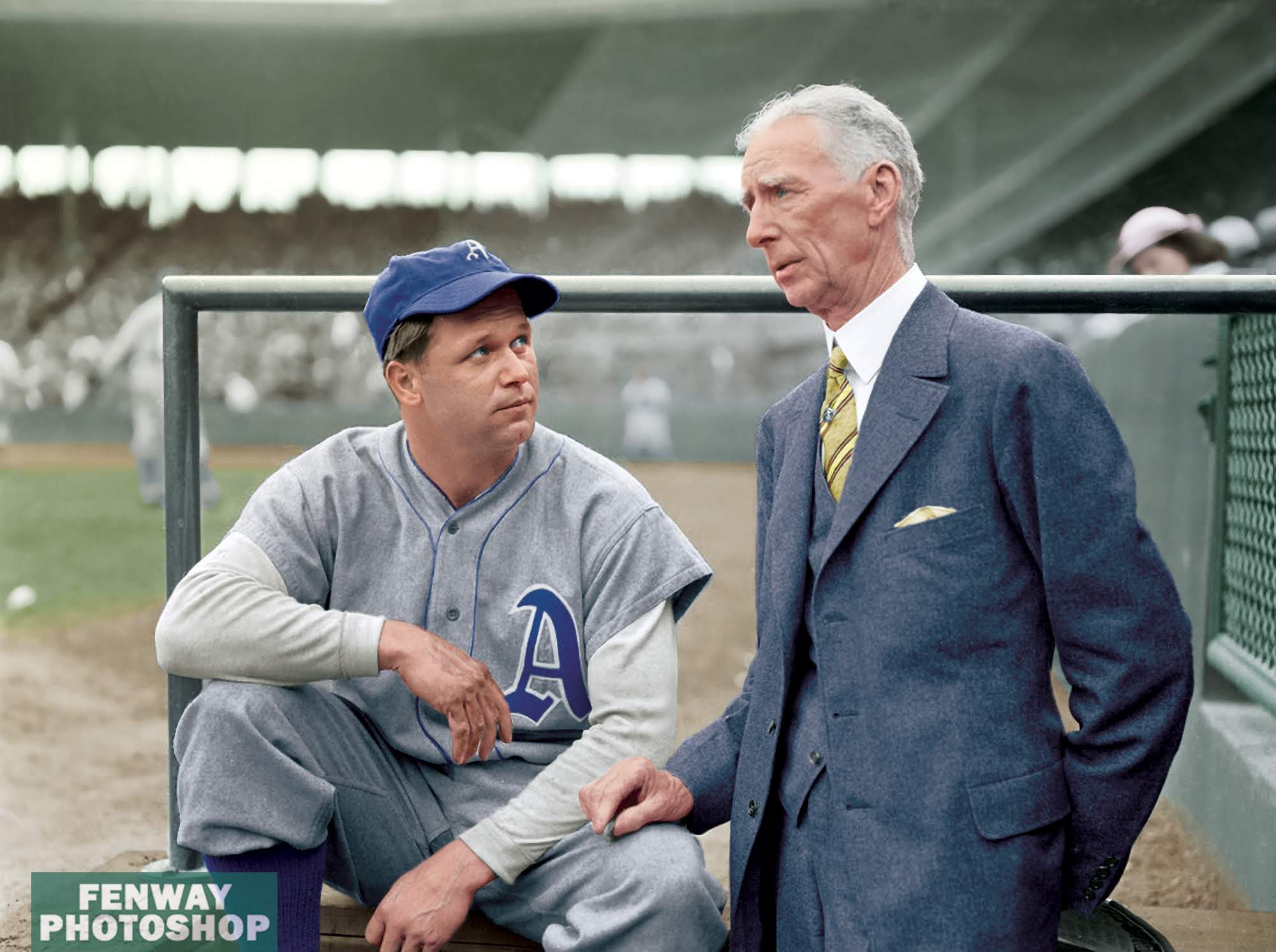
Jimmie Foxx (left) and Connie Mack

September 28, 1932: Connie Mack begins the breakup his of his Philadelphia Athletics. The 1st time he'd done so, in 1914-15, it was because he couldn't keep up with the salaries being offered by the Federal League teams. This time, it was personal.

In 1925, the A's went 88-64, and were only 8 1/2 games behind the 1st-place Washington Senators. But the rise of the "Murderers' Row" Yankees delayed Philadelphia's return to greatness. In 1929, they began a run of 3 seasons in which they won 313 games, and game within a Game 7 loss in 1931 of winning 3 straight World Series.

But Mack lost all of his non-baseball holdings in the stock market Crash of 1929. He couldn't fund the A's with any other income. So, after the 1932 season, despite a strong 94-60 record (but 13 games behind the Pennant-winning Yankees), he began to sell of his 2nd generation of stars.

On September 28, 1932, he sent left fielder Al Simmons, 3rd baseman Jimmy Dykes, and center fielder Mule Haas are all sold to the Chicago White Sox, for $100,000. Simmons would be elected to the Baseball Hall of Fame, and Dykes and Haas would have been perennial All-Stars had the All-Star Game been founded before 1933.

But the big day was...

December 12, 1933: When Mack made 3 separate moves:

* Pitchers Lefty Grove and Rube Walberg, and 2nd baseman Max Bishop, are traded to the Boston Red Sox for Bob Kline and Rabbit Warstler and $125,000. Along with Carl Hubbell, Grove was 1 of the 2 best lefthanded pitchers in the game, and would go to the Hall of Fame. Walberg was the 3rd starter on the A's, behind Grove and George Earnshaw, but would have been the ace on many teams.

Key to this deal was the fact that Tom Yawkey had recently turned 30 and come into his inheritance, and had bought the Red Sox, and could afford to spend whatever he wanted to build a championship team. He did try, but the Yankees' dynasty that was restarted in 1936 thwarted his early efforts.

Grove's 199 wins during the 1930s made him the winningest pitcher of the decade.

* Catcher Mickey Cochrane was traded to the Detroit Tigers for Johnny Pasek and $100,000. The Tigers subsequently named Cochrane player-manager, and won the next 2 American League Pennants.

* Finally, before the ink was dry on the previous 2 trades, Mack traded Pasek and Earnshaw to the White Sox for Charlie Berry and $100,000. So, in 1 day, Mack sold off his 3 best pitchers.

On December 10, 1935, 1st baseman Jimmie Foxx and pitcher Johnny Marcum were traded to the Red Sox for Gordon Rhodes, George Savino and $150,000. Foxx was the best righthanded slugger in the game, and would go to the Hall of Fame. Marcum was the Mackmen's best pitcher following the '33 fire sale, and Mack dumped him, anyway.

The A's went from 94-60 in 1932 to 79-72 in 1933, to 68-82 in 1934, to 58-91 in 1935, and to 53-100 in 1936. To make matters worse, Tom Shibe died in 1936, and Jack Shibe the next year. The deaths of these sons of Ben Shibe, with whom Mack founded the A's in 1901, pretty much left Mack, 74 years old at the time, in full control of the A's, and his control of his mental faculties began to diminish.

The A's never recovered. In 1950, Mack's sons, who seemed to agree on nothing else, ganged up in the senile 87-year-old man, and finally removed him from control, if not ownership, and the manager's job after his 50th season in charge. The Mack family ended up selling the team in 1954, to a buyer who moved them to Kansas City.

They failed there as well, and Charlie Finley bought them in 1960, moving them to Oakland in 1968. After 5 straight AL Western Division titles, 1971-75, including 3 straight World Series wins, 1972-74, he broke them up, and the team crashed. New owner Walter Haas rebuilt them in the early 1980s, but the pitching collapsed, preventing a new dynasty. The A's rebuilt again, and won 3 straight Pennants, 1988-90, but after another Division title in 1992, were broken up again.

The pattern held: By 2000, the "Moneyball" regime built a team that reached the Playoffs 5 times in 7 years, but won no Pennants. They sold off, rebuilt, and made 3 straight Playoffs, 2012-14. They couldn't afford to keep it going, sold off, rebuilt, and made 3 straight Playoffs, 2018-20. They couldn't afford to keep it going, and sold off. In 2022, the A's lost 102 games, their most since the Finley fire sale bottomed out at 108 in 1979.

Rumors of the A's moving again have been renewed, since they haven't been able to get a deal to replace the Oakland Coliseum. If they do move, how long will it be before they win again? And, if so, how long before they have a 9th fire sale?

One thing is for sure: The A's are not moving back to Philadelphia, where the Phillies, having won the 2022 NL Pennant, are overwhelmingly popular. The Delaware Valley is certainly big enough to support one winning Major League Baseball team, but not two MLB teams, regardless of performance. But, wherever they go, or if they stay, at some point, the A's will go back to their Philadelphia roots, by breaking it all down and starting all over again.

In 1949, Ogden Nash, my grandmother's favorite poet, wrote "Line-Up for Yesterday" for Sport magazine, an alphabetical list of star players. For the letter Q, Nash had to cheat a little, and wrote:

Q is for Don Quixote
Cornelius Mack;
Neither Yankees nor years
Can halt his attack.

He also had to cheat a little for the letter X:

X is the first
of two x's in Foxx
Who was right behind Ruth
with his powerful soxx.

*

December 12, 1933 was a Tuesday. Baseball was out of season. The NBA hadn't been founded yet. The NFL was going to play its 1st official Championship Game the following Sunday, and the Chicago Bears won it, 23-21 over the New York Giants.

There were 4 games played in the NHL that night:

* The Toronto Maple Leafs beat the Boston Bruins, 4-1 at the Boston Garden. This was the game in which Eddie Shore hit Ace Bailey over the head with his stick, ending his career. I have a separate entry for that event.

* The New York Americans beat the New York Rangers, 3-0 at the old Madison Square Garden, which was still fairly new at the time. The company that ran the Garden owned the Rangers, and the Amerks were tenants, so any win the tenants had over the landlords was considered big.

* The Detroit Red Wings beat the Chicago Black Hawks, 4-1 at the Olympia Stadium in Detroit.

* And the Montreal Canadiens and the Ottawa Senators played to a 1-1 tie at the Ottawa Auditorium.

Sunday, November 20, 2022

November 20, 1960: Chuck Bednarik Knocks Frank Gifford Out

November 20, 1960: The New York Giants and the Philadelphia Eagles, arch-rivals since the Eagles' founding in 1933, play at Yankee Stadium. The winner was probably going to win the NFL's Eastern Division and play in the NFL Championship Game, as the Giants had in 3 of the last 4 years. Since the hosting alternated between the East and West winners in those days, the winner would also host the title game.

Some cities, like Los Angeles and Miami, like their sports heroes to be flashy. Others, like Philadelphia and Chicago, prefer them to be tough. Blue-collar. They will accept failure, but they will not accept failure to try. They understand it if you fall, as long as you get back up. New York likes to have it both ways: Men like Joe DiMaggio, Joe Namath, Walt "Clyde" Frazier, Derek Jeter.

And one of the flashiest New York athletes was Frank Gifford, Hall of Fame running back for the Giants in the 1950s. Until 1960, it never would have occurred to anyone to call Gifford "tough." What they called this handsome devil out of Bakersfield, California and the University of Southern California was "the Golden Boy." He was already the most popular football player in New York history, so much so that, in the off-season at Yankee Stadium, he got Mickey Mantle's locker.

Chuck Bednarik was tough. How tough was he? He came out of still mill country in Northeastern Pennsylvania, and served as a waist gunner on B-24 bomber in World War II. But he was also smart: He got into the University of Pennsylvania in Philadelphia, and the Ivy League doesn't give athletic scholarships.

He was a rookie on the Eagles' NFL Championship team of 1949, and played center and linebacker for them, even after the switch to two-platoon football. He was "the last of the 60-minute men." Of course, in those days, athletes were paid so little that it was necessarily to get off-season jobs. He sold concrete, and that, rather than his toughness, that earned him the nickname "Concrete Charley."

Both teams had toughness. But the Giants embraced flashiness, while the Eagles ignored it.

The Giants led 10-0 at the half, but blew it. In the 4th quarter, the Eagles' Jimmy Carr picked up a fumble and returned it 38 yards for a touchdown, making it 17-10 Eagles.

With the clock running out, George Shaw, filling in for injured quarterback Charlie Conerly, threw a pass toward Gifford at midfield. Gifford caught the pass, but Bednarik arrived at the same time, and he flattened Gifford, who fumbled. The Eagles recovered.

On the film, this doesn't look like an especially devastating hit. I've seen much worse. What made this the most famous hit in NFL history -- aside from the fact that it was in New York, and involved a New York team, and was seen by a national TV audience -- was how Chuck reacted.

The film shows him reacting to the fumble by jumping around and clapping his hands. Then he pumped his fist, and issued what became his catchphrase: "This fucking game is over!" Which, for all intents and purposes, it was. The final score was, indeed, 17-10 Eagles.

But it was the photograph that proved devastating. It showed Bednarik standing over Gifford, pumping his fist. Gifford is lying on the ground, motionless. Bednarik spent the last 54 years of his life explaining that he didn't even realize Gifford was motionless on the ground in front of him, that he was celebrating the Eagles wrapping up a big win, not the fact that he'd knocked Gifford out. He said he didn't even realize he'd knocked Gifford out.

Legend has it that Gifford was knocked out because, despite wearing a helmet, he hit his head on the frozen grass at Yankee Stadium. This couldn't be true: According to Pro-Football-Reference.com, it was 49 degrees at gametime -- not a particularly notable temperature for mid-November New York, and hardly cold enough to freeze the field.

Gifford was taken to the Giants' locker room. Also taken to the locker room for first aid was a security guard who had a heart attack. Frank's first wife, Maxine, didn't know this, and when she went down to the locker room to see Frank, she heard someone say, "He's dead" -- meaning the security guard. When the guard was wheeled out on a stretcher, with his face covered by a sheet, reporters saw this, and thought it was Gifford.

The rumor began to spread that Bednarik had killed him. And when the photo was seen in newspapers across the country the next day, Bednarik looked like a monster, celebrating his "kill."

It got worse. Bednarik went to see Gifford in the hospital the next day, and was told Gifford couldn't receive visitors. But a new rumor circulated, that Bednarik wouldn't see Gifford. It wasn't that he wouldn't, it was that he couldn't.

Gifford missed the rest of the season, and decided to retire at age 30. But he missed playing, and returned in 1962, switching to receiver for safety reasons. He played 3 more seasons and retired again, becoming one of football's greatest broadcasters.

Gifford always said he never held it against Bednarik. Bednarik said he was tired of people remembering him mainly for one thing: "It was always, 'Oh, you're the guy! You're the guy! You're the guy that got Frank Gifford!'" He was also tired of Howard Cosell, on ABC Monday Night Football, seeing a hard hit, and turning to Gifford, and saying, "Just like Chuck Bednarik blindsided you at Yankee Stadium, Giffaroo!"

"Blindsided, my fanny! It was a clean hit," he always said. And it was: Like the infamous Denis Potvin hit on Ulf Nilsson in 1979, or Scott Stevens leveling Eric Lindros in 2000, the 2 best-known hits in the history of hockey, no penalty was called on it. (And, yes, this profane man would say, "fanny" when he told the story, not "ass." In America, "fanny" means rear end. In Britain, it means the other side, of a woman.)

Both men died in 2015. Bednarik had been dealing with dementia for a few years, almost certainly induced by all that head contact in football. Gifford's 3rd wife, entertainer Kathie Lee Gifford, had also begun to notice him slipping. He, too, was a victim of football-induced head trauma. And that would have been the case even if Bednarik had merely tackled him that day, rather than outright knocking him out.

*

November 20, 1960 was a Sunday. It was also the day that writer Norman Mailer stabbed his wife, Adele Morales, at a party he was hosting in New York. She survived, and he pretty much got away with it. I have a separate entry for this event.

These were the other NFL games played that day:

* The football version of the St. Louis Cardinals, who had been in Chicago until this season, beat the Washington Redskins, 26-14 at Griffith Stadium in Washington.

* The Pittsburgh Steelers beat their arch-rivals, the Cleveland Browns, 14-10 at Forbes Field in Pittsburgh.

* The Chicago Bears beat the Detroit Lions, 28-7 at Wrigley Field in Chicago.

* The Los Angeles Rams beat the Green Bay Packers, 33-31 at Milwaukee County Stadium.

* The San Francisco 49ers beat the Dallas Cowboys, 26-14 at the Cotton Bowl in Dallas. The Cowboys, a 1st-year expansion team, went 0-11-1 that 1st season. Their only non-loss was a tie against the Giants at Yankee Stadium.

* Since there were now 13 teams in the NFL, one team had to have a bye week every week. This week, it was the Baltimore Colts.

This was the 1st season of the American Football League. These were their games on the day:

* The Houston Oilers beat the Denver Broncos, 20-10 at Jeppesen Stadium in Houston.

* The Buffalo Bills beat the Los Angeles Chargers, 32-3 at the Los Angeles Memorial Coliseum.

* The Boston Patriots, the Dallas Texans, the New York Titans and the Oakland Raiders -- the teams now known as the New England Patriots, the Kansas City Chiefs, the New York Jets and the Las Vegas Raiders -- had irregular schedules, and did not play on November 20.

There were 2 games in the NBA. The Boston Celtics beat the Cincinnati Royals, 120-103 at the Cincinnati Gardens. And the Los Angeles Lakers beat the Detroit Pistons, 135-131 at the Olympia Stadium in Detroit. Elgin Baylor scored 52 points for the Lakers.

And the entire NHL, the "Original Six," was in action. The New York Rangers lost to the Detroit Red Wings, 4-3 at the old Madison Square Garden. The Toronto Maple Leafs beat the Boston Bruins, 3-2 at the Boston Garden. And the Montreal Canadiens and the Chicago Black Hawks played to a tie, 1-1 at the Chicago Stadium.

Wednesday, November 9, 2022

November 10, 1928: Notre Dame Wins One for the Gipper

November 10, 1928: The football teams of the University of Notre Dame and the U.S. Military Academy, a.k.a. "Army," play at Yankee Stadium. A crowd of 78,188 see the Cadets lead the Fighting Irish 6-0 at halftime. It wasn't that surprising: Army was undefeated, 6-0, while Notre Dame was only 4-2.

In his halftime pep talk, instead of discussing strategy, Notre Dame coach Knute Rockne tells his players, who would have been in junior high school in 1920, about George Gipp. A back on both offense and defense, and a also a great kicker, Gipp had led Notre Dame to the National Championship that season.
But he had gotten sick -- how it happened depends on who's telling the story -- and, in those pre-antibiotic days, he was doomed to die at the age of 25. As Rockne told it, he went to see Gipp on his deathbed on December 14, 1920, and Gipp told him: 

I've got to go, Rock. It's all right. I'm not afraid. Some time, Rock, when the team is up against it, when things are wrong, and the breaks are beating the boys, ask them to go in there with all they've got, and win just one for the Gipper. I don't know where I'll be then, Rock. But I'll know about it, and I'll be happy.

Having told the 1928 players that story, Rockne concludes by saying, "Gentlemen, this is that game." And the players leave the locker room in tears, and come from behind, with Jack Chevigny and Johnny O'Brien scoring touchdowns, and beat Army 12-6.

That's the story. But it makes no sense. First of all, why choose this game? Because it was in New York? Because it was against Army? Certainly, Rockne didn't need to be afraid of losing his job: He was already an icon in South Bend, Indiana.

Second of all, they were only down by 6 points. Maybe if they needed a much bigger effort, to overcome a 2-touchdown deficit, such a speech might be warranted.

Third of all, like I said, those players were just kids when Gipp died. They never saw him play. It's not like there was television back then. The newsreels probably never showed Gipp. For all they knew, Rockne could have been lying, and Gipp could have walked into the room at that moment, and they wouldn't have recognized him. (Another coach, Edward "Slip" Madigan of St. Mary's in the San Francisco Bay Area, allegedly once tearfully told his players about his sick son, and said to win the game for him, when the son walked in, just fine.) Gipp's legend shouldn't have had any effect on the 1928 Fighting Irish.

And fourth of all, if the locker room speech did happen, Rockne probably made it up. As one sportswriter put it, decades later, If Gipp said anything to Rockne as he was dying, it was probably more along the lines of, "Put a hundred bucks on the 4 horse in tomorrow's 7th race at Arlington for me."

Rockne was killed in a plane crash near Bazaar, Kansas on March 31, 1931. On October 4, 1940, the film Knute Rockne, All-American premiered. Pat O'Brien played the coach. Ronald Reagan, who had played guard at Eureka College in Illinois, now an NCAA Division III school, played Gipp, and played the speech scene straight.

As Reagan went into politics in the 1960s, and was elected President in 1980, he often played up his connection to Notre Dame. His fans joyfully called him "the Gipper." At the 1988 Republican Convention, at the Superdome in New Orleans, knowing he couldn't run for a 3rd term, he told the new nominee, his Vice President, George H.W. Bush (who played baseball at Yale), "Go out there, and win one for the Gipper!" Meaning himself. Bush did win the election.

As Reagan fell victim to Alzheimer's disease, and could no longer make public appearances, campaign signs reading, "WIN ONE FOR THE GIPPER" appeared at rallies for Bob Dole in 1996 and George W. Bush in 2000. Reagan died in 2004, and during Bush's re-election campaign, there were more "Gipper" signs than ever before. They came up again for John McCain in 2008 and Mitt Romney in 2012. They were not used for Donald Trump in 2016 and 2020: Far be it from him to allow someone other than himself to be idolized.

Reagan's political career was built on many, many lies. The "Win one for the Gipper" story was the first. If the truth about Gipp had been widely known in 1966, when Reagan was making his 1st run for public office, for Governor of California, he might never have won an election. After all, the other movie people tended to remember him for was Bedtime for Bonzo, where he worked with a chimpanzee.

George Gipp was a real person, and he really was a great football player. But the thing everybody remembers about him almost certainly isn't true. But, like Reagan's campaign promises, Rockne's Gipper speech was a fraud -- or, as the actual Irish would say, it was blarney -- that worked very well.

*

November 10, 1928 was, like most college football days, a Saturday. There were no baseball games. The NHL season wouldn't start for another 5 days. The NBA wouldn't be founded for another 18 years. But there were NFL games played that day. Because Pennsylvania banned professional sports on Sunday until 1933, the Frankford Yellow Jackets played the Pottsville Maroons on this Saturday, and the Jackets won, 19-0 at Frankford Stadium in Northeast Philadelphia.

And there were other college football games played that day:

* Georgia Tech, 5-0, played Vanderbilt, 6-0, at Grant Field in Atlanta. Tech won, 19-7.

* The championship of the Big Six Conference, the league that would eventually become the Big Eight and 2/3rds of the Big XII, was decided when Nebraska renewed its rivalry with Oklahoma, and won 44-6 at Memorial Stadium in Norman, Oklahoma.

* New York University defeated Alfred University of Alfred, in Western New York State, at Ohio Field in The Bronx.

* Fordham did not play on that day. Instead, they had an Armistice Day (Veterans Day) matinee 2 days later, against Boston College at Fenway Park. BC won, 19-7.

* Rutgers lost to Lafayette, 17-0 at Neilson Field in New Brunswick.

* And Princeton beat Washington & Lee University, 25-12 at Palmer Stadium in Princeton.

Also, Arsenal beat Sheffield United, 2-0 at Highbury in North London.

Also on this day, Italian composer Ennio Morricone was born. He is best known for his collaborations with director Sergio Leone on his "Spaghetti Westerns." His theme for the 1966 Clint Eastwood epic The Good, the Bad, and the Ugly is considered one of the greatest in movie history.

November 9, 1946: Army vs. Notre Dame, "The Game of the Century"

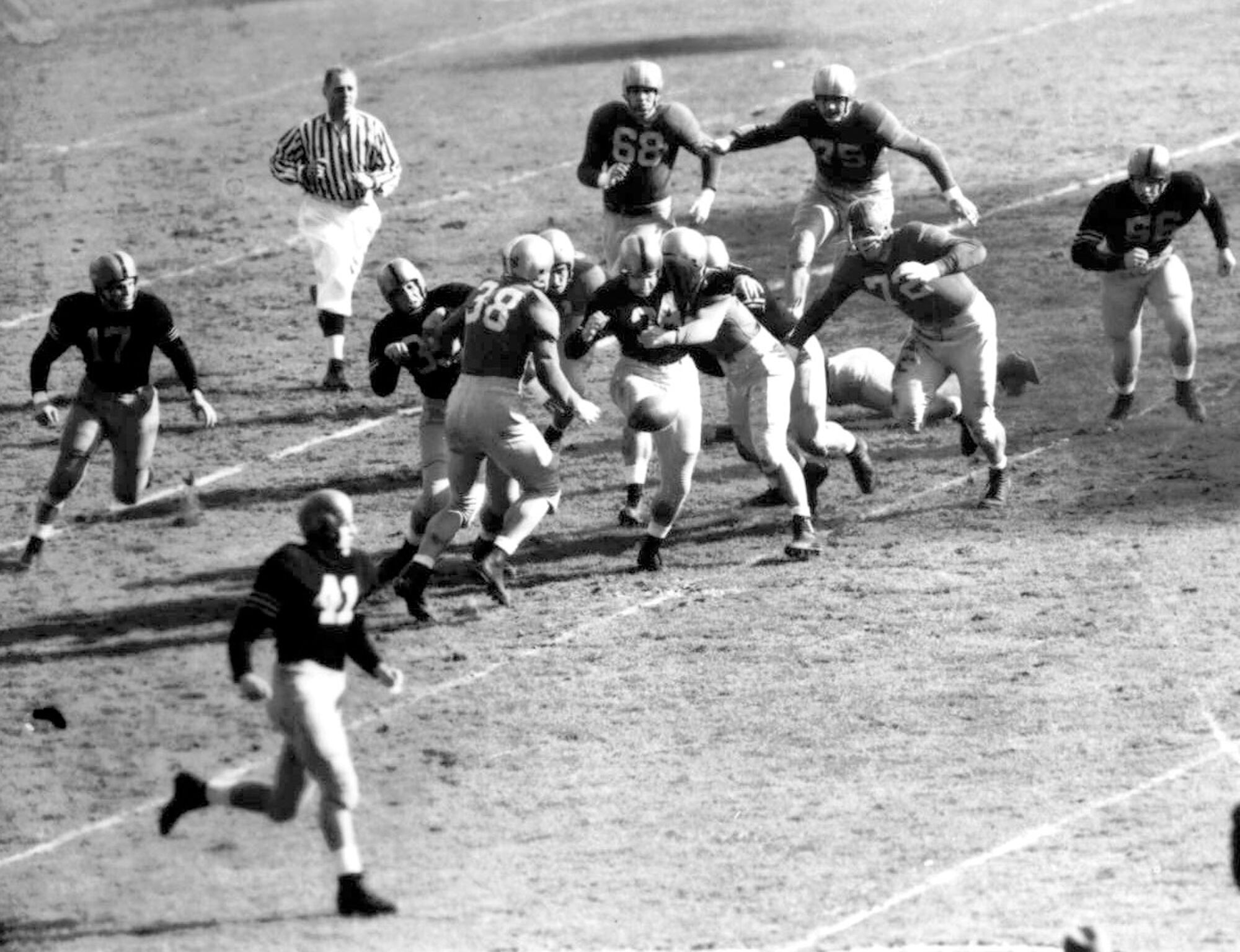
November 9, 1946: One of those college football games that gets the label "Game of the Century" is played at the original Yankee Stadium.

The football team at the United States Military Academy at West Point, New York -- 47 miles north of The Stadium, and they'd used both it and the nearby Polo Grounds as a home-away-from-home a few times -- was usually just called "Army." The teams, as were the students, were known as the Cadets. But, by this point, they were already being called "the Black Knights of the Hudson" in the press. In 1999, the Academy dropped "Cadets," and made "Black Knights" official.

Unlike most college football teams, Army didn't have a manpower drain due to World War II: Quite the opposite: They were training men for war. As a result, head coach Earl "Red" Blaik had the best backfield in the sport, and that included the NFL: Felix "Doc" Blanchard, Number 35; and Glenn Davis, Number 41. Due to their running style, Blanchard became known as "Mr. Inside" and Davis as "Mr. Outside."
In 1943, Army went 7-2-1. They were ranked Number 3 when they played the University of Notre Dame, ranked Number 1, at Yankee Stadium, and lost, 26-0. Army also lost their season finale, to Navy, at Municipal Stadium in Philadelphia (later renamed John F. Kennedy Stadium), 13-0.

But they went 9-0 in 1944, and were named National Champions. This included a 59-0 shellacking of then-Number 5 Notre Dame at Yankee Stadium, and a 23-7 win over Navy at Municipal Stadium in Baltimore. (Memorial Stadium was built on the site in 1954.)

In 1945, again, they went 9-0 and were named National Champions. This included another game at Yankee Stadium, against Notre Dame, then Number 2, and they won it 48-0. And they beat Navy, who had risen to Number 2, 32-13 at Philadelphia Municipal Stadium.

In 1946, they won their 1st 7 games. They beat Villanova at home, 35-0. They beat a rising Oklahoma team at home, 21-7. They beat Cornell at home, 46-21. They went to Ann Arbor and beat Number 4 Michigan, 20-13. They hosted Columbia and won, 48-14. The played Number 13 Duke at the Polo Grounds, and won 19-0. They hosted West Virginia and won, 19-0. They went into Yankee Stadium for the Notre Dame game with a 25-game winning streak.

Notre Dame, based in South Bend, Indiana and known as the Fighting Irish, were coached by Frank Leahy. They won the National Championship in 1943, led by quarterback Angelo Bertelli, who won the Heisman Trophy. In 1944, they went 8-2, losing to Navy and Army in back-to-back games. In 1945, they went 7-2-1. Their loss to Army was immediately preceded by a tie against Navy, and they also lost to the Great Lakes Naval Training Station team.

But in 1946, they were ready to make another run at the National Championship. They beat eventual Big Ten Champion Illinois in Champaign, 26-6. They beat the University of Pittsburgh at home, 33-0. They beat Purdue at home, 49-6. They went to Number 17 Iowa and beat them, 41-6. Then they went to Baltimore and beat Navy, 28-0. They were 5-0 and ranked Number 2 as they went into The Bronx to face Army.

When the teams took the field, there were 4 men who had, or would, win the Heisman Trophy: Blanchard won it in 1945, Davis would win it for 1946, Notre Dame quarterback Johnny Lujack would win it for 1947, and Notre Dame end Leon Hart -- due to the war, freshmen were temporarily made eligible -- would win it for 1949.
Johnny Lujack

There was already history between these teams, and not just in the 3 preceding seasons. In 1913, when Army was one of the top teams in the country and Notre Dame was almost unnoticed, Notre Dame became the 1st college football team to make headlines with the passing game, and upset Army at West Point.

In 1924, they played each other at the Polo Grounds, and Notre Dame won. Nationally-syndicated sportswriter Grantland Rice labeled Notre Dame's backfield "the Four Horsemen." In 1928, they played each other at Yankee Stadium, and Notre Dame coach Knute Rockne invoked the memory of George Gipp, a player who had starred for their 1920 National Championship team and then died, telling them to "win one for the Gipper." The Fighting Irish did just that.

Now, these two powerhouses were playing to set the winner up for the National Championship, in front of 74,121 fans. They saw it in color, but people seeing photographs and newsreels after the fact only saw black & white, and had trouble telling the teams apart: Army wore black jerseys, Notre Dame navy blue ones, and both teams wore gold helmets, with Army's having a black stripe down the middle.
The Corps of Cadets, in formation on the field prior to the game

With the New York and Eastern press pushing Army, and the Chicago and Midwestern press pushing Notre Dame, it was billed as "The Game of the Century."

Sometimes, when a game gets that label, it lives up to the hype. This one did not. Notre Dame had 6 turnovers, 3 of them interceptions of Lujack by Arnold Tucker, who was also Army's quarterback, and finished 5th in the Heisman balloting, behind Davis, Charley Trippi of Georgia, Lujack and Blanchard. (Future Detroit Lions Hall of Fame quarterback Bobby Layne finished 8th.) Army had 4 turnovers.

Notre Dame fumbled on their 1st possession of the game, giving Army the ball on the Notre Dame 23-yard line. But the Cadets couldn't capitalize, and turned the ball over on downs. Notre Dame got to Army's 4-yard line in the 2nd quarter, but also turned it over on downs. Neither Blaik nor Leahy was willing to attempt a field goal; at the very least, the game should have been 3-3 at that point.

In the 3rd quarter, Lujack threw deep, but Tucker intercepted him. Tucker looked like he might return it all the way for a touchdown, but Lujack himself brought him down. A few plays later, Davis tried an option pass, but was intercepted.

And that was the game's last scoring threat. Blanchard and Davis were held to a total of 79 yards. Neither team attempted a field goal. Final score: Army 0, Notre Dame 0. Leahy called it "a terrific battle of defenses."

Army went to Philadelphia, and beat Penn at Franklin Field, and went back there 2 weeks later and beat Navy, to finish the season 9-0-1. Notre Dame hosted Northwestern and beat them, went to New Orleans and beat Tulane, and closed the season by beating Number 16 USC at home.

Neither team accepted an invitation to a postseason bowl game, which was usually the case for each of them. (Although, by playing at Tulane Stadium, site of the Sugar Bowl, it could be argued that Notre Dame played in an equivalent game.) Number 3 Georgia beat Number 9 North Carolina in the Sugar Bowl. Number 5 Illinois beat Number 4 UCLA in the Rose Bowl, the 1st time that game would officially be between the Champions of the Big Nine and the Pacific Coast Conference, the leagues now known as the Big Ten and the Pacific Twelve (or Pac-12). Number 10 Rice beat Number 7 Tennessee in the Orange Bowl. And Number 16 Arkansas beat Number 8 Louisiana State in the Cotton Bowl.

So the question for the National Championship wasn't whether 9-0-1 Army or 8-0-1 Notre Dame was going to receive it, but which one of them. After the season, the Associated Press (AP) released a final poll, with Notre Dame at Number 1 and Army at Number 2. The American Football Coaches Association poll, which became the United Press International (UPI) poll in 1958, also chose Notre Dame. A few minor polls chose Army, and one chose 11-0 Georgia. But Notre Dame was the main pick.

Army eventually extended their unbeaten streak to 31 games, before October 25, 1947, losing to Columbia in a game known as "The Miracle of Morningside Heights." Two weeks after that, they lost to Notre Dame again.

Notre Dame repeated as National Champions, although they split the polls with Michigan. (Now considered big rivals, the teams did not play each other that season.) Only a tie with USC in the season finale spoiled things for the Fighting Irish in 1948, as they again split the polls with Michigan. They went undefeated again in 1949, and there was no split. It was 4 straight National Championships, and a 39-game unbeaten streak. Not until October 7, 1950 did they lose again, at home to Purdue.

That streak would be a record until 1957, when Oklahoma made it 47 straight. Just as would be the case with UCLA basketball and their record 88-game streak from 1971 to 1974, the last team to beat Oklahoma, and the next one, was Notre Dame.

The 1913 game at West Point was the 1st between Army and Notre Dame. They also played each other at West Point in 1914, 1915, 1916, 1917, 1919, 1920, 1921 and 1922. They played at Ebbets Field in 1923. They played at the Polo Grounds in 1925. They played at Yankee Stadium from 1925 to 1929, at Soldier Field in Chicago, Yankee Stadium again from 1931 to 1946. They played at South Bend in 1947, fulfilling their contract. But then they called the rivalry off, as they agreed that the hype had gotten out of control.

They resumed in 1957, at Philadelphia Municipal Stadium. They played at Notre Dame in 1958, 1966, 1970, 1974, 1980, 1985, 1998 and 2006. They played at Shea Stadium in 1965, the old Yankee Stadium in 1969, and West Point in 1973. They played at Giants Stadium in 1977, 1983 and 1995. They played at the new Yankee Stadium in 2010 -- with Notre Dame as the official home team despite Army's proximity -- and the Alamodome in San Antonio in 2016.

Notre Dame leads the rivalry, 39-8-4. Army hasn't beaten Notre Dame since 1958, when Army had Heisman Trophy winner Pete Dawkins. That was Blaik's last season as Army head coach. He lived until 1989. Leahy stayed at Notre Dame through the 1953 season, one more National Championship, and lived until 1973.

The U.S. Army spun the U.S. Air Force off in 1947, and Doc Blanchard was part of its charter officer corps. He later coached Army's freshman football team. He flew 84 combat missions in the Vietnam War, and retired with the rank of Colonel. He served as Commandant of the New Mexico Military Institute, and died in 2009.

Unlike Blanchard, Davis did serve out his military commitment and then play pro football. Unfortunately, when he and Blanchard were filming the movie Spirit of West Point in early 1947 -- which turned out to be Blanchard's last football action -- Davis injured his knee, and arrived with the Los Angeles Rams as damaged goods. He reached the NFL Championship Game in 1950, losing to the Cleveland Browns; and got the Rams back into it in 1951, this time beating the Browns.

Although he made the Pro Bowl in 1950, the knee held him back. And the Rams were loaded in their backfield, with players like Paul "Tank" Younger, "Deacon" Dan Towler and V.T. "Vitamin" Smith. A reinjury of the knee cost Davis the entire 1952 season, and he was released afterward, never to play again. Although both he and Blanchard were elected to the College Football Hall of Fame during their lifetimes, neither became a pro legend. Davis became the organizer of charity events for the Los Angeles Times, and died in 2005.

Lujack played 4 seasons in the NFL, all with the Chicago Bears, succeeding Hall-of-Famer Sid Luckman as starting quarterback. He led the NFL in passing yards and passing touchdowns in 1949, and, despite being a quarterback, led it in rushing touchdowns in 1950. He made the Pro Bowl in 1950 (making him, for the only time in his career, a teammate of Glenn Davis) and 1951.

He returned to Notre Dame as an assistant coach in 1952 and '53, and then became a successful car dealer. As far as I know, Johnny Lujack, now 97 years old, is the last surviving player from this game. He is also the earliest living Heisman Trophy winner. (UPDATE: He died in 2023, leaving Dawkins as the earliest living Heisman winner.)

*

November 9, 1946 was a Saturday. There were other major college football games played that day:

* Number 3 Georgia beat Florida, 33-14 at Fairfield Stadium in Jacksonville, the precursor stadium to the Gator Bowl and the stadium now named TIAA Bank Field.

* Number 6 Michigan beat Michigan State, 55-7 at Michigan Stadium in Ann Arbor.

* Rutgers beat Lafayette, 41-2 at Rutgers Stadium in Piscataway, New Jersey.

* And Princeton lost to Virginia, 20-6 at Palmer Stadium in Princeton, New Jersey.

The baseball season was over. There were 4 games played in the brand-new Basketball Association of America, the league that would become the NBA:

* The Providence Steamrollers beat the Pittsburgh Ironmen, 76-66 at the Rhode Island Auditorium in Providence.

* The Detroit Falcons beat the Boston Celtics, 69-46 at the Olympia Stadium in Detroit.

* The Chicago Stags beat the Toronto Huskies, 62-54 at the Chicago Stadium.

* And the St. Louis Bombers beat the Washington Capitols, 70-69 at the St. Louis Arena.

And there were 2 games played in the NHL:

* The New York Rangers lost to the Toronto Maple Leafs, 4-2 at Maple Leaf Gardens.

* And the Montreal Canadiens beat the Boston Bruins, 5-2 at the Montreal Forum.

Also, Arsenal lost to Preston North End, 2-0 at Deepdale in Preston, Lancashire. 
Friday, November 4, 2022

November 4, 2009: The Yankees "Restore the Universe to Order"

November 4, 2009: Game 6 of the World Series is held at the new Yankee Stadium. Not publicly announced is the fact that, earlier in the day, across 161st Street, demolition began on the old Yankee Stadium.

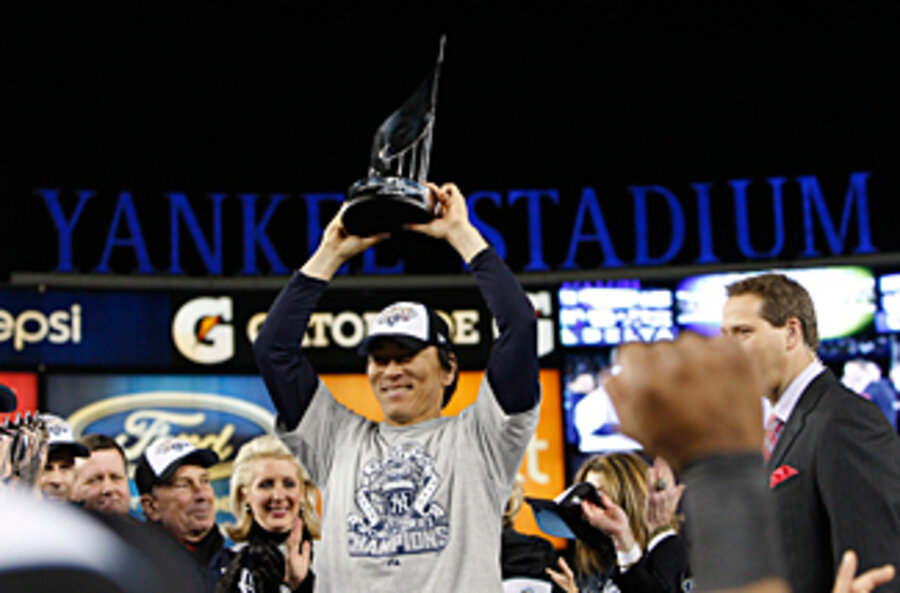
The Yankees beat the Philadelphia Phillies, 7-3 at the new Yankee Stadium, and clinched their 27th World Championship, 8 years to the day after they should have.

Andy Pettitte started and won. (His 148 wins during the 2000s -- that is, 2000 to 2009 -- made him the winningest pitcher of the decade.) Mariano Rivera got the save. Hideki Matsui, in what turned out to be his last game with the Yankees, drove in 6 runs, including hitting a home run, a blast, off a "blast from the past," Pedro Martinez. I don't think any Yankee homer -- not by Chris Chambliss, Reggie Jackson, Bucky Dent, Don Mattingly, Jim Leyritz, Bernie Williams, Tino Martinez, Scott Brosius, Derek Jeter, even Aaron Boone -- has ever made me feel better, because of what Pedro the Punk represents.

Jeter, Rivera, Pettitte and Jorge Posada, the holdovers from 2001, got their rings, Posada his 4th (his 5th title, though I don't think he got a ring for 1996), the others their 5th. For Alex Rodriguez, Mark Teixeira and CC Sabathia, their 1st. And Pedro never appeared in another major league game.

The slates had been wiped clean. As Hank Steinbrenner, son of team owner George Steinbrenner, requested, the universe had been restored to order. Sports Illustrated named Jeter its Sportsman of the Year, the 1st Yankee ever so honored.

The Yankees had taken Title 27. They have not taken Title 28. What had happened was, George was ill, and would die the next year. His sons Hank and Hal had taken over the running of the team. Hank was a big believer in his father's philosophy of "Winning is second, only to breathing." But he, too, got sick, and Hal won a power struggle. Hal gave general manager Brian Cashman new orders: Do whatever it takes to make the team money. Hal has never accepted that winning championships makes more money than simply filling the ballpark and generating TV revenue.

Look at what has happened in the years since:

* 2009 off-season: Cashman lets Matsui and Johnny Damon go. Keeping one of the other would have helped, but he kept neither. From this point onward, it's Cashman's team, not George Steinbrenner's or Gene Michael's.

* 2010: The Yankees win the American League Wild Card, and beat the Minnesota Twins in the AL Division Series, but lose the AL Championship Series to the Texas Rangers, who had never won a Pennant before.

* 2011: The Yankees win the AL Eastern Division, but lose the the ALDS to the Detroit Tigers. Pettitte retires.

* 2012: The Yankees win the AL Eastern Division, and beat the Baltimore Orioles in the ALDS. But Derek Jeter breaks his ankle in Game 1 of the ALCS against the Tigers, and the Yankees get swept.

* 2013: The Yankees miss the Playoffs for the 1st time since 2008, and only the 2nd time since 1993. Rivera retires.

* 2014: The Yankees miss the Playoffs for the 2nd straight season, which hadn't happened since 1992-93. Jeter retires.

* 2015: There are now 2 Wild Card berths in each League. The Yankees host the AL Wild Card Game, but lose it to the Houston Astros.

* 2016: A-Rod retires. But on July 25, with the Yankees 7 1/2 games out of 1st in the AL East, and 4 1/2 games out of the 2nd AL Wild Card slot, both still reachable, Cashman trades relief ace Aroldis Chapman to the Chicago Cubs for Gleyber Torres, Adam Warren, Billy McKinney and Rashad Crawford. Chapman made the difference for the Cubs, who won their 1st World Series in 108 years, and then his contract ran out, and the Yankees re-signed him. 

It got worse: Having already hurt the bullpen by trading Chapman, Cashman wrecked it by trading Andrew Miller to the Cleveland Indians for Clint Frazier, Ben Heller, Justus Sheffield and J.P. Freyereisen. Miller helped the Indians win the Pennant, and then they lost the World Series to the Cubs. Sheffield pitched in 3 major league games in 2018, and then was sent to the Seattle Mariners as trade bait for James Paxton. 

Cashman also traded starting pitcher Iván Nova to the Pittsburgh Pirates for Stephen Tarpley and Tito Polo. And he traded slugger Carlos Beltrán to the Rangers for Erik Swanson, Dillon Tate and Nick Green. Beltran helped the Rangers win the AL Western Division. Swanson and Tate never threw a pitch for the Yankees: The former was also part of the package for Paxton, the latter part of the package for Zack Britton. 

So, to review: Cashman essentially traded Beltrán, Miller and Nova, and loaned Chapman, for Torres, Happ, Paxton, Britton and Frazier. Torres turned into a star in 2018, but has been inconsistent. And of the players acquired in these deals, he is the only one with any amount of success.

The Yankees did not make the Playoffs in 2016.

* 2017: Justin Verlander turned out to be available, but Cashman didn't trade for him. He went to the Houston Astros. Who also traded for Beltran. The Yankees reached the Wild Card Game, beat the Minnesota Twins, and beat the Indians in the ALDS, before losing the ALCS in 7 games to the Astros, including 2 games won by Verlander. They went on to win the World Series.

* 2018: Cashman trades All-Star 2nd baseman Starlin Castro to the Miami Marlins for one-dimensional slugger Giancarlo Stanton. The Yankees reach the Wild Card Game, beat the Oakland Athletics, and lose the ALDS to the Red Sox, a series in which Stanton absolutely disappeared.

* 2019: Several good starting pitchers are available, at a time when the Yankees really need at least 1, possibly 2. Cashman does nothing. The Astros trade for Zack Greinke. But the "Baby Bombers" plan finally begins to pay off for Cashman. Finally, for the 1st time in 7 years, the Yankees win the Division. They beat the Twins in the ALDS. And then they lose to the Astros in the ALCS.

If you're trying to keep score at home: In the last 4 seasons, Cashman has helped 4 different teams -- the Cubs, the Indians, the Rangers and the Astros -- reach 8 postseason berths, win 4 Pennants, and win 2 World Series. Not only have none of these teams been the Yankees, but the Astros have beaten the Yankees in the postseason twice in that time.

* 2020: Due to the COVID epidemic rearranging the season, 3 AL teams now had Wild Card berths. The Yankees turned out to be one of them. They beat Cleveland in the 1st Round, but lost the ALDS to the Tampa Bay Rays.

* 2021: The Yankees lost the Wild Card Game to the Red Sox.

* 2022: The Yankees beat the Cleveland Guardians in the ALDS, but lost the ALCS to the Astros. Again.

Explain to me why Cashman still has a job.

UPDATE: The Yankees missed the Playoffs in 2023. In 2024, they finally won another Pennant after 15 years, but lost the World Series to the Los Angeles Dodgers in 5 games. In 2025, they finally beat the Boston Red Sox in a postseason series, but lost the ALDS to the Toronto Blue Jays. Going into the 2026 season, Cashman still has a job.

Among the Yankees' many traditions is Monument Park at Yankee Stadium. From the 2009 World Champions, they have given Plaques to shortstop Derek Jeter, catcher Jorge Posada; and pitchers Andy Pettitte, Mariano Rivera and CC Sabathia. In 2010, longtime team owner George Steinbrenner died, and they dedicated a Monument to him.

Manager Joe Girardi has not yet been honored -- but then, neither has Cashman.

Pitcher David Robertson retired after the 2025 season, making him the last active player from the 2009 Yankees.

*

November 4, 2009 was a Tuesday. There were no other baseball games. Football was in midweek. There were 10 games played in the NBA:

* The New York Knicks lost to the Indiana Pacers, 101-90 at Madison Square Garden.

* The New Jersey Nets lost to the Denver Nuggets, 122-94 at the Izod Center in the Meadowlands.

* The Miami Heat beat the Washington Wizards, 93-89 at the MCI Center (now the Capital One Arena) in Washington. Dwyane Wade scored 40 points.

* The Orlando Magic beat the Phoenix Suns, 122-100 at the Amway Arena in Orlando.

* The Toronto Raptors beat the Detroit Pistons, 110-99 at the Air Canada Centre (now the Scotiabank Arena) in Toronto.

* The New Orleans Hornets beat the Dallas Mavericks, 114-107 in overtime at the New Orleans Arena (now the Smoothie King Center). Chris Paul scored 39 points for the Hornets.

* The Boston Celtics beat the Minnesota Timberwolves, 92-90 at the Target Center in Minneapolis.

* The Los Angeles Lakers beat the Houston Rockets, 103-102 in overtime at the Toyota Center in Houston. Kobe Bryant scored 41 points.

* The Golden State Warriors beat the Memphis Grizzlies, 113-105 at the Oakland Coliseum Arena (then named the Oracle Arena).

* The Atlanta Hawks beat the Sacramento Kings, 113-105 at the Power Balance Pavilion (formerly the 2nd ARCO Arena) in Sacramento.

There were 6 games played in the NHL:

* The New York Islanders lost to the Buffalo Sabres, 3-0 at the HSBC Arena (now the KeyBank Center) in Buffalo.

* The New Jersey Devils beat the Washington Capitals, 3-2 at the Prudential Center.

* The Florida Panthers beat the Carolina Hurricanes, 3-0 at the BankAtlantic Center (now the Amerant Bank Arena) in the Miami suburb of Sunrise, Florida.

* The San Jose Sharks beat the Columbus Blue Jackets, 3-2 in a shootout at the Nationwide Arena in Columbus.

* The Calgary Flames beat the Dallas Stars, 3-2 at the American Airlines Center in Dallas. Jarome Iginla scored the winning goal with 3:25 left in overtime.

* And the Colorado Avalanche beat the Phoenix Coyotes, 4-1 at the Pepsi Center (now the Ball Arena) in Denver.

In UEFA Champions League action, Arsenal beat Dutch team AZ Alkmaar, 4-1 at the Emirates Stadium in North London. Liverpool and Olympique Lyonnais played to a 1-1 draw at the Stade de Gerland in Lyon, France. Glasgow, Scotland team Rangers and Unirea Urziceni played to a 1-1 draw at Stadionul Steaua in Bucharest, Romania. FC Barcelona and Rubin Kazan played to a 0-0 draw at the Central Stadium in Kazan, Russia.

Internazionale Milano beat Dynamo Kyiv at the Valeriy Lobanovskyi Dynamo Stadium in Kyiv, Ukraine. Sevilla and Stuttgart played to a 1-1 draw at Estadio Ramón Sánchez-Pizjuán in Seville, Spain. Standard Liège beat Olympiacos of Athens, Greece, 2-0 at Stade Maurice Dufrasne in Liège, Belgium. And Fiorentina beat Hungarian team Debrecen, 5-2 at Stadio Aretmio Franchi in Florence, Italy.

Monday, October 31, 2022

October 31, 2001: Derek Jeter Becomes Mr. November

October 31, 2001: Game 4 of the World Series. It's not just Halloween -- the 1st time a Major League Baseball game has been played on the day, due to the postponement of a week of games following the 9/11 attacks -- it's also a night of a Full Moon.

During batting practice at Yankee Stadium, Arizona Diamondbacks 1st baseman Mark Grace, who so long played for the Chicago Cubs without winning a Pennant and is enjoying his 1st World Series, could be seen on the official Series highlight film looking up, and saying, "Full Moon! You know what that means: Strange things happen!"

The Yankees trailed the Diamondbacks 3-1 in the bottom of the 9th, and were about to fall behind in the World Series by the same margin of games. This was due in large part to the fine pitching of Curt Schilling, who was asked about the "mystique" of Yankee Stadium. He said, "Mystique, Aura, those are dancers in a nightclub." Schilling had outpitched the Yankees' Orlando "El Duque" Hernandez. Grace had homered for the Snakes, Shane Spencer for the Yankees.

(Three years later, pitching for Boston, he would prove he was still not intimidated by Yankee Stadium, saying, "I can't think of anything better than making 55,000 Yankee fans shut up.") 

Byung-Hyun Kim, a "submarine" style pitcher from Korea, tried to close the Yankees out. But Paul O'Neill singled, and, after Bernie Williams struck out, Tino Martinez came to the plate as the Yankees' final hope. Tino electrified the crowd by slamming a drive toward the right-center-field Bleachers. The home run tied the game, and sent it into extra innings.


On the video, a fan in the front row of the Bleachers tried to catch the ball, but it bounced off his hand. Now, imagine you are that fan: Are you excited that the Yankees have come back in this World Series game, or are you mad that you were unable to catch this historic homer (and probably hurt your hand in the process)?


As the clock struck midnight, for the 1st time ever, a Major League Baseball game was played in the month of November. It was the bottom of the 10th, and Derek Jeter stepped to the plate against Kim. A fan held up a sign saying, "Mr. November."
Michael Kay, broadcasting this game for the Yankees on radio station WABC, later asked, "How did he know to hold up that sign for Jeter?" The answer is easy: He didn't hold it up specifically for Jeter. Jeter was just the batter when the clock struck 12, making him the first batter for whom it could be held up.

At 12:03 came a typical Jeter hit, an inside-out swing to right-center, and it just... barely... got over the fence for a game-winning home run. Kay yells out, "See ya! See ya! See ya!" Yankees 4, Diamondbacks 3. The Series was tied. The old ballyard was shaking. The "Yankee Mystique" had struck again. It was hits like this that got Jeter the nickname "Captain Clutch."


The next night, the 1st game to officially be played in the month of November, a fan made up a sign that said, "BASEBALL HISTORY MADE HERE" on what looked like an ancient scroll. Another fan made up a sign that said, "MYSTIQUE AND AURA APPEARING NIGHTLY." (Two years later, in what became known as the Aaron Boone Game, that same fan made up one that said, "MYSTIQUE DON’T FAIL ME NOW." It didn't.)

In 2022, Major League Baseball ranked its Top 20 Games of all time -- and by "all time," they meant games for which they had a complete record, so they could broadcast it in full. In other words, from about 1975 onward. This game ranked 12th.

*

October 31, 2001 was a Wednesday. French skier Régine Cavagnoud died, 2 days after a training accident in Pitztal, Austria. Although she had competed in 3 Winter Olympics, she had never won a medal. However, just 7 months before her death, she won the World Championship in the women's super giant slalom, or Super-G, in St. Anton, Austria. She was 31.

Football was in midweek. There were 5 games played in the NBA:

* The New Jersey Nets beat the Boston Celtics, 95-92 at the FleetCenter (now the TD Garden) in Boston. Paul Pierce scored 36 in defeat for the Celtics.

* The Charlotte Hornets beat the Cleveland Cavaliers, 100-94 at the Charlotte Coliseum.

* The Miami Heat beat the Toronto Raptors, 97-92 at the American Airlines Arena (now the Kaseya Center) in Miami.

* The Indiana Pacers beat the Chicago Bulls, 98-73 at the United Center in Chicago.

* And the Portland Trail Blazers beat the Golden State Warriors, 92-87 at the Rose Garden (now the Moda Center) in Portland.

And there were 6 games played in the NHL:

* The New York Rangers lost to the Florida Panthers, 3-1 at Madison Square Garden.

* The Philadelphia Flyers beat their cross-State rivals, the Pittsburgh Penguins, 3-0 at the First Union Center (now the Xfinity Mobile Arena) in Philadelphia.

* The Nashville Predators beat the Minnesota Wild, 6-4 at the Xcel Energy Center in St. Paul, Minnesota.

* The Detroit Red Wings beat the Dallas Stars, 4-3 at the American Airlines Center in Dallas. Brett Hull scored the winning goal, 48 seconds into overtime.

* The St. Louis Blues beat the Colorado Avalanche, 1-0 at the Pepsi Center (now the Ball Arena) in Denver.

* And the San Jose Sharks beat the Mighty Ducks of Anaheim, 4-2 at the Arrowhead Pond of Anaheim (now the Honda Center) in Anaheim.

Sunday, October 30, 2022

October 30, 2024: A Nightmare Inning for the Yankees, Glory for the Dodgers

NOTE: While these entries are dated 2022, I decided to backdate the posting dates of events from 2023 onward to the same date in 2022.

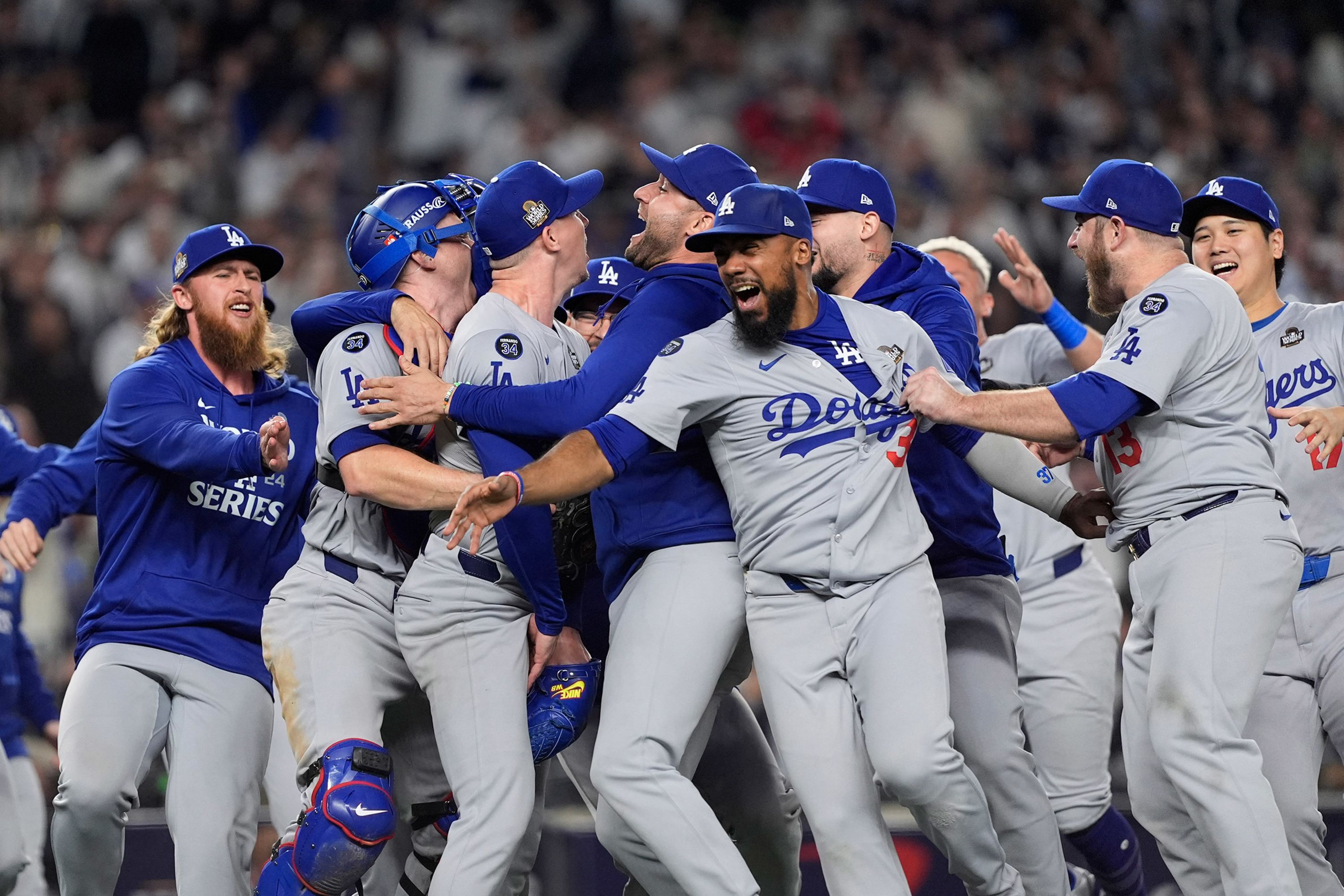
October 30, 2024: Game 5 of the 2024 World Series at Yankee Stadium started out so well for the New York Yankees. It ended as one of the worst performances in the team's history, a set of 4 innings that were worse than the first 3 games combined, as bad as those were.

It started out so well. Aaron Judge and Jazz Chisholm hit back-to-back home runs in the 1st inning, giving the Yankees a 3-0 lead. Alex Verdugo singled Anthony Volpe home in the 2nd, to make it 4-0. Giancarlo Stanton hit one out in the 3rd, making it 5-0. And through the 1st 4 innings, Gerrit Cole had allowed no runs, no hits, just 2 walks. He wasn't overpowering, but he was getting the job done beautifully.

And then came the top of the 5th inning. Yankee Fans who saw this inning will see it in their nightmares until they die:

* Kike Hernández singled to right.
* Tommy Edman hit a fly ball to center field, and Judge dropped it.
* Will Smith grounded to short, but Volpe can't make the double play. Bases loaded, nobody out.
* Cole struck Gavin Lux out.
* Cole struck Shohei Ohtani out. He got to within 1 strike of getting out of it with no runs.
* Mookie Betts grounded to 1st. But 1st baseman Anthony Rizzo was too far from the base to make the play. And so was Cole, so Rizzo couldn't throw to him. It was like Bill Buckner and Bob Stanley in Game 6 of the 1986 World Series, except that, this time, the 1st baseman did get the grounder. Stanley often gets blamed for not covering 1st, but Cole wouldn't have made it in time, either. This was not bad defense, it was just bad luck, and good hitting by Betts. Kike scored. 5-1.
* Freddie Freeman, who seemed to be out-hitting not just the Yankees but his own teammates, singled to center, scoring Edman and Smith. 5-3.
* Teoscar Hernández doubled to center, scoring Betts and Freeman. 5-5.
* Max Muncy drew a walk.
* And Kike batted again, grounding to short, and Volpe stepped on 2nd base to force Teoscar out, and finally end the inning. That's 5 runs on 4 hits (1 of them an infield hit), 1 walk and 2 errors.

It would have been understandable if the Yankees were shellshocked by this. But they loaded the bases in the bottom of the 5th -- but couldn't score. Somehow, Cole survived all this, and pitched a 1-2-3 6th inning. He went 6 innings, allowing no earned runs -- 5 unearned.

In the bottom of the 6th, Juan Soto and Judge walked, Chisholm grounded into a force play that eliminated Judge and moved Soto to 3rd, and Stanton flew to center to sacrifice Soto home. Rizzo drew a walk, but Volpe grounded out to end the rally.

It was 6-5 Yankees, and there was hope again. But the shadow of that 5th inning was too large: It didn't feel like all we had to do was get 9 more outs.

Cole and Clay Holmes got through the 7th. But manager Aaron Boone did not leave Holmes in to pitch the 8th, and Tommy Kahnle allowed singles to Kike and Erdman, and walked Smith. Again, bases loaded and nobody out. Boone brought the closer in, Luke Weaver. Lux hit a sac fly to center, scoring Kike. Ohtani was awarded 1st base on a very dubious catcher's interference call. And Betts flew to center, scoring, Edman. 7-6 Dodgers.

Dodger fans have ripped their manager, Dave Roberts, for the Dodgers' shortfalls over the last few years, with their only World Series win being in the "COVID Bubble" year of 2020. But with this "bullpen game," he outmanaged Boone -- or, rather, Boone let Roberts outmanage him.

The Yankees had men on 1st & 2nd with 1 out in the 8th, but didn't score. And they went very quietly in the 9th, with Walker Buehler striking Verdugo out swinging for the final out. The Dodgers had won the World Series in 5 games, despite Clayton Kershaw being injured and unavailable for the postseason. Freeman, of course, was named the Series Most Valuable Player.

For the Dodgers, a glorious moment, an 8th World Series win, 7 if you properly do not count the 1955 title in Brooklyn. For Roberts, total redemption, and putting himself in the conversation for election to the Hall of Fame once he retires. For Ohtani, a title that cements him as a baseball legend, though his own World Series performance was awful. For Freeman, who had previously won the Series with the 2021 Atlanta Braves, and Betts, who had previously won it with the 2018 Boston Red Sox *, possibly raised to the status of future Hall-of-Famer. (They might have gone on to make it, anyway.)

For the Yankees, a season of big moments, including the 1st American League Pennant in 15 years. And yet, it cannot be termed anything other than a failure. They scored just 7 runs in the 1st 3 games, won Game 4, took a big lead in Game 5 to forge some hope of the greatest comeback in baseball history... and then had the nightmare inning. Once again, the fundamentals were bad. The Yankees took out the fun, and left "da mentals."

*

October 30, 2024 was a Wednesday. Football was in midweek. There were 11 games in the NBA:

* New York had considerably more success in basketball on this night than in baseball, as both of their NBA teams won. The New York Knicks beat the Miami Heat, 116-107 at the Kaseya Center in Miami. Karl-Anthony Towns led all scorers on the night with 44 points.

* The Brooklyn Nets beat the Memphis Grizzlies, 119-106 at the FedEx Forum in Memphis.

* The Detroit Pistons beat the Philadelphia 76ers, 105-95 at the Wells Fargo Center (now the Xfinity Mobile Arena) in Philadelphia.

* The Washington Wizards beat the Atlanta Hawks, 133-120 at the Capital One Arena in Washington.

* The Charlotte Hornets beat the Toronto Raptors, 138-133 at the Spectrum Center in Charlotte.

* The Cleveland Cavaliers beat the Los Angeles Lakers, 134-110 at the Rocket Mortgage FieldHouse (now the Rocket Arena) in Cleveland.

* The Indiana Pacers beat the Boston Celtics, 135-132 in overtime at the Gainbridge Fieldhouse in Indianapolis.

* The Chicago Bulls beat the Orlando Magic, 102-99 at the United Center in Chicago.

* The Oklahoma City Thunder beat the San Antonio Spurs, 105-93 at the Paycom Center in Oklahoma City.

* The Portland Trail Blazers beat the Los Angeles Clippers, 106-105 at the new Intuit Dome outside Los Angeles in Inglewood, California.

* The Golden State Warriors beat the New Orleans Pelicans, 104-89 at the Chase Center in San Francisco.

And there were 6 games in the NHL:

* The New Jersey Devils beat the Vancouver Canucks, 6-0 at Rogers Arena in Vancouver.

* The New York Islanders lost to the Columbus Blue Jackets, 2-0 at the Nationwide Arena in Columbus.

* The Winnipeg Jets beat the Detroit Red Wings, 6-2 at Little Caesars Arena in Detroit.

* The Tampa Bay Lightning beat the Colorado Avalanche, 5-2 at the Ball Arena in Denver.

* The Utah Hockey Club beat the Calgary Flames, 5-1 at the Delta Center in Salt Lake City, Utah.

* And the Los Angeles Kings beat the Vegas Golden Knights, 6-3 at the Crypto.com Arena in Los Angeles.

December 31, 1999 & January 1, 2000: The Millennium

December 31, 1999:  The Millennium arrives. The people of planet Earth survived. At a terrible cost. But we hadn't destroyed ourselves. ...