Showing posts with label alaska. Show all posts

Sunday, October 16, 2022

October 16, 1972: The Boggs-Begich Crash

Hale Boggs (left) and Nick Begich,
shortly before boarding the plane

October 16, 1972: A plane carrying House Majority Leader Hale Boggs of Louisiana, Congressman Nick Begich of Alaska, and two other disappears in Alaska. It has never been found.
Thomas Hale Boggs was born in 1914 in Long Beach, Mississippi, and got his law degree from Tulane University in nearby New Orleans. As a prosecutor, he had put several corrupt Louisiana politicians away, including some from the late Governor Huey Long's political machine. In 1938, he married Corrinne "Lindy" Claiborne, and they had 4 children, 1 who died in infancy.
He was elected to Congress in 1940, making him the youngest member at the time. He was defeated for re-election, enlisted in the U.S. Navy, and returned to the country and Congress in 1946. He continued to be re-elected every 2 years, probably aided by the fact that he opposed civil rights legislation, up to and including the Civil Rights Act of 1964. However, he voted for the Voting Rights Act of 1965 and the Civil Rights Act of 1968.
In 1962, he was elected House Majority Whip in the reorganization of House Democratic leadership following the death of Speaker Sam Rayburn. He was a member of the Warren Commission that decided in 1964 that Lee Harvey Oswald acted alone in assassinating President John F. Kennedy. In 1970, he was elected House Majority Leader.
Nicholas Joseph Begich was born in 1932 in Eveleth, Minnesota, the brother of a State legislator. After the University of Minnesota, he became a teacher in Alaska, winning election to the State Senate in 1962 and to the State's lone seat in the U.S. House of Representatives in 1970.
He was in a tough race for re-election against the Republican who won his State Senate seat, Don Young. Majority Leader Boggs agreed to campaign for him. On October 16, 1972, Boggs, Begich, Begich's aide Russell Brown, and pilot Don Jonz boarded a Cessna 310 in Anchorage, the State's largest city, intending to fly to a fundraiser in Juneau, the State capitol.
A Cessna 310

The plane never arrived, and searching the wildest of Alaska proved to be an impossible task. In half a century, this most-searched-for plane in American history has never been found.
Hale Boggs was held in such regard that, when the Democrats elected a new Majority Leader, it was Thomas P. "Tip" O'Neill of Massachusetts, and he left the Seal of the State of Louisiana on the door, until he was elected Speaker following the 1976 elections.
In 1973, Boggs' wife, Lindy, was elected to his seat, and was continually re-elected to it until retiring in 1990. In 1997, President Bill Clinton appointed her to be U.S. Ambassador to the Vatican, and she held the post until 2001.
Hale and Lindy Boggs had 4 children, but tragedy would follow them. William Roberts Boggs died as an infant. Barbara Boggs Sigmund became a teacher in Princeton, New Jersey, and was elected the town's Mayor. She lost an eye to cancer, leading to her distinctive eyepatches, color-coded to match her clothes. The cancer returned, and she died in 1990. She is buried in the same cemetery in Princeton as President Grover Cleveland and Vice President Aaron Burr.
A son, Thomas Hale Boggs Jr., became a prominent lawyer and lobbyist. And there was another daughter, Corrine. As a boy, Tommy couldn't say, "Corrine," and it came out, "Cokie," so that became her nickname. Tommy ran for Congress in Maryland in 1970, but lost. He died in 2014. Cokie became a journalist, and, upon marrying another, Steven V. Roberts, became known as Cokie Roberts. She and Steven wrote books together, until Cokie also developed cancer, and died in 2019.
Begich's son Mark served as Mayor of Anchorage from 2003 to 2009, and as U.S. Senator from then until 2015. Another son, Tom Begich, was elected to the State Senate in 2016. In 2022, redistricting has led him to withdraw from re-election.
Don Young won Nick Begich's U.S. House seat in 1973, and was Alaska's long Congressman from then until his death in 2022. He built a record as the most anti-environmental member of Congress, a despicable status given Alaska's needs. He was also one of the most pro-gun members.
*

October 16, 1972 was a Monday. Football quarterback Kordell Stewart and Lithuanian hockey player Darius Kasparaitis were born.

This was a travel day in the World Series, in which the Oakland Athletics eventually beat the Cincinnati Reds in 7 games. On ABC Monday Night Football, the Green Bay Packers beat the Detroit Lions, 24-23 at Tiger Stadium in Detroit.

There was 1 game played in the NBA: The Golden State Warriors beat the Baltimore Bullets, 97-96 at the Oakland Coliseum Arena. There was 1 game played in the new World Hockey Association: The New England Whalers beat the Chicago Cougars, 4-1 at the Boston Garden. There were no games in the NHL or the American Basketball Association. Apparently, Monday Night Football had already become enough of a TV juggernaut that the indoor-sports leagues felt it would be, for the most part, pointless to compete with it.

Monday, August 29, 2022

August 29, 2008: John McCain Chooses Sarah Palin

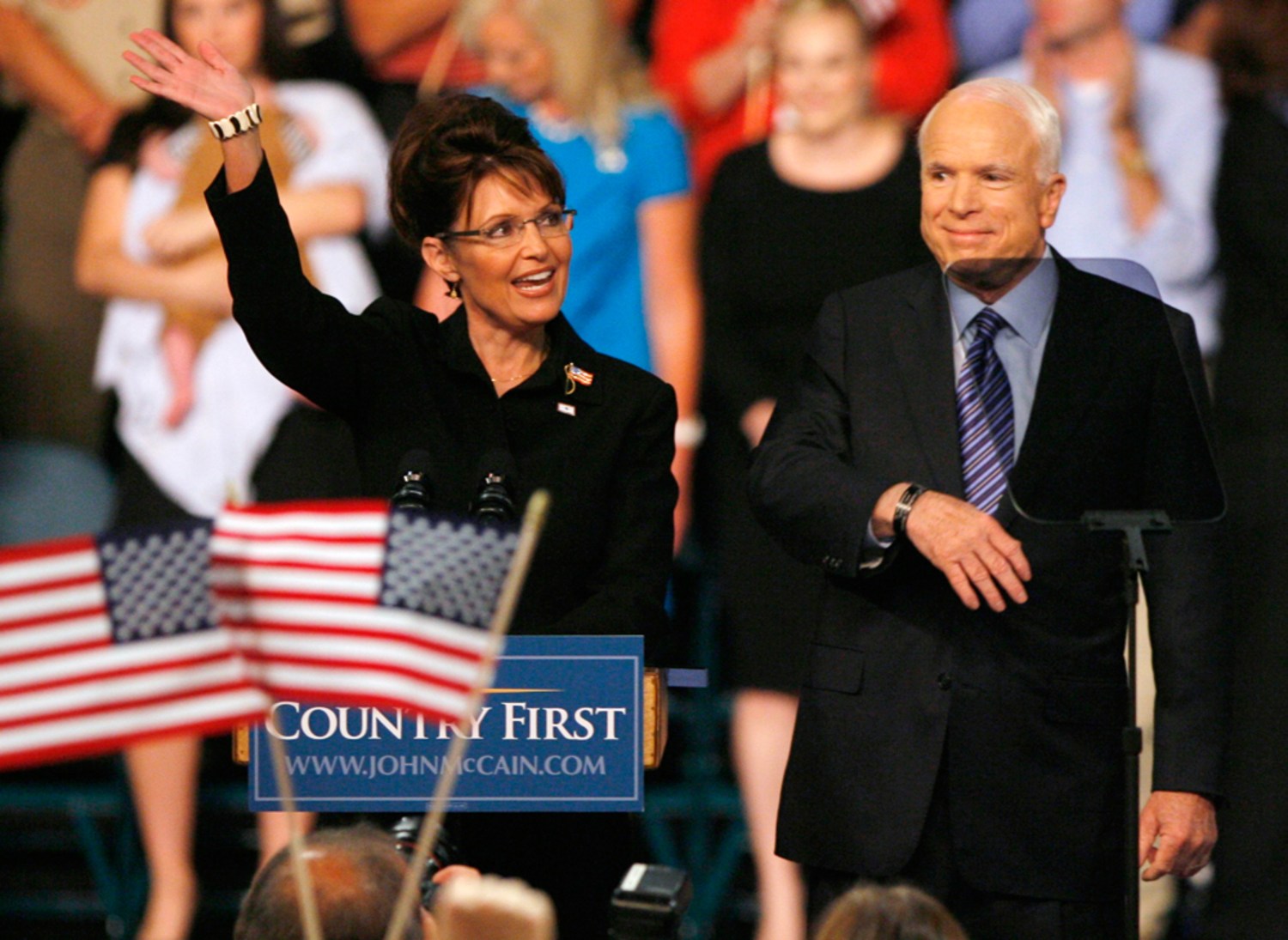
August 29, 2008: The day after a highly successful Democratic Convention in Denver, and on his own 72nd birthday, the Republican nominee for President, Senator John McCain of Arizona, tries to steal the Democrats' thunder by announcing his selection for Vice President: Governor Sarah Palin of Alaska.

Traditionally, Vice Presidential picks are chosen for contrast. Sometimes, they represent a part of the country that the Presidential nominee doesn't, although they usually don't make much of a difference in winning States the Presidential nominee might not win.

Lyndon Johnson made a big difference for John Kennedy in 1960, and Walter Mondale might have done so for Jimmy Carter in 1976, but there have been no good examples since. Alaska has just 3 Electoral Votes, and has gone Republican in every Presidential election since 1968, so McCain didn't need Palin's help McCain there. The same was true on the Democratic side: Delaware also has just 3 EVs, and has gone Democratic in every election since 1992, so whatever help Joe Biden gave to Barack Obama, it wasn't geographic.

Sometimes, the Vice Presidential nominee has a particular strength that the Presidential nominee doesn't have. A younger nominee or a Governor might take an older foreign policy expert: Former Governor Ronald Reagan with George H.W. Bush in 1980, Governor Michael Dukakis with Lloyd Bentsen in 1988, Governor George W. Bush with Dick Cheney in 2000, and, there in 2008, the 47-year-old Obama with Biden. Palin certainly didn't help McCain there, and, with his experience, he was the older person and the foreign policy expert.

Sometimes, the age difference matters. In 1988, 64-year-old George H.W. Bush tried to appeal to youth with 41-year-old Dan Quayle. It's worked the other way, too. In that very election, Obama, 47, chose Biden, 66. McCain was 72, and Palin was 44. (Later, Biden chose Kamala Harris, 78 to 56, in 2020.)

And sometimes, a nominee who doesn't please the "true believers" in the party needs one of them on the ticket. Dwight D. Eisenhower chose Richard Nixon for that reason in 1952. Lyndon Johnson chose Hubert Humphrey in 1964. In 1976, Carter chose Mondale, and Gerald Ford dumped Nelson Rockefeller for Bob Dole. The elder Bush chose Quayle in 1988. In 1996, Dole, no longer seen by GOP archconservatives as one of their own, chose tax-cutting icon Jack Kemp. (Later, Mitt Romney chose Paul Ryan for this reason in 2012, and Donald Trump chose evangelical Catholic Mike Pence in 2016.)

When McCain first ran for the U.S. House of Representatives in 1982, seeking the seat of retiring Minority Leader John Rhodes, he was seen as a staunch conservative, a loyal soldier in the Reagan Revolution. When he first ran for the U.S. Senate in 1986, seeking the seat of retiring conservative icon Barry Goldwater, he was still seen as a good conservative. But by the time he made his 1st run for President in 2000, he was seen as the moderate alternative to George W. Bush. And here, in 2008, despite finally winning his Party's nomination, a lot of Republicans were calling him a liberal.

McCain hadn't changed much over those 26 years. Politically, he was almost exactly the same. But the Party had veered so far to the right, that he was now seen by many moderates and independents as a sane Republican. He needed to shore up the conservative base. And so, he chose Palin, an absolutist on abortion (she had 5 children), guns (she bragged about her hunting skills), and taxes.

An editorial cartoon in the coming days showed an elephant in a suit, behind a podium, with the top half of a McCAIN-PALIN bumper sticker torn off, as if Palin was the reason any true Republican was going to vote for this ticket.

And, given McCain's age, and the fact that he had already beaten cancer once, the possibility that Palin could become President -- the 1st female President if it happened -- made her even more appealing to Republicans. The Democrats had nominated Geraldine Ferraro for Vice President on Mondale's ticket in 1984, and almost nominated Hillary Clinton for President instead of Obama this time. It would give the Republicans a chance to one-up the Democrats on a civil rights issue.

At first glance, it seemed like a very interesting pick: A woman, young, attractive, nice-looking family, in an executive position, shores up areas in the conservative movement where McCain is seen to have fallen short, and comes across like gangbusters on TV. It looks like the Obama-Biden campaign’s momentum has been wiped out, and we might have a close race all the way.

But then she started talking. And she began to sound not just like an archconservative, but like someone too inexperienced for the role into which she was thrust. Like someone whose total political experience had been a year and a half as Governor of a State of 687,000 people (only Vermont and Wyoming had fewer, then as now), and 6 years as Mayor of a "city" of 7,000 people. Like what the early Saturday Night Live would have called a "not-ready-for-prime-time player."

Her acceptance speech at the Republican Convention, at the Xcel Energy Center (UPDATE: It's now named the Grand Casino Arena) in St. Paul, Minnesota, was basically a throwing of platitudes against a wall to see which ones stuck. None did.

In his acceptance speech, McCain's best line referred to his basic idea of "biography as candidacy": He told of his life of service to America, and said, "I have the scars to prove it, Barack Obama does not!" Obama was 11 years old when the Vietnam War ended, and McCain was released as a prisoner of war. McCain found a good way to contrast himself with Obama without directly insulting him. But, to put it in baseball terms, after Palin's strikeouts of the preceding 7 days, he needed a home run, and only managed a single.

Speaking of SNL, former writer and castmember Tina Fey was rehired by the show, because of her resemblance to Palin. It got to the point where all she had to do was repeat what Palin was saying in interviews, and the audience would laugh. Except for one thing: In the September 13 cold open, in character, Fey said, "I can see Russia from my house!"

It seemed like the sort of thing the real thing, dingbat that she was, would have said. What did Palin say? Two days earlier, in her 1st major interview after being nominated, she sat down with Charles Gibson, then the anchor of ABC World News Tonight. He asked her about the proximity of Alaska to Russia, specifically easternmost Siberia, and she said, "They're our next-door neighbors, and you can actually see Russia from land here in Alaska, from an island in Alaska." And, given a day with clear enough skies, that turns out to be true.

The problem was this: She seemed to be citing this fact as a foreign policy credential. It shouldn't have been considered one. In other words, it was actually dumber than the dumb quote misattributed to her.

By putting up such a rotten foreign policy credential, she reminded people of a major reason they'd turned against the Republican Party: The Bush Administration's policies on the Iraq War and the War On Terror. Nor did she, an apparently middle-class family-oriented woman, reassure people that the disastrous Bush economic policies would be significantly altered by an incoming McCain-Palin Administration. She needed to be strong where McCain was weak, and stand with him where he was strong. Not only did she do neither especially well, she emphasized the areas where McCain was weak.

In the Vice Presidential debate, Biden had to walk a fine line, criticizing her ticket's policies without sounding like an old man bullying a young woman. He stuck to criticizing McCain rather than Palin, and it seemed to work. At one point, Palin tried to invoke Reagan by saying, "Oh, there you go again, Joe." But, unlike Reagan's famous 1980 debate zinger on Carter, it sounded planned, and thus artificial. Palin wasn't going to remind any Republican old enough to remember Reagan of him. She didn't make a fool of herself in the debate, but she didn't help herself much, which she needed to do, and Biden won it solidly.

In the end, Palin may have gained as many conservative voters as she turned off independents and Democrats who were unsure about Obama. The Republican politician who really cost John McCain the election wasn't Sarah Palin, it was George W. Bush: McCain never explained how his policies were going to be better than those of the incumbent, the policies America had turned against.

*

August 29, 2008 was a Friday. There were 2 college football games played that night. Temple beat Army, 35-7 at Michie Stadium in West Point, New York. And Rice beat Southern Methodist University (SMU), 56-27 at Rice Stadium in Houston.

These Major League Baseball games were played:

* The New York Yankees beat the Toronto Blue Jays, 2-1 at Yankee Stadium. Carl Pavano, already hated by Yankee Fans, was the winning pitcher, defeating A.J. Burnett, who would become beloved by Yankee Fans. Derek Jeter went 0-for-4. Alex Rodriguez went 1-for-3.

* The New York Mets beat the Florida Marlins, 5-4 at Dolphin Stadium (now Hard Rock Stadium) in Miami Gardens, Florida. The Mets scored 4 runs in the top of the 9th, on a grand slam by Carlos Beltrán, and the Marlins 2 in the bottom half.

* The Boston Red Sox beat the Chicago White Sox, 8-0 at Fenway Park in Boston. Daisuke Matsuzaka allowed 2 hits over 8 innings, and Mike Timlin finished the 2-hit shutout. David Ortiz went 3-for-4 with a walk and an RBI.

* The Washington Nationals beat the Atlanta Braves, 7-3 at Nationals Park in Washington.

* The Tampa Bay Rays beat the Baltimore Orioles, 14-3 at Tropicana Field in St. Petersburg, Florida.

* The Milwaukee Brewers beat the Pittsburgh Pirates, 3-1 at PNC Park in Pittsburgh.

* The Seattle Mariners beat the Cleveland Indians, 3-2 at Progressive Field in Cleveland. Ichiro Suzuki went 1-for-3.

* The Cincinnati Reds beat the San Francisco Giants, 11-7 at Great American Ball Park in Cincinnati.

* The Detroit Tigers beat the Kansas City Royals, 6-3 at Comerica Park in Detroit.

* The Chicago Cubs beat the Philadelphia Phillies, 3-2 at Wrigley Field in Chicago. Alfonso Soriano hit a home run in the 7th inning, which made the difference.

* The Houston Astros beat the St. Louis Cardinals, 3-2 at Minute Maid Park (now Daikin Park) in Houston.

* The Arizona Diamondbacks beat the Los Angeles Dodgers, 9-3 at Chase Field in Phoenix.

* The Colorado Rockies beat the San Diego Padres, 9-4 at Petco Park in San Diego.

* The Los Angeles Angels beat the Texas Rangers, 3-1 at Angel Stadium of Anaheim.

* And the Minnesota Twins beat the Oakland Atletics, 12-2 at the McAfee Coliseum (as the Oakland Coliseum was then known).

Monday, August 15, 2022

August 15, 1935: Will Rogers and Wiley Post Are Killed

August 15, 1935: Comedian and newspaper columnist Will Rogers and pilot Wiley Post are killed in a plane crash near Point Barrow, Alaska.

Born on November 4, 1879 in the Indian Territory, later the State of Oklahoma, William Penn Adair Rogers was the Jon Stewart or Stephen Colbert of his day. In the 1910s, '20s and early '30s, in a nationally-syndicated newspaper column, in stage productions, and eventually on radio and in motion pictures, he combined country horse sense with urban wit to comfort the afflicted and afflict the comfortable.

But he was never mean about it, saying, "When I die, my epitaph, or whatever you call those signs on gravestones, is going to read: 'I joked about every prominent man of my time, but I never met a man I didn't like.' I am so proud of that, I can hardly wait to die so it can be carved."

Some other Willisms: 

* "I don't make jokes. I just watch the government and report the facts."

* "I am not a member of an organized political party. I am a Democrat."

* "It isn't what we don't know that gives us trouble, it's what we know that ain't so."

* "If you ever injected truth into politics you have no politics."

* "Prohibition is like Communism: It's a great idea, but it won't work."

* "Politics is applesauce." (A 1920s way of saying, "Baloney.")

* "Diplomacy is the art of saying, 'Nice doggie' until you can find a rock."

* "Good judgment comes from experience, and a lot of that comes from bad judgment."

* "Even if you're on the right track, you'll get run over if you just sit there."

* "Buy land. They ain't making any more of the stuff." (Not true: In New York City, Battery Park City was built on landfill.)

* "Advertising is the art of convincing people to spend money they don't have for something they don't need."

* "Too many people spend money they haven't earned to buy things they don't want to impress people they don't like."

* "You can't say civilization don't advance. In every war they kill you in a new way." (He lived long enough to see aerial bombardment, but not the atomic bomb.)

* "We will never have true civilization until we have learned to recognize the rights of others." (So he really was a Democrat.)

Born in northeast Texas on November 22, 1898, Wiley Hardeman Post was a pioneer of aviation. He developed an early pressure suit for really high flying, a step forward in what became spacesuits; and discovered the jet stream. Like Rogers, he claimed Native American ancestry.

In 1926, an oil-rig accident cost him the use of his left eye, and he wore an eye patch for the rest of his life. It didn't stop him from flying. He soon met Rogers, and they became close friends.

In 1931, Post and Australian navigator Harold Gatty set a new around-the-world record, taking off in his plane Winnie Mae from Roosevelt Field in Garden City, Long Island, New York (also Charles Lindbergh's starting point for his 1927 flight across the Atlantic Ocean), and heading east, including stops in Berlin and Moscow, across Siberia, to Nome and Fairbanks, Alaska, Edmonton and Cleveland, arriving back at Roosevelt Field in 8 days, 15 hours, 51 minutes.

In 1933, Post topped this -- two ways. He had a compass instead of a navigator, so he could become the 1st person to fly around the world alone. Aside from using Floyd Bennett Field in Brooklyn as his takeoff point, he used the same route, and did it in 7 days, 18 hours and 49 minutes, beating his own record by 21 hours and 2 minutes.

In 1935, he wanted to establish an airmail route between the American West Coast and Russia. He made the mistake of building a hybrid aircraft, including parts from one that had crashed. Rogers asked to come along, for material for his column. They took off from Seattle, and while Post flew, Rogers typed. Yes, he brought his typewriter on the plane.

On August 15, they took off from Fairbanks for Point Barrow, the northernmost point in the United States. A few miles away, the engine failed, and crashed into a lagoon. Both were killed instantly, Rogers at age 55, Post at 36.

Rogers is buried on the grounds of the Will Rogers Memorial, a museum dedicated to his life in Claremore, not far from his hometown of Oologah, in northeastern Oklahoma; Post, at Memorial Park Cemetery in Oklahoma City. Post never married, and is not known to have had any children. Rogers left behind a wife, Betty Blake, along with 3 sons and a daughter. Will Rogers Jr. served a term as a Congressman from California.

When I was a kid, there were T-shirts, commenting on his claim that he never met a man he didn't like: "Will Rogers never met Howard Cosell."

*

August 15, 1935 was a Thursday. These baseball games were played that day:

* The New York Yankees beat the Cleveland Indians, 3-1 at League Park in Cleveland. Johnny Broaca outpitched Willis Hudlin. Lou Gehrig went 0-for-3, but did draw a walk.

* The New York Giants beat the St. Louis Cardinals, 5-4 at the Polo Grounds. Mel Ott went 3-for-5, while manager-1st baseman Bill Terry went 1-for-5.

* The Brooklyn Dodgers lost to the Chicago Cubs, 11-3 at Ebbets Field.

* The Boston Braves beat the Cincinnati Reds, 8-0 at Braves Field in Boston. A rare great game for the Braves in their 115-loss season.

* The Philadelphia Phillies beat the Pittsburgh Pirates, 9-1 at Baker Bowl in Philadelphia.

* The Detroit Tigers beat the Washington Senators, 6-3 at Navin Field in Detroit. (It was later renamed Briggs Stadium and Tiger Stadium.) Hank Greenberg went 2-for-5 with an RBI.

* The Boston Red Sox beat the Chicago White Sox, 3-1 at Comiskey Park in Chicago. Lefty Grove went the distance for the win.

* And the Philadelphia Athletics beat the St. Louis Browns, 5-3. Jimmie Foxx went 3-for-5 with 3 RBIs.

Sunday, June 19, 2022

June 20, 1903: "The Call of the Wild" Is Published

June 20, 1903: The Call of the Wild is published. It is the magnum opus of Jack London. He wasn't America's 1st bohemian writer, but he was the 1st to make it as big as that novel made him.

John Griffith Chaney was born on January 12, 1876 in San Francisco, to an unwed mother, Flora Wellman. His father, William Chaney didn't want the baby, and abandoned the mother. Mother and child moved around the San Francisco Bay Area, before settling in Oakland, where the mother married John London. The boy became known as Jack London to differentiate himself from his father.

By the time he was 18, he had been an oyster pirate on the Bay, a member of the California Fish Patrol, and had worked in a cannery, a jute mill, and a street railway's power plant. He joined Coxey's Army in the original march on Washington in 1894. That year, he was arrested for vagrancy in Buffalo, spending 30 days in the Erie County Penitentiary, while, to put it politely, he faced all the difficulties of prison life.

Then he returned to Oakland, and graduated from high school.

In 1897, he went to Alaska as part of the Klondike Gold Rush, but got sick there, and went home without having made his fortune. Now a dedicated Socialist, he decided that writing was his chance to not just make money, but beat rich people at their own game.

His timing was good: He began his writing career just as new printing technologies enabled lower-cost production of magazines. This resulted in a boom in popular magazines aimed at a wide public audience, and a strong market for short fiction. In early 1903, he sold The Call of the Wild to The Saturday Evening Post for $750 -- about $25,000 in 2022 money -- and the book rights to Macmillan, whose promotional campaign propelled it to swift success.

In the story, Buck is a St. Bernard-collie mix, stolen from California's Santa Clara Valley, who ends up as a sled dog in the Klondike. He goes through several owners, of varying degrees of treatment, until he ends up with experienced outdoorsman John Thornton, and they form a close bond.

One day, Buck hears "the call of the wild": A wolf's howl. He runs off to meet the nearby wolf pack, but he understands that he doesn't belong. When he gets back, he finds Thornton and his gold-panning team have been killed by Native Americans. Driven by grief, Buck hunts them down and kills them. His last contact with the human world gone, and having little choice if he wants to survive, he returns to the pack.

Around the time the novel made London a literary superstar, his 1st marriage, to Bessie Maddern, with whom he had daughters Joan and Becky, was breaking up. His 2nd marriage, to Charmian Kittredge, was happier, but produced no children.

He went into journalism, and his eyewitness accounts of the 1906 San Francisco Earthquake increased his fame. But this career revealed a more sinister side: When Jack Johnson became the 1st black Heavyweight Champion of the World, London was among the sportswriters demanding that a white man beat Johnson, and reclaim the title for the white race.

In 1910, he turned to his fellow Californian, James J. Jeffries, who had held the title for 5 years before retiring, undefeated, to a farm in 1904. In column after column, London wrote, "Jeff, it's up to you." Finally, Jeffries caved in, the fight with Johnson was set for Reno, Nevada on the 4th of July, and London covered it. Johnson won by a knockout in the 15th round, and, while his writeup was as racist as anybody else's, London admitted that Johnson was a better fighter than his hero, Jeffries.

Like so many creative artists before and sense, Jack London fell victim to substance abuse, both booze and morphine. Ultimately, it was long-term kidney failure that killed him on November 22, 1916. He was only 40 years old.

Jack London Square, on the Oakland waterfront at Broadway and Embarcadero, is named for him. So is Mount London, on the Alaska-British Columbia line, a tribute to his writing about the region.

He was played by Michael O'Shea in the 1943 film Jack London, Jeff East in the 1980 film Klondike Fever, Aaron Ashmore in a 2012 episode of Murdoch Mysteries, and Johnny Simmons in the 2014 miniseries Klondike.

"Time's Arrow," a 1992 episode of Star Trek: The Next Generation, was partly set in 1893 San Francisco, and includes Michael Aaron as London, and Jerry Hardin as another iconic writer, Samuel Clemens, a.k.a. Mark Twain. But there is no record of London having been a bellhop at a San Francisco hotel at age 17, Sadly, there is also no record of him ever having met Twain, though it was certainly possible, and they definitely would have had much to talk about.. London was a close friend of writer Ambrose Bierce.

*

June 20, 1903 was a Saturday. There were 4 games played in baseball that day:

* The Pittsburgh Pirates beat the Boston Beaneaters, 8-4 at the South End Grounds in Boston. The Beaneaters went through some name changes, before becoming the Boston Braves in 1972.

* The Boston Americans beat the Cleveland Naps, 5-4 in 10 innings at League Park in Cleveland. The Cleveland team was named for its manager and 2nd baseman, Napoleon "Nap" Lajoie. They became the Cleveland Indians in 1915, and the Cleveland Guardians in 2022. The Boston team became the Red Sox in 1908.

* The Philadelphia Athletics beat the Chicago White Sox, 4-1 at South Side Park in Chicago.

* And the St. Louis Browns beat the Washington Senators, 7-6 at Sportsman's Park in St. Louis.

Sunday, March 27, 2022

March 27, 1964: The Alaska Earthquake

March 27, 1964: The most powerful earthquake ever to hit North America wasn’t the 1906 San Francisco event, or any other to hit California. It was the one that struck on this date, off the coast of Seward, Alaska in Prince William Sound, at 9.2 on the Richter scale.

For comparison's sake: The one that caused the Indonesian tsunami of 2004 was also a 9.2; the San Francisco quake of 1906 was a 7.9; the San Francisco quake of 1989 was a 7.1; the Northridge (Los Angeles) quake of 1994 was a 6.7; and the one that shook up my 4th grade class in Central Jersey in 1979 was "only" a 3.8.

Six hundred miles of fault ruptured at once, releasing about 500 years of stress buildup. Soil liquefaction, fissures, landslides, and other ground failures caused major structural damage in several communities, and considerable damage to property. Anchorage, Alaska's largest city, about 125 miles north of the epicenter, sustained a great great deal or damage, as nearly everything in the city -- houses, buildings, paved streets, sidewalks, water and sewer mains, electrical systems, and other man-made equipment -- was not designed with earthquakes in mind.

A total of 131 deaths have been attributed to the quake. Not all of them were in Alaska: The quake caused a tsunami that wrecked hundreds of houses on the coast of British Columbia, Canada; and people also died at Beverly Beach State Park in Oregon and in Crescent City, California.

*

March 27, 1964 was a Friday. Baseball was in Spring Training. Football was out of season. And the NBA Playoffs and the Stanley Cup Playoffs were both underway, but no games were scheduled for either on this day. So there were no scores.

Thursday, March 24, 2022

March 24, 1989: The Exxon Valdez Disaster

March 24, 1989: The freighter Exxon Valdez, a supertanker run by Exxon, runs aground in Prince William Sound, Alaska. The ship spilled 10.8 million gallons of crude oil over the next few days, making life miserable for area wildlife.

The ship's captain, Joseph Hazelwood, was accused of operating the ship while drunk. He was cleared of that charge, but was convicted of negligent discharge of oil, fined $50,000, and sentenced to 1,000 hours of community service. As of March 24, 2022, he is still alive.

Hazelwood quickly turned from the villain of the story to a mere henchman. Exxon, formerly Standard Oil (or "Esso"), quickly adopted an attitude that could be summed up by platitudes such as "That's life," and "Not our fault."

Environmental activism was on the rise. At the end of 1988, instead of a Person of the Year, Time magazine named "Endangered Earth" its "Planet of the Year." The Presidency of Ronald Reagan, with its proud blatant disregard for America's ecology and natural resources, was over, and his Vice President, George H.W. Bush, an oil company executive before going into politics, had gained the highest office in the land party on a pledge to become "the Environmental President."

Soon, activists began wearing anti-Exxon T-shirts and buttons. There were public demonstrations in New York and Washington against the oil companies, and corporate greed in general. The one in New York, on April 23, 1990, was my first participation in a political demonstration. And the Persian Gulf War of August 1990 to March 1991 was largely seen as a war for oil, and protestors called Bush out on it, with little success.

The Exxon Valdez disaster was the largest oil spill in American history, until 2010, when BP's Deepwater Horizon disaster in the Gulf of Mexico broke all records. The difference in the responses was stark: BP committed itself fully to the cleanup and to reparations, and its reputation actually improved.

The Exxon Valdez had been launched in 1986, and required $30 million worth of repairs. To avoid the stigma of the spill, it was renamed Exxon Mediterranean. Exxon sold the ship in 1993, and it remained in use until 2012, when, under the ownership of Hong Kong, the flag of Panama, and the name Oriental Nicety, it was sold for scrap.

*

March 24, 1989 was a Friday. Baseball was in Spring Training. Football was out of season. There were 6 games played in the NBA:

* The New York Knicks lost to the Boston Celtics, 115-11 at the Boston Garden.

* The New Jersey Nets lost to the Detroit Pistons, 112-96 at The Palace in the Detroit suburb of Auburn Hills, Michigan. Joe Dumars scored 35 points.

* The Philadelphia 76ers beat the San Antonio Spurs, 135-122 at The Spectrum in Philadelphia.

* The Denver Nuggets beat the Dallas Mavericks, 114-105 at the Reunion Arena in Dallas.

* The Utah Jazz beat the Houston Rockets, 102-99 at The Summit in Houston. (The arena has since been converted into the Central Campus of the Lakewood Church, Dr. Joel Osteen's "megachurch.") Despite the Rockets' loss, Hakeem Olajuwon led all scorers on the night with 36.

* And the Chicago Bulls beat the Portland Trail Blazers, 128-113 at the Veterans Memorial Coliseum in Portland. Michael Jordan scored 34.

There were 4 games played in the NHL:

* The Washington Capitals beat the Philadelphia Flyers, 6-1 at the Capital Centre in the Washington suburb of Landover, Maryland.

* The Buffalo Sabres beat the Vancouver Canucks, 5-2 at the Buffalo Memorial Auditorium.

* The Detroit Red Wings beat the Toronto Maple Leafs, 6-2 at the Joe Louis Arena in Detroit.

* And the Winnipeg Jets beat the Calgary Flames, 4-3 at the Winnipeg Arena. Randy Carlyle scored the winning goal with 1:15 left in overtime.

Wednesday, February 2, 2022

February 2, 1925: The Nome Serum Run

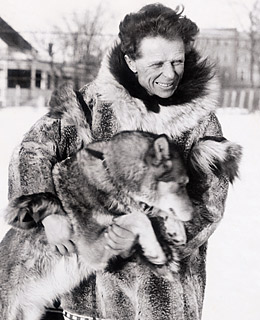
Leonhard Seppala, one of the sled-drivers,
and some of his dogs

February 2, 1925: The Nome Serum Run is completed, saving that city from disease. It was a much-hyped news story, one of the first to have details broadcast nationwide on radio.

In January 1925, an outbreak of diphtheria threatened to wipe out the town of Nome, Alaska, sparking fears that an epidemic would spread and kill thousands if antitoxin medicine was not supplied.

The antitoxin could only be delivered by dogsled across a portion of the Iditarod Trail, the only route accessible for transporting goods during the harsh winters. A heroic relay of dog teams transported the antitoxin across the 674-mile trail from Nenana to Nome, braving gale force winds, -85 degree temperatures, and whiteout conditions across the remote Alaskan Interior.

The life-saving serum was delivered to Nome in a record-breaking 127.5 hours, without a single broken vial. This came to be known as the 1925 Serum Run. Many aspects of this journey are commemorated annually in the Iditarod dog sled race, which began in 1973.

*

February 2, 1925 was a Monday. Actress Elaine Stritch was born. Baseball and football were out of season. Professional basketball was still minor-league at this point. And no NHL games were played that day. So there were no scores on this historic day.

Monday, January 3, 2022

January 3, 1959: Alaska Is Admitted As the 49th State

January 3, 1959: Alaska is admitted to the Union as the 49th State. The 1st 48 States are known as the "Contiguous States." But Alaska and Hawaii, the 2 newest States, are separated from them, and neither borders any other State.

Because new States mean new stars added to the American Flag on the following July 4, but Alaska was admitted before that date in 1959, and Hawaii was admitted after it, from July 4, 1959 to July 4, 1960, the United States had a 49-Star Flag. Since my father graduated from high school in 1960, his yearbook has a photograph of a 49-Star Flag. Alaska's State Flag, adopted as a Territorial Flag in a contest in 1927, shows the constellation known as the Big Dipper and Polaris, the North Star.
Count 'em: 49 Stars, in 7 rows of 7

Alaska is in the Pacific Northwest. It had been acquired from Russia as "The Alaska Purchase" on May 15, 1867. There are still places in Alaska with strong Russian heritage, including Sitka, on Chichagof Island. It is one of several places in the State that is not accessible by road, only boat or plane. In the Bering Strait, Little Diomede Island, population 77, belonging to the U.S., and Big Diomede Island, permanent population zero, belonging to Russia, are 2.4 miles apart at their closest point. But they are also a day apart, as the International Date Line cuts between them: Little Diomede is also known as Yesterday Island, and Big Diomede, or Ratmanov Island, is also known as Tomorrow Island.

Alaska is by far the largest State by area, more than twice as large as Texas -- and people in Texas were not happy that they lost their "largest State" status in 1959. But Alaska's great distances and cold temperatures also mean it's the State with the lowest population density. With 733,000 people according to the 2020 Census, they are 48th, ahead of only Vermont and Wyoming.

It also has the largest percentage of Native Americans than any other State, 15.2 percent. (New Mexico with 13 and South Dakota with 11 are the only States that are close in that regard.) However, the term "Eskimo" is now considered offensive, and the ethnic groups upon whom that term was placed now prefer tribal names like Inuit, Aleut, Yupik, and so on.

The State capital of Juneau is on the Pacific Coast, 1,650 miles by road from the Peace Arch at the Washington-British Columbia border crossing; and 848 miles, including having to cross into Canada, through the Province of British Columbia and the Yukon Territory, before re-entering the U.S., to get to the largest city, Anchorage. From Anchorage to Fairbanks, it's 359 miles; to Nome in the west and Barrow, the northernmost point in the United States, forget it: Plane only, 540 and 725 miles, respectively. Because the Aleutian Islands cross the International Date Line, Alaska holds the United States' northernmost, westernmost and easternmost points. (Hawaii has the southernmost.)

The Alaska Highway, a.k.a. the Alaska-Canadian Highway or the ALCAN Highway, was completed in 1942, running from Delta Junction, Alaska, outside Fairbanks, to Dawson Creek, British Columbia (not to be confused with the fictional titular location of the TV show Dawson's Creek). The Alaska Highway should not be confused with the Alaskan Way, which runs for a mile and a half in Seattle. A Constitution was ratified in 1956, and that paved the way for Statehood in 1959.

Alaska has become known for its terribly cold weather, its inaccessibility, but also its natural beauty, and its natural resources, especially oil. The Trans-Alaska Pipeline System began operating in 1977.

Like many Western States, Alaska tends to be conservative, with a libertarian "Leave me alone, government" bent. The highest-ranking Alaska politician in Congress has been Ted Stevens, who was President Pro Tempore of the U.S. Senate from 2003 to 2007. The highest-ranking one in a President's Cabinet has been Walter Hickel, a former Governor who was Secretary of the Interior under Richard Nixon in 1969 and 1970.

At 291,000 people, Anchorage's population, despite being 40 percent of the entire State, is too small to host major league sports, and the distance makes participation in U.S.-based minor sports leagues problematic. There is an Alaska Baseball League, a "collegiate summer league."

The University of Alaska was founded in 1917, in Anchorage. It has campuses in Anchorage (UAA), Fairbanks (UAF) and the Southeast Campus (UAS) in Juneau. It competes in NCAA Division I for ice hockey and gymnastics, and Division II for most other sports. It has no football team, but the Great Alaska Shootout basketball tournament was held every Thanksgiving weekend from 1978 to 2017. It is being revived in 2022 for women only.

*

January 3, 1959 was a Saturday. Baseball was out of season. The college and pro football seasons had ended that week. There were 2 games in the NBA. The New York Knicks beat the Detroit Pistons, 106-102 at the Olympia Stadium in Detroit. And the St. Louis Hawks beat the Boston Celtics, 116-110 at the Kiel Auditorium in St. Louis.

And the NHL's entire "Original Six" were in action:

* The New York Rangers lost to the Montreal Canadiens, 5-1 at the Montreal Forum.

* The Chicago Black Hawks beat the Toronto Maple Leafs, 2-1 at Maple Leaf Gardens in Toronto.

* And the Boston Bruins beat the Detroit Red Wings, 8-2.

And in English soccer, Arsenal, the North London team I would eventually support, went to the West Midlands, and beat Leicester City, 3-2 at Filbert Street in Leicester.

December 31, 1999 & January 1, 2000: The Millennium

December 31, 1999:  The Millennium arrives. The people of planet Earth survived. At a terrible cost. But we hadn't destroyed ourselves. ...