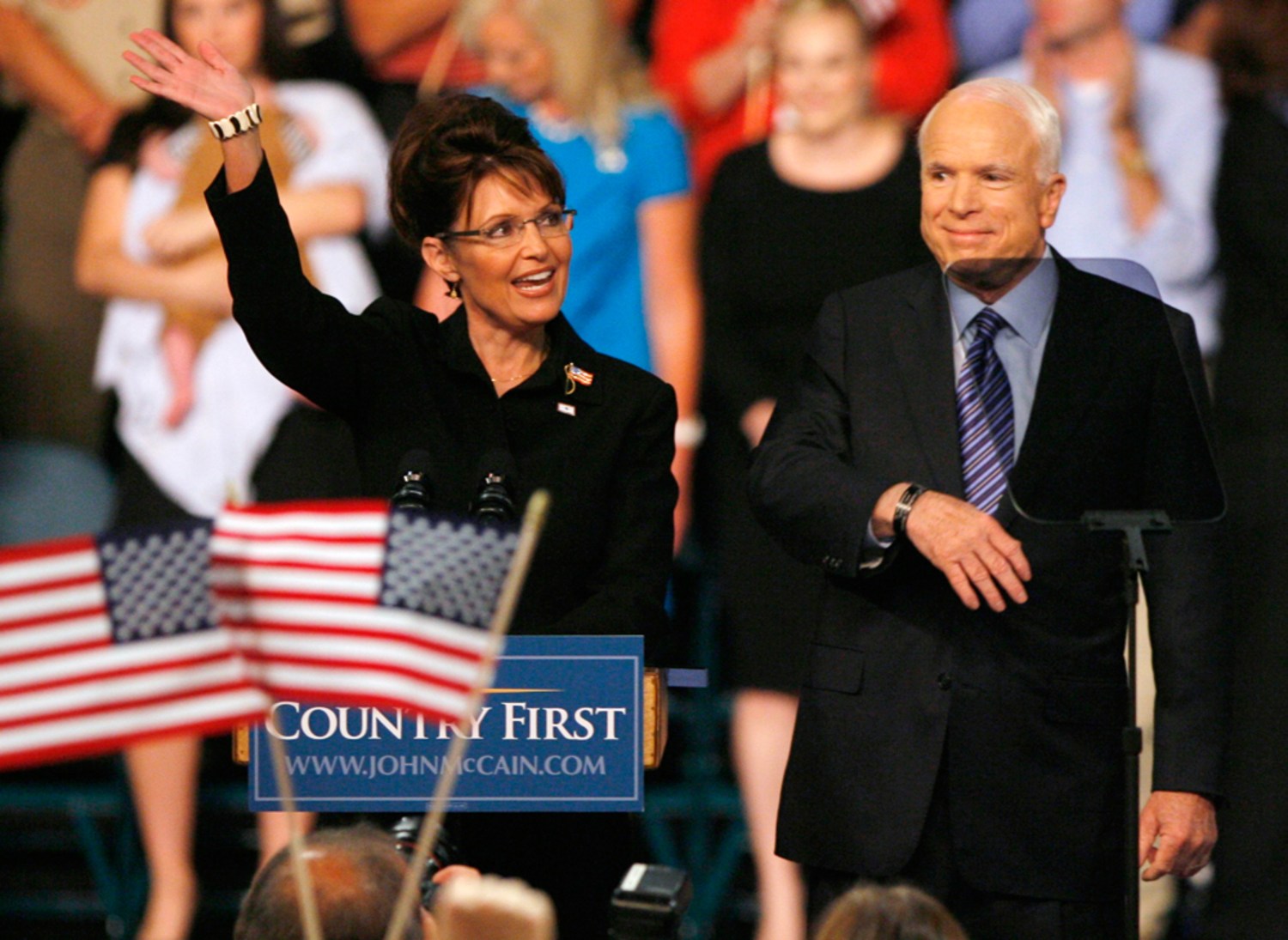
August 29, 2008: The day after a highly successful Democratic Convention in Denver, and on his own 72nd birthday, the Republican nominee for President, Senator John McCain of Arizona, tries to steal the Democrats' thunder by announcing his selection for Vice President: Governor Sarah Palin of Alaska.
Traditionally, Vice Presidential picks are chosen for contrast. Sometimes, they represent a part of the country that the Presidential nominee doesn't, although they usually don't make much of a difference in winning States the Presidential nominee might not win.
Lyndon Johnson made a big difference for John Kennedy in 1960, and Walter Mondale might have done so for Jimmy Carter in 1976, but there have been no good examples since. Alaska has just 3 Electoral Votes, and has gone Republican in every Presidential election since 1968, so McCain didn't need Palin's help McCain there. The same was true on the Democratic side: Delaware also has just 3 EVs, and has gone Democratic in every election since 1992, so whatever help Joe Biden gave to Barack Obama, it wasn't geographic.
Sometimes, the Vice Presidential nominee has a particular strength that the Presidential nominee doesn't have. A younger nominee or a Governor might take an older foreign policy expert: Former Governor Ronald Reagan with George H.W. Bush in 1980, Governor Michael Dukakis with Lloyd Bentsen in 1988, Governor George W. Bush with Dick Cheney in 2000, and, there in 2008, the 47-year-old Obama with Biden. Palin certainly didn't help McCain there, and, with his experience, he was the older person and the foreign policy expert.
Sometimes, the age difference matters. In 1988, 64-year-old George H.W. Bush tried to appeal to youth with 41-year-old Dan Quayle. It's worked the other way, too. In that very election, Obama, 47, chose Biden, 66. McCain was 72, and Palin was 44. (Later, Biden chose Kamala Harris, 78 to 56, in 2020.)
And sometimes, a nominee who doesn't please the "true believers" in the party needs one of them on the ticket. Dwight D. Eisenhower chose Richard Nixon for that reason in 1952. Lyndon Johnson chose Hubert Humphrey in 1964. In 1976, Carter chose Mondale, and Gerald Ford dumped Nelson Rockefeller for Bob Dole. The elder Bush chose Quayle in 1988. In 1996, Dole, no longer seen by GOP archconservatives as one of their own, chose tax-cutting icon Jack Kemp. (Later, Mitt Romney chose Paul Ryan for this reason in 2012, and Donald Trump chose evangelical Catholic Mike Pence in 2016.)
When McCain first ran for the U.S. House of Representatives in 1982, seeking the seat of retiring Minority Leader John Rhodes, he was seen as a staunch conservative, a loyal soldier in the Reagan Revolution. When he first ran for the U.S. Senate in 1986, seeking the seat of retiring conservative icon Barry Goldwater, he was still seen as a good conservative. But by the time he made his 1st run for President in 2000, he was seen as the moderate alternative to George W. Bush. And here, in 2008, despite finally winning his Party's nomination, a lot of Republicans were calling him a liberal.
McCain hadn't changed much over those 26 years. Politically, he was almost exactly the same. But the Party had veered so far to the right, that he was now seen by many moderates and independents as a sane Republican. He needed to shore up the conservative base. And so, he chose Palin, an absolutist on abortion (she had 5 children), guns (she bragged about her hunting skills), and taxes.
An editorial cartoon in the coming days showed an elephant in a suit, behind a podium, with the top half of a McCAIN-PALIN bumper sticker torn off, as if Palin was the reason any true Republican was going to vote for this ticket.
And, given McCain's age, and the fact that he had already beaten cancer once, the possibility that Palin could become President -- the 1st female President if it happened -- made her even more appealing to Republicans. The Democrats had nominated Geraldine Ferraro for Vice President on Mondale's ticket in 1984, and almost nominated Hillary Clinton for President instead of Obama this time. It would give the Republicans a chance to one-up the Democrats on a civil rights issue.
At first glance, it seemed like a very interesting pick: A woman, young, attractive, nice-looking family, in an executive position, shores up areas in the conservative movement where McCain is seen to have fallen short, and comes across like gangbusters on TV. It looks like the Obama-Biden campaign’s momentum has been wiped out, and we might have a close race all the way.
But then she started talking. And she began to sound not just like an archconservative, but like someone too inexperienced for the role into which she was thrust. Like someone whose total political experience had been a year and a half as Governor of a State of 687,000 people (only Vermont and Wyoming had fewer, then as now), and 6 years as Mayor of a "city" of 7,000 people. Like what the early Saturday Night Live would have called a "not-ready-for-prime-time player."
Her acceptance speech at the Republican Convention, at the Xcel Energy Center (UPDATE: It's now named the Grand Casino Arena) in St. Paul, Minnesota, was basically a throwing of platitudes against a wall to see which ones stuck. None did.
In his acceptance speech, McCain's best line referred to his basic idea of "biography as candidacy": He told of his life of service to America, and said, "I have the scars to prove it, Barack Obama does not!" Obama was 11 years old when the Vietnam War ended, and McCain was released as a prisoner of war. McCain found a good way to contrast himself with Obama without directly insulting him. But, to put it in baseball terms, after Palin's strikeouts of the preceding 7 days, he needed a home run, and only managed a single.
Speaking of SNL, former writer and castmember Tina Fey was rehired by the show, because of her resemblance to Palin. It got to the point where all she had to do was repeat what Palin was saying in interviews, and the audience would laugh. Except for one thing: In the September 13 cold open, in character, Fey said, "I can see Russia from my house!"
It seemed like the sort of thing the real thing, dingbat that she was, would have said. What did Palin say? Two days earlier, in her 1st major interview after being nominated, she sat down with Charles Gibson, then the anchor of ABC World News Tonight. He asked her about the proximity of Alaska to Russia, specifically easternmost Siberia, and she said, "They're our next-door neighbors, and you can actually see Russia from land here in Alaska, from an island in Alaska." And, given a day with clear enough skies, that turns out to be true.
The problem was this: She seemed to be citing this fact as a foreign policy credential. It shouldn't have been considered one. In other words, it was actually dumber than the dumb quote misattributed to her.
By putting up such a rotten foreign policy credential, she reminded people of a major reason they'd turned against the Republican Party: The Bush Administration's policies on the Iraq War and the War On Terror. Nor did she, an apparently middle-class family-oriented woman, reassure people that the disastrous Bush economic policies would be significantly altered by an incoming McCain-Palin Administration. She needed to be strong where McCain was weak, and stand with him where he was strong. Not only did she do neither especially well, she emphasized the areas where McCain was weak.
In the Vice Presidential debate, Biden had to walk a fine line, criticizing her ticket's policies without sounding like an old man bullying a young woman. He stuck to criticizing McCain rather than Palin, and it seemed to work. At one point, Palin tried to invoke Reagan by saying, "Oh, there you go again, Joe." But, unlike Reagan's famous 1980 debate zinger on Carter, it sounded planned, and thus artificial. Palin wasn't going to remind any Republican old enough to remember Reagan of him. She didn't make a fool of herself in the debate, but she didn't help herself much, which she needed to do, and Biden won it solidly.
In the end, Palin may have gained as many conservative voters as she turned off independents and Democrats who were unsure about Obama. The Republican politician who really cost John McCain the election wasn't Sarah Palin, it was George W. Bush: McCain never explained how his policies were going to be better than those of the incumbent, the policies America had turned against.
*
August 29, 2008 was a Friday. There were 2 college football games played that night. Temple beat Army, 35-7 at Michie Stadium in West Point, New York. And Rice beat Southern Methodist University (SMU), 56-27 at Rice Stadium in Houston.
These Major League Baseball games were played:
* The New York Yankees beat the Toronto Blue Jays, 2-1 at Yankee Stadium. Carl Pavano, already hated by Yankee Fans, was the winning pitcher, defeating A.J. Burnett, who would become beloved by Yankee Fans. Derek Jeter went 0-for-4. Alex Rodriguez went 1-for-3.
* The New York Mets beat the Florida Marlins, 5-4 at Dolphin Stadium (now Hard Rock Stadium) in Miami Gardens, Florida. The Mets scored 4 runs in the top of the 9th, on a grand slam by Carlos Beltrán, and the Marlins 2 in the bottom half.
* The Boston Red Sox beat the Chicago White Sox, 8-0 at Fenway Park in Boston. Daisuke Matsuzaka allowed 2 hits over 8 innings, and Mike Timlin finished the 2-hit shutout. David Ortiz went 3-for-4 with a walk and an RBI.
* The Washington Nationals beat the Atlanta Braves, 7-3 at Nationals Park in Washington.
* The Tampa Bay Rays beat the Baltimore Orioles, 14-3 at Tropicana Field in St. Petersburg, Florida.
* The Milwaukee Brewers beat the Pittsburgh Pirates, 3-1 at PNC Park in Pittsburgh.
* The Seattle Mariners beat the Cleveland Indians, 3-2 at Progressive Field in Cleveland. Ichiro Suzuki went 1-for-3.
* The Cincinnati Reds beat the San Francisco Giants, 11-7 at Great American Ball Park in Cincinnati.
* The Detroit Tigers beat the Kansas City Royals, 6-3 at Comerica Park in Detroit.
* The Chicago Cubs beat the Philadelphia Phillies, 3-2 at Wrigley Field in Chicago. Alfonso Soriano hit a home run in the 7th inning, which made the difference.
* The Houston Astros beat the St. Louis Cardinals, 3-2 at Minute Maid Park (now Daikin Park) in Houston.
* The Arizona Diamondbacks beat the Los Angeles Dodgers, 9-3 at Chase Field in Phoenix.
* The Colorado Rockies beat the San Diego Padres, 9-4 at Petco Park in San Diego.
* The Los Angeles Angels beat the Texas Rangers, 3-1 at Angel Stadium of Anaheim.
* And the Minnesota Twins beat the Oakland Atletics, 12-2 at the McAfee Coliseum (as the Oakland Coliseum was then known).


No comments:
Post a Comment