Showing posts with label big red machine. Show all posts

Friday, December 16, 2022

December 16, 1976: The Trade That Broke the Big Red Machine

December 16, 1976: The Cincinnati Reds of the 1970s were one of the greatest baseball teams of all time. They included the game's all-time hits leader, Pete Rose; one of its greatest catchers ever, Johnny Bench; and perhaps the best all-around player in the game at the time, Joe Morgan. Between them, those 3 men won the National League Most Valuable Player award 5 times in a span of 7 years.

What few people, including the Reds' organization until it was too late, realized at the time was that none of those men was the most important player on the team.

Those Reds, also known as the Big Red Machine, were one of the most dominant teams in baseball history. Playing their home games on the artificial turf of Riverfront Stadium, they won 5 National League Western Division titles, 4 NL Pennants and 2 World Series in a span of 6 years, with a lineup of Hall of Famers and All-Stars, that became known as "The Great Eight":

3rd Base, Number 14: Pete Rose
2nd Base, Number 8: Joe Morgan
Catcher, Number 5: Johnny Bench
1st Base, Number 24: Tony Pérez
Left Field, Number 15: George Foster
Shortstop, Number 13: Dave Concepción
Right Field, Number 30, Ken Griffey (Sr.)
Center Field, Number 23, César Gerónimo
Pitcher (No Designated Hitter in the National League until 2022)

But after their 2nd World Series win in 1976, they made a trade that changed everything.

Atanasio Pérez Rigal, who had fled Cuba just after the 1959 revolution, had been a cornerstone of the Reds' offense, driving in at least 90 runs every year since 1967. He was also a leader in the clubhouse and a fan favorite, earning the nickname "The Mayor of Riverfront" for his popularity. His teammates called him "Big Doggie."

But, as they did after the 1965 season, when they traded Frank Robinson to the Baltimore Orioles for Milt Pappas, the Reds needed more pitching, and they had a young 1st baseman in Dan Driessen waiting in the wings. So, the Reds' front office decided that Pérez was expendable.

They sent Pérez and relief pitcher Will McEnaney to the Montréal Expos for pitchers Woodie Fryman and Dale Murray. It was supposed to make the Reds stronger over the long haul, but it had the opposite effect. Instead, it broke the heart and the spirit of the team.

And despite the argument in favor of better pitching, it was really over money. The Reds were perennially a cheap organization. Pérez agreed to waive his no-trade clause as a 10-and-5 player (10 years in the major leagues, 5 years with the same team), and accepted a lucrative 3-year contract from the Expos.

Although Driessen was a good hitter and a good 1st baseman, he was not as productive as Pérez. Without his bat in the lineup, they finished 2nd in 1977, 10 games behind the Los Angeles Dodgers. In 1978, they finished 2 1/2 games behind the Dodgers. In 1979, they won the NL West, but were swept in the NL Championship Series by the Pittsburgh Pirates, whom they had beaten in the NLCS in 1970, '72, '74 and '75.

Pérez, meanwhile, thrived in Montreal. In his 3 seasons with the team, his home run totals were 19, 14 and 13, compared to Driessen's 17, 16 and 18; and his RBI totals were 91, 78 and 73, compared to 91, 70 and 75. Based on stats alone, it seems like it wasn't a downgrade. But the Reds' lost Pérez's leadership, which was now mentoring not their young players, but young Expos like Gary Carter and Andre Dawson, which led to them nearly winning the NL Eastern Division in 1980, and winning it in 1981. And both Murray and Fryman were shaky for the Reds. It took them until 1990 to win another Pennant, and that's the only Pennant and World Series they've won since this trade.

Pérez would rejoin his former Reds teammates Rose and Morgan on the Philadelphia Phillies in 1983, and, together with Mike Schmidt and Steve Carlton, they won another Pennant. Pérez was inducted into the Hall of Fame in 2000, joining Bench, Morgan, Schmidt, Carlton, and Reds manager Sparky Anderson. He also would have joined Rose, had Rose not been banned from baseball in 1989. Carter and Dawson were later elected as well.

Murray returned to the Expos in 1979, and in 1981, he signed with the Toronto Blue Jays. After the 1982 season, he would be involved in another lopsided trade involving a power-hitting 1st baseman: With Don Mattingly waiting in the wings, the New York Yankees sent 1st base prospect Fred McGriff to the Jays for Murray. Murray was a bust for the Yankees, while McGriff went on to hit 493 career home runs.

*

December 16, 1976 was a Thursday. Baseball was out of season. Football was in midweek. There were 3 games in the NBA:

* The New York Nets lost to the Kansas City Kings, 100-90 at the Kemper Arena (now the Hy-Vee Arena) in Kansas City.

* The Cleveland Cavaliers beat the Indiana Pacers, 111-105 at The Coliseum in the Cleveland suburb of Richfield, Ohio.

* And the Houston Rockets beat the Atlanta Hawks, 118-107 at The Summit in Houston. Rudy Tomjanovich, later to coach the Rockets to 2 NBA Championships, led all scorers on the night with 36 points. (The arena has since been converted into the Central Campus of the Lakewood Church, Dr. Joel Osteen's "megachurch.")

There were no games in the NHL, but there were 2 in the World Hockey Association. The Minnesota Fighting Saints beat the Indianapolis Racers, 5-3 at the Market Square Arena in Indianapolis. And the San Diego Mariners beat the Edmonton Oilers, 3-0 at the San Diego Sports Arena (now the Pechanga Arena).

Tuesday, November 29, 2022

November 29, 1971: The Trade That Made the Big Red Machine

November 29, 1971: The Cincinnati Reds trade 1st baseman Lee May, 2nd baseman Tommy Helms and utility player Jimmy Stewart to the Houston Astros for 2nd baseman Joe Morgan, center fielder César Gerónimo, outfielder Ed Armbrister, utility player Denis Menke and pitcher Jack Billingham.

May was a power-hitting All-Star, and gave the Astros 3 strong seasons before they foolishly traded him to the Baltimore Orioles. Helms, a former National League Rookie of the Year, a 2-time All-Star and a 2-time Gold Glove, gave the Astros 3 decent seasons, but stopped hitting in his 4th. Stewart stopped hitting, and only played 2 more seasons in the major leagues. Still, getting May in the trade meant that the Astros were not exactly robbed.

If Morgan had gotten hurt and done nothing for the Reds, this would still have been a good trade for them. Menke didn't do much for them, but Billingham was a good starting pitcher, Gerónimo won 4 straight Gold Gloves as their center fielder and even batted .307 in 1976, and Armbrister was a key reserve, famously involved in the play that won Game 3 of the 1975 World Series.

But Morgan became perhaps the best all-around player in baseball, the sparkplug of what had already been known since the 1970 season as "The Big Red Machine." In 1972, he led the NL in walks, on-base percentage and runs scored, and helped the Reds win the Pennant. In 1975 and 1976, he helped them win the World Series, and was named the NL Most Valuable Player both times. In the top of the 9th inning of Game 7, his RBI single was the Series' winning run. He stole 689 bases in his career, 406 of them in his 8 seasons with Cincinnati. He also surpassed Helms by winning 5 straight Gold Gloves.

Unfortunately for Reds fans, their team had a cheap organization, and when his contract ran out after the 1979 season, they didn't try to re-sign him. He went back to the Astros, and helped them win the 1980 NL Western Division title. He was elected to the Baseball Hall of Fame in his 1st year of eligibility.

On this same day, another big trade was made: The San Francisco Giants, coming of a season in which they beat the Reds out for the NL West title, traded their best pitcher, Gaylord Perry, to the Cleveland Indians for their best pitcher, Sam McDowell.
Sam McDowell

It would be a huge mistake: "Sudden Sam" had succeeded Sandy Koufax as baseball's top strikeout artist, but his drinking was out of control, and he was out of the major leagues 3 1/2 years later, only 32 years old. He beat his problem to become one of baseball's foremost substance-abuse counselors.
Gaylord Perry

Perry won the American League's Cy Young Award in 1972, but the Indians made the trade less consequential than it could have been by letting him go too soon, probably for the same reason they traded McDowell: Salary concerns, as the Indians were always short on cash. In 1978, with the San Diego Padres, Perry won the NL's Cy Young Award, becoming the 1st man to win it in both Leagues. McDowell had been considered a possibility to join the 300 Wins and 3,000 Strikeouts Clubs, and the Baseball Hall of Fame. Perry actually did join them.

Two dumb trades in one day. Do I hear three? The Chicago Cubs traded pitcher Ken Holtzman to the Oakland Athletics for center fielder Rick Monday. Holtzman helped the A’s win 3 straight World Series, and Monday did little for the Cubs, until they traded him to the Los Angeles Dodgers.

*

November 29, 1971 was a Monday. Baseball was out of season. No NBA, ABA or NHL games were scheduled. On ABC Monday Night Football, the Miami Dolphins beat the Chicago Bears, 34-3 at the Orange Bowl in Miami.

Friday, October 21, 2022

October 21, 1975, The Carlton Fisk Game

October 21, 1975: In The Curse of the Bambino, his somewhat skewed history of his beloved Boston Red Sox, Boston Globe columnist Dan Shaughnessy called it "a brilliant autumn day in New England," following a 3-day delay for rain. Brilliant though the Tuesday afternoon may have been, Game 6 of the 1975 World Series is played at night at Fenway Park.

The Red Sox, Champions of the American League after winning its Eastern Division and beating the 3-time defending World Champions, the Oakland Athletics, in the AL Championship Series, trail the Cincinnati Reds, a.k.a. the Big Red Machine, Champions of the National League after winning its Western Division and beating the Pittsburgh Pirates in the NLCS, 3 games to 2, and must win to force a Game 7.

The Sox haven't won the World Series in 57 years, including a loss as recently as 1967. The Reds haven't won the World Series in 35 years, including 2 Series losses in this decade already. Boston is looking for its 1st title since 1918; Cincinnati, for its 1st since 1940. Both teams need it badly. Something's gotta give.

Just 14 years later, Shaughnessy wrote, "Game Six has taken on a life of its own in the years since it was played, and it gets larger and more thrilling in each retelling. Some distance allows that there may be other contenders for the title of The Greatest Game Ever Played, but by any measure, 1975's Game Six will stand as one of the top ten games in World Series history, and one that came at a time when baseball needed it most." Shaughnessy was right.
In The New Yorker magazine, Roger Angell wrote, "Game Six... what can we say of it without seeming to diminish it by recapitulation or dull it with detail?" Roger, one of the greatest writers ever on the subject of baseball, was wrong on this one: The details are necessary.

Due to the rain, Sox manager Darrell Johnson was able to start Luis Tiant, winner of Games 1 and 4, on full rest. Reds manager Sparky Anderson started Gary Nolan. Fred Lynn, who, that season, became the 1st player ever to be awarded his league's Rookie of the Year and its Most Valuable Player award in the same season, hit a home run that gave the Sox a 3-0 lead in the 1st inning, and Tiant pitched shutout ball through 4.

But, as they would say in English soccer, Three-nil, and they fucked it up. The Reds got 2 men on in the 5th, and Ken Griffey Sr. sent Lynn to the wall. Lynn crashed, telling NBC's Bob Costas years later that he'd hurt his ribs, and that, for a moment, he was barely conscious and couldn't feel his legs. Griffey's triple scored 2 runs, and then Johnny Bench singled Griffey home to tie the game. A 2-run double by George Foster in the 7th and a solo homer by Cesar Geronimo in the 8th gave the Reds a 6-3 lead, with just 6 outs to go for the title.

Typical Boston choke, leading to a Reds win? As ESPN college football analyst Lee Corso would say, "Not so fast, my friend!" Six-three, and they fucked it up. In the bottom of the 8th, Reds reliever Pedro Borbon (who, like Griffey, would later see his son and namesake play in the major leagues) gave up a single to Lynn and a walk to Rico Petrocelli.

Sparky brought in Rawley Eastwick, who struck out Dwight Evans and got Rick Burleson to line out to left. He got 2 strikes on Bernie Carbo, a former Red, pinch-hitting for pitcher Roger Moret (who had relieved Tiant in the 8th), but Carbo drove one to dead center, and tied it up.

In the bottom of the 9th, Denny Doyle drew a leadoff walk. Carl Yastrzemski singled him over to 3rd. Sparky brought in reliever Will McEnaney, and had him intentionally walk Carlton Fisk. Did Sparky have a premonition? If so, it didn't help him later on.

Lynn flew to left, and Foster threw home. Doyle tagged up and broke for home, because he thought Sox 3rd-base coach Don Zimmer was telling him, "Go, go, go!" In fact, Zim was saying, "No, no, no!" Doyle was out at the plate. Had he scored, winning it for the Sox right there, this would still have been a superb game, but not the legendary game that it became -- except within New England. Outside those 6 States, few baseball fans would have ranked it as an all-time great game. Instead, it went to extra innings.

Dave Concepcion singled and stole 2nd with 1 out in the top of the 10th, but Sox reliever Dick Drago stranded him. Pat Darcy sent the Sox down 1-2-3 in the bottom of the 10th.

Pete Rose led off the top of the 11th, and turned to Sox catcher Fisk, and said, "Can you believe this game?" (Some sources have Rose's comment as, "Some kind of a game, isn't it?") Fisk may not have taken kindly to that, because Drago -- who would bean Thurman Munson in a Yanks-Sox game at Fenway 3 years later -- hit Rose with a pitch.

Griffey bunted, and, unlike the Ed Armbrister play in Game 3, did not even appear to interfere with Fisk, who threw Rose out at 2nd. With Griffey on 1st and 1 out, Joe Morgan, who would be named the NL's MVP that season and the next, drove the ball to right field, and at Fenway the right-field fence was, and remains, only 3 feet high. Evans reached over the fence to make a great catch, and then started a double play, throwing to Yaz, who threw to Burleson who had run over to cover 1st, to eliminate Griffey and end the Reds' rally.

The Sox went down 1-2-3 in the bottom of the 11th. In the top of the 12th, Tony Perez and Foster singled off Rick Wise, but Wise stranded them.

At 12:34 AM on October 22, 1975, Fisk led off the bottom of the 12th against Darcy, and hit a 1-0 pitch down the left-field line. It had enough distance. But would it be fair? Or would it be foul? Fisk, as though it would actually influence the flight of the ball, waved his arms to his right. The ball hit the pole near its top, for a home run. Final score, Boston 7, Cincinnati 6. The Series was tied, and would go to a Game 7.

John Kiley, the organist at Fenway Park (and also at the Boston Garden, thus the answer to the corny old trivia question about "the only man to play for the Red Sox, Celtics and Bruins"), played George Friedrich Handel's "Hallelujah Chorus." Then he played "Stout-Hearted Men." Then he played "The Beer Barrel Polka." ("Roll out the barrel, we'll have a barrel of fun.") Then he played "Seventy-six Trombones" from the Broadway musical The Music Man. (I have no idea why he played that one.)

The shot of Fisk thinking he can wave the ball fair, which I've dubbed the Fenway Twist, is the most familiar clip in the history of televised sports. (As they had with every World Series since 1947, NBC was televising it, although they would begin to alternate with ABC starting with the 1977 season, until 1989.)

From seeing this clip so much, and hearing so much talk about Game 6 of '75 from Red Sox fans, a reasonable person might have asked (through 2004 anyway), "Wait a minute. The Red Sox haven't won the World Series since 1918. That means... they lost Game 7! So why do people make such a big deal about this homer?" Well, it won one game, not a World Series, but it was still one of sports' greatest epics.

Game 6 of the 1975 World Series has been called "The Greatest Baseball Game Ever Played" by many people. Certainly, it is in the discussion, along with Game 8 in 1912 (Game 2 was tied when called due to darkness), Game 7 in 1924, Game 7 in 1960, and Game 7 in 1991, and also with the 1951 Giant-Dodger Playoff and the 1978 Yanks-Sox Playoff.

In 1981, baseball historian John Thorn published Baseball's 10 Greatest Games. He included this game as one of them. In 2010, the MLB Network listed this game on top of their list of MLB's 20 Greatest Games -- limited in scope, due to the availability of surviving videotape, to 1975 onward. Due to the timing -- 1975 to 1980 -- along with the Bucky Dent Game, it was 1 of 2 games to make both lists.

Dick Stockton, born in Philadelphia but grew up in Queens, then the 32-year-old lead broadcaster on Sox games for WSBK-Channel 39, and previously for Boston Celtics games on WBZ-Channel 4, then an NBC station, was the lead broadcaster for NBC in this Series.

A 22-year-old writer from Quincy named Lesley Visser was part of The Boston Globe's coverage. Stockton and Visser would both go on to become key cogs in CBS Sports' programming. Supposedly, they met on this night. Other sources say they met at another Boston-based event in 1982. Either way, they married in 1983, but got divorced in 2010, and each has since married someone else.

And, of course, this game has also been cited in the 1997 film Good Will Hunting, discussed by the characters played by Robin Williams and Matt Damon.

Of course, as Shaughnessy pointed out in his book, in the 1986 World Series, Game 6 would prove disastrous for the Red Sox. So now, if you're in New England, or in the presence of a Red Sox fan anywhere else, and you say the words, "Game Six," they have to ask, "Which one?"

UPDATE: The Reds have a team Hall of Fame. Elected from this 1975 "Big Red Machine" have been 1st baseman Tony Pérez, 2nd baseman Joe Morgan, shortstop Dave Concepción, 3rd baseman Pete Rose, left fielder George Foster, center fielder César Gerónimo, right fielder Ken Griffey Sr., catcher Johnny Bench; pitchers Gary Nolan, Don Gullett, Pedro Borbón, Jack Billingham, Fred Norman and Clay Carroll; manager George "Sparky" Anderson, general manager Bob Howsam, and broadcasters Joe Nuxhall and Marty Brennaman.

The Red Sox also have a team Hall of Fame. From their 1975 Pennant winners, they have inducted 1st baseman Yastrzemski, 3rd baseman Petrocelli, catcher Carlton Fisk, shortstop Rick Burleson, left fielder Jim Rice, center fielder Fred Lynn, right fielder Dwight Evans, pitchers Luis Tiant and Bill Lee, team owner Tom Yawkey, general manager Dick O'Connell, scout George Digby, executives Edward Kenney and Dick Bresciani, groundskeeper Joe Mooney, guest relations director Al Green, public address announcer Sherm Feller, broadcasters Ken Coleman and Ned Martin, and longtime vendor Arthur D'Angelo. 1st baseman George Scott had been traded away, but would be brought back.

*

October 21, 1975 was a Tuesday. Tom Waits releases his album Nighthawks at the Diner, including the song “Eggs and Sausage.” In that song, he sings, "Baby, you gotta understand, I'm in a graveyard charade, a spaceship masquerade." Good metaphors for the 1970s.

It was midweek for football, and the World Football League folded. I have a separate entry for that event.

The NBA and the ABA wouldn't start their seasons for another 2 days. But 3 games were played in the NHL:

* The New York Islanders and the Vancouver Canucks played to a tie, 5-5 at the Nassau Coliseum.

* The Montreal Canadiens beat the Pittsburgh Penguins, 7-1 at the Civic Arena in Pittsburgh.

* And the St. Louis Blues beat the Los Angeles Kings, 6-1 at the St. Louis Arena. From 1977 to 1983, the Arena was named the Checkerdome, because the Blues were owned by St. Louis-based Ralston Purina, whose logo was (and is) a "checkerboard square."

In the World Hockey Association that night:

* The Quebec Nordiques beat the New England Whalers, 6-1 at the Colisee de Quebec.

* The Minnesota Fighting Saints beat the Indianapolis Racers, 2-1 at the Market Square Arena in Indianapolis.

* And the Winnipeg Jets beat the Cincinnati Stingers, 7-0 at the Winnipeg Arena. 

Saturday, October 15, 2022

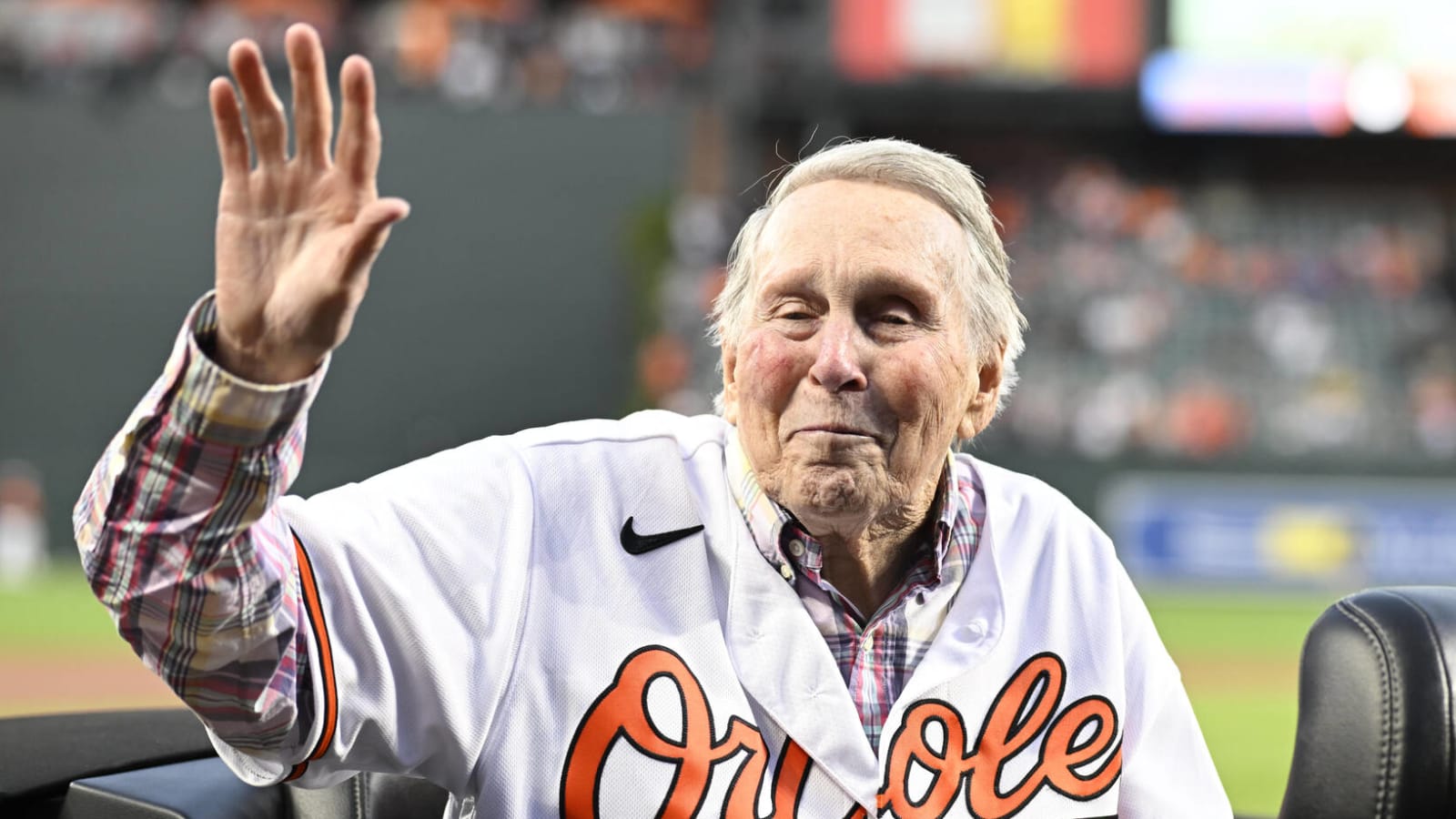
October 15, 1970: Brooks Robinson Re-Invents Third Base

Brooks Robinson and his 16 Gold Gloves

October 15, 1970: Ed Hurley, one of the umpires in the World Series, speaks of Brooks Robinson, the 3rd baseman of the victorious Baltimore Orioles, saying, "He came down from a higher league."

Born on May 18, 1937 in Little Rock, Arkansas, he reached the major leagues with the Orioles in 1955. In 1960, he made his 1st All-Star Game, and won the 1st of 16 consecutive Gold Gloves. In 1964, the Orioles nearly won the American League Pennant, and Robinson was named the AL's Most Valuable Player.

In 1966, the Orioles acquired right fielder Frank Robinson -- black, and, together, he and the white Brooks Robinson joked about the differences in things like their uniform numbers -- and he led them to their 1st Pennant and 1st World Series with with a Triple Crown season. In 1969, the Orioles won another Pennant, but lost the World Series to the New York Mets. Brooks nearly won Game 4 in the bottom of the 9th, but, in one of baseball's great ironies, he lost what would have been his greatest moment at the bat by an opponent's great fielding, a catch by Met right fielder Ron Swoboda.

So when the Orioles won the Pennant again in 1970, they had something to prove. Brooks might not have felt like he had anything to prove. But Frank Robinson was one of the biggest stars in baseball, and another teammate, 1st baseman John "Boog" Powell, was the odds-on favorite to win that season's AL MVP (and he did). It's hard to say that Brooks was forgotten, but he certainly wasn't the first player anyone thought about when they thought of the Orioles.

At the time, the title of the greatest third baseman in baseball history was pretty much up for grabs. Late 19th Century Baltimore Oriole John McGraw, early 20th Century Boston Red Sock Jimmy Collins, 1920s and '30s Pittsburgh Pirate Harold "Pie" Traynor, and Milwaukee Brave star Eddie Mathews were among the best hitters at the position, although only Mathews was known as a power hitter. Collins and Traynor were hailed as the best fielders at the position.

The Boyer brothers, Ken of the St. Louis Cardinals, and Clete, the former New York Yankee 3rd sacker then still active with the Atlanta Braves, also got some accolades, Ken mainly as a hitter, and Clete mainly as one of the few who fielded the position as slickly as Robinson.

But Robinson was not usually considered an all-time great 3rd baseman, despite already having won 10 Gold Gloves. So the 1970 World Series against the Cincinnati squad already known as "The Big Red Machine," would lift him to superstar status.

Game 1, at Cincinnati's Riverfront Stadium. This was the 1st World Series game ever played on artificial turf, and the 1st in which both teams wore names on the backs of their uniforms. And it was the 1st World Series with a black umpire, Emmett Ashford, who had become MLB's 1st black umpire in 1966, and was retiring at the end of the season: At the time, 55 was a mandatory retirement age for umpires, but he was allowed to come back for one more season and officiate in a World Series. The Jackson 5 sang the National Anthem.

Brooks, Powell, and catcher Elrod Hendricks hit home runs. Brooks made a backhanded stop of a grounder by Lee May, spinning, and firing a throw that bounced into Boog's glove, getting May out. Jim Palmer outpitched Gary Nolan. Orioles 4, Reds 3.

Game 2, in Cincinnati. Boog hit another homer in the 4th inning, and the O's tacked 5 runs on in the 5th. As with Game 1, Brooks went 1-for-4 with an RBI, but the hit was a single, not a homer. Orioles 6, Reds 5. With fans seeing vacuum cleaners being used on the artificial turf, they began calling Brooks "The Human Vacuum Cleaner," and "Mr. Hoover," after the brand of vacuum cleaner. 

Game 3, back on the natural grass and dirt infield of Memorial Stadium in Baltimore. Brooks took over the game immediately. In the top of the 1st, he snared a Tony Pérez grounder, and started a double play. In the bottom of the 1st, the Orioles loaded the bases, and Brooks doubled home 2 runs. In the top of the 2nd, he made a tough play to throw out Tommy Helms. In the 6th, Johnny Bench hit a liner that should have gone through the hole, but Brooks snared it on the fly.
Dave McNally pitched a complete game, and became the 1st pitcher ever to hit a grand slam in a World Series game. (Through 2022, he's still the only one.) Frank Robinson and Don Buford added home runs. Orioles 9, Reds 3. What had been predicted as a tight Series was now in danger of becoming a dominating sweep, as with the Orioles over the defending Champion Los Angeles Dodgers in 1966.

Game 4, in Baltimore. The Orioles came in with a 17-game winning streak: Their last 11 of the regular season, 3 straight in the ALCS, and the 1st 3 of the Series. Brooks went 4-for-4, taking Nolan deep on a home run. But the Reds showed up, scoring 3 runs in the 8th inning, and saved some face. Reds 6, Orioles 5.

Game 5, in Baltimore, on October 15. The Reds scored 3 runs in the top of the 1st, and, for a moment, the greatest comeback in sports history seemed possible. But Baltimore put a stop to that, scoring 2 runs in each of their 1st 3 innings, allowing Mike Cuellar to settle down and keep Cincinnati off the scoreboard until next April. Brooks went 1-for-5, and robbed Bench again. Orioles 9, Cincinnati 3.

Brooks Robinson had shown the world the peak of fielding at 3rd base. He was awarded the Series' Most Valuable Player award. With it came a new car. Bench said, "If we had known he wanted a car that badly, we'd all have chipped in and bought him one."

He helped the Orioles win another Pennant in 1971, as part of the "Leather Curtain" that gave Baltimore the best infield defense in the sport, with shortstop Mark Belanger, 2nd baseman Davey Johnson, and 1st baseman Boog Powell. But the O's lost that World Series to the Pittsburgh Pirates. He would help them win the AL East again in 1973 and 1974, losing the ALCS to the Oakland Athletics both times.

A thumb injury in 1975 was the beginning of his end, and he lost his starting job to Doug DeCinces in 1976. In 1977, at 42, he played only 24 games, the last on August 13. With catcher Rick Dempsey coming off the Disabled List, and a roster spot necessary, Brooks announced his retirement on August 21. Brooks Robinson Day was held on September 18, 1977, and his Number 5 became the 1st number ever retired in Baltimore sports.

He finished with a lifetime batting average of .267; 2,848 hits including 482 doubles, 68 triples and 268 home runs, decent totals for a man who spent 23 seasons in a pitcher's park like Memorial Stadium. Those 23 seasons were the most that any player had spent with any one team, a record tied by Carl Yastrzemski of the Boston Red Sox in 1983, but never broken.

Jim Murray, the great sports columnist of The Los Angeles Times, wrote during Robinson's career that "In the future, Brooks Robinson will be the standard every third baseman will be measured by." In his 2015 biography Brooks: The Biography of Brooks Robinson, Doug Wilson said, "That statement has withstood the test of time."

Since then, there has been Mike Schmidt, Graig Nettles, George Brett, Wade Boggs, Chipper Jones, Adrián Beltré, and, for the 2nd half of his career, Alex Rodriguez. Most baseball observers still rank Brooks as the greatest 3rd baseman in American League history, behind only Schmidt overall.

In 1983, Brooks was elected to the Baseball Hall of Fame. When the Orioles established their team Hall of Fame, he and Frank Robinson were the 1st 2 honorees. He was also elected to the Arkansas Sports Hall of Fame. When the Orioles played their last game at Memorial Stadium on October 6, 1991, he and Colts quarterback legend Johnny Unitas threw out ceremonial first balls -- in Unitas' case, a football. In 2012, a statue of Brooks was dedicated outside their new home, Oriole Park at Camden Yards.

In 1999, The Sporting News ranked their 100 Greatest Baseball Players. Brooks was ranked 80th, trailing Traynor (70th), Mathews (63rd) and Schmidt (28th) among 3rd basemen. That year, fans voted Brooks and Schmidt as the 3rd basemen on the Major League Baseball All-Century Team. In 2022, 23 years after TSN did their rankings, ESPN ranked their 100 Greatest Baseball Players, and Brooks came in 67th, trailing Mathews (64th), Boggs (45th), Brett (43rd), A-Rod (26th) and Schmidt (18th).
Brooks broadcast for the Orioles from 1978 to 1993. He formed a group that ran several minor-league teams, including the York Revolution, in York, Pennsylvania, where he had once played minor-league ball for the York White Roses. Their ballpark, WellSpan Park, has the address of 5 Brooks Robinson Way. That ballpark also has a statue of him. A 3rd statue is in downtown Baltimore, on Washington Boulevard. As of October 15, 2022, he is still alive.

UPDATE: He died on September 26, 2023, at the age of 86.

The Orioles have a team Hall of Fame. From this 1970 World Championship team, they have inducted Brooks Robinson, right fielder Frank Robinson, 1st baseman John "Boog" Powell, 2nd basemen Davey Johnson and Bobby Grich, shortstop Mark Belanger, left fielder Don Buford, center fielder Paul Blair, outfielder Terry Crowley, catcher Elrod Hendricks; pitchers Jim Palmer, Mike Cuellar, Dave McNally, Dick Hall, Eddie Watt; manager Earl Weaver, and coaches Billy Hunter and George Bamberger.

The Reds also have a team Hall of Fame. From their 1970 Pennant winners, they have inducted catcher Johnny Bench, 1st basemen Lee May and Tony Pérez, 2nd baseman Tommy Helms, shortstop Dave Concepción, left fielder Pete Rose; pitchers Jim Maloney, Gary Nolan, Wayne Granger, Don Gullett,  Pedro Borbón and Clay Carroll; manager George "Sparky" Anderson, general manager Bob Howsam and broadcaster Joe Nuxhall. Dave Bristol, who had managed the team from 1966 to 1969, has also been inducted.

*

October 15, 1970 was a Thursday. Singer Eric Benét and rapper Elgin Baylor Lumpkin, named for a basketball star but renaming himself Ginuwine, were born on this day.

This was also the day that President Richard Nixon signed the Organized Crime Control Act of 1970 into law. I have a separate entry for that event.

Football was in midweek. There was 1 game played in the NBA: The Phoenix Suns beat the Boston Celtics, 119-100 at the Arizona Veterans Memorial Coliseum in Phoenix. There were 3 games in the American Basketball Association:

* The New York Nets lost to the Pittsburgh Condors, 105-102 at the Civic Arena in Pittsburgh.

* The Miami Floridians beat the Carolina Cougars, 105-97 at the Miami Beach Convention Center.

* And the Indiana Pacers beat their arch-rivals, the Kentucky Colonels, 127-95 at the Indiana State Fairgrounds Coliseum (now the Corteva Coliseum) in Indianapolis.

And there were 4 games in the NHL:

* The Montreal Canadiens beat the expansion Buffalo Sabres, 3-0 at the Buffalo Memorial Auditorium. This was the Sabres' 3rd regular-season game, and their 1st home game at "The Aud." They'd debut by beating Pittsburgh on October 10, before losing to Los Angeles on October 14.

* The Philadelphia Flyers beat the Vancouver Canucks, 5-4 at The Spectrum in Philadelphia. This was the expansion Canucks' 5th regular-season game, and, although they had had a tighter schedule than the Sabres, so far, they'd won 2 of their 1st 4. Their opener, on October 9, was a 3-1 loss to Los Angeles, at home at the Pacific Coliseum.

* The Chicago Black Hawks beat their arch-rivals, the Detroit Red Wings, 2-1 at the Olympia Stadium in Detroit.

* The Minnesota North Stars beat the Pittsburgh Penguins, 4-2 at the Metropolitan Sports Center in the Minneapolis suburb of Bloomington, Minnesota.

* And the New York Rangers, the Toronto Maple Leafs, the Boston Bruins, the Los Angeles Kings, the California Golden Seals and the St. Louis Blues were not scheduled.

Friday, October 14, 2022

October 14, 1975: The Ed Armbrister Game

October 14, 1975: In a game featuring 6 home runs‚ 3 by each team‚ Game 3 of the World Series is won by the Cincinnati Reds over the Boston Red Sox, 6-5 in the 10th inning at Riverfront Stadium in Cincinnati.

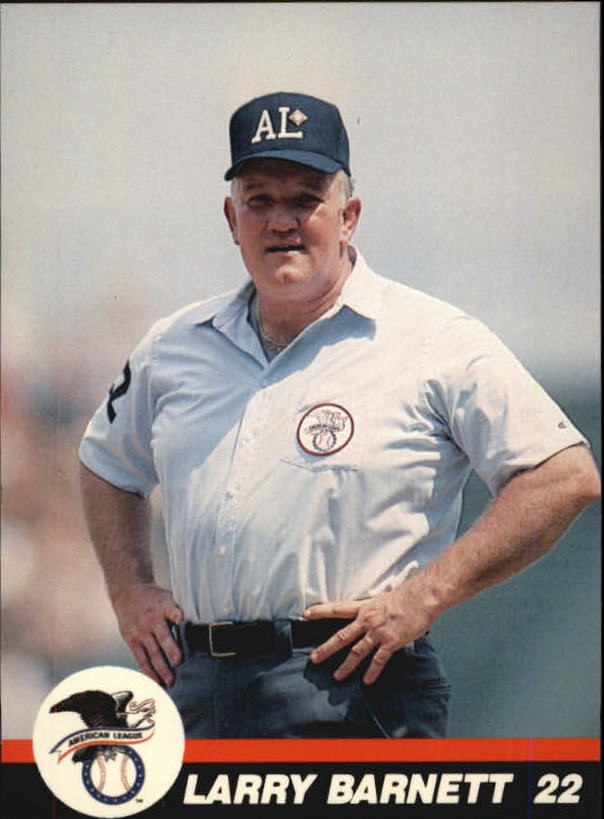
The inning is marked by a controversial play involving Cincinnati's Ed Armbrister and Boston's Carlton Fisk: Armbrister, a backup outfielder, lays down a sacrifice bunt, and seemingly hesitates breaking out of the batter's box; Fisk's subsequent throwing error leads to the Reds' winning run. The Sox scream for an interference call from umpire Larry Barnett‚ but to no avail.
Left to right: Fisk, Barnett, Red Sox manager Darrell Johnson,
Red Sox shortstop Rico Petrocelli

Tony Kubek, former Yankee shortstop and now one of the NBC broadcasters, says on the air that Barnett blew the call. Barnett ends up getting thousands of angry letters, some of them death threats, nearly all of them from the New England States.

The Red Sox won Game 4. The Big Red Machine won Game 5. Game 6 was an all-time classic, won by the Red Sox on Fisk's walkoff home run in the 12th inning. The Reds won Game 7, 4-3, on a 9th inning single by Joe Morgan. The Reds won their 1st World Championship in 35 years. Red Sox fans, who'd waited 57 years, would have to wait 29 years more.

The Armbrister play happened 47 years ago, but Red Sox fans still complain about it. It was even mentioned in the U.S. version of the movie Fever Pitch. Finally having won 4 World Series has done nothing to diminish Sox fans' feelings about it. They still think that, if interference had been called on Armbrister, they would have won the Series.

Barnett made the right call: There was no interference. Watch Armbrister's eyes: He's surprised that the ball went practically straight up into the air, and that made him hesitate. Intentional interference simply cannot be seriously called on that play.

The game was still tied. Curse of the Bambino or no, the game was still tied when it happened. Considering everything that went wrong with the team from 1918 to 2003, if they had gotten the call their way, they still could have lost the game later, possibly in another shocking way.

And the Red Sox blew Game 2, Game 5 and Game 7. They led Game 2, 2-1 going into the 9th inning, but Johnny Bench led off with a double. Johnson pulled Bill Lee, and replaced him with Dick Drago. Tony Pérez moved Bench to 3rd on a groundout, and George Foster popped up. But Dave Concepción singled up the middle to tie the game, and Ken Griffey Sr. doubled Concepción home.

Had the Red Sox held that lead, and nothing else changed, there never would have been a Game 7. And Fisk's home run to win Game 6 would have won the Series, and made him the greatest sports hero in New England history. And Barnett's alleged bad call wouldn't have mattered. But they didn't hold that lead.

In Game 5, they led 1-0 going into the bottom of the 4th, but gave up a run in the 4th, a run in the 5th, 3 runs in the 6, and a run in the 8th. Pérez hit 2 home runs. The Sox pulled a run back in the 9th, but lost the game, 6-2. Again: Had the Red Sox held that lead, and nothing else changed, there never would have been a Game 7. And Barnett's alleged bad call wouldn't have mattered. But they didn't hold that lead.

And in that Game 7, they took a 3-0 lead in the bottom of the 3rd, and held it into the top of the 6th. Then Lee decided to get cute. He started throwing his blooper pitch. He threw one to Pérez,
who deposited it onto the Massachusetts Turnpike, making it 3-2. The Reds tied the game in the 7th when Griffey walked, stole 2nd, and was singled home by Pete Rose.

In the 9th, Griffey led off with another walk. Cesar Gerónimo bunted him to 2nd. A Dan Driessen groundout got him to 3rd. Rose was walked intentionally to set up the force play, but Morgan singled off Jim Burton, and the Red Sox couldn't answer in the bottom of the 9th. Cincinnati 4, Boston 3, for the game, and for the World Series. Had they just prevented the Reds from scoring for 9 more outs, the Barnett non-call would have been a footnote in baseball history, a minor annoyance on the magical way to a title. 

Umpire Larry Barnett was not the reason that the Boston Red Sox lost the 1975 World Series. They had many chances to win it, but they couldn't finish it off. This seems never to have occurred to Red Sox fans. But then, it's been a long time since I gave up on expecting Red Sox fans to be rational. They still blame Don Zimmer for 1978, and they still believe that David Ortiz didn't cheat.

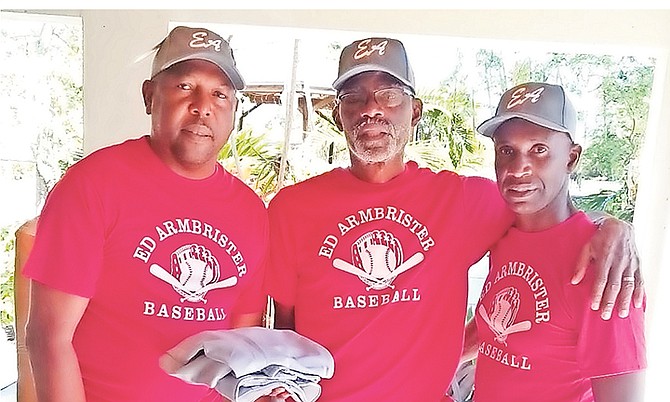
Ed Armbrister would also help the Reds win the World Series in 1976, and played 1 more season in the major leagues. He died in 2021, at 72 years old, in his native Bahamas, where he ran a youth baseball league, and was a consultant to the national Ministry of Sports.
Armbrister flanked by league employees 

Larry Barnett continued as an MLB umpire until 1999, and was the home plate umpire for the Jeffrey Maier Game in the 1996 American League Championship Series, although he had nothing to do with the game's controversial call by Rich Garcia. 

*

October 14, 1975 was a Tuesday. Football was in midweek. The NBA season didn't start for another 9 days. The ABA season started the day after that. There were 3 games in the NHL:

* The New York Islanders beat the Montreal Canadiens, 5-3 at the Nassau Coliseum.

* The St. Louis Blues beat the cross-State Kansas City Scouts, 5-1 at the St. Louis Arena.

* And the Vancouver Canucks beat the Washington Capitals, 7-2 at the Pacific Coliseum in Vancouver.

And there were 3 games in the WHA:

* The Quebec Nordiques beat the Edmonton Oilers, 8-5 at the Colisée de Québec.

* The Toronto Toros beat the Houston Aeros, 6-3 at Maple Leaf Gardens in Toronto.

* And the Calgary Cowboys beat the Indianapolis Racers, 5-3 at the Stampede Corral in Calgary. 

Tuesday, October 11, 2022

October 11, 1972: Bob Moose's Wild Pitch


October 11, 1972: The Pittsburgh Pirates, defending World Champions, lead the Cincinnati Reds 3-2 in the bottom of the 9th inning of the deciding Game 5 of the National League Championship Series at Riverfront Stadium in Cincinnati. But Johnny Bench hits a home run off Dave Guisti, over the left-field fence to tie the game‚ over the head of the Pirates' legendary right fielder, Roberto Clemente, who had joined the 3,000 Hit Club just 2 weeks earlier.
The Big Red Machine collect 2 more singles, and, with Hal McRae at bat, Bob Moose, who had come in to relieve Guisti, throws a wild pitch, and the Reds win, 4-3.
Not since Jack Chesbro in 1904 had a wild pitch decided a Pennant. Not since Johnny Miljus in the 1927 World Series had a wild pitch ended a postseason series. By a weird coincidence, Miljus threw his wild pitch as a Pirate, and Chesbro had also pitched for the Pirates before signing with the Highlanders/Yankees.
The Reds, taking their 2nd Pennant in 3 years, would go on to lose the World Series to the Oakland A's. The Pirates, having won their 3rd straight NL East title but having only 1 Pennant to show for it, would lose something far greater: A plane crash on New Year's Eve would make this game the last one that Clemente would ever play.
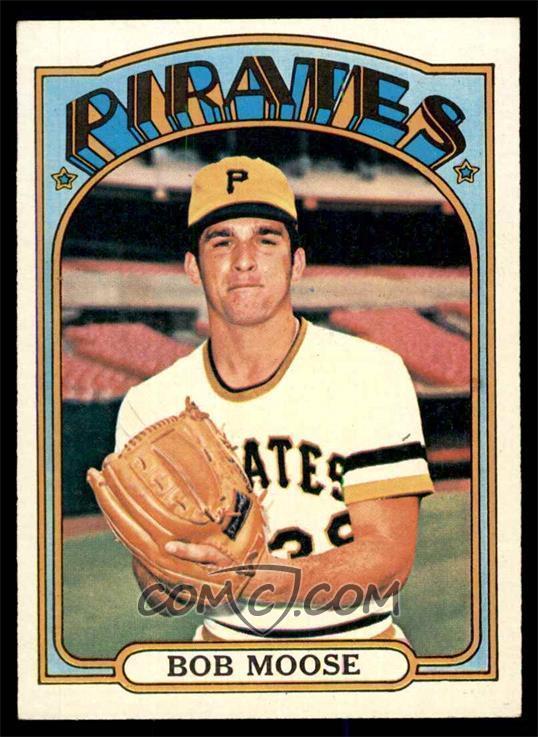
There would be more tragedy. Robert Ralph Moose Jr., a native of the Pittsburgh suburb of Export, Pennsylvania, a key figure on the Pirates' 1971 World Series winners, would be killed in a car crash in Ohio while still with the team, on October 9, 1976 -- his 29th birthday.
Still, he is remembered more for one pitch than for his achievements, or for his death. And he deserves better. The lead was already blown. The Pirates wouldn't have gotten that far without him. He went 13-10 that season, with a 2.91 ERA and a 1.150 WHIP. And he was much more reliable as a starter than as a reliever. Pirate manager Danny Murtaugh should have brought in someone else.
The Pirates should have held their home field advantage. They did win Game 3 at Riverfront. But the Reds won Game 2 at Three Rivers Stadium. Had the Pirates simply held at home, there never would have been a Game 4, let alone a Game 5.
And the Reds were better. True, the Pirates had won 96 games to the Reds' 95. They also scored 19 runs in the series, to the Reds' 15. But in the regular season, the Reds outscored the Pirates 707-691. The Reds had already beaten the Pirates in the 1970 NLCS. When the Pirates won the whole thing the next year, the team they had to beat in the NLCS was not the Reds, but the San Francisco Giants.
Overall, in the 1970s, in NLCS play, the Reds were 4-2, and the Pirates were 2-4. In games, the Reds were 14-8, and the Pirates were 9-13. Against each other, the Reds led 6-5.
Hall-of-Famers? The Pirates had Clemente, Bill Mazeroski and Willie Stargell. But the Reds had Bench, Joe Morgan and Tony Perez, not to mention Pete Rose, who would be in the Hall if he hadn't done something stupid as a manager.
With the 1st all-nonwhite starting lineup, and Clemente's triumph, in '71 and Stargell leading the "Family" in '79, the Pirates were a great story. But the Reds were a great team.
*
October 11, 1972 was a Wednesday. Game 4 of the American League Championship Series was played at Tiger Stadium in Detroit. Jim "Catfish" Hunter of the Oakland Athletics and Mickey Lolich of the Detroit Tigers battled into extra innings.
The A's scored 2 runs in the top of the 10th, but, in the bottom of the 10th, singles by Dick McAuliffe and Al Kaline, a walk by Gates Brown, and an error by Gene Tenace gave the Tigers a run. Norm Cash walked, and Jim Northrup singled home the tying and winning runs, giving the Tigers a 4-3 win and a tie in the series. But the A's won the Pennant the next day.
There were 7 games played in the NHL:

* The New York Rangers beat the Vancouver Canucks, 5-3 at Madison Square Garden. Rod Gilbert scored 2 goals.

* The Montreal Canadiens and the Toronto Maple Leafs, arch-rivals, played to a 2-2 tie at Maple Leaf Gardens in Toronto.

* The Buffalo Sabres beat the Los Angeles Kings, 7-3 at the Buffalo Memorial Auditorium.

* The Detroit Red Wings beat the Boston Bruins, 4-3 at the Olympia Stadium in Detroit.

* The Chicago Black Hawks beat the expansion Atlanta Flames, 4-1 at the Chicago Stadium.

* The Minnesota North Stars beat the California Golden Seals, 5-2 at the Metropolitan Sports Center in the Minneapolis suburb of Bloomington, Minnesota.

* The Pittsburgh Penguins beat the St. Louis Blues, 5-2 at the St. Louis Arena.

* And the expansion New York Islanders and the Philadelphia Flyers were not scheduled.

It was opening night for the World Hockey Association. I have a separate entry for this event. The 1st game is played at the Edmonton Gardens, and the Alberta Oilers -- they would switch from the Province's name to the City's the next season -- beat the Ottawa Nationals 7-4. Ron Anderson scores the team's 1st goal.

The Quebec Nordiques, trying to get good publicity, named Montreal Canadiens legend Maurice "the Rocket" Richard as head coach, but they lose their 1st game, 2-0 to the Cleveland Crusaders at the Cleveland Arena. Richard immediately quits, saying he wasn't meant to be a coach. Nords management asks him to stay on long enough to hire a replacement. They win their 2nd game, but the Rocket has had enough, and Maurice Filion is hired.

Football was in midweek. The American Basketball Association began its season the next day. There were 3 NBA games played:

* The Boston Celtics beat the Detroit Pistons, 121-108 at Cobo Hall (now Huntington Place) in Detroit.

* The Seattle SuperSonics beat the Philadelphia 76ers, 105-100 at The Spectrum in Philadelphia.

* And the Los Angeles Lakers beat the Kansas City-Omaha Kings, 129-94 at the Omaha Civic Auditorium in Omaha, Nebraska.

Also on this day, Australian actress Claudia Black was born. She is known for her roles in the science-fiction TV series Farscape and Stargate SG-1.

December 31, 1999 & January 1, 2000: The Millennium

December 31, 1999:  The Millennium arrives. The people of planet Earth survived. At a terrible cost. But we hadn't destroyed ourselves. ...