Showing posts with label philadelphia civic center. Show all posts

Thursday, November 24, 2022

November 24, 1960: Wilt Chamberlain Grabs 55 Rebounds In a Game

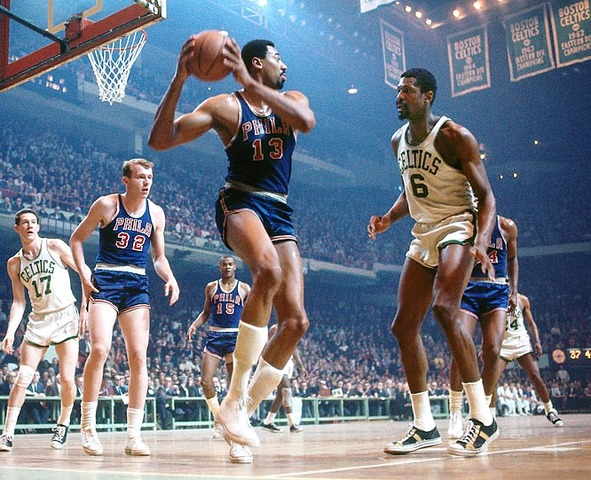
November 24, 1960: Wilt Chamberlain of the Philadelphia Warriors grabs 55 rebounds, setting an NBA record that still stands. He also scored 34 points. And it wasn't against a "slow white guy" or a "plumber," as LeBron James' worshipers say of Wilt's competition today: It was against Bill Russell of the Boston Celtics, the other serious contender for the title of the best player in the sport at the time. The entire Celtic team had 59 rebounds. Russell had 19 of them, which would be a great total by today's standards.

But the Celtics won, 132-129, at the Philadelphia Civic Center. Wilt set lots of records, but Russell (almost) always had the better team. That's why Wilt was prouder of this record than the 100 points he scored against the New York Knicks in a 1962 game: Because it was against the Celtics, particularly with Russell guarding him.

Kareem Abdul-Jabbar surpassed Wilt's record for career points of 31,419 in 1984, but Wilt's record of 23,924 career rebounds has never been seriously challenged. And it won't be: The days of great rebounders ended with Wilt's career in 1973. Russell is 2nd with 21,620. The only player active in the 2021-22 season who was in the Top 10, and even that at 10th place, was Dwight Howard with 14,627.

*

November 24, 1960 was a Thursday, a Thanksgiving Day. There were 2 other NBA games played. The Los Angeles Lakers beat the Cincinnati Royals, 108-100 at the Cincinnati Gardens. Elgin Baylor had 33 points and 19 rebounds for the Lakers. Jack Twyman scored 35 and Oscar Robertson 30 for the Royals.

And the St. Louis Hawks beat the Syracuse Nationals, 132-97 at the Kiel Auditorium in St. Louis. Bob Pettit had  31 points and 19 rebounds for the Hawks.

Baseball was out of season. In the NFL, the Detroit Lions beat the Green Bay Packers, 23-10 at Briggs Stadium in Detroit. The ballpark was renamed Tiger Stadium the next year.

In the brand-new American Football League, which embraced a pass-happy, high-scoring approach, the New York Titans beat the Dallas Texans, 41-35 at the Polo Grounds. In 1963, both teams changed their names: The Titans became the New York Jets, and the Texans moved, becoming the Kansas City Chiefs. In 1999, the original AFL team that had been the Houston Oilers, now playing in Tennessee, became the Tennessee Titans.

These college football games were played:

* The University of Pennsylvania beat Cornell, 18-7 at Franklin Field in Philadelphia.

* The University of Richmond beat the College of William & Mary, 19-0 at City Stadium in Richmond, Virginia.

* Virginia Tech beat the Virginia Military Institute, 13-12 at Victory Stadium in Roanoke, Virginia.

* Wichita State beat West Texas State (now named West Texas A&M), 31-14 at Veterans Field in Wichita, Kansas.

* Texas beat Texas A&M, 21-14 at Memorial Stadium in Austin, Texas.

* And the University of Denver beat Colorado State, 21-12 at DU Stadium in Denver.

The NHL was then based in Canada, where Thanksgiving is celebrated on the 2nd Monday in October, not the 4th Thursday in November. But the entire "Original Six" was in action that day:

* The New York Rangers beat the Boston Bruins, 5-3 at the Boston Garden.

* The Detroit Red Wings, despite playing on the same day as the Detroit Lions, sold out the Olympia Stadium, and beat the Montreal Canadiens, 3-1.

* And the Chicago Black Hawks beat the Toronto Maple Leafs, 2-1 at the Chicago Stadium.

Wednesday, October 19, 2022

October 19, 1963: The Philadelphia 76ers Debut

October 19, 1963: After 14 seasons as the Syracuse Nationals, the NBA's Philadelphia 76ers make their home debut, taking the place of the Philadelphia Warriors, who moved to San Francisco the year before. It doesn't go so well: Despite 31 points from Lee Shaffer and 24 from Chet "the Jet" Walker, they lose to the Detroit Pistons, 124-121 at the Convention Hall of the Philadelphia Civic Center.

After bringing Wilt Chamberlain back from the Warriors in 1965, the 76ers built one of the greatest teams every in 1967, winning the NBA Championship. By 1973, they had collapsed, and finished with the worst record in NBA history, 9-73.

They rebuilt, and reached the NBA Finals in 1977, 1980 and 1982, before winning another title in 1983. But 2 disastrous trades in 1986 doomed them, and they've only reached the NBA Finals once since, in 2001. The last few years, they have asked their fans to "trust the process." Well, they're waiting.

They played at the Convention Hall of the Philadelphia Civic Center through the 1967 title, then moved to The Spectrum in South Philadelphia. In 1996, they moved next-door to the arena currently named the Wells Fargo Center.
The Philadelphia Civic Center's Convention Hall

From their beginnings, the have retired the Number 4 of forward Dolph Schayes, who had starred for them in Syracuse. From their 1967 title team, coached by Alex Hannum with Dr. Jack Ramsay as their general manager, they have retired the 13 of center Wilt Chamberlain, the 15 of guard Hal Greer, and the 32 of forward Billy Cunningham.

From the 1983 title team, coached by Cunningham, with Pat Williams as general manager, they have retired the 2 of center Moses Malone, the 6 of Julius "Dr. J" Erving, the 10 of guard Maurice Cheeks, and the 24 of forward Bobby Jones. From the late 1980s and early 1990s, they have retired the 34 of forward Charles Barkley. From the 2001 Finalists, they have retired the 3 of guard Allen Iverson.

And, in place of a retired number, they have hung a banner with a picture of a microphone, in memory of Dave Zinkoff, the public address announcer for the Warriors from their founding 1946 until their move in 1962, and for the 76ers from their 1963 arrival until his death in 1985.

*

October 19, 1963 was a Saturday. This was also the day that the song "You'll Never Walk Alone" was first played at Anfield, home stadium of Liverpool Football Club, who beat Birmingham-area team West Bromwich Albion, 1-0. I have a separate entry for that event. Also, Arsenal lost to Aston Villa, 2-1 at Villa Park in Birmingham.

There were 3 other games in the NBA that day:

* The New York Knicks lost to the Cincinnati Royals, 121-97 at the Cincinnati Gardens.

* The aforementioned San Francisco Warriors beat the Baltimore Bullets, 103-102 at the Baltimore Civic Center (now named the CFG Bank Arena) Wilt Chamberlain scored only 23 points. Walt Bellamy scored 36 in defeat.

* And the St. Louis Hawks beat the Los Angeles Lakers, 117-108 at the Kiel Auditorium in St. Louis. Jerry West scored 30 for the Lakers, Bob Pettit 32 for the Hawks.

There were 2 games played in the NHL. The Montreal Canadiens beat the Boston Bruins, 2-0 at the Montreal Forum. And the Toronto Maple Leafs beat the Detroit Red Wings, 2-1 at Maple Leaf Gardens in Toronto. The New York Rangers and the Chicago Black Hawks were not scheduled.

And these major college football games were played:

* Number 1 Texas beat Arkansas, 17-13 at Razorback Stadium in Fayetteville, Arkansas. Texas went on to win the Southwest Conference, and won the National Championship by beating Navy in the Cotton Bowl.

* Number 2 Wisconsin beat Iowa, 10-7 at Iowa Stadium (later renamed Kinnick Stadium) in Iowa City. But Wisconsin would lose to Ohio State the next week, knocking them out of the Big 10 and national title pictures.

* Number 3 Pittsburgh beat their arch-rivals, West Virginia, 13-10 at the old Mountaineer Field in Morgantown, West Virginia, in the "Backyard Brawl." Pitt lost their next game, away to Navy, and blew their shot at the National Championship. And, then an independent, it had no conference championship to win. They finished the season 9-1 and ranked Number 4, but didn't even go to a bowl game.

* Number 4 Ohio State were upset by USC, and it was a regular-season game, not the Rose Bowl. It wasn't even close: 32-3 at the Los Angeles Memorial Coliseum. This ruined Ohio State's chances of winning the Big 10 and National Championships. As I said, they took their frustrations out on Wisconsin the next week.

* Number 5 Mississippi beat Tulane, 21-0 at Tulane Stadium in New Orleans. "Ole Miss" went on to win the Southeastern Conference, but lost to Alabama in the Sugar Bowl.

* Number 6 Oklahoma beat Kansas, 21-6 at Oklahoma Memorial Stadium in Norman. A later loss to Nebraska cost them the Big 8 title.

* Number 7 Illinois beat Minnesota, 16-6 at Memorial Stadium in Champaign, Illinois. Illinois won the Big 10, and beat Washington in the Rose Bowl.

* Number 8 Georgia Tech were upset by Auburn, 29-21 at Grant Field in Atlanta.

* Number 9 Alabama beat Tennessee, 35-0 at Legion Field in Birmingham. 

* Number 10 Navy beat Virginia Military Institute, 21-12 at Navy-Marine Corps Memorial Stadium in Annapolis, Maryland. Navy would rise to Number 2, but lost the Cotton Bowl and the National Championship to Texas.

* North Carolina, currently unranked, beat North Carolina State, 31-10 at Kenan Stadium in Chapel Hill, North Carolina. UNC won the Atlantic Coast Conference title, and beat the Air Force Academy in the Gator Bowl.

* Nebraska, currently unranked, beat Kansas State, 28-6 at Memorial Stadium in Manhattan, Kansas. Nebraska would go on to win the Big 8, and beat Auburn in the Orange Bowl.

* Washington, currently unranked, beat Stanford, 19-11 at Husky Stadium in Seattle. Washington went on to win the title in the AAWU (forerunner of the Pac-12), but lost the Rose Bowl to Illinois.

* Army beat Wake Forest, 47-0 at Michie Stadium in West Point, New York.

* Notre Dame beat UCLA, 27-12 at Notre Dame Stadium in South Bend, Indiana.

* Dartmouth beat Holy Cross, 13-8 at Memorial Field in Hanover, New Hampshire. Dartmouth went on to win the Ivy League title.

* And in New Jersey, Rutgers beat Lehigh, 30-6 at Rutgers Stadium in Piscataway. And Princeton beat Colgate, 42-0 at Palmer Stadium in Princeton.

Wednesday, July 27, 2022

July 27, 1936: FDR & a Rendezvous With Destiny

July 27, 1936: The Democratic National Convention is held at the Philadelphia Civic Center's Convention Hall. (A hospital is on the site now.) President Franklin D. Roosevelt and Vice President John Nance Garner are nominated for a 2nd term.

For the 1st time, the Democrats needed only a majority of their Delegates to officially nominate a President and a Vice President. The previous rule required two-thirds of the Delegates, and basically gave Southern States a veto over a potential nominee.

One candidate whose Convention bid was derailed by the 2/3rds rule was Champ Clark of Missouri, Speaker of the House, who ran in 1912. His son, Senator Bennett Champ Clark, said at the 1936 Convention that the abolition of the rule meant that "the Democratic Party is no longer a sectional party, it has become a great national party."

But Southern Democrats considered it a slap in the face, and while FDR managed to keep them as part of his coalition, they began to break away, starting with the "Dixiecrat" walkout in 1948. At this convention Senator Ellison Smith of South Carolina walked out when he saw that a black minister, Rev. Marshall L. Shepard, was going to deliver the invocation.

That was all indoors. Outdoors, at the University of Pennsylvania's Franklin Field (which is still in use), FDR was being led to the podium to give his acceptance speech. He "walked" by using a can in one hand, and having his other arm held by an aide, usually his son, James. With people packed around him, it looked from a distance like he was walking, and that, while it was known that he once had polio, it hadn't affected him much. In fact, he was, for the most part, paralyzed from the waist down, so this illusion of walking was necessary.

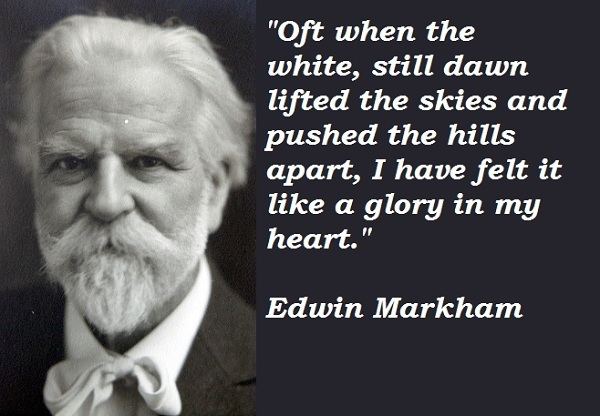
Among those in attendance on this day was poet Edwin Markham, best known for his 1898 poem "The Man With the Hoe," making him popular with farmers and other working men. In 1914, his contribution to the nonfiction book Children In Bondage helped to end child labor in America. As an editor, he popularized for the 20th Century the works of John Keats, Edgar Allan Poe, John Greenleaf Whittier and Henry Wadsworth Longfellow. In 1922, he published the poem "Lincoln, Man of the People," and a recording of him reciting it became one of the earliest sound film.
Markham was a great fan of FDR's, and walked up to shake his hand. But, 84 years old, he tripped, and knocked FDR over.

Markham was terribly embarrassed. FDR was not hurt, and was quickly picked up so that the audience couldn't really see what has happened. But the pages of his speech were scattered. (No teleprompters in those days.) So he had to put them back together. He said:

Here, and in every community throughout the land, we are met at a time of great moment to the future of the Nation. It is an occasion to be dedicated to the simple and sincere expression of an attitude toward problems, the determination of which will profoundly affect America.
I come not only as a leader of a party, not only as a candidate for high office, but as one upon whom many critical hours have imposed and still impose a grave responsibility...
America will not forget these recent years, will not forget that the rescue was not a mere party task. It was the concern of all of us. In our strength we rose together, rallied our energies together, applied the old rules of common sense, and together survived.
In those days we feared fear. That was why we fought fear. And today, my friends, we have won against the most dangerous of our foes. We have conquered fear.
But I cannot, with candor, tell you that all is well with the world. Clouds of suspicion, tides of ill-will and intolerance gather darkly in many places. In our own land we enjoy indeed a fullness of life greater than that of most Nations. But the rush of modern civilization itself has raised for us new difficulties, new problems which must be solved if we are to preserve to the United States the political and economic freedom for which Washington and Jefferson planned and fought...
Out of this modern civilization, economic royalists carved new dynasties. New kingdoms were built upon concentration of control over material things. Through new uses of corporations, banks and securities, new machinery of industry and agriculture, of labor and capital, all undreamed of by the fathers, the whole structure of modern life was impressed into this royal service...
Throughout the Nation, opportunity was limited by monopoly. Individual initiative was crushed in the cogs of a great machine. The field open for free business was more and more restricted. Private enterprise, indeed, became too private. It became privileged enterprise, not free enterprise.
An old English judge once said: "Necessitous men are not free men." Liberty requires opportunity to make a living—a living decent according to the standard of the time, a living which gives man not only enough to live by, but something to live for.
For too many of us the political equality we once had won was meaningless in the face of economic inequality. A small group had concentrated into their own hands an almost complete control over other people's property, other people's money, other people's labor, other people's lives. For too many of us life was no longer free; liberty no longer real; men could no longer follow the pursuit of happiness.
Against economic tyranny such as this, the American citizen could appeal only to the organized power of Government. The collapse of 1929 showed up the despotism for what it was. The election of 1932 was the people's mandate to end it. Under that mandate it is being ended...
These economic royalists complain that we seek to overthrow the institutions of America. What they really complain of is that we seek to take away their power. Our allegiance to American institutions requires the overthrow of this kind of power. In vain they seek to hide behind the Flag and the Constitution. In their blindness, they forget what the Flag and the Constitution stand for. Now, as always, they stand for democracy, not tyranny; for freedom, not subjection; and against a dictatorship by mob rule and the over-privileged alike.
The brave and clear platform adopted by this Convention, to which I heartily subscribe, sets forth that Government in a modern civilization has certain inescapable obligations to its citizens, among which are protection of the family and the home, the establishment of a democracy of opportunity, and aid to those overtaken by disaster...
We are poor indeed if this Nation cannot afford to lift from every recess of American life the dread fear of the unemployed that they are not needed in the world. We cannot afford to accumulate a deficit in the books of human fortitude...
Governments can err. Presidents do make mistakes. But the immortal Dante tells us that divine justice weighs the sins of the cold-blooded and the sins of the warm-hearted in different scales. Better the occasional faults of a Government that lives in a spirit of charity than the consistent omissions of a Government frozen in the ice of its own indifference.
There is a mysterious cycle in human events. To some generations much is given. Of other generations much is expected. This generation of Americans has a rendezvous with destiny.
In this world of ours in other lands, there are some people, who, in times past, have lived and fought for freedom, and seem to have grown too weary to carry on the fight. They have sold their heritage of freedom for the illusion of a living. They have yielded their democracy.
I believe in my heart that only our success can stir their ancient hope. They begin to know that here in America we are waging a great and successful war. It is not alone a war against want and destitution and economic demoralization. It is more than that; it is a war for the survival of democracy. We are fighting to save a great and precious form of government for ourselves and for the world.
I accept the commission you have tendered me. I join with you. I am enlisted for the duration of the war.
FDR knew what he was doing with that closing: Within the last year, Italy's Fascist dictator Benito Mussolini had invaded and annexed Ethiopia, Somaliland and Eritrea, and created the colony of Italian East Africa, as the start of a new version of the Roman Empire; Fascists led by Francisco Franco began the Spanish Civil War, to overthrow the leftist Second Republic; Nazi Germany's Fascist dictator Adolf Hitler had occupied the Rhineland, violating the terms of the Treaty of Versailles that finalized the results of World War I; and Japan had increased its aggressiveness toward China. The clouds of war were forming.

But that phrase, "a rendezvous with destiny," would echo through the ages. Later Presidents John F. Kennedy and Ronald Reagan would use it. And in his speech announcing the independence of India in 1947, Prime Minister Jawaharlal Nehru would say that his new nation's people had "a tryst with destiny."

*

July 27, 1936 was a Monday. These 4 baseball games were played:

* The New York Yankees lost to the Detroit Tigers, 9-1 at Navin Field (later renamed Briggs Stadium and Tiger Stadium) in Detroit. Lynwood "Schoolboy" Rowe not only outpitched Vernon "Lefty" Gomez, but, in his own cause, went 2-for-4 with a home run and 4 RBIs. Hank Greenberg had been injured early in the season, and missed the rest, including this game.

* The Brooklyn Dodgers beat the Pittsburgh Pirates, 6-3 at Ebbets Field. Paul Waner went 0-for-4. Lloyd Waner went 1-for-5 with an RBI.

* The Philadelphia Athletics beat the Chicago White Sox, 15-8 at Comiskey Park in Chicago. All the A's got at least 1 hit, including pitcher Harry Kelley; and all but Kelley got at least 2 hits. Lou Finney went 5-for-6 with an RBI. Pinky Higgins went 4-for-6 with 2 RBIs. Frankie Hayes went 3-for-5 with a walk and 2 RBIs. Wally Moses went 3-for-6 with 2 RBIs. Chubby Dean (no relation to Dizzy and Daffy) went 3-for-6 with 1 RBI. Bob Johnson went 2-for-6 with 4 RBIs.

Zeke Bonura went 4-for-5 with 2 RBIs for the South Siders. In spite of a combined 23 runs, no home runs were hit by either team.

* And the St. Louis Browns beat the Boston Red Sox, 7-5 at Sportsman's Park in St. Louis. Jimmie Foxx went 3-for-4 with an RBI.

Saturday, July 23, 2022

July 23, 1948: The Progressive Convention Nominates Henry Wallace

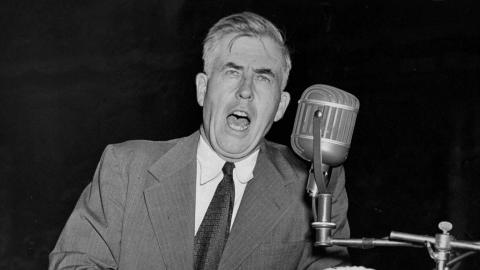
July 23, 1948: As the Democratic and Republican Parties both did this year, the Progressive Party holds its Convention at the Convention Hall of the Philadelphia Civic Center. The left-wing party, with little connection besides name to the Theodore Roosevelt party of that name of 1912 and the Robert LaFollette version of 1924, nominates Henry Wallace for President.

Henry Agard Wallace was born on October 7, 1888 in Orient, Iowa, and grows up in Des Moines, Iowa. In 1923, when his father, Henry Cantwell Wallace, was serving as U.S. Secretary of Agriculture under Presidents Warren Harding and Calvin Coolidge, the younger Henry actually did more to support American farmers and feed people all over the world, developing a hybrid corn he called Copper Cross. It revolutionized corn production.

A split between the Wallaces and U.S. Secretary of Commerce Herbert Hoover, himself an Iowa native, led to the Wallaces leaving the Republican Party and supporting the Progressive Party candidacy of Governor Robert La Follette of Wisconsin in 1924. It may also have hastened the death of the elder Henry, right before the election, which Coolidge won.

When Hoover was elected President in 1928, the stock market Crash of 1929 and the Great Depression followed within a year, devastating the already hard-hit American farmers. In 1932, the younger Henry Wallace worked for the election of Democratic Governor Franklin D. Roosevelt of New York. When FDR won, he appointed Wallace to his father's old post. Historian Arthur Schlesinger Jr. wrote that Wallace was "the best Secretary of Agriculture the country has ever had," but also that he was "an incorrigibly naive politician."

In 1940, FDR ran for a 3rd term, with Wallace as his Vice President. Farmers, labor leaders and civil rights activists were happy with this, but Southerners didn't like his closeness to black leaders, and big business didn't like his openness to the Soviet Union. In 1942, he gave a speech, citing a term coined by Time magazine publisher Henry Luce, saying, "Some of have spoken of the 'American Century.' I say that the century on which we are entering, the century which will come into being after this war, can be, and must be, the Century of the Common Man."

But the Democratic Party's conservative wing, believing (correctly, as it turned out) that FDR was a sick man, and might not survive a 4th term, didn't want Wallace succeeding him. In 1944, for one of the few times in his career, FDR got ganged-up-on, and dropped Wallace from the ticket, in favor of Senator Harry Truman of Missouri.

With some irony, Wallace was appointed to Hoover's old job, Secretary of Commerce. FDR died in 1945, and Truman became President. Wallace split with Truman over Cold War policy, resigned in 1946, and ran for President to Truman's left in 1948.

The Vice Presidential nominee was Senator Glen H. Taylor of Idaho, also normally a Democrat. Just 44 years old, and in his 1st term, he had run for the Senate in 1940 (a special election) and 1942, and finally won in 1944. He was considered the 2nd-most liberal Senator, behind Wayne Morse of Oregon, a Republican who eventually became an Independent, and then a Democrat. In 1945, he submitted a resolution to the Senate, "favoring the creation of a world republic." A one-world government has long been a great fear of conservatives, afraid that it would, by nature, be Communist.
Taylor (left) and Wallace

Before going into politics, Taylor had been recorded singing country music, and his sister was a jazz singer under her married name, Lee Morse. (Her husband, though a supporter of Glen's, was no relation to Wayne.)

Wallace gave his acceptance speech outdoors -- not at nearby Franklin Field, owned by the University of Pennsylvania, and not exactly welcoming to leftists, but halfway across the city, at Shibe Park, then the home of baseball's Athletics and Phillies and football's Eagles.

You talk about your "Hollywood liberals": The Progressives had the support of John Huston, Lee J. Cobb, Uta Hagen, Judy Holliday, Sam Jaffe, and, singing its campaign songs, Paul Robeson.

Also: Writers W.E.B. DuBois, Howard Fast, Dashiell Hammett, Lillian Helman, Garson Kanin, Thomas Mann, Arthur Miller, Clifford Odets, S.J. Perelman, Budd Schulberg, I.F. Stone, Mark Van Doren, and the big new thing in American letters, Norman Mailer, who had published his debut novel, the World War II story The Naked and the Dead, a few weeks earlier. Also: Musical personalities Aaron Copland, Artie Shaw and Burl Ives; scientist Linus Pauling; and architect Frank Lloyd Wright.

However, the Wallace campaign also had big support from the Communist Party, which tainted it in the eyes of average Americans. It was tainted to the point that most conservatives didn't both to attack it. An exception was far-right fanatic Westbrook Pegler, of William Randolph Hearst's newspaper syndicate: He called Wallace a "messianic fumbler" and "off-center mentally." The former charge had some reason, as he had some religious views that were considered unacceptable then, and would even be odd now; the latter charge could have been leveled at Pegler himself.

The fear among Democrats was that the Progressives would pull enough liberal votes -- hard-left, labor and black -- from New York City to cost Harry Truman New York State, Philadelphia to cost him Pennsylvania, Boston to cost him Massachusetts, Detroit to cost him Michigan, Chicago to cost him Illinois, and Los Angeles and San Francisco to cost him California, thus costing him the election. And, of course, Governor Strom Thurmond of South Carolina had temporarily left the Democrats to lead the States' Rights Party, the "Dixiecrats," and Democrats feared that would help cost them the election as well.

In the end, the popular vote was as follows: Truman, a little over 24 million; Dewey, a little under 22 million; Thurmond, 1,176,023; and Wallace, 1,157,328. Percentages: Truman 49.5, Dewey 45.0, Thurmond 2.41, Wallace 2.37. Electoral Votes: Truman 303, Dewey 189, Thurmond 39, Wallace none. Wallace did not win a single State, or even a single County. He couldn't even beat a segregationist, who wasn't even on the ballot in all the States, for 3rd place overall.

Dewey did, indeed, win New York (where he lived), Pennsylvania and Michigan (where he was born). And Wallace did win 60 percent of the votes he would win in New York State and California alone.

Had Wallace also thrown Illinois and California to Dewey, Dewey would have led in Electoral Votes, 252-250, but fallen short of the 269 needed to be elected. The election would have been thrown to the House of Representatives, then controlled by the Republicans, and Dewey would have won. Instead, Truman hung on to Illinois by 33,000 votes, and California by 18,000 votes, and won.

Wallace got 2.37 percent of the popular vote. Openly leftist candidates have struggled to do even that well since. In 2000, Ralph Nader got 2.74 percent. In 2016, Jill Stein got 1.07 percent. Each time, it was enough to cost the Democratic nominee the election, something Wallace was unable to do.

He turned back toward earlier stances after 1948. He repudiated the Soviet Union in 1952, and did not endorse a candidate in that year's election. He endorsed President Dwight D. Eisenhower for re-election in 1956, and refused to endorse a candidate in 1960. Nevertheless, he supported Democratic Presidents John F. Kennedy and Lyndon B. Johnson.

In 1963, as part of a discussion of the 30th Anniversary of FDR's Inauguration and the New Deal in 1933, he appeared on the NET (forerunner of PBS) talk show The Open Mind, hosted by Rutgers University professor Richard D. Heffner. The other guests were James Roosevelt, FDR's son and a close aide, and later a Congressman from California; James A. Farley, FDR's campaign manager and Postmaster General; Thomas G. Corcoran, a.k.a. Tommy the Cork, a New Deal official who had become an advisor to LBJ; and Ernest K. Lindley, who covered the FDR Administration for the New York Herald Tribune and later The Washington Post.

Shortly after that appearance, in which he barely moved and looked stiff and uncomfortable, Wallace was diagnosed with amyotrophic lateral sclerosis. Like the most famous ALS patient, whose name was given to the disease, Lou Gehrig, he consulted numerous specialists and tried various methods of treating the disease, saying, "I look on myself as an ALS guinea-pig, willing to try almost anything." Nothing worked, and he died on November 18, 1965, at the age of 87.

The Henry A. Wallace Beltsville Agricultural Research Center, the largest agricultural research complex in the world, was named for him, and is located in the Washington suburb of Beltsville, Maryland. The visitor center at the Franklin D. Roosevelt Presidential Library and Museum at Hyde Park, New York is named the Henry A. Wallace Visitor and Education Center. It doesn't have a statue of Wallace, but it does have one of what FDR called "my little dog, Fala."

None of Wallace's children entered politics, but his grandson, Scott Wallace, was the Democratic nominee for the U.S. House of Representatives in Pennsylvania's 1st District in 2018, losing a close race with nearly 49 percent of the vote.

Wallace's running mate, Glen Taylor, lost his bid for re-election in the 1950 Democratic Primary, and ran and lost again in 1954 and 1956. Having lost his hair earlier than most men, he wore homemade hairpieces, and began designing and selling them after leaving politics. By 1960, Taylor Topper was America's leading hairpiece company. It is now known as Taylormade Hair Replacement.

He also went back to show business, appearing in 9 episode of The Adventures of Ozzie and Harriet. He died in 1984, at the age of 80.

*

July 23, 1948 was a Friday. These baseball games were played:

* The New York Giants beat the Chicago Cubs, 5-0 at Wrigley Field in Chicago. Larry Jansen pitched a 5-hit shutout. Johnny Mize hit a home run.

* The Brooklyn Dodgers beat the Pittsburgh Pirates, 4-3 at Forbes Field in Pittsburgh. Erv Palica was the winning pitcher. Pee Wee Reese and Tommy Brown hit home runs. Jackie Robinson went 2-for-4 with a stolen base and an RBI. For the Pirates, Ralph Kiner went 0-for-3 with a walk.

* The Boston Red Sox beat the Chicago White Sox, 13-1 at Fenway Park in Boston. Ted Williams went 2-for-4 with a walk and 3 RBIs. The only Boston home run was hit by Bobby Doerr. The best White Sox player of the era, Luke Appling, went 0-for-3 with a walk.

* The Detroit Tigers beat the Washington Senators, 11-5 at Griffith Stadium in Washington.

* The Philadelphia Phillies beat the Cincinnati Reds, 6-1 at Crosley Field in Cincinnati.

* The St. Louis Cardinals beat the Boston Braves, 7-5 at Sportsman's Park in St. Louis. Stan Musial went 3-for-4 with a walk and an RBI.

* The Philadelphia Athletics and the St. Louis Browns were rained out at Shibe Park in Philadelphia. The game was made up as part of a doubleheader on August 27. The A's swept, 6-0 and 9-1. Dick Fowler pitched a 3-hit shutout in the opener.

* And the New York Yankees and the Cleveland Indians were not scheduled.

Thursday, July 14, 2022

July 14, 1948: The Democrats Split Over Civil Rights

Mayor Hubert Humphrey of Minneapolis.
He was 37 years old.

July 14, 1948: The Democratic National Convention is being conducted at the Convention Hall of the Philadelphia Civic Center. It's not going well. Their nominee for President, the incumbent, Harry S Truman, is not popular, having had a very rough 1st term, which wasn't even intended as his: He became President when Franklin D. Roosevelt died on April 12, 1945.

The Republicans had a successful Convention, in the same building, nominating Governor Thomas E. Dewey of New York for President, and Governor Earl Warren of California for Vice President. What's more, the Democrats were divided between North and South, on the issue of civil rights: The Northern Delegates wanted to expand them, while the Southern Delegates, based on white supremacy, were determined that there would be no progress at all.

The Convention's Chairman was Senator Alben Barkley of Kentucky, the Senate Minority Leader, the Majority Leader from 1941 to 1946. The Republicans had proposed "to clean the cobwebs" from the federal government. Barkley invoked the Republicans' guilt over the Great Depression, telling the Convention, "I am not an expert on cobwebs. But if my memory does not betray me, when the Democratic Party took over, 16 years ago, even the spiders were so weak from starvation, they could not weave a cobweb in any department of the government in Washington!" 

But the Republicans had ridden to victory in the Congressional elections of 1946, reminding the American people of the regulations of FDR's New Deal, which Truman had kept in place, and summarized it in two words: "Had enough?" The answer seemed to be, "Yes." The Democrats' goal of more federal government action seemed to be out of step with what the country wanted. And civil rights? For most white Americans, this issue was not on the front burner, or even on the back burner.

But 2 Delegates proposed a strong civil rights plank for the Party's platform, including an endorsement of the pro-civil rights actions already taken by Truman. (Just 12 days after this, Truman ordered the racial desegregation of the U.S. armed forces.) They were Hubert Humphrey, the Mayor of Minneapolis, and Paul Douglas, a former member of the Chicago City Council. Both men were candidates for the U.S. Senate that year.

In a speech heard on nationwide radio -- and, for the 1st time, seen on nationwide television (the 1940 Conventions were televised, but not nationally) -- Humphrey made it a moral crusade, connecting it with the American Revolution and the spirit of 1776:

To those who say, my friends, to those who say that we are rushing this issue of civil rights, I say to them we are 172 years late! To those who say this civil rights program is an infringement on States' rights, I say this: the time has arrived in America for the Democratic Party to get out of the shadow of States' rights, and walk forthrightly into the bright sunshine of human rights!

The Northern Delegates erupted in cheers. The Southern Delegates were dead silent. The plank was voted on, and it passed, 651½–582½.

Of the 278 Southern Delegates, 35 walked out: All 22 from Mississippi, and 13 from Alabama. The remaining Southern Delegates gave their support to Senator Richard B. Russell Jr. of Georgia. It wasn't enough to prevent Truman's nomination on the 1st ballot: He won 926 delegates, Russell 266, with the other 42 votes scattered.

The bolted delegates and other Southerners then formed the States' Rights Democratic Party, a.k.a. the Dixiecrats, who nominated Governor Strom Thurmond of South Carolina for President, and Governor Fielding Wright of Mississippi for Vice President.

In addition to this challenge from the right, there was a challenge from the left: Henry Wallace, dumped as Vice President in favor of Truman at the 1944 Convention, formed a new party with an old name, the Progressive Party. The concern was not that Wallace would win any States, but that he would gain enough liberal votes, especially enough black votes, to cost Truman the City of New York, and thus the State of New York; Chicago, and thus Illinois; and Los Angeles, and thus California.

Nobody thought Truman could win. Thurmond, the last survivor of the 4 main candidates, admitted in a 1988 interview, "I thought Dewey would win." Unlike Wallace, Thurmond was under no illusions about his own victory: He wasn't on the ballot in any State outside the South, but he could cost Truman some Southern States, to the point where, even if he finished with more Electoral Votes than Dewey, he would fall short of the 267 necessary to become President, throwing the election into the House of Representatives, which was controlled by the Republicans, and would choose Dewey.

Nobody thought Truman could win, not even inside the Convention Hall. Nobody, that is, except Truman himself. He chose Barkley as his nominee for the vacant Vice Presidency, and told the Convention, and told the country, "Senator Barkley and I are going to win this election, and make the Republicans like it, and don't you forget it!" For the 1st time since it was gaveled into session, the Convention had a positive message, and it gave Truman a standing ovation.

Thurmond did cost Truman the States of South Carolina, Alabama, Mississippi and Louisiana, winning them himself. And Wallace did cost Truman every State in the Northeast except Massachusetts and Rhode Island, throwing them to Dewey.

But Truman won, and brought Democratic majorities to both houses of Congress, returning Rayburn to the Speakership, and making Scott Lucas of Illinois the Senate Majority Leader. Douglas was elected to Illinois' other Senate seat, and Humphrey was elected in Minnesota, beginning a career that would see him be elected Vice President, and run for the Presidency 3 times.

In 1953, Earl Warren, the Republican nominee for Vice President in 1948, was appointed to be Chief Justice of the U.S. Supreme Court. He would lead a branch of the civil rights revolution from the highest court of the land.

But the shift from the Republicans being "the Party of Lincoln" to the Democrats being "the Party of Civil Rights" was well underway. In 1964, President Lyndon B. Johnson signed a Civil Rights Act into law. Humphrey, then the Majority Whip, had gotten it pushed through the Senate. Strom Thurmond subsequently became the 1st major politician to switch from the Democratic Party to the Republican Party over the issue of race.

*

July 14, 1948 was a Wednesday. There were no scores on this historic day: The only sport in-season at the time was baseball, and it was the All-Star Break. The day before, the American League won the All-Star Game, beating the National League, 5-2 at Sportsman's Park in St. Louis.

Tuesday, June 28, 2022

June 28, 1940: Wendell Willkie Is Nominated for President

June 28, 1940: Wendell Willkie is nominated for President at the Republican National Convention, at the Philadelphia Civic Center. It was the 1st political convention broadcast on television -- the Democratic National Convention would follow, 4 weeks later -- but that's not what was historic about this Convention. Hardly anybody had television sets to watch it on, anyway.

Lewis Wendell Willkie was born on February 18, 1892 in Elwood, Indiana, 46 miles northeast of Indianapolis. The U.S. Army reversed his name to "Wendell Lewis" when he enlisted in World War I, and, since his family had always called him "Wendell," anyway, he never corrected the mistake, and later made that his legal name. He served, but did not see combat.

He dropped out of law school to enlist, and returned. He was hired by the law firm that represented Firestone Tire and Rubber Company in Akron, Ohio, but when he met company founder Harvey Firestone -- a friend of President Warren G. Harding, a Republican -- he was told he would never amount to anything because he was a Democrat.

In 1924, he was a Delegate to the Democratic Convention, the one that went to 103 ballots before Congressman John W. Davis was nominated. Despite being a Midwestern Protestant, Willkie had supported Governor Al Smith, because of Smith's opposition to the Ku Klux Klan, which had essentially taken over the Republican Party in Indiana. In 1925, Willkie got Klan members expelled from the Akron school board.

Willkie built a reputation as a great trial lawyer, representing public utilities. In 1932, he was a Democratic Delegate again, supporting Governor Franklin D. Roosevelt, who was elected President. But in 1935, with FDR at the height of his New Deal, Willkie broke with him to represent Commonwealth & Southern Corporation against the Tennessee Valley Authority. In 1936, Willkie voted for FDR's Republican opponent, Governor Alf Landon. In 1939, he switched parties, becoming a Republican, becoming perhaps the 1st ex-Democrat to say, "I did not leave my party, my party left me."

In 1940, the Republicans figured, after 8 years of the New Deal, the American people would want to go back to conservative leadership. They didn't expect FDR to run for a 3rd term. But with Adolf Hitler taking over most of Europe, and threatening Britain, FDR knew he was the only American politician experienced enough to handle the Nazi leader.

The elections of 1932, 1934 and 1936 had brought many Republican figures down to defeat. But the economic downturn of 1938 knocked a few potential Democratic successors to FDR out of contention. Neither party really had a wealth of contenders. The leading Republican contenders were Senators Robert Taft of Ohio (son of President William Howard Taft) and Arthur Vandenberg of Michigan; and the District Attorney of Manhattan, Thomas E. Dewey.

Dewey was just 38 years old, and, though nationally famous due to his prosecution of organized crime figures, would have been a poor choice as nominee against the veteran FDR. But Taft was in only his 2nd year in the U.S. Senate. More importantly, Taft and Vandenberg were isolationists: Had they been elected, they would have done everything they could to keep America from going to war with Hitler. Therefore, millions of Americans, in both parties -- none more so than FDR -- wanted the Republicans to nominate an internationalist.

After the Nazi invasion of Poland started The War, Willkie gave speeches, including on radio, about the threat to America and the need to aid its allies. He transformed his image: Before, he was mocked, including by Republicans, as "the barefoot boy of Wall Street." As Chicago Sun-Times columnist Steve Neal, who wrote books about both him and FDR (and also Harry Truman and Dwight D. Eisenhower), put it, his wartime speeches "transformed Willkie from a big-business critic of the New Deal into a champion of freedom. And it gave his candidacy new purpose."

Senator James E. Watson, of Willkie's home State of Indiana, was appalled that his candidacy was being taken so seriously. It wasn't because Willkie was the least-qualified Presidential nominee in GOP history. It was because he had so recently been a Democrat: "I may welcome the town whore into my church, but I wouldn't want him to lead the church choir." And Alice Roosevelt Longworth, daughter of President Theodore Roosevelt and widow of House Speaker Nicholas Longworth, owner of the sharpest tongue in Washington society, said that the Willkie campaign came "from the grass roots of ten thousand country clubs."

But Willkie had one key ally: Henry Luce, publisher of Time, Life and Fortune magazines. (Sports Illustrated came later, in 1954.) Luce was one of the biggest names in American conservatism, and he was an internationalist. Born in China as the son of Christian missionaries, he opposed the Nazis in large part because their Axis included the Empire of Japan, which was devastating China. He made sure the stands at the Civic Center were packed with people chanting, "We want Willkie!" This gave the "dark horse" the appearance of having more support than he actually did -- leading to more people switching their support to him, a self-fulfilling prophecy.

The brothers Gardner and John Cowles, publishers of Look magazine, and owners of the largest newspaper chain in the Midwest, sought to break the Taft/Vandenberg hold on the region. They figured Willkie could be the man to do it, and asked him to make a speech in St. Paul, the capital of Minnesota. For half an hour, Willkie read a very dry speech. At its end, he threw it to the ground, and said, "Some damn fool told me I had to read this speech. Now, let me tell you what I think." He did, and the audience perked up, and they loved it. The brothers published the speech, and it gained Willkie some support.

Furthermore, Hitler's victory in France, 2 weeks before the Convention, left only Britain between the Nazis and America. When the Delegates gathered in Philadelphia, they joked that Dewey was "the first American casualty of World War II."

Before a candidate could be nominated, a platform had to be approved. It split the difference between what the interventionists and the isolationists wanted: "We favor the extension of aid to all people fighting for liberty or whose liberty is threatened, as long as such aid is not in violation of international law or inconsistent with the requirements of our national defense."

Years later, someone discovered that the text was lifted, almost verbatim, from an ad that had appeared in several newspapers, including The New York Times, over the names of isolationist Congressmen, written and aid for by Nazi agents. But, even at the time, the nationally syndicated journalist H.L. Mencken, no stranger to epic put-downs, especially of the Republican Party, wrote that this was "so written that it will fit both the triumph of democracy and the collapse of democracy, and approve both the sending of arms to England and sending only flowers."

On the 1st ballot, Dewey led with 360 Delegates, to 189 for Taft, 105 for Willkie, 76 for Vandenberg, 74 for Governor Arthur James of Pennsylvania, and 196 scattered among other candidates. James' name was placed in nomination because, in the old days, before Primaries became the way nominees were selected, the Governor of the host city's State, should he be of the same party, was usually given the courtesy of being nominated as a "favorite son." Dewey led, but he was nowhere near a majority of the Delegates, so more ballots would be needed.

On the 2nd ballot, it was Dewey 338, Taft 203, Willkie 171, Vandenberg 73, James 66. On the 3rd ballot, it was Dewey 315, Willkie moving up to 2nd with 259, Taft gaining so that he also had 259, Vandenberg 72, James 59.

Willkie took the lead on the 4th ballot, with 306, to Taft 254, Dewey 250, Vandenberg 61, James 56. On the 5th ballot, Dewey's support collapsed, leaving only 2 contenders: Willkie with 429 Delegates, and Taft with 377. On the 6th ballot, Willkie clinched a majority, with 655 to Taft's 318. Charles McNary of Oregon, the Senate Minority Leader, was nominated for Vice President.
Charles McNary

FDR was relieved. Not because he thought Willkie, whom he'd met a few times, would be easy to beat. Nor because he thought, should Willkie beat him, he would be a good President. It was because FDR knew that, no matter what, whoever was President from 1941 onward would oppose Hitler, and that was Issue Number One, to the point where, whatever people thought Issue Number Two should be, it was far behind in consideration.

Indeed, over the next 4 months, Willkie gave several speeches supporting an internationalist outlook. He did, however, rip FDR's policies more strongly than Landon had in 1936, proving that Republican voters will vote for any Republican, as long as he sufficiently rips the Democratic nominee.

The election was closer than FDR would have liked: He won 55 percent of the popular vote, to Willkie's 45. The Electoral Vote gave the appearance of a landslide, as FDR won 36 States, beating Willkie 449 to 82.

After the election, Willkie made 2 foreign trips as Roosevelt's informal envoy. After the Japanese attack on Pearl Harbor brought America into The War, Willkie, as nominal leader of the Republican Party, gave the President his full support.

The War was serious enough that Vandenberg dropped his former isolationist policies, and became one of the leading advocates for building up the armed forces, to the point where one of the early bases of the U.S. Air Force, outside Santa Barbara, California, would be named for him. Taft supported the war effort in full, although, after The War, he opposed the formation of NATO. To his credit, Taft was opposed to the internment of Japanese Americans. To America's detriment, he was the only major American politician, of either party, who was.

Willkie had not entered the Republican Primaries in 1940. In 1944, he did enter the Primaries, but conservatives, angry at his being chummy with FDR, turned on him, and nominated Dewey, who had been elected Governor of New York in 1942.

Willkie died of a heart attack on October 8, 1944, before the election. His former running mate, McNary, had died earlier in the year. So, while the Republicans engaged in a whispering campaign that FDR was sick, or even dying, which turned out to be true, both of the Republicans' 1940 nominees failed to live to see the end of the term for which they had run.

After Willkie, the Republican Party took great care to nominate more qualified candidates for President: From 1944 to 2012, not counting the renomination of incumbent Presidents, they nominated 3 current or former Vice Presidents (Richard Nixon twice and George H.W. Bush), 5 current or former Governors (Dewey twice, Ronald Reagan of California, George W. Bush of Texas and Mitt Romney of Massachusetts), 3 Senators (Barry Goldwater and John McCain of Arizona, and Bob Dole of Kansas), and a 5-star General (Dwight D. Eisenhower).

They weren't always more qualified than their respective Democratic opponents, but, at least, they were qualified. Willkie may have been smart, but by no measure was he remotely qualified to be President. An advisor to the President, certainly: He proved that after the election. But the President himself, no. A nominee for the office must be qualified, or you risk having a disastrous Presidency.

In 2016, the Republican Party nominated Donald Trump, who had never previously run for elective office, and had never served in appointive office at any level of government. He and his supporters thought that was a plus. As it turned out, it was a huge minus.

*

June 28, 1940 was a Friday. Muhammad Yunus, the Bangladeshi financier who won the Nobel Peace Prize for his "microcredit" initiative, was born on this day.

These baseball games were played:

* The New York Yankees beat the Philadelphia Athletics, 4-1 at Yankee Stadium. Marius Russo went the distance for the win, Charlie Keller hit a home run, and Joe DiMaggio went 1-for-3.

* The Brooklyn Dodgers were leading the Boston Bees -- as the Braves had been known since 1936, but they would switch the name back the next season -- 2-1 at Ebbets Field, when the game was called due to rain after 8 innings.

* The Washington Senators beat the Boston Red Sox, 4-3 at Fenway Park in Boston. Charlie Gelbert doubled home the winning run in the top of the 10th inning. Jimmie Foxx went 2-for-4 with a walk and an RBI. Ted Williams went 0-for-4 with a walk.

* The St. Louis Cardinals beat the Pittsburgh Pirates, 8-2 at Forbes Field in Pittsburgh. Neither of the Waner brothers, Paul or Lloyd, played in this game.

* The Chicago Cubs beat the Cincinnati Reds, 3-2 at Crosley Field in Cincinnati.

* The Detroit Tigers and the St. Louis Browns were rained out at Sportsman's Park in St. Louis. The game was made up as part of a doubleheader 2 days later, on a Sunday. The Browns won the opener, 7-6. George McQuinn singled home the winning run in the bottom of the 11th inning. The Tigers led, 7-1 after 7 innings, when the game was called due to darkness. Over the 2 games, Hank Greenberg went 3-for-7 with a home run, 2 walks and 4 RBIs.

* And the New York Giants, the Chicago White Sox, the Cleveland Indians, and the Philadelphia Phillies were not scheduled.
Thursday, February 24, 2022

February 25, 1931: The Philadelphia Civic Center Opens

February 25, 1931: The Philadelphia Civic Center opens its Convention Hall, 2 blocks west of the University of Pennsylvania's Franklin Field and Palestra. It is eventually billed as "The Nation's Most Historic Arena."

The Hall seated 12,000 people, in a horseshoe shape, with a stage at one end. It was home to the NBA's Philadelphia Warriors from 1952 to 1962; the NBA's Philadelphia 76ers from 1963 to 1967; the American Basketball League's Philadelphia Tapers in 1962; the World Hockey Association's Philadelphia Blazers in the 1972-73 season; and the basketball teams of Temple University from 1938 to 1955 and La Salle University from 1989 to 1996. The University of Pennsylvania used it for their graduation ceremony, as shown here in 1985.
The Democratic National Convention was held there in 1936, nominating President Franklin D. Roosevelt for a 2nd term. The Republican National Convention was held there in 1940, nominating Wendell Willkie, and was the 1st major party Convention to be televised. An adjacent building had hosted the Republican Convention in 1900.

In 1948, there were 4 candidates running, and 3 of them held their Conventions at the Civic Center: The Democrats, nominating President Harry S Truman for a full term; the Republicans, nominating Governor Thomas E. Dewey of New York; and the Progressive Party, nominating former Vice President Henry Wallace. The States' Rights Party, which nominated Governor Strom Thurmond of South Carolina, held their Convention in Birmingham, Alabama.

Civil rights-themed speeches were delivered there by Martin Luther King and Nelson Mandela. On August 29, 1964, having been nominated at nearby Convention Hall (now Boardwalk Hall) in Atlantic City, New Jersey, President Lyndon B. Johnson held a campaign rally at the Civic Center. On September 2, 3 days after playing Atlantic City, The Beatles played the Civic Center, starting an era of rock concerts there.

Before that, entertainment events included Big Band shows, and shows by the Mummers, with their brightly colored costumes and string bands. They parade up Broad Street every New Year's Day, and have other shows, which used to include an annual show at the Civic Center. In 1989, I got to see the Mummers' show there.

The last event there was the 1996 Atlantic-10 Conference basketball tournament. The building was torn down in 2005, and the University of Pennsylvania's Perelman Center for Advance Medicine was built on the site.

*

February 25, 1931 was a Wednesday. Baseball and football were out of season. The NBA hadn't been founded yet. And the NHL had no games scheduled. So there were no scores on this historic day.

December 31, 1999 & January 1, 2000: The Millennium

December 31, 1999:  The Millennium arrives. The people of planet Earth survived. At a terrible cost. But we hadn't destroyed ourselves. ...