Showing posts with label big ten. Show all posts

Wednesday, November 30, 2022

November 30, 1905: Chicago vs. Michigan, College Football's 1st "Game of the Century"

Walter Eckersall

November 30, 1905: The Championship of college football's Western Conference -- forerunner of the Big Ten -- is decided at Marshall Field in Chicago, named for the department store mogul who funded its construction. It becomes the 1st of many college football games referred to as "The Game of the Century."

The University of Chicago, coached by Amos Alonzo Stagg, came into the game at 10-0. They had allowed only 5 points all season, in a 16-5 win over Indiana. They had scored 44 points against Illinois, 42 each against Iowa and Beloit College, 33 against Lawrence University, and 32 against Northwestern.

They were led by Walter Eckersall, and, while quarterback was a very different position at the time, with the forward pass not legalized until the next season, he was widely regarded as the best player in the country. Stagg, later to be known as "The Grand Old Man of Football," called Eckersall "a selfless performer, marked by complete dedication to victory."

Future Notre Dame star end and coach Knute Rockne grew up in Chicago, and saw Eckersall play in both high school and college. He said of Eckersall, "The first time I learned a football was not only something to kick, but something to think with, was when I saw a great football player in action."

Stagg had recruited Eckersall out of Hyde Park High School, on the city's South Side, not far from the UC campus. Fielding Yost had also tried to recruit him, for the University of Michigan. There, Yost had such a high-powered offense that they were known as "The Point-a-Minute Team." They came in at 12-0: 65-0 over Ohio Wesleyan, 44-0 over Kalamazoo College, 36-0 over Case University, 23-0 over Ohio Northern, 18-0 over Vanderbilt, 31-0 over Nebraska, 70-0 over Albion, 48-0 over Drake, 33-0 over Illinois, 40-0 over Ohio State, 12-0 over Wisconsin, and 75-0 over Oberlin.

Granted, this 495-0 performance wasn't exactly against a modern Football Bowl Subdivision "Power 5 Conference" schedule. And only one of those games, the win over Illinois, was played away from Regents Field in Ann Arbor, Michigan. It should be noted that Wisconsin came closer than anybody to beating each team, having come within 4-0 of Chicago.

Since the start of the 1902 season, the Chicago Maroons were 46-4-3. But the Michigan Wolverines were 54-0-1 in their last 55 games. Their last loss? November 29, 1900, 15-6 -- against Chicago at Marshall Field. The showdown was set for Thanksgiving Day, and a crowd of 27,000, believed to be the largest in college football history to that point, filed into Marshall Field. (At the time, Thanksgiving Day was the last Thursday in November. It became the 4th Thursday in November in 1941.)
Marshall Field, built 1893, renamed Stagg Field 1913

At first, the game was a punting duel between Eckersall and Michigan's John Garrels. It was scoreless early in the 3rd quarter, when a Garrels punt and a penalty pinned Chicago inside its own 10-yard line. On third down, as Eckersall attempted to punt, he encountered a fearsome rush, but evaded the Michigan tacklers, and was able to scramble to the 22-yard line and a 1st down.

After 3 more 1st downs, the drive stalled and Chicago were forced to punt again. Eckersall's booming punt carried into the end zone, where it was caught by Michigan's William Dennison "Denny" Clark, who attempted to run the ball out. He advanced the ball forward to the 1-yard line, but was hit hard by Art Badenoch, and then was brought back inside his own end zone by Mark Catlin.

Under the rules of the time, forward progress was not credited, and a ball carrier could be carried backwards or forwards until he was down. Therefore, Chicago were credited with a safety: 2 points. And that would produce the final score: Chicago 2, Michigan 0. Michigan's streak was over, and Chicago were awarded the Western Conference and National Championships.

Football observers like to say, "Defense wins championships." This is hardly ever true: You can't win if you don't score, and you can't score if you don't have the ball; and, if you have the ball, by definition, you are on offense. This time, defense really did win a Conference and a National Championship. The only other major football championship ever decided on a safety was the 1929 Rose Bowl, the Roy Riegels Game. (I have an entry for that event.)

Clark received the blame for the Michigan loss, and tried to live with it, but couldn't. In 1932, he shot and killed himself. He was 48 years old. In a suicide note to his wife, he reportedly expressed the hope that his "final play" would be of some benefit in atoning for his error at Marshall Field.
Denny Clark

Chicago would see its 14-game winning streak end on November 10, 1906, defeated by Minnesota. Since there was, as yet, no real professional football to speak of, Eckersall became a college football referee, considered the finest of his era. He also became a writer on the game for the Chicago Tribune. At the end of each season, as a counterweight to the Eastern-heavy "All-American" team selected by former Yale coach Walter Camp, Eckersall named an "All-Western" team, and it was considered prestigious in its day.

But "Eckie" was a heavy drinker, and died of cirrhosis of the liver on March 24, 1930. He was only 43 years old, and, to protect his public image, the Tribune reported the cause of death as a heart attack.

In 1949, the Chicago Public Schools constructed a sporting facility on the South Side, at 2423 East 82nd Street, named "Walter Eckersall Stadium." Eckersall, Stagg and Yost would all be charter inductees into the College Football Hall of Fame in 1951.

*

November 30, 1905 was a Thursday. Among the other notable college football games played that Thanksgiving Day: Alabama beat Tennessee, 29-0; Auburn beat Georgia, 20-0; Georgia Tech beat Clemson, 17-0; Holy Cross beat Fordham, 28-5; Indiana beat Ohio State, 11-0; Iowa beat St. Louis University, 31-0; Iowa State beat cross-State rival Drake, 17-12; Kansas beat arch-rival Missouri, 24-0 in Kansas City; Nebraska beat Illinois, 24-6; North Carolina beat Virginia, 17-0 in Norfolk, Virginia; Penn State beat the University of Pittsburgh, 6-0; the University of Pennsylvania beat Cornell, 6-5; and Utah beat Colorado State, 24-0.

Rutgers, Princeton, Harvard and Yale all completed their seasons the preceding Saturday. Army and Navy had the week off, to prepare for each other: They tied, 6-6, at Princeton's University Field.

Thursday, November 24, 2022

November 24, 1973: The Ohio State-Michigan Tie

Glenn Edward Schembechler Jr. (left) and Wayne Woodrow Hayes

November 24, 1973: The football teams of Ohio State University and the University of Michigan play each other at Michigan Stadium in Ann Arbor. This was intended as the 30th time that the winner of this game would win the Big Ten Conference Championship. (And there have been many more since.)

Wayne Woodrow Hayes, known as Woody, had coached at Ohio State since 1951, and had already won the Big 10 title 7 times, and the National Championship in 1954, 1957, 1961 and 1968. Glenn Edward Schembechler Jr., known as Bo, had played for him at Miami University in Ohio, and had coached under him there and at Ohio State, before becoming head coach at Miami and then at Michigan in 1969.

Ohio State was going for back-to-back National Championships in 1969, with a supposedly unbeatable team, but Bo's Wolverines shocked Woody's Buckeyes in Ann Arbor, re-establishing Michigan as a national football power, and beginning what would eventually be known as "The Ten-Year War" between not just the two programs, but between the two men. Ohio State won in 1970, Michigan in 1971 and Ohio State in 1972.

Ohio State came into the game at 9-0, having been ranked Number 1 for most of the season. The closest any team had come to beating them was Wisconsin, and they lost 24-0. The Buckeyes had hung 60 points on Northwestern, 56 on Minnesota, 55 on Iowa, 37 on both Texas Christian and Indiana, and 35 on Michigan State. With sophomore running back Archie Griffin, on his way to becoming the only 2-time Heisman Trophy winner, and future All-Pro linebacker Randy Gradishar, they looked unbeatable -- just as they were in 1968, and just as they looked in 1969.

Michigan came into the game 10-0, and ranked Number 4. They'd had some closer calls, only beating Navy by 14 points and Illinois by 15. But they scored 49 on Indiana, 47 on Stanford, 35 on Wisconsin, and 34 on both Minnesota and Purdue. And they had a strong defense, shutting out Navy, Oregon and Michigan State. Only Stanford and Indiana reached double figures against them. Cornerback Dave Brown, defensive tackle Dave Gallagher, tight end Paul Seal and placekicker Mike Lantry were named All-Americans.

A crowd of 105,223 plowed into the enormous bowl in Ann Arbor, nicknamed The Big House. Millions more watched Chris Schenkel and former Michigan State coach Duffy Daugherty call the game on ABC. It was Ohio State vs. Michigan. It was "The Game."

It rained before the game. Coupled with both coaches' distaste for the forward pass -- Hayes famously said, "There are three things that can happen when you throw the football, and two of them are bad," meaning an incompletion and an interception -- this game was destined to remain mostly on the ground. Michigan passed for only 90 yards, and Ohio State attempted only 4 passes.

The game was scoreless after the 1st quarter. Early in the 2nd quarter, Blair Conway kicked a field goal to put Ohio State up 3-0. Michigan struggled, and Ohio State gained a lot on the ground through Griffin. But it was the other big back, Pete Johnson, who ended up scoring the Buckeye touchdown, putting them up 10-0 just before halftime.

Midway through the 3rd quarter, Ohio State got to the Michigan 34-yard line, but on 4th and 2, Hayes, that most conservative of football coaches, refused to gamble on a 51-yard field goal attempt, and went for the 1st down, and couldn't convert it. That gave the Wolverines new life, and they drove 11 plays, and Lantry got them on the board with a field goal.

Midway through the 4th quarter, Michigan was able to drive down to the Ohio State 10-yard line, but the Buckeyes held them, and it was 4th and inches. Hayes put 9 men on the line of scrimmage, making a "goal-line stand" on the 10, because he had predicted that Wolverine quarterback Dennis Franklin would once again hand off to Ed Shuttlesworth.

But Schembechler, unlike Hayes, was willing to gamble: He had Franklin fake the handoff to Shuttlesworth, and got himself through the line for a touchdown. It was 10-10.

With 6 minutes left, Michigan got the ball on their 10. Franklin drove into Buckeye territory, but with 2:23 to go, he was injured and had to leave the game. Schembechler decided to gamble again, and had Lantry try a 58-yard field goal. It had the distance, but was just wide left.

Ohio State couldn't do anything with their opportunity, and quarterback Greg Hare threw an interception that must have driven Hayes up the wall. The Wolverines got the ball to the Buckeye 28, and Lantry attempted a game-winning 45-yard field goal. But he missed, and 10-10 was the final score.
So now, there was a tie not just in the game, but for the Big 10 title. And, at the time, the Big 10 had a rule that now seems ridiculous: Only the league's Champion could go to a bowl game, the Rose Bowl. Until 1971, they had another ridiculous rule: No team could go to the Rose Bowl 2 years in a row. In other words, if a team won back-to-back titles, the 2nd place team would go to the Rose Bowl instead.

With that rule having gone by the wayside, and the title being tied, the Big 10's representative to play the University of Southern California (USC) in the Rose Bowl would be up to a vote the next day, held in a telephone conference call of the league's athletic directors. Since Ohio State had gone to the Rose Bowl the year before, it seemed simple enough: It was Michigan's turn.

Even Hayes agreed. He hated Michigan as much as any coach has ever hated his school's arch-rival. You approached him with great care during "Michigan Week." And he usually referred to them as "that school up north." Ohio State fans began referring to them by the initials of that epithet: "TSUN." But as competitive as Woody was, this time, he admitted, "We had to win this one to go, and we didn't. If they vote Michigan, Michigan deserves to go." And if the vote were a 5-5 split, then the old rule would be observed, and Michigan would go.

The vote was 6-4 for Ohio State. The Buckeyes voted for themselves, of course; and also got the votes of Illinois, Northwestern, Purdue, Wisconsin and Michigan State. The Wolverines voted for themselves, and also got the votes of Indiana, Iowa and Minnesota.

Bo blew his stack. He would have blown it again if he had lived long enough to hear a recording released in connection with the 2013 Big Ten Network documentary Tiebreaker, of Michigan State athletic director J. Burt Smith, 4 days after the game and 3 days after the vote, that he had voted for Ohio State, because they "best met the definition of the most representative team."

Another rumor came out that MSU voted for Ohio State in retaliation for Michigan's "No" vote on their admittance to the Big Ten in 1949. (The University of Chicago had dropped out in 1940, and so the league was a Big Nine for a few years.) Granted, Michigan State hates Michigan as much as Ohio State does, but 24 years is a long time to hold a grudge, especially over a move that didn't even work.

In his 1989 memoir, Schembechler said that Illinois coach Bob Blackman was told by his athletic director, Cecil Coleman, that he would vote for Michigan, but that Coleman voted for Ohio State anyway.

Bo also suggested in that memoir that the Big Ten knew that Franklin's injury would make it problematic for Michigan, and they'd already lost the last 4 Rose Bowls to the league then known as the Pacific-Eight, and they thought Ohio State would have a better chance to win. As it turned out, that was correct: Ohio State won the 1974 Rose Bowl, beating USC 42-21.

But the tie ended up hurting Ohio State, if not as much as it hurt Michigan. Notre Dame, ranked Number 3, upset the new Number 1, Alabama, in the Sugar Bowl, and were awarded the National Championship. Ohio State ended up Number 2 in both the Associated Press poll (AP, the football writers) and the United Press International poll (UPI, the football coaches). Michigan finished Number 6 in both polls.

In 1972, '73 and '74 combined, Michigan went 30-2-1, their only non-wins being the '72 loss to Ohio State, 14-11; the '73 tie with Ohio State, 10-10; and the '74 loss to Ohio State, 12-10. Three non-wins, by a combined total of 5 points. And yet, they didn't go to a bowl game in any of those seasons. Even fans of the other 9 schools in the league at the time, used to hating Michigan and wanting them to suffer, had to admit that this was a bit unfair.

Finally, in 1975, the Big Ten voted to open postseason bids to as many as 4 teams, which has since been expanded to 6. Fittingly, Michigan became the 1st team to benefit, going 8-0-2 in 1975 before losing to Ohio State, and then going to the Orange Bowl, where they lost to Oklahoma.

*

November 24, 1973 was a Saturday. And there were other big games in college football that day, some of them rivalries, besides Number 1 Ohio State vs. Number 4 Michigan:

* Number 2 Alabama had already played 2 days earlier, on Thanksgiving, beating Number 7 Louisiana State, 21-7 at Tiger Stadium in Baton Rouge, Louisiana.

* Number 3 Oklahoma played the day before, the day after Thanksgiving, beating Nebraska, 27-0 at Memorial Stadium in Norman, Oklahoma. This clinched them the Big Eight title. However, they were on probation, and couldn't accept the Big Eight Champions' bid to the Orange Bowl.

* Number 5 Notre Dame had also played on Thanksgiving, beating the Air Force Academy, 48-15 at Notre Dame Stadium in South Bend, Indiana.

* Number 6 Penn State beat Number 20 Pittsburgh, 35-13 at Beaver Stadium in State College, Pennsylvania. Led by Heisman Trophy-winning running back John Cappelletti, Joe Paterno's Nittany Lions went on to beat LSU in the Orange Bowl, and finished undefeated. But they only finished Number 5 in the polls, behind fellow undefeated Notre Dame, undefeated-but-one-tie Ohio State, undefeated-but-one-tie Oklahoma, and one-loss Alabama.

* Number 9 USC beat Number 8 UCLA, 23-13 at the Los Angeles Coliseum. This clinched the Pac-8 title. But, as I said, USC lost the Rose Bowl to Ohio State.

* Number 11 Texas played on Thanksgiving, beating Texas A&M, 42-13 at Kyle Field in College Station, Texas. That clinched the Southwest Conference title. But they lost the Cotton Bowl to Nebraska.

* In a rare Sunday game for college football in those days, Number 13 Arizona State played arch-rival Arizona the next day, November 25, and won, 55-19 at Sun Devil Stadium in the Phoenix suburb of Tempe, Arizona. This clinched the title of the Western Athletic Conference. In 1978, Arizona and Arizona State left the WAC, and made the Pac-8 a Pac-10.

* Number 16 North Carolina State, then coached by Lou Holtz in his 2nd season of his 1st NCAA Division I-A head coaching job, beat Wake Forest, 52-13 at Carter Stadium in Raleigh. (It's now named Carter-Finley Stadium.) This game won N.C. State the Atlantic Coast Conference title.

* Dartmouth beat Princeton, 42-24 at Palmer Stadium in Princeton, New Jersey, to wrap up the Ivy League title.

* New York City's only remaining major-college football team, Columbia, lost to Brown, 37-14 at Brown Stadium in Providence, Rhode Island.

* And Rutgers got pasted by Colgate, 42-0 at Rutgers Stadium in Piscataway, New Jersey.

There were 5 games played in the NBA that day:

* The New York Knicks lost to the Golden State Warriors, 107-99 at Madison Square Garden. Walt "Clyde" Frazier scored 34 points, but it wasn't enough.

* The Buffalo Braves beat the Kansas City-Omaha Kings, 143-131 at the Buffalo Memorial Auditorium. Bob McAdoo had 43 points and 17 rebounds for the Braves, who became the San Diego Clippers in 1978 and the Los Angeles Clippers in 1984.

* The Milwaukee Bucks beat the Atlanta Hawks, 112-91 at The Omni in Atlanta.

* The Chicago Bulls beat the Detroit Pistons, 114-112 in overtime at the Chicago Stadium.

* And the Los Angeles Lakers beat the Portland Trail Blazers, 113-108 at the Portland Memorial Coliseum.

There were also 5 games played in the ABA:

* The New York Nets beat the Utah Stars, 119-113 at the Salt Palace in Salt Lake City. Julius "Dr. J" Erving scored 38 points for the Long Island club.

* The Virginia Squires beat the Indiana Pacers, 108-102 at The Scope in Norfolk, Virginia.

* The Denver Rockets beat the Carolina Cougars, 127-122 in overtime at the Greensboro Coliseum. The Rockets became the Denver Nuggets in 1974.

* The Kentucky Colonels beat the San Diego Conquistadors, 124-121 at Freedom Hall in Louisville.

* And the San Antonio Spurs beat the Memphis Tams, 121-118 in double overtime at the HemisFair Arena in San Antonio.

There were 6 games played in the NHL:

* The New York Rangers played the Los Angeles Kings to a tie, 5-5 at The Garden.

* The New York Islanders lost to the Detroit Red Wings, 6-4 at the Olympia Stadium in Detroit.

* The Montreal Canadiens beat the Pittsburgh Penguins, 5-2 at the Civic Arena in Pittsburgh.

* The Chicago Black Hawks beat the Toronto Maple Leafs, 3-1 at Maple Leaf Gardens in Toronto.

* The Minnesota North Stars beat the California Golden Seals, 6-3 at the Metropolitan Sports Center in the Minneapolis suburb of Bloomington, Minnesota.

* The Philadelphia Flyers beat the St. Louis Blues, 1-0 at the St. Louis Arena.

* The Atlanta Flames, the Boston Bruins, the Buffalo Sabres and the Vancouver Canucks were not scheduled.

And there were 2 games played in the World Hockey Association. The Cleveland Crusaders beat the Toronto Toros, 2-1 at the Cleveland Arena. And the Houston Aeros beat the Chicago Cougars, 5-3 at the Sam Houston Coliseum in Houston. 

Friday, November 18, 2022

November 18, 2006: Ohio State vs. Michigan, "The Game of the Century"

November 18, 2006: Ohio State University hosts its arch-rival, the University of Michigan, in what Midwestern college football fans call "The Game." This time, it was labeled "The Game of the Century" -- even though the previous season's National Championship Game, a Texas win over the University of Southern California (USC), had already been called that.

Michigan had dominated the rivalry in recent years, going 10-2-1 from 1988 to 2000. But when Jim Tressel was hired away from NCAA Division I-AA (now FCS, Football Championship Subdivision) power Youngstown State, also in Ohio, to run the Ohio State program, he vowed to beat Michigan. He did, winning 4 of his 1st 5 games against the school that Woody Hayes, the most successful of all Buckeye coaches, derisively called "That School Up North."

He took his Buckeyes into his 6th game against the Wolverines with an 11-0 record. They had been ranked Number 1 from the start of the season and all the way through it to this point. They didn't come by that record cheaply, either: They had already beaten a team ranked Number 2 that season, beating Texas in Austin. They beat Number 24 Penn State at home, and Number 13 Iowa away.

Quarterback Troy Smith was the favorite for the Heisman Trophy, and did go on to win it. He and his top receiver, Ted Ginn Jr., were considered big NFL prospects. James Laurinaitis would receive the Bronko Nagurski Trophy as the best defensive player in the country.

Michigan, coached by Lloyd Carr, were also 11-0. They began the season ranked Number 14, and had only beaten 1 ranked team, but it was Number 2 Notre Dame, in South Bend. They slowly climbed in the rankings, including beating their other main rival, Michigan State, and then beating Penn State away. By the time they came back from beating Indiana away on November 11, they were the Number 2 team in the country. Their own quarterback, Chad Henne, and top receiver, Mario Manningham, were highly regarded.

There had been many games in which both Ohio State and Michigan were highly ranked going into The Game, but this would be the 1st time it was ever Number 1 vs. Number 2 -- regardless of which one was which. It was the 1st time since the infamous 1973 tie game that both teams came in undefeated.

The game was endlessly hyped, and why not: The winner would win the Big Ten Conference Championship (which has been the case many, many times), and would secure a place in the Bowl Championship Series National Championship Game. And, unlike that 1973 tie, it would be the loser who went to the Rose Bowl -- the bowls' "Granddaddy of Them All" in the increasingly common situation, in this era of definitive National Championship Games, of being a consolation prize.

Woody Hayes arrived in Columbus in 1951, and made beating Michigan a priority. Up until 1968, a season in which he won his 4th National Championship at Ohio State, he usually did. The season before he got there, he coached at Miami University of Ohio, and one of his players was Bo Schembechler. He named Bo one of his assistants at Ohio State. Bo left to become head coach at Miami, and then, in 1969, at Michigan. He made beating Ohio State a priority, and, the 1st time out, did, ruining Woody's chance at back-to-back National Championships and "greatest team ever" status.

That started what is retroactively known as "The Ten-Year War." The men were very much alike, both heavily favoring the running game over passing, and adopting a my-way-or-the-highway approach. In 10 seasons, Bo won 5 games, Woody 4, and there was that tie in 1973. After the 1978 season, Woody was fired for punching an opposing player during a bowl game, and died in 1987. Bo remained Michigan's head coach through the 1989 season.

Through the tenures of his former assistants Gary Moeller and Lloyd Carr, Bo was invited to speak before the Michigan players on the Thursday before the Ohio State game. But in 2006, at age 77, his heart condition had gotten worse, and he'd had a pacemaker installed. The Thursday before the game, he attended the funeral of Tom Slade, his 1971 quarterback, who became his dentist, and who had just died of leukemia at age 54. That night, he talked to the players not about the tradition of the Ohio State game, or about what they could win, but about how they should be like Slade, who, he said, embodied what it meant to be Bo's three favorite words: "A Michigan man."

The next day, Bo was at WXYZ-Channel 7, the ABC affiliate in Detroit, where, as usual, he was going to tape that week's installment of Big Ten Ticket, which discussed Big Ten football, particularly Michigan and Michigan State. But he had another heart attack, and died, just 30 hours before the biggest game in the history of the Michigan-Ohio State rivalry.

A crowd of 105,708 plowed into Ohio Stadium -- or, as the recently-retired ABC college football master Keith Jackson called it, "The Big Horseshoe On the Olentangy" (River). ABC would do the game as usual, with Brent Musberger and Kirk Herbstreit (a former Ohio State quarterback, but one often critical of his Alma Mater) announcing. The Buckeyes were favored by 7 points. Before the game, in recognition of the great mutual respect between the rivals, a video tribute to Schembechler was played on the scoreboard, and received a standing ovation.

Michigan scored first, but Ohio State took charge after that, and led 28-14 at halftime. By the opening minutes of the 4th quarter, the Wolverines had closed to within 28-24. Smith took control of the game, and with 5 minutes left, the Buckeyes led, 42-31. But with 2 minutes left, Henne led the Wolverines to a touchdown and a 2-point conversion. It was 42-39. But the Wolverines were unable to recover the onside kick, and the Buckeyes ran out the clock.

Antonio Pittman rushed for 139 yards for Ohio State. Mike ran for 142 yards and 3 touchdowns for Michigan, but it wasn't enough.

Many fans hoped for a rematch in the BCS National Championship Game. But when the University of Florida beat arch-rival Florida State the following week, and beat Arkansas in the Southeastern Conference Championship Game the week after that, they became the consensus Number 2 team in the country, setting up the definitive title game with the Buckeyes.

Neither Big Ten team closed their season with a win. Michigan lost the Rose Bowl to USC on New Year's Day 2007, 32-18. Seven days later, at what's now named State Farm Stadium in the Phoenix suburbs, Ohio State were defeated by Florida, 41-14. A season full of bangs for both teams ended with whimpers for both.

Troy Smith played 3 seasons for the Baltimore Ravens, and 1 for the San Francisco 49ers. Ted Ginn Jr. had a much more successful pro career, playing 14 seasons, and reaching Super Bowls (but not winning them) with the San Francisco 49ers and the Carolina Panthers. James Laurinaitis played 8 seasons, and never reached a Super Bowl, but led the NFL in solo tackles with the St. Louis Rams in 2012.

Chad Henne has played 13 seasons in the NFL, but only started 54 games. He won a Super Bowl ring as Patrick Mahomes' backup on the Kansas City Chiefs. Mario Manningham played 6 seasons, winning a Super Bowl with the New York Giants, and was a teammate of Smith on the team that lost a Super Bowl.

*

November 18, 2006 was a Saturday. Among the other college football games played that day were these:

* Number 3 Florida beat Western Carolina, 62-0 at Ben Hill Griffin Stadium in Gainesville, Florida.

* Number 4 University of Southern California (USC) beat Number 17 University of California, 23-9 at the Los Angeles Memorial Coliseum.

* Number 5 Arkansas beat Mississippi State, 28-14 at Davis Wade Stadium in Starkville, Mississippi.

* Number 6 Notre Dame beat Army, 41-9 at Notre Dame Stadium in South Bend, Indiana.

* Number 7 Rutgers were upset by the University of Cincinnati, 30-11, costing the Scarlet Knights the Big East Conference title.

* Two days earlier, in a rivalry game, Number 8 West Virginia beat the University of Pittsburgh, 45-27.

* Number 9 Louisiana State (LSU) beat Mississippi (Ole Miss), 23-20 at Tiger Stadium in Baton Rouge, Louisiana.

* Number 10 Louisville beat South Florida, 31-8 at Cardinal Stadium in Louisville.

* Number 14 Wake Forest were mildly upset by Number 19 Virginia Tech, 27-6 at Groves Stadium (now Truist Field) in Winston-Salem, North Carolina.

* Rivalry: Number 15 Auburn beat Alabama, 22-15 at Bryant-Denny Stadium in Tuscaloosa.

* Number 20 Boston College beat Number 21 Maryland, 38-16 in the Boston suburb of Chestnut Hill, Massachusetts.

* Rivalry: Number 22 Tennessee beat Vanderbilt, 39-10 at Vanderbilt Stadium (now First Bank Stadium) in Nashville.

* Rivalry: Yale beat Harvard, 34-13 at Harvard Stadium in Boston.

* Navy beat Temple, 42-6 at Navy-Marine Corps Memorial Stadium in Annapolis, Maryland.

* Rivalry: Purdue beat Indiana, 28-19 at Ross-Ade Stadium in West Lafayette, Indiana.

* Rivalry: Northwestern beat Illinois, 27-16 at Ryan Field in the Chicago suburb of Evanston, Illinois.

* Rivalry: Minnesota beat Iowa, 34-24 at the Metrodome in Minneapolis.

* Rivalry: Kansas beat Kansas State, 39-20 at Memorial Stadium in Lawrence, Kansas.

* Rivalry: Washington beat Washington State, 35-32 at Martin Stadium in Pullman, Washington.

There were 13 games in the NBA that day:

* The New York Knicks lost to the Boston Celtics, 122-118 at Madison Square Garden. Paul Pierce scored 39 points.

* The New Jersey Nets lost to the Portland Trail Blazers, 86-68 at the Continental Airlines Arena at the Meadowlands.

* The Washington Wizards beat the Cleveland Cavaliers, 111-99 at the Verizon Center (now the Capital One Arena) in Washington. Gilbert Arenas led all players on the day with 45 points.

* The Miami Heat beat the Atlanta Hawks, 93-88 at the Philips Arena (now the State Farm Arena) in Atlanta. Dwyane Wade scored 37 points.

* The Orlando Magic beat the Charlotte Bobcats, 97-83 at the Amway Arena in Orlando.

* The Dallas Mavericks beat the Memphis Grizzlies, 89-84 at the American Airlines Center in Dallas.

* The Detroit Pistons beat the Houston Rockets, 104-92 at The Palace in the Detroit suburb of Auburn Hills, Michigan. Yao Ming scored 33 points in defeat.

* The Indiana Pacers beat the Milwaukee Bucks, 102-100 at the Bradley Center in Milwaukee.

* The New Orleans Hornets beat the Minnesota Timberwolves, 99-96 at the Target Center in Minneapolis. Chris Paul scored 35 points for the Hornets.

* The Denver Nuggets beat the Toronto Raptors, 117-109 at the Pepsi Center (now the Ball Arena) in Denver. Carmelo Anthony scored 34 points for the Nuggets.

* The Utah Jazz beat the Phoenix Suns, 120-117 in overtime at the Delta Center in Salt Lake City (then named the EnergySolutions Arena). Shawn Marion scored 35 points in defeat.

* The Los Angeles Clippers beat the Philadelphia 76ers, 103-97 in overtime at the Staples Center (now the Crypto.com Arena) in Los Angeles.

* And the Golden State Warriors beat the Seattle SuperSonics, 107-95 at the Oakland Coliseum Arena (then named the Oracle Arena). Ray Allen scored 34 points in defeat.

There were 12 games in the NHL:

* The New York Rangers lost to the Pittsburgh Penguins, 3-1 at the Mellon Arena (as the Civic Arena was then known) in Pittsburgh.

* The New York Islanders beat the Florida Panthers, 4-1 at the BankAtlantic Center in the Miami suburb of Sunrise, Florida.

* The New Jersey Devils beat the Toronto Maple Leafs, 2-1 at the Air Canada Centre (now the Scotiabank Arena) in Toronto.

* The Montreal Canadiens beat the Atlanta Thrashers, 3-1 at the Bell Centre in Montreal.

* The Boston Bruins beat the Washington Capitals, 3-2 at the TD Banknorth Garden (now just the TD Garden) in Boston. Glenn Murray scored the game-winner with 2:54 left in overtime.

* The Carolina Hurricanes beat the Dallas Stars, 5-4 at the RBC Center (now the Lenovo Center) in Raleigh, North Carolina.

* The Nashville Predators beat the Columbus Blue Jackets, 4-2 at the Gaylord Entertainment Center (now the Bridgestone Arena) in Nashville.

* The Ottawa Senators beat the Buffalo Sabres, 4-1 at Scotiabank Place (now the Canadian Tire Centre) in Ottawa.

* The Colorado Avalanche beat the Minnesota Wild, 2-1 at the Xcel Energy Center in St. Paul, Minnesota.

* The Edmonton Oilers beat the Detroit Red Wings, 4-3 in a shootout at Rexall Place (as the Northlands Coliseum was then known).

* The Los Angeles Kings beat the Phoenix Coyotes, 5-3 at the Staples Center (now the Crypto.com Arena) in Los Angeles.

* The San Jose Sharks beat the Philadelphia Flyers, 6-1 at the HP Pavilion at San Jose (now the SAP Center).

* And the Chicago Blackhawks, the St. Louis Blues, the Vancouver Canucks, the Calgary Flames, the Tampa Bay Lightning and the Anaheim Ducks were not scheduled.

And in English soccer, Arsenal played North-East team Newcastle United to a draw, 1-1 at the Emirates Stadium in North London.

Thursday, October 13, 2022

October 13, 1923: Nebraska's Memorial Stadium Opens

October 13, 1923: Memorial Stadium opens on the campus of the University of Nebraska in Lincoln. The Cornhuskers are not yet arch-rivals with the University of Oklahoma, but that's who they play in the 1st game, and they beat the Sooners 24-0. A week later, Oklahoma opened its own Memorial Stadium.
From 1909 to 1922, the 'Huskers had played at Nebraska Field. Their new stadium originally seated 31,080. In 1962, with Bob Devaney as head coach, they got good, and began a streak of selling out that lasted through the 2019 season. Due to the COVID restrictions of 2020, the NCAA recognizes the streak as still being intact as of October 13, 2022.
Because of the team's success, the stadium was expanded to 64,000 in 1967, 73,000 in 1972, 74,000 in 1999, 81,000 in 2006, and 87,000 in 2013. Subsequently, wider seats were installed, and by 2017, capacity was reduced to 85,458. Every seat is still filled, known as "The Sea of Red." The field was concerted to artificial turf in 1970, was renamed for coach Tom Osborne in 1998, and since 1999 has been FieldTurf.
Since moving in, Nebraska have won 30 Conference Championships: 1923 in the Missouri Valley Intercollegiate Athletic Association; in the league alternately known as the Big Six, the Big Seven and the Big Eight, in 1928, '29, '31, '32, '33, '35, '36, '37 and '40, '63, '64, '65, '66, '69, '70, '71, '72, '75, '78, '81, '82, '83, '84, '88, '91, '92, '93, '94, '95; and in 1997 and '99 in the Big Twelve. They joined the Big Ten in 2011, and have won their Division in 2013, but not the Conference. They were awarded National Championships under Devaney in 1970 and 1971; and under Osborne in 1994, 1995 and 1997.
*
October 13, 1923 was a Saturday. Among the other notable college football games played that day were these:
* Notre Dame beat Army, 13-0 at Ebbets Field.
* Navy beat West Virginia Wesleyan, 26-7 at Worden Field in Annapolis, Maryland.
* Columbia beat Wesleyan University, 12-6 at Baker Field (now Wien Stadium) in Upper Manhattan.
* Rutgers beat Lehigh, 10-0 at Neilson Field in New Brunswick, New Jersey
* Princeton beat Georgetown, 17-0 at Palmer Stadium in Princeton, New Jersey.
* Harvard were held to a 6-6 tie by Middlebury College at Harvard Stadium in Boston.
* In a rivalry that would one day be known as the "Backyard Brawl," West Virginia beat the University of Pittsburgh, 13-7 at Forbes Field in Pittsburgh.
* Ohio State were held to a 23-23 tie by Colgate at Ohio Stadium in Columbus.
* Unusually, there were 3 North vs. South matchups on this day, all held in the North. Yale beat Georgia, 40-0 at the Yale Bowl in New Haven, Connecticut. Syracuse beat Alabama, 23-0 at Archbold Stadium in Syracuse, New York.
And Michigan beat Vanderbilt, 3-0 at Ferry Field in Ann Arbor, Michigan. Given that each was a major power in its own region, this was a major measuring stick for Southern college football, and the fact that Vandy only lost by 3 points on the road was taken as a good sign.
Game 4 of the World Series was played that day. A 6-run 2nd inning leads the New York Yankees to an 8-4 win over the New York Giants at the Polo Grounds, and ties up the Series. Bob Shawkey was the winning pitcher, and Babe Ruth went 1-for-3 with 2 walks.
Also, Dutch soccer legend Servaas "Faas" Wilkes was born on this day.

Friday, October 7, 2022

October 7, 1922: Ohio Stadium Opens

October 7, 1922: Ohio Stadium opens in Columbus. Ohio State University had outgrown the 14,000-seat Ohio Field, but people laughed when they built a 66,210-seat stadium. They got over 71,000 fans for the opening game, a 5-0 win over Ohio Wesleyan.

NOTE: New York University, oddly, also played football at a facility named Ohio Field, from 1901 until they dropped their program after the 1952 season.

Seating capacity was raised to 78,000 in 1948, 81,000 in 1962, 83,000 in 1974, 85,000 in 1982, 91,000 in 1991, and it broke the 100,000-seat barrier in 2001. Officially, since 2019, the seating capacity of what ABC Sports college football master Keith Jackson labeled "The Big Horseshoe on the Olentangy" has been 102,780, but they've topped out at 110,045, in their 2016 win over arch-rival Michigan. The field was switched to AstroTurf in 1971, back to natural grass in 1990, and to FieldTurf in 2007.

Since moving in, the Buckeyes have won 34 Big Ten Conference Championships, and claim 8 National Championships: 1942, under head coach Paul Brown; 1954, 1957, 1961, 1968 and 1970, under Woody Hayes; 2002, under Jim Tressel; and 2014, under Urban Meyer. Ohio Stadium has been home to 6 Heisman Trophy winners, including Archie Griffin in 1974 and 1975, the only 2-time winner. The others have been Les Horvath in 1944, Vic Janowicz in 1950, Howard Cassady in 1955, Eddie George in 1995, and Troy Smith in 2006. Smith was a quarterback, the rest were running backs.

Ohio Stadium was also home to the Ohio Glory of the World League of American Football (WLAF) in 1992, and to the Columbus Crew of Major League Soccer from their 1996 founding until 1998. The Columbus Bullies, winners of the only titles in the 1940 and 1941 edition of the American Football League, played at Red Bird Stadium, later Cooper Stadium, the city's minor-league ballpark from 1931 to 2008.

*

October 7, 1922 was a Saturday. These other notable college football games were played:

* Army beat Kansas, 13-0 on The Plain in West Point, New York.

* Navy beat Western Reserve, 71-0 at Worden Field in Annapolis, Maryland.

* Columbia beat Amherst, 43-6 at South Field in Upper Manhattan.

* Rutgers beat Fordham, 20-15 at Neilson Field in New Brunswick, New Jersey.

* Princeton beat Virginia, 5-0 at Palmer Stadium in Princeton, New Jersey.

* Syracuse beat New York University (NYU), 34-0 at Archbold Stadium in Syracuse, New York.

* Harvard beat Holy Cross, 20-0 at Harvard Stadium in Boston.

* Yale beat North Carolina, 18-0 at the Yale Bowl in New Haven, Connecticut.

* Alabama beat Oglethorpe, 41-0 at Denny Field in Tuscaloosa, Alabama.

* Notre Dame beat Saint Louis University, 26-0 at Cartier Field in South Bend, Indiana.

* Michigan beat Case -- an Ohio school, if not Ohio State -- 48-0 at Ferry Field in Ann Arbor, Michigan. In 1970, Case and Western Reserve merged, forming Case Western Reserve University.

* The University of Chicago beat the University of Georgia, 20-0 at Stagg Field in Chicago.

There was also a World Series game played. With the questionable calling of Game 2 due to "darkness" in mind, Commissioner Kenesaw Mountain Landis insists that Game 4 be played, despite a heavy rain. Again, one big inning, a 4-run 4th off Yankee pitcher Carl Mays, is enough for Hugh McQuillan of the Giants to squeeze out a 4-3 win. Aaron Ward's 2nd homer of the Series is all the long-ball clout the Yankees will display.

Mays' brief collapse today‚ coupled with his 2 losses in the 1921 Series‚ and with the 1919 Series still fresh in fans' memories, leads to rumors that he took money to throw the games. The accusations will persist for decades. As with the claim that his pitch that killed Ray Chapman of Cleveland in 1920 was on purpose, Mays goes to his grave in 1971 insisting that it wasn't true.

Also on this day, Grady Edgebert Hatton Jr. is born in Beaumont, Texas. A 3rd baseman, he played from 1946 to 1960, mostly for the Cincinnati Reds, and was an All-Star in 1952. He later managed the Houston Astros from 1966 to 1968, remained with them as a scout and a coach, and died in 2013.

Also on this day, for the 1st time, a member of the British royal family speaks during a radio broadcast. It is Edward Albert Christian George Andrew Patrick David, Prince of Wales, the heir to the throne. In early 1936, upon the death of his father, King George V, he became King Edward VIII. In late 1936, he used another radio broadcast to to explain his decision to abdicate the throne, and became the Duke of Windsor. 

Friday, September 30, 2022

October 1, 1927: Michigan Stadium Opens

October 1, 1927: Michigan Stadium opens in Ann Arbor, 38 miles west of downtown Detroit. The University of Michigan defeats Ohio Wesleyan (not Ohio State), 33-0. At the time, it seated 72,000. By 1956, it would top 100,000. Today, officially, capacity is 107,601.
The Michigan Wolverines had previously played at the Washtenaw County Fairgrounds from 1883 to 1892; Regents Field from 1893 to 1906, winning the National Championship in 1901, 1902, 1903 and 1904; and Ferry Field from 1907 to 1926, winning the National Championship in 1918 and 1923.
Fielding Yost, Michigan's head coach from 1901 to 1926, and its athletic director from 1921 to 1940, had it set Michigan Stadium up so that the foundations could handle an expansion well beyond 72,000. He imagined as much as 150,000, since Soldier Field in Chicago could supposedly hold that many. A later Michigan coach, Herbert "Fritz" Crisler, resumed the Wolverines' winning tradition that Yost began. In 1969, athletic director Don Canham laid down the Big Ten Conference's 1st artificial turf field.
This led the school's radio broadcaster, Bob Ufer, to call the Stadium "The hole that Yost dug! Crisler paid for! And Canham carpeted!" It was switched back to real grass in 1991, and then to FieldTurf in 2003.
Michigan Stadium was built across the railroad from Ferry Field. Yost Ice Arena (formerly Yost Field House) was built next to Ferry Field in 1924, and Crisler Center (formerly Crisler Arena) was built next to Michigan Stadium in 1967.
Since moving in, the Wolverines have won 32 Big Ten Conference Championships, and 5 National Championships: 1932 and 1933 under head coach Harry Kipke; 1947 under Crisler; 1948 under Bennie Oosterbaan; and 1997 under Lloyd Carr. (UPDATE: In the 2023 season, they added a 6th under Jim Harbaugh. And their Conference Championship haul rose to 34.)
Originally, it was not an architectural marvel, just a very, very big stadium. A 2010 expansion gave it an outer brick shell that made it resemble many other 1920s-built stadiums, including the ones built as World War I Memorials, including other Big Ten stadiums like Ohio State's Ohio Stadium, Iowa's Kinnick Stadium, Purdue's Ross-Ade Stadium, and the Memorial Stadiums in Illinois and the now-demolished one in Minnesota. The field was converted to artificial turf in 1969, back to natural grass in 1991, and to FieldTurf in 2003.
"The Big House" holds the following all-time single-game attendance records: College football, in any on-campus stadium, 115,109 (September 7, 2013, Michigan 41, Notre Dame 30); hockey, anywhere in the world, 105,491 (January 1, 2014, Toronto Maple Leafs 3, Detroit Red Wings 2 in the NHL Winter Classic); and soccer, anywhere in the United States, 109,318 (August 2, 2014, Manchester United 3, Real Madrid 1 in the International Champions Cup).
*
October 1, 1927 was a Saturday. These other notable college football games were played that day:
* Army beat the University of Detroit, 6-0 at Michie Stadium in West Point, New York.
* Navy beat Davis & Elkins University, 27-0 at Thompson Stadium in Annapolis, Maryland.
* Columbia beat Union College, 28-0 at Baker Field (now Wien Stadium) in Upper Manhattan.
* New York University (NYU) beat West Virginia Wesleyan (WVW), 29-13 at Ohio Field in The Bronx.
* Rutgers beat Manhattan College, 24-6 at Nielson Field in New Brunswick, New Jersey.
* Princeton beat Amherst, 14-0 at Palmer Stadium in Princeton, New Jersey.
* Ohio State beat Wittenberg, 31-0 at Ohio Stadium in Columbus, Ohio.
* Notre Dame beat Coe College, 28-7 at Cartier Field in South Bend, Indiana.
* Indiana beat rivalry Kentucky, 21-0 at McLean Stadium in Lexington, Kentucky.
* Oklahoma upset the University of Chicago, 13-7 at Stagg Field in Chicago.
* The University of Texas and Texas Christian University (TCU) played to a 0-0 tie at Memorial Stadium in Austin, Texas.
These baseball games were played:
* The New York Yankees beat the Washington Senators, 4-3 at Yankee Stadium. The day before, Babe Ruth had hit his record-breaking 60th home run of the season, and the Senators' legendary pitcher Walter Johnson had made his last big-league appearance. In this game, Ruth went 0-for-3 with a walk, while Lou Gehrig hit his 47th home run. At the time, that was the most of any player other than Ruth.
* The New York Giants beat their arch-rivals, the Brooklyn Dodgers (or the Robins, as they were known during Wilbert Robinson's managerial tenure, 1914-1931), 6-1 at Ebbets Field. Travis Jackson hit a home run. Rogers Hornsby went 2-for-3 with a walk and an RBI. Bill Terry went 2-for-4 with an RBI.
* The Boston Braves swept a doubleheader from the Philadelphia Phillies, 14-9 and 8-6 at Braves Field in Boston.
* The Philadelphia Athletics swept a doubleheader from the Boston Red Sox, 10-2 and 3-2 at Shibe Park in Philadelphia.
* The Pittsburgh Pirates beat the Cincinnati Reds, 9-6 at Redland Field (later renamed Crosley Field) in Cincinnati. Paul Waner went 2-for-5, and Lloyd Waner went 3-for-5.
* The Chicago White Sox beat the St. Louis Browns, 8-5 at Comiskey Park in Chicago, in the 1st game of a doubleheader. The White Sox were leading the 2nd game, 5-3 after 5 innings, when it was stopped by rain.
* The Cleveland Indians and the Detroit Tigers were rained out at Navin Field (later renamed Briggs Stadium and Tiger Stadium) in Detroit. The game was made up as part of a doubleheader the next day, the last day of the regular season. The Tigers swept, 11-5 and 5-4. Jack Warner doubled Bob Fothergill home in the bottom of the 11th inning, to win the 2nd game.
* And the Chicago Cubs and the St. Louis Cardinals were rained out at Sportsman's Park in St. Louis. The game was never made up.
And in English soccer, London teams Arsenal (North) and West Ham United (East) played to a 2-2 draw at Arsenal Stadium, a.k.a. Highbury.
Also on this day, Thomas Edward Bosley is born in Chicago. He won a Tony Award playing New York's Mayor LaGuardia in the 1960 musical Fiorello! But he became a legend as Howard Cunningham, the genial dad trying to understand the changes in the 1950s and '60s in the Milwaukee-based 1974-85 sitcom Happy Days. He was the 1st member of the main cast to die, in 2010.
Howard was once shown taking his son Richie, played by Ron Howard, to a Braves game at Milwaukee County Stadium, where he caught a home run ball hit by Hank Aaron. He also mentions having run away from home at age 15, and going to New York, and seeing Babe Ruth play.
On another episode, when Arthur Fonzarelli (Henry Winkler) bemoaned his difficulty in teaching high school kids his automotive skills, Howard reminded him of Rogers Hornsby, the great hitter who couldn't win as a manager, because he had no patience with players who weren't as good as he was. Howard reminded The Fonz that the reason he's there to teach is that these kids aren't as good as he is, but they want to learn. The Fonz went on to become one of the most popular teachers as Jefferson High School.
(Milwaukee doesn't actually have a Jefferson High, but it has a Washington High, where exterior scenes for Jefferson were filmed.)

Friday, September 2, 2022

September 2, 2017: The 1st Kinnick Wave

September 2, 2017: The University of Iowa, a school with many notable traditions, develops a new one. ESPN called it "college football's coolest new tradition."

The University of Iowa Children's Hospital's new building, opening in 2017, overlooks the East stands of Kinnick Stadium. The new facility includes a top-floor lounge area known as the Press Box Cafe. It has a view of the entire field, allowing patients and their families to see all Iowa home games live, and also includes big-screen TVs to allow them to watch Hawkeyes road games.

A suggestion on a Hawkeyes Facebook fan page, by Iowan Krista Young, led to "The Wave" at Iowa home games. Following the 1st quarter, the crowd faces the hospital and waves at the patients and their families watching the game. The 1st game ended in a 24-3 victory for Iowa over the University of Wyoming.

For the Hawkeyes' 1st night home game of the 2017 season, against Penn State, the fan site where the idea of "The Wave" originated encouraged fans to turn on their cell phone flashlights while they waved to the patients. Penn State won that game, 21-19.

Ever since the humble beginnings of the “Kinnick Wave,” even players on both teams and the on-field game officials join in this heartwarming tradition now.

*

September 2, 2017 was a Saturday. These other notable college football games were played that day:

* Number 1 Alabama beat Number 3 Florida State, 24-7 in the 1st football game played at the new Mercedes-Benz Stadium in Atlanta.

* Number 4 University of Southern California (USC) beat Western Michigan, 49-31 at the Los Angeles Memorial Coliseum.

* Number 5 Clemson beat Kent State, 56-3 at Memorial Stadium in Clemson, South Carolina.

* Number 6 Penn State beat the University of Akron, 52-0 at Beaver Stadium in State College, Pennsylvania.

* Number 7 Oklahoma beat the University of Texas at El Paso (UTEP), 56-7 at Gaylord Family Memorial Stadium in Norman, Oklahoma.

* Number 11 Michigan beat Number 17 Florida at AT&T Stadium in the Dallas suburb of Austin, Texas.

* Number 23 Texas were upset by Maryland, 51-41 at Memorial Stadium in Austin, Texas.

* Notre Dame beat Temple, 49-16 at Notre Dame Stadium in South Bend, Indiana.

The day before, Number 8 Washington beat Rutgers, 30-14 at High Point Solutions Stadium (now SHI Stadium) in Piscataway, New Jersey; Number 9 Wisconsin beat Utah State, 59-10 Camp Randall Stadium in Madison, Wisconsin; Army beat Fordham, 64-6 at Michie Stadium in West Point, New York; and Navy beat Florida Atlantic, 42-19 at FAU Stadium in the Miami suburb of Boca Ration, Florida.

The day before that, Number 2 Ohio State beat Indiana, 49-21 at Memorial Stadium in Bloomington, Indiana; and Number 10 Oklahoma State beat the University of Tulsa, 59-24 at Boone Pickens Stadium in Stillwater, Oklahoma.

And these Major League Baseball games were played that day:

* The New York Yankees beat the Boston Red Sox, 5-1 at the new Yankee Stadium. Masahiro Tanaka was the winning pitcher. Chase Headley and Matt Holliday hit home runs. Aaron Judge went 0-for-4.

* The New York Mets lost to the Houston Astros, 12-8 at Minute Maid Park (now Daikin Park) in Houston.

* The Toronto Blue Jays beat the Baltimore Orioles, 7-2 at Camden Yards in Baltimore.

* The Miami Marlins beat the Philadelphia Phillies, 10-9 at Marlins Park (now LoanDepot Park) in Miami.

* The Pittsburgh Pirates beat the Cincinnati Reds, 5-0 at PNC Park in Pittsburgh. How many Pirate pitchers does it take to pitch a 5-hit shutout? This time, 4: Jameson Taillon (3 hits over 6 innings), A.J. Schugel (2 hits in the 7th), Daniel Hudson (a scoreless 8th) and Felipe Vázquez.

* The Cleveland Indians beat the Detroit Tigers, 5-2 at Comerica Park in Detroit.

* The Chicago White Sox beat the Tampa Bay Rays, 5-4 at Guaranteed Rate Field (now Rate Field) in Chicago.

* The Chicago Cubs beat the Atlanta Braves, 14-12 at Wrigley Field in Chicago. Yes, another football score. And, yes, both Chicago teams were at home on the same day.

* The Washington Nationals beat the Milwaukee Brewers, 3-2 at Miller Park (now American Family Field) in Milwaukee.

* The Minnesota Twins beat the Kansas City Royals, 17-0 at Target Field in Minneapolis. Yes, that's baseball, not football. The Twins scored 4 in the 1st inning, and 6 in the 2nd. They got a home run from Brian Dozier, and 2 of them from Eduardo Escobar, who had 6 RBIs. Joe Mauer went 4-for-4 with 2 RBIs.

* The Los Angeles Angels beat the Texas Rangers, 7-4 at Globe Life Park (now Choctaw Stadium) in the Dallas suburb of Arlington, Texas. Jose Leclerc walked the 1st 3 batters in the top of the 10th inning, and that led to the Angels' win.

* The Arizona Diamondbacks beat the Colorado Rockies, 6-2 at Coors Field in Denver.

* The San Diego Padres swept a doubleheader from their arch-rivals, the Los Angeles Dodgers, 6-5 and 7-2 at Petco Park in San Diego.

* The San Francisco Giants beat the St. Louis Cardinals, 2-1 at Oracle Park in San Francisco. Nick Hundley hit a home run to win it in the bottom of the 10th inning.

* And the Seattle Mariners beat the Oakland Athletics, 7-6 at Safeco Field (now T-Mobile Park) in Seattle.

Sunday, May 29, 2022

May 30, 1879: The 1st College Football Game in the Midwest

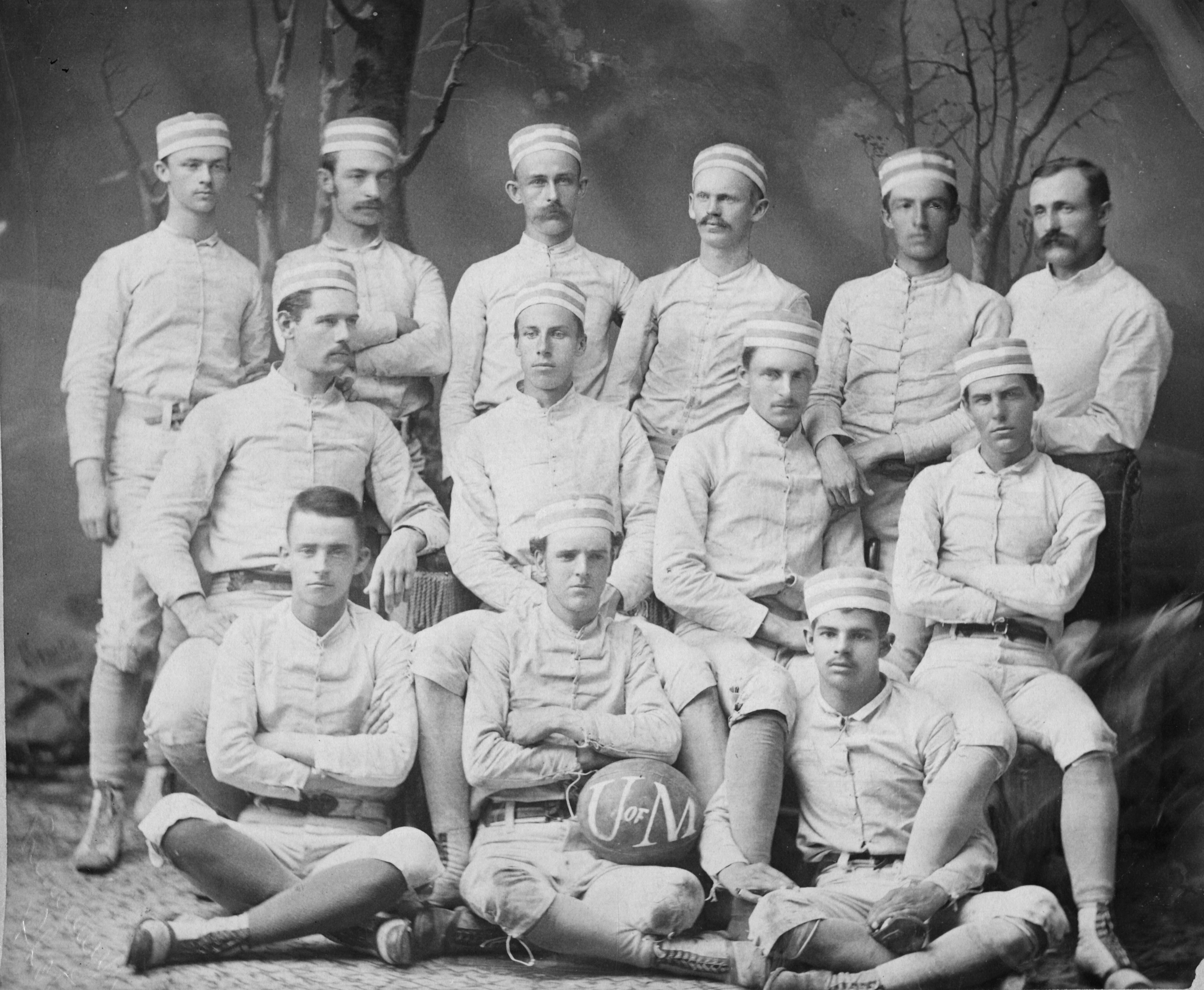
The 1879 University of Michigan football team

May 30, 1879: For the 1st time, a college football game is played in the Midwest. The game is played at the home field of the Chicago White Stockings of baseball's National League, the team that will one day be known as the Chicago Cubs. The facility was variously known as the Union Base-Ball Grounds, White-Stocking Park, Lake-Shore Park, Lake Front Park, or just Lake Park. Like the later home of the New York Giants, the Polo Grounds, this facility had a shape that made it much better suited to football than to baseball.

The University of Michigan met Racine College, of Wisconsin, and won 1-0, on a place-kick by David DeTarr. In modern terms, it was a field goal. Under today's rules, the score of the game would have been 3-0.

Racine College was run by the Episcopal Church between 1852 and 1933, when it had to close due to the Great Depression. The DeKoven Foundation took over the campus, and has run various events there ever since.

The University of Michigan, of course, went on to become the first true college football power in the Midwest. In 1896, it was a founding member of the Western Conference, along with the Universities of Chicago, Illinois, Minnesota, and Wisconsin; and Northwestern and Purdue Universities. Indiana University and the University of Iowa joined in 1899, and it was renamed the Big Nine Conference. Ohio State University joined in 1912, and it was renamed the Big Ten Conference.

The University of Chicago dropped football after the 1940 season, and the league was again known as the Big Nine. Michigan State University joined in 1950, and it was again the Big 10. Despite new arrivals, the Big 10 name has stuck.

*

May 30, 1879 was a Friday. These National League baseball games were played that day:

* The Chicago White Stockings beat the Boston Red Stockings, 8-0 at the original South End Grounds in Boston. These teams are known today as the Chicago Cubs and the Atlanta Braves.

* The Providence Grays beat the Buffalo Bisons, 4-0 at the Messer Street Grounds in Providence, Rhode Island. The Grays won the NL Pennant in 1879, and did so again in 1884. Yet, after just 1 more season, the Grays went out of business. The Bisons did, too. As it turned out, they played their last game against each other.

* The Cincinnati Reds beat the Troy Trojans, 4-2 at the Putnam Grounds in Troy, New York, across the Hudson River from the State capital in Albany. Not the same team as the 1st openly professional team, the 1869-70 Cincinnati Red Stockings, these Reds were charter members of the NL in 1876, but went out of business after this season. In 1882, the American Association was founded, with a new Cincinnati Reds. That team joined the NL in 1892, after the AA folded, and that is the current team with the name.

The Trojans are often said to have moved in 1883, to become the New York Giants. That's not what happened, although the confusion is understandable: The Trojans folded; the Giants, then known as the New York Gothams, took their place in the NL; and 4 Trojan players joined the Gothams.

* And the Syracuse Stars beat the Cleveland Blues, 4-2 at Newell Park in Syracuse, New York. The Stars folded before the end of the season.

Monday, February 7, 2022

February 8, 1896: What Became the Big Ten Conference Is Founded

February 8, 1896: The Intercollegiate Conference of Faculty Representatives is founded in Chicago. It eventually became known as the Big Ten Conference, or the Big 10. It is the oldest college sports league in America.

To deal with mounting criticism of college football, James Henry Smart, then the President of Purdue University in West Lafayette, Indiana invited the presidents of some other Midwestern schools to a meeting in Chicago. The original 7 members were Purdue; the University of Chicago; the University of Illinois, in Champaign, Illinois; the University of Michigan, in Ann Arbor; the University of Minnesota, in Minneapolis; Northwestern University, in Evanston, Illinois; and the University of Wisconsin, in Madison.

"The Intercollegiate Conference of Faculty Representatives" was an unwieldy name. So they called themselves "The Western Conference." This would appear to make little sense, but the western part of the U.S., in spite of the transcontinental railroad having been in place since 1869, still didn't really feel like part of the country to the east. And so, what is now called "the Midwest" was still "the West" for a lot of people.

Indicative of this is the fact that a school just north of Chicago is called "Northwestern University"; and also the fact that, in 1899, the University of Michigan published a fight song, "Hail to the Victors," that calls themselves "Michigan, the Champions of the West." Schools that would later oppose them in the Rose Bowl would sometimes get a laugh at that.

In 1899, Indiana University, in Bloomington, and the University of Iowa, in Iowa City, joined. This led to the league being nicknamed the Big Nine. In 1900, the University of Nebraska, in Lincoln, petitioned to join, but were turned down. They were turned down again in 1911.

In 1907, Michigan were voted out of the league. In 1912, the Ohio State University, in Columbus, were voted in. In 1916, Michigan were voted back in, and the league began to be called the Big Ten for the first time. In 1939, the University of Chicago de-emphasized their sports program, and dropped out, making the league a Big Nine again. In 1949, Michigan State University, in East Lansing, were admitted, and it was a Big Ten Conference again, although that name wasn't made official until 1987.
Logo, 1949-1990

From 1947 until 2001, the Rose Bowl in the Los Angeles suburb of Pasadena, California usually invited the Big 10 football champion to play against the champion of the league that would eventually be known as the Pac-8, the Pac-10 and the Pac-12.

Of those 55 appearances: Michigan made 16, Ohio State 12, Wisconsin 6, Iowa 5, Illinois 4, Michigan State 4, Minnesota 2, Northwestern 2, Purdue 2, Indiana 1... and Penn State 1. More on that in a moment. It should be noted that, until 1975, the Big 10 had a rule: No school could represent them in the Rose Bowl 2 years in a row. So, if a team won back-to-back titles, in the 2nd season, the 2nd-place team would go to the Rose Bowl instead.

In 1990, Pennsylvania State University, or "Penn State" for short, based in State College and an independent until then, were admitted as the league's 11th member, to begin play in the 1993-94 schoolyear. A vote was taken to keep the Big Ten name, but a new logo was designed, with the number 11 worked in. Leaving the Big 12, Nebraska were finally admitted, effective 2011, and the current "B1G" logo was unveiled.
Logo, 1990-2011

But at least a school in Nebraska was Midwestern, and it was odd, but not outrageous, to give a school in Central Pennsylvania the "Midwestern" label. But in 2013, effective the next year, the Big 10 admitted Rutgers University, in New Brunswick, New Jersey, from the Big East; and the University of Maryland, in the Washington suburb of College Park, from the Atlantic Coast Conference.

All geographical sense was blown out of the water in 2022, when the 2 major schools in Los Angeles -- UCLA, the University of California at Los Angeles, and USC, the University of Southern California -- were admitted, effective with the 2024-25 schoolyear. The Pac-12 was disintegrating. The following year, the University of Oregon, in Eugene, and the University of Washington, in Seattle, joined the Big 10, also effective in 2024. That made the Big 10 an 18-team league.

The University of Notre Dame, in South Bend, Indiana, had long had rivalries with Michigan, Michigan State, Purdue and Northwestern, and had occasionally had big games with Ohio State. But, being an independent, they didn't want to split bowl game and other-sports tournament revenue. Finally, other expenses prevailed: They joined the Big 10, but only for hockey purposes, in 2016, and the ACC for other sports.

A person knowing only geography, and not the history of college football, would think that Michigan and Michigan State would be a big rivalry. And it is. Certainly, Michigan State fans think of Michigan as their biggest rivals. But Michigan fans see MSU as merely "the little brother." To them, the true arch-enemy is Ohio State. The schools were so dominant in football for so long, and are again, that the league was often referred to as "The Big Two, Little Eight." UM-MSU is, however, a big rivalry in basketball and hockey.

In football, Michigan and Michigan State play each other for the Paul Bunyan Trophy. Michigan and Minnesota play for the Little Brown Jug. Minnesota and Wisconsin play for the Paul Bunyan Axe. And Minnesota and Iowa play for a bronze statue of a pig, named Floyd of Rosedale, after a live pig that was a trophy designed to actually calm down the rivalry during a nasty stage in 1935.

Minnesota vs. Wisconsin is easily the biggest college hockey rivalry in the country, the way many people (ignoring Alabama vs. Auburn and Texas vs. Texas A&M) think of Michigan vs. Ohio State. The biggest basketball rivalry is the intrastate one between Indiana and Purdue. In football, Indiana and Purdue play for the Old Oaken Bucket. Illinois vs. Northwestern is also a big rivalry.

Ohio State vs. Penn State would seem to be a big rivalry, but PSU's recency in the league keeps a damper on it. Penn State's main rivals are the University of Pittsburgh, now in the ACC. Same with Iowa vs. Nebraska: Both schools have a bigger rivalry with Iowa State, Iowa because it's intrastate, Nebraska because they were in the Big 8 and then the Big 12 with Iowa State. Neither Rutgers nor Maryland have a rivalry with any of the other Big 10 schools, although it wouldn't be surprising to see them develop one with each other.

*

February 8, 1896 was a Saturday. Baseball and football were out of season. Hockey was all-amateur. And basketball barely existed. The only scores on this day were in English soccer, and some of the teams involved no longer exist. And most of the teams that do don't even use the same names anymore.

December 31, 1999 & January 1, 2000: The Millennium

December 31, 1999:  The Millennium arrives. The people of planet Earth survived. At a terrible cost. But we hadn't destroyed ourselves. ...