Showing posts with label 1978. Show all posts

Thursday, December 29, 2022

December 29, 1978: Woody Hayes Punches Out

December 29, 1978: An era comes to an end for the football program at The Ohio State University. An ignominious end.

Football coaches had been abusing their own players for as long as there had been football. And Wayne Woodrow Hayes was no exception.

"Woody" was born on February 14, 1913, the exact same day as Yankee broadcaster Mel Allen and Teamsters union president Jimmy Hoffa. He came to Ohio State in 1951 after success at 2 smaller schools in Ohio, Denison University and Miami University. At Miami, one of his players was Glenn Edward Schembechler Jr. -- "Bo." Bo later served as Woody's assistant at Ohio State, and then as head coach at Miami.

Hayes led Ohio State to 13 Big Ten Conference Championships: 1954, 1955, 1957, 1961, 1968, 1969, 1970, 1972, 1973, 1974, 1975, 1976 and 1977. However, some of these were ties: Only the titles of 1954, 1955, 1957, 1961, 1968, 1970 and 1975 were won outright. In the seasons of 1954, 1957, 1961, 1968 and 1973, he led Ohio State to win the Rose Bowl. In 1954, 1957, 1961 and 1968, the Buckeyes were declared National Champions.

Notable college or pro head coaches who had played or coached under him included Schembechler, Ara Parseghian, Lou Holtz, Joe Bugel, Bill Mallory, Bill Arnsparger, Dick LeBeau, and the man who succeeded him as Ohio State head coach, Earle Bruce.

His players included Pro Football Hall-of-Famer Jim Parker; All-Pros Jim Otis, Jack Tatum, John Brockington, John Hicks, Randy Gradishar and Tom Cousineau; and Heisman Trophy winners Howard Cassady and Archie Griffin.

In 1969, Schembechler became head coach at Michigan. What followed was "The Ten-Year War" between the master and the apprentice. Always the last game of the regular season, Ohio State and Michigan treated 364 consecutive days as if they were nothing but preparation for "The Game." It reached the point where you couldn't think of Woody without thinking of Bo, and vice versa.

Woody was a tyrant. It was his way, or the highway. His preferred method of offensive football was having his linemen open a hole in the enemy's defensive line, and sending a big fullback storming through that line. It's not clear who first described it as "Three yards and a cloud of dust." Nor is it clear what the man who thought of that line thought when Ohio Stadium switched from natural grass to AstroTurf in 1971.

Woody hated the passing game. He said, "There are three things that can happen when you throw the football, and two of them are bad," meaning an incompletion and an interception. He had nothing against quarterbacks, as long as they properly directed his running game.

If you didn't buy into Woody's system, he treated you like crap. If you did buy into his system, he would go to war for you. He was always willing to help out a former player. He not only coached football at OSU, he taught history there. He told his players the best thing they could do after graduating -- and they damn well would graduate on time -- was not play pro football, but go to law school.

And he was conservative as hell. He was pro-Nixon, pro-war, anti-long hair, anti-rock and roll, and anti-"New Hollywood," well past the point where such stands were no longer held by a majority of Americans.

But he was not racist: He gave black players a fair chance. In 1961, he coached running back Bob Ferguson, who nearly became the 1st black player to win the Heisman Trophy. He finished 2nd, to Ernie Davis of Syracuse, who did become the 1st black player to win it. He also coached running back Archie Griffin, who became the only 2-time Heisman winner, in 1974 and '75.

The only colors that mattered to Woody Hayes were the colors of the uniforms: If you wore Scarlet & Gray, you were his man; if you wore the other colors, he was coming for you.

And Ohio loved him. While most States have at least 2 major universities playing top-level college football, Ohio had OSU and several smaller schools. Cleveland and Cincinnati might have hated each other, but on Woody and his Buckeyes, they were in complete agreement.

That, and they hated Michigan, or, as Woody called them, "That school up north." The abbreviation "tsun" (never capitalized) began appearing around campus. This was before the era of social media, when Ohio State fans would use a red X in place of the letter M: "Going to Ohio StadiuX to watch the Bucks kick Xichigan ass."

But there was a dark side to Woody. There were always whispers of him hitting his players in practice, but most of those stories were kept quiet until after he was gone. In 1959, following a loss to USC, he wanted to hit Al Bine of the Los Angeles Examiner. He missed, and hit someone else instead. In 1965, at a meeting of Big Ten coaches and athletic directors, he got into a shouting match with Iowa's AD, Forest Evashevski, and lunged at him, with the others separating them before a fight could happen.

In 1971, Woody thought a Michigan player had committed pass interference, and that the officials had missed it. He ran onto the field, yelled at the referee, went back to the sideline, and began tearing up the sideline markers. He was assessed a 15-yard penalty for unsportsmanlike conduct. He picked up the penalty flag, and threw it into the crowd. He was assessed an additional penalty, and thrown out of the game. So instead of being +15 yards, he was -30 and out of the game.

Unlike those earlier incidents, this was seen on TV, and couldn't be covered up. He was suspended for 1 game, and fined $1,000 -- about $6,700 in today's money.

In 1973, he took the field at the Rose Bowl, but saw an NBC camera get too close. He shoved the camera, and a news photographer was hit in the face with it. This, too, was caught on TV. He was suspended for 3 games, and was fined $2,000. In 1977, they lost to Michigan, with a late fumble clinching it. An ABC camera got too close, and he charged. The cameraman got out of the way. He was thrown out of the game even before the kickoff, fined $2,000, and put on probation by the Big Ten.

In 1978, he finished the regular season 7-3-1, finishing 4th in the Big Ten, the team's worst performance in 12 years. They still made it to a bowl game, the Gator Bowl in Jacksonville, Florida. The opponent was Clemson University.

With 2:30 left in regulation, Clemson led 17-15, but the Buckeyes were driving -- to Woody's ironic surprise, thanks to the passing of a freshman, the best quarterback he ever had, Art Schlichter. (Schlichter's pro career was derailed by injury, and his personal life was devastating by the gambling addiction he already had on the Columbus campus.) The Buckeyes got to the Clemson 24, and it was 3rd & 5.

Woody went against his instincts, and called for a pass. Schlichter threw the ball, but it was intercepted by Clemson noseguard Charlie Bauman. He took the ball toward the sideline -- the Ohio State sideline. Enraged, Woody threw a punch at him. It bounced off Bauman's left shoulder pad, causing no damage. But it was still an egregious, unacceptable act.
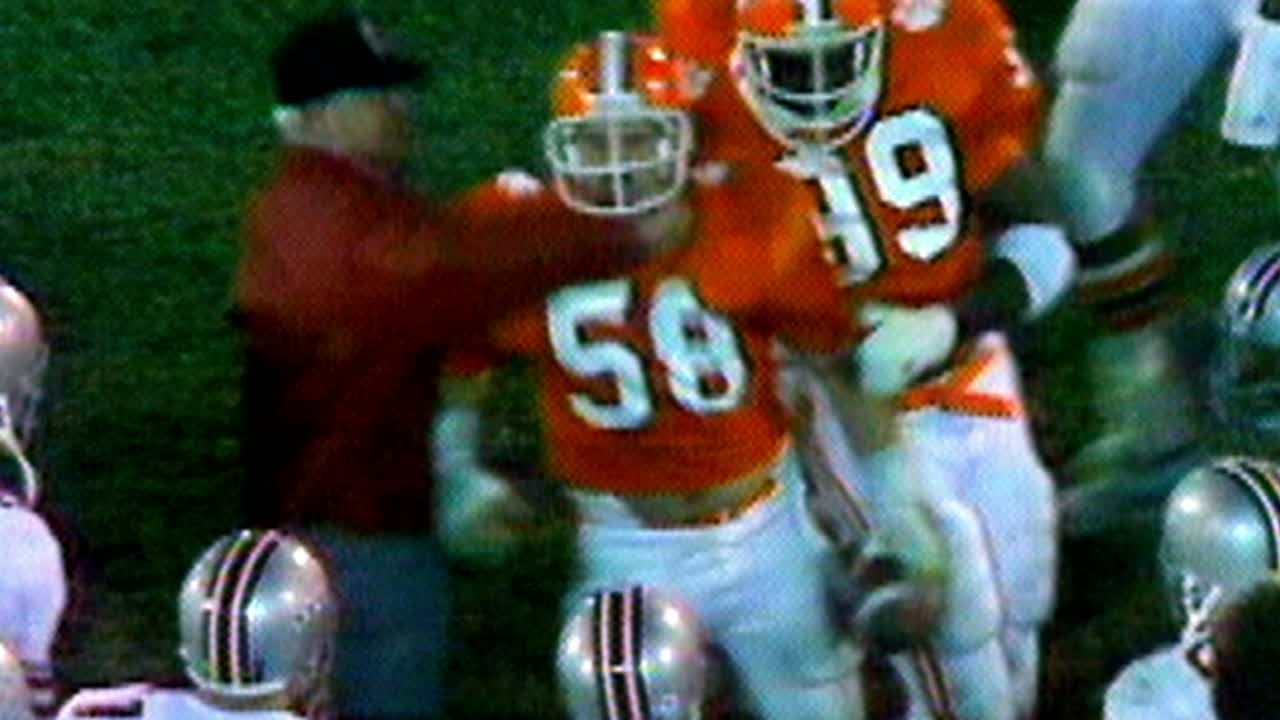
ABC commentators Keith Jackson and the aforementioned Ara Parseghian (who had coached under him at Miami before building his own legend at Notre Dame) never saw the punch. They saw the play as it happened, and the punch happened in a jumble. The instant replay that was shown was from an angle that did not clearly show the punch.

But the Clemson players saw it, and they came toward Woody. The Ohio State players stepped up to defend the old man -- he was 65, but looked older -- and a bench-clearing brawl resulted. As in the 1973 incident, Ohio State was assessed 2 15-yard penalties for unsportsmanlike conduct. Clemson held its 17-15 lead.

After the game, Woody was approached by his athletic director, Hugh Hindman. Hindman had played for him at Miami, and had been an assistant under him at Ohio State. He told Woody that he was going to recommend to University President Harold Enarson that he be fired, and gave him a chance to resign with whatever dignity he had left. According to Hindman, Woody said, "That would make it too easy for you. You had better go ahead and fire me."

The next day, Hindman fired Woody. His career record was finalized at 238-72-10, 205-61-10 of it at Ohio State, 152-37-7 of that in Big Ten Conference games. He had gone 6-6 in bowl games.

He lived until March 12, 1987, at age 74. He never apologized for the punch. And yet, he is still honored at The Ohio State University. The mailing address of Ohio Stadium is 411 Woody Hayes Drive.

Bobby Knight was a student at Ohio State, and a reserve player on their basketball team that won the 1960 National Championship. He was a great admirer of Woody. That frequently showed in his tenure as head basketball coach at Indiana University: He ran a clean program where his players not only excelled, but graduated on time.

Unfortunately, Knight was a lot like Hayes in another way. He hit his players, kicked them, and was even once caught on video choking one. Despite winning more games than any college basketball coach before him, and winning 11 Big Ten titles and 3 National Championships, he, too, was fired in disgrace. 
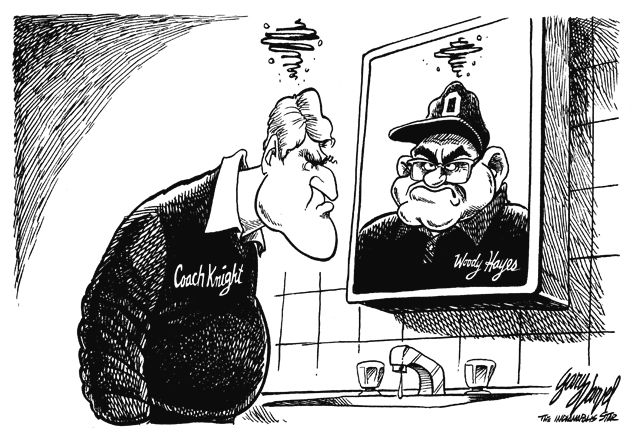
Somewhere, there must be a photograph of Knight and Hayes together.
Until I find it, I'll have to settle for this editorial cartoon.

*

December 29, 1978 was a Friday. This was the only bowl game played that day. There were no NFL games, either regular-season or Playoff. Baseball was out of season. But 8 games were played in the NBA that night:

* The New Jersey Nets lost to the Kansas City Kings, 137-126 at the Rutgers Athletic Center in Piscataway, New Jersey. (It's now the Louis Brown Athletic Center.)

* The Philadelphia 76ers beat the Atlanta Hawks, 113-107 at The Spectrum in Philadelphia.

* The San Diego Clippers beat the Detroit Pistons, 111-107 at the Silverdome in the Detroit suburb of Pontiac, Michigan.

* The Chicago Bulls beat the Denver Nuggets, 123-117 at the Chicago Stadium.

* The Houston Rockets beat the Milwaukee Bucks, 106-103 at The Summit in Houston. (This arena still stands. It's now the Lakewood Church Central Campus, the mega "church" of Dr. Joel Osteen.)

* The Los Angeles Lakers beat the Portland Trail Blazers, 118-95 at The Forum outside Los Angeles in Inglewood, California.

* The Golden State Warriors beat the New Orleans Jazz, 118-106 at the Oakland Coliseum Arena.

* And the Seattle SuperSonics beat the Phoenix Suns, 119-92 at the Seattle Center Coliseum.

There were no games played in the NHL that night, but 1 game was played in the World Hockey Association: The New England Whalers beat the Birmingham Bulls, 5-0 at the Springfield Civic Center in Springfield, Massachusetts. (Now known as the MassMutual Center, the Whalers played here for 2 years while the Hartford Civic Center was rebuilt following the 1978 collapse of its roof.) 

Friday, December 23, 2022

December 23, 1978: Arsenal's Lampoon Christmas Vacation

Liam Brady, after scoring that goal

December 23, 1978: A North London Derby is played at White Hart Lane. Tottenham Hotspur Football Club host their arch-rivals, Arsenal FC.

Arsenal were by far the more historically successful team, while Tottenham -- or "Spurs" -- were the team whose fans had a chip on their shoulders. I've often compared the relationship to that between New York's baseball teams, but that's a bit unfair -- to the Mets. The Mets began play in 1962, a year after Spurs won their most recent Football League title. They've won the FA Cup (England's national soccer tournament) 6 times since then, but the last of those was in 1991, and they haven't even reached a Final since.

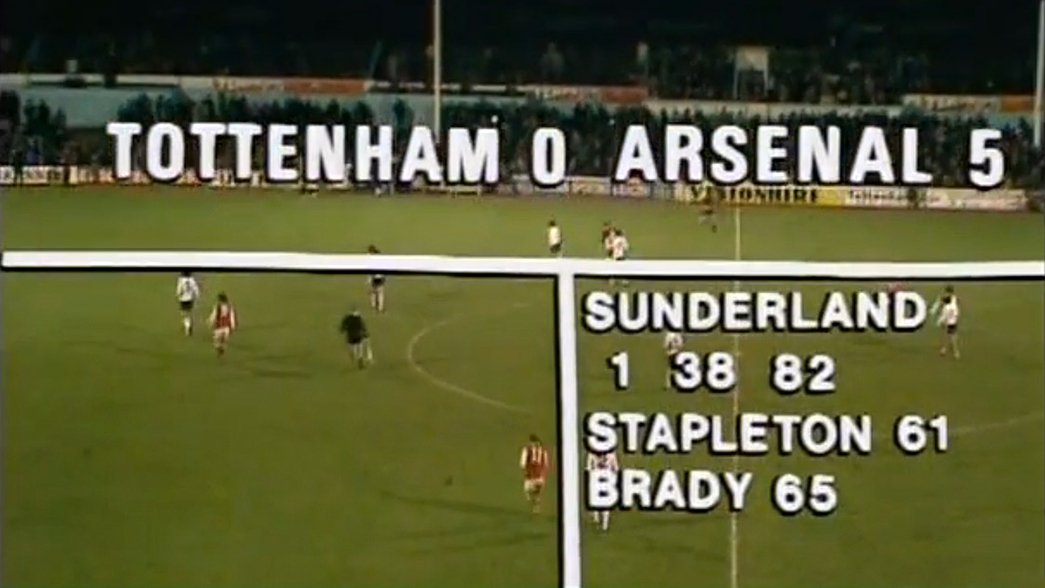
A foolish backpass by Spurs' John Pratt fell into the path of Alan Sunderland, allowing him to score, just 43 seconds into the game. Spurs never got going, even their much-heralded midfielder Glenn Hoddle making the kind of mistakes that had John Motson, calling the game for Match of the Day on the BBC, saying, "Oh, dear me!" In the 38th minute, Sunderland scored again.

This Arsenal team was known as the Irish Connection.  Midfielder Liam Brady and forward Frank Sfapleton had grown up together in Dublin, the Republic of Ireland. Manager Terry Neill was from Belfast, Northern Ireland, as were right back and team Captain Pat Rice, the last holdover from Arsenal’s team that won "The Double," both the Football League and the FA Cup, in 1971; left back Sammy Nelson, a reserve on that 1971 team; and goalkeeper Pat Jennings, once a star for Spurs, but they let him go, and Arsenal picked him up for free.

Just after the hour, Brady picked up the ball, dribbled down the touch line with the most famous left foot in Arsenal history, got nearly to the corner, and sent a hellacious cross into the box. Stapleton was waiting, threw himself forward, and sent a diving header into the net.

It was 3-0 to The Arsenal. With Christmas just 2 days away, the 5,000 or so Arsenal fans in White Hart Lane began to sing:

Jingle bells, jingle bells
jingle all the way!
Oh, what fun it is to see
The Arsenal win away!

Just 4 minutes later, there was a scramble on front of Spurs' net. Brady began one of the most fondly-remembered sequences in Arsenal history, sliding in to steal the ball cleanly, then dribbling while looking for a shot, finding one, and sending it curling in. 4-0. Motson said, "Look at that! Oh, look at that! What a goal by Brady!" Brady ran over to celebrate in front of a group of Spurs fans, and there was nothing he could do, for it was 4-0 to The Arsenal.

Sunderland really wanted a 3rd goal. He had several attempts that came to nothing. Only 1 Arsenal player had ever scored a "hat trick" against Spurs: Ted Drake, in 1934. (Only 1 Tottenham player has ever done it against Arsenal: Terry Dyson in 1961.) Finally, in the 82nd minute, he got a breakaway, and got his 3rd. In stoppage time, Stapleton got the ball and got loose, and launched a shot that hit the corner of the goal. Motson said, "Well! That could have been six!" Instead, it ended Tottenham 0-5 Arsenal.
The BBC's postgame graphic

(UPDATE: In 2025, Eberechi Eze became the 3rd Arsenal player to score a hat trick against Tottenham.)

Arsenal fans who were there claimed that, on the way out, Spurs hooligans were assaulting anyone they saw wearing red, even if they hadn't been to the game. But Arsenal were on their way to a Merry Christmas (or, as they would say in England, a Happy Christmas) and that season's FA Cup; while Spurs were on their way to another trophyless season.

Soon, Spurs signed 2 superstars from Argentina's recent World Cup win: Osvaldo "Ossie" Ardiles and Ricardo "Ricky" Villa. This later led to a joke among Arsenal fans: Alan Sunderland never played for Sunderland, Ricky Villa never played for Aston Villa, and Danny Shittu never played for Tottenham. (A few years earlier, Tottenham had a player named Mike England, but he was from Wales, and played his international football for Wales. In the 2000s and 2010s, there was a player named Stephen Ireland who played his international football for the Republic of Ireland.)

*

December 23, 1978 was a Saturday. Venezuelan baseball player Víctor Martínez and Canadian actress-model Estella Warren were born.

Baseball was out of season. Although NFL Playoff games are usually played on Saturdays, it didn't happen this time. There were 3 college football bowl games played that day:

* Number 14 Texas beat Number 13 Maryland, 42-0 in the Sun Bowl, at the stadium of the same name in El Paso, Texas.

* Number 16 Pittsburgh lost to North Carolina State, 30-17 in the Tangerine Bowl, at the stadium of the same name in Orlando.

* And Number 18 Missouri beat Louisiana State (LSU), 20-15 in the Liberty Bowl, at the stadium of the same name in Memphis.

There were 6 games played in the NBA that day:

* New York Knicks lost to the Houston Rockets, 129-107 at The Summit in Houston. (The arena has since been converted into the Central Campus of the Lakewood Church, Dr. Joel Osteen's "megachurch.")

* The Atlanta Hawks beat the Cleveland Cavaliers, 109-91 at The Omni in Atlanta.

* The Indiana Pacers beat the New Orleans Saints, 127-103 at the Market Square Arena in Indianapolis.

* The San Antonio Spurs beat the Detroit Pistons, 130-126 at the Silverdome in the Detroit suburb of Pontiac, Michigan.

* The Kansas City Kings beat the Milwaukee Bucks, 122-117 in overtime at the Milwaukee Exposition, Convention Center and Arena, or "The MECCA." Since 2014, it has been named the UW-Panther Arena.

* And the Portland Trail Blazers beat the Washington Bullets, 114-109 at the Portland Memorial Coliseum.

There were 7 games played in the NHL:

* The New York Islanders beat their arch-rivals, the New York Rangers, 9-4 at the Nassau Coliseum. Bryan Trottier scored 5 goals and 3 assists.

* The Montreal Canadiens beat the Colorado Rockies, 3-2 at the Montreal Forum.

* The Boston Bruins beat the Buffalo Sabres, 6-4 at the Boston Garden.

* The Detroit Red Wings and the Washington Capitals played to a tie, 2-2 at the Olympia Stadium in Detroit.

* The Chicago Black Hawks beat the Philadelphia Flyers, 5-2 at the Chicago Stadium.

* The Minnesota North Stars beat the Pittsburgh Penguins, 5-3 at the Metropolitan Sports Center in the Minneapolis suburb of Bloomington, Minnesota.

* The Toronto Maple Leafs beat the St. Louis Blues, 6-1 at the Checkerdome, as the St. Louis Arena was then known.

* The Vancouver Canucks beat the Los Angeles Kings, 2-0 at the Pacific Coliseum in Vancouver.

* And the Atlanta Flames and the Colorado Rockies were not scheduled.

And there were 2 games played in the World Hockey Association. The New England Whalers beat the Birmingham Bulls, 4-3 at the Springfield Civic Center (now the MassMutual Center) in Springfield, Massachusetts, where they were playing during repairs on the Hartford Civic Center. And the Cincinnati Stingers beat the Quebec Nordiques, 6-2 at the Riverfront Coliseum (now the Heritage Bank Center).

Thursday, December 15, 2022

December 15, 1978: Cleveland Goes Into Default

December 15, 1978: The City of Cleveland goes into default, the largest American city ever to do so. Between this, the Cuyahoga River catching on fire in 1969, the industry falloff, and the nasty Winter weather, Cleveland became America's city of jokes.

Dennis Kucinich, a Democrat, had been elected the city's "Boy Mayor" at age 31 in 1977, but was in over his head. He relied heavily on confrontation politics, a style that, according to a book about his tenure, "alienated business and civic leaders, the news media, and, ultimately, even those neighborhood groups that had been his chief supporters."

The key was the sale of the city's electric company, Municipal Light, to the Cleveland Electric Illuminating Company (CEI). Kucinich opposed it, because it would have resulted in a monopoly on public power in the city. But without the money from the sale, the city would have defaulted. His stubbornness made that happen, and Cleveland remains the only American city to default since the Great Depression.

Kucinich had infuriated everybody, including the local Mafia. A contract was put out in him, and he was set to be assassinated at a public ceremony. It didn't happen because he missed the ceremony, due to being hospitalized for an ulcer. He was defeated for re-election in 1979, by Republican George Voinovich, and the contract was called off.

Kucinich's decision was later vindicated by both city officials and the U.S. Senate, whose investigations found that CEI and the banks had acted improperly. He later served in Congress, and ran a hard-left campaign for President in 2004. Voinovich later served as Governor and U.S. Senator.

In 1983 "Muny Light" became Cleveland Public Power. In 1997, CEI merged with Ohio Edison to become FirstEnergy.

The city's population peaked at 914,808 in 1950, making it, then, the 6th-largest in America, behind New York, Chicago, Los Angeles, Philadelphia and Detroit. It dropped to 876,000 in 1960, no big deal. But "white flight," especially after the East Side race riot of 1966, caused a drop to 751,000 in 1970.

And with the loss of industry and the financial crisis, it got worse, falling to 574,000 in 1980, 505,000 in 1990, 478,000 in 2000, 397,000 in 2010, and 372,000 in 2020. In 1970, the city was 59 percent white, 38 percent black, 2 percent Hispanic; by 2010, it was 52 black, 33 white, 10 Hispanic. The metropolitan area, however, is still home to 3.6 million people.

All the city's problems led to the rise of Cleveland jokes:

* Why do ducks fly over Cleveland upside-down? Because there's nothing worth crapping on.

* What's the only thing that grows in Cleveland? The crime rate.

* How much snow and sleet fell in Cleveland? So much that hookers are exchanging sex for Ice Melt.

* What does the average student from Cleveland get on his SAT? Drool.

* Why don't girls play hide and seek in Cleveland? Because no one would look for them.

* A radio host in rival city Cincinnati asked, "What's the difference between Cleveland and the Titanic?" His answer: "Well, at least Cleveland has a better orchestra." (The city is renowned for it, while, on the Titanic, to comfort the passengers who couldn't get off, the orchestra kept playing, their last song being "Nearer, My God, To Thee.")

* The sports teams haven't been spared. The NBA's Cavaliers have been known as the Cavalosers and the Cadavers.

* Where should Clevelanders go to avoid a tornado? The Browns' stadium. No chance of a touchdown there!

* On a flight to the city, to play the Indians, New York Yankees 3rd baseman Graig Nettles, who had played for them, got on the plane's speaker, and told his teammates, "We are now arriving in Cleveland. Please set your watches back 42 minutes."

* An earlier player, Richie Scheinblum, said, "Maybe we should change our name to the Cleveland Utility Company. All we have are utility players."

* When Len Barker of the Indians pitched a perfect game against the Toronto Blue Jays at Municipal Stadium on May 15, 1981, a sportswriter (whose name I've forgotten) said, "How cold it be perfect? It was in Cleveland."

* It was no surprise that the 1989 and 1994 Major League movies were set in Cleveland, to represent a city that never won.

* In 1989, Cincinnati Bengals fans threw snowballs onto the field to protest a bad call. Their coach, Sam Wyche, was given a house microphone to try to calm the crowd. He said, "Will the next person that sees anybody throw anything onto this field, point 'em out, and get 'em out of here. You don't live in Cleveland, you live in Cincinnati!" The crowd cheered, and no more snowballs were thrown.

* In 1995, The Drew Carey Show premiered on ABC. Cleveland native Carey, a successful comedian, played a struggling middle-manager in a struggling city he still loved. When the Indians won the American League Pennant that year, he said, "Finally, it's everybody else's team that sucks!" And then, as if to remind Northern Ohio not to get cocky, the Indians lost the World Series, and the original version of the Browns moved.

* Want to hear a joke about construction in Cleveland? Sorry, it's not finished yet.

*

December 15, 1978 was a Friday. This was also the day that Superman: The Movie, starring Christopher Reeve, premiered. I have a separate entry for that event.

Baseball was out of season. The NFL was in midweek, and there were no college football bowl games. There were 9 games played in the NBA that night. None of them were played in Metropolis:

* The New York Knicks beat the Chicago Bulls, 118-94 at the Chicago Stadium. Toby Knight scored 43 points for the Knicks. No, I don't remember him, either.

* The New Jersey Nets lost to the Atlanta Hawks, 121-104 at the Rutgers Athletic Center in Piscataway, New Jersey. (It was renamed the Louis Brown Athletic Center in 1986, after a generous University donor.)

* The Philadelphia 76ers beat the Houston Rockets, 91-84 at The Spectrum in Philadelphia.

* The Kansas City Kings beat the Boston Celtics, 105-101 at the Boston Garden.

* The Washington Bullets beat the Detroit Pistons, 116-114 at the Silverdome in the Detroit suburb of Pontiac, Michigan.

* The San Antonio Spurs beat the Indiana Pacers, 125-113 at the Market Square Arena in Indianapolis.

* The Cleveland Cavaliers beat the Milwaukee Bucks, 110-106 at the Milwaukee Exposition, Convention Center and Arena, or "The MECCA." Since 2014, it has been named the UW-Panther Arena.

* The Portland Trail Blazers beat the Denver Nuggets, 116-113 at the McNichols Arena in Denver. David Thompson scored 36 for the Nuggets, but for the Blazers, Maurice Lucas scored 32 with 23 rebounds.

* And the Los Angeles Lakers beat the Seattle SuperSonics, 100-98 at The Forum, outside Los Angeles in Inglewood, California.

Only 1 game was played in the NHL: The Minnesota North Stars beat the Washington Capitals, 6-1 at the Capital Centre in the Washington suburb of Landover, Maryland. And in this season, which turned out to be the last for the World Hockey Association, a Soviet All-Stars team was a member. And on this night, they played in the only WHA game scheduled, losing 5-3 to the Edmonton Oilers at the Northlands Coliseum in Edmonton.

December 15, 1978: "Superman: The Movie" Premieres

December 15, 1978: Superman: The Movie premieres. Although there had been a Broadway musical titled It's a Bird, It's a Plane, It's Superman! in 1966, and a TV version of it in 1975, neither was well-received or even well-watched. This was the 1st live-action Superman that most people had seen since George Reeves died in 1959.

The film makes a star out of Christopher Reeve. Note there's no S on the end: He was not related to George Reeves, whose real name was George Keefer Brewer.

There were some established stars in the film. Superman's Kryptonian parents, Jor-El and Lara, were played by Marlon Brando and Susannah York. His Earth parents, Jonathan and Martha Kent, were played by Glenn Ford and Phyllis Thaxter. Kirk Alyn and Noel Neill, who played Superman and Lois Lane in film serials in 1948 and 1950, played Lois' parents in this movie. (Neill also played Lois for most seasons of the 1952-58 series The Adventures of Superman, starring Reeves.)

Jackie Cooper, who had mostly directed since being a child star in the 1930s, played Daily Planet publisher Perry White. The villains were familiar faces. Superman's arch-nemesis, Lex Luthor, was played by Gene Hackman. His henchman, Otis (we never found out if this was his first name or his last name), was Ned Beatty. And his gun moll, Eve Teschmacher, was Valerie Perrine.

This film established some things about Superman that have become standard ever since: Krypton as a crystalline planet, his hometown of Smallville is in Kansas, Lois is a brilliant reporter but can't spell, Jimmy Olsen (played here by Marc McClure) is young but not a teenager, and, for all his evil, Luthor can be a bit charming.

I was just short of turning 9 when the movie came out. My father had been a Superman fan since the Alyn serials, had previously shown me the George Reeves show, and took me to see this film 3 times. He didn't fall for the tagline, "You'll believe a man can fly," but he loved it.

Having the Daily News Building on East 42nd Street, which had a big globe in the lobby (and still does, even though the newspaper has moved to new digs), stand in for the Daily Planet Building was a good idea.

But the various New York landmarks, including Grand Central Terminal, the Statue of Liberty, and even the original World Trade Center (the "Twin Towers" were still new structures at that point), made it obvious that Metropolis was a fictional stand-in for New York. And the mixture of the Art Deco buildings with the Disco Era signage and advertising is a little off-putting, especially when you consider that Superman Returns was set 5 years after Superman II -- and the year 2006 was shown in it, more than once.

And one thing that always bothered me is that Hackman, one of the great actors of the last 40 years of the 20th Century, played Luthor with a little too much charm. A little too jokey, even as he's planning the deaths of Superman and millions of other people.

There wasn't much to go on: Lyle Tablot in the 1950 serial Atom Man vs. Superman was the only previous live-action Lex. He seemed to be doing for Luthor what Cesar Romero did for the Joker on the 1966-68 Batman series.

As horrible a person as Kevin Spacey turned out to be, he managed to do for Luthor in Superman Returns what Jack Nicholson did for the Joker in the 1989 Batman film: He reminded us that this guy is supposed to be scary. A man who would think nothing of killing an innocent person, or two, or a dozen, or a million, if he thought it would advance his own cause. Or, as Melissa Benoist said of Jon Cryer's Luthor on a 2020 episode of Supergirl, "Lex is a psychopathic lunatic!"

The Superman movies starring Reeve all made money, but each was less successful than the one before. Superman II, in 1981, was pretty good, but had a little too much silliness put in after Richard Donner, who directed the 1st film, was replaced by Richard Lester, best known for directing The Beatles' film A Hard Days' Night. Superman III, in 1983, was slapstick, and a Superman story shouldn't be slapstick. Superman IV: The Quest for Peace, in 1987, was unintentionally ridiculous, and Reeve said that's it.

Reeve was paralyzed in a horse-riding accident in 1994, and died in 2004 from complications of his condition. In 2006, Brandon Routh was cast in Superman Returns, a direct sequel to Superman II that acts as though III and IV never happened. It was the best one since II, its heart was in the right place, but it just missed the mark, and no further movies were made until the start of "The DC Extended Universe" in 2013, when Henry Cavill was cast in Man of Steel, and also played Superman in Batman v. Superman: Dawn of Justice in 2016 and Justice League in 2017.

Routh did get to play Superman once more, in The CW's "Arrowverse" series of superhero shows and their production of the 2019-20 crossover miniseries Crisis On Infinite Earths. A few years older, and noticeably more thoughtful, he made a better Superman this time around.

Routh became a true successor to Reeve, as Dean Cain sometimes seemed in the 1993-97 ABC series Lois & Clark: The New Adventures of Superman, as Tom Welling occasionally seemed in the 2001-11 WB Network series Smallville, as Tyler Hoechlin sometimes seems in the Arrowverse, and as Henry Cavill just can't be given the way his part is written.

But Chris Reeve is still the Superman for my generation, and Superman: The Movie set the standard for every superhero movie that followed.

*

December 15, 1978 was a Friday. This was also the day that the City of Cleveland went into economic default. I have a separate entry for that event.

Baseball was out of season. The NFL was in midweek, and there were no college football bowl games. There were 9 games played in the NBA that night. None of them were played in Metropolis:

* The New York Knicks beat the Chicago Bulls, 118-94 at the Chicago Stadium. Toby Knight scored 43 points for the Knicks. No, I don't remember him, either.

* The New Jersey Nets lost to the Atlanta Hawks, 121-104 at the Rutgers Athletic Center in Piscataway, New Jersey. (It was renamed the Louis Brown Athletic Center in 1986, after a generous University donor.)

* The Philadelphia 76ers beat the Houston Rockets, 91-84 at The Spectrum in Philadelphia.

* The Kansas City Kings beat the Boston Celtics, 105-101 at the Boston Garden.

* The Washington Bullets beat the Detroit Pistons, 116-114 at the Silverdome in the Detroit suburb of Pontiac, Michigan.

* The San Antonio Spurs beat the Indiana Pacers, 125-113 at the Market Square Arena in Indianapolis.

* The Cleveland Cavaliers beat the Milwaukee Bucks, 110-106 at the Milwaukee Exposition, Convention Center and Arena, or "The MECCA." Since 2014, it has been named the UW-Panther Arena.

* The Portland Trail Blazers beat the Denver Nuggets, 116-113 at the McNichols Arena in Denver. David Thompson scored 36 for the Nuggets, but for the Blazers, Maurice Lucas scored 32 with 23 rebounds.

* And the Los Angeles Lakers beat the Seattle SuperSonics, 100-98 at The Forum, outside Los Angeles in Inglewood, California.

Only 1 game was played in the NHL: The Minnesota North Stars beat the Washington Capitals, 6-1 at the Capital Centre in the Washington suburb of Landover, Maryland. And in this season, which turned out to be the last for the World Hockey Association, a Soviet All-Stars team was a member. And on this night, they played in the only WHA game scheduled, losing 5-3 to the Edmonton Oilers at the Northlands Coliseum in Edmonton. 

Sunday, December 11, 2022

December 11, 1978: The Lufthansa Heist

December 11, 1978: The largest robbery on American soil to that point is committed at John F. Kennedy International Airport in Queens, New York City. 

Members of the Lucchese crime family robbed Lufthansa Cargo Building 261, belonging to Lufthansa, the largest airline in Germany, taking $5 million in cash and $875,000 worth of jewelry. The $5,875,000 heist would be worth about $26.4 million in 2022 money. The story was told in the film Goodfellas, but, with most of the names changed, the story is true.

Organized crime in New York is led by the so-called Five Families: Lucchese, Gambino, Genovese, Colombo and Bonanno. Jimmy "the Gent" Burke was a Lucchese associate, but, being of Irish descent, he could never be a "soldier," or a "made man," in the "family." But, as the top hijacker of trucks and their cargo in New York in the 1960s and '70s, he sure made them a lot of money. He had previously done so at JFK Airport, at the Air France terminal on April 7, 1967, netting $420,000 worth of cash and cargo (about $3.7 million today).

Having succeeded in the Lufthansa heist, Burke was paranoid about it. He was afraid that, if his guys spent too much of the loot too soon, it would attract the attention of the Federal Bureau of Investigation. (As the crime was on the grounds of an airport, it was in the FBI's jurisdiction, not the New York Police Department's.)

But it was 2 weeks before Christmas, and, in anticipation of getting their share of the loot, some of the guys in Burke's crew began spending like crazy, especially on their wives and/or mistresses. One of them bought a brand-new top-of-the-line Cadillac, which, parked in front of a known Lucchese Family hideout in Queens, might as well have been spray-painted with the words "UNMARKED MOB CAR." And some of them were getting antsy, and demanded their share before Burke was ready to give the shares out.

So all through 1979, members of Burke's crew started dying. The guy who bought the car, and his wife, were found shot to death inside the car. One member of the crew, Henry Hill, got busted for cocaine trafficking in 1980, and it may have saved his life, because Jimmy had told him to go down to Florida to perform a contract killing. That made Henry suspicious, because Jimmy had never asked him to do a "hit" before. He was sure that if he went down, he would never come back up alive. So he made preparations to go into hiding, but the Feds got him first.

The first time Henry got arrested, as a teenager, he kept his mouth shut, earning the respect of Burke, Burke's boss Paul Vario, and everybody else who called Vario his boss. This time, with a wife and 2 kids to think about, he spilled his guts.

Ironically, most of the guys he ratted on were charged with things other than the Lufthansa heist. Burke, the mastermind, was charged for his role in the 1978-79 Boston College basketball point-shaving scandal. While serving time for that, he was convicted of a murder, and that had nothing to do with the Lufthansa heist or its aftermath, either. He was doomed to die in prison, and did, in 1996. So did Paul Vario, in 1988.

Hill was involved in the planning of the Lufthansa heist, but did not actually participate in it, only finding out it was successful by listening to the radio the next morning. (He did participate in the Air France robbery at JFK in 1967.)

He and his family went into the FBI's Witness Protection Program, going from the life of a millionaire gangster to, as he put it, "living like a schnook." Nicholas Pileggi wrote the book Wiseguy based on Hill's story, and quoted Hill, half-Italian and half-Irish (and thus also ineligible to be a made man, as you have to be full Italian, preferably full Sicilian but that's negotiable), as having to endure indignities like ordering spaghetti marinara and getting egg noodles with ketchup.

In 1990, Martin Scorsese released the film Goodfellas, based on Pileggi's book. The two of them wrote the screenplay together, and it has been hailed as one of the best movies ever made, not just one of the best gangster movies. Hill was played by Ray Liotta. Hill and his wife Karen, played by Lorraine Bracco, were the only people whose names weren't changed for the movie. (Although the guy who bought the Cadillac, and paid for it with his life and his wife's? He was played by a guy named Johnny Williams, and his nickname was Johnny Roastbeef. Scorcese liked the nickname so much, he named the character "Johnny Roastbeef," too.) As of December 11, 2022, Williams is still alive.

Jimmy Burke, who was still alive but in prison when the movie came out, became Jimmy Conway, and was played by Robert De Niro. Vario became Paul Cicero, and was played by Paul Sorvino. Tommy DeSimone, involved in both heists, became Tommy DeVito, and was played by Joe Pesci. In real life, DeSimone was not funny. In fact, Pesci may have toned the character down.

The real Hill couldn't stay out of trouble, and was busted for drugs again, and served time, and was kicked out of the Witness Protection Program. Karen divorced him, and she and their kids were allowed to stay in the Program.

Henry Hill was a schnook. Still, the Mob never did kill him. He did that to himself: He may have gotten off drugs, but he continued to drink like there was no tomorrow, and died in 2012, a day after his 69th birthday.

The money and the jewels from the Lufthansa heist have never been found.

One more thing: That great single-shot sequence of Henry and Karen going through the kitchen to the main room of New York's legendary Copacabana Club, to the tune of "Then He Kissed Me" by The Crystals? Well, the Copa has since been moved to new addresses, but is still in business. The original building, at 10 East 60th Street, is still there, and Scorcese had the interior made up to look like it did in 1963 when that song came out.

And I wish somebody had done a similar filming sequence at the old Yankee Stadium, from Subway tunnel to gate to seat, before it was torn down.

*

December 11, 1978 was a Monday. It was the off-season for baseball, and there were no games played that night in the NBA, the NHL or the WHA. But, that night, on ABC's Monday Night Football, the Cincinnati Bengals beat the Los Angeles Rams, 20-19 at the Los Angeles Memorial Coliseum.

Saturday, December 3, 2022

December 3, 1978: "Christmas Eve On Sesame Street" Premieres

December 3, 1978: The special Christmas Eve On Sesame Street airs on PBS for the 1st time. It was early in the 10th season of Sesame Street, and the producers and writers for the show's production company, The Children's Television Workshop, felt like it was the right time to do a holiday special.

It begins with some of the show's characters, human and Muppet alike, at an ice-skating rink. They sing "True Blue Miracle," a song written for the special, even though Christmas is not mentioned in it.

There are 3 main storylines in the hourlong special. Spoiler Alerts for a 44-year-old TV special for kids:

On the way home from the skating party, Oscar the Grouch plays a dirty trick on Big Bird. Carroll Spinney wore the Big Bird costume, and also operated the Oscar puppet, and voiced both characters. So this was an unusual instance of Spinney's characters interacting, meaning someone else had to operate Oscar.

Oscar askes Big Bird how big fat Santa Claus gets down those skinny little chimneys on the roofs of city apartment buildings. Big Bird comes up with all kinds of ideas, but, each time, Oscar says something along the lines of, "Ding-dong, you're wrong." While they're on the Subway trying to get back to Sesame Street (So that's how to get, how to get there), Big Bird comes up with another, and a train rushes past, interrupting Oscar's apparently profane response: "You are the stupidest (train sound for about 10 seconds) bird I have ever seen!"

So now, Big Bird gets worried that Santa might not be able to come to Sesame Street, and nobody would get any presents. He enlists friends like Mr. Snuffleupagus, Grover and Kermit the Frog to find out. They come up with various ideas, but none of them seem to make sense.

Well, now, it's Christmas Eve, and Big Bird is sure that Santa can't come to Sesame Street, and that nobody will get any presents. Well, in a rare (for that period of the show, anyway) example of seeing the inside of the main apartment building of the show, with the address of 123 Sesame Street, we see the Christmas tree of Susan and Gordon's apartment, and there's presents underneath. Gordon (Roscoe Orman) explains to Big Bird that it didn't matter how it happened, only that it did, and he sings the song's closing line one more time: "And if that isn't a true blue miracle, I don't know what one is."

Storyline 2: Muppet roommates Bert and Ernie unwittingly recreate the 1905 O. Henry story The Gift of the Magi. Neither one of them has enough money to buy the other a Christmas present. So Ernie (operated by Muppets creator Jim Henson, as was Kermit) traded his beloved rubber duckie to Mr. Hooper (Will Lee) for a cigar box, so Bert would have a good place to store his beloved paper clip collection.

But a moment later, after Ernie leaves Hooper's store, Bert (Frank Oz) shows up, and trades that collection to Mr. Hooper for a soap dish, so Ernie's rubber duckie wouldn't keep slipping off the edge and into the bathtub.

That night, they open their presents, and get the explanations. Each wonders how he can tell the other that he traded the item the present he received was made for, for the present he gave the other.

But, before either one tries, in one of the rare appearances by one of the show's human characters in Bert and Ernie's apartment, Mr. Hooper shows up. He gives Ernie a present. He unwraps it, and it's his rubber duckie. And he gives Bert a present. He unwraps it, and it's a box containing his paper clip collection.

Now, the boys realize what has happened, and they're relieved. Then they felt guilty that they hadn't gotten Mr. Hooper anything. Being Jewish, and having been wished a Happy Hannukah by Bob (Bob McGrath) earlier in the show, Mr. Hooper tells Bert and Ernie, "I got the best Christmas present ever: I got to see that everybody got exactly what they wanted!"

Storyline 3: This one is considerably funnier. Cookie Monster (also operated by Oz) writes a letter to Santa Claus, telling him what he wants for Christmas: An Atari video game system. Just kidding: That's what I wanted that year. (And I didn't get it for another 4 years, until I had saved up the $197 needed to buy what turned out to be the next-generation system. It was worth it!)

Of course, what Cookie Monster wants Santa Claus to give him for Christmas is cookies. A reasonable request: Cookies are a food associated with Christmas. Not only that, but the Dutch, the original European settlers of what became New York City, not only introduced the concept of St. Nicholas, a.k.a. Sinterklaas, a.k.a. Santa Claus to these shores, but they also introduced cookies.

Unfortunately, Cookie Monster starts thinking about the cookies, and he gets hungry, and he looks at his pencil, and imagines that it's a cookie. I've never seen a cookie in the shape of a pencil. A candy bar, yes; a licorice wrap or a Twizzler, yes; a cookie, no. Anyway, he eats the pencil. When he's finished, he breaks the fourth wall, looks in the camera, and says, in his usual bad grammar, "Where pencil?"

A few minutes later, after pieces of the other storylines, we see Cookie Monster using a typewriter to write a letter to Santa. He finishes the letter, and ruminates on what kind of cookies he will get. Maybe oatmeal raisin cookies. Suddenly, he starts to eat the typewriter keys, as if they're raisins. Then he speculates that Santa might give him "fortune cookies, with delicious paper inside them!" And he eats the letter. And the typewriter's roller. And then he thinks of round cookies, round like the ribbon reel. 

And then he yells, "Cowabunga!" and destroys the typewriter and eats the pieces. Finally, he looks in the camera, and asks, "Where typewriter?" Then he pulls the ribbon out of his mouth, and realizes what he's done.

In the next segment, it finally dawns on him that Christmas Eve is too late to send a letter to Santa. It will never reach him in time. (Unless the U.S. Postal Service has flying reindeer.) So he calls Santa on the phone. (How did he get Santa's number? And did it occur to him that Santa might be a bit busy that night?)

So he dials the number, and holds the phone in his hand. The phone is black, and the ends are round, and, to him, it looks like "cuppy-cakes." And he eats the receiver. And Santa picks up the phone, and we hear jingling bells, and "Ho ho ho, hello?" And Cookie Monster looks into the camera and says, "Oh, boy."

So Cookie Monster tells Gordon what happened, and Gordon assures him that Santa will come and give him cookies. Then he suggests that maybe Cookie Monster could leave something for Santa, and that the traditional gift is... cookies. Actually, milk and cookies. Oh, boy.

I was just about to turn 9 when the special aired. I never believed in Santa Claus, but, as an adult, I love the concept. And I knew that Oscar was being a total jerk to Big Bird. And while I hadn't yet read The Gift of the Magi, I understood the pathos (not yet having heard the word "pathos") of what Bert and Ernie had done for each other, and the decency of Mr. Hooper for giving them a resolution that O. Henry never gave Jim and Della Young 73 years earlier.

Christmas Eve On Sesame Street remains my favorite Christmas special, ahead of even A Charlie Brown Christmas. Will Lee died 4 years after it aired, and some of it might seem strange to generations who associate Sesame Street with Elmo (who didn't come along until 1985), and only know Hooper's Store, not Mr. Hooper himself. But, like the holiday and its traditions, it remains timeless, and people of any age can enjoy it.

And if that isn't a true blue miracle, I don't know what one is.

*

December 3, 1978 was a Sunday. These NFL games were played: 

* The New York Giants lost to the Los Angeles Rams, 20-17 at Giants Stadium in the Meadowlands.

* The New York Jets beat the Baltimore Colts, 24-16 at Shea Stadium.

* The Miami Dolphins beat the Washington Redskins, 16-0 at Robert F. Kennedy Stadium in Washington.

* The Green Bay Packers beat the Tampa Bay Buccaneers, 17-7 at Tampa Stadium. There were times, though this was not one of them, when both Green Bay and Tampa Bay were so bad (How bad were they?), their twice-yearly NFC Central Division matchup was known as the Bay of Pigs.

* The New Orleans Saints beat the San Francisco 49ers, 24-13 at the Superdome in New Orleans.

* The Pittsburgh Steelers beat the Houston Oilers, 13-3 at the Astrodome in Houston.

* The Dallas Cowboys beat the New England Patriots, 17-10 at Texas Stadium in the Dallas suburb of Irving, Texas.

* The Cincinnati Bengals beat the Atlanta Falcons, 37-7 at Riverfront Stadium in Cincinnati.

* The Minnesota Vikings beat the Philadelphia Eagles, 28-27 at Metropolitan Stadium in the Minneapolis suburb of Bloomington, Minnesota.

* The football version of the St. Louis Cardinals beat the Detroit Lions, 21-14 at Busch Memorial Stadium in St. Louis.

* The Kansas City Chiefs beat the Buffalo Bills, 14-10 at Arrowhead Stadium in Kansas City.

* The Denver Broncos beat the Oakland Raiders, 21-6 at the Oakland Coliseum.

* The Seattle Seahawks beat the Cleveland Browns, 47-24 at the Kingdome in Seattle.

* And in the Monday Night Football game the next night, the San Diego Chargers beat the Chicago Bears, 40-7 at San Diego Stadium.

Only 1 game was played in the NBA that day. The New Jersey Nets beat the Los Angeles Lakers, 107-105 at The Forum outside Los Angeles in Inglewood, California.

There were 4 games played in the NHL:

* The New York Rangers lost to the Boston Bruins, 3-2 at Madison Square Garden.

* The Philadelphia Flyers beat the Toronto Maple Leafs, 7-2 at The Spectrum in Philadelphia.

* The Montreal Canadiens beat the Buffalo Sabres, 4-1 at the Buffalo Memorial Auditorium.

* And the Chicago Black Hawks beat the Colorado Rockies, 4-3 at the Chicago Stadium. The Rockies became the New Jersey Devils in 1982. In 1993, a baseball team named the Colorado Rockies began play.

And there were 3 games played in the World Hockey Association:

* The Quebec Nordiques beat the Winnipeg Jets, 5-3 at the Colisee de Quebec.

* The Cincinnati Stingers, with 17-year-old Mark Messier, beat the Indianapolis Racers, with 17-year-old Wayne Gretzky, 4-2 at the Market Square Arena in Indianapolis.

* And the New England Whalers beat the Edmonton Oilers, 7-0 at the Northlands Coliseum in Edmonton. Within days, Gretzky would be an Oiler. Within weeks, so would Messier. And the rest is history. 

Tuesday, November 29, 2022

November 29, 1978: The Viv Anderson Game

November 29, 1978: England, trying to rebound from not qualifying for the last 2 World Cups or Euro 76, defeats Czechoslovakia, winners of Euro 76, 1-0 at the old Wembley Stadium in London.

Steve Coppell of Manchester United scores the goal. Vivian Alexander "Viv" Anderson of Nottingham Forest starts at right back, making him the 1st black player to start for the England senior national football (soccer) team.

Paul Reaney of Leeds United had appeared as a substitute in a 1968 England match, making him the 1st black player for the side. However, he was mixed-race, and was light-skinned enough that he rarely faced racial abuse, and many fans didn't even realize that he was black, so that Anderson frequently got full credit later.

Vivian Alexander Anderson was born on July 29, 1956 in Nottingham. He helped the Forest team, managed by Brian Clough, win the Football League and the League Cup in 1978, and the European Cup in 1979 and 1980. In 1984, he was sold to Arsenal, and he helped coach the North London club's young black players, such as David Rocastle, Paul Davis and Michael Thomas. They won the League Cup in 1987. He helped Manchester United win the FA Cup in 1990, and retired in 1995.

*

November 29, 1978 was a Wednesday. Baseball was out of season. Football was in midweek. There were 4 games in the NBA:

* The New York Knicks lost to the Indiana Pacers, 101-99 at the Market Square Arena in Indianapolis.

* The New Jersey Nets lost to the Seattle SuperSonics, 125-111 at the Kingdome in Seattle.

* The Philadelphia 76ers beat the San Antonio Spurs, 120-114 at the HemisFair Arena in San Antonio. Despite the Spurs' loss, George Gervin led all scorers on the night with 35 points.

* And the Golden State Warriors beat the Houston Rockets, 109-94 at the Oakland Coliseum Arena.

There were 6 games in the NHL:

* The New York Rangers beat the Atlanta Flames, 5-3 at The Omni in Atlanta.

* The New York Islanders and the Los Angeles Kings played to a tie, 5-5 at The Forum outside Los Angeles in Inglewood, California.

* The Pittsburgh Penguins beat the Washington Capitals, 5-3 at the Civic Arena in Pittsburgh.

* The Chicago Black Hawks and the Vancouver Canucks played to a tie, 1-1 at the Chicago Stadium.

* The Toronto Maple Leafs beat the Minnesota North Stars, 5-3 at the Metropolitan Sports Center in the Minneapolis suburb of Bloomington, Minnesota.

* And the Detroit Red Wings and the Colorado Rockies played to a tie, 2-2 at the McNichols Arena in Denver.

And there were 2 games in the world Hockey Association. The Quebec Nordiques beat the Birmingham Bulls, 7-4 at the Colisée de Québec. And the Winnipeg Jets beat the New England Whalers, 4-2 at the Winnipeg Arena.

Sunday, November 27, 2022

November 27, 1978: "The White Shadow" Premieres

November 27, 1978: The White Shadow premieres on CBS. Series creator Bruce Paltrow was the husband of actress Blythe Danner, and the father of actress Gwyneth Paltrow. Mike Post wrote the theme song. It remains the best sports-related TV show ever, and, aside from ABC’s later Coach, the longest-running: 3 seasons.

It was also the 1st television ensemble drama to feature a mostly nonwhite cast, with African-American actors playing the high school principal and vice-principal, the majority of the teenage basketball players, and other supporting roles.

Ken Howard actually was a basketball player at Amherst College, and "The White Shadow" was his real nickname. He got hurt, and turned to acting, playing Thomas Jefferson in the 1972 film version of the musical 1776.

In 1978, he was cast as Ken Reeves, who played for Boston College and the Chicago Bulls until a knee injury ended his career. He moved to Los Angeles, and was hired as the head basketball coach at George Washington Carver High School, where his former BC teammate Jim Willis (played by Ed Bernard) was now the principal. Reeves' own background in multiracial, multiethnic basketball helped him relate to his players, who came to hold him in very high regard.

He frequently stepped in to help his players out with the many personal problems that developed in inner cities. He helped budding superstar Warren Coolidge (Byron Stewart) avoid the temptation of agents, Curtis Jackson (Erik Kilpatrick) quit drinking, Milton Reese (Nathan Cook) through a relationship with a lying girlfriend and a transfer issue, Ricardo "Go-Go" Gomez (Ira Ingustain) with bad grades and his father's physical abuse, Gomez and James "Hollywood" Hayward (Thomas Carter) with avoiding gang violence, Morris Thorpe (Kevin Hooks) in dealing with an STD, and Mario "Salami" Pettrino (Timothy Van Patten, son of Eight Is Enough star Dick) with the results of an on-court fight.

At one point, during the 1979-80 season, the players got cocky during a winning streak, thinking no one could beat them. So Reeves used his connections to get some old friends to scrimmage against them. In the 1st half, in spite of being noticeably older, those players totally schooled the Carver players, who promised Reeves in the halftime team talk that they would take the opposition more seriously. In the 2nd half, the opposition wore their regular uniforms: They were the Harlem Globetrotters. The Globies still won, but the Carver players had learned their lesson.

Carver advanced to the City Championship in 1980, to be played at The Forum in Inglewood. But Jackson was shot and killed the night before, the victim of a store robbery gone bad. The game went on as scheduled: His teammates dedicated the game to his memory, and became City Champions for the 1st time.

Joan Pringle played Sybil Buchanan, a vice principal who succeeded Willis as principal. But, like every other show set in a high school, the writers and producers had to face the fact that, eventually, students graduate -- or drop out, or flunk out -- and move on. Thus, castmembers have to be replaced, and, as is so often the case, the new castmembers don't really catch on, and the ratings go down. The show was canceled after 3 seasons.

Nathan Cook died in 1988, the result of a penicillin allergy. He was only 38. Howard died in 2016. Larry "Flash" Jenkins, who played player Wardell Stone in Season 3, died in 2019. As of November 27, 2022, every other series star, including the players mentioned in the opening credits, is still alive.

UPDATE: John Mengatti, who played Nick "New York" Vitaglia in Seasons 2 and 3, died in 2023.

*

November 27, 1978 was a Monday. This was also the day of the assassinations of Mayor George Moscone and City Supervisor Harvey Milk at City Hall in San Francisco. I have a separate entry for that event.

Baseball was out of season, although there was a notable event in the sport that day: Jimmy Rollins, Captain of the Philadelphia Phillies' 2007-11 quasi-dynasty, including the 2008 World Series win, was born, in Oakland, California, and grew up in neighboring Alameda.

There were no games scheduled that day for the NBA, the NHL, or the World Hockey Association. But Monday Night Football aired on ABC. And in the "You can't make this stuff up" department, the game that night happened to be set for Candlestick Park, between the San Francisco 49ers and the Pittsburgh Steelers.

Pete Rozelle, Commissioner of the NFL, and a former publicity director for the University of San Francisco, had been through this before. In 1963, President John F. Kennedy had been assassinated about 48 hours before NFL games were to kick off. Knowing that some teams scheduled to play on the road were already at their respective airports, and may even have been in the air, he decided to let the games go ahead as scheduled. He later called that his biggest mistake of his career.

This time, with only a few hours to make a decision, he decided to let the game be played, but ordered a moment of silence in memory of Moscone and Milk, to be held right before the National Anthem. But right between them, a truck backed into a wooden flagpole near the south end zone. The sound the pole made when it hit the ground unnerved many people who had been on edge, some for a few hours, some for a few days. At any rate, the Steelers, on their way to winning Super Bowl XIII, won the game, 24-7. 

November 27, 1978: The Moscone-Milk Assassination

Harvey Milk (left) and George Moscone

November 27, 1978: A city still reeling from losing hundreds of its citizens in a cult suicide the week before suffers a shocking double assassination.

On November 18, nearly 1,000 people, most of them from the San Francisco Bay Area, died in a mass suicide ordered by the Rev. Jim Jones in the South American nation of Guyana. By the 27th, there were still funerals to conduct, when the next awful thing happened.

Before his descent into paranoia, Jones had been active in city politics, and had been helpful in the election of George Moscone as Mayor in 1975, and that of Harvey Milk to the Board of Supervisors, San Francisco's version of a City Council, in 1977.

Moscone served in the U.S. Navy in the Korean War, became a lawyer, and an ally of the Burton family's Democratic political machine in San Francisco. He was elected to the Board of Supervisors in 1962, and to the State Senate in 1966, rising to the rank of Majority Leader.

He was known for his support of poor people, minorities, small business owners, and, before most politicians dared, gay rights. He also helped block construction of a freeway that would have cut the city in half and destroyed Golden Gate Park and some neighborhoods. He sponsored bills creating a State school lunch program and legalizing abortion in the State. And both of these bills were signed into law by Governor Ronald Reagan.

He wanted to run for Governor of California in 1974, but was talked out of it, in favor of Jerry Brown, who won. (Jerry's father, Pat Brown, had been elected in 1958, and had beaten Richard Nixon in 1962, but had lost to Reagan in 1966.) Moscone was rewarded for this by being elected Mayor in 1975. Within weeks of taking office, he was instrumental in preventing the San Francisco Giants from moving to Toronto.

He also led the move away from the Board of Supervisors having all at-large seats to having neighborhood seats. This led to the 1977 election of Milk, the 1st openly gay elected official in America; Gordon Lau, the 1st Asian-American elected official in San Francisco; and Dan White, a cop-turned-fireman.

Milk was Jewish, and a native of Bay Shore, Long Island, outside New York City. Like Moscone, he served in the Navy during the Korean War. Unlike Moscone, he was gay, and this was discovered, so had to accept an "other than honorable" discharge. He returned to Long Island and taught in high school, then worked as an insurance actuary in Manhattan.

In 1970, he left New York, and arrived in San Francisco. In 1973, he opened a camera shop on Castro Street, the center of the Castro District, the city's premier gay neighborhood. In 1973, he ran for the Board of Supervisors, but finished 10th among 32 candidates for the at-large seats. In 1975, he ran again, and finished 7th. Under the old system, he had to finish at least 6th.

But with the new system in place in 1977, he only had to finish 1st in his own District, and he did. Part of it was leading the fight against singer Anita Bryant's move to ban gay people from teaching in Florida's public schools. This meant a boycott of the product for which Bryant was a spokeswoman: Florida oranges.

In 1978, Milk was among the leaders of the fight to stop a similar move in California, Proposition 6. He began to get death threats. He made a public statement: "If a bullet should enter my brain, let that bullet destroy every closet door."

Milk had clashed with White on a few issues. White got more and more frustrated in his job, and, on November 10, he resigned, saying a salary of $9,600 -- $43,000 in 2022 money -- was not enough to support his family.

But on November 15, he changed his mind, and asked Moscone to reinstate him. At first, Moscone was willing. But the other Supervisors, including Milk and the Board's President (and thus next in line to be Mayor), Dianne Feinstein, talked him out of it.

The Peoples Temple suicide happened on November 18, and word reached San Francisco on November 19. White told his aides, "One day, I'm on the front page; and the next, I'm swept right off."

Moscone announced a press conference for November 27, at which he would announce his appointment to serve as an interim holder of White's seat, until a special election could be held. White went to City Hall, with its dome making it look more like a State Capitol, and got in through a basement window, avoiding metal detectors. Because he had a gun, his former police issue revolver.
San Francisco City Hall

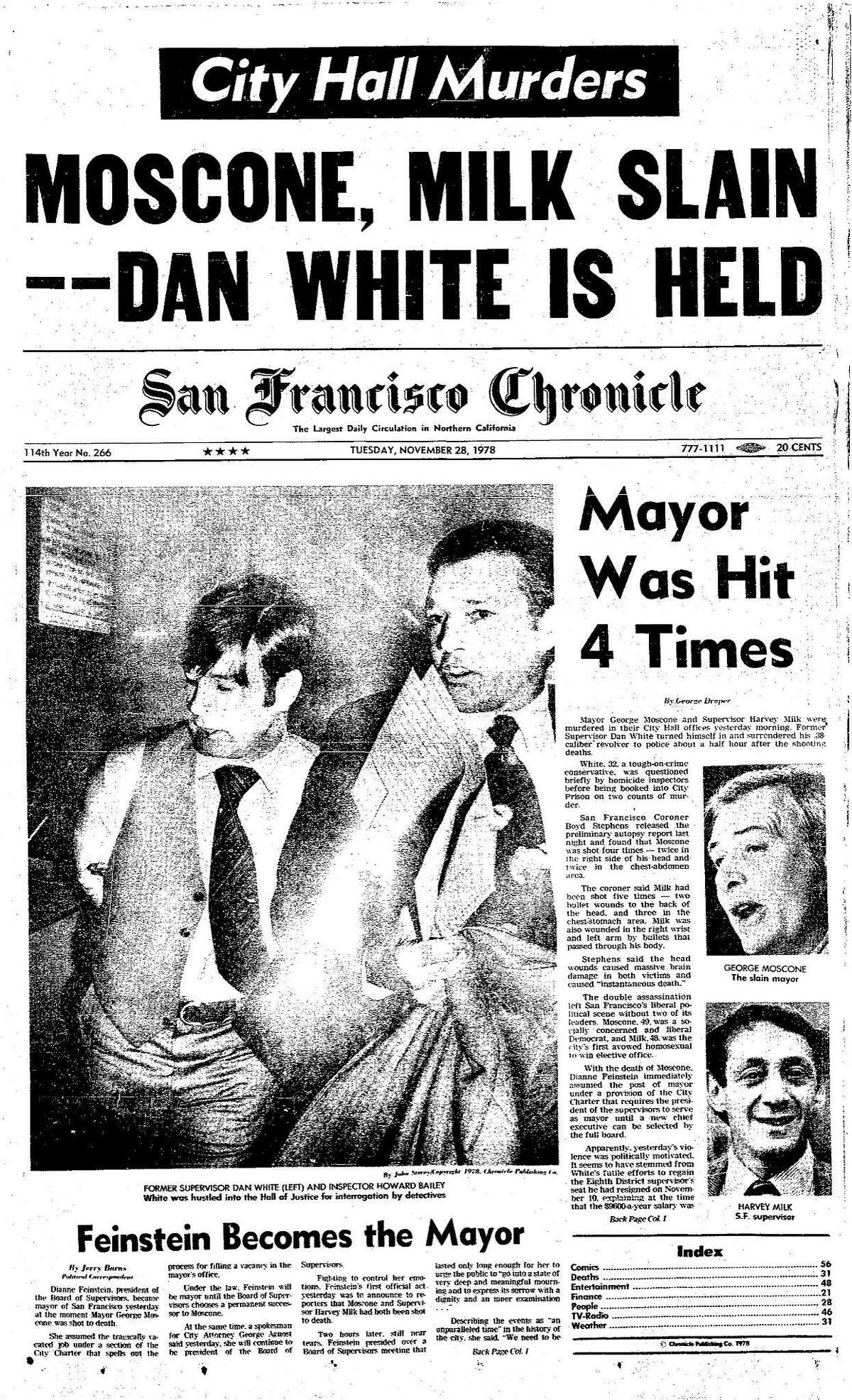
He went to Moscone's office. People nearby heard shouting, then gunshots. White shot Moscone in the shoulder, then the chest, and then finished him off with 2 shots to the head. White then walked over to his former office, and reloaded his gun. He walked into the corridor, and came face to face with Milk. From her office, Feinstein heard gunshots, and called the police. She went into the corridor, and found Milk down, shot 5 times -- like Moscone, twice in the head.
Moscone had just turned 49 years old. Milk was 48. Feinstein was 45. White was 33.

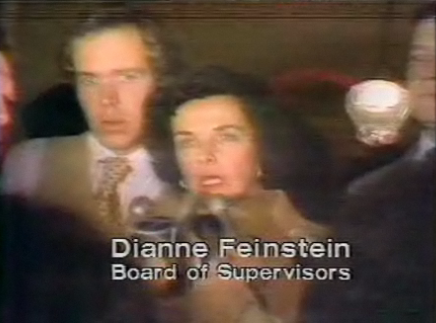
Now the Acting Mayor, the 1st woman and the 1st Jewish person to hold that post, Feinstein was forced to call a press conference to announce the assassinations, and say that White the suspect. White turned himself in after about an hour.
Flowers were left on the steps of City Hall, and when darkness fell, 40,000 people marched in a candlelight vigil from Castro Street to City Hall. The next day, both men lay in state in City Hall's rotunda.

White's trial was fixed. There were no gay people on the jury, nor any ethnic minorities, nor poor people. It was all white middle-class people, most of them Catholic. White's attorney blamed the dual assassination on his mistreatment by his colleagues, and also on a junk-food binge that messed with his blood sugar. Although Hostess' Twinkies were never mentioned, this became known as "the Twinkie defense." (This dovetailed with the Jonestown Massacre: The tainted drink was Flavor Aid, but everybody remembers it as Kool-Aid.)

On May 21, 1979, White was found not guilty on both counts of first degree murder, and found guilty on two counts of voluntary manslaughter. He was sentenced to 7 years in prison. Seven years for murdering two men -- and the Mayor and another major politician of his hometown, no less.

The sadness of the gay community 6 months earlier turned to rage. People began throwing rocks at the front doors of City Hall. Allies of Milk tried to reason with them, but there was no listening. Several downtown buildings were damaged, and a police car was set on fire. It became known as the White Night Riot. When a reporter asked a rioter why they were "destroying parts of the city," the rioter said, "Just tell people that we ate too many Twinkies."

San Francisco-based punk rocker Eric Boucher, taking the stage name Jello Biafra and fronting a band named for assassinated politicians, the Dead Kennedys, ran for Mayor in the 1979 election. A part of his platform was for a statue to be erected to Dan White, and to supply eggs, tomatoes and stones nearby, to give people something to throw at it. Apparently, despite being only 21 years old, he was serious about his campaign.

Appearing on the ballot with both his real name and his stage name, as "Eric 'Jello Biafra' Boucher," he actually finished 4th, with 6,591 votes, a little less than 4 percent of the vote, ahead of 6 other people who were on the ballot. Feinstein barely won, with 46.6 percent of the vote to the 44.7 of Supervisor Quentin Kopp, a margin of 3,331 votes. Kopp was later elected to the State Senate.

Things would get worse. The 1980s would bring the AIDS epidemic. It would take pretty much the entire decade for the disease to be stripped of its stigma as "gay cancer," or as "God's punishment for homosexuals." Per capita, San Francisco was hit harder by the disease than even the much larger cities of New York and Los Angeles.

In 1981, a Convention Center for which Moscone had lobbied was finished. It was named for him, and it hosted the 1984 Democratic National Convention. It remains the last building smaller than a professional sports arena to host a Democratic Convention.
The George R. Moscone Convention Center

Also in 1984, White was released from prison, having served a little over 5 years -- for murdering 2 men. On October 21, 1985, having won his case, but having lost pretty much everything else, including his wife to divorce, he committed suicide. He was 39 years old.

Feinstein was re-elected in 1983. Leaving office at the beginning of 1988, she ran for Governor in 1990, losing to Senator Pete Wilson. In 1992, she was elected to an unexpired term in the U.S. Senate, and was re-elected in 1994, 2000, 2006, 2012 and 2018. She is still alive, 89 years old, and still fighting for the rights of all Americans. It is not yet known if she will run for re-election in 2024, and people who hate her -- being female, Jewish, liberal, and outspoken, she pushes a lot of buttons -- claim that she has dementia. There is no reliable evidence of this. (UPDATE: She died in office in 2023.)

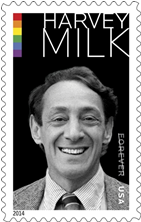
Milk has gone down in history as a pioneer of gay rights, a "Martin Luther Queen." In 2014, the U.S. Postal Service made him the 1st openly gay American politician to be honored with a postage stamp.
In 1980, Representative Robert Bauman, Republican of Maryland, was outed, making him the 1st member of Congress known to be gay. What's more, he was caught soliciting a teenage male prostitute. He was the 1st Republican politician, but by no means the last, to blame his indiscretion on alcoholism. He apologized for said indiscretion, but lost his bid for re-election. As of November 27, 2022, he is still alive.

In 1983, Representative Gerry Studds, Democrat of Massachusetts, was outed, and had his relationship with a 17-year-old Congressional page exposed. He was censured, but won re-election in 1984, making him the 1st openly gay person to win an election for Congress. He continued to serve his District -- which includes Cape Cod, which includes Provincetown, one of the most gay-friendly places in America -- until retiring in 1996, and died in 2006.

In 1998, Tammy Baldwin of Wisconsin was elected to Congress, the 1st openly gay non-incumbent to be elected, and the 1st openly gay woman to serve. In 2012, she became the 1st openly gay person elected to the U.S. Senate.

In 2004, Governor Jim McGreevey, Democrat of New Jersey, exposed as having appointed an unqualified lover to public office, came out, and resigned. He has never run for public office again. In 2018, Jared Polis, Democrat of Colorado, having previously been elected to Congress, was the 1st openly gay person elected Governor of any State. (UPDATE: In 2023, McGreevey announced that he was running for Mayor of his birthplace, Jersey City, in the 2025 election.)

In 2020, Mayor Pete Buttigieg of South Bend, Indiana became the 1st openly gay person to win delegates for a Presidential nomination. When Joe Biden was elected President, he appointed Buttigieg to be Secretary of Transportation, making him the 1st openly gay member of a President's Cabinet. And a few transgender politicians have been elected to local and State offices, though not yet to Congress or Governorships.

One last thing. I was 8 years old, almost 9, in November 1978. I remember seeing the Jonestown story on the news, dominating coverage for a few days, leading into Thanksgiving weekend, November 23 to 26. But I have no memory of seeing the national news cover the assassinations of Moscone and Milk on the 27th. I knew Moscone's name from having watched the 1984 Democratic Convention. But I don't recall hearing Milk's name until I was already out of high school. And I have no idea why that is.

*

November 27, 1978 was a Monday. The White Shadow, perhaps the best sports-themed TV show of all time, premiered on this night.

Baseball was out of season, although there was a notable event in the sport that day: Jimmy Rollins, Captain of the Philadelphia Phillies' 2007-11 quasi-dynasty, including the 2008 World Series win, was born, in Oakland, California, and grew up in neighboring Alameda.

There were no games scheduled that day for the NBA, the NHL, or the World Hockey Association. But Monday Night Football aired on ABC. And in the "You can't make this stuff up" department, the game that night happened to be set for Candlestick Park, between the San Francisco 49ers and the Pittsburgh Steelers.

Pete Rozelle, Commissioner of the NFL, and a former publicity director for the University of San Francisco, had been through this before. In 1963, President John F. Kennedy had been assassinated about 48 hours before NFL games were to kick off. Knowing that some teams scheduled to play on the road were already at their respective airports, and may even have been in the air, he decided to let the games go ahead as scheduled. He later called that his biggest mistake of his career.

This time, with only a few hours to make a decision, he decided to let the game be played, but ordered a moment of silence in memory of Moscone and Milk, to be held right before the National Anthem. But right between them, a truck backed into a wooden flagpole near the south end zone. The sound the pole made when it hit the ground unnerved many people who had been on edge, some for a few hours, some for a few days. At any rate, the Steelers, on their way to winning Super Bowl XIII, won the game, 24-7.

December 31, 1999 & January 1, 2000: The Millennium

December 31, 1999:  The Millennium arrives. The people of planet Earth survived. At a terrible cost. But we hadn't destroyed ourselves. ...